
Automotive Connectors Market Size, Share & Trends by 2034
Coverage: By Product (PCB, IC, RF, Fiber Optic, Other); Connectivity (Wire to Wire, Wire to Board, Board to Board); Vehicle Type (Passenger Cars, Commercial Vehicles); Application (Powertrain, Body Wiring and Power Distribution, Navigation and Instrumentation, Safety and Security, Others) , and Geography (North America, Europe, Asia Pacific, and South and Central America)
- Status : Data Released
- Report Code : TIPRE00008373
- Category : Electronics and Semiconductor
- No. of Pages : 150
- Available Report Formats :


- Last update date : July 20, 2026


2025 Market Size
US$ 8.19 Bn
Base year value
2034 Forecast
US$ 14.28 Bn
Projected by 2034
CAGR 2026-2034
6.37 %
Growth rate
Addressable Market
US$ 101.65 Bn
(2026-2034)
The Automotive Connectors market was valued at US$ 8.19 Billion in 2025 and is projected to reach US$ 14.28 Billion by 2034, registering a CAGR of 6.37% during 2026–2034. Vehicle electrification, advanced driver assistance, software-defined architectures, and higher in-cabin electronic density are increasing the number, durability, and performance requirements of connector interfaces across passenger and commercial platforms.
In North America, the Automotive Connectors Market size expansion is expected to track a CAGR of 5.8–6.6% during 2026–2034, supported by electrified pickup platforms, data-rich safety systems, and localized vehicle electronics manufacturing. Structural demand is reinforced by OEM investment in high-voltage harnesses, automotive Ethernet, and sensor-rich modules that require sealed, vibration-resistant, and space-efficient interconnect solutions.
Automotive Connectors Market Assessment and Insights
- North America accounted for 28–32% share in 2025 and is growing at a CAGR of 5.8–6.6% during 2026–2034, led by electrified trucks, ADAS adoption, and regional sourcing.
- US represented 74–78% of North American revenue in 2025 and is growing at a CAGR of 5.9–6.7% during 2026–2034, driven by EV platforms.
- Europe held 25–29% share in 2025 and is growing at a CAGR of 5.3–6.1% during 2026–2034, with Germany, France, the UK, Italy, and Spain leading demand.
- Asia Pacific held 34–38% share in 2025 and is growing at a CAGR of 6.9–7.8% during 2026–2034, led by China, Japan, South Korea, India, and Australia.
- Largest Segment Wire to Wire held 39–43% market share in 2025 and is growing at a CAGR of 5.7–6.4% during 2026–2034 due to harness-intensive vehicle architectures.
- High Growth Segment Fiber Optic represented 8–11% market share in 2025 and is growing at a CAGR of 8.2–9.3% during 2026–2034, supported by high-speed data backbones.
- Key companies analyzed in detail: Amphenol Corporation; Aptiv PLC; HIROSE ELECTRIC CO., LTD.; J.S.T. Mfg. Co., Ltd.; Japan Aviation Electronics Industry, Ltd.; Molex, LLC; Rosenberger Hochfrequenztechnik GmbH & Co. KG; Sumitomo Wiring Systems, Ltd.; TE Connectivity plc; Yazaki Corporation.
Source: The Insight Partners' analysis based on proprietary research, government publications, company annual reports, investor presentations, industry databases, and expert interviews.
Vehicle electronics have evolved from discrete harness connections toward dense, multi-domain networks linking battery systems, power electronics, sensors, displays, safety controllers, and body modules. Within the Automotive Connectors Market, suppliers now design around higher current, faster data rates, electromagnetic shielding, sealing classes, and assembly automation. Production dynamics are changing as OEMs reduce wiring complexity, adopt zonal electrical architectures, and require connectors that tolerate vibration, temperature cycling, fluids, and compact packaging.
Forward demand will be shaped by EV production scale, software-defined vehicle platforms, regional battery manufacturing, and stricter reliability expectations for safety-critical electronics. Asia Pacific should remain the volume center, while North America and Europe prioritize high-value applications and localized supply chains. Regulatory pressure on emissions, road safety, and charging interoperability will continue moving connector specifications toward higher voltage, higher bandwidth, and better lifecycle traceability.
Automotive Connectors Market Report Scope
| Report Attribute | Details |
|---|---|
| Market size in 2025 | US$ 8.19 Billion |
| Market Size by 2034 | US$ 14.28 Billion |
| Global CAGR (2026 - 2034) | 6.37% |
| Historical Data | 2021-2024 |
| Forecast period | 2026-2034 |
Automotive Connectors Market Analysis
Automotive Connectors' growth is being driven by the rising electronic content per vehicle rather than unit vehicle production alone. Electric powertrains require high-voltage interfaces for battery packs, inverters, charging inlets, compressors, and DC-DC converters, while ADAS and infotainment systems require compact data connectors for cameras, radar, LiDAR, displays, and central compute modules. IEA reporting shows global electric car output reached nearly 22 million units in 2025, lifting demand for more robust interconnect systems.
The ecosystem includes resin suppliers, stamped terminal producers, plating providers, cable and harness manufacturers, Tier 1 electrical distribution specialists, module suppliers, OEM engineering teams, and validation laboratories. Within the Automotive Connectors Market, supply dynamics depend on copper availability, tooling lead times, regional qualification, thermal performance, and compliance with USCAR, LV214, ISO, and OEM-specific test requirements. Buyers increasingly assess connector systems on assembly speed, mating assurance, contact resistance, and fault tolerance.
Automotive Connectors analysis shows a competitive landscape led by companies that combine product breadth, application engineering, and global manufacturing. TE Connectivity plc, Amphenol Corporation, Aptiv PLC, Molex, LLC, and Yazaki Corporation compete across high-voltage, signal, board, and harness interfaces. HIROSE ELECTRIC CO., LTD., Japan Aviation Electronics Industry, Ltd., J.S.T. Mfg. Co., Ltd., Rosenberger Hochfrequenztechnik GmbH & Co. KG, and Sumitomo Wiring Systems, Ltd. strengthen the market through specialization.
Investment is moving toward miniaturized terminals, automotive Ethernet, shielded high-voltage platforms, fiber optic links, and modular wire-to-wire systems for zonal architectures across the Automotive Connectors Market. Strategic positioning depends on qualification speed, connector family standardization, localized inventories, and co-development with OEM electrical teams. Suppliers able to reduce harness mass while maintaining safety margins can defend pricing because vehicle manufacturers are under pressure to improve range, reliability, and manufacturability.
● REPORT CUSTOMIZATION
Tailor This Report To Align With Your Specific Business Requirements
This report can be customized to align precisely with your business objectives, scope, and target markets. Customization options include tailored segmentation, geography, competitive analysis, and strategic insights to support informed decision-making.
Customize This Report →WHAT YOU CAN ADJUST
- ● Segmentations
- ● Geography
- ● Competitive Analysis
- ● Language Preferences
Automotive Connectors Market: Strategic Insights
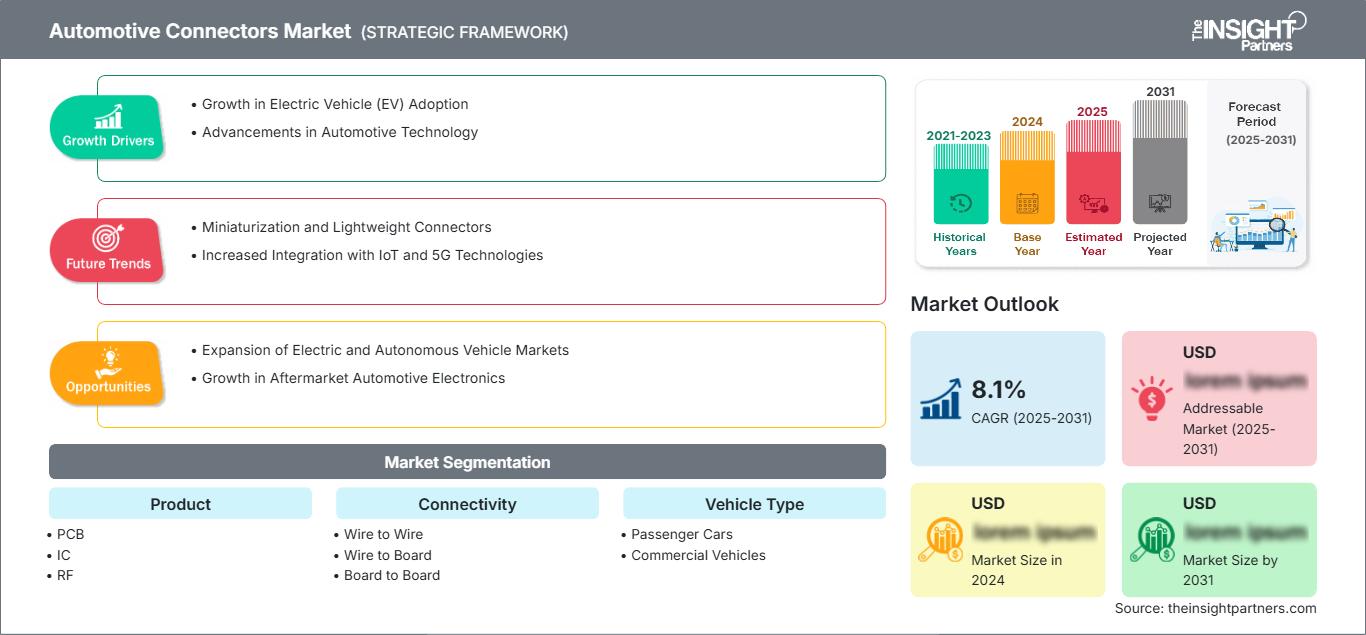
Regional Insights
North America Automotive Connectors Market
North America accounted for 28–32% of the Automotive Connectors Market share in 2025 and is projected to grow at a CAGR of 5.8–6.6% during 2026–2034. Demand is supported by electric pickup trucks, SUVs, commercial fleets, charging interfaces, and ADAS upgrades. Localized battery and vehicle electronics investment increases the need for qualified suppliers able to serve OEM plants with short lead times and engineering support.
The region favors sealed connectors, high-current battery interfaces, automotive Ethernet, and rugged board-to-board solutions for powertrain and safety modules. Federal incentives, grid-edge charging deployment, and reshoring strategies increase the value of regional validation capability. Automotive Connectors adoption is strongest where OEMs need high reliability across harsh climates, towing duty cycles, and long vehicle lifetimes.
U.S. Automotive Connectors Market
The U.S. represented 74–78% of North American revenue in 2025 and is expected to grow at a CAGR of 5.9–6.7% during 2026–2034. Within the Automotive Connectors Market, company presence is broad, with TE Connectivity plc, Aptiv PLC, Amphenol Corporation, Molex, LLC, and Yazaki Corporation supporting EV, ADAS, body electronics, and commercial vehicle programs through manufacturing, design centers, and distributor networks.
Application trends favor high-voltage connectors for battery packs and power electronics, RF links for antennas, and board-to-board systems for compact control units. The U.S. also benefits from software-defined vehicle testing, fleet electrification, and premium infotainment content. Supplier selection is increasingly tied to durability evidence, local support, cybersecurity-aware diagnostics, and the ability to meet platform launch schedules.
Europe Automotive Connectors Market
Europe held 25–29% share in 2025 and is forecast to grow at a CAGR of 5.3–6.1% during 2026–2034. Germany remains the leading country because premium OEMs, Tier 1 suppliers, and battery programs require high-voltage and data connector qualification. The UK supports demand through luxury vehicles, motorsport engineering, commercial fleets, and emerging EV assembly investments.
France, Italy, and Spain contribute through passenger car platforms, light commercial vehicles, and supplier clusters serving body electronics, safety, and power distribution. European buyers emphasize recyclability, lightweighting, functional safety, and compliance with strict vehicle validation cycles. Automotive Connectors suppliers with localized technical support and proven performance in compact EV architectures are well-positioned.
APAC Automotive Connectors Market
Asia Pacific accounted for 34–38% share in 2025 and is projected to grow at a CAGR of 6.9–7.8% during 2026–2034. China leads through EV scale, battery integration, and domestic OEM expansion, while Japan and South Korea remain strong in hybrid systems, high-reliability electronics, and advanced manufacturing.
India and Australia add demand through localization, commercial vehicle electrification, safety regulation, and connected mobility deployment. Policy support for battery manufacturing, charging infrastructure, and semiconductor ecosystems strengthens the region. Suppliers must balance high-volume cost targets with rapid qualification for new vehicle platforms and export-oriented production.
Middle East & Africa Automotive Connectors Market
The Middle East & Africa market is projected to grow at a CAGR of 5.0–5.8% during 2026–2034. Saudi Arabia leads as industrial diversification, EV assembly ambitions, charging corridors, and premium vehicle demand expand connector requirements in harsh operating environments. The UAE supports adoption through connected fleets and smart mobility initiatives.
South Africa remains important for regional vehicle production and aftermarket replacement, while the Rest of MEA demand improves with logistics, mining, and public transport modernization. Heat, dust, corrosion, and service accessibility drive preference for sealed, durable connectors with dependable distributor support.
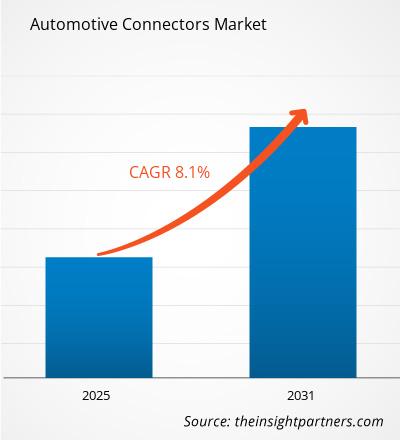
Segmentation Analysis
Product
Product is projected to grow at a CAGR of 6.2–7.0% during 2026–2034. The Automotive Connectors scope spans PCB, IC, RF, and fiber optic interfaces that support power distribution, sensing, compute, infotainment, and communication functions. Product demand is moving toward smaller footprints, higher pin density, enhanced shielding, and better thermal stability as electronic modules consolidate inside vehicles.
- PCB connectors support electronic control units, lighting modules, battery management systems, and infotainment boards where compact assembly, vibration tolerance, and repeatable signal integrity are essential.
- IC connectors remain strategically relevant where semiconductor packages, sensors, and compute modules require secure electrical paths, repairability, and dependable performance in dense automotive electronics.
- RF connectors serve antennas, telematics, V2X, navigation, radar support, and connected vehicle systems, making shielding, frequency stability, and compact routing important selection factors.
- Fiber Optic connectors address high-speed, EMI-resistant data transmission for zonal backbones, displays, autonomous functions, and premium infotainment, where copper links face bandwidth or noise limits.
Connectivity
Connectivity is forecast to grow at a CAGR of 6.0–6.8% during 2026–2034. Wire-to-wire, wire to board, and board to board formats remain foundational as OEMs simplify harness layouts and consolidate computing. Automotive Connectors must support automated assembly, secure mating, and stable contact resistance while vehicle platforms transition toward zonal and centralized electrical architectures.
- Wire-to-Wire dominates due to harness-intensive vehicle locations such as seats, doors, lighting systems, and distribution systems, which need detachable connections with assembly indication and servicing.
- Wire-to-Board adoption will grow in control units, battery packs, sensors and power electronics, wherein cable assemblies need to be connected to miniature printed circuit boards.
- Board-to-Board connectors play a crucial role in stacked modules, high-performance computers, displays, and advanced driving assist systems, which need space saving and reliable signaling.
Vehicle Type
Vehicle Type is projected to grow at a CAGR of 6.1–6.9% during 2026–2034. Passenger cars generate the broadest volume because electrification, infotainment, comfort features, and safety systems are spreading across price bands. Commercial vehicles add higher value through durability requirements, fleet telematics, power distribution, and electrified drivetrains that need rugged connectors designed for longer duty cycles.
- Passenger Cars dominate unit demand as EVs, hybrids, ADAS, digital cockpits, and comfort electronics increase connector counts across mass-market and premium models.
- Commercial Vehicles require robust sealed systems for vibration, payload duty, charging hardware, fleet diagnostics, body builders, and telematics, increasing value per vehicle.
Application
Application is forecast to grow at a CAGR of 6.3–7.1% during 2026–2034. Powertrain, body wiring, navigation, instrumentation, safety, and security applications require different current, sealing, signal, and packaging profiles. Growth is strongest where electrification and automated driving increase the number of sensors, actuators, controllers, and high-speed communication paths inside the same vehicle.
- Powertrain Connectors serve batteries, inverters, motors, sensors, and engine control systems, and hence thermal management, high current handling capability, sealing, and safety during disconnect operations become important.
- Body Wiring & Power Distribution continues to be important for lighting, door, seat, HVAC, and power distribution applications, with demand driven by harness simplification and vehicle module architecture.
- Navigation & Instrumentation demand is driven by demand from display systems, GPS, cockpit control panels, antennas, and infotainment units, where reliable data connectors provide a good user experience.
- Safety and Security Connectors are used in airbag systems, camera modules, radar, braking control systems, access systems, and driver monitoring, with emphasis on high reliability and robustness.
Opportunity Snapshot
| Segment Name | Revenue Contribution | Trend Tag | Adoption Stage |
| Powertrain | High | High Voltage | Scaling |
| Body Wiring and Power Distribution | High | Zonal Harness | Scaling |
| Navigation and Instrumentation | Medium | Digital Cockpit | Mature |
| Safety and Security | High | Sensor Fusion | Scaling |
| Others | Low | Auxiliary Loads | Mature |
Automotive Connectors Market Growth Drivers and Impact Analysis
Electrification raises voltage, current, and sealing requirements
The EV and hybrid architectures will need a connector system that can deliver increased power without succumbing to heat, vibration, moisture, and manual manipulation. The batteries, inverters, charger inlets, electric compressors, and DC-DC converters contribute additional connection points that were not present before in the ICE automobiles to such a magnitude. Market consequences include a transition from being commoditized low-voltage parts to high-voltage connections that have shielding, interlocking capabilities, touch protection, and increased validation. Price advantage for suppliers comes through their help in decreasing the copper weight and assembly process of OEMs.
ADAS and software-defined vehicles expand data connectors
The use of advanced driving assistance systems, digital cockpits, over-the-air updates, and central computing leads to an increased number of connections at high speeds within the automobile. Connectors are needed for cameras, radars, LiDAR, displays, gateways, and domain controllers that will maintain signal integrity despite noise and harsh environmental conditions. This customer modifies the buying process since bandwidth, shielding, insertion loss, and routing become equally significant as the simple physical connection. Market implications include a growing demand for RF, board-to-board, Ethernet, and fiber optic connector solutions, especially for premium automobiles and EVs using zonal architectures.
Harness simplification increases modular connector demand
The automobile manufacturers face the need to reduce harness weights, labor costs, wiring complexity, and platform variability. The modular connectors help to achieve this by integrating the power, signaling, and data ports together while allowing reuse among the different vehicle designs. The zonal architecture also involves fewer lengthy cabling paths but many local connection points, making the connectors' reliability critical to manufacturing. This leads to the increased need for wire-to-wire and wire-to-board systems that allow for automation, cartridge flexibility, mating assurance, and services. The suppliers that reduce part uniqueness become strategic partners rather than suppliers of components.
Automotive Connectors Market Future Trends
Fiber and automotive Ethernet backbones enter higher-volume platforms
Automotive Connectors Market trends indicate that high-speed vehicle networks will move from premium models toward broader platforms as software-defined vehicles require faster movement of sensor and compute data. Connectors that use fiber optics and improved Ethernet technology will be used when bandwidth, immunity to electromagnetic interference, and efficient routing are important. Future projects will judge connector systems on their latency time, shielding, ability to be maintained, and compatibility with central computing. Such projects would favor suppliers who have data connectivity capabilities and coordination skills.
Localized validation and circular material choices gain priority
Connectors manufacturers will increasingly be asked to test their products near vehicle manufacturing facilities, speed up qualification periods, and measure material performance under all lifecycle scenarios. Recycled plastics, reduced plating scrap, and lighter components will also play an increasing role in view of the reporting of Scope 3 carbon emissions by the vehicle manufacturers. The combination of engineering data and sustainability measures will hence play a key role in future procurement considerations.
Automotive Connectors Market Opportunities
Platform-level connector kits for EV power electronics
Automotive Connectors Market Forecasts point to an opportunity for suppliers to offer platform-level kits covering battery, inverter, charging, thermal, and auxiliary interfaces. OEMs want fewer qualification paths, shorter launch timelines, and better electrical consistency across vehicle derivatives. A kit-based approach can include high-voltage connectors, shielding components, service disconnects, wire-to-board interfaces, and documentation for automated assembly. The opportunity is strongest where new EV entrants and established OEMs need scalable architectures that can support multiple voltage classes, battery sizes, and regional regulatory requirements.
Zonal architecture design-in partnerships
The concept of zonal electrical architecture opens up new possibilities for the connector suppliers to enter early on in the design of vehicles, instead of doing so in later stages during the process of sourcing. The engineering team needs assistance regarding the choice of connector families, sealing level, routing of cables, terminals and service strategy of the localized controllers. Value can be derived by giving simulation support, quick samples, harness design and worldwide manufacturing readiness.
Recent Developments
- June 2026: Molex, a global electronics leader and connectivity innovator, announces the expansion of its proven, field-tested HSAutoLink Interconnect portfolio, which has delivered more than 700 million connectors to the automotive industry since 2008. The new Molex HSAutoLink G Connector System provides multi-gig Ethernet connections of up to 25Gbps in a compact, USCAR-compatible interface, making it ideally suited to address escalating bandwidth demands driven by Advanced Driver-Assistance Systems (ADAS), radar, LiDAR, zonal architecture, immersive displays and central compute modules.
- October 2025: TE Connectivity (TE), a global leader in connectors and sensors, introduces its inside device connectivity portfolio designed to support the evolving needs of automotive electronic control units (ECUs) and next-generation vehicle platforms, including software-defined vehicles. The portfolio includes board-to-board, wire-to-board, flex-to-board and wire-to-wire connector solutions, purpose-built for compact, high-performance applications.
- May 2024: Molex, a global electronics leader and connectivity innovator, continues to build on its automotive industry expertise with the introduction of its MX-DaSH family of data-signal hybrid connectors that unify power, signal and high-speed data connectivity in a single connector system. These innovative wire-to-wire and wire-to-board connectors are designed to support the transition to zonal architecture and address the full range of emerging applications requiring reliable data transmission. These include autonomous driving modules, camera systems, GPS and infotainment devices, LiDAR, high-resolution displays, sensor-device connectivity and more.
Frequently Asked Questions

- Comprehensive Market Sizing and Forecast Analysis
- Detailed Segmentation Analysis
- In-Depth Market Dynamics Assessment
- Regional and Country-Level Insights
- Competitive Landscape and Company Benchmarking
- Strategic Business Intelligence
Recent Reports
Testimonials

The Insight Partners' SCADA System Market report is comprehensive, with valuable insights on current trends and future forecasts. The team was highly professional, responsive, and supportive throughout. We are very satisfied and highly recommend their services.
RAN KEDEM Partner, Reali Technologies LTDs
I requested a report on a very specific software market and the team produced the report in a few days. The information was very relevant and well presented. I then requested some changes and additions to the report. The team was again very responsive and I got the final report in less than a week.
JEAN-HERVE JENN Chairman, Future Analytica
We worked with The Insight Partners for an important market study and forecast. They gave us clear insights into opportunities and risks, which helped shape our plans. Their research was easy to use and based on solid data. It helped us make smart, confident decisions. We highly recommend them.
PIYUSH NAGPAL Sr. Vice President, High Beam Global
The Insight Partners delivered insightful, well-structured market research with strong domain expertise. Their team was professional and responsive throughout. The user-friendly website made accessing industry reports seamless. We highly recommend them for reliable, high-quality research services
YUKIHIKO ADACHI CEO, Deep Blue, LLC.
This is the first time I have purchased a market report from The Insight Partners.While I was unsure at first, I visited their web site and felt more comfortable to take the risk and purchase a market report.I am completely satisfied with the quality of the report and customer service. I had several questions and comments with the initial report, but after a couple of dialogs over email with their analyst I believe I have a report that I can use as input to our strategic planning process.Thank you so much for taking the extra time and making this a positive experience.I will definitely recommend your service to others and you will be my first call when we need further market data.
JOHN SUZUKI President and Chief Executive Officer, Board Director, BK Technologies
I wish to appreciate your support and the professionalism you displayed in the course of attending to my request for information regarding to infectious disease IVD market in Nigeria. I appreciate your patience, your guidance, and the fact that you were willing to offer a discount, which eventually made it possible for us to close a deal. I look forward to engaging The Insight Partners in the future, all thanks to the impression you have created in me as a result of this first encounter.
DR CHIJIOKE ONYIA MANAGING DIRECTOR, PineCrest Healthcare Ltd.Reason to Buy
- Informed Decision-Making
- Understanding Market Dynamics
- Competitive Analysis
- Identifying Emerging Markets
- Customer Insights
- Market Forecasts
- Risk Mitigation
- Boosting Operational Efficiency
- Strategic Planning
- Investment Justification
- Tracking Industry Innovations
- Aligning with Regulatory Trends





 Get Free Sample for