
Automotive Drive Shaft Market Share, Size & Demand by 2034
Coverage: By Type (Propeller Shaft, Half Shaft); Vehicle Type (Passenger Cars, Light Commercial Vehicles, Heavy Commercial Vehicles), and Geography (North America, Europe, Asia Pacific, and South and Central America)
- Status : Data Released
- Report Code : TIPRE00014493
- Category : Automotive and Transportation
- No. of Pages : 150
- Available Report Formats :


- Last update date : August 12, 2026


2025 Market Size
US$ 12.39 Bn
Base year value
2034 Forecast
US$ 18.29 Bn
Projected by 2034
CAGR 2026-2034
4.43 %
Growth rate
Addressable Market
US$ 139.37 Bn
(2026-2034)
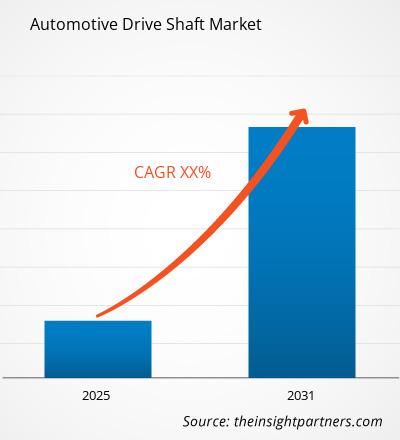
The automotive drive shaft market size was recorded as US$ 12.39 Billion in 2025 and is expected to be US$ 18.29 Billion by 2034, growing with a CAGR of 4.43% for the period 2026-2034. The market drivers include increasing vehicle production, all-wheel drives, fleet applications, and the need for drive shafts that deliver torque in an efficient manner while minimizing vibrations, weights, and driveline noises.
The North American region is expected to remain a vital region owing to the growth in the market size of automotive drive shafts because of pickups, SUVs, light trucks, and off-roaders. The North American region is expected to record a CAGR of 4.0 – 4.6% for the period 2026-2034.
Automotive Drive Shaft Market Assessment and Insights
- North America: Accounted for 24–27% share in 2025 and is expected to grow at a CAGR range of 4.0–4.6% between 2026–2034, driven by SUVs, pickups, commercial vans, and aftermarket replacement cycles.
- US: Represented 78–82% of North America in 2025 and is expected to grow at a CAGR range of 4.1–4.7% between 2026–2034, led by light trucks and driveline suppliers.
- Europe: Held 22–25% share in 2025 and is projected to grow at a CAGR range of 3.8–4.4% between 2026–2034, with Germany, the UK, France, Italy, and Spain leading demand through premium and commercial platforms.
- Asia Pacific: Captured 39–43% share in 2025 and is forecast to grow at a CAGR range of 4.6–5.2% between 2026–2034, led by China, Japan, South Korea, India, and Australia.
- Largest Segment: Passenger Cars held 58–62% market share in 2025 and are expected to grow at a CAGR range of 4.1–4.7% during 2026–2034 because volume production and compact driveline layouts dominate demand.
- High Growth Segment: Heavy Commercial Vehicles held 11–14% market share in 2025 and are expected to grow at a CAGR range of 5.0–5.6% during 2026–2034 as heavy-duty logistics, mining, and construction fleets expand.
- Key companies analyzed in detail: American Axle & Manufacturing Holdings, Inc., Dana Incorporated, GKN Automotive Limited, Hyundai Wia Corporation, JTEKT Corporation, Meritor, Inc., NEAPCO Holdings LLC, Nexteer Automotive Corporation, NTN Corporation, SHOWA CORPORATION.
Source: The Insight Partners' analysis based on proprietary research, government publications, company annual reports, investor presentations, industry databases, and expert interviews.
The trend is towards a change from conventional steel driveline systems to hollow shafts, balanced propeller shafts, half shafts and composites. Driveline systems are being redesigned to meet requirements for higher torque and lower noise, as well as for compact design. Electrification will change the requirements for products but not the demand because hybrids, all-wheel drive EVs and trucks will need robust torque transfer devices.
Market growth will be driven by vehicle production in emerging geographies, efforts in weight reduction and ability to support conventional internal combustion engines and e-drives. Emerging geographies will increase production of passenger cars and commercial vehicles, whereas established geographies will need replacement products and advanced shafts for NVH improvement. Suppliers with manufacturing capabilities around the world, forging, heat treatment and e-drive capabilities will benefit.
Automotive Drive Shaft Market Report Scope
| Report Attribute | Details |
|---|---|
| Market size in 2025 | US$ 12.39 Billion |
| Market Size by 2034 | US$ 18.29 Billion |
| Global CAGR (2026 - 2034) | 4.43% |
| Historical Data | 2021-2024 |
| Forecast period | 2026-2034 |
Automotive Drive Shaft Market Analysis
The automotive drive shaft market growth will be facilitated by the ongoing trend towards sport utility vehicles, pick-up trucks, crossovers, and all-wheel drive configurations. These types of vehicles utilize more advanced torque transfer systems than conventional front-wheel-drive automobiles, resulting in the greater demand for propeller shafts and half-shafts. There will be reliable replacement demand coming from commercial vehicle fleets due to wear of the joints, imbalance, corrosion, and boot degradation during operation.
There will be supply dynamics associated with the availability of steel, alloys, forging, heat treatment, machining, and balancing. The automotive drive shaft market research reveals that in addition to the price, automakers will increasingly judge the performance of a shaft in terms of its contribution to the overall driveline efficiency.
The competition exists among specialists in drivelines with international programs. American Axle & Manufacturing Holdings, Inc., and Dana Incorporated are competing on driveline and e-propulsion integration whereas GKN Automotive Limited has reputation due to its sideshafts and innovative drive systems. JTEKT Corporation, NTN Corporation, Hyundai Wia Corporation, NEAPCO Holdings LLC, Nexteer Automotive Corporation, SHOWA CORPORATION, and Meritor, Inc. contribute to the market by providing shafts, joints, bearings, steering related components, and commercial drivelines.
Trends in investments include materials that are light, modular shaft families and instant electric torque components. The acquisition of GKN Automotive by American Axle & Manufacturing increased consolidation of drivelines and metal forming technology. Supplier portfolios have been combining internal combustion engines, hybrids, and electric vehicles applications. The strategy of positioning now involves servicing various types of propulsion systems.
● REPORT CUSTOMIZATION
Tailor This Report To Align With Your Specific Business Requirements
This report can be customized to align precisely with your business objectives, scope, and target markets. Customization options include tailored segmentation, geography, competitive analysis, and strategic insights to support informed decision-making.
Customize This Report →WHAT YOU CAN ADJUST
- ● Segmentations
- ● Geography
- ● Competitive Analysis
- ● Language Preferences
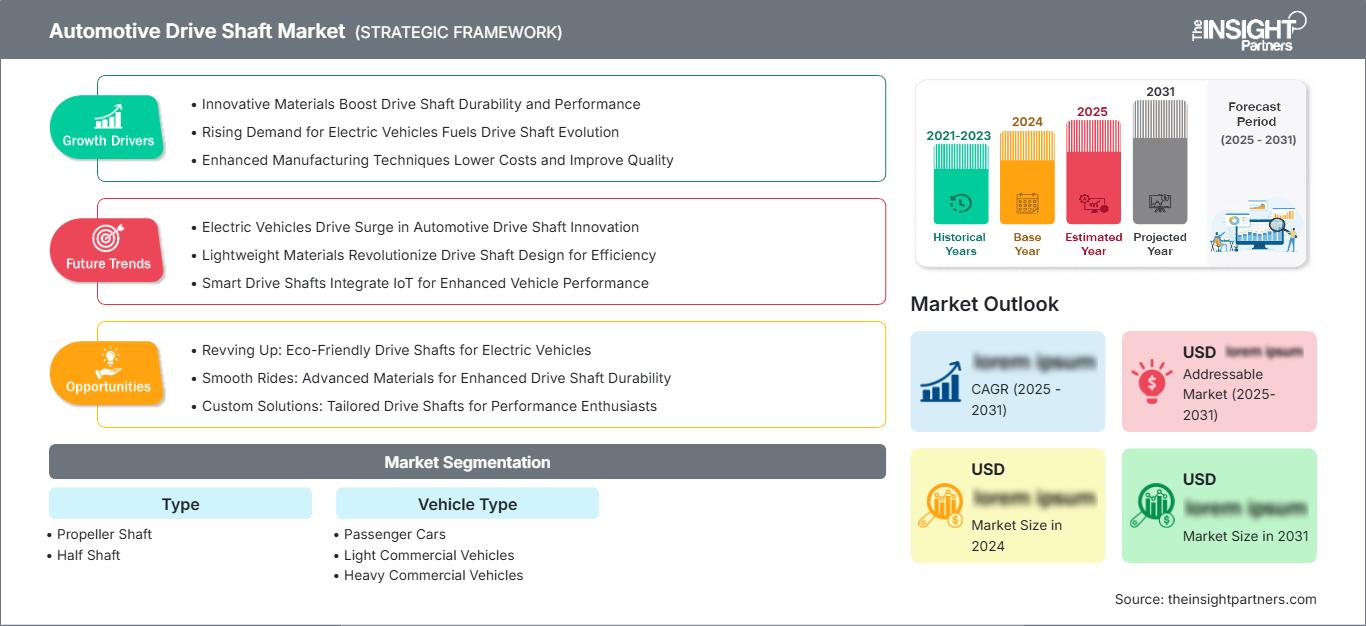
Automotive Drive Shaft Market: Strategic Insights
Regional Insights
North America automotive drive shaft market
North America accounted for 24–27% automotive drive shaft market share in 2025 and is expected to grow at a CAGR range of 4.0–4.6% through 2034. The region benefits from strong pickup, SUV, and light truck production, where rear-wheel-drive and four-wheel-drive layouts require robust propeller shafts and half shafts.
Replacement demand is also meaningful because high-mileage vehicles, towing use, winter road salt, and off-road driving accelerate wear. OEMs are adopting lighter, better-balanced shafts to improve fuel economy and reduce NVH. Commercial vans and utility fleets add recurring demand for durable assemblies with predictable service intervals.
U.S. automotive drive shaft Market
The U.S. represented 78–82% of North America in 2025 and is projected to grow at a CAGR range of 4.1–4.7% during 2026–2034. Demand is reinforced by domestic light truck output, large aftermarket distribution networks, and the presence of major driveline suppliers.
Application trends favor high-torque shafts for pickups, precision half shafts for crossovers, and lightweight products for hybrid and EV programs. American Axle & Manufacturing Holdings, Inc., Dana Incorporated, NEAPCO Holdings LLC, and Nexteer Automotive Corporation support domestic manufacturing, engineering, and service-channel depth.
Europe automotive drive shaft Market
The Europe segment has held a market share ranging from 22–25%, with an anticipated growth rate in terms of CAGR of 3.8–4.4% over 2026–2034. Germany is leading due to its requirement of high-end passenger vehicles, sports cars, and commercial platforms with driveline engineering. The United Kingdom provides opportunities for performance cars and specialist vehicles.
France, Italy, and Spain are providing opportunities through compact cars, vans, and regional manufacturing units. Europe's requirements include low vibration, efficient torque transmission, light weighting, and suitability in hybrid systems. The supplier initiatives are now becoming compatible with the electric vehicle platform with compact half-shafts and high-strength joints.
APAC automotive drive shaft Market
APAC accounted for 39–43% share in 2025 and is forecast to grow at a CAGR range of 4.6–5.2% through 2034. China leads due to large vehicle production, EV launches, and expanding supplier localization.
Japan and South Korea add advanced driveline engineering through JTEKT Corporation, NTN Corporation, Hyundai Wia Corporation, and SHOWA CORPORATION. India supports growth through passenger cars, light commercial vehicles, and infrastructure-linked fleet demand, while Australia contributes through pickup, utility, and aftermarket requirements.
Middle East & Africa automotive drive shaft Market
Middle East & Africa is expected to grow at a CAGR range of 3.5–4.1% during 2026–2034. Saudi Arabia and the UAE lead demand through SUVs, off-road vehicles, logistics fleets, and premium imports.
South Africa and the Rest of MEA rely more on replacement parts, commercial vehicles, mining, and infrastructure activity. Harsh heat, dust, and load conditions make durability, sealing, and serviceability central purchase criteria for drivetrain components across the region.
Segmentation Analysis
Type
Type is expected to grow at a CAGR range of 4.2–4.8% during 2026–2034. The automotive drive shaft market scope is shaped by propeller shafts for rear-wheel and all-wheel-drive layouts and half shafts for transaxle-based vehicles. EV and hybrid platforms are changing shaft length, joint angles, and torque requirements, creating demand for lighter and more accurately balanced assemblies.
- Propeller Shaft demand is concentrated in rear-wheel-drive, four-wheel-drive, pickup, SUV, and commercial vehicle platforms that require longer torque-transfer components with strong balancing and torsional performance.
- Half Shaft applications remain essential in front-wheel-drive, all-wheel-drive, hybrid, and electric vehicles because compact shafts must transfer wheel torque while accommodating steering, suspension, and packaging movement.
Vehicle Type
Vehicle Type is expected to grow at a CAGR range of 4.3–4.9% during 2026–2034 as passenger cars provide scale, light commercial vehicles add fleet intensity, and heavy commercial vehicles require higher-strength driveline systems under severe load conditions.
- Passenger Cars dominate because global volume production, crossover adoption, and electrified driveline layouts require large quantities of precision half shafts and compact torque-transfer components.
- Light Commercial Vehicles generate steady demand through delivery vans, pickups, and service fleets where uptime, repairability, and load-bearing performance are important operating requirements.
- Heavy Commercial Vehicles require robust shafts capable of handling high torque, payload duty, road shock, and long service intervals in logistics, construction, mining, and infrastructure applications.
Opportunity Snapshot
| Vehicle Type | Revenue Contribution | Trend Tag | Adoption Stage |
| Passenger Cars | High | Compact Shafts | Scaling |
| Light Commercial Vehicles | Medium | Fleet Uptime | Mature |
| Heavy Commercial Vehicles | Medium | High Torque | Scaling |
Automotive Drive Shaft Market Growth Drivers and Impact Analysis
SUV and AWD Adoption Raises Driveline Content
Consumers' growing favorability towards SUVs, crossovers, trucks, and AWD vehicles is resulting in an increase in the content per vehicle in the driveline component. There is increased demand for more shafts, joints, bearings, and balance from these complex platforms than there is for two-wheel-drive platforms. The effect can be seen in North America and APAC, where there is continued high production of light trucks and crossovers. The supplier benefits from this driver as well since heavy vehicles need increased torque capability.
Electrification Changes Shaft Engineering Requirements
Electric motors deliver instant torque, which places new stress on half shafts, joints, and related driveline components. Rather than removing demand, electrification creates a need for compact, high-strength, precisely balanced shafts suitable for e-axles, hybrid systems, and all-wheel-drive EV platforms. The market impact is a shift toward improved materials, tighter tolerances, and better sealing. Suppliers that understand both mechanical driveline behavior and electrified torque delivery can capture business across transitional vehicle architectures.
Commercial Fleet Wear Sustains Replacement Demand
Commercial vehicles operate under frequent stop-start cycles, heavy payloads, towing loads, and long annual mileage. These conditions accelerate wear in joints, boots, splines, and balanced shaft assemblies, creating recurring replacement demand beyond new vehicle production. Delivery vans, construction vehicles, logistics fleets, and public service vehicles need predictable repairs to maintain uptime. The impact is a stable aftermarket base for regional distributors and driveline specialists, especially where fleet operators standardize maintenance schedules and value durable parts.
Automotive Drive Shaft Market Future Trends
Composite Shafts Move Into Higher-Volume Platforms
The automotive drive shaft market trends point toward wider use of composite and hollow shaft designs as automakers reduce mass while retaining torsional stiffness. Carbon fiber remains cost-sensitive, but premium, performance, and EV platforms are proving its value where weight reduction improves range, acceleration, and vibration behavior. Wider adoption will depend on manufacturing scale, crash validation, repair practices, and material cost control. Steel will remain dominant, but lightweight alternatives will gain share in higher-value applications.
Integrated E-Drive Modules Reshape Supplier Portfolios
Future driveline sourcing will increasingly combine shafts, joints, differentials, e-axles, and torque management into integrated modules. This favors suppliers that can deliver mechanical durability alongside electrified propulsion knowledge. OEMs want fewer interfaces, shorter validation cycles, and better package efficiency. As skateboard EV platforms expand, shaft geometry and torque loading will be defined earlier in vehicle architecture. Suppliers with modular designs and regional production footprints will be better positioned for long-term programs.
Automotive Drive Shaft Market Opportunities
EV and Hybrid Shaft Customization
The strongest opportunity lies in customized shafts for EV and hybrid platforms. The automotive drive shaft market Forecasts remain favorable where suppliers can design compact half shafts, lightweight propeller shafts, and high-strength joints around instant torque, regenerative braking, and tighter underbody packaging. Early engineering involvement can improve NVH behavior, durability, and system efficiency. Suppliers that offer validation support, thermal understanding, and regional production can secure long-running platform awards as electrified vehicle lineups expand.
Aftermarket Programs for High-Mileage Fleets
Fleet-focused aftermarket programs offer a practical growth route because drive shaft failure can immobilize vehicles and disrupt operations. Suppliers can build value through complete shaft assemblies, boot kits, universal joints, fitment databases, and rapid distribution. Light commercial vehicles, delivery vans, taxis, and heavy-duty fleets create recurring replacement demand. The opportunity is strongest where distributors provide warranty-backed parts, technical support, and predictable availability for vehicles operating under high mileage and heavy load conditions.
Frequently Asked Questions

- Comprehensive Market Sizing and Forecast Analysis
- Detailed Segmentation Analysis
- In-Depth Market Dynamics Assessment
- Regional and Country-Level Insights
- Competitive Landscape and Company Benchmarking
- Strategic Business Intelligence
Recent Reports
Testimonials

The Insight Partners' SCADA System Market report is comprehensive, with valuable insights on current trends and future forecasts. The team was highly professional, responsive, and supportive throughout. We are very satisfied and highly recommend their services.
RAN KEDEM Partner, Reali Technologies LTDs
I requested a report on a very specific software market and the team produced the report in a few days. The information was very relevant and well presented. I then requested some changes and additions to the report. The team was again very responsive and I got the final report in less than a week.
JEAN-HERVE JENN Chairman, Future Analytica
We worked with The Insight Partners for an important market study and forecast. They gave us clear insights into opportunities and risks, which helped shape our plans. Their research was easy to use and based on solid data. It helped us make smart, confident decisions. We highly recommend them.
PIYUSH NAGPAL Sr. Vice President, High Beam Global
The Insight Partners delivered insightful, well-structured market research with strong domain expertise. Their team was professional and responsive throughout. The user-friendly website made accessing industry reports seamless. We highly recommend them for reliable, high-quality research services
YUKIHIKO ADACHI CEO, Deep Blue, LLC.
This is the first time I have purchased a market report from The Insight Partners.While I was unsure at first, I visited their web site and felt more comfortable to take the risk and purchase a market report.I am completely satisfied with the quality of the report and customer service. I had several questions and comments with the initial report, but after a couple of dialogs over email with their analyst I believe I have a report that I can use as input to our strategic planning process.Thank you so much for taking the extra time and making this a positive experience.I will definitely recommend your service to others and you will be my first call when we need further market data.
JOHN SUZUKI President and Chief Executive Officer, Board Director, BK Technologies
I wish to appreciate your support and the professionalism you displayed in the course of attending to my request for information regarding to infectious disease IVD market in Nigeria. I appreciate your patience, your guidance, and the fact that you were willing to offer a discount, which eventually made it possible for us to close a deal. I look forward to engaging The Insight Partners in the future, all thanks to the impression you have created in me as a result of this first encounter.
DR CHIJIOKE ONYIA MANAGING DIRECTOR, PineCrest Healthcare Ltd.Reason to Buy
- Informed Decision-Making
- Understanding Market Dynamics
- Competitive Analysis
- Identifying Emerging Markets
- Customer Insights
- Market Forecasts
- Risk Mitigation
- Boosting Operational Efficiency
- Strategic Planning
- Investment Justification
- Tracking Industry Innovations
- Aligning with Regulatory Trends





 Get Free Sample for