
Automotive Jack Market Size, Share & Trends by 2034
Coverage: By Type (Floor Jacks, Scissor Jacks, Hydraulic Bottle Jacks, Hi-Lift Jacks, High Tonnage Jacks, Forklift Jacks); Pump Type (Manual, Pneumatic, Electric, Hydraulic); Weight Capacity (Less than 2 tons, 2 Tons to 4 Tons, 5 Tons to 10 Tons, 11 Tons to 25 Tons, 26 Tons to 50 Tons, More than 50 Tons); Vehicle Type (Passenger Car, Light Commercial Vehicle, Heavy Commercial Vehicle, Industrial Vehicle) , and Geography (North America, Europe, Asia Pacific, and South and Central America)
- Status : Data Released
- Report Code : TIPRE00009128
- Category : Automotive and Transportation
- No. of Pages : 150
- Available Report Formats :


- Last update date : August 04, 2026


2025 Market Size
US$ 2.91 Bn
Base year value
2034 Forecast
US$ 4.96 Bn
Projected by 2034
CAGR 2026-2034
6.12 %
Growth rate
Addressable Market
US$ 35.66 Bn
(2026-2034)
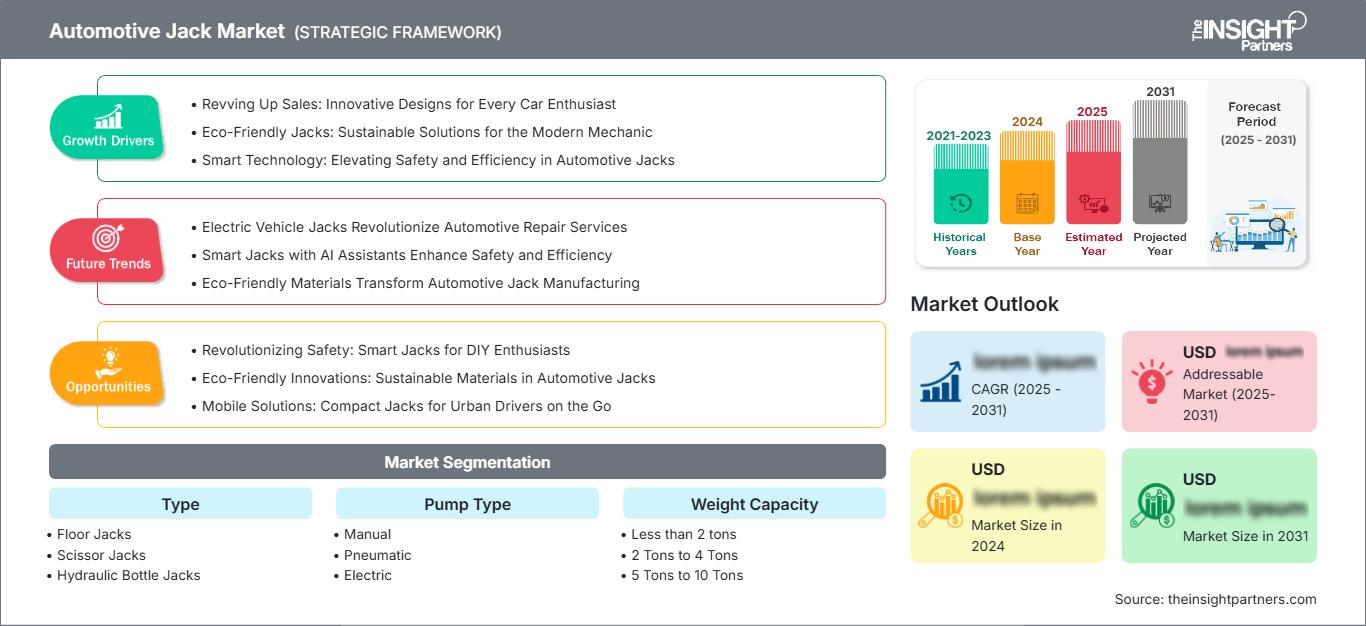
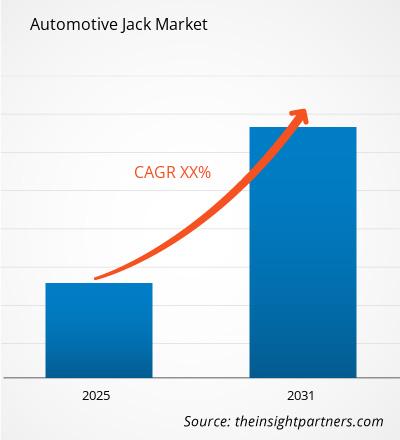
The automotive jack market was valued at US$ 2.91 Billion in 2025 and is projected to reach US$ 4.96 Billion by 2034, registering a CAGR of 6.12% during 2026–2034. Increasing numbers of vehicles on a global level, greater need for maintenance, and the rising requirement for efficient lifting equipment in all kinds of industrial and non-industrial settings will keep the market expanding. The manufacturers are focusing on developing safer products with greater carrying capacities, light weight, and ergonomically designed products.
North America continues to represent a technologically mature market supported by an extensive automotive aftermarket, high vehicle ownership, and well-established professional repair infrastructure. The automotive jack market size in the region is supported by increasing investments in commercial vehicle maintenance, industrial equipment servicing, and premium garage equipment. Growing adoption of electric and hydraulic lifting systems, combined with stringent workplace safety regulations and replacement demand for aging workshop equipment, is expected to support a regional CAGR of approximately 5.6%–6.1% through the forecast period.
Automotive Jack Market Assessment and Insights
- North America: The region accounted for 31–34% share in 2025 and is expected to grow at a CAGR of 5.6%–6.1% during 2026–2034, supported by strong aftermarket demand, commercial fleet servicing, advanced repair infrastructure, and stringent occupational safety standards.
- US: The country represented approximately 75–79% of the North American market in 2025 and is projected to register a CAGR of 5.7%–6.2%, driven by large vehicle parc, professional workshops, and increasing replacement demand.
- Europe: Europe captured 25–28% share in 2025 and is forecast to expand at a CAGR of 5.9%–6.5%, led by Germany, the UK, France, and Italy, where advanced vehicle servicing networks and industrial lifting equipment demand remain robust.
- Asia Pacific: Asia Pacific accounted for 34–37% share in 2025 and is expected to register the fastest regional expansion with a CAGR of 6.8%–7.4%, supported by China, Japan, India, and South Korea through rising vehicle production and expanding aftermarket services.
- Largest Segment: Passenger Car represented the largest segment with an estimated 54–58% market share in 2025 and is projected to expand at a CAGR of 5.9%–6.4%, supported by increasing global vehicle ownership and maintenance activities.
- High Growth Segment: Electric Pump Type accounted for approximately 14–17% market share in 2025 and is anticipated to record the highest CAGR of 8.4%–9.1% due to increasing workshop automation and productivity improvements.
- Key companies analyzed in detail: Affjaxx, ARGO MANUFACTURING CO., ESCO Equipment Supply Company, J&S Jacks, LLC., Milwaukee Hydraulics, Norco Industries, Inc., Shinn Fu Company of America, Inc., Simplex, U.S. Jack Company, Weaver Jacks Corporation.
Source: The Insight Partners' analysis based on proprietary research, government publications, company annual reports, investor presentations, industry databases, and expert interviews.
The technology of automobile maintenance continues to advance to ensure greater safety, increased workshop efficiency, and equipment automation, thereby promoting the development of new car-lifting methods by automobile manufacturers. The hydraulic lifters are still considered the best choice because of their durability, operational precision, and ability to lift heavy trucks. In addition, the components' weight reduction and corrosion resistance make operating the lift more comfortable.
Future automotive jack market development will increasingly rely on industrial upgrading, service center growth, and infrastructure developments in emerging countries. Advances in digital inventory control systems, preventative maintenance schemes, and stringent work safety requirements have encouraged fleet managers and auto repair shops to upgrade their older lifting machines with technologically advanced products. Companies that will be able to provide such solutions will become more competitive over the forecast period.
Automotive Jack Market Report Scope
| Report Attribute | Details |
|---|---|
| Market size in 2025 | US$ 2.91 Billion |
| Market Size by 2034 | US$ 4.96 Billion |
| Global CAGR (2026 - 2034) | 6.12% |
| Historical Data | 2021-2024 |
| Forecast period | 2026-2034 |
Automotive Jack Market Analysis
Growing vehicle ownership, expanding commercial transportation fleets, and increasing demand for preventive maintenance continue to accelerate automotive jack market growth across developed and emerging economies. Owners of vehicles are concerned about conducting regular inspections and changing tires, whereas fleet managers are concerned about the use of reliable lifting equipment to reduce time spent servicing the equipment. Independent workshops, dealerships, and industrial maintenance companies all together ensure that there is steady demand for various types of lifting equipment.
The industry value chain benefits from advances in steel fabrication, hydraulic cylinder manufacturing, precision machining, sealing technologies, and industrial automation. Suppliers continue investing in higher load capacities, compact product designs, and improved operator safety while strengthening relationships with automotive distributors, industrial equipment suppliers, and aftermarket retailers.
Competitive intensity within the automotive jack market analysis is moderate in nature, with leading firms stressing durability, compliance to regulations, engineering prowess, and extensive distribution networks. Firms like Shinn Fu Company of America, Inc., Norco Industries, Inc., ESCO Equipment Supply Company, Simplex, Milwaukee Hydraulics, and U.S. Jack Company keep coming up with specialized lifting products for commercial vehicles, heavy machinery, mining purposes, and maintenance activities. Lifting accuracy, resistance to corrosion, and safety at work have been key differentiators of products.
Investment activity continues expanding toward electric-powered lifting equipment, intelligent hydraulic systems, and higher-capacity industrial lifting solutions. Manufacturers are strengthening regional distribution partnerships while increasing production capabilities to meet rising global demand. Growth opportunities are particularly evident across Asia Pacific, Latin America, and the Middle East, where expanding automotive service infrastructure and industrial development continue supporting long-term demand for professional lifting equipment.
● REPORT CUSTOMIZATION
Tailor This Report To Align With Your Specific Business Requirements
This report can be customized to align precisely with your business objectives, scope, and target markets. Customization options include tailored segmentation, geography, competitive analysis, and strategic insights to support informed decision-making.
Customize This Report →WHAT YOU CAN ADJUST
- ● Segmentations
- ● Geography
- ● Competitive Analysis
- ● Language Preferences
Automotive Jack Market: Strategic Insights
Regional Insights
North America Automotive Jack Market
North America accounted for 32–35% of the global automotive jack market share in 2025 and is projected to expand at a CAGR of 5.8–6.2% during 2026–2034. The region benefits from one of the world's largest vehicle fleets, mature automotive repair infrastructure, and stringent occupational safety regulations governing lifting equipment used in commercial garages and industrial facilities. Continuous investments in dealership service centers and independent workshops sustain replacement demand for hydraulic and pneumatic jacks.
North America is led by the US and Canada due to high vehicle ownership rates, a well-developed aftermarket industry, and a growing need for maintenance equipment for heavy-duty applications in logistics, construction, and mining. The companies are increasingly spending on reliable equipment which will be able to lift not only electric cars but also more heavyweight trucks. Moreover, manufacturers are developing new aluminum floor jacks and electric lifts which enhance efficiency of mechanics.
U.S. Automotive Jack Market
The U.S. represented approximately 79–82% of the North American automotive jack market in 2025 and is expected to record a CAGR of 5.9–6.3% through 2034. Extensive automotive repair networks, strong aftermarket spending, and widespread commercial transportation activities continue to support equipment replacement cycles. Professional workshops increasingly prefer hydraulic and pneumatic lifting equipment because of higher operational efficiency and improved workplace ergonomics.
The rising popularity of electric vehicles has generated the need for specialized lifting equipment that can be used for battery maintenance and underbody maintenance. The leading distributors are consistently improving their digital procurement channels to facilitate the efficient procurement of safety-ceritfied lifting equipment by repair shops. The industrial applications of such equipment in manufacturing plants, ports, and logistics centers add to the steady demand of the market.
Europe Automotive Jack Market
Europe accounted for 27-30% of worldwide revenue in 2025 and is expected to register a CAGR of 5.9-6.4% during the forecast period. Germany leads as the foremost regional market owing to the presence of a significant number of automotive manufacturing units in the country; while the UK, France, Italy, and Spain derive contribution from their aftermarket service industry and commercial vehicle maintenance.
The UK market is benefited by the presence of an established independent garage network and increasing investments towards electric vehicle service infrastructure. Growing demand for portable hydraulic lift trucks from roadside assistance and fleet maintenance companies ensures regular replacement of the equipment. Increasing focus on technician safety further pushes workshop owners to opt for safety certified lifting systems.
Germany maintains regional leadership through advanced automotive manufacturing, large commercial vehicle fleets, and widespread industrial maintenance activities. Demand remains strong for high-capacity hydraulic jacks used across OEM production facilities, logistics centers, and heavy equipment servicing operations. Manufacturers continue integrating advanced hydraulic technologies to improve operational efficiency and reduce maintenance downtime.
This cluster of nations constitutes an important growth region owing to the growing availability of auto repair services, increased replacement demand due to old age of vehicles, and enhanced construction in the field of commercial transport facilities. The government programs for green transport are motivating repair shops to upgrade their facilities to service hybrid/electric cars.
APAC Automotive Jack Market
Asia Pacific accounted for 29–32% of global revenue in 2025 and is forecast to register the fastest regional expansion at a CAGR of 6.8–7.3%. China leads regional demand owing to its vast automotive manufacturing sector, while Japan and South Korea contribute through advanced automotive service industries and premium equipment manufacturing.
India and Australia continue witnessing rising investments in commercial transportation, mining, and industrial infrastructure, supporting demand for high-capacity lifting equipment. Rapid growth of organized automotive service chains, expanding vehicle ownership, and increasing industrial safety awareness are expected to strengthen regional market expansion throughout the forecast period.
Middle East & Africa Automotive Jack Market
The Middle East & Africa market is projected to expand at a CAGR of 5.5–5.9% during 2026–2034. Saudi Arabia leads regional demand owing to large commercial vehicle fleets, expanding logistics infrastructure, and continuous investments in industrial maintenance facilities. The UAE supports steady equipment demand through automotive service centers, construction projects, and heavy equipment maintenance operations.
South Africa remains an important aftermarket hub supported by mining activities, commercial transportation, and a well-established vehicle repair industry. The Rest of the Middle East & Africa continues to witness gradual adoption of professional lifting equipment as industrialization and infrastructure development accelerate. Growing awareness of workplace safety standards and increasing investments in organized automotive service networks are expected to support long-term market expansion.
Segmentation Analysis
Type
The Type segment accounted for the largest revenue contribution across the market owing to diverse lifting requirements across passenger vehicles, commercial vehicles, industrial machinery, and maintenance workshops. The segment is projected to register a CAGR of 6.0–6.4% during 2026–2034. Expanding vehicle fleets, stricter workplace safety regulations, and continuous product innovation strengthen long-term demand. The automotive jack market scope continues to widen as manufacturers introduce lightweight, corrosion-resistant, and high-capacity lifting solutions for both professional and consumer applications.
- Floor Jacks: Widely used in professional repair workshops because of superior lifting stability, faster operation, and compatibility with passenger cars and light commercial vehicles. Aluminum designs continue gaining popularity due to improved portability.
- Scissor Jacks: Commonly supplied as original equipment with passenger vehicles for emergency roadside tire replacement. Compact dimensions, affordability, and simple mechanical operation sustain demand despite increasing adoption of hydraulic alternatives.
- Hydraulic Bottle Jacks: Preferred for commercial vehicles and industrial maintenance because they deliver high lifting force while occupying minimal storage space. Continuous improvements in hydraulic sealing enhance durability and operational safety.
- Hi-Lift Jacks: Extensively utilized for off-road vehicles, agricultural machinery, and recovery applications requiring extended lifting height. Demand remains concentrated among specialty vehicle operators and outdoor equipment users.
- High Tonnage Jacks: Designed for heavy-duty industrial equipment, buses, and large commercial vehicles where substantial lifting capacity is essential. Infrastructure development and logistics expansion continue supporting equipment demand.
- Forklift Jacks: Specialized products developed for servicing forklifts and warehouse material handling equipment. Growing warehouse automation and distribution center expansion contribute to increasing replacement demand.
Pump Type
The Pump Type segment is anticipated to grow at a CAGR of 6.2–6.6% during the automotive jack market forecast period as workshops increasingly prioritize productivity, operator safety, and lifting efficiency. Technological advancements in hydraulic systems and electrically powered lifting mechanisms continue improving equipment performance while reducing physical effort during maintenance operations.
- Manual: Continues serving cost-sensitive workshops and emergency roadside applications due to low maintenance requirements, operational simplicity, and widespread availability across developing automotive markets.
- Pneumatic: Increasingly adopted by professional repair facilities where compressed air infrastructure enables rapid lifting cycles and improved technician productivity during high-volume maintenance operations.
- Electric: Demand is rising as electric vehicle servicing expands and workshops seek automated lifting solutions that improve precision, reduce operator fatigue, and enhance workplace safety.
- Hydraulic: Remains the dominant pump technology owing to exceptional lifting force, operational reliability, smooth load control, and suitability across passenger, commercial, and industrial vehicle maintenance applications.
Weight Capacity
The Weight Capacity segment is projected to expand at a CAGR of 6.3–6.8% during 2026–2034. Demand is closely associated with the growing diversity of vehicles on the road, increasing commercial transportation activities, and expanding industrial maintenance operations. Rising sales of SUVs, electric vehicles, buses, and heavy-duty trucks are encouraging manufacturers to develop lifting equipment with higher load capacities while maintaining portability, stability, and compliance with international safety standards.
- Less than 2 tons: Primarily used for compact passenger vehicles and roadside emergency applications. Low weight, compact dimensions, and affordability make these products suitable for individual vehicle owners.
- 2 Tons to 4 Tons: Represents the most widely utilized capacity range across passenger cars, SUVs, and light commercial vehicles owing to its versatility in independent garages and dealership service centers.
- 5 Tons to 10 Tons: Commonly adopted for medium-duty commercial vehicles, pickup trucks, utility vehicles, and fleet maintenance operations requiring higher lifting capacity and operational reliability.
- 11 Tons to 25 Tons: Designed for buses, heavy commercial vehicles, construction machinery, and industrial equipment where stable lifting performance and enhanced safety features are essential.
- 26 Tons to 50 Tons: Serves mining equipment, large transport fleets, and heavy industrial maintenance applications requiring durable hydraulic lifting systems capable of repeated high-load operations.
- More than 50 Tons: Utilized in specialized industrial environments including shipyards, energy facilities, railway maintenance, and heavy manufacturing plants where extremely high lifting capacities are required.
Vehicle Type
The Vehicle Type segment is expected to register the fastest growth, with a CAGR of 6.5–6.9% during the forecast period. Increasing global vehicle ownership, expanding commercial transportation networks, and rising maintenance requirements are supporting demand across all vehicle categories. The shift toward electrified mobility is also encouraging workshops to invest in advanced lifting systems capable of safely servicing battery-electric and hybrid vehicles.
- Passenger Car: Generates the highest equipment demand because of the large global vehicle parc, frequent tire replacement, routine maintenance, and extensive dealership and independent workshop networks.
- Light Commercial Vehicle: Supported by expanding last-mile logistics, e-commerce delivery fleets, and growing maintenance requirements for vans and utility vehicles operating under intensive usage conditions.
- Heavy Commercial Vehicle: Requires high-capacity hydraulic and pneumatic lifting systems for trucks, trailers, buses, and long-haul transportation fleets where operational uptime remains critical.
- Industrial Vehicle: Includes forklifts, construction equipment, mining machinery, and warehouse vehicles requiring specialized heavy-duty lifting solutions designed for demanding industrial operating environments.
Opportunity Snapshot
| Vehicle Type | Revenue Contribution | Trend Tag | Adoption Stage |
| Passenger Car | High | Vehicle Service | Mature |
| Light Commercial Vehicle | Medium | Fleet Repair | Scaling |
| Heavy Commercial Vehicle | High | Heavy Fleet | Mature |
| Industrial Vehicle | Medium | Industrial Maintenance | Scaling |
Automotive Jack Market Growth Drivers and Impact Analysis
Expansion of Global Vehicle Parc and Aftermarket Maintenance
The continuous growth of the global vehicle population remains one of the strongest demand generators for automotive jacks. Passenger vehicles, light commercial vehicles, and heavy-duty trucks require regular tire replacement, brake servicing, suspension repairs, and underbody inspections, all of which depend on reliable lifting equipment. Expanding vehicle ownership in developing economies and increasing average vehicle age in mature markets are strengthening aftermarket repair activity. Independent garages and dealership workshops are investing in durable hydraulic and pneumatic jacks to improve operational efficiency while complying with occupational safety standards. Fleet operators are also replacing conventional lifting equipment with higher-capacity solutions that minimize maintenance downtime, thereby creating sustained demand across both OEM and replacement markets.
Increasing Industrial Safety Regulations Across Workshops
Governments and workplace safety organizations continue strengthening regulations governing lifting equipment used in automotive repair facilities, manufacturing plants, and industrial maintenance environments. Compliance with standards related to load stability, hydraulic reliability, and operator safety is encouraging workshops to replace aging equipment with certified lifting solutions. Automotive service chains are investing in advanced floor jacks, hydraulic bottle jacks, and pneumatic systems featuring overload protection, improved sealing technologies, and ergonomic designs. The transition toward organized service networks, particularly across Asia Pacific and Latin America, is further accelerating demand for professionally certified lifting equipment while reducing dependence on low-quality, unregulated products available in informal markets.
Growth of Commercial Transportation and Heavy Equipment Maintenance
Rapid expansion of logistics, construction, mining, agriculture, and infrastructure projects is increasing maintenance requirements for heavy commercial vehicles and industrial machinery. Large trucks, buses, forklifts, and specialized equipment require high-capacity lifting systems capable of operating safely under demanding working conditions. Fleet operators increasingly prioritize preventive maintenance to maximize vehicle availability and reduce operational costs, driving investment in premium hydraulic lifting equipment. Infrastructure spending across emerging economies continues expanding service networks for heavy equipment maintenance, while mining and warehouse operators are upgrading maintenance facilities with advanced lifting systems that improve technician productivity and enhance workplace safety.
Automotive Jack Market Future Trends
Electrification of Professional Vehicle Lifting Equipment
Automotive jack market trends indicate increasing adoption of electrically powered lifting equipment designed to reduce technician effort while improving lifting precision and workplace safety. Smart electric jacks equipped with digital load monitoring, automatic height control, overload protection, and wireless diagnostics are gradually replacing traditional manual systems in high-volume workshops. Growing electric vehicle servicing requirements are expected to accelerate adoption because battery maintenance demands stable and highly accurate lifting platforms. Manufacturers are integrating lightweight materials and intelligent control technologies to improve operational efficiency and reduce maintenance requirements.
Lightweight Materials and Advanced Hydraulic Engineering
Manufacturers are increasingly utilizing aluminum alloys, high-strength steel, and improved hydraulic sealing technologies to reduce product weight without compromising lifting capacity. Advanced engineering enables higher durability, lower maintenance requirements, and improved corrosion resistance, making equipment suitable for intensive commercial applications. Future product development will focus on portable heavy-duty designs that combine high load capacity with enhanced mobility, enabling technicians to perform maintenance efficiently across workshops, roadside assistance operations, and industrial maintenance facilities.
Automotive Jack Market Opportunities
Expansion of Organized Automotive Service Networks
Automotive jack Market Forecasts indicate significant investment opportunities arising from the rapid expansion of organized dealership workshops, franchise service centers, and fleet maintenance facilities across Asia Pacific, the Middle East, and Latin America. These facilities increasingly require standardized lifting equipment that complies with international safety regulations while supporting high service volumes. Manufacturers capable of offering durable products, technical training, and comprehensive aftermarket support can strengthen long-term customer relationships. Investments in regional manufacturing, distribution infrastructure, and digital procurement platforms are expected to improve market accessibility while reducing supply chain costs.
Development of High-Capacity Smart Hydraulic Solutions
The growing popularity of electric SUVs, commercial vehicles, buses, construction equipment, and industrial machinery creates substantial opportunities for advanced high-capacity lifting systems. Manufacturers investing in intelligent hydraulic technologies, predictive maintenance features, remote diagnostics, and digital load monitoring can differentiate their product portfolios within premium market segments. Integration of IoT-enabled maintenance tracking and safety monitoring systems is expected to generate additional value for fleet operators, industrial facilities, and large automotive service chains seeking higher operational efficiency and lower lifecycle maintenance costs.
Frequently Asked Questions

- Comprehensive Market Sizing and Forecast Analysis
- Detailed Segmentation Analysis
- In-Depth Market Dynamics Assessment
- Regional and Country-Level Insights
- Competitive Landscape and Company Benchmarking
- Strategic Business Intelligence
Recent Reports
Testimonials

The Insight Partners' SCADA System Market report is comprehensive, with valuable insights on current trends and future forecasts. The team was highly professional, responsive, and supportive throughout. We are very satisfied and highly recommend their services.
RAN KEDEM Partner, Reali Technologies LTDs
I requested a report on a very specific software market and the team produced the report in a few days. The information was very relevant and well presented. I then requested some changes and additions to the report. The team was again very responsive and I got the final report in less than a week.
JEAN-HERVE JENN Chairman, Future Analytica
We worked with The Insight Partners for an important market study and forecast. They gave us clear insights into opportunities and risks, which helped shape our plans. Their research was easy to use and based on solid data. It helped us make smart, confident decisions. We highly recommend them.
PIYUSH NAGPAL Sr. Vice President, High Beam Global
The Insight Partners delivered insightful, well-structured market research with strong domain expertise. Their team was professional and responsive throughout. The user-friendly website made accessing industry reports seamless. We highly recommend them for reliable, high-quality research services
YUKIHIKO ADACHI CEO, Deep Blue, LLC.
This is the first time I have purchased a market report from The Insight Partners.While I was unsure at first, I visited their web site and felt more comfortable to take the risk and purchase a market report.I am completely satisfied with the quality of the report and customer service. I had several questions and comments with the initial report, but after a couple of dialogs over email with their analyst I believe I have a report that I can use as input to our strategic planning process.Thank you so much for taking the extra time and making this a positive experience.I will definitely recommend your service to others and you will be my first call when we need further market data.
JOHN SUZUKI President and Chief Executive Officer, Board Director, BK Technologies
I wish to appreciate your support and the professionalism you displayed in the course of attending to my request for information regarding to infectious disease IVD market in Nigeria. I appreciate your patience, your guidance, and the fact that you were willing to offer a discount, which eventually made it possible for us to close a deal. I look forward to engaging The Insight Partners in the future, all thanks to the impression you have created in me as a result of this first encounter.
DR CHIJIOKE ONYIA MANAGING DIRECTOR, PineCrest Healthcare Ltd.Reason to Buy
- Informed Decision-Making
- Understanding Market Dynamics
- Competitive Analysis
- Identifying Emerging Markets
- Customer Insights
- Market Forecasts
- Risk Mitigation
- Boosting Operational Efficiency
- Strategic Planning
- Investment Justification
- Tracking Industry Innovations
- Aligning with Regulatory Trends





 Get Free Sample for