
Automotive MEMS Sensor Market Size, Share & Demand by 2034
Coverage: By Type (MEMS Inertial Sensor, MEMS Microphones, MEMS Pressure Sensor); Application (Advanced Driver Assistance System, Electronic Control Unit, Electronic Stability Control, Heating Ventilation and Air Conditioning System, Safety and Security, In-Car Navigation, OIS Cameras, Microphone In Cabin, Tire Pressure Monitoring System, Others) and Geography
- Status : Data Released
- Report Code : TIPTE100000501
- Category : Electronics and Semiconductor
- No. of Pages : 150
- Available Report Formats :


- Last update date : July 20, 2026


2025 Market Size
US$ 4.65 Bn
Base year value
2034 Forecast
US$ 15.24 Bn
Projected by 2034
CAGR 2026-2034
14.09 %
Growth rate
Addressable Market
US$ 85.66 Bn
(2026-2034)
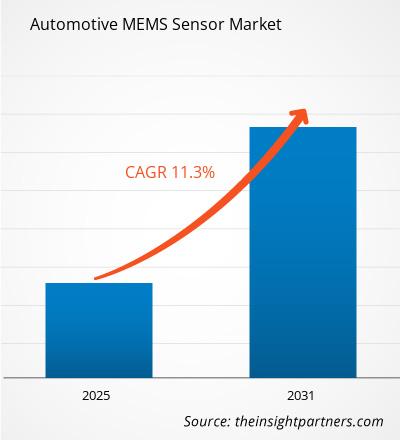
The Automotive Mems Sensor Market size stood at US$ 4.65 billion in 2025 and is expected to increase up to US$ 15.24 billion by 2034, registering a CAGR of 14.09% from 2026 to 2034. The factors supporting the demand are safety electronics, adoption of advanced driver-assistance systems, electronic stability control, tire pressure monitoring systems, in-cabin microphones, accuracy in navigation, and compact sensing technologies.
North America is one of the highest-valued regions in terms of the number of adoptions owing to the presence of safety, comfort, and advanced driving electronics in content-heavy vehicles. The market in North America is anticipated to grow between 12.4%–13.4% between 2026 and 2034.
Automotive MEMS Sensor Market Assessment and Insights
- North America held 24%–28% share in 2025 and is expected to grow at a CAGR of 12.4%–13.4% between 2026–2034, driven by ADAS, TPMS, and premium vehicle electronics.
- US represented 78%–83% of North America in 2025 and is projected to grow at a CAGR of 12.6%–13.6% between 2026–2034.
- Europe accounted for 25%–29% share in 2025 and is forecast to grow at a CAGR of 11.8%–12.8% between 2026–2034, led by Germany, France, the UK, Italy, and Spain.
- Asia Pacific held 37%–41% share in 2025 and is projected to grow at a CAGR of 15.1%–16.1% between 2026–2034, supported by China, Japan, South Korea, India, and Australia.
- Largest Segment MEMS Pressure Sensor held a market share of 38%–42% in 2025, with CAGR range of 13.2%–14.2% between 2026–2034.
- High Growth Segment Advanced Driver Assistance System held a market share of 16%–20% in 2025, with CAGR range of 16.4%–17.4% between 2026–2034.
- Key companies analyzed in detail: Analog Devices, Inc., BorgWarner Inc., DENSO Corporation, Infineon Technologies AG, InvenSense, Inc. (TDK Corporation), Murata Manufacturing Co., Ltd., Panasonic Holdings Corporation, Robert Bosch GmbH, Sensata Technologies, Inc., and STMicroelectronics N.V.
Source: The Insight Partners' analysis based on proprietary research, government publications, company annual reports, investor presentations, industry databases, and expert interviews.
Automotive sensors have transitioned from simple safety sensors to MEMS-based sensors that enable continuous measurement, sensor fusion, and vehicle control. Production economics are based on wafer-level production capabilities, automotive qualification, packaging, and stability under vibration, heat, and humidity conditions. The Automotive Mems Sensor Market is driven by airbag deployment, ESC, tire pressure monitoring, inertial navigation, in-cabin voice command systems, and camera image stabilization.
Future demand is expected to grow most rapidly in the areas where there is convergence between electrified vehicles, automated cars, and software-defined architectures. Manufacturing capacity in Asia Pacific, EU safety standards, and high levels of ADAS adoption in North America are all driving interest in pressure, inertial, and acoustic MEMS solutions.
Automotive MEMS Sensor Market Report Scope
| Report Attribute | Details |
|---|---|
| Market size in 2025 | US$ 4.65 Billion |
| Market Size by 2034 | US$ 15.24 Billion |
| Global CAGR (2026 - 2034) | 14.09% |
| Historical Data | 2021-2024 |
| Forecast period | 2026-2034 |
Automotive MEMS Sensor Market Analysis
Factors behind the demand are electronic safety regulations, increased usage of ADAS, electrification of the drivetrain and the requirement of accurate data from small-sized and low-powered components. The Automotive Mems Sensor Market growth is attributed to the attempts by OEMs to enhance crash sensing, stability control, tire pressure warning, passenger interaction, camera functioning and inertial navigation without burdening the system with extra weight or power consumption.
The value chain comprises MEMS foundries, ASIC design companies, packaging firms, tier 1 players, modules providers and vehicle makers. Favorable supply-side dynamics are observed in the companies that have quality systems for the automotive industry, high wafer production capabilities and application engineering support. Based on OICA production figures, China, Japan, India, Germany and South Korea are the major vehicle producers.
Market dynamics consist of companies that provide solutions combining MEMS technology design, automotive qualification, and application-specific integration. They include Robert Bosch GmbH, STMicroelectronics N.V., Analog Devices, Inc., Infineon Technologies AG, Murata Manufacturing Co., Ltd., InvenSense, Inc. (TDK Corporation), Sensata Technologies, Inc., DENSO Corporation, BorgWarner Inc., and Panasonic Holdings Corporation. The competition is based on precision, quality, quantity, and applicability.
Current investments focus on the following product types: 6-axis inertial units, pressure sensors for TPMS/HVAC, microphones for in-cabin interfaces, and sensor fusion solutions for ADAS controllers. The market analysis pays more attention to packaging yield, calibration capabilities, cybersecurity-ready data pathways, and lifecycle-resilience. Successful positioning requires addressing not only traditional safety functions but also assisted driving features.
● REPORT CUSTOMIZATION
Tailor This Report To Align With Your Specific Business Requirements
This report can be customized to align precisely with your business objectives, scope, and target markets. Customization options include tailored segmentation, geography, competitive analysis, and strategic insights to support informed decision-making.
Customize This Report →WHAT YOU CAN ADJUST
- ● Segmentations
- ● Geography
- ● Competitive Analysis
- ● Language Preferences
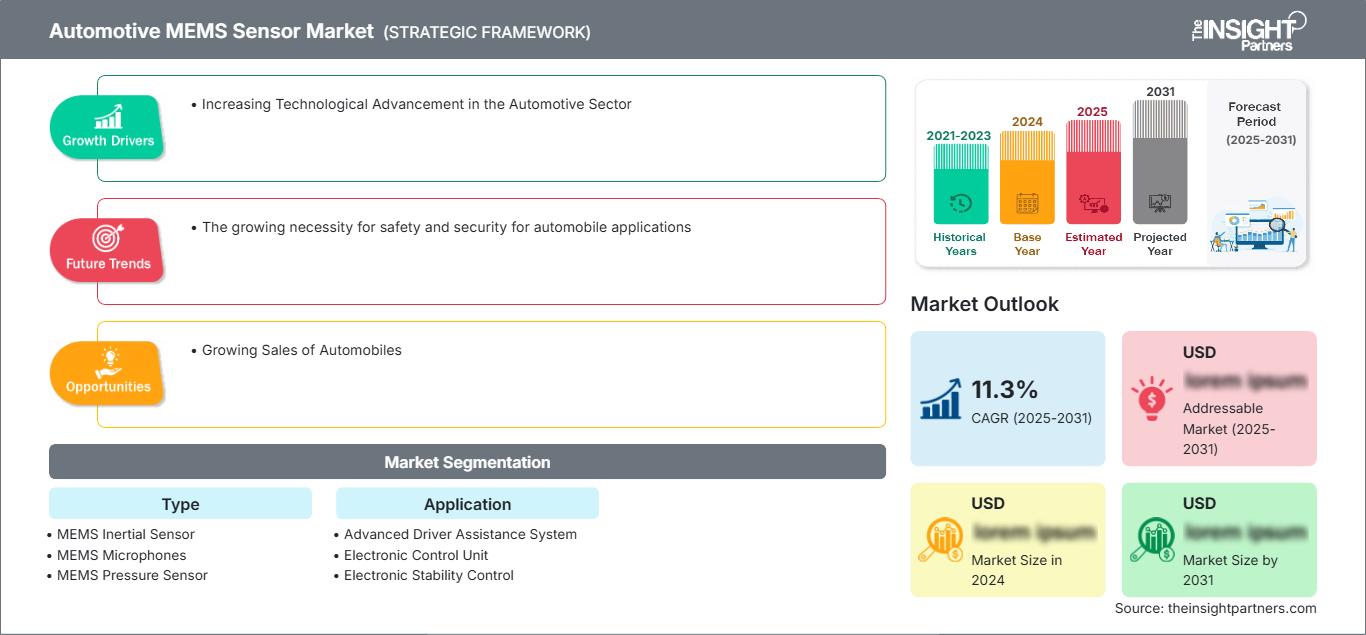
Automotive MEMS Sensor Market: Strategic Insights
Regional Insights
North America Automotive Mems Sensor Market
The share for North America was 24% to 28% in 2025, and the region will witness growth at a rate of 12.4% to 13.4% until 2034. The Automotive MEMS Sensor Market share is driven by extensive implementation of ADAS, electronic stability control, TPMS, in-cab audio microphones, and navigation assistance in passenger cars and light trucks.
Buyers prefer automotive-grade products, quick diagnosis, and compatibility with domain controllers. Analog Devices, Inc., Sensata Technologies, Inc., Infineon Technologies AG, Robert Bosch GmbH, and STMicroelectronics N.V. cater to regional demands through their offerings in terms of inertial sensors, pressure sensors, and signal processing. Growth is highest in ADAS, TPMS, in-cab audio, and safety electronics where malfunctioning impacts the vehicle's operation.
U.S. Automotive Mems Sensor Market Market
The U.S. was 78%–83% of total North American market in 2025, and it is expected to grow by 12.6%–13.6%. The major application areas were ADAS sensors, ESC inertial sensors, TPMS pressure sensors, microphones used in cabin control, and optical image stabilization for camera modules. The pickup trucks, SUVs, and luxury cars had more electronics, hence more MEMS per platform.
Companies operating in the segment include semiconductor companies, sensor makers, and automotive electronics suppliers. Analog Devices, Inc. caters to the inertial sensors and signal chain applications, while Sensata Technologies, Inc. handles pressure sensors and controls requirements. Infineon Technologies AG, STMicroelectronics N.V., Murata Manufacturing Co., Ltd., and Robert Bosch GmbH operate in the segment with their automotive grade portfolios.
Europe Automotive Mems Sensor Market Market
Europe held 25%–29% market share in 2025 and is forecast to witness growth of 11.8%–12.8%. Germany leads due to high-end automobiles, stability control know-how, and Tier 1 partnerships. The UK helps with software-defined vehicle testing and electronic systems. France develops its capabilities in safety and electrification solutions, where inertial and pressure sensors will be required.
Italy and Spain have strengths in vehicle manufacturing, brake systems, HVAC parts, and commercial vehicles. Robert Bosch GmbH, Infineon Technologies AG, STMicroelectronics N.V., Murata Manufacturing Co., Ltd., and DENSO Corporation cater to European needs for functional safety, qualifications, and long-lived products. Demand from Europe is driven by regulatory requirement in vehicle safety and emission standards.
APAC Automotive Mems Sensor Market Market
APAC held 37%–41% share in 2025 and is projected to grow at 15.1%–16.1%. China leads through vehicle output scale, EV penetration, and localized electronics supply. Japan and South Korea add strength in MEMS manufacturing, while India and Australia support rising safety and comfort adoption.
Industrial policy, electronics localization, and high-volume platforms strengthen regional momentum. Murata Manufacturing Co., Ltd., Panasonic Holdings Corporation, DENSO Corporation, InvenSense, Inc. (TDK Corporation), Robert Bosch GmbH, and STMicroelectronics N.V. address demand for inertial, pressure, and acoustic sensing. Adoption is strongest where OEMs combine cost discipline with ADAS and connected cabin features.
Middle East & Africa Automotive Mems Sensor Market Market
Middle East and Africa will grow between 8.2%-9.2%, with UAE driving initial adoption by way of expensive imports, connected mobility, and superior safety technology. While Saudi Arabia is making moves in the manufacturing of automobiles, South Africa continues to be the primary assembly location and aftermarket source.
The rest of the MEA market will be driven by demand from commercial fleets, infrastructure developments, tire safety, HVAC performance, and resistance to harsh climates. Energy and logistics developments help drive the gradual adoption of TPMS, pressure sensors, and cabin electronics, although adoption rates vary based on manufacturing capabilities and vehicle cost.
Segmentation Analysis
Type
Type is projected to grow at 13.7%–14.7% during 2026–2034. Automotive Mems Sensor Market scope spans inertial sensors, microphones, and pressure sensors, with adoption shaped by safety-critical measurement, cabin interface quality, and environmental monitoring. Pressure sensors remain broad-based through TPMS and HVAC, while inertial devices gain relevance in ADAS, ESC, navigation, and camera stabilization.
- MEMS Inertial Sensor supports acceleration, angular rate, and motion sensing for stability control, airbag logic, ADAS positioning, and navigation, making it strategically important for safety and automation.
- MEMS Microphones enable voice control, hands-free calling, active noise functions, and in-cabin monitoring, with demand rising as vehicles adopt more conversational interfaces and connected infotainment features.
- MEMS Pressure Sensor represents the largest installed base because tire pressure monitoring, HVAC control, braking, fuel, and engine systems require compact, accurate, and durable pressure measurement.
Application
Application is forecast to grow at 14.2%–15.2% during 2026–2034. Demand is distributed across driver assistance, control units, stability functions, climate systems, security, navigation, optical image stabilization, cabin microphones, and tire pressure monitoring. The Automotive Mems Sensor Market benefits as each application requires reliable physical-world inputs for safer, more responsive, and more automated vehicles.
- Advanced Driver Assistance System is the high-growth application as vehicle platforms use inertial, pressure, and environmental inputs to support lane assistance, braking, perception support, and sensor fusion.
- Electronic Control Unit demand reflects the need for accurate sensor signals inside powertrain, chassis, body, and safety controllers that convert MEMS measurements into vehicle actions.
- Electronic Stability Control remains a core safety application because accelerometers and gyroscopes help detect yaw, roll, and lateral movement before corrective braking or torque intervention occurs.
- Heating Ventilation and Air Conditioning System uses pressure and acoustic sensing to improve airflow, refrigerant monitoring, cabin comfort, and energy efficiency, especially in electric and premium vehicles.
- Safety and Security applications include crash detection, alarm systems, occupancy awareness, and impact monitoring, where compact MEMS devices deliver rapid and reliable event detection.
- In-Car Navigation depends on inertial measurement when satellite signals weaken in tunnels, dense cities, or parking structures, improving route continuity and positioning confidence.
- OIS Cameras use MEMS motion sensing to stabilize images for driver monitoring, surround view, and digital mirror functions where vibration can degrade image quality.
- Microphone In Cabin demand rises with hands-free control, voice assistants, road noise management, and occupant communication features across connected and premium vehicles.
- Tire Pressure Monitoring System remains a volume application because pressure monitoring improves safety, fuel efficiency, tire life, and regulatory compliance across passenger and commercial vehicles.
Opportunity Snapshot
| Application | Revenue Contribution | Trend Tag | Adoption Stage |
| Advanced Driver Assistance System | High | Sensor Fusion | Scaling |
| Electronic Control Unit | High | Signal Control | Mature |
| Electronic Stability Control | High | Yaw Sensing | Mature |
| Heating Ventilation and Air Conditioning System | Medium | Climate Sensing | Scaling |
| Safety and Security | High | Crash Logic | Mature |
| In-Car Navigation | Medium | Dead Reckoning | Scaling |
| OIS Cameras | Medium | Image Stability | Emerging |
| Microphone In Cabin | Medium | Voice Cabin | Scaling |
| Tire Pressure Monitoring System | High | Tire Safety | Mature |
Automotive MEMS Sensor Market Growth Drivers and Impact Analysis
ADAS and Stability Control Expand MEMS Content
ADAS, electronic stability control, and crash safety functions require fast, accurate, and redundant physical measurement. MEMS accelerometers, gyroscopes, and pressure sensors support yaw detection, lateral acceleration, rollover sensing, braking intervention, tire status, and airbag timing. The commercial impact is strongest where safety ratings and regulation encourage higher standard equipment levels. Automakers can add multiple sensors without large packaging penalties, while suppliers gain content per vehicle as platforms move from basic warning functions toward assisted control. This driver also increases demand for automotive-qualified devices with stable calibration, low noise, functional safety alignment, and predictable performance across temperature and vibration extremes.
TPMS and Pressure Monitoring Remain Volume Anchors
Pressure-based sensing for tire pressure monitoring system provides a reliable demand foundation since pressure readings influence such important factors as braking distance, tire degradation rate, fuel consumption, and conformity with regulations. Moreover, MEMS pressure sensors can perform HVAC, braking, fuel, and thermal management tasks, providing a broader set of uses for the component than just one application cycle. In the case of electric cars that prioritize thermal efficiency and energy conservation, pressure-based sensing plays an increasing role in the climate control and cooling system. Market impact is quite tangible and includes such characteristics as high volumes, replacement opportunities, and wide usage in different platforms.
Connected Cabins Increase Microphone and Motion Demand
Connected cabins are expanding the role of MEMS microphones, inertial sensors, and camera stabilization devices beyond traditional safety systems. Voice assistants, hands-free calling, occupant interaction, active noise functions, driver monitoring, and digital imaging all require compact sensing elements that perform reliably in noisy, vibrating environments. The market gains because these functions are moving from premium models into mainstream trims as software-defined interiors become more common. Suppliers can capture value by offering matched microphones, low-noise inertial devices, and application support for acoustic and imaging performance. This driver also links sensor demand to user experience, not only compliance.
Automotive MEMS Sensor Market Future Trends
Sensor Fusion Moves Closer to the Edge
Automotive Mems Sensor Market trends will increasingly center on combining inertial, pressure, acoustic, and imaging-related inputs near the control unit. Future vehicles will not treat MEMS devices as isolated components; instead, sensor fusion will support faster decisions for ADAS, navigation, occupant monitoring, and stability control. Edge processing can reduce latency, lower data traffic, and improve resilience when cloud connectivity is unavailable. This trend favors suppliers that provide calibrated devices, embedded diagnostics, and reference designs compatible with domain controllers. It also raises the importance of cybersecurity-ready data paths and software validation.
Automotive-Grade Miniaturization Advances System Design
Future platforms will demand smaller MEMS packages that maintain accuracy, durability, and qualification standards. Miniaturization allows sensors to be placed closer to tires, cameras, cabin microphones, airbags, HVAC circuits, and control modules without increasing packaging complexity. The trend will support lighter harnesses, modular electronics, and easier integration into compact EV and hybrid architectures. Suppliers with advanced wafer processing, hermetic packaging, and high-yield calibration can convert technical capability into sourcing advantage. Adoption will be gradual because automakers must validate reliability across long vehicle lifecycles and harsh environmental exposure.
Automotive MEMS Sensor Market Opportunities
ADAS Platform Design Wins Across Global OEMs
Automakers developing global ADAS platforms need MEMS suppliers that can support inertial accuracy, pressure sensing, camera stabilization, qualification documentation, and regional production continuity. Automotive Mems Sensor Market Forecasts support investment in platform-ready sensor families that can be adapted across safety, navigation, and driver assistance packages. Suppliers can differentiate through co-development, second-source planning, functional safety support, and calibration tools. The opportunity is strongest where one qualified architecture can serve multiple vehicle programs and trim levels. Long-term supply agreements may reduce launch risk for OEMs while giving sensor makers better capacity visibility.
Cabin Intelligence and Acoustic Sensing Expansion
Cabin intelligence creates investment opportunities for MEMS microphones, inertial devices, and image stabilization support as automakers improve voice interaction, driver monitoring, occupant detection, and active noise functions. Suppliers can package hardware with acoustic tuning, reference software, and validation services that shorten OEM development cycles. This opportunity is distinct from safety compliance because it is tied to user experience and vehicle differentiation. Growth will depend on microphone array performance, noise rejection, low power consumption, and integration with infotainment or cockpit domain controllers. Tier 1 partnerships can accelerate adoption across connected and premium mainstream platforms.
Recent Developments
- July 2025: STMicroelectronics N.V. agreed to acquire NXP Semiconductors’ MEMS sensor business for US$ 950 million, strengthening its position in automotive safety sensors, including applications such as airbags and tire-pressure monitoring, while expanding scale in a recovering MEMS industry.
- June 2025: Bosch has developed and launched the SMP290, a compact micro-electromechanical system (MEMS) sensor with an integrated Bluetooth low energy (BLE) interface for measuring tire pressure which the company states is the first of its kind on the market.
- December 2025: Coretronic MEMS Corporation (CMC), a subsidiary of Coretronic Corporation (5371.TW), officially announced the launch of CAAP02B, the world’s smallest three-axis analog accelerometer designed specifically for Tire Pressure Monitoring Systems (TPMS). This innovation represents a major breakthrough in micro-electro-mechanical systems (MEMS) processing technology, offering exceptional shock resistance and high reliability for automotive applications, and providing global automakers with a lighter, more efficient, and safer solution for tire pressure monitoring.
Frequently Asked Questions

- Comprehensive Market Sizing and Forecast Analysis
- Detailed Segmentation Analysis
- In-Depth Market Dynamics Assessment
- Regional and Country-Level Insights
- Competitive Landscape and Company Benchmarking
- Strategic Business Intelligence
Recent Reports
Testimonials

The Insight Partners' SCADA System Market report is comprehensive, with valuable insights on current trends and future forecasts. The team was highly professional, responsive, and supportive throughout. We are very satisfied and highly recommend their services.
RAN KEDEM Partner, Reali Technologies LTDs
I requested a report on a very specific software market and the team produced the report in a few days. The information was very relevant and well presented. I then requested some changes and additions to the report. The team was again very responsive and I got the final report in less than a week.
JEAN-HERVE JENN Chairman, Future Analytica
We worked with The Insight Partners for an important market study and forecast. They gave us clear insights into opportunities and risks, which helped shape our plans. Their research was easy to use and based on solid data. It helped us make smart, confident decisions. We highly recommend them.
PIYUSH NAGPAL Sr. Vice President, High Beam Global
The Insight Partners delivered insightful, well-structured market research with strong domain expertise. Their team was professional and responsive throughout. The user-friendly website made accessing industry reports seamless. We highly recommend them for reliable, high-quality research services
YUKIHIKO ADACHI CEO, Deep Blue, LLC.
This is the first time I have purchased a market report from The Insight Partners.While I was unsure at first, I visited their web site and felt more comfortable to take the risk and purchase a market report.I am completely satisfied with the quality of the report and customer service. I had several questions and comments with the initial report, but after a couple of dialogs over email with their analyst I believe I have a report that I can use as input to our strategic planning process.Thank you so much for taking the extra time and making this a positive experience.I will definitely recommend your service to others and you will be my first call when we need further market data.
JOHN SUZUKI President and Chief Executive Officer, Board Director, BK Technologies
I wish to appreciate your support and the professionalism you displayed in the course of attending to my request for information regarding to infectious disease IVD market in Nigeria. I appreciate your patience, your guidance, and the fact that you were willing to offer a discount, which eventually made it possible for us to close a deal. I look forward to engaging The Insight Partners in the future, all thanks to the impression you have created in me as a result of this first encounter.
DR CHIJIOKE ONYIA MANAGING DIRECTOR, PineCrest Healthcare Ltd.Reason to Buy
- Informed Decision-Making
- Understanding Market Dynamics
- Competitive Analysis
- Identifying Emerging Markets
- Customer Insights
- Market Forecasts
- Risk Mitigation
- Boosting Operational Efficiency
- Strategic Planning
- Investment Justification
- Tracking Industry Innovations
- Aligning with Regulatory Trends





 Get Free Sample for