
Automotive Microcontrollers Market Demand, Trends & Forecast by 2034
Coverage: by Technology (Park Assist System, Blind Spot Detection System, Tyre Pressure Monitoring System, Brake Control System); Application (Body Electronics, Power train Chassis, Telematics, Safety and Security); Vehicle (Passenger Vehicle, Commercial Vehicle); Electric Vehicle (BEV, PHEV, HEV) , and Geography (North America, Europe, Asia Pacific, and South and Central America)
- Status : Data Released
- Report Code : TIPRE00005244
- Category : Electronics and Semiconductor
- No. of Pages : 150
- Available Report Formats :


- Last update date : July 20, 2026


2025 Market Size
US$ 25.67 Bn
Base year value
2034 Forecast
US$ 42.85 Bn
Projected by 2034
CAGR 2026-2034
6.62 %
Growth rate
Addressable Market
US$ 322.70 Bn
(2026-2034)
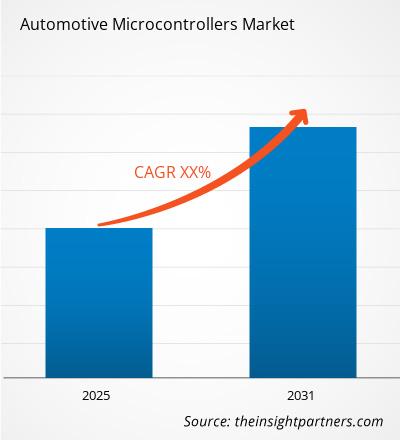
The Automotive Microcontrollers Market size is forecast to be worth US$ 25.67 Billion in 2025 and is expected to grow up to US$ 42.85 Billion in 2034 at a CAGR of 6.62% during the period of 2026 to 2034. The market will be driven by increasing semiconductors per vehicle, extensive use of electronic control units, and more advanced functions for safety, electrification, connectivity, and chassis control.
The market in North America is bolstered by consistent uptake of advanced driver assistance systems, software defined vehicle design and electrification of the power train. The market growth rate of the region is expected to be at a 6.0–6.6% CAGR during the period of 2026 to 2034.
Automotive Microcontrollers Market Assessment and Insights
- North America accounted for 24–27% share in 2025 and is expected to grow at a CAGR of 6.0–6.6% between 2026–2034, supported by ADAS penetration, EV platforms, and resilient Tier-1 electronics demand.
- US represented 78–82% of North America in 2025 and is projected to grow at a CAGR of 6.1–6.7% between 2026–2034, led by connected safety systems and zonal architectures.
- Europe held 22–25% share in 2025 and is forecast to expand at a CAGR of 5.8–6.4% between 2026–2034, with Germany, France, the UK, Italy, and Spain leading safety and electrification programs.
- Asia Pacific captured 40–44% share in 2025 and is expected to grow at a CAGR of 7.0–7.6% between 2026–2034, driven by China, Japan, South Korea, and India.
- Largest Segment Body Electronics held 30–34% market share in 2025 and is projected to grow at a CAGR of 5.8–6.3% between 2026–2034.
- High Growth Segment Safety and Security held 22–26% market share in 2025 and is projected to grow at a CAGR of 7.2–7.8% between 2026–2034.
- Key companies analyzed in detail: Analog Devices, Inc., Cypress Semiconductor Corporation, Infineon Technologies AG, Maxim Integrated Products, Inc., Microchip Technology Incorporated, NXP Semiconductors N.V., Renesas Electronics Corporation, ROHM Co., Ltd., STMicroelectronics N.V., Toshiba Electronic Devices & Storage Corporation.
Source: The Insight Partners' analysis based on proprietary research, government publications, company annual reports, investor presentations, industry databases, and expert interviews.
Vehicle electronics have transitioned from discrete control modules to domain and zonal controls. As a result, microcontrollers are becoming crucial in the design and development of powertrain, chassis, body, and safety systems. The market has been growing due to improved production after semiconductor shortages and the redesign of platforms based on scalable software stacks. In the future, investments are expected in India, ASEAN, Mexico, Eastern Europe, and Gulf assembly eco-systems as car makers are exploring alternate sourcing options and qualifying electronic suppliers within these regions.
Regulatory focus on crash avoidance systems, tire pressure monitoring systems, emission control systems, and cybersecurity adds a sustainable demand to the adoption. Further adoption will be witnessed in EV platforms where automotive microcontrollers play a key role in managing batteries, controlling inverters, thermal management systems, and secure over-the-air software updates.
Automotive Microcontrollers Market Report Scope
| Report Attribute | Details |
|---|---|
| Market size in 2025 | US$ 25.67 Billion |
| Market Size by 2034 | US$ 42.85 Billion |
| Global CAGR (2026 - 2034) | 6.62% |
| Historical Data | 2021-2024 |
| Forecast period | 2026-2034 |
Automotive Microcontrollers Market Analysis
The Automotive Microcontroller Market depends on the increasing content of electronics per vehicle, especially in power train control, ADAS, body electronics, and telematics. According to reports from the International Energy Agency, more than 17 million electric cars have been sold in 2024, leading to increased requirements for battery management and thermal management microcontrollers. Safety electronics also continue to be a structural factor due to increased adoption of crash avoidance systems.
Some of the supply chain players include wafer foundries, semiconductor companies, Tier-1 integration firms, software vendors, and platform teams of OEMs. There have been improvements in supply chains, but the qualification cycle time remains long since the product needs to meet requirements on temperature, reliability, cybersecurity, and ISO 26262.
Market Analysis indicates that the competitive landscape comprises of companies such as Infineon Technologies AG, NXP Semiconductors N.V., Renesas Electronics Corporation, STMicroelectronics N.V., and Microchip Technology Incorporated. Analog Devices, Inc. and Maxim Integrated Products, Inc. add value to mixed signal and power management adjacency, while ROHM Co., Ltd. and Toshiba Electronic Devices & Storage Corporation cater to EVs and chassis electronics.
Strategic positioning increasingly revolves around scalable MCU families that enable software-defined cars, cybersecurity, deterministic networking, and ECU consolidation. Investments are being made in RISC-V, Arm, MRAM, and high-performance real-time processors. Vendors with broad tool ecosystems and reference software can minimize the validation costs for OEMs, making design win continuity more important than component pricing.
● REPORT CUSTOMIZATION
Tailor This Report To Align With Your Specific Business Requirements
This report can be customized to align precisely with your business objectives, scope, and target markets. Customization options include tailored segmentation, geography, competitive analysis, and strategic insights to support informed decision-making.
Customize This Report →WHAT YOU CAN ADJUST
- ● Segmentations
- ● Geography
- ● Competitive Analysis
- ● Language Preferences
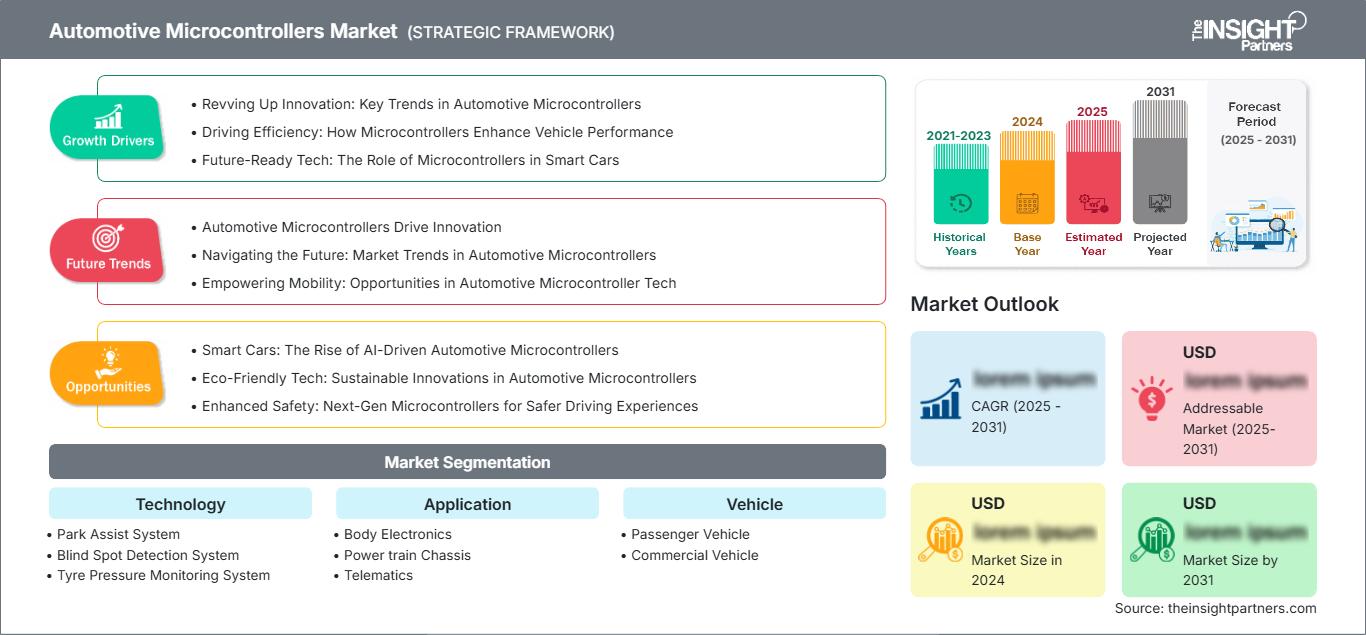
Automotive Microcontrollers Market: Strategic Insights
Regional Insights
North America Automotive Microcontrollers Market
North America held 24–27% share in 2025, and the Automotive Microcontrollers Market share is reinforced by premium vehicle penetration, high ADAS installation rates, and EV manufacturing incentives. The region is projected to grow at a CAGR of 6.0–6.6% during 2026–2034.
The highest demand will come from the fields of security, body electronics, telematics, and electrified chassis control, which require secure and low-latency solutions. Policies for semiconductor localization, battery manufacturing facilities, and connected infrastructure projects provide better supply chain management, and Tier-1 suppliers qualify automotive controllers for vehicle lifecycle use.
U.S. Automotive Microcontrollers Market
US made up for 78-82% of North America in 2025 and is expected to grow at a CAGR of 6.1-6.7% between 2026-2034. The growth drivers include the investment in electric vehicle assembly, incorporation of safety systems, ready over-the-air (OTA) ECU, and software defined vehicles programs.
NXP Semiconductors N.V., Analog Devices, Inc., Microchip Technology Incorporated, and Infineon Technologies AG have been engaged with the customers in America through their automotive engineering, distribution, and reference designs. Applications are shifting towards zonal control, battery management system, brake control, telematics gateway, and cabin electronics applications needing secure real-time processing.
Europe Automotive Microcontrollers Market
Europe had 22-25% market share in 2025 and will grow at a CAGR of 5.8-6.4% till 2034. Germany dominates owing to its presence through premium OEM platforms and Tier 1 engineering capabilities, while France benefits from electrification programs and semiconductors in small cars.
The UK focuses on connectivity & safety electronics for premium and motorsport based platforms. Italy and Spain participate in terms of component manufacturing and light commercial vehicles and EV investments. Safety regulations, cybersecurity regulations, and CO2 emissions mandates in the EU are driving the requirement for microcontrollers in braking, powertrain, tire pressure management, and body electronic control systems.
APAC Automotive Microcontrollers Market
APAC captured a market share ranging between 40–44% in 2025 and is anticipated to register a CAGR of 7.0-7.6% in the period between 2026 and 2034. China dominates the EVs volume, whereas Japan and South Korea dominate the high-reliability electronics segment.
India and Australia contribute to incremental demand due to localization efforts, fleet electrification, and regulatory compliance requirements. The industrial policies for batteries, vehicle manufacturing exports, and semiconductors drive the market demand.
Middle East & Africa Automotive Microcontrollers Market
The Middle East and Africa region will grow at a CAGR of 5.5%–6.1% during 2026–2034. Saudi Arabia and the United Arab Emirates drive the market via EV assembly goals, smart mobility initiatives, and luxury cars imports.
South Africa contributes via vehicle manufacturing/export activities; while Rest of MEA drives through infrastructure development and fleet upgrade needs. Energy diversification, charging networks, and safety regulations help increase the need for MCU applications in telematics, braking, body electronics, and powertrain management.
Segmentation Analysis
Technology
Technology is projected to grow at a CAGR of 6.2–6.8% from 2026 to 2034. This segment reflects rising deployment of electronic sensing, actuation, and control systems across safety, comfort, and vehicle-dynamics functions. The Automotive Microcontrollers Market scope covers systems that require deterministic response, compact integration, and automotive-grade reliability under demanding thermal and vibration conditions.
- Park Assist System adoption is expanding in urban passenger vehicles as camera, ultrasonic, and radar inputs require fast processing for low-speed maneuvering, collision avoidance, and driver convenience.
- Blind Spot Detection System demand is supported by safety ratings, lane-change assistance, and radar integration, making reliable MCUs important for real-time object detection and warning signal control.
- Tyre Pressure Monitoring System remains a compliance-driven segment where low-power microcontrollers enable sensor communication, warning logic, and durable operation across passenger and commercial vehicle platforms.
- Brake Control System requires high-reliability MCUs for anti-lock braking, stability control, regenerative braking coordination, and fail-safe response across electrified and conventional powertrain architectures.
Application
Application is forecast to grow at a CAGR of 6.4–7.0% from 2026 to 2034. Body electronics remain the largest use case, while safety, telematics, and powertrain chassis functions gain from software-defined architectures. Automakers are prioritizing scalable MCU platforms that reduce wiring complexity and support secure software updates.
- Body Electronics dominates through lighting, windows, seats, climate interfaces, and access systems, where cost-efficient controllers support comfort features and platform-wide electronic standardization.
- Power train Chassis demand is rising as electrified drivetrains, braking, suspension, and stability systems require precise control loops, redundancy, and durable operation across harsh operating conditions.
- Telematics depends on secure MCUs for gateways, diagnostics, connectivity modules, positioning, and over-the-air update coordination as vehicles become connected digital assets.
- Safety and Security is the high-growth application as ADAS, cybersecurity, immobilization, braking, and crash-avoidance functions demand real-time processing and certified functional safety.
Vehicle
Vehicle is estimated to grow at a CAGR of 6.1–6.7% from 2026 to 2034. Passenger vehicles generate higher volumes, but commercial vehicles increasingly need telematics, braking assistance, and fleet efficiency systems. The Automotive Microcontrollers Market benefits as both vehicle categories migrate toward electronics-rich architectures.
- Passenger Vehicle demand is broad-based across comfort electronics, ADAS, infotainment interfaces, and electrification, making this sub-segment the primary volume foundation for MCU suppliers.
- Commercial Vehicle adoption is driven by fleet telematics, braking regulation, predictive maintenance, and electrified delivery vehicles, where rugged controllers support uptime and operating efficiency.
Electric Vehicle
Electric Vehicle is projected to grow at a CAGR of 7.1–7.7% from 2026 to 2034. Electrified platforms require controllers for battery management, inverter coordination, charging communication, thermal systems, and regenerative braking. Growth is strongest where automakers localize EV production and expand software-enabled energy management.
- BEV platforms need dense MCU content for battery packs, charging, traction inverters, thermal control, and safety supervision, making them strategically important for high-value semiconductor integration.
- PHEV systems require coordination between combustion and electric propulsion, creating demand for reliable controllers that manage power transitions, charging logic, and emissions-related functions.
- HEV adoption supports cost-sensitive electrification, where MCUs optimize regenerative braking, motor assistance, battery state monitoring, and fuel-efficiency control without full plug-in infrastructure dependence.
Opportunity Snapshot
| Application | Revenue Contribution | Trend Tag | Adoption Stage |
| Body Electronics | High | Cabin Control | Mature |
| Power train Chassis | High | Drive Control | Scaling |
| Telematics | Medium | Secure Gateway | Scaling |
| Safety and Security | High | ADAS Safety | Scaling |
Automotive Microcontrollers Market Growth Drivers and Impact Analysis
Rising Electronic Content per Vehicle
Car manufacturers are integrating electronics into cars in order to distinguish their products and comply with various safety and efficiency standards. Lighting, climate control, brake, steering, propulsion, infotainment, and access modules all require either separate or integrated control algorithms. This drives the integration of MCU components despite only a moderate growth in automotive production. The consequences of this trend can be observed through longer component BOMs, additional qualification requirements, and platform procurement policies favoring long-term contracts. Regarding the Automotive Microcontrollers Market, the driver contributes to stable volumes by integrating electronics in all car classes.
Electrification and Battery Control Requirements
BEVs, PHEVs, and HEVs require tight control over the state of their battery, their inverter, their charging process, thermal management, and their regenerative braking function. The forecast from IEA for 2025 with more than 17 million sales of electric cars by 2024 is indicative of a trend towards high-power electronics equipped cars. As such, there will be a need for microcontrollers that consume little energy, have functional safety, secure firmware, and fast analog interface.
ADAS and Functional Safety Expansion
Systems related to safety and security are shifting focus from their inclusion in premium models to incorporation into more vehicle models due to the emphasis placed by policymakers, insurance companies, and customers on minimizing crashes. Detection of blind spots, brake systems, parking aids, and stability systems require determinism and robust design. WHO figures relating to road safety keep emphasizing the importance of active safety systems based on estimates of crash consequences. This driver creates more demand for certified MCUs, cyber security elements, and redundant controllers, giving semiconductors companies room to compete.
Automotive Microcontrollers Market Future Trends
Shift Toward Zonal and Software-Defined Architectures
The Automotive Microcontrollers market trends indicate an evolution towards lower numbers of distributed ECUs and increased use of zone controllers which consolidate sensors, actuators, and communications into one unit. This evolution does not mean a reduction in MCUs; rather, it means redefining the functions of MCUs towards edge control, secure gateways, and deterministic communication. The emphasis for vendors will be on Ethernet compatibility, CAN-XL capability, cybersecurity features, and software portability.
Open Architectures and Advanced Embedded Memory
Future MCU design is likely to combine open instruction-set options, advanced embedded memory, and pre-silicon software development. RISC-V initiatives, MRAM-enabled controllers, and virtual prototypes are emerging because vehicle programs require longer software preparation before hardware availability. These technologies can improve update speed, durability, and architectural flexibility. Adoption will depend on toolchain maturity, safety certification, and ecosystem confidence, but early investment suggests suppliers view software portability as a competitive requirement for next-generation vehicle electronics.
Automotive Microcontrollers Market Opportunities
Localized EV Electronics Supply Chains
Automotive Microcontrollers Market Forecasts indicate that localization will become a major opportunity as OEMs seek supply resilience for EV and hybrid platforms. Semiconductor suppliers can capture design wins by aligning packaging, testing, distribution, and application engineering near vehicle assembly hubs. India, Mexico, Southeast Asia, and Eastern Europe offer attractive expansion points because they combine growing vehicle output with policy support. The most actionable opportunity is not only chip shipment, but bundled reference software, safety documentation, and long-term lifecycle support for regional Tier-1 customers.
Cybersecure Telematics and OTA Control
Connected vehicles create an opportunity for MCUs that combine secure boot, hardware encryption, intrusion monitoring, and reliable gateway control. Automakers need these functions to support OTA updates, remote diagnostics, fleet analytics, and regulatory cybersecurity compliance. Semiconductor companies can differentiate through integrated security modules and certified software stacks. The opportunity is strongest in telematics, body gateways, and zonal controllers because these nodes manage communication between external networks and safety-critical vehicle functions.
Recent Developments
- February 2026: STMicroelectronics (NYSE: STM), a global semiconductor leader serving customers across the spectrum of electronics applications, announced the Stellar P3E, the first automotive microcontroller (MCU) with built-in AI acceleration for automotive edge intelligence. Designed for future software-defined vehicles, the Stellar P3E simplifies multi-function integration for X-in-1 Electronic Control Units (ECUs) that reduce system cost, weight, and complexity.
- February 2026: Geehy has introduced the G32A1425, a new automotive microcontroller designed for body control modules and comfort systems in new energy vehicles. Announced through the company’s global site, the device expands the G32A14xx family with a 40 nm Cortex-M4F architecture operating at up to 112 MHz, along with 256 KB of flash memory and 32 KB of SRAM. The MCU is designed for AEC-Q100 Grade 1 environments and ISO 26262 ASIL-B applications, meeting the requirements of modern automotive electronics programs.
- June 2026: Infineon Technologies AG is collaborating with Amazon Web Services (AWS) to accelerate microcontroller (MCU) evaluation and shorten development cycles for automotive systems. As part of the collaboration, Infineon is launching a cloud-based platform powered by AWS for virtual evaluation of Infineon automotive MCUs. The new platform eliminates the need for physical hardware, reduces evaluation cycles from multiple weeks to minutes, significantly lowers evaluation costs per user, and supports hundreds of concurrent users worldwide. The platform already includes Infineon’s next-generation RISC-V architecture.
Frequently Asked Questions

- Comprehensive Market Sizing and Forecast Analysis
- Detailed Segmentation Analysis
- In-Depth Market Dynamics Assessment
- Regional and Country-Level Insights
- Competitive Landscape and Company Benchmarking
- Strategic Business Intelligence
Recent Reports
Testimonials

The Insight Partners' SCADA System Market report is comprehensive, with valuable insights on current trends and future forecasts. The team was highly professional, responsive, and supportive throughout. We are very satisfied and highly recommend their services.
RAN KEDEM Partner, Reali Technologies LTDs
I requested a report on a very specific software market and the team produced the report in a few days. The information was very relevant and well presented. I then requested some changes and additions to the report. The team was again very responsive and I got the final report in less than a week.
JEAN-HERVE JENN Chairman, Future Analytica
We worked with The Insight Partners for an important market study and forecast. They gave us clear insights into opportunities and risks, which helped shape our plans. Their research was easy to use and based on solid data. It helped us make smart, confident decisions. We highly recommend them.
PIYUSH NAGPAL Sr. Vice President, High Beam Global
The Insight Partners delivered insightful, well-structured market research with strong domain expertise. Their team was professional and responsive throughout. The user-friendly website made accessing industry reports seamless. We highly recommend them for reliable, high-quality research services
YUKIHIKO ADACHI CEO, Deep Blue, LLC.
This is the first time I have purchased a market report from The Insight Partners.While I was unsure at first, I visited their web site and felt more comfortable to take the risk and purchase a market report.I am completely satisfied with the quality of the report and customer service. I had several questions and comments with the initial report, but after a couple of dialogs over email with their analyst I believe I have a report that I can use as input to our strategic planning process.Thank you so much for taking the extra time and making this a positive experience.I will definitely recommend your service to others and you will be my first call when we need further market data.
JOHN SUZUKI President and Chief Executive Officer, Board Director, BK Technologies
I wish to appreciate your support and the professionalism you displayed in the course of attending to my request for information regarding to infectious disease IVD market in Nigeria. I appreciate your patience, your guidance, and the fact that you were willing to offer a discount, which eventually made it possible for us to close a deal. I look forward to engaging The Insight Partners in the future, all thanks to the impression you have created in me as a result of this first encounter.
DR CHIJIOKE ONYIA MANAGING DIRECTOR, PineCrest Healthcare Ltd.Reason to Buy
- Informed Decision-Making
- Understanding Market Dynamics
- Competitive Analysis
- Identifying Emerging Markets
- Customer Insights
- Market Forecasts
- Risk Mitigation
- Boosting Operational Efficiency
- Strategic Planning
- Investment Justification
- Tracking Industry Innovations
- Aligning with Regulatory Trends





 Get Free Sample for