
Automotive Oxygen Sensor Market Size, Share & Growth by 2034
Coverage: by Product (Narrow Band Zirconia Sensor, Wideband Zirconia Sensor, Titania Sensor); Application (Passenger Vehicles, Commercial Vehicles, Two Wheelers), and Geography (North America, Europe, Asia Pacific, and South and Central America)
- Status : Data Released
- Report Code : TIPRE00013529
- Category : Electronics and Semiconductor
- No. of Pages : 150
- Available Report Formats :


- Last update date : July 20, 2026


2025 Market Size
US$ 6.0 Bn
Base year value
2034 Forecast
US$ 11.07 Bn
Projected by 2034
CAGR 2026-2034
7.04 %
Growth rate
Addressable Market
US$ 77.06 Bn
(2026-2034)
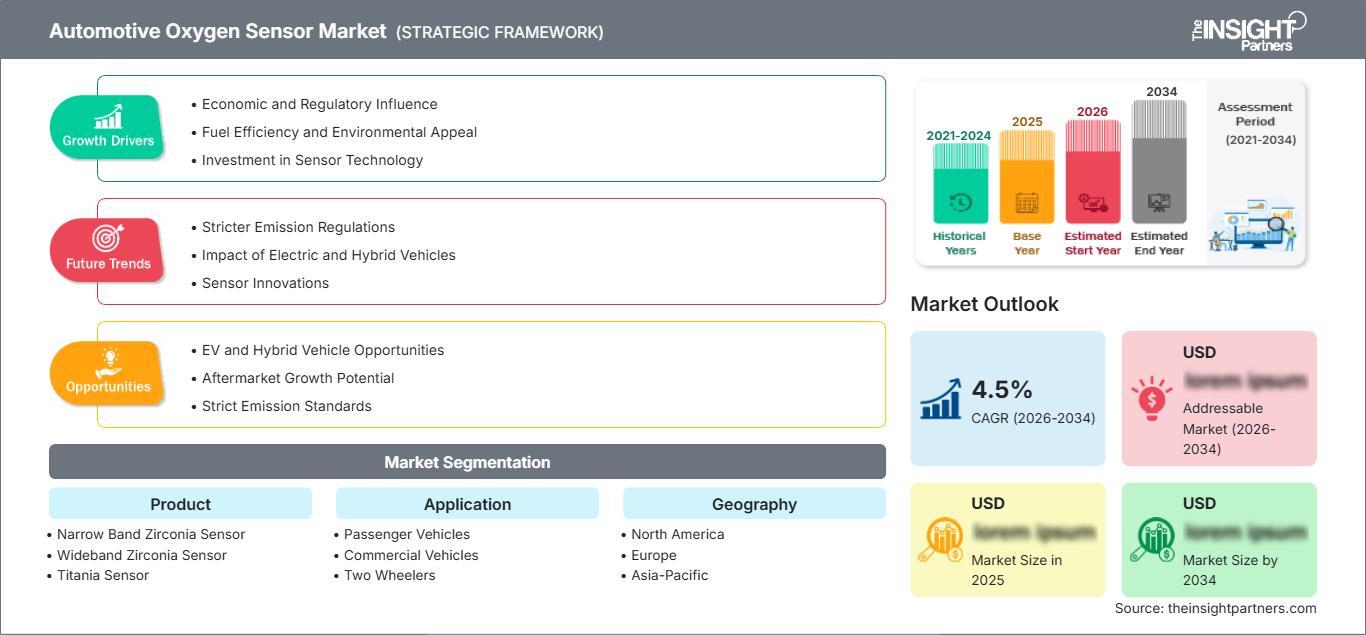
The Automotive Oxygen Sensor Market size was recorded at US$ 6.0 Billion in 2025 and expected to hit US$ 11.07 Billion by 2034, registering a CAGR of 7.04% between 2026 and 2034. Growth will be driven by emissions compliance, on-board diagnostic system requirements, catalyst system control, gasoline and hybrid engines, and replacement applications in passenger cars, commercial vehicles, and two wheelers.
In North America, the need for regulation-driven inspections and the aging of the vehicle fleet ensures a steady stream of oxygen sensor replacements. In the region, the market size is anticipated to grow at 5.8%–6.8% between 2026 and 2034, due to OBD requirement, light truck fuel consumption, hybrid fleet addition, and diagnostics that identify slow-response sensors prior to declining fuel economy.
Automotive Oxygen Sensor Market Assessment and Insights
- North America held 22%–26% share in 2025 and is expected to grow at a CAGR between 5.8%–6.8% during 2026–2034, driven by inspection programs, gasoline trucks, and aftermarket replacement.
- US represented 80%–85% of North America in 2025 and is projected to grow at a CAGR between 5.9%–6.9% during 2026–2034.
- Europe accounted for 24%–28% share in 2025 and is forecast to grow at a CAGR between 5.4%–6.4% during 2026–2034, led by Germany, France, the UK, Italy, and Spain.
- Asia Pacific held 38%–42% share in 2025 and is projected to grow at a CAGR between 7.8%–8.8% during 2026–2034, supported by China, Japan, South Korea, India, and Southeast Asia.
- Largest Segment Narrow Band Zirconia Sensor held a market share of 44%–48% in 2025, with CAGR range of 5.9%–6.9% between 2026–2034.
- High Growth Segment Wideband Zirconia Sensor held a market share of 30%–34% in 2025, with CAGR range of 8.2%–9.2% between 2026–2034.
- Key companies analyzed in detail: Niterra Co., Ltd., Robert Bosch GmbH, DENSO Corporation, PHINIA Inc., Hyundai Kefico Corporation, United Automotive Electronic Systems Co., Ltd., Zhejiang VOLKSE Auto Parts Co., Ltd., Pucheng Sensors (Shanghai) Co., Ltd., Airblue Auto Parts Co., Ltd., Trans Auto Parts Co., Ltd., PAILE International Trade Co., Ltd., and ACHR Autoparts Co., Ltd.
Source: The Insight Partners' analysis based on proprietary research, government publications, company annual reports, investor presentations, industry databases, and expert interviews.
Automotive oxygen sensing has moved away from simple switch-type feedback systems towards more refined calibration for emissions control associated with engine management and catalyst protection, as well as onboard diagnostics. Product development focuses increasingly on fast warming up, better heater control, immunity against contamination, and precise air/fuel ratio measurement. The market witnesses ongoing production of conventional engines and hybrids, while suppliers adapt their ceramics technology, coatings, connectors, and validation procedures for regional requirements of emission testing.
The future demand will be determined by the scale of manufacturing in Asia Pacific, compliance culture in Europe, and replacement in North America. According to OICA, global vehicle production totaled 96.4 million units in 2025, and China, Japan, India, Germany, South Korea, and the US still remain among the leading manufacturers. Regulatory concerns about real-world emissions and catalyst performance maintain strategic relevance of sensor accuracy despite electrification.
Automotive Oxygen Sensor Market Report Scope
| Report Attribute | Details |
|---|---|
| Market size in 2025 | US$ 6.0 Billion |
| Market Size by 2034 | US$ 11.07 Billion |
| Global CAGR (2026 - 2034) | 7.04% |
| Historical Data | 2021-2024 |
| Forecast period | 2026-2034 |
Automotive Oxygen Sensor Market Analysis
Demands arise from stricter tailpipe standards, engine downsizing, hybrids duty cycle, and necessity to keep stoichiometric combustion at different loads. Market growth will be supported through the replacement demand because aged oxygen sensors may lead to slower feedback, higher fuel consumption, and emission-related diagnostic trouble codes.
The value chain involves the manufacture of ceramic element, heater supplier, ASIC, and connector, Tier 1 manufacturer, engine control development firm, distribution network, and service channel. Favorable supply factors for market participants include consistency of zirconia manufacturing process, thermal stability packaging, timely validation services, and local logistics. The OICA 2025 statistics demonstrate that China produced 34.5 million vehicles; thus, a significant installed base is formed.
The competitive environment focuses on the ability of suppliers to deliver OEM qualification, aftermarket coverage, ceramic technology, and calibration services. Niterra Co., Ltd., Robert Bosch GmbH, DENSO Corporation, PHINIA Inc., Hyundai Kefico Corporation, United Automotive Electronic Systems Co., Ltd., Zhejiang VOLKSE Auto Parts Co., Ltd., Pucheng Sensors (Shanghai) Co., Ltd., Airblue Auto Parts Co., Ltd., Trans Auto Parts Co., Ltd., PAILE International Trade Co., Ltd., and ACHR Autoparts Co., Ltd. compete based on coverage, durability, and price positioning. The Automotive Oxygen Sensor Market study now includes considerations such as supply consistency and emission standard compatibility.
Investments are made in the development of wideband sensors, quicker light-off heaters, greater contamination resistance, and expanded parts catalogues for older cars. Positioning strategies vary based on channels: OEM suppliers focus on testing and integration, and aftermarket suppliers on coverage, cross-referencing, warranty coverage, and pricing.
● REPORT CUSTOMIZATION
Tailor This Report To Align With Your Specific Business Requirements
This report can be customized to align precisely with your business objectives, scope, and target markets. Customization options include tailored segmentation, geography, competitive analysis, and strategic insights to support informed decision-making.
Customize This Report →WHAT YOU CAN ADJUST
- ● Segmentations
- ● Geography
- ● Competitive Analysis
- ● Language Preferences
Automotive Oxygen Sensor Market: Strategic Insights
Regional Insights
North America Automotive Oxygen Sensor Market
North America occupied a market share of 22%-26% in 2025 and is forecasted to register 5.8%-6.8% growth from 2026-2034. North American automotive oxygen sensor market share is influenced by the prevalence of gasoline light trucks, aged vehicles, repairs owing to OBD, and strict inspection protocols.
OE-equivalent performance, connectivity, and reliable feedback despite high miles run are key considerations for regional consumers. Key players include Robert Bosch GmbH, Niterra Co., Ltd., DENSO Corporation, and PHINIA Inc., while distributors increase their presence for domestic as well as import vehicles. Growth opportunities are highest in the after-market segment and hybrids utilizing gasoline engines.
U.S. Automotive Oxygen Sensor Market Market
Market share in 2025 is estimated at 80% - 85%, with growth forecast at 5.9% - 6.9%. Market application trend focuses on passenger cars, pickups, SUVs and fleet vehicles that use narrow band and wide band zirconia sensors in controlling air-fuel mixture and in catalytic converter monitoring as well as OBD readiness.
Market presence is bolstered through aftermarket brand names, warehouse distributors, repair network and OEM service network. Companies like Niterra Co., Ltd., Robert Bosch GmbH, DENSO Corporation, and PHINIA Inc. cater to the replacement market for domestic, Asian, and European makes. Market demand is expected to be stable due to vehicle age.
Europe Automotive Oxygen Sensor Market Market
In Europe, the market had a 24% to 28% share in 2025 and forecasted to grow at 5.4% to 6.4%. Germany leads through premium gasoline, hybrid vehicles, and Tier 1 Engineering. UK provides support on service demand and diagnostics repairs, while France enhances hybridization and emissions compliance on compact and light-commercial platforms.
In Italy and Spain, contribution was made by vehicle assembly, aftermarket sales, and replacement demand for emissions test. Companies such as Robert Bosch GmbH, Niterra Co., Ltd., DENSO Corporation, Hyundai Kefico Corporation, and PHINIA Inc. cater to the European market for durability of lambda feedback and catalyst monitoring systems.
APAC Automotive Oxygen Sensor Market Market
The APAC region held 38%–42% market share in 2025 and is expected to record 7.8%–8.8% growth. China dominated because of the scale of its production and adherence to China 6 standards. Japan and South Korea contribute in the manufacture of ceramic sensors. India and Australia provide market pull through their demands for gasoline vehicles and two-wheelers.
Industrial policies and increasing aftermarket coverage are driving this trend. Among key players are Niterra Co., Ltd., DENSO Corporation, Hyundai Kefico Corporation, United Automotive Electronic Systems Co., Ltd., Zhejiang VOLKSE Auto Parts Co., Ltd., Pucheng Sensors (Shanghai) Co., Ltd., Airblue Auto Parts Co., Ltd., Trans Auto Parts Co., Ltd., PAILE International Trade Co., Ltd., and ACHR Autoparts Co., Ltd.
Middle East & Africa Automotive Oxygen Sensor Market Market
Middle East & Africa growth rate will be 4.6% - 5.6% with the growth in Saudi Arabia & UAE due to their reliance on high value imports, fleet management, and inspection systems. South Africa still leads in assembly and aftermarket operations whereas Rest of MEA depends on used vehicle imports and commercial transport.
Energy logistics and infrastructure work keeps gasoline and diesel fleets needing maintenance for emission control. Tough climatic conditions make sensor reliability, heater efficiency, and proper connector sealing critical. Adoption is slow as service standards and counterfeits risks along with age of vehicle differ in import-based markets.
Segmentation Analysis
Product
Product is projected to grow at 6.6%–7.6% during 2026–2034. Automotive Oxygen Sensor Market scope covers switching, wideband, and titania technologies serving different engine-control needs. Narrow band zirconia sensors remain common in cost-sensitive applications, while wideband zirconia sensors gain share where tighter fuel control, hybrid operation, and catalyst protection require richer data.
- Narrow Band Zirconia Sensor remains the largest product type because it provides dependable switching feedback for stoichiometric control in mature gasoline platforms and replacement channels.
- Wideband Zirconia Sensor supports precise air-fuel ratio measurement, making it strategically important for direct injection, hybrid engines, turbocharging, and tighter emissions calibration.
- Titania Sensor serves selected legacy and specialized applications where resistance-based oxygen detection remains compatible with existing engine-control architectures and service requirements.
Application
Application is forecast to grow at 6.8%–7.8% during 2026–2034. Passenger vehicles dominate volume because gasoline and hybrid platforms use multiple sensors for upstream control and downstream catalyst monitoring. Commercial vehicles add durability needs, while two wheelers expand in regulated Asian markets where compact sensing improves fuel efficiency and compliance.
- Passenger Vehicles generate the largest demand because high production volumes, gasoline powertrains, hybridization, and strict onboard diagnostics require reliable upstream and downstream oxygen sensing.
- Commercial Vehicles require durable sensors for fleet uptime, fuel efficiency, and emissions checks, especially in light commercial vehicles, delivery fleets, and mixed urban duty cycles.
- Two Wheelers represent a growth channel in Asia as tighter emission norms increase adoption of compact, cost-sensitive oxygen sensors for fuel-injected motorcycles and scooters.
Opportunity Snapshot
| Application | Revenue Contribution | Trend Tag | Adoption Stage |
| Passenger Vehicles | High | Hybrid Control | Mature |
| Commercial Vehicles | Medium | Fleet Uptime | Scaling |
| Two Wheelers | Medium | Emission Norms | Scaling |
Automotive Oxygen Sensor Market Growth Drivers and Impact Analysis
Stricter Emissions Diagnostics Sustain Replacement Demand
Emission control regulations remain the strongest driver because of the direct connection between oxygen sensors, fuel trim corrections, catalyst efficiencies, and failure modes. Requirements for on-board diagnostics by the EPA require that vehicles detect emission control system failures, store fault codes, and provide an operator notification through the check engine lamp, creating clear value within the repair community. Market demand is significant where inspection programs exist, as faulty sensors will create noncompliance issues, decrease fuel economy, and cause problems in the catalyst system. Demand becomes more mandatory when the check engine light is required for registration, warranties, or fleet maintenance. OEM sensors win based on matching the original equipment response characteristics, connectors, and thermal capabilities.
Hybrid Powertrains Preserve Oxygen Sensor Content
The reason why oxygen sensing has not been phased out in hybrids is that combustion engines continue to operate in the context of constant starting, acceleration, and cold starting. The emission sensing for many hybrid vehicles becomes much more complicated because engine operation will often occur in a stop-go fashion, and it will be important to monitor catalyst temperature carefully. Wideband sensors will help keep air fuel ratio precise during engine restart following electric operation, while downstream sensors will ensure the performance of catalysts. As far as the effects on the market go, this is a move from mere replacement units to high value sensing devices, quick heaters, and calibration-intensive sensors.
Vehicle Parc Aging Expands Aftermarket Coverage Needs
As the global parc ages, more oxygen sensors will hit their maintenance windows or failure points. Prolonged exposure to heat, contamination by additives in the fuel or oil, vibrations, and thermal cycling can all result in slow response times, which cause driveability problems and diagnostic trouble codes. This particular trend has a significant effect in North America and Europe because cars are kept on the road longer in those regions, and it makes economic sense to replace the sensor rather than dispose of the car. The industry impact is wider catalogs, increased difficulty cross-referencing, and more parts that fit directly.
Automotive Oxygen Sensor Market Future Trends
Wideband Calibration Moves Deeper into Mass Platforms
Automotive Oxygen Sensor Market trends will increasingly center on wideband calibration for mainstream gasoline and hybrid platforms. Future engine programs will require richer exhaust feedback to manage lean transients, turbocharged combustion, catalyst protection, and cold-start emissions under real-world driving. This trend favors suppliers with stable ceramic elements, low-noise signal electronics, fast heaters, and application engineering support. As regulators emphasize in-use compliance rather than laboratory-only performance, automakers will treat accurate oxygen measurement as a control-system enabler. Adoption will expand from premium and performance applications into higher-volume vehicles where fuel economy, emissions durability, and hybrid operating patterns require more precise air-fuel management.
Aftermarket Digital Cataloging Becomes a Differentiator
Future competition will depend increasingly on catalog accuracy, VIN matching, repair-platform integration, and installer confidence. Oxygen sensors appear similar across part numbers, but connector shape, cable routing, heater resistance, and response profile can vary materially by engine family. Suppliers that connect product data with workshop software, e-commerce platforms, and distributor systems can reduce returns and improve first-time-fit performance. This trend benefits companies with structured application databases, validated cross-references, and technical content for diagnostics. The shift is operational rather than purely technical, yet it directly affects revenue capture because repairers prefer brands that simplify selection and reduce comeback risk.
Automotive Oxygen Sensor Market Opportunities
Wideband Sensor Localization in Asia Pacific
Asia Pacific offers a practical investment opportunity for localized wideband sensor production, especially in China, India, Japan, and South Korea. Automotive Oxygen Sensor Market Forecasts support capacity additions where vehicle production scale, regional emission standards, and hybrid platform growth intersect. Investors can target ceramic processing, heater modules, connector assemblies, and final calibration near OEM clusters to reduce logistics risk. Localized production also supports aftermarket availability for fast-growing vehicle fleets. The opportunity is strongest for suppliers that combine cost control with OE-level validation, because automakers require quality consistency while repair channels need affordable, direct-fit products.
Premium Aftermarket Coverage for Aging Fleets
Premium aftermarket coverage creates an actionable opportunity in North America and Europe, where aging vehicles generate predictable sensor replacement cycles. Distributors can expand revenue by carrying OE-equivalent narrow band and wideband references for high-volume SUVs, pickups, compact cars, and light commercial vehicles. The opportunity depends on accurate application data, training for diagnostic workflows, and inventory planning around emissions-test seasons. Suppliers can differentiate through low return rates, clear installation content, and warranty support. This is attractive because oxygen sensor replacement is often urgent after a fault code, making local availability and trusted brands important purchasing factors.
Recent Developments
- November 2025: Niterra Co., Ltd. NTK Vehicle Electronics expanded its oxygen sensor range with 52 new applications, including wideband and switching sensors. The company stated the additions would cover more than 30 million vehicles in operation across Pan Europe and increase market coverage by around 4%, strengthening its aftermarket oxygen sensor portfolio.
- September 2025: Niterra Co., Ltd. NGK Ignition Parts and NTK Vehicle Electronics achieved strong results in the company’s 2025 EMEA Aftermarket Customer Satisfaction Survey. The recognition supports the supplier’s position in service channels where oxygen sensor coverage, availability, and technical reliability influence installer choice.
- September 2025: DENSO CORPORATION (hereinafter “DENSO”) announced that its Board of Directors has resolved to transfer its Spark Plug and Exhaust Gas Sensor business (Oxygen Sensor and Air-Fuel Ratio Sensor), to Niterra Co., Ltd (hereinafter “Niterra”). The two parties reached a decision to sign the business transfer agreement during a board of directors meeting on September 1st, 2025
Frequently Asked Questions

- Comprehensive Market Sizing and Forecast Analysis
- Detailed Segmentation Analysis
- In-Depth Market Dynamics Assessment
- Regional and Country-Level Insights
- Competitive Landscape and Company Benchmarking
- Strategic Business Intelligence
Recent Reports
Testimonials

The Insight Partners' SCADA System Market report is comprehensive, with valuable insights on current trends and future forecasts. The team was highly professional, responsive, and supportive throughout. We are very satisfied and highly recommend their services.
RAN KEDEM Partner, Reali Technologies LTDs
I requested a report on a very specific software market and the team produced the report in a few days. The information was very relevant and well presented. I then requested some changes and additions to the report. The team was again very responsive and I got the final report in less than a week.
JEAN-HERVE JENN Chairman, Future Analytica
We worked with The Insight Partners for an important market study and forecast. They gave us clear insights into opportunities and risks, which helped shape our plans. Their research was easy to use and based on solid data. It helped us make smart, confident decisions. We highly recommend them.
PIYUSH NAGPAL Sr. Vice President, High Beam Global
The Insight Partners delivered insightful, well-structured market research with strong domain expertise. Their team was professional and responsive throughout. The user-friendly website made accessing industry reports seamless. We highly recommend them for reliable, high-quality research services
YUKIHIKO ADACHI CEO, Deep Blue, LLC.
This is the first time I have purchased a market report from The Insight Partners.While I was unsure at first, I visited their web site and felt more comfortable to take the risk and purchase a market report.I am completely satisfied with the quality of the report and customer service. I had several questions and comments with the initial report, but after a couple of dialogs over email with their analyst I believe I have a report that I can use as input to our strategic planning process.Thank you so much for taking the extra time and making this a positive experience.I will definitely recommend your service to others and you will be my first call when we need further market data.
JOHN SUZUKI President and Chief Executive Officer, Board Director, BK Technologies
I wish to appreciate your support and the professionalism you displayed in the course of attending to my request for information regarding to infectious disease IVD market in Nigeria. I appreciate your patience, your guidance, and the fact that you were willing to offer a discount, which eventually made it possible for us to close a deal. I look forward to engaging The Insight Partners in the future, all thanks to the impression you have created in me as a result of this first encounter.
DR CHIJIOKE ONYIA MANAGING DIRECTOR, PineCrest Healthcare Ltd.Reason to Buy
- Informed Decision-Making
- Understanding Market Dynamics
- Competitive Analysis
- Identifying Emerging Markets
- Customer Insights
- Market Forecasts
- Risk Mitigation
- Boosting Operational Efficiency
- Strategic Planning
- Investment Justification
- Tracking Industry Innovations
- Aligning with Regulatory Trends





 Get Free Sample for