
Automotive Power Semiconductor Market Share, Growth & Demand by 2034
Coverage: By Component (Power Discrete, Power Modue, Power Integrated Circuits (ICS)); Application (Powertrain and Chassis, Body Electronics, Safety and Security, Infotainment and Telematics); Vehicle Type (Passenger Car, LCV, HCV) , and Geography (North America, Europe, Asia Pacific, and South and Central America)
- Status : Data Released
- Report Code : TIPRE00002912
- Category : Electronics and Semiconductor
- No. of Pages : 150
- Available Report Formats :


- Last update date : July 17, 2026


2025 Market Size
US$ 6.02 Bn
Base year value
2034 Forecast
US$ 13.87 Bn
Projected by 2034
CAGR 2026-2034
9.72 %
Growth rate
Addressable Market
US$ 88.64 Bn
(2026-2034)
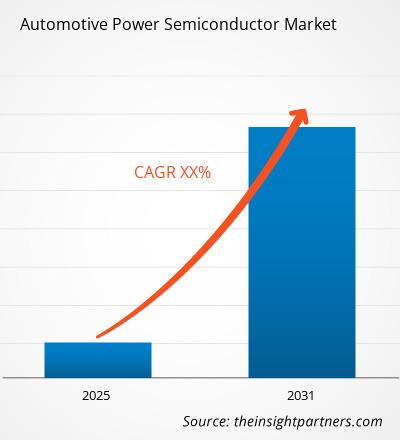
The Automotive Power Semiconductor Market was valued at US$ 6.02 Billion in 2025 and is projected to reach US$ 13.87 Billion by 2034; it is expected to register a CAGR of 9.72% during 2026–2034. Demand fundamentals are centered around electric propulsion, increasing content per vehicle, and increased need for effective conversion, protection, switching, and thermal management in powertrain, chassis, safety, body, infotainment, and telematics electronics.
North America continues to be a vital demand base, driven by vehicle electrification programs, efforts to build semiconductors locally, and increased OEM focus on high-voltage platforms. The market size in North America is anticipated to grow at an estimated CAGR of 8.7-9.4% in 2026-2034 on the back of traction inverters, battery management systems, zonal controllers, and safety electronics in premium electric & hybrid cars.
Automotive Power Semiconductor Market Assessment and Insights
- North America accounted for 28–31% share in 2025 and is projected to grow at a CAGR of 8.7–9.4% during 2026–2034, supported by EV incentives, local chip investment, and premium vehicle electrification.
- US represented 78–82% of North America in 2025 and is expected to expand at an 8.8–9.5% CAGR during 2026–2034 as OEMs localize electronics supply.
- Europe held 24–27% share in 2025 and is the Automotive Power Semiconductor Market forecast is expected to grow at an 8.9–9.6% CAGR during 2026–2034, with Germany, France, the UK, Italy, and Spain leading demand.
- Asia Pacific captured 35–38% share in 2025 and is projected to record a 10.4–11.2% CAGR during 2026–2034, led by China, Japan, South Korea, India, and Australia.
- Largest Segment Powertrain and Chassis held 41–45% market share in 2025 and is expected to grow at a 10.1–10.8% CAGR during 2026–2034.
- High Growth Segment Power Integrated Circuits represented 24–28% market share in 2025 and is projected to expand at an 11.0–11.8% CAGR during 2026–2034.
- Key companies analyzed in detail: NXP Semiconductors N.V., Infineon Technologies AG, Renesas Electronics Corporation, Texas Instruments Incorporated, STMicroelectronics N.V., Robert Bosch GmbH, onsemi, NVIDIA Corporation, TRUMPF SE + Co. KG, Intel Corporation.
Source: The Insight Partners' analysis based on proprietary research, government publications, company annual reports, investor presentations, industry databases, and expert interviews.
Power electronic components in vehicles have moved away from discrete switches towards more efficient, integrated devices that are suitable for electric drives and software defined architectures. The combination of silicon, SiC and packaging technology has helped vehicle platforms reduce losses and boost the power density. According to the International Energy Agency, sales of electric cars were greater than 17 million in 2024, providing a strong basis for 2025 in terms of inverter, onboard charger and DC/DC converter demand.
Investment flows are targeting regions that provide a resilient automotive ecosystem, have qualified wafer production capacity and module assembly facilities. Localization policies benefit North America and Europe while Asia Pacific region is still scaling up EV production. Regulatory pressure for emission controls, safety and efficiency will drive the amount of semiconductors in vehicles, especially in high voltage platforms.
Automotive Power Semiconductor Market Report Scope
| Report Attribute | Details |
|---|---|
| Market size in 2025 | US$ 6.02 Billion |
| Market Size by 2034 | US$ 13.87 Billion |
| Global CAGR (2026 - 2034) | 9.72% |
| Historical Data | 2021-2024 |
| Forecast period | 2026-2034 |
Automotive Power Semiconductor Market Analysis
Automotive Power Semiconductor Market growth is being driven by the shift from mechanical architectures to electronically-controlled power conversion. Battery electric vehicles and hybrids have a need for efficient traction inverters, onboard chargers, battery protection circuits, and high-efficiency switches. Safety electronics and body electronics are also being integrated into the car in the form of sensors, lighting, braking, steering, and comfort electronics.
The value chain includes wafer suppliers, component makers, module builders, tier 1 suppliers integrating the components, and automakers qualifying their components against the AEC-Q standards. The supply landscape continues to be impacted by substrate supply, packaging yields, and region-specific fab capacity. The Automotive Power Semiconductor Market report suggests that players having the capability to produce SiC, expertise in analog design, and quality systems in the automotive segment are well-positioned to win long-term automotive projects.
Competition mainly occurs between firms that have diverse product offerings including power discrete components, modules, gate drivers, microcontrollers, and reference design systems. These firms include Infineon Technologies AG, NXP Semiconductors N.V., STMicroelectronics N.V., Renesas Electronics Corporation, Texas Instruments Incorporated, and onsemi who are competitors based on reliability, design and long-term supply contracts and not pricing alone.
Positioning is becoming more related to 800V architecture, SiC MOSFET scale and power management. Robert Bosch GmbH uses system integration from automotive electronics production, while NVIDIA Corporation and Intel Corporation are driving the high performance computing platforms increasing the demand for power in vehicles. The company TRUMPF SE + Co. KG participates through lasers that are used in precision manufacturing and power electronics production.
● REPORT CUSTOMIZATION
Tailor This Report To Align With Your Specific Business Requirements
This report can be customized to align precisely with your business objectives, scope, and target markets. Customization options include tailored segmentation, geography, competitive analysis, and strategic insights to support informed decision-making.
Customize This Report →WHAT YOU CAN ADJUST
- ● Segmentations
- ● Geography
- ● Competitive Analysis
- ● Language Preferences
Automotive Power Semiconductor Market: Strategic Insights

Regional Insights
North America Automotive Power Semiconductor Market
North America held a 28–31% Automotive Power Semiconductor Market share in 2025 and is expected to grow at an 8.7–9.4% CAGR during 2026–2034. Demand is supported by EV assembly investment, local battery supply chains, and higher semiconductor content in pickup trucks, SUVs, and premium electric models.
Federal and state programs supporting clean mobility, charging infrastructure, and domestic semiconductor production reinforce long-cycle demand. Automakers are prioritizing powertrain reliability, thermal efficiency, and charging performance, which supports discrete devices, power modules, and integrated circuits used in high-voltage propulsion, safety electronics, and zonal electrical architectures.
U.S. Automotive Power Semiconductor Market
The U.S. represented 78–82% of North America in 2025 and is forecast to expand at an 8.8–9.5% CAGR during 2026–2034. The country benefits from EV platform launches, battery plant localization, and semiconductor manufacturing incentives that improve supply visibility for automotive-grade components.
NXP Semiconductors N.V., Texas Instruments Incorporated, onsemi, NVIDIA Corporation, and Intel Corporation maintain strong U.S. engineering, manufacturing, or customer engagement footprints. Application demand is strongest in powertrain and chassis, followed by safety electronics and telematics, as OEMs transition toward centralized computing and distributed power management.
Europe Automotive Power Semiconductor Market
Europe accounted for 24–27% share in 2025 and is projected to grow at an 8.9–9.6% CAGR during 2026–2034. Germany leads because of premium OEM concentration, Tier 1 electronics scale, and power module expertise. The UK benefits from electrified luxury platforms and advanced engineering services, while France supports inverter and charging demand through EV policy alignment.
Italy and Spain contribute through vehicle production, commercial fleets, and component manufacturing networks tied to European OEM programs. Infineon Technologies AG, STMicroelectronics N.V., Robert Bosch GmbH, and TRUMPF SE + Co. KG strengthen the regional supply base. Emissions compliance, safety regulation, and charging infrastructure expansion sustain the Automotive Power Semiconductor Market across Europe.
APAC Automotive Power Semiconductor Market
Asia Pacific held 35–38% share in 2025 and is expected to grow at a 10.4–11.2% CAGR during 2026–2034. China leads through high EV output, 800V platform adoption, and domestic power electronics investment. Japan and South Korea add strength in hybrid systems, batteries, and automotive-grade semiconductor manufacturing.
India and Australia are smaller but increasingly relevant as vehicle electrification, charging infrastructure, and fleet modernization expand. Regional policy support, cost-efficient production, and dense supplier networks make Asia Pacific the highest-growth geography for Automotive Power Semiconductor Market demand across powertrain, body electronics, infotainment, and safety applications.
Middle East & Africa Automotive Power Semiconductor Market
Middle East & Africa is projected to grow at a 7.6–8.4% CAGR during 2026–2034. Saudi Arabia and the UAE lead regional adoption through EV infrastructure, industrial diversification, and premium vehicle demand. South Africa contributes through established vehicle assembly and aftermarket electronics requirements.
Rest of MEA demand is linked to commercial fleets, energy projects, and gradual charging network deployment. The region’s opportunity remains selective, with strongest pull for robust power discrete devices, protection ICs, and thermal management components suited to high-temperature operating environments and infrastructure-led mobility programs.
Segmentation Analysis
Component
Component demand is expected to grow at a 9.5–10.3% CAGR during 2026–2034 as OEMs balance discrete efficiency, module integration, and compact power IC design. The Automotive Power Semiconductor Market scope includes silicon, SiC, and integrated architectures supporting switching, conversion, protection, and control across low-voltage and high-voltage vehicle systems.
- Power Discrete devices remain essential for switching, rectification, and protection in cost-sensitive vehicle systems, with demand supported by body electronics, lighting, pumps, relays, and auxiliary power conversion.
- Power Modue solutions address high-current requirements in traction inverters, onboard chargers, and DC-DC converters, making packaging reliability, thermal performance, and qualification cycles central to supplier selection.
- Power Integrated Circuits gain strategic importance as vehicles add zonal controllers, smart switches, battery monitoring, and compact power management functions requiring lower board space and higher diagnostic capability.
Application
Application is projected to grow at a 9.8–10.6% CAGR during 2026–2034, led by energy conversion, safety compliance, and connected feature expansion. Powertrain and chassis remain the largest application base, while infotainment, telematics, and body electronics increase demand for efficient low-voltage regulation and protected switching.
- Powertrain and Chassis dominate due to traction inverters, steering, braking, suspension, and battery interfaces where reliability, fast switching, and heat dissipation directly affect vehicle efficiency and safety.
- Body Electronics demand rises as doors, seats, lighting, climate systems, and comfort features use protected power switches, motor drivers, and compact regulators across distributed electrical architectures.
- Safety and Security applications require dependable power delivery for ADAS sensors, braking control, restraint systems, and security modules, making diagnostic capability and functional safety alignment key procurement factors.
- Infotainment and Telematics adoption is driven by connected cockpits, navigation, displays, and vehicle communication units that need efficient power management, low noise, and stable operation under variable loads.
Vehicle Type
Vehicle Type demand is expected to grow at a 9.2–10.0% CAGR during 2026–2034 as passenger cars absorb the highest semiconductor volume, while LCV and HCV platforms add electrified auxiliaries and fleet telematics. Commercial vehicle electrification raises requirements for rugged power modules, high-temperature operation, and long service life.
- Passenger Car demand is strongest because high production volumes, EV launches, ADAS penetration, and connected features increase semiconductor intensity across propulsion, safety, body, and infotainment systems.
- LCV adoption grows with last-mile delivery electrification, fleet efficiency targets, and telematics integration, creating demand for durable power devices that support charging, auxiliaries, and payload-sensitive designs.
- HCV applications require robust power modules and discrete devices for electrified drivetrains, braking, thermal systems, and high-duty-cycle fleet operations where reliability and serviceability remain critical.
Opportunity Snapshot
| Application | Revenue Contribution | Trend Tag | Adoption Stage |
| Powertrain and Chassis | High | 800V Drive | Scaling |
| Body Electronics | Medium | Smart Switch | Mature |
| Safety and Security | Medium | Safe Power | Scaling |
| Infotainment and Telematics | Medium | Connected Cockpit | Scaling |
Automotive Power Semiconductor Market Growth Drivers and Impact Analysis
Electrified Powertrains Raise High-Voltage Semiconductor Content
Electric vehicles necessitate more conversions than traditional internal combustion systems in the form of traction inverters, on-board chargers, DC-DC converters, battery disconnect modules, and thermal pump converters. This means that there will be additional needs for semiconductor devices such as MOSFETs, IGBTs, SiCs, drivers, and protection circuitry. Practically speaking, this translates into more value being attributed to semiconductors per vehicle as well as more time required for their qualification process; hence, encouraging OEMs to sign long-term contracts with their suppliers. Given the coexistence of 400V and 800V systems, suppliers supporting silicon and SiC technologies can cater to both categories of vehicles.
Software-Defined Vehicles Expand Distributed Power Management
Automotive electronics architecture is shifting from a domain-based approach to zonal control, centralized processing, and intelligent power distribution. In the process, the demand for smart high-side switches, power management ICs, diagnostics, and load protection will be higher for body, safety, infotainment, and telematics applications. The effect on the market will include increased use beyond the propulsion system, enabling suppliers to access more than one subsystem within the automobile. Vehicle manufacturers will also save on weight and perform better diagnostic work, enabling integrated systems with embedded fault and functional safety capabilities.
Localized Supply Chains Improve Automotive-Grade Availability
Automotive semiconductor shortage has revealed the vulnerabilities involved in the reliance on tight corridors of supply for qualified devices. Wafer fabrication, packaging, and regionalization initiatives have been the responses of governments and industry. In the case of power semiconductors, it is important to note that qualification, substrate availability, and module assembly need to be aligned to OEM schedules. The result is an evolution from reactive supply to proactive capacity management. Suppliers with regional redundancy, visibility of quality processes, and reliability in automotive applications will have a more secure position in the design cycle.
Automotive Power Semiconductor Market Future Trends
SiC Migration Across Mid-Range Electric Platforms
The Automotive Power Semiconductor Market Trends for Automotive Power Semiconductor suggest that SiC usage will not be restricted to high-end electric cars anymore due to increasing yield rates, advanced packaging technology, and increased prevalence of 800V systems in higher volumes. It is not necessary that mid-market car platforms will adopt SiC on an equal scale, however, its implementation in such key systems as inverters, chargers, and DC-DC converters will help in boosting the charging rate and energy efficiency.
Power ICs Become Central to Zonal Architectures
Vehicle architectures of the future will incorporate smart power ICs for control of loads close to their point of use. With zonal controllers eliminating wire paths, switches, regulators and diagnostics embedded into them will enable real-time control of the loads for lighting, seating, heating, sensors and infotainment. This will favor suppliers that are strong in mixed-signal design as well as have experience in automotive software. The purchasing process itself will shift, since OEMs and tier-1 suppliers will be selecting power semiconductors at the architectural level.
Automotive Power Semiconductor Market Opportunities
Design Wins in 800V Electric Vehicle Programs
Opportunities in Automotive Power Semiconductor Market Predictions lie in 800V platforms for EVs, where the ability to charge quickly and have an efficient inverter becomes an important consideration for buyers. The suppliers could leverage their offerings such as SiC modules, gate drivers, reference designs, and thermal simulation in a package engineering solution targeting the OEM programs. Such opportunities would present themselves in situations where semiconductor suppliers engage early on with Tier 1 suppliers of inverters and chargers.
Integrated Power Solutions for Commercial Fleets
Fleet operations present chances to leverage durable power electronics for availability, predictable maintenance, and energy efficiency. Electrification of light commercial vehicles, delivery trucks, buses, and initial heavy commercial vehicle applications require durable power modules, battery protection, charging ports, and telematics power control. Suppliers have an edge by providing temperature tolerance, diagnostics, and product lifecycle management. Fleet operators consider total cost of operation rather than cost per part, thus manufacturers offering reliable products in high duty cycle environments will see gains from platform agreements and aftermarket services.
Recent Developments
- December 2025: ROHM Co., Ltd., a leading Japanese semiconductor and electronics manufacturer, and Tata Electronics, a pioneering leader in India’s electronics and semiconductor manufacturing sector, announced today that they have entered into a strategic partnership for semiconductor manufacturing in India for both Indian and global markets. This partnership aims to leverage the expertise and ecosystem of both the companies in order to expand business opportunities for both ROHM and Tata Electronics, thereby further strengthening the relationship between the semiconductor industries of Japan and India.
- October 2025: Infineon Technologies AG is further advancing on its path to become a leading GaN powerhouse and bolstering its position as the world’s leader in automotive semiconductors by introducing its first gallium nitride (GaN) transistor family qualified to the Automotive Electronics Council (AEC) standard for automotive applications.
- October 2025: Sony Semiconductor Solutions Corporation (Sony) announced the upcoming release of the IMX828, the industry’s first CMOS image sensor for automotive applications with a built-in MIPI A-PHY interface. There are multiple high-speed transmission interface standards for automotive applications. This product is the first in the industry*1 to include the interface in the image sensor.
Frequently Asked Questions

- Comprehensive Market Sizing and Forecast Analysis
- Detailed Segmentation Analysis
- In-Depth Market Dynamics Assessment
- Regional and Country-Level Insights
- Competitive Landscape and Company Benchmarking
- Strategic Business Intelligence
Recent Reports
Testimonials

The Insight Partners provided valuable market intelligence that supported our global go-to-market strategy. Their team was professional, responsive, and attentive to our feedback, providing thoughtful analysis and helpful methodological clarifications throughout the project.
Junmo Kim Chief Financial Officer (CFO), Enertech Co., Ltd.
The Insight Partners' SCADA System Market report is comprehensive, with valuable insights on current trends and future forecasts. The team was highly professional, responsive, and supportive throughout. We are very satisfied and highly recommend their services.
RAN KEDEM Partner, Reali Technologies LTDs
I requested a report on a very specific software market and the team produced the report in a few days. The information was very relevant and well presented. I then requested some changes and additions to the report. The team was again very responsive and I got the final report in less than a week.
JEAN-HERVE JENN Chairman, Future Analytica
We worked with The Insight Partners for an important market study and forecast. They gave us clear insights into opportunities and risks, which helped shape our plans. Their research was easy to use and based on solid data. It helped us make smart, confident decisions. We highly recommend them.
PIYUSH NAGPAL Sr. Vice President, High Beam Global
The Insight Partners delivered insightful, well-structured market research with strong domain expertise. Their team was professional and responsive throughout. The user-friendly website made accessing industry reports seamless. We highly recommend them for reliable, high-quality research services
YUKIHIKO ADACHI CEO, Deep Blue, LLC.
This is the first time I have purchased a market report from The Insight Partners.While I was unsure at first, I visited their web site and felt more comfortable to take the risk and purchase a market report.I am completely satisfied with the quality of the report and customer service. I had several questions and comments with the initial report, but after a couple of dialogs over email with their analyst I believe I have a report that I can use as input to our strategic planning process.Thank you so much for taking the extra time and making this a positive experience.I will definitely recommend your service to others and you will be my first call when we need further market data.
JOHN SUZUKI President and Chief Executive Officer, Board Director, BK Technologies
I wish to appreciate your support and the professionalism you displayed in the course of attending to my request for information regarding to infectious disease IVD market in Nigeria. I appreciate your patience, your guidance, and the fact that you were willing to offer a discount, which eventually made it possible for us to close a deal. I look forward to engaging The Insight Partners in the future, all thanks to the impression you have created in me as a result of this first encounter.
DR CHIJIOKE ONYIA MANAGING DIRECTOR, PineCrest Healthcare Ltd.Reason to Buy
- Informed Decision-Making
- Understanding Market Dynamics
- Competitive Analysis
- Identifying Emerging Markets
- Customer Insights
- Market Forecasts
- Risk Mitigation
- Boosting Operational Efficiency
- Strategic Planning
- Investment Justification
- Tracking Industry Innovations
- Aligning with Regulatory Trends





 Get Free Sample for