
Automotive Supercapacitor Market Size, Share & Growth by 2034
Coverage: by Construction Type (Pseudocapacitors, Electrochemical Double Layer Capacitor (EDLC), Hybrid Capacitor, Others); System Type (Battery Propulsion System, Kinetic Energy Recovery System (KERS), Start Stop System, Starting Lighting and Ignition (SLI) System, Others); Application (Passenger Cars, Commercial Vehicles) , and Geography (North America, Europe, Asia Pacific, and South and Central America)
- Status : Data Released
- Report Code : TIPRE00009289
- Category : Electronics and Semiconductor
- No. of Pages : 150
- Available Report Formats :


- Last update date : July 17, 2026


2025 Market Size
US$ 1,242.04 Mn
Base year value
2034 Forecast
US$ 4,643.58 Mn
Projected by 2034
CAGR 2026-2034
15.78 %
Growth rate
Addressable Market
US$ 24,956.35 Mn
(2026-2034)
The Automotive Supercapacitor Market was valued at US$ 1,242.04 Million in 2025 and is projected to reach US$ 4,643.58 Million by 2034, registering a CAGR of 15.78% from 2026 to 2034. Adoption is growing in numbers as car manufacturers equip their vehicles with high-energy storage systems for use in regenerative braking systems, voltage regulation, start-stop operations, and as an aid to propulsion.
North America still stands out as an important geographical area as the Automotive Supercapacitor Market size gets fueled by the development of electrified pickup trucks, fleets’ decarbonization efforts, and the adoption of 48V technology. It is anticipated that the region will experience a 14.5% - 15.5% CAGR over the period of 2026 to 2034.
Automotive Supercapacitor Market Assessment and Insights
- North America accounted for 18–20% share in 2025 and is expected to grow at a CAGR between 2026–2034 of 14.5–15.5%, supported by premium EVs, commercial fleets, and cold-start reliability needs.
- US represented 78–82% of North America in 2025 and is projected to grow at a CAGR between 2026–2034 of 14.8–15.8%, led by EV platforms and fleet electrification.
- Europe held 25–28% share in 2025 and is expected to grow at a CAGR between 2026–2034 of 14.0–15.0%, with Germany, France, the UK, Italy, and Spain leading integration.
- Asia Pacific captured 45–48% share in 2025 and is projected to grow at a CAGR between 2026–2034 of 16.4–17.4%, driven by China, Japan, South Korea, and India.
- Largest Segment Electrochemical Double Layer Capacitor held 52–56% market share in 2025 and is expected to grow at a CAGR range of 14.7–15.7% during 2026–2034.
- High Growth Segment Hybrid Capacitor held 18–22% market share in 2025 and is expected to grow at a CAGR range of 17.2–18.2% during 2026–2034.
- Key companies analyzed in detail: Kyocera AVX Components Corporation, Eaton Corporation plc, Hitachi, Ltd., Murata Manufacturing Co., Ltd., Nippon Chemi-Con Corporation, Panasonic Holdings Corporation, Samsung SDI Co., Ltd., Skeleton Technologies GmbH, Targray Technology International Inc., Tesla, Inc.
Source: The Insight Partners' analysis based on proprietary research, government publications, company annual reports, investor presentations, industry databases, and expert interviews.
Architecture of the energy storage system for automobiles is moving from a one-dimensional battery assistance system to the power buffer distributed among components such as braking system, steering system, ignition system, infotainment system, and the propulsion system. Supercapacitors have come to be considered more as the choice of designers because they are better at capturing power surges than stand-alone batteries. The dynamics of production process will be changed with the advances in electrode materials technology, package technology, and qualification process at the level of automobile industry.
During the forecast period, growth will not be restricted only to the premium electric vehicle sector but will extend to mild hybrid vehicles, commercial vehicles, and fleets of urban mobility. This investment will be made in regions where there is clustering of manufacturing plants of electric vehicles, supply chain of electronics, and restrictions on fuel consumption.
Automotive Supercapacitor Market Report Scope
| Report Attribute | Details |
|---|---|
| Market size in 2025 | US$ 1,242.04 Million |
| Market Size by 2034 | US$ 4,643.58 Million |
| Global CAGR (2026 - 2034) | 15.78% |
| Historical Data | 2021-2024 |
| Forecast period | 2026-2034 |
Automotive Supercapacitor Market Analysis
Drivers behind the Automotive Supercapacitors Market are expected to be driven by the increasing trend of electrification, higher power loads in the auxiliary systems, and requirements for quick energy recovery when decelerating. In 2024, more than 17 million of global electric car sales were recorded by the International Energy Agency, which provides a larger installed base for solutions that increase the performance of the power system as well as the lifespan of batteries.
From the supply side, the production process relies on activated carbon, graphite-based materials, electrolytes, controls for module, and validation through the automotive cycles. From the demand side, there will be an opportunity for those manufacturers that can meet the requirements of cost-effective and reliable products.
Competitive positioning in the Automotive Supercapacitor Market report is being determined more in terms of applications rather than just availability of components alone. In the Automotive Supercapacitor Market report, the companies Kyocera AVX Components Corporation, Murata Manufacturing Co., Ltd., Panasonic Holdings Corporation, and Nippon Chemi-Con Corporation compete based on miniaturization and reliability, whereas Skeleton Technologies GmbH focuses on high-power modules for transport and industrial mobility applications.
Eaton Corporation plc and Hitachi, Ltd. gain advantage through their power management and vehicle electronics competencies, while Samsung SDI Co., Ltd., Targray Technology International Inc., and Tesla, Inc. improve their linkages with electrification supply chain. There is now investment being directed towards hybrid capacitors, module-level integration, and localized manufacturing amid efforts by vehicle manufacturers to mitigate risks from batteries.
● REPORT CUSTOMIZATION
Tailor This Report To Align With Your Specific Business Requirements
This report can be customized to align precisely with your business objectives, scope, and target markets. Customization options include tailored segmentation, geography, competitive analysis, and strategic insights to support informed decision-making.
Customize This Report →WHAT YOU CAN ADJUST
- ● Segmentations
- ● Geography
- ● Competitive Analysis
- ● Language Preferences
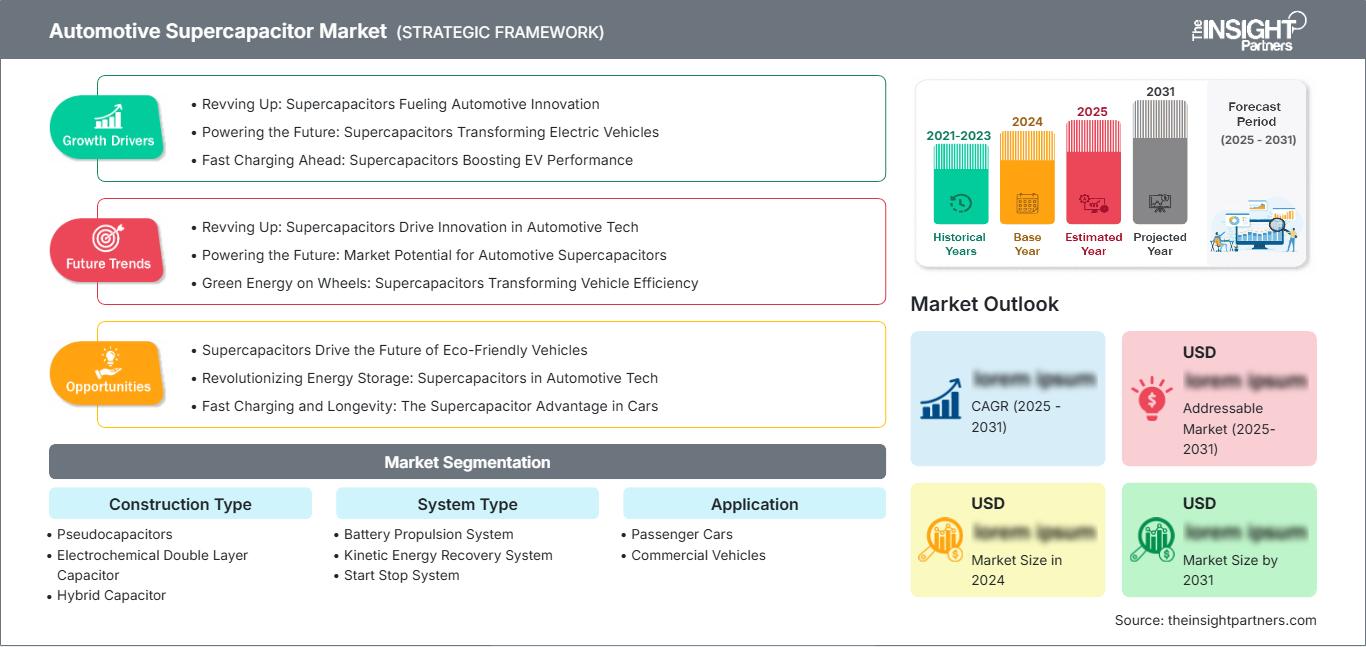
Automotive Supercapacitor Market: Strategic Insights
Regional Insights
North America Automotive Supercapacitor Market
North America held an estimated 18–20% Automotive Supercapacitor Market share in 2025 and is forecast to grow at a 14.5–15.5% CAGR from 2026 to 2034. Demand relates to electrified pickup trucks, commercial vehicles, and premium electric vehicles that need buffering at high power for acceleration, braking, and auxiliary services.
The area can take advantage of national and state-level policies related to electrification, battery investments locally, and greater interest in 48V mild hybrid systems. The use of supercapacitors for reliable cold start capabilities and reduced battery stress under load is appreciated by automakers.
U.S. Automotive Supercapacitor Market
The U.S. accounted for 78–82% of North America in 2025 and is expected to expand at a 14.8–15.8% CAGR during 2026–2034. Adoption is supported by EV manufacturing capacity, light truck electrification, and growing use of start-stop and regenerative braking functions in passenger and commercial vehicles.
This is important to note since Tesla, Inc. drives pull in the domestic EV ecosystem, while Eaton Corporation plc assists in the application of power management systems, and Kyocera AVX Components Corporation offers advanced components. U.S. fleets are also experimenting with power buffering technologies, where high duty cycle, quick stop-and-go maneuvers, and accessories form better cases than conventional passenger operations.
Europe Automotive Supercapacitor Market
Europe represented 25–28% share in 2025 and is projected to grow at a 14.0–15.0% CAGR through 2034. Germany remains the leading country because of its premium automotive engineering base, strong Tier 1 network, and focus on high-efficiency electric and hybrid platforms. The UK is seeing demand from performance EVs and commercial mobility pilots.
France, Italy, and Spain contribute through domestic vehicle production, urban emission-zone policies, and growing electrified fleet procurement. European standards on carbon reduction encourage systems that recover braking energy and reduce battery load. Suppliers with automotive-grade qualification and local engineering support are positioned to benefit as OEMs move beyond laboratory validation.
APAC Automotive Supercapacitor Market
APAC held 45–48% share in 2025 and is expected to grow at a 16.4–17.4% CAGR from 2026 to 2034. China is the leading country, supported by EV scale, supplier localization, and rapid adoption of power electronics. Japan and South Korea add materials and component expertise.
India and Australia contribute smaller but rising demand through commercial vehicle electrification, urban mobility, and infrastructure modernization. Policy support for EV manufacturing, battery localization, and energy efficiency strengthens adoption. The region’s production density allows faster cost reduction for qualified modules and broader integration into passenger and commercial vehicles.
Middle East & Africa Automotive Supercapacitor Market
Middle East & Africa is expected to grow at a 12.8–13.8% CAGR during 2026–2034, with Saudi Arabia leading adoption through mobility diversification, smart-city projects, and fleet modernization. The UAE follows through logistics, public transport electrification, and high-temperature testing environments.
South Africa and the Rest of MEA remain early-stage markets, where commercial vehicles and backup power resilience are more immediate use cases than mass EV adoption. Energy infrastructure investment, charging networks, and government-backed transport modernization will determine the pace of supercapacitor integration across the region.
Segmentation Analysis
Construction Type
Construction Type is expected to grow at a 15.2–16.2% CAGR from 2026 to 2034 as OEMs balance cost, power density, and energy density. The Automotive Supercapacitor Market forecast across construction technologies is widening because EDLCs serve mature power-buffering needs, pseudocapacitors improve charge storage, and hybrid capacitors bridge performance gaps between batteries and capacitors.
- Pseudocapacitors serve applications needing higher charge storage through surface redox reactions, making them strategically relevant where compact packaging and improved energy density matter.
- Electrochemical Double Layer Capacitor remains the most established construction type because of high power density, long cycle life, and proven use in braking and voltage stabilization.
- Hybrid Capacitor is gaining attention as automakers seek devices that combine capacitor response speed with improved energy retention for advanced electrified architectures.
System Type
System Type is projected to grow at a 15.5–16.5% CAGR from 2026 to 2034 as supercapacitors move into multiple vehicle electrical systems. Adoption is strongest where power pulses, short recovery cycles, and battery-life extension are operational priorities. Demand differs by platform, with EVs emphasizing propulsion support and hybrids prioritizing start-stop and recuperation functions.
- Battery Propulsion System uses supercapacitors to reduce peak load on battery packs, improve transient response, and support efficient power delivery in electric and hybrid vehicles.
- Kinetic Energy Recovery System benefits from rapid charge acceptance during braking, making supercapacitors valuable for vehicles operating in stop-start urban and commercial duty cycles.
- Start Stop System remains a practical use case because fast discharge and recharge improve restart reliability while reducing strain on lead-acid or lithium-ion batteries.
- Starting Lighting and Ignition System applies supercapacitor modules to stabilize voltage, support cold starts, and maintain electrical continuity during high-load ignition and accessory operation.
Application
Application is anticipated to grow at a 15.0–16.0% CAGR from 2026 to 2034 as demand expands across passenger and commercial vehicles. Passenger cars lead current integration because EV and hybrid platforms require fast energy recovery, while commercial vehicles offer higher lifecycle value from durability, uptime, and repeated braking cycles.
- Passenger Cars account for broad adoption due to EV penetration, premium comfort electronics, regenerative braking, and growing interest in battery-life optimization across urban driving conditions.
- Commercial Vehicles represent a strategically attractive base because high mileage, frequent stops, and auxiliary loads make power buffering economically valuable for fleets.
Opportunity Snapshot
| Application | Revenue Contribution | Trend Tag | Adoption Stage |
| Passenger Cars | High | EV Buffering | Scaling |
| Commercial Vehicles | Medium | Fleet Uptime | Emerging |
Automotive Supercapacitor Market Growth Drivers and Impact Analysis
Electrified Powertrains Need High-Power Buffering
Electric cars necessitate power components that will be able to absorb and discharge energy at a quicker rate compared to the batteries when accelerating, decelerating, and accessing accessories. The supercapacitors play this role by ensuring reduced peak loads on the battery packs and enhanced energy recovery and voltage stabilization. With the increase in sales of electric cars, there is pressure on the OEMs to enhance efficiency, longevity, and economics of their warranties. This pressure is felt most in cities and performance vehicles due to frequent decelerations and demands for transient power.
Start-Stop and 48V Systems Expand Addressable Demand
Start-stop and 48V Mild Hybrid systems pose practical requirements for the use of supercapacitors due to the necessity for fast discharging, charging, and longevity. Ordinary batteries can perform such operations, however, numerous cycles of high current usage speed up their degradation. Start-stop and 48V systems using supercapacitors increase the reliability of restarts and eliminate drops in electricity usage, as well as provide an opportunity for manufacturers to achieve the necessary fuel economy levels without changing the vehicle into a full-electric one.
Commercial Fleets Prioritize Uptime and Lifecycle Cost
Since commercial vehicles go through repetitive cycles of braking, idling, loading, and auxiliary power, they become ideal candidates for supercapacitors. In the fleet industry, technologies are judged on the basis of uptime, maintenance savings, and payback period, as opposed to novel parts. Supercapacitors can enable regenerative braking, cold start, liftgate load, and power flattening. The implications will be particularly pertinent in buses, vans, refuse trucks, and port vehicles. In an age of increasing electrification of fleets, vendors who exhibit robustness in tough duty cycles will be able to turn pilot programs into platforms.
Automotive Supercapacitor Market Future Trends
Hybrid Capacitor Architectures Move Toward Platform Design
Automotive Supercapacitors Market Trends are moving towards hybrid design concepts which help achieve high energy densities along with fast charging capabilities. These trends will become important for OEMs who require small size modules that complement the battery systems but do not add extra weight or thermal issues. Future products will incorporate better electronics, enhanced electrode design, and packaging optimized for vehicle platforms. It will lead to greater use of supercapacitors in electric and hybrid vehicles.
Localized Supply Chains Become a Procurement Priority
Vehicle manufacturers will be encouraged to source supercapacitors locally due to the impact that geopolitical risks, limitations on materials for batteries, and lack of electronic components will have on purchasing. Local manufacturing will allow for shorter qualification periods and less logistics risk, and will also be aligned with incentive programs related to local production. This could present opportunities for suppliers that are based in multiple regions, have automotive-level manufacturing capability, and are located near EV assembly plants.
Automotive Supercapacitor Market Opportunities
Commercial Vehicle Retrofit and OEM Programs
Platform solutions from commercial vehicles present an obvious path to Automotive Supercapacitor Market Forecasts, as these fleets have been able to measure savings on fuel usage, extended battery life, and reduced maintenance needs. There are chances that suppliers may enter into both original equipment manufacturing and retrofit projects for buses, delivery trucks, trash trucks, and vocational vehicles. The best chances lie in those cases where there is frequent braking and high auxiliary loads in the duty cycle.
Battery-Supercapacitor Integration for Premium EVs
A premium EV investment is an area for development of battery-supercapacitor integration systems to achieve improved acceleration dynamics, thermal management, and regenerative braking. It allows car manufacturers to employ supercapacitors to decrease the peak load for batteries while maintaining distinguishing characteristics. Supplier strategy for development should include cooperation with engineering teams of OEMs based on module validation, software algorithms, and packaging solutions. The technology adoption might start with sporty car classes moving further to regular models as costs lower and reliability increases.
Recent Developments
- June 2026: ANCEL, a globally renowned brand of intelligent automotive aftermarket equipment, has officially introduced the ANCEL BS300 Super Starter and ANCEL BS400 Super Starter, expanding its BS Series of super capacitor jump starters designed for high-displacement SUVs, pickup trucks, and light commercial vehicles.
- June 2025: Clarios has announced that it is evaluating U.S. locations for a next-generation technology campus centered on new supercapacitor system production. Supercapacitors are an advanced energy storage technology used in cutting-edge applications, including next-generation American-made vehicle platforms, artificial intelligence (AI) data centers, and advanced military technology. Currently, most supercapacitors are manufactured in China, while the U.S. manufacturing footprint in this sector remains limited.
- February 2026: ANCEL has recently introduced the BS200 Super Starter, a smart, maintenance-free solution that combines active battery protection with emergency starting capabilities. Unlike traditional jump starters that only provide passive support during battery failure, the BS200 actively assists in the engine starting process on a regular basis. This helps reduce battery load during everyday use while delivering instant starting support when critical situations occur.
Frequently Asked Questions

- Comprehensive Market Sizing and Forecast Analysis
- Detailed Segmentation Analysis
- In-Depth Market Dynamics Assessment
- Regional and Country-Level Insights
- Competitive Landscape and Company Benchmarking
- Strategic Business Intelligence
Recent Reports
Testimonials

The Insight Partners' SCADA System Market report is comprehensive, with valuable insights on current trends and future forecasts. The team was highly professional, responsive, and supportive throughout. We are very satisfied and highly recommend their services.
RAN KEDEM Partner, Reali Technologies LTDs
I requested a report on a very specific software market and the team produced the report in a few days. The information was very relevant and well presented. I then requested some changes and additions to the report. The team was again very responsive and I got the final report in less than a week.
JEAN-HERVE JENN Chairman, Future Analytica
We worked with The Insight Partners for an important market study and forecast. They gave us clear insights into opportunities and risks, which helped shape our plans. Their research was easy to use and based on solid data. It helped us make smart, confident decisions. We highly recommend them.
PIYUSH NAGPAL Sr. Vice President, High Beam Global
The Insight Partners delivered insightful, well-structured market research with strong domain expertise. Their team was professional and responsive throughout. The user-friendly website made accessing industry reports seamless. We highly recommend them for reliable, high-quality research services
YUKIHIKO ADACHI CEO, Deep Blue, LLC.
This is the first time I have purchased a market report from The Insight Partners.While I was unsure at first, I visited their web site and felt more comfortable to take the risk and purchase a market report.I am completely satisfied with the quality of the report and customer service. I had several questions and comments with the initial report, but after a couple of dialogs over email with their analyst I believe I have a report that I can use as input to our strategic planning process.Thank you so much for taking the extra time and making this a positive experience.I will definitely recommend your service to others and you will be my first call when we need further market data.
JOHN SUZUKI President and Chief Executive Officer, Board Director, BK Technologies
I wish to appreciate your support and the professionalism you displayed in the course of attending to my request for information regarding to infectious disease IVD market in Nigeria. I appreciate your patience, your guidance, and the fact that you were willing to offer a discount, which eventually made it possible for us to close a deal. I look forward to engaging The Insight Partners in the future, all thanks to the impression you have created in me as a result of this first encounter.
DR CHIJIOKE ONYIA MANAGING DIRECTOR, PineCrest Healthcare Ltd.Reason to Buy
- Informed Decision-Making
- Understanding Market Dynamics
- Competitive Analysis
- Identifying Emerging Markets
- Customer Insights
- Market Forecasts
- Risk Mitigation
- Boosting Operational Efficiency
- Strategic Planning
- Investment Justification
- Tracking Industry Innovations
- Aligning with Regulatory Trends





 Get Free Sample for