
Autonomous Train Technology Market Growth, Trends & Forecast by 2034
Coverage: By Grade of Automation (Grade of Automation 1 (GOA 1), Grade of Automation 2 (GOA 2), Grade of Automation 3 (GOA 3), Grade of Automation 4 (GOA 4)); Train Type (Passenger Train, Freight Train); Technology (Communication Based Train Control (CBTC), European Railway Traffic Management System (ERTMS), Automatic Train Control (ATC), Positive Train Control (PTC)); Component (Camera, Accelerometer, Odometer, Tachometer, Others) and Geography
- Status : Data Released
- Report Code : TIPAT00002098
- Category : Automotive and Transportation
- No. of Pages : 150
- Available Report Formats :


- Last update date : May 22, 2026


2025 Market Size
US$ 4.79 Bn
Base year value
2034 Forecast
US$ 6.80 Bn
Projected by 2034
CAGR 2026-2034
3.98 %
Growth rate
Addressable Market
US$ 52.67 Bn
(2026-2034)
The global autonomous train technology market size is projected to reach US$ 6.80 billion by 2034 from US$ 4.79 billion in 2025. The market is anticipated to register a CAGR of 3.98% during the forecast period 2026–2034.
Key market dynamics include a heightening global focus on reducing human error in rail operations, rising passenger demand for high-frequency urban transit, and a significant shift toward digital signaling infrastructure. Additionally, the market is expected to benefit from the growing adoption of fully unattended train operations (GoA 4) in metro networks, expansion of high-speed rail corridors in emerging economies, and the increasing integration of artificial intelligence for obstacle detection and predictive maintenance.
Autonomous Train Technology Market Analysis
The autonomous train technology market analysis shows a shift toward high-capacity automated rail as transit authorities prioritize punctuality and energy efficiency. The market is moving into traditional rail modernizations using Grade of Automation 2 and high-growth greenfield projects in Asia-Pacific employing Grade of Automation 4. Strategic opportunities are emerging in the freight industry, where autonomous locomotives offer a solution to labor shortages and rising fuel costs. The analysis also notes that market expansion depends on the interoperability of signaling systems like ERTMS and CBTC. Competitive differentiation now stands out depending on software-defined architectures that highlight cybersecurity resilience, real-time data processing, and 5G connectivity. This approach helps technology providers secure long-term contracts in a market with significant infrastructure barriers.
Autonomous Train Technology Market Overview
Rail automation systems have advanced from niche airport shuttles to mainstream urban mobility solutions. The market includes driverless metros, automated light rail, and self-driving heavy-haul freight locomotives. Both global engineering giants and specialized software startups compete in this market, using technologies such as LiDAR, high-definition cameras, and edge computing. Growing demand for sustainable, low-carbon mass transit among government bodies in Europe and Asia has increased the popularity of autonomous trains as a portable wellness solution for congested cities. Asia-Pacific leads in revenue due to its rapid urban expansion, while Europe is advancing in the digital transformation of its transcontinental rail lines. The US market is expanding through the implementation of Positive Train Control (PTC) and the modernization of urban transit in major hubs. Competition among brands is fueling greater innovation in sensor fusion and the inclusion of AI-driven traffic management platforms.
Market Research Highlights
- Global market for Autonomous Train Technology was valued at US$ 4.79 Billion in 2025
- Annual market size is expected to reach US$ 6.80 Billion by 2034
- Total addressable market (TAM) during 2026-2034 is projected to reach approximately US$ 52.67 Billion
- Market is anticipated to register a CAGR of 3.98% during the forecast period
- The United States represents a key market, supported by Increasing Global Trade and Focus on Connectivity, as well as evolving industry dynamics
- Market analysis covers North America, Europe, Asia-Pacific, South and Central America, Middle East and Africa, with growth evaluated across the forecast period
- Market opportunities such as Technological Advancement in Transportation Sector are expected to influence market dynamics and addressable market
- Report profiles industry participants, including ABB, Alstom S.A., CRRC Transportation, General Electric, Hitachi Ltd., Kawasaki Heavy Industries Ltd., Mitsubishi Heavy Industries, Siemens AG, while analyzing competitive strategies and innovation developments
-
Source: The Insight Partners' analysis based on proprietary research, government publications, company annual reports, investor presentations, industry databases, and expert interviews.
● REPORT CUSTOMIZATION
Tailor This Report To Align With Your Specific Business Requirements
This report can be customized to align precisely with your business objectives, scope, and target markets. Customization options include tailored segmentation, geography, competitive analysis, and strategic insights to support informed decision-making.
Customize This Report →WHAT YOU CAN ADJUST
- ● Segmentations
- ● Geography
- ● Competitive Analysis
- ● Language Preferences
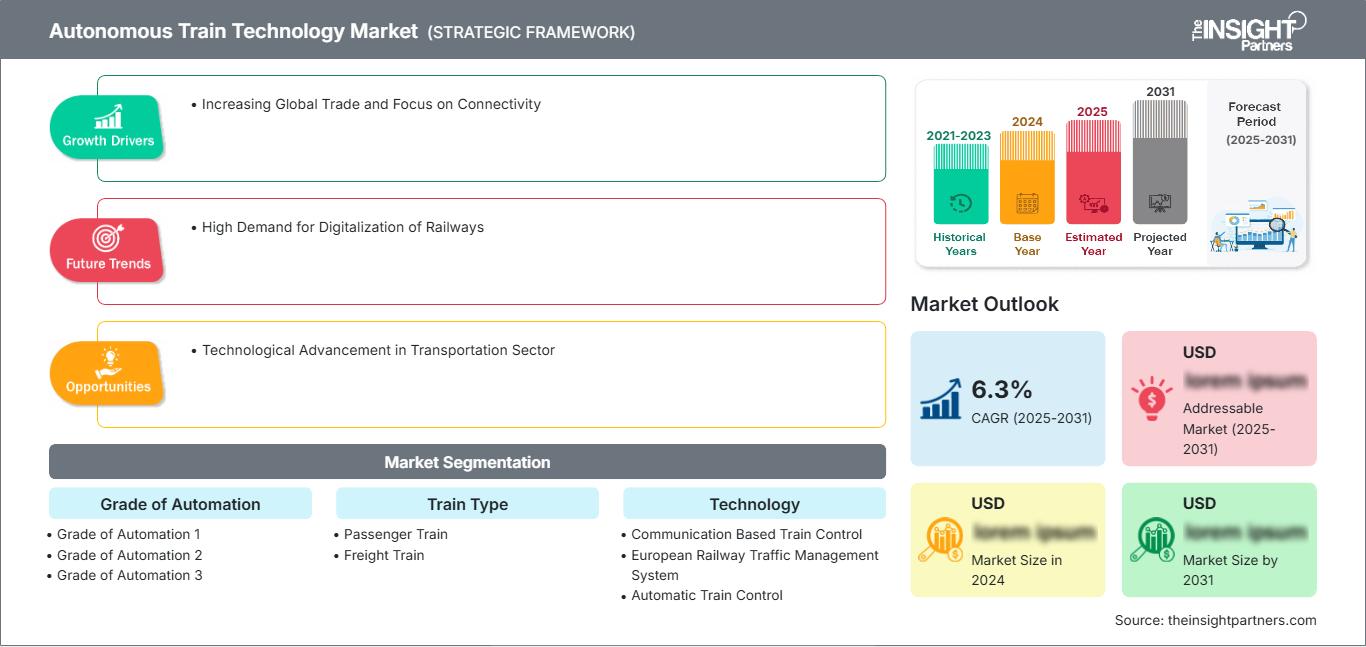
Autonomous Train Technology Market: Strategic Insights
-
Get Top Key Market Trends of this report.This FREE sample will include data analysis, ranging from market trends to estimates and forecasts.
Autonomous Train Technology Market Drivers and Opportunities
Market Drivers:
- Enhanced Operational Safety and Reliability: Autonomous systems eliminate human-factor risks like fatigue or distraction, ensuring consistent braking and acceleration. This precision reduces the likelihood of collisions and derailments, driving global adoption.
- Urban Transit Capacity Optimization: Automated systems allow for shorter headways between trains, significantly increasing the number of passengers transported per hour without requiring new track infrastructure.
- Reduction in Long-term Operational Costs: While initial setup costs are high, automation lowers labor expenses and optimizes energy consumption through AI-guided driving profiles, offering a clear ROI for public and private operators.
Market Opportunities:
- Automation of Long-Haul Freight: Beyond urban metros, there are significant opportunities in the freight segment, particularly for mining and transcontinental logistics, where autonomous operation improves fuel efficiency.
- Retrofitting Legacy Rail Networks: Transforming existing Grade of Automation 1 lines into Grade of Automation 2 or 3 through modular technology upgrades provides a massive recurring revenue stream for component suppliers.
- Growth in Smart City Integration: Forming strategic partnerships between rail technology providers and urban planners may facilitate access to integrated MaaS (Mobility as a Service) ecosystems in developing smart cities.
Autonomous Train Technology Market Report Segmentation Analysis
The Autonomous Train Technology Market share is analyzed across various segments to provide a clearer understanding of its structure, growth potential, and emerging trends. Below is the standard segmentation approach used in industry reports:
By Grade of Automation:
- Grade of Automation 1 (GoA 1): The current baseline, featuring manual operation with automated safety functions. It remains common in regional and suburban rail systems.
- Grade of Automation 2 (GoA 2): Semi-automated operation where the train is automatically driven, but a driver stays in the cab to supervise and handle emergencies.
- Grade of Automation 3 (GoA 3): Driverless operation where the train runs automatically, and a staff member is present on the train but not in the cab.
- Grade of Automation 4 (GoA 4): Fully unattended train operation where no staff is required on board, representing the fastest-growing segment for new metro lines.
By Train Type:
- Passenger Train: The dominant volume driver, particularly within the urban metro and high-speed rail, due to the global push for efficient mass transit.
- Freight Train: An emerging high-growth segment favored for industrial applications like mining and long-distance cargo transport.
By Technology:
- Communication-Based Train Control (CBTC): The primary technology for urban metros, providing real-time positioning and high-frequency service capabilities.
- European Railway Traffic Management System (ERTMS): The standard for cross-border rail interoperability in Europe, ensuring safety across different national networks.
- Automatic Train Control (ATC): A traditional but widely deployed technology that manages train speed and safety limits.
- Positive Train Control (PTC): A critical technology in the North American market designed to prevent collisions and overspeed accidents.
By Component:
- Camera: Essential for obstacle detection and passenger monitoring in driverless systems.
- Accelerometer: Used to measure train speed and orientation for precise movement control.
- Odometer: Provides critical data on the distance traveled to ensure accurate station docking.
- Tachometer: Measures the rotation speed of wheels to monitor traction and prevent slippage.
- Others: Includes LiDAR sensors, radar systems, and onboard control computers.
By Geography:
- North America
- Europe
- Asia Pacific
- South & Central America
- Middle East & Africa
Autonomous Train Technology Market Report Scope
| Report Attribute | Details |
|---|---|
| Market size in 2025 | US$ 4.79 Billion |
| Market Size by 2034 | US$ 6.80 Billion |
| Global CAGR (2026 - 2034) | 3.98% |
| Historical Data | 2021-2024 |
| Forecast period | 2026-2034 |
| Segments Covered |
By Grade of Automation
|
| Regions and Countries Covered |
North America
|
| Market leaders and key company profiles |
|
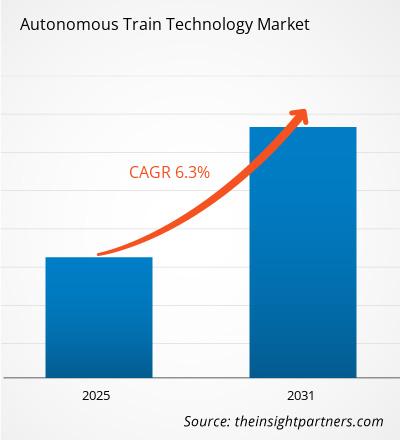
Autonomous Train Technology Market Players Density: Understanding Its Impact on Business Dynamics
The Autonomous Train Technology Market is growing rapidly, driven by increasing end-user demand due to factors such as evolving consumer preferences, technological advancements, and greater awareness of the product's benefits. As demand rises, businesses are expanding their offerings, innovating to meet consumer needs, and capitalizing on emerging trends, which further fuels market growth.
Autonomous Train Technology Market Share Analysis by Geography
Asia-Pacific is expected to grow fastest in the coming years. Emerging markets in the Middle East and Africa also have many untapped opportunities for smart rail infrastructure and autonomous metro expansions.
The autonomous train technology market is undergoing a significant transformation, moving from manual safety assistance to fully unattended operations. Growth is driven by the rise of megacities, a surge in demand for green transport, and the expansion of high-speed rail. Below is a summary of market trends by region:
North America
- Market Share: A steadily advancing segment, driven by rail modernization and safety mandates.
- Key Drivers:
- Implementation of Positive Train Control (PTC) systems to enhance safety across Class I railroads
- Mainstreaming of automated people movers in major airport hubs and urban transit corridors
- Increased focus on freight automation to optimize transcontinental logistics and supply chain efficiency
- Trends: Deployment of advanced sensor suites for obstacle detection and the successful adoption of remote monitoring technologies to improve operational resilience.
Europe
- Market Share: Holds a significant share globally, anchored by extensive cross-border rail networks and standardized signaling frameworks.
- Key Drivers:
- High domestic adoption of European Railway Traffic Management System (ERTMS) standards
- Established processing infrastructure and strict regulatory frameworks for high-speed rail safety
- Robust government support for decarbonization through electrified, automated rail transit
- Trends: A strategic shift toward prioritizing GoA 4 (unattended) metro lines in major capitals. There is also an increasing focus on cybersecurity certifications to protect interconnected digital rail assets.
Asia-Pacific
- Market Share: The largest and fastest-growing region, with China and Japan acting as the primary innovation for the entire continent.
- Key Drivers:
- Massive consumer base in China, India, and Southeast Asia requiring high-capacity, driverless urban metro systems
- Government-supported industrial corridors focused on high-value smart logistics
- Rapid urbanization leading to a preference for high-speed autonomous bullet trains
- Trends: Heavy reliance on 5G-enabled communication-based train control (CBTC) and B2B contracts for AI-driven traffic management systems used in the logistics and passenger sectors.
South and Central America
- Market Share: Emerging market with a growing urban transit in countries like Brazil and Chile.
- Key Drivers:
- Increasing awareness of the safety superiority of autonomous systems in reducing human-driven accidents
- Modernization of aging metro lines into commercial-grade automated systems to supply urban centers
- Rising interest in sustainable mass transit among middle-to-high income urban segments
- Trends: Growth of boutique automated transit projects and the introduction of autonomous light rail to differentiate from traditional bus rapid transit systems.
Middle East and Africa
- Market Share: Developing market with ambitious infrastructure goals, transitioning toward formalized smart rail production.
- Key Drivers:
- High demand for world-class, fully automated metro systems in the Gulf region (e.g., Dubai and Riyadh)
- Strategic investments in Smart Infrastructure to improve local connectivity and reduce oil reliance
- Implementation of modern signaling and sensor technologies to formalize regional rail networks
- Trends: Deployment of GoA 4 systems in desert climates using specialized cooling and sand-protection tech, coupled with a focus on high-speed autonomous corridors.
High Market Density and Competition
Competition is intensifying due to the presence of established leaders such as Alstom S.A., Siemens AG, and Hitachi, Ltd. Regional players and innovators like CRRC Corporation and Wabtec Corporation also contribute to a diverse and rapidly expanding market landscape.
This competitive environment pushes vendors to differentiate through:
- Digital Twin Technology: Using virtual models to simulate rail operations and optimize maintenance schedules.
- Sensor Fusion: Integrating LiDAR, radar, and cameras to create a 360-degree safety envelope around the train.
- 5G Connectivity: Ensuring ultra-low latency communication between the train and control centers for real-time remote intervention.
Opportunities and Strategic Moves
- Partner with urban planners and government bodies to tap into the surging demand for fully automated (GoA 4) metro systems in Asia-Pacific and Middle Eastern markets.
- Incorporate sustainable energy solutions and green propulsion technologies to appeal to environmentally conscious regulators and municipal authorities seeking carbon-neutral transit alternatives.
Major Companies operating in the Autonomous Train Technology Market are:
- ABB
- Alstom S.A.
- CRRC Transportation
- General Electric
- Hitachi Ltd.
- Kawasaki Heavy Industries Ltd.
- Mitsubishi Heavy Industries
- Siemens AG
Disclaimer: The companies listed above are not ranked in any particular order.
Autonomous Train Technology Market News and Recent Developments
- In April 2026, AI World Tour Singapore, SMRT, Singapore's leading public transportation provider, is working on a pilot project using Oracle Cloud Infrastructure (OCI) Enterprise AI and Oracle Autonomous AI Database to help improve rail maintenance through its intelligent data AI platform, JARVIS.
- In January 2026, ABB secured a major order from Titagarh Rail Systems Ltd. to supply advanced propulsion systems and Train Control and Management System (TCMS) software for the Mumbai Metro Line. These upcoming metro lines are key to Mumbai’s rail network in significantly improving connectivity between key geographical locations, reducing travel time, and easing road traffic for daily commuters. The order reinforces ABB’s role as a trusted partner in delivering energy-efficient, reliable, and sustainable solutions for India’s growing metro networks.
Autonomous Train Technology Market Report Coverage and Deliverables
The Autonomous Train Technology Market Size and Forecast (2021–2034) report provides a detailed analysis of the market covering below areas:
- Autonomous Train Technology Market size and forecast at global, regional, and country levels for all the key market segments covered under the scope
- Autonomous Train Technology Market trends, as well as market dynamics such as drivers, restraints, and key opportunities
- Detailed PEST and SWOT analysis
- Autonomous Train Technology Market analysis covering key market trends, global and regional framework, major players, regulations, and recent market developments
- Industry landscape and competition analysis covering market concentration, heat map analysis, prominent players, and recent developments in the Autonomous Train Technology Market.
- Detailed company profiles
Frequently Asked Questions

- Comprehensive Market Sizing and Forecast Analysis
- Detailed Segmentation Analysis
- In-Depth Market Dynamics Assessment
- Regional and Country-Level Insights
- Competitive Landscape and Company Benchmarking
- Strategic Business Intelligence
Recent Reports
Testimonials

The Insight Partners' SCADA System Market report is comprehensive, with valuable insights on current trends and future forecasts. The team was highly professional, responsive, and supportive throughout. We are very satisfied and highly recommend their services.
RAN KEDEM Partner, Reali Technologies LTDs
I requested a report on a very specific software market and the team produced the report in a few days. The information was very relevant and well presented. I then requested some changes and additions to the report. The team was again very responsive and I got the final report in less than a week.
JEAN-HERVE JENN Chairman, Future Analytica
We worked with The Insight Partners for an important market study and forecast. They gave us clear insights into opportunities and risks, which helped shape our plans. Their research was easy to use and based on solid data. It helped us make smart, confident decisions. We highly recommend them.
PIYUSH NAGPAL Sr. Vice President, High Beam Global
The Insight Partners delivered insightful, well-structured market research with strong domain expertise. Their team was professional and responsive throughout. The user-friendly website made accessing industry reports seamless. We highly recommend them for reliable, high-quality research services
YUKIHIKO ADACHI CEO, Deep Blue, LLC.
This is the first time I have purchased a market report from The Insight Partners.While I was unsure at first, I visited their web site and felt more comfortable to take the risk and purchase a market report.I am completely satisfied with the quality of the report and customer service. I had several questions and comments with the initial report, but after a couple of dialogs over email with their analyst I believe I have a report that I can use as input to our strategic planning process.Thank you so much for taking the extra time and making this a positive experience.I will definitely recommend your service to others and you will be my first call when we need further market data.
JOHN SUZUKI President and Chief Executive Officer, Board Director, BK Technologies
I wish to appreciate your support and the professionalism you displayed in the course of attending to my request for information regarding to infectious disease IVD market in Nigeria. I appreciate your patience, your guidance, and the fact that you were willing to offer a discount, which eventually made it possible for us to close a deal. I look forward to engaging The Insight Partners in the future, all thanks to the impression you have created in me as a result of this first encounter.
DR CHIJIOKE ONYIA MANAGING DIRECTOR, PineCrest Healthcare Ltd.Reason to Buy
- Informed Decision-Making
- Understanding Market Dynamics
- Competitive Analysis
- Identifying Emerging Markets
- Customer Insights
- Market Forecasts
- Risk Mitigation
- Boosting Operational Efficiency
- Strategic Planning
- Investment Justification
- Tracking Industry Innovations
- Aligning with Regulatory Trends





 Get Free Sample for