
Ball Bearing Market Share, Size & Demand by 2034
Coverage: By Size (Upto 30 mm, 31-40 mm, 41-50 mm, 51-60 mm, 61-70 mm, 71 mm and Above); Application (Automotive, Agriculture, Electrical , Mining and Construction, Aerospace and Defense, Others), and Geography
- Status : Published
- Report Code : TIPRE00043879
- Category : Manufacturing and Construction
- No. of Pages : 220
- Available Report Formats :


- Last update date : September 01, 2026


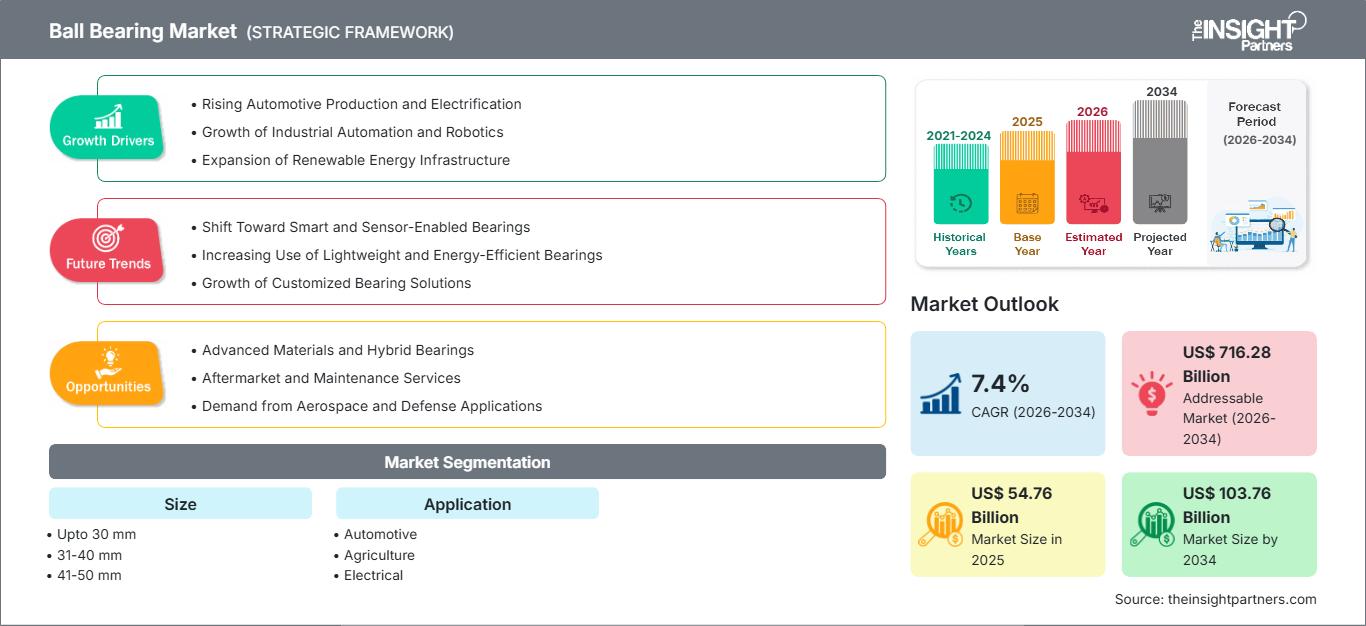
2025 Market Size
US$ 54.76 Bn
Base year value
2034 Forecast
US$ 103.76 Bn
Projected by 2034
CAGR 2026-2034
7.4 %
Growth rate
Addressable Market
US$ 716.28 Bn
(2026-2034)
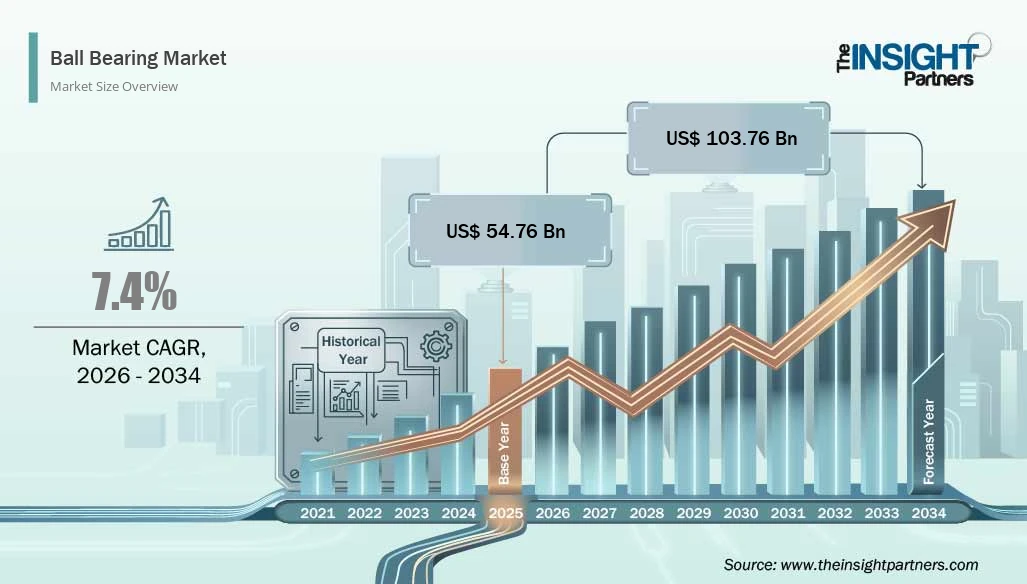
The Ball Bearing Market was valued at US$ 54.76 billion in 2025 and is projected to reach US$ 103.76 billion by 2034, registering a CAGR of 7.4% during the forecast period from 2026 to 2034. Ball bearings are critical mechanical components that reduce rotational friction and support radial and axial loads in machinery. Their applications span across multiple industry verticals, including automotive, aerospace, electrical equipment, agriculture, and heavy machinery. The market growth trajectory is underpinned by the accelerating demand from electric vehicle production, increasing industrial automation, and the expanding renewable energy sector that relies on these components for turbines and generators.
North America accounts for a substantial revenue share in the global ball bearing market, estimated between 14.69% in 2025, growing at a CAGR of approximately 6.2% through 2034. The region's growth is driven by the aerospace sector's stringent quality requirements and a strong aftermarket for automotive bearings. The U.S. leads this regional expansion, supported by a robust manufacturing base and ongoing investments in defense and aerospace applications. Moreover, the rising adoption of advanced manufacturing technologies such as Industry 4.0 necessitates high-precision bearings, further propelling market demand in this region.
Ball Bearing Market Assessment and Insights
- North America accounted for 14.69% share of the Ball Bearing Market in 2025, with a projected CAGR of 6.2% from 2026 to 2034. The region's growth is anchored by the aerospace industry's demand for high-precision bearings and the automotive sector's shift towards electric vehicles requiring specialized bearing solutions .
- US held a dominant position within North America, contributing 73.75% of the regional market share in 2025. The market is growing at a CAGR of 5.9% during the forecast period, driven by strong defense spending, aerospace manufacturing, and a resilient automotive aftermarket.
- Europe accounted for 19.23% share in 2025, with a CAGR of 7.1% through 2034. Germany, France, and the UK are leading countries, supported by a well-established automotive industry, stringent emission regulations promoting EV adoption, and a strong presence of bearing manufacturers such as Schaeffler AG and SKF AB.
- Asia Pacific dominated the global market with 58.52% share in 2025 and is growing at the highest CAGR of 7.9% from 2026 to 2034. China, Japan, India, and South Korea are the major contributors, driven by rapid industrialization, expanding automotive production, and favorable government policies supporting manufacturing .
- Largest Segment (Automotive) held a 33.93% market share in 2025 and is projected to grow at a CAGR of 7.3% from 2026 to 2034. The segment benefits from the global surge in electric vehicle production, which requires specialized, high-performance bearings for motors and drivetrains .
- High Growth Segment (Electrical) accounted for 13.40% share in 2025 and is growing at a CAGR of 8.9%. This segment is experiencing robust demand due to rising adoption of electric vehicles, growing use of electric motors in industrial and consumer applications, and increasing investments in renewable energy infrastructure such as wind turbines, driving the need for high-precision, low-friction bearing solutions.
- Key companies analyzed in detail: Scheerer Bearing Corporation, The Timken Co, RBC Bearings Incorporated, NSK Ltd, Schaeffler AG, SKF AB, Auburn Bearing & Manufacturing, NTN Corporation, JTEKT Corp, and Pacific Bearing Company.
Source: The Insight Partners' analysis based on proprietary research, government publications, company annual reports, investor presentations, industry databases, and expert interviews.
Technological innovation in the ball bearing market has been significant in the sense that while conventional steel bearings were initially produced, today's generation of the product involves ceramic and hybrid bearings that perform well under severe conditions. In terms of production, there have been significant changes in technology in the sense that the processes involved have become automated and digitized to increase precision and reduce production costs. Manufacturers are focusing more on research and development to produce bearings that can carry heavy loads, have low friction, and last longer. One of the significant innovations in the industry has been the use of sensor technologies in bearings to facilitate condition-based monitoring and predictive maintenance.
Emerging geographies including Southeast Asian and Latin American countries hold potential to drive the growth of the Ball Bearing Market forward in the coming years. There are increased investments in manufacturing activities in countries like Vietnam, Indonesia, and Mexico among others and therefore rising demand for bearings. Regulatory tailwinds such as government's encouragement for electric vehicles and renewables among others are also anticipated to drive market growth. With increased concerns about energy efficiency in various industrial activities, there will be high demand for low-friction bearings. Increased research and development in innovative materials including silicon nitride ceramics are also expected to result in longer service-life and reliability of bearings and therefore accelerate market growth.
Ball Bearing Market Report Scope
| Report Attribute | Details |
|---|---|
| Market size in 2025 | US$ 54.76 Billion |
| Market Size by 2034 | US$ 103.76 Billion |
| Global CAGR (2026 - 2034) | 7.4% |
| Historical Data | 2021-2024 |
| Forecast period | 2026-2034 |
Ball Bearing Market Analysis
Market Demand for the Ball Bearing is mainly fueled by the strong demand from the automotive industry, which remains the biggest buyer of ball bearings in the world. Growing adoption of electric vehicles (EVs) has become an important catalyst because electric powertrains need bearings that are able to perform at higher speeds and temperatures. In accordance with statistics of the International Energy Agency (IEA), sales of electric cars in 2025 reached 14 million units, which is much more than in the previous years. It directly affects the need for special bearings that would work in the conditions of electric cars. Moreover, agricultural and construction industries continue growing and adding to market development because ball bearings are widely used in the machinery, including tractors, harvesters, and excavators.
Competitive scenario in Ball Bearing Market is defined by the presence of global giants and specialized companies. The major participants in the market include SKF AB, Schaeffler AG, NSK Ltd, and The Timken Co, which have managed to capture a notable market share. These companies are taking measures to build up their position through investments in innovations, geographical expansions, and partnerships. Investment trends show that companies are making high investments in research and development to introduce bearings made up of novel materials and sensors. For example, investment in bearing with superior corrosion resistance properties and long fatigue life that are suitable for use in tough conditions like offshore wind turbines and marine application. There are strategic investments in acquisitions and partnerships to help expand portfolio and geographical regions. Specialized companies such as Auburn Bearing & Manufacturing and Pacific Bearing Company provide specialized bearings to cater unique needs.
● REPORT CUSTOMIZATION
Tailor This Report To Align With Your Specific Business Requirements
This report can be customized to align precisely with your business objectives, scope, and target markets. Customization options include tailored segmentation, geography, competitive analysis, and strategic insights to support informed decision-making.
Customize This Report →WHAT YOU CAN ADJUST
- ● Segmentations
- ● Geography
- ● Competitive Analysis
- ● Language Preferences
Ball Bearing Market: Strategic Insights
Regional Insights
North America Ball Bearing Market
The North American ball bearing market is projected to grow at a CAGR of 6.2% from 2026 to 2034. The major driving factors behind the expansion include the high-end aerospace and defense industries of the region which require high-quality precision bearings. The US is the biggest contributor in the market owing to a strong aftermarket of automotive bearings as well as increased industrial automation. Moreover, the increasing emphasis on renewable sources of energy, especially wind energy, in the region is driving the demand for large-diameter bearings used in wind turbines. Reshoring is another factor which will drive the demand for ball bearings in the coming years.
U.S. Ball Bearing Market
The U.S. market accounts for approximately 73.75% of the North American share and is growing at a CAGR of 5.9%. The country's dominance is attributed to its large aerospace industry, which includes major aircraft manufacturers and a robust defense supply chain. The automotive sector in the U.S. is also a significant consumer, with the growing production of electric vehicles driving demand for specialized bearings. Companies such as The Timken Co and RBC Bearings Incorporated have a strong presence, offering a wide range of products for diverse applications. The trend towards industrial automation and the adoption of Industry 4.0 technologies are further propelling market growth. Moreover, the U.S. government's initiatives to promote domestic manufacturing are expected to create additional opportunities for bearing manufacturers.
Europe Ball Bearing Market
The European market accounted for an estimated 19.23% share in 2025, with a CAGR of 7.1% through 2034. Germany remains the leading country, driven by its world-class automotive and industrial machinery sectors. The UK, France, and Italy are also significant markets, with their aerospace, automotive, and renewable energy industries contributing substantially to demand. Germany, being the hub of automotive manufacturing, continues to dominate the region, with a CAGR of approximately 6.5%. The UK market, valued at a significant share, is growing at a CAGR of 6.0%, supported by its aerospace and defense industries. France and Italy, with their industrial manufacturing and automotive sectors, exhibit CAGRs of 6.5% and 6.0%, respectively. The region's stringent environmental regulations are promoting the adoption of energy-efficient bearings, further driving market growth.
APAC Ball Bearing Market
The Asia Pacific region held the largest market share, estimated at 58.52% in 2025, and is growing at the highest CAGR of 7.9%. China is the dominant player, driven by its massive manufacturing base, growing automotive industry, and government initiatives such as "Made in China 2025". India is another key market, with rapid industrialization and infrastructure development fueling demand. Japan and South Korea are significant contributors, with their advanced automotive, electronics, and precision machinery industries. The region's growth is supported by favorable government policies, increasing foreign direct investment in manufacturing, and a rising middle class with growing purchasing power. The expanding renewable energy sector, particularly wind power in China and India, is also contributing to the demand for ball bearings.
Middle East & Africa Ball Bearing Market
The Middle East & Africa region is projected to grow at a CAGR of 5.3%. Saudi Arabia and the UAE are the leading countries, driven by their oil and gas, construction, and infrastructure development activities. South Africa is also a significant market, supported by its mining and automotive industries. The region's increasing focus on economic diversification and renewable energy projects, such as solar and wind power, is creating new opportunities for bearing manufacturers. Investments in large-scale infrastructure projects, including smart cities and transportation networks, are further stimulating demand. The market is characterized by the presence of international bearing manufacturers catering to the region's growing industrial needs.
Segmentation Analysis
Size
The Ball Bearing Market is segmented by size into Upto 30 mm, 31-40 mm, 41-50 mm, 51-60 mm, 61-70 mm, and 71 mm and Above. The 31-40 mm segment is expected to grow at a CAGR of 5.5% from 2026 to 2034. This segment holds a substantial market share due to its extensive application in automotive components, electric motors, and industrial machinery.
- Upto 30 mm: Bearings in this size range are extensively used in small electric motors, automotive accessories, and consumer appliances. Their compact design makes them ideal for applications requiring high precision and minimal space.
- 31-40 mm: This size range is widely adopted in automotive transmission systems, pumps, and compressors. The growing demand for energy-efficient automotive components is expected to bolster the growth of this segment.
- 41-50 mm: Bearings of this size are commonly used in medium-duty industrial machinery and agricultural equipment. Their robust design enables them to withstand moderate loads and speeds effectively.
- 51-60 mm: These bearings are typically employed in heavy-duty industrial applications, including construction equipment and large electric motors. Their ability to handle significant radial and axial loads enhances their operational reliability.
- 61-70 mm: Bearings in this range are utilized in demanding applications such as wind turbines and marine propulsion systems. Their large diameter allows them to support substantial loads encountered in these environments.
- 71 mm and Above: This segment caters to specialized industrial applications, including mining equipment and steel production machinery. Bearings in this category are designed for extreme load conditions and harsh operating environments.
Application
The market is segmented by application into Automotive, Agriculture, Electrical, Mining and Construction, Aerospace and Defense, and Others. The Automotive segment is projected to exhibit a CAGR of 7.3% from 2026 to 2034. The segment's dominance is driven by the global rise in automotive production and the increasing adoption of electric vehicles, which require highly efficient bearings for motors and drivetrains.
- Automotive: The automotive industry is the largest consumer of ball bearings, utilizing them in engines, transmissions, wheel hubs, and electric vehicle motors. The shift towards electric vehicles is creating new opportunities for specialized bearings with enhanced performance characteristics.
- Agriculture: Ball bearings are used in agricultural machinery such as tractors, harvesters, and irrigation systems. Their durability and reliability are crucial for equipment operating in harsh outdoor conditions and heavy-duty applications.
- Electrical: Bearings in this segment are utilized in electric motors, generators, and other electrical equipment. The growing demand for energy-efficient electrical machines is expected to drive the demand for high-precision bearings.
- Mining and Construction: This segment demands robust bearings capable of withstanding heavy loads, shock, and vibrations encountered in mining and construction equipment. The expansion of infrastructure projects globally is expected to contribute to market growth.
- Aerospace and Defense: The aerospace industry requires high-precision, lightweight bearings that can operate reliably under extreme temperatures and loads. The defense sector also contributes to demand, with applications in aircraft, naval vessels, and land-based military equipment.
Opportunity Snapshot
| Segment Name | Revenue Contribution | Trend Tag | Adoption Stage |
|---|---|---|---|
| Automotive | High | EV Transition | Scaling |
| Agriculture | Medium | Precision Farming | Mature |
| Electrical | Medium | Motor Efficiency | Scaling |
| Mining and Construction | Medium-High | Infrastructure Push | Mature |
| Aerospace and Defense | High | Lightweighting | Emerging |
Ball Bearing Market Growth Drivers and Impact Analysis
Electric Vehicle Production Surge Driving Bearing Demand
The increase in electric vehicle manufacturing is one of the major factors driving the Ball Bearing Market. Special bearings are required for electric drive systems which function at higher speeds and temperatures than the conventional Internal Combustion Engines. Low friction bearings are also required to make full use of the batteries' capacity and maximize the efficiency of the car. Industry experts estimate that over 20 million electric vehicles will be manufactured worldwide by 2030. This will create huge demand for efficient ball bearings. Bearing companies are working to develop innovative ceramic and hybrid bearings capable of meeting the special demands of EVs.
Industrial Automation and Industry 4.0 Adoption
The growing trend towards industrial automation, along with the application of Industry 4.0 concepts, is an important factor influencing the growth of the Ball Bearing market. Modern automated manufacturing operations need highly accurate ball bearings to ensure smooth and efficient functioning of robots, conveyors, and CNC machines. The development of IoT-enabled ball bearings will facilitate predictive maintenance, increase efficiency and help cut downtime. Manufacturers are creating smart ball bearings equipped with sensors measuring the temperature, vibration, and loads to generate the required data for condition monitoring. This innovative development is especially important for industries like automotive, aerospace, and electronics manufacturing. The need for efficient energy use is another factor encouraging the use of low-friction bearings.
Renewable Energy Sector Expansion
The fast growth of the renewable energy industry, especially wind energy production, will be an important factor for the Ball Bearing Market development. Ball bearings with high load capacity and big diameter will be needed in the shaft, gearbox, and yaw system of wind turbines. The installation of wind energy stations around the world under governmental incentives and due to environmental issues leads to an increase in demand for special ball bearings that will be applied in these stations. These ball bearings should have high wear resistance and be fatigue resistant because it is expensive and difficult to carry out repairs in offshore locations. Moreover, the fast development of solar and hydroelectric energy also stimulates the demand for ball bearings for this equipment.
Ball Bearing Market Future Trends
Integration of Smart Sensor Technologies
The development of the implementation of the smart sensor technology in ball bearings is one of the trends that will influence the future of the market. The smart ball bearings which have sensors can provide data related to the working parameters such as the temperature, vibrations, and loads. The implementation of the smart ball bearings will help to monitor the condition of the bearings as well as conduct the preventive maintenance. The implementation of this kind of technology in ball bearings will be stimulated by the tendency in the industry to minimize the downtimes and optimize the maintenance activities. It is worth mentioning that the data collected from the smart bearings can be analyzed through the use of AI algorithms in order to detect potential problems. The usage of smart bearings will be particularly important for the wind energy, aerospace, and manufacturing industries.
Advancements in Bearing Materials
The development of innovative materials for ball bearings is an important trend that is likely to increase the efficiency and expand the sphere of applications of such devices. The development of ceramic bearings made of materials like silicon nitride is considered to be better than that of traditional steel bearings in terms of increased hardness, density, corrosion resistance, and thermal resistance. The above properties provide the ceramic bearings with better suitability for the operation at high temperatures and high speeds of the rotating bodies, for example, the electric cars' motor parts. Moreover, hybrid bearings made of ceramic rolling elements and steel rings have recently attracted attention as an affordable alternative to the fully ceramic bearings. In addition, the development of innovative alloys and coatings of steel bearings is another area of scientific research.
Ball Bearing Market Opportunities
Expansion in Emerging Manufacturing Hubs
The shifting of manufacturing operations to developing nations such as Southeast Asian and South American countries offers many lucrative business prospects to the Ball Bearings Market. Nations like Vietnam, Thailand, Mexico, and Brazil are witnessing rapid industrialization and investments in automobile and electronics manufacturing through foreign direct investment. The process generates a need for a variety of ball bearings, ranging from common ball bearing types to specialized types designed specifically for certain applications. The manufacturing organizations have the possibility to set up local plants and make collaborations with regional distributors in order to cater to the rising demand. Moreover, these regions provide scope for cost-effective manufacturing.
Development of Specialized Bearings for Emerging Applications
The progress of emerging technologies and industrial applications is creating new opportunities for developing special bearings. The development of the renewable energy industry, such as offshore wind farms, will require bearings capable of operating in tough environmental conditions and having a long service life to decrease expenses related to maintenance operations. At the same time, the growth of the medical robotics industry and advanced surgical instruments will need special bearings characterized by high precision and reliability, as well as very clean bearings. The development of special bearings for electric airplanes and urban air mobility vehicles will provide another area of potential growth for the bearing manufacturing companies. Special bearings can be developed by bearing manufacturing companies based on their experience in materials science and precision engineering.
Recent Developments
- July 2026: Cosmo Eco Power Co., Ltd., a subsidiary of Cosmo Energy Holdings Co., Ltd., and NSK Ltd. are advancing multiple verification experiments in a joint initiative aimed towards securing stable operation long-term and enhancing operations and maintenance (O&M) in wind turbines. As part of this initiative, the first field test of proprietary technology from NSK for monitoring bearing lubrication conditions in wind power generation equipment was conducted, confirming its applicability for practical operations. This technology enables earlier detection of changes in bearing conditions and is expected to help enhance wind turbine reliability and improve maintenance efficiency.
- May 2026: NTN Corporation has commenced efforts to establish a local manufacturing capability in China for its “Resin Mold Insulated Bearings” for e-Axles, a drivetrain unit of electric vehicles (EVs) and hybrid electric vehicles (HEVs), with a view toward future mass production.
- September 2025: The SKF Super-precision centre in Airasca, Italy, has been inaugurated. This highly automated facility with a digitally connected environment is SKF’s new global centre of excellence for Super-precision bearings. It includes all key functions to drive innovation, efficiency, and customer value for high-performance bearing solutions. The Airasca facility integrates SKF’s manufacturing operations, business support functions, R&D, product line management, and engineering competence resources into a single, collaborative environment.
Frequently Asked Questions

- Comprehensive Market Sizing and Forecast Analysis
- Detailed Segmentation Analysis
- In-Depth Market Dynamics Assessment
- Regional and Country-Level Insights
- Competitive Landscape and Company Benchmarking
- Strategic Business Intelligence
Recent Reports
Testimonials

The Insight Partners provided valuable market intelligence that supported our global go-to-market strategy. Their team was professional, responsive, and attentive to our feedback, providing thoughtful analysis and helpful methodological clarifications throughout the project.
Junmo Kim Chief Financial Officer (CFO), Enertech Co., Ltd.
The Insight Partners' SCADA System Market report is comprehensive, with valuable insights on current trends and future forecasts. The team was highly professional, responsive, and supportive throughout. We are very satisfied and highly recommend their services.
RAN KEDEM Partner, Reali Technologies LTDs
I requested a report on a very specific software market and the team produced the report in a few days. The information was very relevant and well presented. I then requested some changes and additions to the report. The team was again very responsive and I got the final report in less than a week.
JEAN-HERVE JENN Chairman, Future Analytica
We worked with The Insight Partners for an important market study and forecast. They gave us clear insights into opportunities and risks, which helped shape our plans. Their research was easy to use and based on solid data. It helped us make smart, confident decisions. We highly recommend them.
PIYUSH NAGPAL Sr. Vice President, High Beam Global
The Insight Partners delivered insightful, well-structured market research with strong domain expertise. Their team was professional and responsive throughout. The user-friendly website made accessing industry reports seamless. We highly recommend them for reliable, high-quality research services
YUKIHIKO ADACHI CEO, Deep Blue, LLC.
This is the first time I have purchased a market report from The Insight Partners.While I was unsure at first, I visited their web site and felt more comfortable to take the risk and purchase a market report.I am completely satisfied with the quality of the report and customer service. I had several questions and comments with the initial report, but after a couple of dialogs over email with their analyst I believe I have a report that I can use as input to our strategic planning process.Thank you so much for taking the extra time and making this a positive experience.I will definitely recommend your service to others and you will be my first call when we need further market data.
JOHN SUZUKI President and Chief Executive Officer, Board Director, BK Technologies
I wish to appreciate your support and the professionalism you displayed in the course of attending to my request for information regarding to infectious disease IVD market in Nigeria. I appreciate your patience, your guidance, and the fact that you were willing to offer a discount, which eventually made it possible for us to close a deal. I look forward to engaging The Insight Partners in the future, all thanks to the impression you have created in me as a result of this first encounter.
DR CHIJIOKE ONYIA MANAGING DIRECTOR, PineCrest Healthcare Ltd.Reason to Buy
- Informed Decision-Making
- Understanding Market Dynamics
- Competitive Analysis
- Identifying Emerging Markets
- Customer Insights
- Market Forecasts
- Risk Mitigation
- Boosting Operational Efficiency
- Strategic Planning
- Investment Justification
- Tracking Industry Innovations
- Aligning with Regulatory Trends





 Get Free Sample for