
Roller Bearing Market Size, Growth & Trends by 2034
Coverage: By Size (Upto 30 mm, 31-40 mm, 41-50 mm, 51-60 mm, 61-70 mm, 71 mm and Above); Application (Automotive, Agriculture, Electrical , Mining and Construction, Aerospace and Defense, Others), and Geography
- Status : Published
- Report Code : TIPRE00043878
- Category : Manufacturing and Construction
- No. of Pages : 224
- Available Report Formats :


- Last update date : September 01, 2026


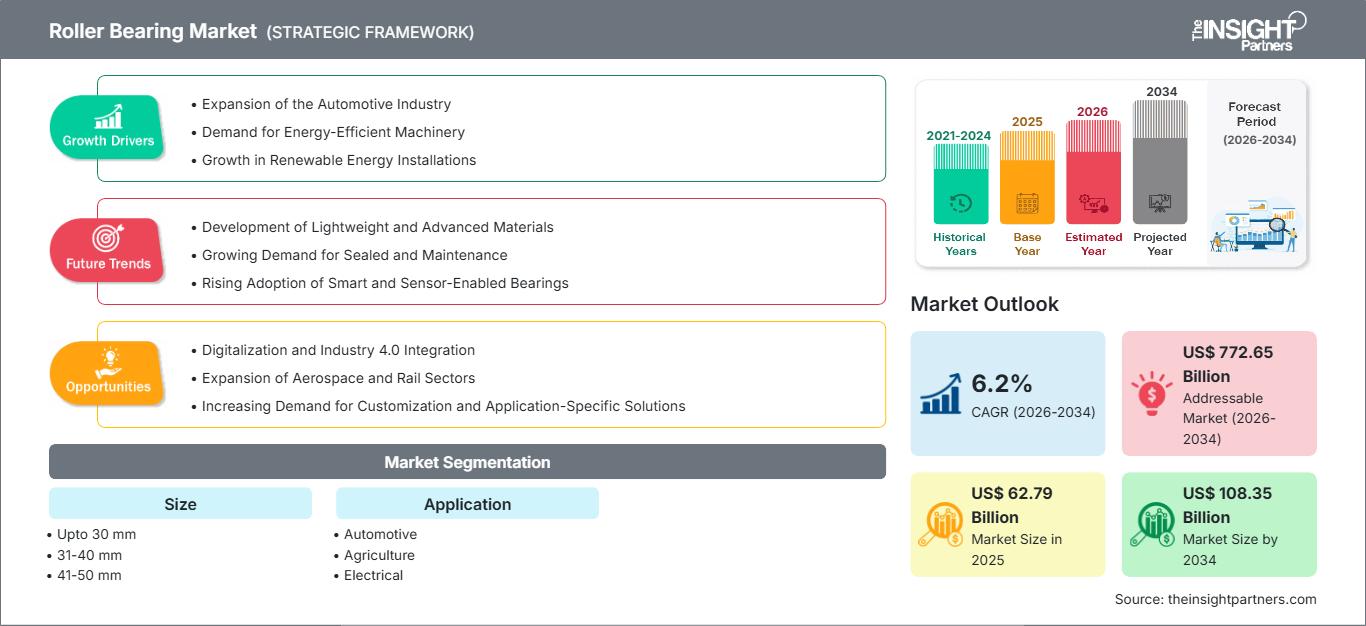
2025 Market Size
US$ 62.79 Bn
Base year value
2034 Forecast
US$ 108.35 Bn
Projected by 2034
CAGR 2026-2034
6.2 %
Growth rate
Addressable Market
US$ 772.65 Bn
(2026-2034)
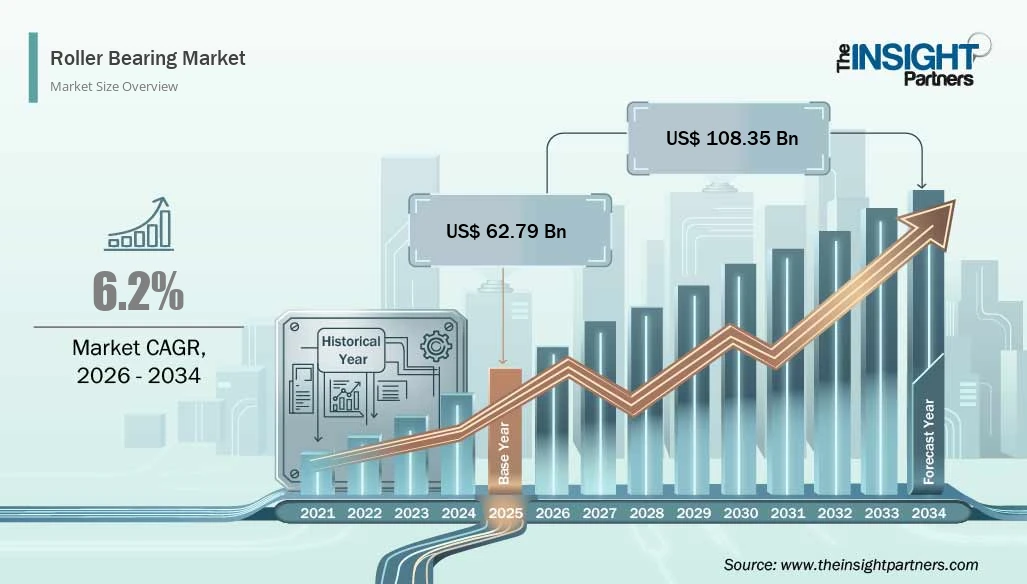
The global Roller Bearing Market was valued at US$ 62.79 billion and is projected to reach US$ 108.35 billion by 2034, registering a compound annual growth rate (CAGR) of 6.2% from 2026 to 2034. Roller bearings are critical mechanical components that utilize cylindrical, spherical, or tapered rolling elements to reduce friction while supporting heavy radial and axial loads across diverse industrial applications. These components are fundamental to the operation of automotive drivetrains, industrial machinery, aerospace systems, mining equipment, and renewable energy infrastructure. The market's growth trajectory is underpinned by accelerating global industrialization, expanding automotive production, and the rising adoption of automation across manufacturing sectors. According to the International Organization of Motor Vehicle Manufacturers (OICA), global vehicle production surpassed 93 million units in 2024, with continued growth expected in 2025, directly stimulating bearing consumption across wheel hubs, transmissions, and electric drivetrain applications . Furthermore, increasing investments in renewable energy, particularly wind power installations which grew by 13% in 2024 according to the International Renewable Energy Agency, generate substantial demand for heavy-duty bearings capable of withstanding extreme operational conditions.
The North America Roller Bearing Market is projected to grow at a CAGR of 5.3% during the forecast period, driven by robust aerospace and defense spending, a resilient automotive manufacturing base, and ongoing industrial automation initiatives. The region benefits from substantial investments in manufacturing reshoring and advanced production technologies, with the U.S. Department of Energy allocating US$ 17 billion in loan authority to support domestic battery supply chains, which includes components such as low-friction bearings used in electric vehicle motors. Additionally, the European Bearing Manufacturers Association has emphasized the necessity of sustainable manufacturing practices, advocating for the use of eco-friendly materials and processes in bearing production across the region.
Roller Bearing Market Assessment and Insights
- North America held a market share of 14.69% in 2025 and is projected to grow at a CAGR of 5.3% from 2026 to 2034. The region's growth is driven by aerospace and defense investments, automotive manufacturing recovery, and industrial reshoring initiatives that stimulate demand for precision motion components across heavy machinery and transportation sectors.
- US accounted for 73.75% of the North American market in 2025 and is expected to grow at a CAGR of 4.9%. The country's advanced manufacturing ecosystem, robust automotive sector, and expanding aerospace and heavy machinery industries drive demand for industrial-grade roller bearings .
- Europe held a market share of 19.23% in 2025, growing at a CAGR of 5.9%. Germany, France, and Italy represent the leading markets, with Germany's automotive manufacturing and precision engineering sectors driving substantial demand. The European Green Deal and Horizon Europe program funding accelerate adoption of energy-efficient bearing solutions.
- Asia Pacific accounted for 58.52% of the global market in 2025 and is projected to grow at a CAGR of 6.8%. China, Japan, India, and South Korea are major contributors, driven by expansive manufacturing operations, rapid urbanization, and strong automotive production. Japan's technological leadership in precision bearings and China's industrial policy support further strengthen the region's position .
- Largest Segment: The Automotive segment held the largest market share of 33.93% in 2025, with a projected CAGR of 6.2%. Bearings are integral to engines, transmissions, wheel hubs, and steering systems. The accelerating transition toward electric vehicles reshapes demand, requiring specialized bearings for high-speed electric motors, drivetrains, and advanced transmission systems .
- High Growth Segment: The Electrical segment is projected to grow at a CAGR of 7.7%. This segment demands bearings capable of operating at high speeds, resisting electrical pitting, and delivering extended service life in motors, generators, and pumps used across industrial and commercial applications.
- Key companies analyzed in detail: Scheerer Bearing Corporation, The Timken Co, RBC Bearings Incorporated, NSK Ltd, Schaeffler AG, SKF AB, Auburn Bearing & Manufacturing, NTN Corporation, JTEKT Corp, Pacific Bearing Company.
Source: The Insight Partners' analysis based on proprietary research, government publications, company annual reports, investor presentations, industry databases, and expert interviews.
The Roller Bearing Market is experiencing tremendous changes due to innovations in material sciences and manufacturing techniques. Steel bearings have been gradually replaced by improved ceramic and hybrid alternatives which are known for their better durability and performance in harsh conditions. Companies are focusing on advanced grinding techniques and automation of cage production, in addition to innovative sealing techniques to improve the performance and life span of bearings. In fact, the inclusion of smart sensors for monitoring performance is changing the face of the industry, with companies moving from selling components to offering performance-based services. Indeed, according to the U.S. Department of Energy, industrial motors use more than 50% of all the energy used in manufacturing operations. This makes efficient, low friction, and high-performance bearings very important for saving energy and reducing costs. As industries demand bearings that can operate at faster speeds, carry more loads, and function in harsher conditions, innovations in bearings become imperative.
Market forecast indicates that new geographic markets, especially countries from Southeast Asia and Middle Eastern regions, offer significant growth prospects owing to their growth in terms of infrastructure development. The growing global emphasis on energy efficiency and carbon emission reduction is resulting in favorable market regulation trends regarding adoption of frictionless and high-performing bearings in automotive, industrial, and renewable energy sectors. The European Union’s Horizon Europe funding scheme invested around EUR 1.2 billion in 2023 in research and innovation projects concerning advanced manufacturing technologies, which includes machine parts such as roller bearings. Investment in manufacturing capacity of electric vehicles, increased wind energy production capacity, and robotics in the industry sector constitute the primary drivers for the market.
Roller Bearing Market Report Scope
| Report Attribute | Details |
|---|---|
| Market size in 2025 | US$ 62.79 Billion |
| Market Size by 2034 | US$ 108.35 Billion |
| Global CAGR (2026 - 2034) | 6.2% |
| Historical Data | 2021-2024 |
| Forecast period | 2026-2034 |
Roller Bearing Market Analysis
The demand for roller bearings is inherently intertwined with the well-being of the downstream industries, namely automobile manufacturing, industrial machinery manufacturing, and aerospace assembling. Increased global production of automobiles drives an increase in the consumption of bearings, as reported by the International Organization of Motor Vehicle Manufacturers. Indeed, vehicle production increases have been noted in important areas, namely more than 12.1 million units (+11%) in the European Union, more than 25.3 million units (+9%) in China, and 7.6 million units (+8.5%) in the United States in 2024 . Another important aspect is the growing use of electric vehicles, which implies that bearings are needed for powertrains of these vehicles. In particular, the bearings should operate at higher speeds, resist electrical pitting, and fit into the compact assembly of motors. According to the U.S. Department of Energy, there was an increase of 40% in sales of electric vehicles in the United States in 2023, indicating the need for bearings as an important component of such automobiles . The industrial machinery industry has strong demand due to automation of manufacturing process and implementation of robots and other smart technologies. Indeed, the National Institute of Standards and Technology notes that the industrial machinery and equipment remains one of the most valuable industries in U.S. manufacturing, thus indicating the increasing demand for roller bearings as industrial machinery cannot function effectively without them . The value chain for roller bearings includes the procurement of raw materials, namely high-carbon chromium bearing steel and various special alloys, manufacturing process, and distribution networks. Supply factors include the supply and price of special steels, ceramics, and plastics.
The competitive structure of the Roller Bearing Market is dominated by global market leaders together with specialized regional producers. Some of the key market incumbents are SKF AB, Schaeffler AG, NSK Ltd, NTN Corporation, JTEKT Corp, and The Timken Company. All these players have considerable shares in the global market due to diverse product range, broad geographical presence and large amounts of R&D expenses. In recent years, all these incumbents have been actively pursuing innovation strategies aimed at development of hybrid bearings, smart bearings with condition monitoring system and environmentally-friendly products. In February 2023, The Timken Company made an acquisition of American Roller Bearing Company in order to expand its portfolio of engineered bearings and strengthen its presence in the US market . Another example of new products release is NJ23-ILR series of cylindrical roller bearings introduced by Schaeffler AG in March 2024. This new product line is characterized by 24% higher dynamic load capacity than previous version and is designed for heavy duty industrial gearboxes and construction machinery . Current investment trends are related to automation in production facilities, digitalization of services and acquisitions that help companies to broaden their product range and geographic coverage. One more important feature of competition in Roller Bearing Market is associated with regional players from Asia Pacific that improve their positions by cost efficient production and proximity to fast growing end markets. Strategic partnerships between bearing manufacturers and original equipment makers become very popular nowadays.
● REPORT CUSTOMIZATION
Tailor This Report To Align With Your Specific Business Requirements
This report can be customized to align precisely with your business objectives, scope, and target markets. Customization options include tailored segmentation, geography, competitive analysis, and strategic insights to support informed decision-making.
Customize This Report →WHAT YOU CAN ADJUST
- ● Segmentations
- ● Geography
- ● Competitive Analysis
- ● Language Preferences
Roller Bearing Market: Strategic Insights
Regional Insights
North America Roller Bearing Market
The North America Roller Bearing Market is estimated to account for 14.69% of the global market share in 2025, with a projected CAGR of 5.3% from 2026 to 2034. Growth in the region is driven by large investments made in aerospace and defense sectors, a robust automotive manufacturing sector and an active industrial aftermarket. Reshoring and strengthening of the country’s supply chains by the U.S. government has been fueling manufacturing activities, with industries like heavy equipment, automotive and aerospace being the primary sources of demand for precision bearings. The $17 billion loan facility provided by the U.S. Department of Energy to support the domestic battery supply chain entails parts like low-friction bearings used in electric motors, which helps drive growth in the roller bearings segment in the energy industry. The aerospace sector requires bearings that are ultra-reliable and have excellent performance capabilities in engines, landing gears, and control systems. Moreover, adoption of industrial automation and robotics technologies in manufacturing and logistics facilities boosts the market growth by generating demand for conveyor bearings, robotic arms, and automatic assembly line bearings.
U.S. Roller Bearing Market
The U.S. Roller Bearing Market accounted for 73.75% of the North American share in 2025 and is projected to grow at a CAGR of 4.9% during the forecast period . The markets in the country have been bolstered by an extremely strong auto manufacturing industry, massive defense budgets, and huge manufacturing of machinery equipment. The automotive manufacturing sector generated an estimated US$ 522 billion worth of GDP in 2023 according to the U.S. Bureau of Economic Analysis. This shows the huge demand for roller bearings needed in the manufacture of such machines. The transition into electric automobiles will result in increased demand for roller bearings that fit into electric drivetrain components. The manufacturing output rose by more than 6.4% according to the U.S. Bureau of Labor Statistics, and this was due to automation techniques and energy technology adoption in the manufacturing industry. Prominent companies like The Timken Company and SKF are constantly developing and researching on new materials to meet the changing performance requirements. Government infrastructure projects and increasing defense budgets continue to expand the addressable market in the U.S.
Europe Roller Bearing Market
The Europe Roller Bearing Market captured 19.23% of the global share in 2025 and is projected to grow at a CAGR of 5.9% from 2026 to 2034. Germany is the most developed market in the region in terms of technological capabilities due to its highly developed automotive industry, precision engineering skills, and the manufacture of industrial machines. According to the German Association of the Automotive Industry, Germany manufactured about 4.7 million passenger cars in 2023, thus, there was a great demand for high-quality roller bearings, which were needed for engines, transmissions, and wheels. The French and Italian markets are also significant due to well-developed aerospace, automotive, and industrial machinery industries. The United Kingdom market is driven by the aerospace and defense industries and industrial manufacturing. The Spanish market is developing due to growth in the automotive industry and infrastructural projects. The European market is defined by a high level of demand for custom-engineered bearings that need to demonstrate good performance and sustainability. The increasing demand for electric vehicles in Europe has caused a demand for customized bearings in electric drives, while industrial automation leads to increased demand in manufacturing and logistics.
APAC Roller Bearing Market
The Asia Pacific Roller Bearing Market accounted for 58.52% of global share in 2025 and is projected to grow at a CAGR of 6.8%, the highest among all regions . China, Japan, India, and South Korea are the dominant markets that drive the demand for the products through large-scale manufacturing, automotive production, and industrialization. China is the world’s largest buyer and manufacturer of roller bearings with its industrial policy emphasizing domestic value chain development and innovation. India and China are making huge investments in infrastructure with an investment of US$ 1.2 trillion in infrastructure projects by 2025 for China and smart city and transport related projects by India. This makes the prospects of growth in the heavy machinery and automotive industry. Japan leads in the area of precision bearings technology with firms like NSK Ltd and NTN Corporation at the forefront of developments in bearings specific to EVs, robotics and aerospace.
Middle East & Africa Roller Bearing Market
The Middle East and Africa Roller Bearing Market is projected to grow at a CAGR of 4.2% from 2026 to 2034, driven by economic diversification strategies, infrastructure investment, and energy sector activities . Saudi Arabia and the United Arab Emirates are among the key regional markets where major infrastructure development, petrochemical and industrial development projects have been implemented through government backing to drive demand in pumps, compressors, heavy machinery and construction machinery. Initiatives such as Vision 2030 in Saudi Arabia and development of industrial corridors in Africa are driving growth in the market. The South African market is considered as one of the key markets in Africa, and demand in this market is driven by mining, automotive and industrial sectors. Growth potential in the region is supported by developments in renewable energy projects, especially wind and solar energy projects that require special bearings for the operation of turbines and tracking system. Growing construction activities and urbanization in GCC countries are boosting consumption of bearings in construction and transportation equipment.
Segmentation Analysis
Size
The Roller Bearing Market is segmented by size into Upto 30 mm, 31-40 mm, 41-50 mm, 51-60 mm, 61-70 mm, and 71 mm and Above, with the 51-60 mm segment projected to grow at a CAGR of 7.0-6.6% from 2026 to 2034. This size range serves medium-to-heavy-duty industrial applications including construction equipment, mining machinery, and large industrial gearboxes. The segment's growth is anchored by infrastructure investment, mining activities, and the expansion of renewable energy projects requiring robust bearing solutions. Cylindrical roller bearings in this size range are particularly important for industrial motors, which account for over 50% of total energy consumption in manufacturing, as they play a crucial role in improving operational efficiency . Manufacturers are focusing on optimizing the load capacity, friction characteristics, and operational lifespan of bearings within this size range, with companies like NSK developing high-load cylindrical roller bearings with up to 23% higher basic load rating.
- Upto 30 mm: Serves precision applications in automotive systems, electric motors, and small machinery. Demand is driven by the miniaturization trend in automotive components and the growing production of compact electric motors for consumer and industrial applications.
- 31-40 mm: Widely used in automotive wheel hubs, transmissions, electric motors, and agricultural machinery. Growth is anchored by automotive production volumes and the rising adoption of electric vehicles requiring specialized bearings.
- 41-50 mm: Addresses medium-duty industrial applications including conveyor systems, pumps, compressors, and agricultural equipment. Demand correlates with industrial production levels and infrastructure development activities.
- 51-60 mm: Used in heavy-duty applications such as construction equipment, mining machinery, wind turbine gearboxes, and large industrial gearboxes. Growth is linked to infrastructure investment, mining activities, and renewable energy expansion.
- 61-70 mm: Serves heavy industrial and energy sector applications, including wind turbine main shafts, marine propulsion systems, and large compressors. Demand is driven by renewable energy investments and industrial capacity expansion.
- 71 mm and Above: Addresses specialized heavy machinery applications including mining equipment, steel mills, and large-scale industrial processing facilities. Growth is relatively stable, tied to capital-intensive industries and major infrastructure projects.
Application
The Automotive application segment, projected to grow at a CAGR of 6.2% from 2026 to 2034, remains the dominant end-use sector for roller bearings. Bearings are integral to engines, transmissions, wheel hubs, steering columns, and suspension systems in internal combustion vehicles, while electric vehicles require specialized bearings for high-speed motors, drivetrain components, and battery systems . The global shift toward electric mobility is fundamentally reshaping automotive bearing demand, with EV-specific requirements including high-speed capability, electrical insulation, lightweight construction, and extended maintenance intervals. According to the International Organization of Motor Vehicle Manufacturers, aggregated global vehicle production is estimated to exceed 100 million units by 2025, hence increasing the demand for roller bearings . Leading manufacturers are developing dedicated EV bearing solutions, such as Schaeffler Group's VoltPath Shunt Bearing and TriFinity Wheel Bearings, designed specifically for e-mobility applications. The growth of the automotive sector, supported by global vehicle production volumes and the rapid penetration of electric vehicles, ensures sustained demand across the forecast period.
- Automotive: The dominant segment, encompassing bearings for engines, transmissions, wheel hubs, steering systems, suspension systems, and EV motors. Growth is driven by global vehicle production, electric vehicle adoption, and emissions reduction mandates .
- Agriculture: Serves farm machinery, tractors, and harvesting equipment, requiring durable bearings capable of withstanding harsh operating conditions, dust, and moisture.
- Electrical: Includes bearings for electric motors, generators, and pumps used in industrial, commercial, and residential applications. Industrial motors alone account for more than half of total energy consumption in manufacturing, driving demand for energy-efficient bearing solutions.
- Mining and Construction: Addresses heavy machinery used in extraction, material handling, and construction activities. Bearings must withstand extreme loads, contamination, and shock loading in harsh operating environments.
- Aerospace and Defense: The highest value segment, requiring ultra-precision, lightweight bearings capable of extreme temperature and pressure operation. Growth is driven by commercial aviation expansion and defense modernization programs.
- Others: Encompasses renewable energy equipment, robotics, medical devices, and consumer appliances, representing diverse and growing application areas.
Opportunity Snapshot
| Segment | Revenue Contribution | Trend Tag | Adoption Stage |
|---|---|---|---|
| Automotive | High | EV Transition | Scaling |
| Aerospace & Defense | Medium-High | Lightweighting | Mature |
| Mining & Construction | Medium | Automation | Scaling |
| Agriculture | Medium | Precision Farming | Scaling |
| Electrical | Medium-High | Energy Efficiency | Mature |
Roller Bearing Market Growth Drivers and Impact Analysis
Accelerating Electric Vehicle Production and Automotive Electrification
The shift towards electric cars is a revolutionary driving force behind the Roller Bearing market, which will change the way demand emerges and functions. Electric cars have unique requirements on the bearings used in electric motors, drivetrain and battery, since their characteristics differ significantly from those required in internal combustion engines. According to the International Energy Agency, more than 17 million electric cars were sold worldwide in 2024, accounting for 20% of all car sales, and further growth is expected. The U.S. Department of Energy stated that the number of EVs bought in America in 2023 has grown by 40%, and it is likely because of the increasing need for high-quality bearings. The EV motors tend to rotate at higher speeds than IC engines, therefore better heat management is needed, and friction and durability are improved as well. In addition, the danger of electrical pitting due to stray currents traveling through motor shafts requires special insulating coating and ceramic rolling elements, which results in additional premium products in the market. Emissions regulations and incentives for customers make major markets of automobiles switch to electric cars, thus making the demand for bearing solutions grow rapidly.
Rapid Expansion of Industrial Automation and Robotics
One of the major factors driving the Roller Bearings Market growth is the increasing automation in the manufacturing and logistics sectors as well as the service industry. Automated machinery and robots use precision motion control equipment which includes bearings to facilitate smooth and accurate operation of robotic arms, conveyors, automated guided vehicles, and machine tools. The global market for industrial robots is constantly growing as more industries adopt automation techniques to boost efficiency, cut down on expenses, and achieve high product quality. Technologies associated with Industry 4.0 such as smart manufacturing, digital twins, and predictive maintenance systems all need bearings that are able to perform with utmost accuracy and very low friction levels and have built-in monitoring systems. The growth in manufacturing sector production, which increased by 6.4% according to the U.S. Bureau of Labor Statistics, indicates greater industrial activity thanks to automation techniques and energy technologies . In 2023, the European Union allocated EUR 1.2 billion through Horizon Europe program to promote advanced manufacturing technologies, including machinery parts such as roller bearings . As automation technology expands into emerging areas such as healthcare logistics, warehousing, and e-commerce, the potential industrial bearings market continues to grow.
Renewable Energy Infrastructure Investment
Globally, investments into renewable energy infrastructure, especially wind energy, present high demand for highly specialized roller bearings that can withstand harsh operating conditions. Bearings used in wind turbines are large-size and high-load capacity bearings used in main shafts, gear boxes, and yaw/pitch control system of wind turbines, with such specifications as high endurance, corrosion resistance, and reliability throughout their operating period. According to International Renewable Energy Agency, there is a 13% increase in global installations of wind energy in 2024, where roller bearings form one of the essential elements of efficiency in applications of wind turbines. Tax breaks, renewables portfolio standards, and mandates on green energy contribute to consistent investments into development of wind farms, thus positively affecting manufacturers of highly specialized roller bearings used in such an environment. The U.S. Department of Energy and the National Renewable Energy Laboratory are financing tribology projects focused on enhancing reliability of drivetrain in wind turbines, which has direct influence on bearing performance under extreme load and speeds. Companies producing highly specialized roller bearings for the wind energy industry develop novel designs of bearings with innovations in sealings, condition monitoring, and materials.
Roller Bearing Market Future Trends
Integration of Smart Bearing Technologies and Condition Monitoring
The integration of sensor technologies and digital intelligence into roller bearing products represents a transformative trend reshaping the industry's value proposition. Smart bearings equipped with micro-sensors capable of monitoring vibration, temperature, and load in real-time enable predictive maintenance strategies that reduce downtime, extend equipment life, and optimize operational efficiency . These intelligent components transmit performance data to industrial internet of things platforms, facilitating condition-based maintenance and eliminating costly, unnecessary bearing replacements. The trend toward digitalization of service offerings is changing the bearing industry from purely component sales to long-term performance partnerships, creating recurring revenue streams and customer loyalty. Manufacturers are investing in development of bearing-integrated sensor solutions, wireless communication capabilities, and advanced analytics that provide actionable insights to end-users. This trend is particularly relevant in high-value applications including aerospace, wind energy, and industrial machinery, where unplanned downtime carries significant operational and financial consequences. As digital technologies become more cost-effective and ubiquitous, smart bearing adoption is expected to expand across broader application segments, creating differentiation opportunities for technologically advanced manufacturers.
Advancements in Bearing Materials and Hybrid Technologies
Continuous innovation in bearing materials, particularly the adoption of ceramic and hybrid bearing technologies, represents a defining trend in the Roller Bearing Market. Ceramic bearings incorporating silicon nitride rolling elements offer superior hardness, wear resistance, and corrosion protection compared to conventional steel bearings, enabling operation at higher speeds with reduced friction and extended service life. Hybrid bearings combining steel rings with ceramic rolling elements deliver an optimal balance of performance and cost, making them increasingly attractive for automotive, aerospace, and industrial applications. The growing demand for bearings capable of operating in extreme environments, including high temperatures, corrosive conditions, and high-speed applications, drives material innovation and adoption. Manufacturers such as NSK have produced high-load cylindrical roller bearings specifically for electric vehicles which improve operational efficiency and enhance the durable capacity of their bearings . Additionally, the development of advanced lubricants, specialized coatings, and engineered polymers for bearing cages and seals further enhances performance and reliability. As industries prioritize energy efficiency, extended maintenance intervals, and operational reliability, the trend toward advanced materials and hybrid technologies is expected to accelerate, creating product differentiation opportunities for innovative manufacturers.
Roller Bearing Market Opportunities
Aerospace and Defense Modernization Programs
Significant growth opportunities exist in the aerospace and defense sector, where expanding commercial aviation demand and defense modernization programs drive requirements for ultra-precision, high-performance bearings. Commercial aircraft production continues to recover from pandemic-related disruptions, with backlogs of narrow-body and wide-body aircraft supporting sustained demand for landing gear bearings, engine bearings, and control system components. Defense modernization efforts, particularly in the US, Europe, and Asia Pacific, create demand for bearings used in military aircraft, naval vessels, and ground vehicles. The aerospace segment demands bearings capable of operating under extreme conditions, including high temperatures, cryogenic environments, and intense vibration, requiring specialized materials, precision engineering, and rigorous quality assurance. Manufacturers capable of meeting stringent aerospace standards and delivering customized engineered solutions can capture premium pricing and establish long-term supply relationships. The trend toward lightweighting in aircraft design further drives innovation, with manufacturers developing advanced hybrid bearings that reduce weight while maintaining performance. Additionally, the growing space exploration and satellite deployment sector presents niche opportunities for bearings used in launch vehicles, spacecraft mechanisms, and satellite positioning systems, offering high-value, low-volume applications with demanding technical requirements.
Expansion in Emerging Industrial Economies
The rapid industrialization of emerging economies, particularly in Southeast Asia, South Asia, and parts of Africa, presents substantial growth opportunities for the Roller Bearing Market. These regions are experiencing accelerated infrastructure development, manufacturing capacity expansion, and increasing automotive production, directly stimulating bearing demand. Government policies promoting domestic manufacturing, foreign investment, and technology transfer create favorable conditions for bearing suppliers to establish or expand regional presence. The relocation of manufacturing activities from China to Southeast Asian countries, driven by supply chain diversification strategies, further amplifies demand in these emerging markets. Suppliers with established distribution networks, localized production capabilities, and customer relationship management systems can capture market share in these high-growth regions. Additionally, the aftermarket segment in emerging economies presents significant opportunities, as growing machinery and equipment installed bases require ongoing maintenance and replacement bearings. Manufacturers that adapt product offerings to local requirements, offer cost-effective solutions without compromising quality, and establish strong channel partnerships can leverage this demographic and economic tailwind. As these economies develop and industrialize, per capita bearing consumption is expected to converge with developed market levels, unlocking substantial long-term growth potential.
Recent Developments
- May 2026: NTN Corporation has commenced efforts to establish a local manufacturing capability in China for its “Resin Mold Insulated Bearings” for e-Axles, a drivetrain unit of electric vehicles (EVs) and hybrid electric vehicles (HEVs), with a view toward future mass production.
- April 2026: Schaeffler, the Motion Technology Company, has agreed a strategic technology partnership in the field of humanoid robotics with the Swiss company Hexagon Robotics. The cooperation centers on the development and supply of high-precision strain wave and planetary gear actuators from Schaeffler's actuator platform, winner of Deutsche Messe's Hermes Award. This move sees the company systematically bringing its core competence in power transmission to the development of humanoid robotic systems. Moreover, Schaeffler is also planning to deploy at least one thousand humanoid robots from Hexagon Ro botics in its global production system within the next seven years. Schaeffler provides an extensive product portfolio for humanoid robotics – from roller bearings, precision drives, motors and sensors through to thermal and battery management.
- September 2025: NTN Corporation has announced plans to expand the production capacity of aerospace bearings at its Argonay Plant in France, operated by its consolidated subsidiary NTN Europe S.A. (Headquarters: Annecy, France, hereafter, NTN Europe) This decision reflects the strong recovery of the aviation market and expectations for sustained future growth.
Frequently Asked Questions

- Comprehensive Market Sizing and Forecast Analysis
- Detailed Segmentation Analysis
- In-Depth Market Dynamics Assessment
- Regional and Country-Level Insights
- Competitive Landscape and Company Benchmarking
- Strategic Business Intelligence
Recent Reports
Testimonials

The Insight Partners provided valuable market intelligence that supported our global go-to-market strategy. Their team was professional, responsive, and attentive to our feedback, providing thoughtful analysis and helpful methodological clarifications throughout the project.
Junmo Kim Chief Financial Officer (CFO), Enertech Co., Ltd.
The Insight Partners' SCADA System Market report is comprehensive, with valuable insights on current trends and future forecasts. The team was highly professional, responsive, and supportive throughout. We are very satisfied and highly recommend their services.
RAN KEDEM Partner, Reali Technologies LTDs
I requested a report on a very specific software market and the team produced the report in a few days. The information was very relevant and well presented. I then requested some changes and additions to the report. The team was again very responsive and I got the final report in less than a week.
JEAN-HERVE JENN Chairman, Future Analytica
We worked with The Insight Partners for an important market study and forecast. They gave us clear insights into opportunities and risks, which helped shape our plans. Their research was easy to use and based on solid data. It helped us make smart, confident decisions. We highly recommend them.
PIYUSH NAGPAL Sr. Vice President, High Beam Global
The Insight Partners delivered insightful, well-structured market research with strong domain expertise. Their team was professional and responsive throughout. The user-friendly website made accessing industry reports seamless. We highly recommend them for reliable, high-quality research services
YUKIHIKO ADACHI CEO, Deep Blue, LLC.
This is the first time I have purchased a market report from The Insight Partners.While I was unsure at first, I visited their web site and felt more comfortable to take the risk and purchase a market report.I am completely satisfied with the quality of the report and customer service. I had several questions and comments with the initial report, but after a couple of dialogs over email with their analyst I believe I have a report that I can use as input to our strategic planning process.Thank you so much for taking the extra time and making this a positive experience.I will definitely recommend your service to others and you will be my first call when we need further market data.
JOHN SUZUKI President and Chief Executive Officer, Board Director, BK Technologies
I wish to appreciate your support and the professionalism you displayed in the course of attending to my request for information regarding to infectious disease IVD market in Nigeria. I appreciate your patience, your guidance, and the fact that you were willing to offer a discount, which eventually made it possible for us to close a deal. I look forward to engaging The Insight Partners in the future, all thanks to the impression you have created in me as a result of this first encounter.
DR CHIJIOKE ONYIA MANAGING DIRECTOR, PineCrest Healthcare Ltd.Reason to Buy
- Informed Decision-Making
- Understanding Market Dynamics
- Competitive Analysis
- Identifying Emerging Markets
- Customer Insights
- Market Forecasts
- Risk Mitigation
- Boosting Operational Efficiency
- Strategic Planning
- Investment Justification
- Tracking Industry Innovations
- Aligning with Regulatory Trends





 Get Free Sample for