
Barometric Pressure Sensors Market Size, Growth & Trends by 2034
Coverage: By Type (SIL Housings, DIP Housings, Other); Application (Weather Networks, Wind Industry, Other) , and Geography (North America, Europe, Asia Pacific, and South and Central America)
- Status : Data Released
- Report Code : TIPRE00021260
- Category : Electronics and Semiconductor
- No. of Pages : 150
- Available Report Formats :


- Last update date : July 21, 2026


2025 Market Size
US$ 1.65 Bn
Base year value
2034 Forecast
US$ 3.05 Bn
Projected by 2034
CAGR 2026-2034
7.03 %
Growth rate
Addressable Market
US$ 21.18 Bn
(2026-2034)
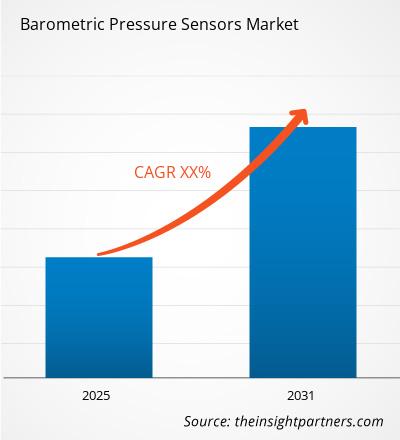
In 2025, the Barometric Pressure Sensors Market size stood at US$ 1.65 Billion and will grow up to reach US$ 3.05 Billion in 2034, registering a compound annual growth rate of 7.03%. Key drivers of demand include precision meteorology, industrial applications, renewable energy installations, and small-scale environmental sensing systems, which need accurate atmospheric pressure measurement in distributed operations.
In North America, the market depends on extensive automated weather networks, aircraft-grade observational networks, and wind energy assessments. The region is expected to grow at a 6.6 – 7.1% CAGR between 2026 and 2034 with a leading market share held by the U.S. Growth will be driven by procurement for system modernization and resilience in environmental data collection.
Barometric Pressure Sensors Market Assessment and Insights
- North America accounted for 32–35% share in 2025 and is expected to grow at a 6.6–7.1% CAGR between 2026–2034, driven by meteorological automation, aviation weather systems, and wind measurement upgrades.
- US represented 78–82% of North America in 2025 and is projected to grow at a 6.7–7.2% CAGR between 2026–2034, supported by national observation networks.
- Europe held 24–27% share in 2025 and is forecast to grow at a 6.2–6.8% CAGR between 2026–2034, led by Germany, the UK, France, Italy, and Spain.
- Asia Pacific captured 28–31% share in 2025 and is expected to expand at a 7.5–8.2% CAGR between 2026–2034, with China, Japan, South Korea, India, and Australia leading adoption.
- Largest Segment Weather Networks held 58–62% market share in 2025 and is expected to grow at a 6.5–7.0% CAGR between 2026–2034.
- High Growth Segment Wind Industry held 38–42% market share in 2025 and is projected to grow at a 7.4–8.1% CAGR between 2026–2034.
- Key companies analyzed in detail: Apogee Instruments, Inc., All Weather, Inc., Bosch Sensortec GmbH, TE Connectivity Germany GmbH, Fluigent SA, Infineon Technologies AG, Murata Manufacturing Co., Ltd., NovaLynx Corporation, OMEGA Engineering, Inc., and Sensirion AG.
Source: The Insight Partners' analysis based on proprietary research, government publications, company annual reports, investor presentations, industry databases, and expert interviews.
The development of technology has shifted from big analog sensors to miniature-sized digital output low-power sensors which are capable of being used either in rugged outdoor enclosures or even built-in smart instruments. The barometric pressure sensor market today is focused on stable calibration, moisture resistance, drift control, and availability for meteorological departments, wind generation companies, and automation providers.
The future demand would expand due to increasing installation of weather stations in developing countries, need for bankable data at wind generation sites, and regulation of climate-resilient infrastructure. Investments would be directed towards reliable and digital sensors.
Barometric Pressure Sensors Market Report Scope
| Report Attribute | Details |
|---|---|
| Market size in 2025 | US$ 1.65 Billion |
| Market Size by 2034 | US$ 3.05 Billion |
| Global CAGR (2026 - 2034) | 7.03% |
| Historical Data | 2021-2024 |
| Forecast period | 2026-2034 |
Barometric Pressure Sensors Market Analysis
The market is benefiting from the demand for real-time atmospheric pressure data in weather systems, wind energy plants, aviation assistance systems, and environmental monitoring. The sensors should withstand the effects of humidity, precipitation, temperature variations, and remote-site operating environments; thus, enclosure and calibration traceability are important purchasing factors.
There are various players along the supply chain that range from MEMS die manufacturers, packaging suppliers, calibration labs, dataloggers producers, stations assembly firms, to distributors. It should be noted that there is an advantage for vendors who can manage mass production of semiconductors alongside application-oriented reliability.
Barometric Pressure Sensors Market analysis suggests that competition is moderately fragmented in nature. Competition between Bosch Sensortec GmbH, Infineon Technologies AG, Murata Manufacturing Co., Ltd., and Sensirion AG revolves around MEMS, power efficiency, and digitization, whereas Apogee Instruments, Inc., All Weather, Inc., NovaLynx Corporation, and OMEGA Engineering, Inc. cater to the needs of instrumentation and weather networks.
There is increased emphasis on investment in small pressure modules, factory calibration, wireless data collection, and durable sensor enclosures. Strategic positioning is becoming more a matter of demonstrating reliability in outdoor conditions and ease of integration. TE Connectivity Germany GmbH and Fluigent SA provide added value through their expertise in pressure sensors used in industrial and fluid measurement applications.
● REPORT CUSTOMIZATION
Tailor This Report To Align With Your Specific Business Requirements
This report can be customized to align precisely with your business objectives, scope, and target markets. Customization options include tailored segmentation, geography, competitive analysis, and strategic insights to support informed decision-making.
Customize This Report →WHAT YOU CAN ADJUST
- ● Segmentations
- ● Geography
- ● Competitive Analysis
- ● Language Preferences
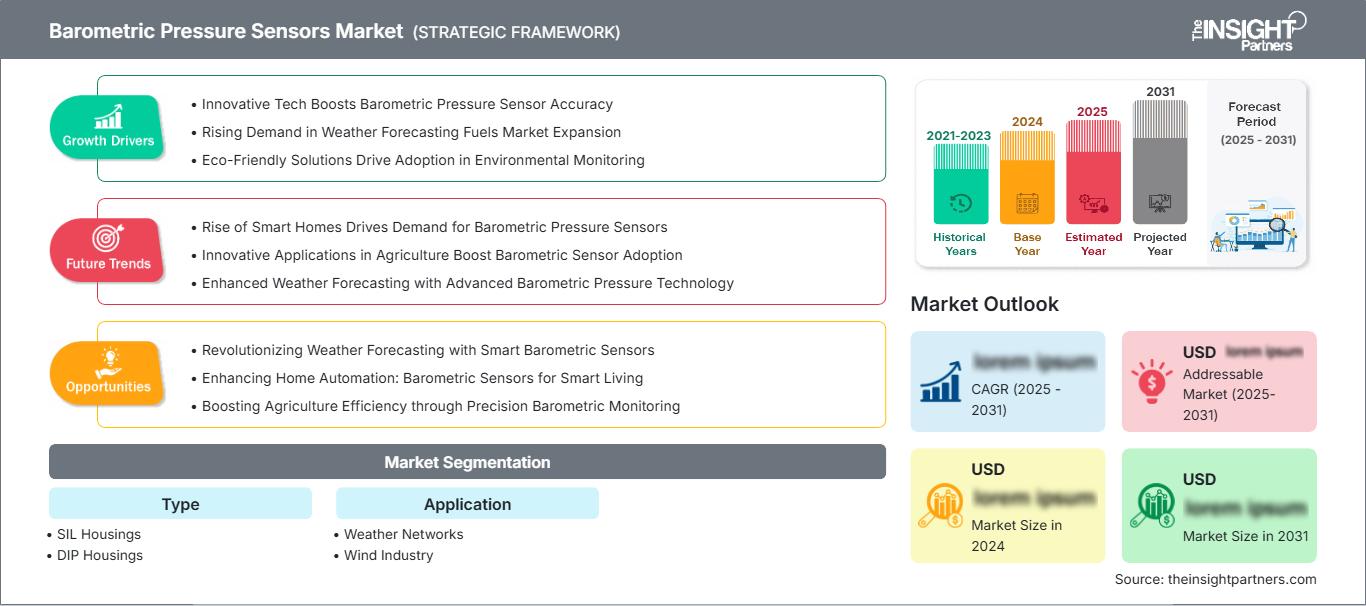
Barometric Pressure Sensors Market: Strategic Insights
Regional Insights
North America Barometric Pressure Sensors Market
North America accounted for 32% to 35% of global revenue in 2025 and is expected to grow at a CAGR of 6.6% to 7.1% between 2026 and 2034. The Barometric Pressure Sensors Market share in North America depends on advanced meteorology stations, airport observational equipment, hydrology stations, and distributed wind assessment programs.
The demand for structural reasons depends on weather, modernization, power grid reliability planning, and preparedness for extreme events. The agencies and utilities need sensors which do not drift and have a robust construction, which makes it easy to calibrate and provide digital output.
U.S. Barometric Pressure Sensors Market
In 2025, the United States held a 78-82% share of North America and was forecast to have a 6.7-7.2% CAGR from 2026-2034. The demand drivers are based on automated surface observation, renewable energy site selection, aviation-related applications, and dense commercial meteorology networks.
Company presence is established through instrument manufacturers, semiconductor distributors, and environmental monitoring system integrators. Current application trends include compact sensors connected to dataloggers, remote telemetry, and pressure adjustment algorithms that ensure consistency between multiple sites required by wind farm operators and weather services companies.
Europe Barometric Pressure Sensors Market
Market share in Europe is estimated to be 24% to 27% in 2025 and to grow at a compound annual growth rate of 6.2% to 6.8% through 2034, driven by Germany, owing to its industrial sensing capabilities and use of renewable energy systems.
The UK will be boosted by the development of its weather observation infrastructure and offshore wind energy measurement capabilities. France, Italy, and Spain boost demand for climate change tracking, aviation security, agricultural forecast, and energy infrastructure. Calibration and data integrity are important to European customers and drive calibrated sensor sales.
APAC Barometric Pressure Sensors Market
APAC holds a 28%-31% market share in 2025 and is predicted to grow at a 7.5%-8.2% CAGR between 2026 and 2034. China is leading the regional demand side, while countries such as Japan, South Korea, India, and Australia are contributing through electronics production, weather forecasting, and wind energy production.
Industrial policies, disaster preparedness initiatives, and renewable capacity addition are driving the installation base of pressure sensors. Local assembly, semiconductor packaging expertise, and datalogger availability are helping improve procurement flexibility. APAC emerges as the fastest-growing region.
Middle East & Africa Barometric Pressure Sensors Market
The Middle East and Africa region is expected to witness 6.4–7.0% CAGR from 2026 to 2034, with Saudi Arabia dominating the regional adoption. The United Arab Emirates, South Africa, and rest of MEA are generating demand via aviation infrastructure development, solar and wind resource monitoring, and environmental monitoring.
Weather-grade sensing is gaining traction because of energy diversification and infrastructure resilience. The demanding atmospheric conditions call for a tough enclosure, reliable pressure measurement, and occasional calibration assistance; hence, reliability is a more important purchasing criterion than the device's price.
Segmentation Analysis
Type
The Type segment is expected to grow at a 6.8–7.3% CAGR during 2026–2034. Barometric Pressure Sensors Market scope across housings is determined by installation environment, board-level integration, serviceability, and exposure to moisture or vibration. Buyers select housing formats according to datalogger design, enclosure space, and replacement strategy.
- SIL Housings maintain demand in field instruments where simple mounting, service access, and electrical isolation are important for weather stations and industrial monitoring panels.
- DIP Housings support compact circuit integration, prototyping flexibility, and established assembly workflows for dataloggers, embedded modules, and customized sensing equipment.
Application
The Application segment is forecast to grow at a 7.0–7.6% CAGR during 2026–2034. Demand is led by applications where pressure data improves forecast accuracy, turbine siting, altitude correction, and environmental risk planning. Procurement decisions increasingly consider connectivity, maintenance interval, calibration stability, and compatibility with station-level analytics.
- Weather Networks represent the largest application base because automated stations depend on stable atmospheric pressure readings for forecasting, aviation support, climate records, and hydrological event analysis.
- Wind Industry is the faster-scaling application as developers use pressure data with temperature, humidity, and wind measurements to validate resource quality and operating conditions.
Opportunity Snapshot
| Application | Revenue Contribution | Trend Tag | Adoption Stage |
| Weather Networks | High | Smart Stations | Mature |
| Wind Industry | Medium | Resource Data | Scaling |
Barometric Pressure Sensors Market Growth Drivers and Impact Analysis
Weather Network Modernization
Weather stations operated by government and commercial weather organizations are switching from manual to automatic stations to provide continuous measurements of pressure, temperature, humidity, and wind. This shift results in more need for sensors that can keep accuracy in face of moisture, dust, and temperature changes. This industry effect is most felt in those regions where air traffic control, agriculture, utility services, and disaster management require real-time alarms. Vendors who supply calibration services, environmental protection, and datalogger support get to reap profits through repeated replacements.
Wind Resource Measurement Expansion
Validating environmental data prior to investment, permitting, and wind turbine procurement is necessary for wind power generation. Data of barometric pressure help in the correction of air density, calculation of energy production, and performance testing in combination with information about wind speed and temperature. In the face of complex terrain where future wind farms will be situated, pressure sensors are becoming an integral part of the set of bankable measurement instruments.
Miniaturization and Digital Integration
MEMS-based pressure sensors are enabling smaller, lower-power, digitally connected modules that fit into compact weather stations, industrial devices, drones, and smart infrastructure systems. Integration through I²C, SPI, and other digital interfaces reduces design complexity and improves signal reliability. This driver broadens the addressable base beyond traditional meteorological installations. Manufacturers that combine low noise, low drift, and flexible interface support can serve both high-volume electronics and specialist instrumentation customers, strengthening the market as pressure sensing becomes embedded in broader environmental intelligence platforms.
Barometric Pressure Sensors Market Future Trends
AI-Ready Environmental Sensing Nodes
Barometric Pressure Sensors Market trends point toward edge-enabled sensing nodes that process pressure anomalies locally before transmitting alerts. This approach reduces bandwidth, improves response time, and supports remote weather, wind, and infrastructure sites where connectivity can be intermittent. Future products are likely to pair pressure sensing with embedded diagnostics, self-check routines, and adaptive sampling. Suppliers that support sensor fusion with temperature, humidity, vibration, and wind inputs will be better positioned as customers seek actionable environmental intelligence rather than isolated pressure readings.
Calibration-as-a-Service Models
As networks expand, operators will need documented calibration histories, drift monitoring, and predictable service intervals. Calibration-as-a-service models can reduce downtime by bundling replacement sensors, certificates, and maintenance schedules into recurring programs. This trend is especially relevant for aviation, weather agencies, and wind developers, where pressure data quality affects operational decisions. Vendors with traceable laboratories, field-service partnerships, and standardized sensor modules can shift revenue from one-time hardware sales toward lifecycle support, improving customer retention and data reliability.
Barometric Pressure Sensors Market Opportunities
Emerging Market Weather Station Density
Many emerging economies still operate sparse observation networks relative to their exposure to floods, heatwaves, cyclones, and agricultural volatility. Expanding station density creates procurement opportunities for rugged, low-maintenance pressure sensors that can be deployed across schools, airports, farms, ports, and municipal infrastructure. Barometric Pressure Sensors Market Forecasts indicate that suppliers offering bundled sensors, dataloggers, solar power options, and remote commissioning support can reduce adoption barriers. Partnerships with meteorological agencies, development banks, and telecom operators may accelerate deployments while creating recurring demand for replacement and calibration services.
Wind Farm Performance Analytics
Wind operators are moving from project-level measurement toward continuous performance analytics that compare turbine output with atmospheric conditions. Pressure sensors can support air-density correction, icing analysis, and operational benchmarking when combined with supervisory control data. This creates an opportunity for sensor vendors and integrators to package pressure measurement with analytics software, maintenance alerts, and digital twins. The strongest near-term potential lies in repowering projects and hybrid renewable sites, where incremental data quality can improve asset management and energy forecasting without major hardware redesign.
Recent Developments
- April 2026: steute Technologies GmbH & Co. KG announced an agreement to acquire Electro-Sensors, Inc. in a transaction valued at approximately US$28 million. The acquisition expands steute's portfolio of industrial machine monitoring and hazard monitoring sensors, strengthening its safety and monitoring solutions while expanding its manufacturing presence in the U.S.
- January 2026: Baker Hughes completed the sale of its Precision Sensors & Instrumentation (PSI) product line, including the Druck, Panametrics, and Reuter-Stokes brands, to Crane Company. The US$1.15 billion transaction strengthens Baker Hughes' balance sheet while enabling Crane to expand its portfolio of precision sensing and industrial instrumentation solutions.
- September 2024: ProfEC Ventus GmbH introduced the AP65 and AP80 barometric ambient pressure sensors for wind and solar energy applications. The sensors offer improved accuracy, IP67 protection, long-term stability, and come factory-calibrated with ISO 17025 traceable calibration reports, making them suitable for IEC and MEASNET-compliant measurement campaigns.
Frequently Asked Questions

- Comprehensive Market Sizing and Forecast Analysis
- Detailed Segmentation Analysis
- In-Depth Market Dynamics Assessment
- Regional and Country-Level Insights
- Competitive Landscape and Company Benchmarking
- Strategic Business Intelligence
Recent Reports
Testimonials

The Insight Partners' SCADA System Market report is comprehensive, with valuable insights on current trends and future forecasts. The team was highly professional, responsive, and supportive throughout. We are very satisfied and highly recommend their services.
RAN KEDEM Partner, Reali Technologies LTDs
I requested a report on a very specific software market and the team produced the report in a few days. The information was very relevant and well presented. I then requested some changes and additions to the report. The team was again very responsive and I got the final report in less than a week.
JEAN-HERVE JENN Chairman, Future Analytica
We worked with The Insight Partners for an important market study and forecast. They gave us clear insights into opportunities and risks, which helped shape our plans. Their research was easy to use and based on solid data. It helped us make smart, confident decisions. We highly recommend them.
PIYUSH NAGPAL Sr. Vice President, High Beam Global
The Insight Partners delivered insightful, well-structured market research with strong domain expertise. Their team was professional and responsive throughout. The user-friendly website made accessing industry reports seamless. We highly recommend them for reliable, high-quality research services
YUKIHIKO ADACHI CEO, Deep Blue, LLC.
This is the first time I have purchased a market report from The Insight Partners.While I was unsure at first, I visited their web site and felt more comfortable to take the risk and purchase a market report.I am completely satisfied with the quality of the report and customer service. I had several questions and comments with the initial report, but after a couple of dialogs over email with their analyst I believe I have a report that I can use as input to our strategic planning process.Thank you so much for taking the extra time and making this a positive experience.I will definitely recommend your service to others and you will be my first call when we need further market data.
JOHN SUZUKI President and Chief Executive Officer, Board Director, BK Technologies
I wish to appreciate your support and the professionalism you displayed in the course of attending to my request for information regarding to infectious disease IVD market in Nigeria. I appreciate your patience, your guidance, and the fact that you were willing to offer a discount, which eventually made it possible for us to close a deal. I look forward to engaging The Insight Partners in the future, all thanks to the impression you have created in me as a result of this first encounter.
DR CHIJIOKE ONYIA MANAGING DIRECTOR, PineCrest Healthcare Ltd.Reason to Buy
- Informed Decision-Making
- Understanding Market Dynamics
- Competitive Analysis
- Identifying Emerging Markets
- Customer Insights
- Market Forecasts
- Risk Mitigation
- Boosting Operational Efficiency
- Strategic Planning
- Investment Justification
- Tracking Industry Innovations
- Aligning with Regulatory Trends





 Get Free Sample for