
Battery Cyclers Market Size, Growth Factors & Forecast 2034
Coverage: By Channel Type (16, 8, and 4), Battery Type [Lead Acid, Nickel Cadmium (NiCd) Batteries, Nickel-Metal (NiMh) Batteries, and Lithium-Ion (Li-Ion) Batteries], and End User (Aerospace, Energy & Power, Automotive, Consumer Electronics, and Others
- Status : Data Released
- Report Code : TIPRE00029730
- Category : Electronics and Semiconductor
- No. of Pages : 150
- Available Report Formats :


- Last update date : July 17, 2026


2025 Market Size
US$ 249.13 Mn
Base year value
2034 Forecast
US$ 427.23 Mn
Projected by 2034
CAGR 2026-2034
6.18 %
Growth rate
Addressable Market
US$ 3,062.49 Mn
(2026-2034)
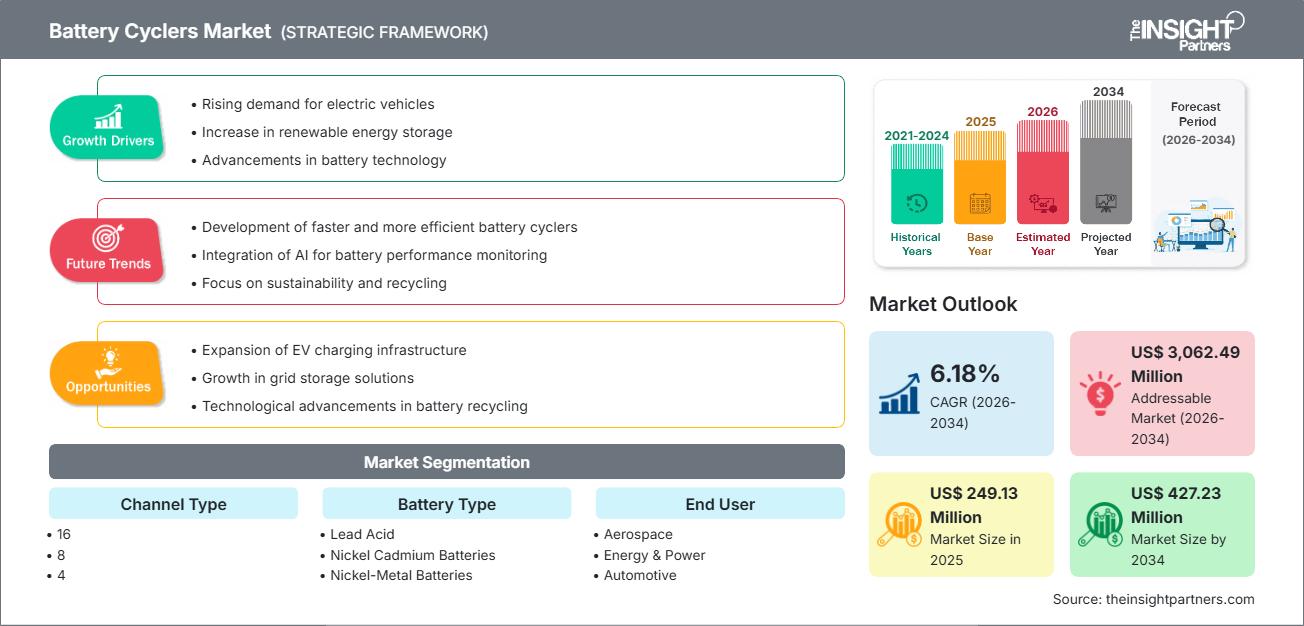
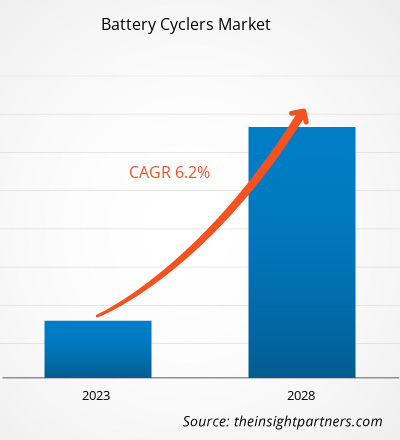
The Battery Cyclers Market size was valued at US$ 249.13 Million in 2025 and is projected to reach US$ 427.23 Million by 2034, growing at a CAGR of 6.18% from 2026 to 2034. Demand for battery cyclers will be driven by the requirements for battery validation in the areas of electric mobility, grid storage, aerospace electrification, backup power for industries, and consumer electronics manufacturing where tests on charge and discharge cycles help validate the capacity, efficiency, safety, and performance degradation.
North America continues to be an advanced region in terms of testing technology, and Battery Cyclers Market is estimated to grow at a CAGR of 5.7%–6.7% in 2026-2034. Growth will be based on demand for battery qualification for EVs, aerospace electrification initiatives, storage programs for utilities, and labs looking for high-accuracy battery cycler systems.
Battery Cyclers Market Assessment and Insights
- North America accounted for 27%–31% of the Battery Cyclers Market share in 2025 and is expected to grow at a CAGR between 5.7%–6.7% during 2026–2034, supported by EV labs, aerospace battery qualification, and grid storage testing.
- US represented 76%–81% of North America in 2025 and is projected to grow at a CAGR between 5.8%–6.8% during 2026–2034.
- Europe held 22%–26% share in 2025 and is forecast to grow at a CAGR between 5.1%–6.1% during 2026–2034, led by Germany, the UK, France, Italy, and Spain.
- Asia Pacific captured 34%–38% share in 2025 and is projected to grow at a CAGR between 6.9%–7.9% during 2026–2034, led by China, Japan, South Korea, India, and Australia.
- Largest Segment Lithium-Ion Batteries held a market share of 56%–60% in 2025, with CAGR range of 6.8%–7.8% between 2026–2034.
- High Growth Segment Automotive held a market share of 31%–35% in 2025, with CAGR range of 7.0%–8.0% between 2026–2034.
- Key companies analyzed in detail: BioLogic SAS, Unico, LLC, Bitrode Corporation, Chroma Systems Solutions, Inc., HIOKI E.E. CORPORATION, Arbin Instruments, DIGATRON, PEC NV, Xiamen Tmax Battery Equipments Limited, and Gamry Instruments, Inc.
Source: The Insight Partners' analysis based on proprietary research, government publications, company annual reports, investor presentations, industry databases, and expert interviews.
Battery tests have developed from mere lifecycles into more integrated validation setups which integrate formation, impedance measurement, temperature control, safety procedures, and data analytics based on computerized processes. The Battery Cyclers Market demonstrates this trend in that manufacturers require repeatable tests on various batteries using diverse types of chemistry. Changes are taking place in terms of production in that the future will feature high channel densities and regenerative systems.
Future market trends will be driven by regional incentives in battery manufacturing, localization of electric vehicles platforms, aerospace battery technology and stationary storage technology. In Asia Pacific, there will be a scale advantage in terms of cell manufacturing. North America and Europe will see a growth in capacity in terms of validation through local supply chains. Advanced cyclers will remain a staple in standards-based testing and performance.
Battery Cyclers Market Report Scope
| Report Attribute | Details |
|---|---|
| Market size in 2025 | US$ 249.13 Million |
| Market Size by 2034 | US$ 427.23 Million |
| Global CAGR (2026 - 2034) | 6.18% |
| Historical Data | 2021-2024 |
| Forecast period | 2026-2034 |
Battery Cyclers Market Analysis
Increasing demand stems from the fact that battery designers need to confirm the cycle life, capacity retention, charging performance, efficiency and thermal characteristics of batteries before going into mass production. Growth in the market for Battery Cyclers is due to the increased size of batteries for vehicles, energy storage solutions, aviation applications, and consumer electronics. The buyers emphasize the importance of precision, programmability, channel efficiency, and safety of testing across lithium-ion, lead acid, nickel cadmium, and nickel-metal chemistries.
Ecosystem participants include manufacturers of power electronics, formation equipment, electrochemical instruments, battery labs, automation systems, software and cells. Favorable supply dynamics can be expected by suppliers with modular design, wide current range, proper calibration, and after-sales services. According to the International Energy Agency, electric vehicles accounted for 18% of all car sales in the world in 2023.
In terms of competitive landscape, the competition consists of electrochemical experts as well as providers of production equipment. Companies such as BioLogic SAS and Gamry Instruments, Inc. dominate in research-level electrochemical testing, whereas Arbin Instruments, Bitrode Corporation, DIGATRON, PEC NV, and Unico, LLC focus on higher power cyclers designed for laboratories as well as production. The Battery Cyclers Market Report takes into account such factors as software workflow, energy recovery, channel density, and application engineering.
Investment directions include regenerative discharge, high throughput cycling, environmental interfaces, and analytics to detect degradation signatures. The companies that provide solutions for automated test systems include Chroma Systems Solutions, Inc., the company that supplies battery measurement tools is HIOKI E.E. CORPORATION, and Xiamen Tmax Battery Equipments Limited supplies solutions for laboratory and pilot line.
● REPORT CUSTOMIZATION
Tailor This Report To Align With Your Specific Business Requirements
This report can be customized to align precisely with your business objectives, scope, and target markets. Customization options include tailored segmentation, geography, competitive analysis, and strategic insights to support informed decision-making.
Customize This Report →WHAT YOU CAN ADJUST
- ● Segmentations
- ● Geography
- ● Competitive Analysis
- ● Language Preferences
Battery Cyclers Market: Strategic Insights
Regional Insights
North America Battery Cyclers Market
North America held 27%–31% share in 2025 and is expected to grow at 5.7%–6.7% through 2034. The Battery Cyclers Market share is supported by EV battery laboratories, aerospace qualification programs, defense energy systems, and utility storage pilots. Regional buyers require traceable test data, redundant safety controls, and multi-channel architectures that reduce validation bottlenecks.
Procurement is concentrated among automotive OEMs, cell developers, universities, national laboratories, and pack integrators. Bitrode Corporation, Arbin Instruments, Unico, LLC, Chroma Systems Solutions, Inc., and Gamry Instruments, Inc. maintain relevance through local engineering support and application-specific platforms. Demand is strongest where long-cycle validation, regenerative discharge, and compliance documentation are required.
U.S. Battery Cyclers Market Market
The U.S. represented 76%–81% of North American demand in 2025 and is projected to grow at 5.8%–6.8%. Domestic demand is concentrated in EV battery qualification, aerospace electrification, grid storage testing, and electrochemical research. Buyers emphasize safety interlocks, flexible test profiles, high current capability, and integration with environmental chambers.
Company presence is reinforced by manufacturing, service, and application support. Bitrode Corporation develops laboratory and manufacturing systems, Arbin Instruments supports cell and module testing, and Gamry Instruments, Inc. addresses electrochemical workflows. Application trends include formation cycling, cell aging, module characterization, fast-charge studies, and battery management system validation.
Europe Battery Cyclers Market Market
Europe accounted for 22%–26% share in 2025 and is expected to grow at 5.1%–6.1%. Germany leads through automotive battery engineering, cell manufacturing projects, and industrial electrification. The UK supports aerospace, defense, and university testing. France, Italy, and Spain contribute through EV platforms, energy storage demonstrations, and research infrastructure.
European demand is shaped by safety regulations, recycling-linked quality requirements, and domestic battery value-chain investment. BioLogic SAS, DIGATRON, and PEC NV provide regional depth across research instruments, formation systems, and high-power test equipment. Customers value energy-efficient cycling, documentation quality, service proximity, and compatibility with multi-chemistry development programs.
APAC Battery Cyclers Market Market
APAC held 34%–38% share in 2025 and is projected to grow at 6.9%–7.9%. China leads through battery cell production, EV manufacturing, and pilot-line scale-up, while Japan and South Korea support precision measurement, automotive batteries, and electronics-grade validation.
India is gaining importance through battery localization policies and two-wheeler electrification, while Australia supports mining electrification and storage trials. HIOKI E.E. CORPORATION and Xiamen Tmax Battery Equipments Limited reflect regional equipment capability. Policy incentives, gigafactory investment, and export-oriented electronics manufacturing strengthen regional momentum.
Middle East & Africa Battery Cyclers Market Market
Middle East & Africa is projected to grow at 4.4%–5.4%, with Saudi Arabia and the UAE leading through energy storage pilots, EV infrastructure, and industrial diversification. South Africa remains the strongest technical base for universities, mining power systems, and electronics testing.
Rest of MEA demand is linked to telecom backup power, solar-plus-storage projects, and industrial batteries. Adoption is slower because local cell manufacturing remains limited, but renewable energy investment creates testing needs for lead acid and lithium-ion systems used in harsh operating environments.
Segmentation Analysis
Channel Type
Channel Type is projected to grow at 5.9%–6.9% during 2026–2034. Battery Cyclers Market forecast is defined by the need to test more cells simultaneously while preserving accuracy, safety, and data traceability. Higher channel counts improve laboratory throughput, while lower channel systems remain useful for specialized studies, pack diagnostics, and budget-constrained research programs.
- 16 channel systems support high-throughput cell screening, aging studies, and formation trials where laboratories need parallel testing without moving immediately to large production-scale cabinets.
- 8 channel systems balance flexibility and cost for research teams testing multiple chemistries, current profiles, and environmental conditions across limited sample sets.
- 4 channel systems are important for focused material studies, teaching laboratories, and early-stage development where precision, programmability, and manageable footprint outweigh maximum throughput.
Battery Type
Battery Type is forecast to grow at 6.2%–7.2% during 2026–2034. Lithium-ion dominates testing demand because of EVs, consumer electronics, and storage systems, while lead acid and nickel-based chemistries continue to require validation in backup power, aviation, rail, and industrial applications. Multi-chemistry compatibility remains a key purchasing criterion.
- Lead Acid batteries retain strategic relevance in telecom backup, UPS, industrial vehicles, and starter systems, requiring cyclers that validate capacity, charge acceptance, and endurance under established standards.
- Nickel Cadmium Batteries remain important in aviation, emergency systems, and rugged industrial uses where durability and predictable performance support continued testing despite environmental restrictions.
- Nickel-Metal Batteries serve hybrid vehicles, consumer devices, and specialty power applications, requiring cycling platforms that assess memory effects, thermal behavior, and usable capacity over long programs.
- Lithium-Ion Batteries lead demand because high-energy cells require detailed lifecycle, fast-charge, thermal, and safety validation before deployment in vehicles, electronics, aerospace systems, and stationary storage.
End User
End User is expected to grow at 6.4%–7.4% during 2026–2034. Automotive users generate the largest validation load, but aerospace, energy and power, and consumer electronics each require specialized test profiles. Purchasing decisions differ by current range, cycle duration, safety certification, integration needs, and software reporting requirements.
- Aerospace requires highly documented cycling for aircraft batteries, satellites, unmanned systems, and emergency power, where reliability, safety margins, and qualification traceability are essential.
- Energy & Power users test batteries for renewable storage, backup power, microgrids, and utility pilots, prioritizing long-duration cycling, efficiency measurement, and degradation forecasting.
- Automotive is the most strategic end user because EV cells, modules, and packs need validation for fast charging, aging, safety, range, and warranty planning.
- Consumer Electronics demand is driven by smartphones, wearables, laptops, and small devices, where manufacturers need compact cyclers for capacity grading, safety checks, and product reliability.
Opportunity Snapshot
| End User | Revenue Contribution | Trend Tag | Adoption Stage |
| Aerospace | Medium | Flight Safety | Scaling |
| Energy & Power | Medium | Grid Storage | Scaling |
| Automotive | High | Fast Charging | Mature |
| Consumer Electronics | Medium | Device Runtime | Mature |
Battery Cyclers Market Growth Drivers and Impact Analysis
EV Battery Qualification Expands Cycling Workloads
Programs for electric vehicles need a lot of cycling prior to the commercial release of cell chemistry, module construction, and pack structure. The validation protocol comprises capacity decay, fast charging capability, thermal rise, pulse power delivery, and degradation behavior important for warranty considerations. As a result, there is stable demand for cyclers capable of conducting multiple channels for tens of thousands of cycles and acquiring quality data. In commercial terms, the effect is an increased usage of laboratory instruments and rising demand for scalable cabinets, regenerative discharging, and software assisting engineers in degradation comparison of various chemistries.
Energy Storage Projects Require Long-Duration Validation
The applications for which batteries will be required to have high reliability during their lifespan include grid storage, microgrids, telecom backups, and renewable energy integration. To achieve this, cyclers are necessary to replicate partial state of charge cycling, deep discharges, stand-by states, and variations of battery performance as functions of temperature. The commercial effect of this is the expansion of the customer base from automobile to utilities, EPC companies, energy storage systems providers, and energy laboratories. The long-term nature of tests makes regenerative discharge more valuable as an energy-efficient solution due to the increased cost of running tests over months.
Battery Safety Standards Raise Testing Intensity
The risk to safety, warranties, and brand reputation in the case of battery failure makes it necessary for the companies to go deeper into validation prior to the product launch. The use of cyclers allows for a controlled evaluation of the overcharge effect, capacity degradation, impedance growth, thermal effects, and operations adjacent to abuse cases when used with chambers and measurement equipment. Standardization efforts of groups like IEC, UL, SAE, and UN transport standards make it imperative for there to be recorded results. The effect is more money spent on reliable instrumentation, rather than just cheap equipment.
Battery Cyclers Market Future Trends
AI-Assisted Test Analytics Move into Battery Laboratories
Battery Cycler Trends will move more towards analysis that helps in reducing test times without affecting confidence levels. Laboratories have been generating huge data sets in relation to voltage, current, temperature, impedance, rests, and capacity fading. The use of Artificial Intelligence-based algorithms can help in early detection of any anomalies, suggest profile optimization, and sort cells prior to completing the aging process. However, this does not mean that there is no requirement for the physical test cycle process. Suppliers who integrate cycler software with databases and models can offer value to their customers. This would be highly applicable in case of automotive and energy storage companies.
Regenerative and Modular Platforms Become Standard
The procurement for the future will have an edge toward those cyclers which decrease the energy usage of facilities and increase channel capacity as the number of testing programs increases. The regenerative discharge method returns the energy to the network or common bus rather than wasting it through heat generation, thus enhancing the economics of operations during the long life cycle analysis process. Further, modular cabinets will allow laboratories to increase their capacity by chemistry, current, or voltage as and when needed, without the need for the replacement of the entire system.
Battery Cyclers Market Opportunities
Localized Battery Manufacturing Test Infrastructure
Battery localization policies create an investment opportunity for cycler suppliers that can support new cell plants, pilot lines, and validation centers close to customers. Battery Cyclers Market trends indicate that buyers will need equipment before production ramps, because process recipes and formation profiles must be proven early. Vendors can target gigafactory developers, universities, government-backed labs, and pack assemblers with staged capacity packages. The strongest opportunity lies in combining equipment with installation, training, calibration, and workflow consulting. Regional service presence can become a differentiator because downtime The localization of battery manufacturing policies will provide investment potential for the manufacturers of cyclers that could be used to help build new plants for batteries, pilot lines, and validation centers near their clients. According to Battery Cyclers Market Forecasts, the clients will require machines before production begins, since the recipes of processes and profiles of formation should be validated from the very beginning. The vendors can sell their products to gigafactory builders, universities, government-funded laboratories, and pack assemblers by offering capacity packages in stages. The biggest investment potential will be to offer a package of services together with equipment.during qualification delays product launches and reduces confidence in production readiness.
Aerospace and Defense Battery Validation Programs
Aerospace and defense applications create attractive opportunities because qualification cycles are rigorous, documentation requirements are high, and approved suppliers can remain embedded for long program periods. Electrified aircraft systems, satellites, unmanned platforms, portable soldier power, and backup systems all require batteries that perform under vibration, temperature extremes, storage intervals, and mission-specific load profiles. Cycler vendors can capture value by offering high-accuracy measurement, secure data handling, environmental chamber integration, and lifecycle support. The opportunity is not purely volume-driven; it depends on reliability, auditability, and engineering collaboration. Suppliers with strong calibration discipline and responsive technical teams are well positioned.
Recent Developments
- March 2026: TAKASAGO, LTD. announced the launch of its new Battery Cycler and Emulation Test System, the RZ-X2-100K-HG, for the U.S. market. The system is a high-voltage, high-current platform integrating advanced charge/discharge testing and battery emulation capabilities in a single unit.
- October 2025: Associated Environmental Systems (AES) and MACCOR Inc. today announced FUSION, a fully integrated battery test system. FUSION combines environmental chambers, battery test fixtures, and battery cyclers in a single pre-configured solution, eliminating integration delays and giving developers a faster, more reliable way to validate and improve battery performance. Manufactured in the U.S., FUSION reflects AES and Maccor's commitment to quality, customer confidence, and constant innovation.
- April 2024: Biologic launches the latest BCS-900 Battery Cycler series. BCS-900 series is a modular battery cycling system designed to meet the needs at every level of the battery value chain, from R&D to pilot production, from production testing to quality control. Made up of three modular options (BCS-905, 910 and 915), these advanced battery cyclers offer 8 independent channels with a maximum current of ±150 mA, ±1.5 A and ±15 A, respectively per channel.
Frequently Asked Questions

- Comprehensive Market Sizing and Forecast Analysis
- Detailed Segmentation Analysis
- In-Depth Market Dynamics Assessment
- Regional and Country-Level Insights
- Competitive Landscape and Company Benchmarking
- Strategic Business Intelligence
Recent Reports
Testimonials

The Insight Partners provided valuable market intelligence that supported our global go-to-market strategy. Their team was professional, responsive, and attentive to our feedback, providing thoughtful analysis and helpful methodological clarifications throughout the project.
Junmo Kim Chief Financial Officer (CFO), Enertech Co., Ltd.
The Insight Partners' SCADA System Market report is comprehensive, with valuable insights on current trends and future forecasts. The team was highly professional, responsive, and supportive throughout. We are very satisfied and highly recommend their services.
RAN KEDEM Partner, Reali Technologies LTDs
I requested a report on a very specific software market and the team produced the report in a few days. The information was very relevant and well presented. I then requested some changes and additions to the report. The team was again very responsive and I got the final report in less than a week.
JEAN-HERVE JENN Chairman, Future Analytica
We worked with The Insight Partners for an important market study and forecast. They gave us clear insights into opportunities and risks, which helped shape our plans. Their research was easy to use and based on solid data. It helped us make smart, confident decisions. We highly recommend them.
PIYUSH NAGPAL Sr. Vice President, High Beam Global
The Insight Partners delivered insightful, well-structured market research with strong domain expertise. Their team was professional and responsive throughout. The user-friendly website made accessing industry reports seamless. We highly recommend them for reliable, high-quality research services
YUKIHIKO ADACHI CEO, Deep Blue, LLC.
This is the first time I have purchased a market report from The Insight Partners.While I was unsure at first, I visited their web site and felt more comfortable to take the risk and purchase a market report.I am completely satisfied with the quality of the report and customer service. I had several questions and comments with the initial report, but after a couple of dialogs over email with their analyst I believe I have a report that I can use as input to our strategic planning process.Thank you so much for taking the extra time and making this a positive experience.I will definitely recommend your service to others and you will be my first call when we need further market data.
JOHN SUZUKI President and Chief Executive Officer, Board Director, BK Technologies
I wish to appreciate your support and the professionalism you displayed in the course of attending to my request for information regarding to infectious disease IVD market in Nigeria. I appreciate your patience, your guidance, and the fact that you were willing to offer a discount, which eventually made it possible for us to close a deal. I look forward to engaging The Insight Partners in the future, all thanks to the impression you have created in me as a result of this first encounter.
DR CHIJIOKE ONYIA MANAGING DIRECTOR, PineCrest Healthcare Ltd.Reason to Buy
- Informed Decision-Making
- Understanding Market Dynamics
- Competitive Analysis
- Identifying Emerging Markets
- Customer Insights
- Market Forecasts
- Risk Mitigation
- Boosting Operational Efficiency
- Strategic Planning
- Investment Justification
- Tracking Industry Innovations
- Aligning with Regulatory Trends






 Get Free Sample for