
Battery Free RFID Sensor Market Share, Growth & Forecast by 2034
Coverage: by Application (Food Quality Monitoring, Supply Chain Management, Condition monitoring, Others); End User (Food and Beverage, Logistics, Aerospace and Defense, Others) , and Geography (North America, Europe, Asia Pacific, and South and Central America)
- Status : Data Released
- Report Code : TIPRE00011481
- Category : Electronics and Semiconductor
- No. of Pages : 150
- Available Report Formats :


- Last update date : July 20, 2026


2025 Market Size
US$ 657.71 Mn
Base year value
2034 Forecast
US$ 1,283.55 Mn
Projected by 2034
CAGR 2026-2034
7.71 %
Growth rate
Addressable Market
US$ 8,740.03 Mn
(2026-2034)
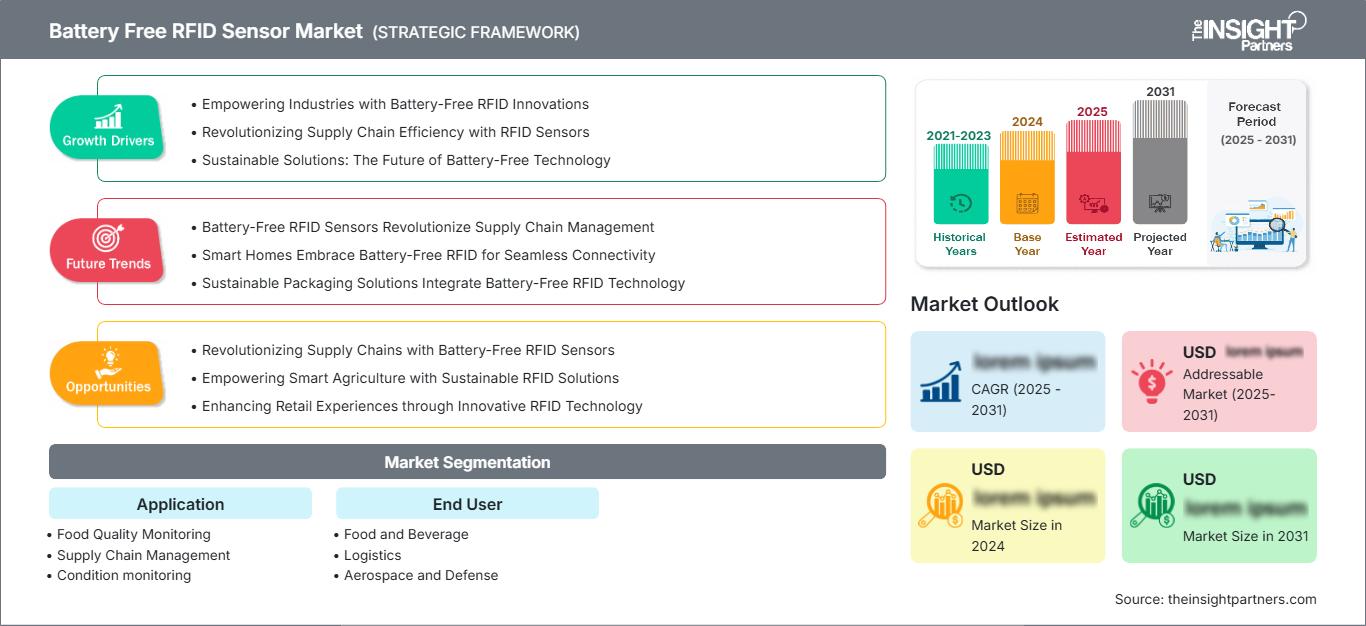
The global Battery Free RFID Sensor market was valued at US$ 657.71 million in 2025 and is expected to reach US$ 1283.55 million by 2034; it is estimated to record a CAGR of 7.71% during 2026-2034.
Battery Free RFID Sensor Market Assessment and Insights
- North America held a 35–38% share in 2025 and is expected to grow at a CAGR range of 8.4–8.9% during 2026–2034, driven by cold-chain compliance, aerospace traceability, and automated distribution networks.
- US accounted for 76–79% of North America in 2025 and is projected to expand at 8.5–9.0% CAGR, led by logistics, defense, and food safety programs.
- Europe captured 24–27% share in 2025 and is forecast to grow at 8.0–8.5% CAGR, with Germany, the UK, and France leading adoption in industrial and regulated supply chains.
- Asia Pacific represented 25–28% share in 2025 and is likely to expand at 9.1–9.7% CAGR, supported by China, Japan, South Korea, and India across manufacturing, logistics, and food exports.
- Largest Segment Supply Chain Management held 42–45% market share in 2025 and is projected to register 8.6–9.1% CAGR due to pallet, container, and item-level monitoring needs.
- High Growth Segment Condition monitoring accounted for 27–30% share in 2025 and is expected to grow at 9.3–9.9% CAGR as industrial operators reduce wired sensor and battery maintenance costs.
- Key companies analyzed in detail: Farsens S.L., GAO RFID Inc., Inductosense Ltd, Metalcraft, Inc., HID Global Corporation, ON Semiconductor Corporation, Phase IV Engineering Inc., Powercast Corporation, Axzon Inc., Texas Instruments Incorporated.
Source: The Insight Partners' analysis based on proprietary research, government publications, company annual reports, investor presentations, industry databases, and expert interviews.
Technology evolution within the Battery Free RFID Sensor Market is shifting from simple identification tags to sensing platforms capable of measuring temperature, humidity, pressure, strain, and exposure events. There is a change in manufacturing dynamics where the antenna structure, energy harvesting ICs, and compatibility with readers will play key roles in the reliability of tags. Manufacturers are designing form factors for metal surfaces, cold chain packaging, and aerospace assets, while the end users are focusing on maintenance-free deployment that avoids battery changes, inspections, and wired installation.
Future outlook of the market sees applications in emerging logistics centers, high value food exports and digital aircraft maintenance facilities. The need for traceability and temperature management is driving the adoption of these devices in the market, especially where passive data collection is needed to be paired with enterprise resource planning and warehouse software systems. The investment will go towards interoperable reader systems, customized sensor inlays and passive rugged tags.
Battery Free RFID Sensor Market Report Scope
| Report Attribute | Details |
|---|---|
| Market size in 2025 | US$ 657.71 Million |
| Market Size by 2034 | US$ 1,283.55 Million |
| Global CAGR (2026 - 2034) | 7.71% |
| Historical Data | 2021-2024 |
| Forecast period | 2026-2034 |
Battery Free RFID Sensor Market Analysis
Battery Free RFID Sensor Market growth is supported by three demand clusters: food quality monitoring, supply chain management, and condition monitoring. Cold chain players employ passive tags to monitor temperature fluctuations without worrying about battery recycling, while warehousing can benefit from simultaneous identification and sensing capabilities. The value chain consists of semiconductor, antenna, tag conversion, reader systems, middleware, and analytics platform technologies, providing opportunities for component manufacturers and solution providers.
Supply dynamics continue to be very application-dependent due to reliance on RF energy harvesting, memory requirements, read range, and sensor calibrations. For applications where products are moving in metal-environment, refrigeration, and/or dense-pallet environments, there is a need to find the right balance between tag price and accuracy of information retrieval. Therefore, suppliers are rewarded for their ability to provide solution components beyond just tags.
Battery-free RFID Sensor Market Competitive Dynamics highlights players comprising sensor experts, RFID hardware makers, and semiconductor vendors. Powercast Corporation develops RF energy-harvesting technology, Axzon Inc. concentrates on passive sensing IC platforms, and Farsens S.L. caters to industrial sensor tags. Texas Instruments Incorporated and ON Semiconductor Corporation are enhancing the component supply chain, while Metalcraft, Inc., HID Global Corporation, and GAO RFID Inc. provide tags and identification systems.
Market positioning is getting more and more oriented towards application use cases instead of product range. Inductosense Ltd specializes in structural and corrosion monitoring, Phase IV Engineering Inc. provides wireless sensing applications, and integrated RFID companies pursue logistics and regulated cold-chain markets. Collaboration with system integration providers, data center owners, aerospace maintenance providers, and food distributors will define which vendors succeed in translating technical expertise into viable business solutions.
● REPORT CUSTOMIZATION
Tailor This Report To Align With Your Specific Business Requirements
This report can be customized to align precisely with your business objectives, scope, and target markets. Customization options include tailored segmentation, geography, competitive analysis, and strategic insights to support informed decision-making.
Customize This Report →WHAT YOU CAN ADJUST
- ● Segmentations
- ● Geography
- ● Competitive Analysis
- ● Language Preferences
Battery Free RFID Sensor Market: Strategic Insights
Regional Insights
North America Battery Free RFID Sensor Market
North America held a 35–38% share in 2025 and is projected to grow at 8.4–8.9% CAGR during 2026–2034. The region benefits from established RAIN RFID deployments in retail, warehousing, healthcare logistics, and aerospace supply chains. The Battery Free RFID Sensor Market share is reinforced by demand for maintenance-free visibility across temperature-sensitive goods, high-value components, and automated fulfillment centers.
Structural drivers include pharmaceutical handling standards, food traceability expectations, and rising data-center monitoring requirements. IATA highlights that healthcare cargo requires strict temperature management, while passive sensing tags help logistics providers document excursions without adding battery service cycles. US-led deployments are expanding into cold storage, defense inventory, and industrial asset monitoring.
U.S. Battery Free RFID Sensor Market
The US accounted for 76–79% of North America in 2025 and is forecast to expand at 8.5–9.0% CAGR through 2034. Demand is strongest in logistics, aerospace and defense, food distribution, and pharmaceutical handling, where passive RFID sensor tags can capture condition data while aligning with existing reader networks.
Company presence supports domestic commercialization. Powercast Corporation has demonstrated battery-free condition monitoring for data-center assets. At the same time, Axzon Inc., Metalcraft, Inc., Phase IV Engineering Inc., and Texas Instruments Incorporated contribute sensing ICs, tag manufacturing, and wireless sensor expertise. Application trends point toward asset-level monitoring, warehouse automation, and controlled shipment validation.
Europe Battery Free RFID Sensor Market
Europe represented 24–27% share in 2025 and is projected to grow at 8.0–8.5% CAGR. Germany leads regional adoption through industrial automation, automotive supply chains, and stringent quality assurance practices. The UK supports structural health monitoring and aerospace maintenance use cases, while France, Italy, and Spain contribute to food logistics and regulated transport demand.
UK adoption is supported by specialist sensing activity, including Inductosense Ltd, in condition monitoring for difficult-to-access structures. Germany’s manufacturing base encourages RFID-enabled traceability for parts, tooling, and maintenance workflows. France, Italy, and Spain are expected to expand deployments in food quality monitoring, cold storage, and export logistics as retailers and distributors tighten visibility requirements.
APAC Battery Free RFID Sensor Market
Asia Pacific held 25–28% share in 2025 and is forecast to grow at 9.1–9.7% CAGR, making it the fastest regional market. China leads due to manufacturing scale, smart logistics investment, and food export monitoring needs. Japan and South Korea support advanced electronics and industrial automation adoption.
India and Australia add growth through cold-chain infrastructure, agrifood logistics, and warehouse modernization. Policy support for digital manufacturing, quality traceability, and export compliance strengthens long-term demand. Regional suppliers and multinational tag providers are likely to localize solutions for dense logistics networks and cost-sensitive deployments.
Middle East & Africa Battery Free RFID Sensor Market
Middle East & Africa is expected to register 7.6–8.2% CAGR during 2026–2034. Saudi Arabia leads regional adoption as logistics zones, food import infrastructure, and industrial diversification programs expand. The UAE supports smart warehousing, aviation logistics, and temperature-controlled distribution, while South Africa drives demand in retail supply chains and food monitoring.
Energy and infrastructure projects create additional condition monitoring opportunities for passive wireless sensors in hard-to-access assets. Rest of MEA demand remains early-stage but improving, particularly where operators seek low-maintenance visibility for imported perishables, pharmaceuticals, and industrial spare parts moving across long-distance distribution routes.
Segmentation Analysis
Application
The Application segment is projected to grow at 8.7–9.2% CAGR during 2026–2034. The Battery Free RFID Sensor Market scope within applications is expanding as users combine identification with condition intelligence. Supply chain programs remain the largest use case, while food quality monitoring and industrial condition monitoring gain relevance where batteries are impractical, expensive, or noncompliant with sustainability objectives.
- Food Quality Monitoring supports freshness validation, spoilage prevention, and temperature excursion documentation for meat, dairy, produce, and packaged foods moving through refrigerated storage and transport networks.
- Supply Chain Management is the dominant application because passive sensing tags can monitor pallets, cases, and containers while integrating with warehouse readers and enterprise traceability platforms.
- Condition monitoring is strategically important in aerospace, industrial equipment, and data-center assets, where inaccessible locations make wired sensors and battery replacement costly.
End User
The End User segment is expected to advance at 8.5–9.0% CAGR from 2026 to 2034. Food and beverage companies prioritize freshness and recall readiness, logistics providers focus on automated visibility, and aerospace and defense users value passive monitoring for high-value components. Adoption improves when tag data can feed quality systems, maintenance schedules, and shipment compliance records.
- Food and Beverage uses passive sensing to support shelf-life assurance, cold-chain integrity, and compliance documentation across processing, storage, transportation, and retail distribution environments.
- Logistics relies on RFID sensor data to improve shipment visibility, reduce manual checks, identify condition excursions, and support differentiated services for regulated or perishable goods.
- Aerospace and Defense applies battery-free sensing to monitor parts, structures, and mission-critical assets where reliability, traceability, and low-maintenance operation are essential.
Opportunity Snapshot
| Application | Revenue Contribution | Trend Tag | Adoption Stage |
| Food Quality Monitoring | Medium | Freshness Sensing | Scaling |
| Supply Chain Management | High | Pallet Visibility | Mature |
| Condition monitoring | Medium | Asset Health | Emerging |
Battery Free RFID Sensor Market Growth Drivers and Impact Analysis
Cold-Chain Compliance Moves from Logging to Passive Sensing
There is now an increasing need for the ability to document the history of conditions in foods and pharmaceuticals rather than just tracking shipment identification. The IATA guidelines on the transportation of health care shipments highlight the need for standard handling and acceptance procedures that correlate well with passive sensing by RFID because sensors could be incorporated into items, cases, or pallets. The market will experience the most impact where excursion documentation minimizes product loss, facilitates release decision-making, and facilitates audit trail procedures. Passive sensors will minimize waste and cost when compared to active loggers.
RF Energy Harvesting Reduces Sensor Maintenance Economics
The expense associated with battery changes is an overlooked factor in mass sensor deployment, particularly when the tags have been embedded in containers, server racks, parts of aircraft, or machinery. Tag-less RFID sensors use power from the reader’s energy, which reduces maintenance needs and allows for closer placement of sensors. The business effect becomes apparent in scenarios involving thousands of data points, where the use of wires or batteries becomes problematic. Suppliers that enhance the read range, antenna durability, and memory writing ability of their RFID sensors may be able to move past the basic temperature measurement to other variables such as humidity, strain, pressure, and exposure monitoring.
Automation Creates Demand for Item-Level Condition Intelligence
Warehouses, factories, and military bases are increasingly implementing automated data capture solutions in order to minimize their dependence on labor and increase visibility. Passive RFID sensors are one such technology which will help in the transformation since passive RFID sensors have the capability to be read without line-of-sight as well as collect conditions data along with inventory transactions. This is especially true for high-value items, perishable items, and shipments that require controlled conditions where manual inspection alone may prove to be time-consuming or ineffective. Condition-aware RFID integration into the warehouse management system will facilitate exception handling, inspection, and preventive maintenance processes.
Battery Free RFID Sensor Market Future Trends
Multi-Variable Passive Tags Become Standard in Regulated Logistics
Battery Free RFID Sensor Market trends indicate a shift from single-variable temperature tags toward multi-variable passive devices that capture humidity, light, shock, and exposure histories. The regulated logistics will cause such a change, as the quality of products is determined not just by temperature. The customers from the fields of food, pharmaceutics, and aerospace are going to ask for additional information for releasing their goods, resolving any disputes, and fulfilling all requirements. Suppliers with small-sized antenna designs and sensors together with reliable memory will win the market.
Reader Networks Evolve into Distributed Sensing Infrastructure
The current RFID reader network is likely to grow beyond just an inventory management system to become a distributed sensor network. The more fixed readers that are deployed by organizations near doorways, conveyor systems, stockrooms, and manufacturing lines, the more that can be done with passive sensing through incremental hardware. In the future, it will be critical for the middleware to have the ability to filter the reads and identify deviations, and push those into the enterprise system.
Battery Free RFID Sensor Market Opportunities
Food Export Chains Need Low-Cost Freshness Verification
Producers of fresh fruit and vegetables, seafood, dairy products, and meat need more documentation requirements from retail distributors and importers. Battery Free RFID Sensor Market Forecasts suggest good potential for areas where passive sensors are able to prove freshness and temperature without complicating packaging. Providers can sell their solutions to exporters, to cold storage companies, and to third party logistics services through reusable readers and affordable sensor tags. The business will succeed by demonstrating less spoilage, quicker processing of disputes, and better shelf-life distribution. Cooperation with packaging companies and warehouse management systems will allow turning sensing into a service rather than a hardware product.
Aerospace Maintenance Can Adopt Embedded Passive Monitoring
Traceability, reliability, and efficiency in inspection are necessary in the field of aerospace and defense in relation to their expensive assets. Passive RFID sensors embedded inside can be used for the purpose of condition monitoring of structures, inventory, tools, and critical machinery, where battery-operated sensors are not preferred. There is a huge opportunity for companies that have the ability to prove their RFID tag performance against metallic interference, vibrations, temperature changes, and longer operational lifetimes. The use of such technology can start from maintenance depots and inventories, and then can move towards structural health monitoring.
Recent Developments
- May 2025: Powercast Corporation, the go-to source for the entire spectrum of wireless charging solutions, announced that RFID Journal LIVE! has honored Powercast’s RFID-powered, wire-and-battery-free sensor condition monitoring system customized for data centers as its Best New Product 2025.
- February 2025: Panasonic Holdings Corporation, together with Keio University, DENSO WAVE INCORPORATED, and RAMXEED LIMITED, has announced the approval and publication of ISO/IEC 18000-65, a new international standard for battery-free RFID-based wireless sensing. The standard enables continuous sensor data streaming from battery-free RFID sensor tags, marking a significant advancement in Ambient IoT technology.
- February 2025: UC San Diego Researchers Develop Low-Cost Battery-Free RFID Sensor Technology that transforms low-cost commercial RFID tags into real-time wireless sensors. The innovation enables continuous monitoring without batteries, specialized hardware, or complex calibration, making large-scale sensor deployment more affordable and practical.
Frequently Asked Questions

- Comprehensive Market Sizing and Forecast Analysis
- Detailed Segmentation Analysis
- In-Depth Market Dynamics Assessment
- Regional and Country-Level Insights
- Competitive Landscape and Company Benchmarking
- Strategic Business Intelligence
Recent Reports
Testimonials

The Insight Partners' SCADA System Market report is comprehensive, with valuable insights on current trends and future forecasts. The team was highly professional, responsive, and supportive throughout. We are very satisfied and highly recommend their services.
RAN KEDEM Partner, Reali Technologies LTDs
I requested a report on a very specific software market and the team produced the report in a few days. The information was very relevant and well presented. I then requested some changes and additions to the report. The team was again very responsive and I got the final report in less than a week.
JEAN-HERVE JENN Chairman, Future Analytica
We worked with The Insight Partners for an important market study and forecast. They gave us clear insights into opportunities and risks, which helped shape our plans. Their research was easy to use and based on solid data. It helped us make smart, confident decisions. We highly recommend them.
PIYUSH NAGPAL Sr. Vice President, High Beam Global
The Insight Partners delivered insightful, well-structured market research with strong domain expertise. Their team was professional and responsive throughout. The user-friendly website made accessing industry reports seamless. We highly recommend them for reliable, high-quality research services
YUKIHIKO ADACHI CEO, Deep Blue, LLC.
This is the first time I have purchased a market report from The Insight Partners.While I was unsure at first, I visited their web site and felt more comfortable to take the risk and purchase a market report.I am completely satisfied with the quality of the report and customer service. I had several questions and comments with the initial report, but after a couple of dialogs over email with their analyst I believe I have a report that I can use as input to our strategic planning process.Thank you so much for taking the extra time and making this a positive experience.I will definitely recommend your service to others and you will be my first call when we need further market data.
JOHN SUZUKI President and Chief Executive Officer, Board Director, BK Technologies
I wish to appreciate your support and the professionalism you displayed in the course of attending to my request for information regarding to infectious disease IVD market in Nigeria. I appreciate your patience, your guidance, and the fact that you were willing to offer a discount, which eventually made it possible for us to close a deal. I look forward to engaging The Insight Partners in the future, all thanks to the impression you have created in me as a result of this first encounter.
DR CHIJIOKE ONYIA MANAGING DIRECTOR, PineCrest Healthcare Ltd.Reason to Buy
- Informed Decision-Making
- Understanding Market Dynamics
- Competitive Analysis
- Identifying Emerging Markets
- Customer Insights
- Market Forecasts
- Risk Mitigation
- Boosting Operational Efficiency
- Strategic Planning
- Investment Justification
- Tracking Industry Innovations
- Aligning with Regulatory Trends





 Get Free Sample for