
Bio-Based Chemicals Market Size, Trends & Demand by 2034
Coverage: By Type (Bioplastics, Bio-Lubricants, Bio-Solvents, Bio-Alcohols, Bio-Based Acids, Bio-Surfactants); Application (Food and Beverage, Pharmaceuticals, Agriculture, Packaging), and Geography (North America, Europe, Asia Pacific, and South and Central America)
- Status : Data Released
- Report Code : TIPRE00014344
- Category : Chemicals and Materials
- No. of Pages : 150
- Available Report Formats :


- Last update date : August 27, 2026


2025 Market Size
US$ 162.07 Bn
Base year value
2034 Forecast
US$ 362.4 Bn
Projected by 2034
CAGR 2026-2034
9.35 %
Growth rate
Addressable Market
US$ 2,341.76 Bn
(2026-2034)
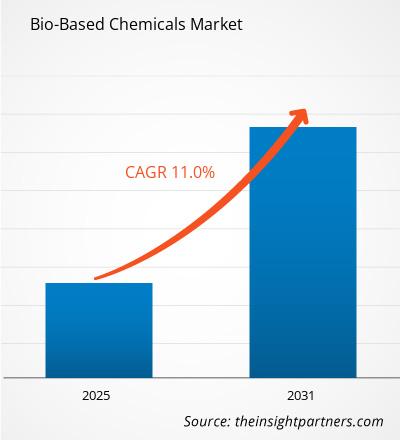
The Bio-Based Chemicals Market represents a transition from fossil-derived chemical feedstocks toward renewable carbon sources such as biomass, agricultural residues, sugars, oils, and other biological resources. The value of the market is US$ 162.07 Billion in 2025, which will increase to US$ 362.4 Billion by 2034, growing at a CAGR of 9.35% during 2026–2034. Growth will be driven by increasing use in industries, feedstock diversification, and rising demand for environmentally friendly chemical products.
North America continues to be a key production and consumption hub due to its existing expertise in biotechnology, feedstock sources, and bioeconomy strategies supported by government policies. The Bio-Based Chemicals Market Size is forecasted to grow at a projected 8.2–9.0% CAGR during 2026–2034, backed by investment in renewable chemicals, fermentation technology, biomass processing, and low carbon chemical applications.
Bio-Based Chemicals Market Assessment and Insights
- North America: North America is estimated to hold a 24–28% share in 2025 and expand at an 8.2–9.0% CAGR during 2026–2034, supported by biotechnology infrastructure, renewable feedstock availability, and federal investment in biomass-derived chemicals and fuels.
- U.S.: The U.S. is estimated to represent 78–83% of North America's 2025 market and grow at an 8.3–9.1% CAGR during 2026–2034, supported by domestic biomanufacturing, waste feedstocks, and commercialization funding.
- Europe: Europe is estimated to account for a 29–33% share in 2025 and expand at an 8.7–9.5% CAGR during 2026–2034, with Germany, France, Italy, the Netherlands, and the UK supporting bioeconomy investment, circularity, and renewable-carbon adoption.
- Asia Pacific: Asia Pacific is estimated to represent a 31–35% share in 2025 and register a 9.4–10.2% CAGR during 2026–2034, led by China, Japan, India, and South Korea, where packaging, automotive, textiles, and consumer industries stimulate renewable chemical demand.
- Largest Segment: Bioplastics is estimated to hold a 28–32% market share in 2025, supported by packaging and consumer applications, with a projected 9.2–10.0% CAGR during 2026–2034.
- High Growth Segment: Bio-surfactants are estimated to hold a 6–9% market share in 2025 and register a 10.1–11.0% CAGR during 2026–2034, supported by personal care, detergents, and renewable-carbon substitution.
- Key companies analyzed in detail: UPM-Kymmene Oyj, BASF SE, Vertec BioSolvents Inc., Archer-Daniels-Midland Company, Braskem S.A., Evonik Industries AG, Mitsubishi Chemical Group Corporation, Cargill, Incorporated, Itaconix plc, and GFBiochemicals S.p.A.
Source: The Insight Partners' analysis based on proprietary research, government publications, company annual reports, investor presentations, industry databases, and expert interviews.
The Bio-Based Chemicals sector is moving towards the integration of commercial-scale chemicals production based on renewable sources. Innovations in fermentation, biomass processing, enzyme technology, and mass-balancing production processes allow producers to replace fossil-based sources with no need to modify downstream formulations. Combined use of agricultural waste, forest biomass, sugar, vegetable oils, and waste-based intermediates provides greater feedstock flexibility and protection against oil prices fluctuations.
Future innovations are expected to be largely driven by commercial-scale production facilities, stable supply of feedstock, and customer acceptance of carbon renewable sources. Industrial deployment in Europe will be facilitated by investments into bioeconomy, whereas in North America there will be an emphasis on biomass conversion technologies and their commercialization. Asia-Pacific will be expanding its manufacturing capacity and benefiting from high levels of demand for packaging materials, automotive parts, textiles, and consumer goods.
Bio-Based Chemicals Market Report Scope
| Report Attribute | Details |
|---|---|
| Market size in 2025 | US$ 162.07 Billion |
| Market Size by 2034 | US$ 362.4 Billion |
| Global CAGR (2026 - 2034) | 9.35% |
| Historical Data | 2021-2024 |
| Forecast period | 2026-2034 |
Bio-Based Chemicals Market Analysis
Growth in the Market for Bio-based Chemicals is influenced by corporate decarbonization initiatives, regulation related to the dependency of companies on fossil sources and increasing demand for renewables in packaging, cosmetics, automobile, coating, agriculture and consumer products industries. The supply chain involves cultivation/harvesting of raw materials, pre-processing, fermentation/thermochemical process, production of intermediates, purification, formulation and further manufacturing. Thus, the economics of supply not only relies on biological performance but also on efficiency of conventional chemistry processes.
It is getting more important to diversify sources of feedstock. Sugar crops and vegetable oils represent commercial sources of raw material. Agriculture residues, forest-based biomass and waste oils as well as other sources not related to food industry are getting more and more strategic significance. Companies that utilize several pathways of feedstocks have a greater flexibility regarding seasonal availability and prices of commodities.
Competitive positioning has become dependent upon the technological base of the company, feedstock availability, production scale, renewable carbon certification, and customer qualification capabilities. In this context, the Bio-Based Chemicals Market Report takes into account the strategies through which companies are integrating the technologies of biotechnology along with the conventional chemical processing technologies for commercialization improvement. UPM-Kymmene Oyj is focusing on wood based biochemical production, whereas BASF SE is integrating renewable feedstocks within its portfolio of chemicals. On the other hand, Braskem S.A. is working towards bio-based polymers, whereas Mitsubishi Chemical Group Corporation is a combination of chemical engineering capability along with renewable materials.
Increasingly, investments are being made to scale up technologies from lab/pilot scale to larger commercial scale. The companies such as Archer-Daniels-Midland Company and Cargill, Incorporated have strong positions in agricultural feedstock supply chain, whereas Evonik Industries AG, Itaconix plc and GFBiochemicals S.p.A. are involved in specific renewable chemical pathways.
● REPORT CUSTOMIZATION
Tailor This Report To Align With Your Specific Business Requirements
This report can be customized to align precisely with your business objectives, scope, and target markets. Customization options include tailored segmentation, geography, competitive analysis, and strategic insights to support informed decision-making.
Customize This Report →WHAT YOU CAN ADJUST
- ● Segmentations
- ● Geography
- ● Competitive Analysis
- ● Language Preferences
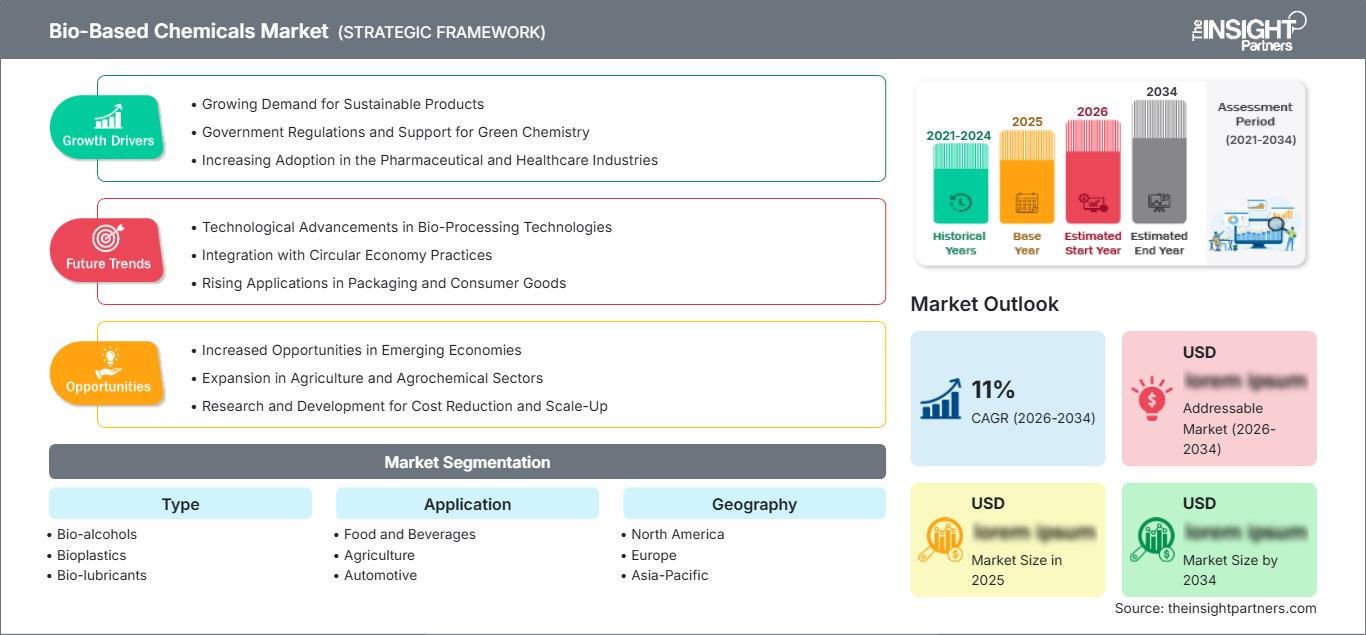
Bio-Based Chemicals Market: Strategic Insights
Regional Insights
North America Bio-Based Chemicals Market
The North American Bio-Based Chemicals Market Share is projected to have 24-28% Market Share in 2025 and grow at a 8.2-9.0% CAGR during 2026-2034. The region has access to abundant agricultural resources, chemical industry infrastructure, biotechnology knowledge base, and favorable policies for renewable chemicals. The United States is the leading market in the region, with Canada playing a role in developing forestry biomass and clean technology.
The industrial sectors that show demand for bio-based chemicals are bio-alcohol, bioplastic, bio-lubricants, and bio-solvent segments. The major end-use industries driving demand in the region are packaging, automotive, agriculture, and personal care. The focus of investment in the region is on agricultural waste, waste-to-energy feedstock, fermentation, and carbon-neutral production techniques.
U.S. Bio-Based Chemicals Market
The USA makes up around 78–83% of the North American Bio-Based Chemicals Market for 2025, and it is estimated to experience a 8.3–9.1% CAGR during 2026–2034. Favorable agricultural performance, well-developed biotech industry and government policies in favor of the use of biomass chemicals promote the economics of local production. The demand is divided among such applications as packaging, agriculture, automotive, personal care, and industry.
The USA sees more and more efforts aimed at producing drop-in renewable chemicals that can be used in existing value chains without significant modifications. Flexibility regarding feedstocks becomes one of the key strategic factors since corn, soybeans, forestry waste, oil waste and other biomass sources have various economic and environmental characteristics.
Europe Bio-Based Chemicals Market
Europe is projected to have a share of 29–33% in 2025 and record CAGR of 8.7–9.5% during 2026-2034. Germany is one of the key markets owing to its industrial chemistry and biochemicals capacity. The UK, France, Italy, and Spain are contributing through specialty chemicals, bioeconomy R&D, agricultural feedstock, and consumer demand for renewable materials.
The importance of Germany lies in the increasing capacity for industrial biochemical infrastructure. The Leuna biorefinery of UPM-Kymmene Oyj showcases the trend towards chemical production from wood and commercialization of renewable intermediates. The UK has capability in biotechnology and specialty chemicals, while France has advantage in agriculture feedstock and chemical manufacturing. Italy and Spain are contributing through biobased materials, food processing waste, packaging, and personal care applications.
APAC Bio-Based Chemicals Market
It is projected that APAC will contribute 31-35% of the Bio-Based Chemicals Market in 2025 and will experience a 9.4-10.2% CAGR between 2026-2034. The leading country in the region in terms of consumption and production is China, whereas advanced material is the primary concern for Japan and South Korea. India can benefit from agricultural residue and increasing production of chemical, and Australia can contribute in terms of biomass and biotechnology.
Increased investments in bio-refinery, renewable feedstock, and sustainable chemical production process have been driving the regional market. Chemical companies are trying to convert agriculture wastes, forestry residue, starches, sugars, and other biomass to produce bio-based intermediates, polymers, solvents, and specialty chemicals. Moreover, circular economy initiatives along with reduction in carbon emission and renewable resource utilization are encouraging chemical producers to use bio-based products in their production process. The growing demands from packaging, automotive, food and beverages, personal care, and pharmaceutical industries are going to promote bio-based chemicals in APAC region.
Middle East & Africa Bio-Based Chemicals Market
Middle East & Africa is expected to experience a 7.0-8.0% CAGR between 2026-2034 due to diversification from traditional hydrocarbons, agricultural residues, and new industrial infrastructure development. The nations of Saudi Arabia and UAE are pursuing comprehensive chemical and circular economy plans, whereas South Africa is rich in agricultural resources.
Opportunities in the region are largely focused on bio-alcohols, bio-lubricants, bio-solvents, and renewable chemical intermediates. Availability of infrastructure, feedstock logistics, water, and technology investments are among the key commercial issues. The gulf economies have an advantage of using existing chemical facilities for incorporation of renewable carbon, whereas Africa has long-term prospects from agricultural and sugar crops waste.
Segmentation Analysis
Product Type
Product Type in the Bio-Based Chemicals Market is expected to remain central to competitive positioning, with each category addressing different substitution opportunities. The segment is projected to grow at a 9.1–9.9% CAGR during 2026–2034. Bioplastics benefit from packaging demand, while bio-alcohols and bio-solvents provide comparatively mature drop-in opportunities.
- Bio-alcohols: Bio-alcohols benefit from established production infrastructure and broad use across fuels, solvents, intermediates, and formulations. Their compatibility with existing chemical pathways supports continued industrial adoption and feedstock diversification.
- Bioplastics: Bioplastics represent a major renewable-material opportunity in packaging, consumer goods, automotive components, and specialty applications. Their strategic importance increases as manufacturers seek renewable carbon without sacrificing processability and product performance.
- Bio-lubricants: Bio-lubricants gain adoption where biodegradability, renewable content, and performance under demanding operating conditions are important. Industrial machinery, automotive applications, agriculture, and environmentally sensitive operations provide attractive demand channels.
- Bio-solvents: Bio-solvents support the substitution of conventional solvents in coatings, cleaning, printing, adhesives, and industrial formulations. Demand is strengthened by lower-VOC formulation strategies and interest in renewable raw materials.
- Bio-surfactants: Bio-surfactants are increasingly used in personal care, household cleaning, agriculture, and industrial formulations. Their renewable origin, biodegradability, and formulation compatibility strengthen their strategic position in sustainable ingredient portfolios.
- Bio-based Acids: Bio-based Acids serve as renewable intermediates for polymers, food ingredients, coatings, pharmaceuticals, and specialty chemicals. Fermentation-based production provides pathways for replacing selected petrochemical-derived acid intermediates.
Application
Application in the Bio-Based Chemicals Market is projected to expand at a 9.4–10.2% CAGR during 2026–2034, reflecting broader use of renewable chemical inputs across consumer and industrial value chains. Packaging and personal care are important near-term applications, while automotive and pharmaceuticals offer higher-value specialty opportunities.
- Food and Beverages: Food and beverage applications use renewable chemicals in ingredients, packaging materials, processing aids, and functional formulations. Sustainability requirements increasingly influence material selection and supplier qualification.
- Agriculture: Agriculture uses renewable chemicals in crop formulations, adjuvants, biodegradable materials, and specialty inputs. Demand is supported by efforts to reduce environmental persistence while maintaining formulation performance.
- Automotive: Automotive manufacturers increasingly evaluate renewable polymers, lubricants, coatings, and specialty chemicals to reduce product carbon footprints. Performance requirements make qualification standards particularly important.
- Personal Care: Personal care provides a strong outlet for bio-surfactants, solvents, polymers, and specialty ingredients. Natural-origin positioning, biodegradability, and traceable feedstocks increasingly influence formulation decisions.
- Packaging: Packaging remains a major application because renewable polymers and chemical intermediates can address material substitution, brand sustainability targets, and evolving regulations surrounding conventional plastics.
- Paints and Coatings: Paints and coatings use bio-based solvents, resins, surfactants, and additives to lower fossil-carbon dependence while maintaining application performance and formulation stability.
- Adhesives and Sealants: Renewable chemical intermediates are increasingly incorporated into adhesives and sealants where manufacturers seek lower-carbon formulations, improved renewable content, and compatibility with established processing technologies.
- Pharmaceuticals: Pharmaceuticals represent a specialty application requiring stringent purity, consistency, and regulatory compliance. Bio-based intermediates can provide alternative routes to selected active and excipient-related chemical building blocks.
Opportunity Snapshot
| Application | Revenue Contribution | Trend Tag | Adoption Stage |
|---|---|---|---|
| Food and Beverages | Medium | Renewable Ingredients | Scaling |
| Agriculture | Medium | Bio Inputs | Scaling |
| Automotive | High | Renewable Materials | Scaling |
| Personal Care | High | Natural Formulations | Mature |
| Packaging | High | Bio Polymers | Mature |
| Paints and Coatings | Medium | Bio Resins | Scaling |
| Adhesives and Sealants | Medium | Renewable Binders | Scaling |
| Pharmaceuticals | Medium | Bio Intermediates | Emerging |
Bio-Based Chemicals Market Growth Drivers and Impact Analysis
Increasing substitution of fossil-derived chemical feedstocks
Manufacturers are increasingly replacing selected fossil-derived inputs with renewable carbon from biomass, agricultural residues, sugars, oils, and waste streams. The substitution trend is strongest where renewable feedstocks can deliver equivalent technical performance without major changes to downstream equipment. Drop-in chemicals, therefore, provide an important commercialization pathway because customers can reduce fossil dependence while preserving existing formulation and manufacturing processes. BASF SE, for example, has expanded bio-based routes for established chemical products, illustrating how feedstock substitution can occur within conventional chemical value chains. This model lowers adoption barriers and creates opportunities for renewable intermediates across coatings, personal care, packaging, automotive, and industrial formulations. Over time, procurement criteria are expected to incorporate renewable-carbon content alongside price, quality, supply reliability, and product carbon footprint.
Expansion of bioeconomy policies and industrial investment
Government programs are increasingly supporting the development of domestic bioeconomies, renewable feedstocks, biomanufacturing infrastructure, and low-carbon chemical technologies. Public funding helps reduce the financial risk associated with demonstration facilities and first commercial plants, where capital intensity and technology uncertainty can otherwise delay deployment. The European Union is emphasizing biobased materials and chemicals within its broader bioeconomy strategy, while the U.S. Department of Energy continues to support biomass-derived chemical and fuel technologies. These initiatives improve the investment environment for producers developing advanced fermentation, thermochemical conversion, and integrated biorefinery systems. The resulting infrastructure can reduce commercialization timelines, improve technology validation, and create regional supply networks. As more facilities reach commercial scale, unit economics and customer confidence are expected to improve.
Rising demand for lower-carbon materials across end-use industries
Packaging, personal care, automotive, coatings, agriculture, and consumer-product manufacturers are increasingly evaluating the carbon intensity of raw materials used throughout their supply chains. This creates demand for renewable chemicals that can reduce fossil-carbon exposure while satisfying performance requirements. The effect is particularly significant for multinational brands with public climate targets, because chemical inputs influence upstream Scope 3 emissions and material footprints. Renewable surfactants, polymers, solvents, acids, and lubricants can therefore become procurement priorities rather than niche sustainability products. Suppliers that provide traceable feedstocks, verified renewable content, consistent specifications, and lifecycle information are better positioned to qualify with large customers. This shift broadens the addressable market and encourages chemical producers to develop scalable renewable alternatives across both commodity and specialty applications.
Bio-Based Chemicals Market Future Trends
Greater adoption of advanced biomass and waste feedstocks
The Bio-Based Chemicals Market trends landscape is moving toward feedstocks that minimize competition with food production and improve resource efficiency. Agricultural residues, forestry by-products, waste oils, industrial by-products, and other secondary biomass streams are receiving greater attention as producers seek reliable renewable-carbon sources. Advanced pretreatment and conversion technologies can transform heterogeneous biomass into standardized chemical intermediates, improving utilization rates. Integrated biorefineries are particularly important because they can separate multiple value streams from a common feedstock, including sugars, lignin-derived materials, alcohols, and specialty intermediates. This approach can improve plant economics and reduce dependence on a single product. Future projects are therefore likely to prioritize flexible feedstock systems, higher biomass utilization, regional sourcing, and integration with existing chemical infrastructure.
Movement toward measurable renewable-carbon content
Renewable-carbon measurement is becoming increasingly important as customers distinguish between broad sustainability claims and verified material attributes. Carbon-14 measurement, chain-of-custody systems, mass-balance certification, and lifecycle assessment are supporting more transparent purchasing decisions. The trend will encourage producers to quantify renewable content and document feedstock origins rather than relying only on product-level sustainability statements. This development is particularly relevant for specialty chemicals, where renewable inputs may represent only part of a molecule or production pathway. Greater transparency can also help downstream manufacturers substantiate sustainability claims and comply with customer procurement standards. As reporting requirements become more sophisticated, suppliers with robust traceability systems and independently verifiable product data are expected to gain stronger access to multinational customers and regulated applications.
Bio-Based Chemicals Market Opportunities
Scaling integrated biorefineries for diversified chemical output
The Bio-Based Chemicals Market scope is expanding beyond individual renewable products toward integrated facilities capable of producing several chemical streams from one feedstock base. Such facilities can improve asset utilization by converting different biomass fractions into higher-value intermediates, polymers, solvents, acids, and specialty materials. Investors can target projects located near agricultural, forestry, sugar-processing, or industrial waste clusters to reduce logistics costs. Integration with existing chemical infrastructure can further lower capital requirements by using established utilities, storage, distribution, and downstream processing assets. The strongest opportunities are likely to involve flexible platforms that can change product output according to market conditions. Long-term offtake contracts with packaging, automotive, personal care, and chemical manufacturers can strengthen project bankability and reduce commercialization risk.
Developing renewable chemical platforms for specialty applications
Specialty applications provide opportunities to achieve higher value per unit of renewable feedstock because customers often prioritize performance, traceability, and functional characteristics over commodity pricing alone. Bio-surfactants, bio-based acids, specialty solvents, renewable lubricants, and pharmaceutical intermediates can therefore support attractive commercialization models. Producers can focus on applications where renewable chemistry delivers additional functional benefits such as biodegradability, low volatility, improved formulation compatibility, or reduced carbon intensity. Partnerships between biotechnology developers, chemical manufacturers, and end users can accelerate qualification and reduce scale-up risk. The Bio-Based Chemicals Market Forecasts indicate that diversification into specialty applications can complement larger-volume commodity pathways and create more resilient revenue structures, particularly when producers combine proprietary technology with secure renewable feedstock access.
Recent Developments
- May 2026: UPM-Kymmene Corporation acquired the intellectual property associated with Avantium's Ray Technology, covering processes for producing bio-based mono-ethylene glycol (MEG) and mono-propylene glycol (MPG) from plant-based sugars. The transaction broadens UPM's biomass-to-glycols technology portfolio and provides additional process options as it scales renewable chemical production at its Leuna biorefinery in Germany.
- February 2026: Henkel AG & Co. KGaA entered a strategic collaboration with Swedish company Sekab to replace fossil-based ethyl acetate with a bio-based alternative in adhesive manufacturing. The drop-in approach is designed to introduce renewable raw materials into existing adhesive production while maintaining product performance, supporting the broader substitution of fossil-derived chemical inputs in industrial adhesives.
Frequently Asked Questions

- Comprehensive Market Sizing and Forecast Analysis
- Detailed Segmentation Analysis
- In-Depth Market Dynamics Assessment
- Regional and Country-Level Insights
- Competitive Landscape and Company Benchmarking
- Strategic Business Intelligence
Recent Reports
Testimonials

The Insight Partners provided valuable market intelligence that supported our global go-to-market strategy. Their team was professional, responsive, and attentive to our feedback, providing thoughtful analysis and helpful methodological clarifications throughout the project.
Junmo Kim Chief Financial Officer (CFO), Enertech Co., Ltd.
The Insight Partners' SCADA System Market report is comprehensive, with valuable insights on current trends and future forecasts. The team was highly professional, responsive, and supportive throughout. We are very satisfied and highly recommend their services.
RAN KEDEM Partner, Reali Technologies LTDs
I requested a report on a very specific software market and the team produced the report in a few days. The information was very relevant and well presented. I then requested some changes and additions to the report. The team was again very responsive and I got the final report in less than a week.
JEAN-HERVE JENN Chairman, Future Analytica
We worked with The Insight Partners for an important market study and forecast. They gave us clear insights into opportunities and risks, which helped shape our plans. Their research was easy to use and based on solid data. It helped us make smart, confident decisions. We highly recommend them.
PIYUSH NAGPAL Sr. Vice President, High Beam Global
The Insight Partners delivered insightful, well-structured market research with strong domain expertise. Their team was professional and responsive throughout. The user-friendly website made accessing industry reports seamless. We highly recommend them for reliable, high-quality research services
YUKIHIKO ADACHI CEO, Deep Blue, LLC.
This is the first time I have purchased a market report from The Insight Partners.While I was unsure at first, I visited their web site and felt more comfortable to take the risk and purchase a market report.I am completely satisfied with the quality of the report and customer service. I had several questions and comments with the initial report, but after a couple of dialogs over email with their analyst I believe I have a report that I can use as input to our strategic planning process.Thank you so much for taking the extra time and making this a positive experience.I will definitely recommend your service to others and you will be my first call when we need further market data.
JOHN SUZUKI President and Chief Executive Officer, Board Director, BK Technologies
I wish to appreciate your support and the professionalism you displayed in the course of attending to my request for information regarding to infectious disease IVD market in Nigeria. I appreciate your patience, your guidance, and the fact that you were willing to offer a discount, which eventually made it possible for us to close a deal. I look forward to engaging The Insight Partners in the future, all thanks to the impression you have created in me as a result of this first encounter.
DR CHIJIOKE ONYIA MANAGING DIRECTOR, PineCrest Healthcare Ltd.Reason to Buy
- Informed Decision-Making
- Understanding Market Dynamics
- Competitive Analysis
- Identifying Emerging Markets
- Customer Insights
- Market Forecasts
- Risk Mitigation
- Boosting Operational Efficiency
- Strategic Planning
- Investment Justification
- Tracking Industry Innovations
- Aligning with Regulatory Trends





 Get Free Sample for