
Bio-based Construction Polymers Market Size, Trends & Demand by 2034
Coverage: By Product (Polyurethane, Epoxies, PLA, PHA); Application (Pipe, Profile, Insulation) , and Geography (North America, Europe, Asia Pacific, and South and Central America)
- Status : Data Released
- Report Code : TIPRE00017845
- Category : Chemicals and Materials
- No. of Pages : 150
- Available Report Formats :


- Last update date : October 15, 2026


2025 Market Size
US$ 13.95 Bn
Base year value
2034 Forecast
US$ 23.37 Bn
Projected by 2034
CAGR 2026-2034
5.91 %
Growth rate
Addressable Market
US$ 169.15 Bn
(2026-2034)
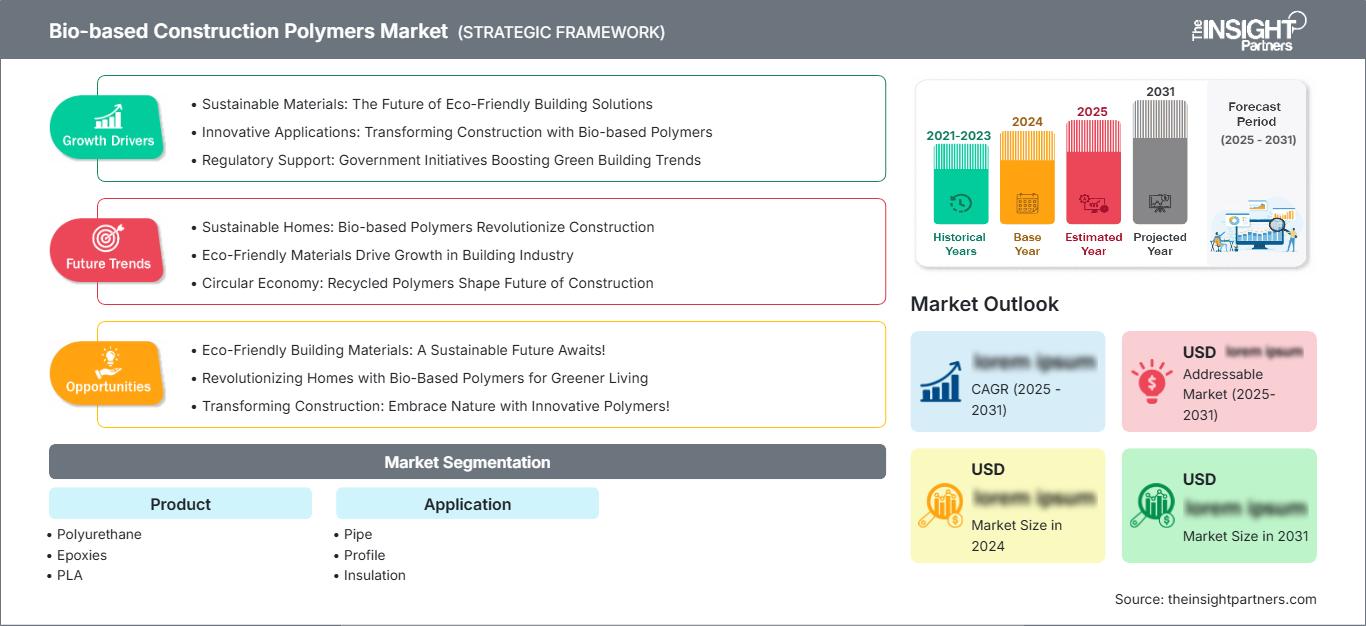
The bio-based construction polymers market size is expanding as building material producers seek lower-carbon alternatives without sacrificing durability, insulation performance, processing efficiency, or design flexibility. The market is valued at US$ 13.95 Billion in 2025 and is projected to reach US$ 23.37 Billion by 2034, registering a CAGR of 5.91% during 2026–2034. Adoption is being supported by renewable feedstocks, improved polymer chemistry, lifecycle assessment, and growing demand for sustainable construction materials.
North America is positioned for steady expansion as building owners, contractors, and material manufacturers increasingly evaluate embodied carbon alongside operational efficiency. The regional CAGR is estimated at 5.1–5.8% between 2026 and 2034, supported by green-building specifications, renovation activity, insulation demand, and investment in higher-performance materials using renewable or bio-attributed feedstocks.
Bio-based Construction Polymers Market Assessment and Insights
- North America: North America is estimated to hold a 25–29% bio-based construction polymers market share in 2025 and grow at a 5.1–5.8% CAGR between 2026–2034, supported by sustainable building standards, insulation upgrades, renovation programs, and increasing manufacturer investment in renewable polymer technologies.
- US: The US is estimated to account for 72–76% of North America's 2025 share, expanding at a 5.2–5.9% CAGR between 2026–2034, with demand centered on insulation, profiles, coatings, and high-performance construction systems.
- Europe: Europe is estimated at a 27–31% share in 2025, advancing at a 5.7–6.4% CAGR between 2026–2034. Germany, France, Italy, the UK, and Spain are leading adoption through decarbonization requirements, circular construction initiatives, and stronger preference for renewable material inputs.
- Asia Pacific: Asia Pacific is estimated at a 31–35% share in 2025 and a 6.1–6.8% CAGR between 2026–2034, led by China, Japan, South Korea, and India, where construction expansion, polymer manufacturing capacity, and sustainability-focused product development support adoption.
- Largest Segment: Polyurethane is estimated to hold a 34–38% market share in 2025, growing at a 6.0–6.6% CAGR during 2026–2034, supported by insulation, profiles, and performance-critical construction applications.
- High Growth Segment: PLA is estimated to hold a 10–14% market share in 2025, with a 6.8–7.5% CAGR during 2026–2034, benefiting from renewable feedstock development and expanding applications requiring bio-based polymer content.
- Key companies analyzed in detail: BASF SE, Bio-On, E. I. du Pont de Nemours and Company, Evonik Industries AG, Mitsubishi Gas Chemical Company, Inc., NatureWorks LLC, Avient Corporation, SK Chemicals Co., Ltd., Teijin Limited, and Toyobo Co., Ltd.
Source: The Insight Partners' analysis based on proprietary research, government publications, company annual reports, investor presentations, industry databases, and expert interviews.
Polymer production is moving away from fossil carbon sources to renewable carbon, mass balance materials, recycling content, and fermentation chemicals as intermediates. Manufacturers are enhancing the molecular structure to ensure thermal stability, mechanical strength, adhesion, and processability of bio-based polymers. Production economics will always be important since feedstock access, purification, conversion efficiency, and scale will decide whether sustainable polymers will be able to compete with existing petrochemical polymers in construction value chains.
In the upcoming years, investments will shift towards feedstock systems integration, biorefineries, polyols, epoxy bio-based materials, and better performing PLA and PHA polymers. Europe is stepping up its policy support for bio-based building materials, whereas North America and Asia-Pacific represent manufacturing and application options. Standardization, environmental product declarations, product digitalization, and lifecycle assessment are some other factors that might impact purchasing decisions and project qualifications.
Bio-based Construction Polymers Market Report Scope
| Report Attribute | Details |
|---|---|
| Market size in 2025 | US$ 13.95 Billion |
| Market Size by 2034 | US$ 23.37 Billion |
| Global CAGR (2026 - 2034) | 5.91% |
| Historical Data | 2021-2024 |
| Forecast period | 2026-2034 |
Bio-based Construction Polymers Market Analysis
The bio-based construction polymers market will be influenced by needs for better insulation, lightweight construction, renewable content, and the reduction of embodied carbon. The supply chain starts from biomass, agriculture waste, bio-intermediates, and fermentation precursors, followed by polymerization, compounding, formulation, conversion, and incorporation into the construction systems. Manufacturers have to find a balance between renewable content and thermomechanical performance.
However, supply in the bio-based construction polymers market is increasingly based on feedstock certification and process scalability. Big chemical companies may capitalize on their production infrastructure, whereas developers specializing in bio-intermediates may choose to compete there. In any case, construction converters are important, since qualification of materials may require compatibility with existing extruders, injection molding machines, foamers, coatings, and adhesives equipment. Therefore, suppliers offering drop-in solutions may minimize implementation barriers.
Moreover, the bio-based construction polymers market demonstrates a highly competitive landscape featuring a mix of diverse chemical players alongside biomaterials focused businesses. Companies such as BASF SE and Evonik Industries AG have diverse polymer and formulation expertise, whereas Mitsubishi Gas Chemical Company, Inc., Teijin Limited, and Toyobo Co., Ltd. specialize in materials expertise. NatureWorks LLC and SK Chemicals Co., Ltd. complement the bio-based polymers portfolio by offering expertise in renewable polymers and polyols.
As far as strategic positioning is concerned, the emphasis has been shifting to performance characteristics of particular materials based on their applications rather than bio-content only. Companies like E. I. du Pont de Nemours and Company, Bio-On, and Avient Corporation possess unique material development capabilities. Moreover, the majority of companies within the entire value chain assess the use of renewable feedstock, recycling, mass balance approach and lifecycle certification.
● REPORT CUSTOMIZATION
Tailor This Report To Align With Your Specific Business Requirements
This report can be customized to align precisely with your business objectives, scope, and target markets. Customization options include tailored segmentation, geography, competitive analysis, and strategic insights to support informed decision-making.
Customize This Report →WHAT YOU CAN ADJUST
- ● Segmentations
- ● Geography
- ● Competitive Analysis
- ● Language Preferences
Bio-based Construction Polymers Market: Strategic Insights
Regional Insights
North America bio-based construction polymers market
North America is estimated to represent 25–29% share in 2025, with a 5.1–5.8% CAGR through 2034. This region enjoys the advantages of renovation efforts, energy efficiency insulation requirements, green buildings standards, and robust chemical manufacturing capabilities. The US is the leading regional demand driver, but there are also opportunities arising from Canada due to sustainable construction efforts and the use of low-carbon materials.
The regional supply system favors traditional polymer makers that have the capability to blend in renewable resources within the production process. Thermal and structural durability become important construction considerations rather than just being able to incorporate renewable resources into the construction. Profiles, insulation, and polyurethane systems present possible opportunities due to the ability to add bio-renewable components without modifying existing downstream equipment.
U.S. bio-based construction polymers market
The US accounts for an estimated 72–76% of North America's 2025 share and is expected to expand at a 5.2–5.9% CAGR. The demand is centered in insulation, construction profiles, sealants, coatings, and performance materials because energy efficiency and durability factor into the choice of materials. BASF SE and other leading polymer companies have well-established technology and commercial expertise in various construction applications.
Renovation of buildings, energy-performance standards, and the need to reduce CO2 emissions are motivating contractors and material formulators to consider bio-based polymers. Qualification is application-dependent since fire resistance, moisture resistance, dimensional stability, and longevity need to be comparable with traditional options. The adoption of such products is consequently most pronounced where biochemistry is able to confer an environmental advantage but requires little change to construction procedures.
Europe bio-based construction polymers market
The bio-based construction polymers market report shows that Europe is estimated to hold a 27–31% share in 2025 and grow at a 5.7–6.4% CAGR, with Germany representing the leading national contributor. There are strong prospects for insulation and highly developed materials in the United Kingdom and Germany markets, whereas there are strong prospects for renovation, sustainability and renewable construction materials in France, Italy and Spain.
In the United Kingdom, there is a focus on energy efficient renovation and low-carbon building materials, which creates prospects for development of bio-polyurethane, epoxy and insulation technologies. Germany unites the manufacturing of advanced polymers with high sustainability requirements; therefore, it is a leading country of development and qualification. France presents good conditions for adoption of bio-construction technologies, while Italy and Spain present prospects for renovations and sustainable materials.
APAC bio-based construction polymers market
The bio-based construction polymers market forecast shows that APAC is estimated at 31–35% share in 2025, expanding at a 6.1–6.8% CAGR, with China leading regional demand. The two nations of Japan and South Korea provide advanced polymer technologies, India gives room for construction material expansion, and Australia allows for the provision of sustainable building materials.
China is a nation with polymer manufacturing capacity and increasing applications of construction materials. The nations of Japan and South Korea focus on the manufacturing of high-performance polymers, whereas India has a base for insulation, profiles, and sustainable building products. Australia contributes to this process through its energy efficient construction. The producers in the region have increasingly focused on the use of renewable feedstocks.
Middle East & Africa bio-based construction polymers market
Middle East and Africa adoption is developing from a smaller base, with a projected 4.2–5.0% CAGR. In terms of regional opportunities, Saudi Arabia and the UAE have the best opportunities due to their extensive construction programs, while South Africa has the best sub-Saharan opportunities. Energy-intensive construction and infrastructure projects require durable and efficient polymer materials.
Saudi Arabia is the best opportunity center due to its infrastructure and diversification programs, while the UAE has the advantage of its commercial and sustainable building constructions. South Africa has the best opportunities in terms of insulation and construction profiles, while the rest of MEA is still fragmented.
Segmentation Analysis
Product
The product segment is expected to expand at a 5.8–6.4% CAGR during 2026–2034. Material selection depends on mechanical strength, thermal performance, moisture resistance, processing conditions, and renewable-content requirements. Polyurethane remains important for insulation and profiles, while PLA and PHA provide opportunities where renewable or biodegradable characteristics are strategically valuable. Epoxies support applications requiring adhesion, chemical resistance, and dimensional stability.
- Polyurethane: Polyurethane maintains a strong position because insulation systems require controlled thermal performance, low density, adhesion, and dimensional stability. Bio-derived polyols and renewable feedstocks can be incorporated while preserving established processing routes.
- Epoxies: Bio-based epoxies address applications requiring strong adhesion, chemical resistance, and dimensional stability. Their strategic importance is increasing where formulators seek renewable content for coatings, binders, composites, and construction-related protective systems.
- PLA: PLA benefits from renewable feedstock availability and established polymer-processing knowledge. Its construction opportunity is strongest in profiles, specialty components, and applications where controlled performance and bio-based content justify material qualification.
- PHA: PHA remains an emerging option with potential in applications requiring bio-based and biodegradable characteristics. Commercial adoption depends on cost reduction, production scale, processing consistency, and validation against construction durability requirements.
Application
The application segment is projected to grow at a 5.5–6.2% CAGR during 2026–2034. Construction applications require polymers to satisfy performance, safety, service-life, and installation requirements simultaneously. Insulation represents a particularly important opportunity because polymer formulation directly influences thermal performance and building energy efficiency, while pipe and profile applications emphasize mechanical strength, dimensional stability, and long-term durability.
- Pipe: Pipe applications require resistance to pressure, moisture, chemicals, and long-term environmental exposure. Bio-based polymer adoption will depend on maintaining service performance while improving renewable feedstock content and lifecycle characteristics.
- Profile: Profiles provide opportunities in window systems, architectural components, trims, and lightweight structures. Demand favors materials combining dimensional stability, weather resistance, processing efficiency, and compatibility with established extrusion technologies.
- Insulation: Insulation represents a strategically important application because polymer chemistry influences thermal resistance, density, moisture behavior, and installation efficiency. Bio-attributed polyurethane systems can support lower-carbon building specifications without sacrificing established performance requirements.
Opportunity Snapshot
| Application | Revenue Contribution | Trend Tag | Adoption Stage |
|---|---|---|---|
| Pipe | Medium | Durable Polymers | Scaling |
| Profile | Medium | Low Carbon | Scaling |
| Insulation | High | Thermal Efficiency | Scaling |
Bio-based Construction Polymers Market Growth Drivers and Impact Analysis
Decarbonization of Building Materials
Decarbonization is changing how construction materials are evaluated because project developers increasingly consider embodied emissions alongside operational energy performance. Bio-based polymers can reduce dependence on fossil carbon when renewable feedstocks are sustainably sourced and verified. The commercial impact is strongest in applications where polymer systems represent a meaningful material input, particularly insulation, coatings, profiles, and composite components. Suppliers able to document feedstock origin, carbon accounting, and lifecycle performance can improve qualification prospects with architects, contractors, and developers. The transition also encourages chemical producers to develop mass-balance and bio-attributed formulations that can enter existing production systems. As procurement criteria become more carbon-conscious, performance specifications are likely to incorporate environmental information more systematically, creating opportunities for differentiated polymer grades with credible lifecycle evidence.
Expansion of Energy-Efficient Construction
Energy-efficient construction is increasing demand for advanced insulation and building-envelope materials that combine low thermal conductivity with durability and installation efficiency. Polyurethane systems are particularly relevant because polymer formulation directly affects foam density, cell structure, dimensional stability, and insulation performance. Bio-based feedstocks can therefore enter a large existing application base when they preserve established technical characteristics. The impact extends beyond new construction because renovation programs require materials compatible with existing buildings and installation practices. Suppliers that provide drop-in or minimally modified formulations can reduce contractor retraining and equipment changes. Greater use of high-performance insulation also creates opportunities for profiles, adhesives, coatings, and composite systems that complement efficient building envelopes. This application-led approach can accelerate commercialization more effectively than renewable content alone.
Advances in Bio-Based Polymer Processing
Processing advances are reducing technical barriers that previously limited bio-based polymer adoption. Improvements in polymerization, fermentation, compounding, reactive chemistry, and additive formulation allow renewable inputs to achieve more consistent molecular characteristics and processing behavior. For construction manufacturers, consistency is essential because extrusion, molding, foaming, and coating lines are optimized around narrow operating windows. Better processability can reduce scrap, improve throughput, and simplify qualification against conventional materials. The commercial effect is particularly relevant for PLA, PHA, polyurethane, and bio-based epoxy systems, where cost and performance remain central adoption considerations. Continued development of renewable intermediates can also diversify feedstock sources and reduce dependence on a single agricultural or biochemical pathway. Over time, these improvements should expand the range of construction applications suitable for bio-derived polymer formulations.
Bio-based Construction Polymers Market Future Trends
bio-based construction polymers market trends Shift Toward Verified Carbon Performance
Future purchasing decisions are likely to move beyond simple bio-content claims toward verified carbon performance, traceable feedstocks, and lifecycle documentation. Environmental product declarations, digital product information, mass-balance certification, and building-level carbon calculations will increasingly influence material qualification. Suppliers will need to demonstrate not only renewable input percentages but also how feedstock sourcing, manufacturing energy, transport, processing, use, and end-of-life affect total environmental performance. This shift favors companies capable of integrating polymer chemistry with transparent sustainability accounting. Construction manufacturers may increasingly compare alternative materials using standardized lifecycle indicators rather than relying on single environmental attributes. As databases and procurement systems improve, product-level environmental information could become a routine commercial requirement. The result will be stronger differentiation between technically similar polymer grades based on verified carbon performance and supply-chain transparency.
Integrated Renewable Feedstock Platforms
The next stage of development will likely involve closer integration between biomass producers, biotechnology companies, chemical manufacturers, compounders, and construction-material converters. Instead of purchasing isolated bio-based intermediates, polymer producers may secure dedicated feedstock pathways through long-term partnerships, joint ventures, or offtake arrangements. This model can improve supply visibility while supporting investment in fermentation, biorefineries, and purification infrastructure. Construction applications will benefit when renewable polymers become available in consistent grades with predictable pricing and technical specifications. Integration may also encourage the use of agricultural residues, industrial by-products, and alternative biomass streams, reducing reliance on limited feedstocks. As conversion technologies mature, vertically coordinated supply chains could shorten commercialization cycles and make renewable polymers more competitive in applications where customers require dependable volumes and repeatable performance.
Bio-based Construction Polymers Market Opportunities
Premium Insulation Systems With Renewable Content
Insulation offers investors a practical route into higher-value sustainable polymer applications because thermal performance remains a measurable purchasing criterion. Producers can develop polyurethane systems using bio-derived polyols or other renewable inputs while maintaining established foam-processing methods. Commercial opportunities are strongest where developers seek lower embodied carbon without accepting reduced insulation performance, durability, or installation efficiency. Suppliers should prioritize formulations supported by lifecycle evidence, third-party certification, and compatibility with existing equipment. Partnerships between chemical producers, insulation manufacturers, building-system suppliers, and construction companies can accelerate qualification and reduce technical risk. Regional production can further improve feedstock logistics and customer responsiveness. Over time, differentiated insulation systems may command stronger positions in projects where sustainability specifications are embedded into procurement requirements and where building owners value both operational energy savings and reduced embodied impacts.
Regional Bio-Polymer Manufacturing Hubs
Investment opportunities are emerging around regional manufacturing hubs that combine renewable feedstocks, polymer processing, formulation expertise, and downstream construction converters. Such clusters can reduce logistics complexity while improving access to technical services and customer qualification facilities. Asia Pacific offers scale-oriented opportunities because of its large polymer manufacturing base, while Europe provides a strong policy environment for bio-based material commercialization. North America can support specialized production focused on high-performance formulations and construction applications. Investors should prioritize technologies capable of using multiple feedstocks, because flexibility can reduce exposure to agricultural supply volatility and improve long-term resilience. Collaboration with local construction-material producers can also create application-specific demand before large-scale capacity is commissioned. Successful hubs are likely to integrate feedstock certification, polymer synthesis, compounding, testing, and lifecycle assessment within a coordinated ecosystem.
Frequently Asked Questions

- Comprehensive Market Sizing and Forecast Analysis
- Detailed Segmentation Analysis
- In-Depth Market Dynamics Assessment
- Regional and Country-Level Insights
- Competitive Landscape and Company Benchmarking
- Strategic Business Intelligence
Recent Reports
Testimonials

The Insight Partners provided valuable market intelligence that supported our global go-to-market strategy. Their team was professional, responsive, and attentive to our feedback, providing thoughtful analysis and helpful methodological clarifications throughout the project.
Junmo Kim Chief Financial Officer (CFO), Enertech Co., Ltd.
The Insight Partners' SCADA System Market report is comprehensive, with valuable insights on current trends and future forecasts. The team was highly professional, responsive, and supportive throughout. We are very satisfied and highly recommend their services.
RAN KEDEM Partner, Reali Technologies LTDs
I requested a report on a very specific software market and the team produced the report in a few days. The information was very relevant and well presented. I then requested some changes and additions to the report. The team was again very responsive and I got the final report in less than a week.
JEAN-HERVE JENN Chairman, Future Analytica
We worked with The Insight Partners for an important market study and forecast. They gave us clear insights into opportunities and risks, which helped shape our plans. Their research was easy to use and based on solid data. It helped us make smart, confident decisions. We highly recommend them.
PIYUSH NAGPAL Sr. Vice President, High Beam Global
The Insight Partners delivered insightful, well-structured market research with strong domain expertise. Their team was professional and responsive throughout. The user-friendly website made accessing industry reports seamless. We highly recommend them for reliable, high-quality research services
YUKIHIKO ADACHI CEO, Deep Blue, LLC.
This is the first time I have purchased a market report from The Insight Partners.While I was unsure at first, I visited their web site and felt more comfortable to take the risk and purchase a market report.I am completely satisfied with the quality of the report and customer service. I had several questions and comments with the initial report, but after a couple of dialogs over email with their analyst I believe I have a report that I can use as input to our strategic planning process.Thank you so much for taking the extra time and making this a positive experience.I will definitely recommend your service to others and you will be my first call when we need further market data.
JOHN SUZUKI President and Chief Executive Officer, Board Director, BK Technologies
I wish to appreciate your support and the professionalism you displayed in the course of attending to my request for information regarding to infectious disease IVD market in Nigeria. I appreciate your patience, your guidance, and the fact that you were willing to offer a discount, which eventually made it possible for us to close a deal. I look forward to engaging The Insight Partners in the future, all thanks to the impression you have created in me as a result of this first encounter.
DR CHIJIOKE ONYIA MANAGING DIRECTOR, PineCrest Healthcare Ltd.Reason to Buy
- Informed Decision-Making
- Understanding Market Dynamics
- Competitive Analysis
- Identifying Emerging Markets
- Customer Insights
- Market Forecasts
- Risk Mitigation
- Boosting Operational Efficiency
- Strategic Planning
- Investment Justification
- Tracking Industry Innovations
- Aligning with Regulatory Trends





 Get Free Sample for