
Biocatalysis and Biocatalysts Market Trends, Share & Demand by 2034
Coverage: By Type (Oxidoreductases, Transferases, Hydrolases, Others); Application (Food and Beverages, Cleaning Agents, Biofuel Production, Agriculture and Feed, Biopharmaceuticals, Others), and Geography (North America, Europe, Asia Pacific, and South and Central America)
- Status : Data Released
- Report Code : TIPRE00013906
- Category : Chemicals and Materials
- No. of Pages : 150
- Available Report Formats :


- Last update date : August 28, 2026


2025 Market Size
US$ 29.28 Bn
Base year value
2034 Forecast
US$ 67.57 Bn
Projected by 2034
CAGR 2026-2034
9.74 %
Growth rate
Addressable Market
US$ 431.59 Bn
(2026-2034)
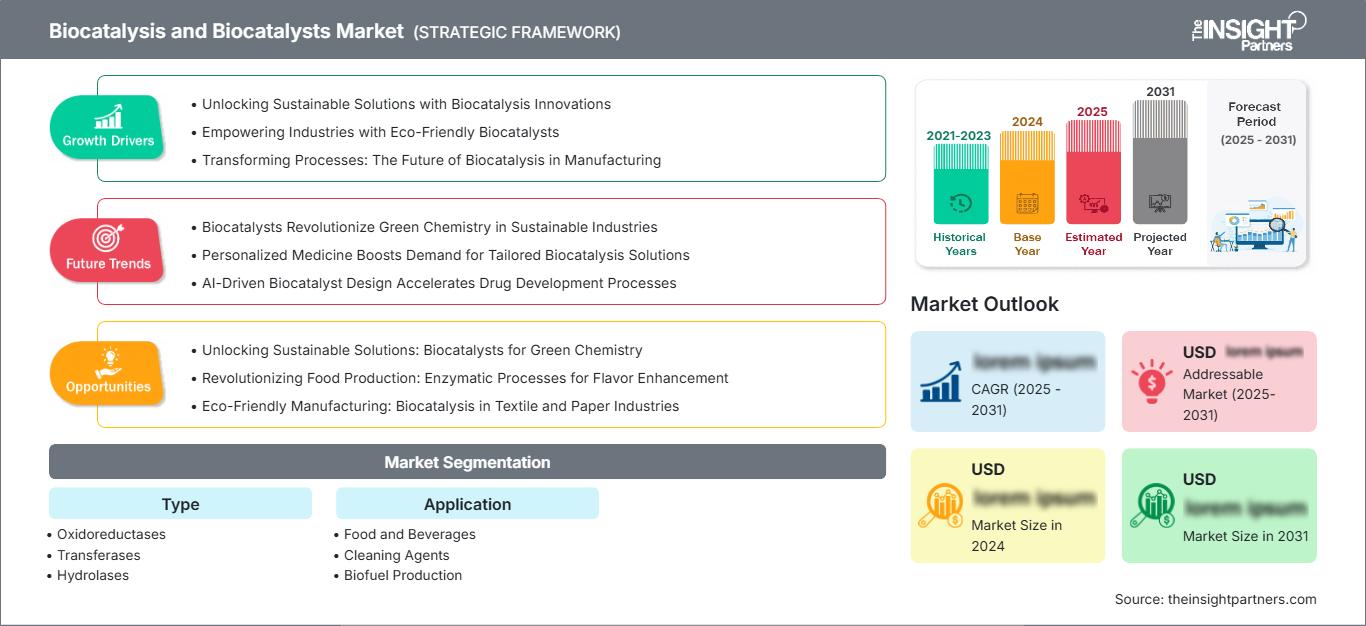
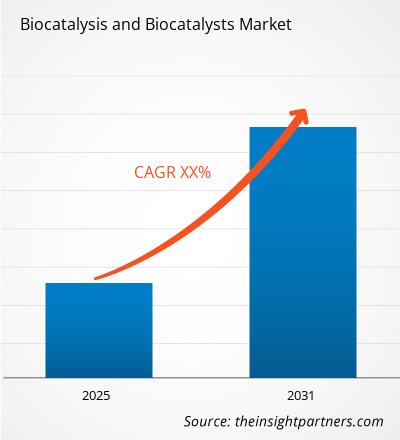
The Biocatalysis and Biocatalysts market was valued at US$ 29.28 Billion in 2025 and is projected to reach US$ 67.57 Billion by 2034, registering a CAGR of 9.74% during 2026–2034. Expansion is supported by enzyme engineering, fermentation advances, and growing substitution of conventional chemical catalysts across food processing, cleaning, biofuels, agriculture, feed, and biopharmaceutical manufacturing.
North America remains a major technology and commercialization hub, with the Biocatalysis and Biocatalysts Market size outlook supported by pharmaceutical process development, specialty chemical manufacturing, and advanced enzyme engineering. Regional expansion is estimated at 8.8–9.5% CAGR during 2026–2034, supported by demand for selective synthesis, lower process waste, and increasingly sophisticated biomanufacturing infrastructure.
Biocatalysis and Biocatalysts Market Assessment and Insights
- North America: North America held an estimated 34–37% share in 2025 and is projected to grow at 8.8–9.5% CAGR between 2026 and 2034, supported by pharmaceutical manufacturing, enzyme engineering, biotechnology investment, and industrial process optimization.
- U.S.: The U.S. represented approximately 75–78% of North American demand in 2025, with growth estimated at 8.9–9.7% CAGR during 2026–2034, led by biopharmaceutical and specialty-chemical applications.
- Europe: Europe accounted for approximately 29–32% share in 2025 and is expected to register 9.0–9.7% CAGR during 2026–2034, with Germany, France, the UK, Denmark, and the Netherlands supporting enzyme commercialization and industrial biotechnology.
- Asia Pacific: Asia Pacific represented approximately a 25–28% share in 2025 and is forecast to expand at a 10.2–11.0% CAGR during 2026–2034, led by China, Japan, South Korea, India, and Australia through food, feed, pharmaceutical, and biofuel applications.
- Largest Segment: Hydrolases held approximately 43–46% market share in 2025, with an estimated 8.7–9.5% CAGR during 2026–2034, supported by food, cleaning, feed, and industrial processing.
- High Growth Segment: Biopharmaceuticals represented approximately 24–27% application share in 2025 and are projected to grow at 11.0–11.8% CAGR during 2026–2034, driven by precision synthesis and biologics manufacturing.
- Key companies analyzed in detail: AB Enzymes GmbH, Amano Enzyme Inc., BASF SE, Codexis, Inc., Dyadic International, Inc., DuPont de Nemours, Inc., Novonesis A/S, Koninklijke DSM N.V., Groupe Soufflet, International Flavors & Fragrances Inc.
Source: The Insight Partners' analysis based on proprietary research, government publications, company annual reports, investor presentations, industry databases, and expert interviews.
Biocatalysts and biocatalysis are shifting from classical enzyme-based catalysis to engineered catalysts tailored for particular substrates and processes. Biocatalysis through protein engineering, directed evolution, high throughput screening, computational design, and fermentation processes is becoming more efficient and manufacturable and making enzymes capable of handling reactions which had been traditionally performed using metals, solvents, heat, or several rounds of purification.
Development efforts need to focus on manufacture clusters in Asia Pacific, pharmaceutical outsourcing, green chemicals, and precision fermentation. Investments in computational protein engineering and process intensification are anticipated to help bring about commercialization. Enzyme catalysis gaining regulatory acceptance, increased sustainability demands, and customer demand for lower process mass intensity are also expected to aid in increasing adoption especially where the biocatalysis route has any advantage in yield, cost, safety, or sustainability.
Biocatalysis and Biocatalysts Market Report Scope
| Report Attribute | Details |
|---|---|
| Market size in 2025 | US$ 29.28 Billion |
| Market Size by 2034 | US$ 67.57 Billion |
| Global CAGR (2026 - 2034) | 9.74% |
| Historical Data | 2021-2024 |
| Forecast period | 2026-2034 |
Biocatalysis and Biocatalysts Market Analysis
Biocatalysis and Biocatalysts Market growth will be driven by the increasing demand for reactions that have high specificity in the pharmaceutical industry, food & feed processing, cleaning, and general manufacturing industries. The value chain includes enzyme discovery, strain development, protein engineering, fermentation, purification, formulation, testing/validation, and implementation. Pharmaceutical companies are now considering the use of enzymes if they offer stereoselectivity, milder reaction conditions, less waste, or improved process economics to boost performance.
The supply chain consists of the microbial strains, fermentation process, enzyme expression, purification, and formulation. Companies that are involved in discovering up to the implementation of enzymes can accelerate commercialization processes while addressing specific substrate requirements. Feedstock availability and cost-effective fermentation process remain key factors, especially for high-volume enzymes. However, enzyme engineering can boost catalyst efficiency, enabling clients to reach the required conversions at low enzyme loadings.
Differentiation becomes more dependent on proprietary enzyme libraries, platforms for protein engineering, application know-how, and manufacturing at scale. While Novonesis A/S remains broadly exposed to the food, household care, agriculture, animal feed, and industrial biotechnology markets, BASF SE has been combining enzyme technologies with large-scale chemistry and formulation. Amano Enzyme Inc. has been focusing more on specialized enzymes in food and pharmaceutical applications, but Codexis, Inc. has been focusing heavily on engineered enzymes and pharmaceutical process development.
More investments go into artificial intelligence-based enzyme design, automation of screening, fermentation at scale, and process integration. In 2025, Codexis, Inc. has reported 53 projects completed with 34 customers, and it keeps positioning CodeEvolver technology as one that can be used for enzyme engineering and manufacturing. Likewise, BASF SE has been putting emphasis on computation technologies, biotechnology, and process innovations.
The Biocatalysis and Biocatalysts Market analysis indicates that market leadership will depend on the ability to convert laboratory enzyme performance into commercially reliable manufacturing outcomes. Large suppliers benefit from global production and customer relationships, while specialists can compete through proprietary catalysts and high-value applications. Strategic positioning is therefore shifting from supplying individual enzymes toward providing complete discovery, optimization, scale-up, and process-integration solutions.
● REPORT CUSTOMIZATION
Tailor This Report To Align With Your Specific Business Requirements
This report can be customized to align precisely with your business objectives, scope, and target markets. Customization options include tailored segmentation, geography, competitive analysis, and strategic insights to support informed decision-making.
Customize This Report →WHAT YOU CAN ADJUST
- ● Segmentations
- ● Geography
- ● Competitive Analysis
- ● Language Preferences
Biocatalysis and Biocatalysts Market: Strategic Insights
Regional Insights
North America Biocatalysis and Biocatalysts Market
North America accounted for approximately 34–37% of the Biocatalysis and Biocatalysts Market share in 2025 and is projected to expand at an 8.8–9.5% CAGR through 2034. The U.S. is the leading regional market due to pharmaceutical R&D, biotech, specialty chemicals, food processing, and fermentation technologies. Canada has been contributing through its industrial biotech, agriculture, food processing, and bio manufacturing.
There has been excellent cooperation between pharmaceutical companies, academia, biotechnology firms, and enzyme producers in the regional ecosystem. The market is characterized by increasing demand for high value uses where stereoselectivity, purity, efficiency, and sustainability make enzyme development worth investing in. Biopharmaceutical production is particularly vital since enzymes may be able to provide complex intermediate and molecular transformations not feasible in chemical processes.
U.S. Biocatalysis and Biocatalysts Market
The U.S. represented approximately 75–78% of North American Biocatalysis and Biocatalysts Market in 2025 and is expected to grow at 8.9–9.7% CAGR through 2034. This is backed up by advances in pharmaceutical technology, contract development and manufacturing organizations, biotechnology, and specialty chemicals. Companies such as Codexis, Inc., DuPont de Nemours, Inc., and BASF SE are major users of applications.
The manufacture of pharmaceuticals and biopharmaceuticals remains one of the key sectors of demand due to the ability of engineered enzymes to increase selectivity and simplify reactions. Other applications in food, cleaning products, agriculture, and industrial biotechnology also exist. Computational enzyme design and automation are speeding up research and development, while customer demands for scalable catalysts are pushing suppliers to combine enzyme discovery and fermentation services.
Europe Biocatalysis and Biocatalysts Market
Europe represented approximately a 29–32% Biocatalysis and Biocatalysts Market in 2025 and is forecast to expand at a 9.0–9.7% CAGR through 2034. Germany accounts for the biggest regional consumption, followed by the UK, France, Denmark, Italy, and the Netherlands. The region's enzyme-based manufacturing industry is underpinned by advanced industrial biotechnology infrastructure, pharmaceuticals manufacture, food processing, and sustainable manufacturing practices.
The UK continues to be a key research hub and is home to a strong biotechnology infrastructure for enzyme discovery and pharmaceuticals manufacturing processes. Germany has the advantage of its chemical and pharmaceutical manufacturing facilities, while France and Italy account for the major food, beverages, agriculture, and industrial processing needs of the region. Denmark's importance lies in its biosciences and enzyme development capabilities.
APAC Biocatalysis and Biocatalysts Market
APAC accounted for approximately a 25–28% share in 2025 and is expected to grow at a 10.2–11.0% CAGR through 2034. China is the dominant region in terms of demand followed by Japan, South Korea, India, and Australia. The use of industrial biotechnology, food processing, animal nutrition, pharmaceutical outsourcing, and biofuels enables the growth of enzyme usage.
China has its advantage due to mass production, Japan and South Korea focus on biotechnology and pharmaceuticals, India takes its strength from pharmaceutical production and developing biotechnology capabilities, while Australia is involved in agriculture and food processing. The government policy promoting biotechnology and bio manufacturing encourages local enzyme production and application.
Middle East & Africa Biocatalysis and Biocatalysts Market
The Middle East & Africa region still represents an emerging market, with applications dominated by food processing, agriculture, animal feed, cleaning, pharmaceuticals, and industrial bio-based ventures. Biotechnology as well as diversified manufacturing is being developed in Saudi Arabia and the UAE, while South Africa offers a better foothold for food, agriculture, feed, and industrial processing applications.
According to the Biocatalysis and Biocatalysts Market forecast, estimated regional growth rates stand at 8.0%-8.8% CAGR up to 2034, and Saudi Arabia appears to be the most promising region within that market. Energy diversification policies may foster investments in bio-based chemicals and manufacturing technologies, whereas infrastructure development will help food, agriculture, and pharmaceutical industries. Sensitivity factors include enzyme imports, technical assistance, fermentation facilities, and local manufacturing development.
Segmentation Analysis
Type
Type determines catalytic mechanism, substrate compatibility, reaction environment, and application suitability. Hydrolases are estimated to expand at 8.7–9.5% CAGR during 2026–2034, supported by extensive use in food, cleaning, feed, and industrial processing. Oxidoreductases and Transferases provide important growth opportunities in pharmaceutical synthesis and specialized biochemical transformations.
- Oxidoreductases: These enzymes support oxidation and reduction reactions requiring high selectivity, making them strategically important for pharmaceutical intermediates, specialty chemicals, and processes where conventional catalytic systems create unwanted by-products.
- Transferases: Transferases enable the selective movement of functional groups between molecules and are increasingly relevant to pharmaceutical synthesis, carbohydrate modification, and advanced biochemical manufacturing requiring precise molecular transformations.
- Hydrolases: Hydrolases provide broad commercial utility across food, detergents, feed, agriculture, and industrial processing because their catalytic functions are compatible with numerous high-volume substrate-conversion applications.
Application
Application determines enzyme selection, required stability, regulatory qualification, production scale, and customer economics. The Biocatalysis and Biocatalysts Market scope spans Food and Beverages, Cleaning Agents, Biofuel Production, Agriculture and Feed, and Biopharmaceuticals. Biopharmaceuticals provide the strongest growth opportunity, while food and cleaning remain important high-volume applications.
- Food and Beverages: Enzymes support baking, brewing, dairy processing, starch conversion, juice clarification, and ingredient modification, with demand shaped by process efficiency, product consistency, and clean-label formulation requirements.
- Cleaning Agents: Proteases, amylases, lipases, cellulases, and related enzymes improve stain removal and fabric care, supporting lower-temperature washing and increasingly concentrated detergent formulations.
- Biofuel Production: Enzymes facilitate biomass breakdown and carbohydrate conversion, helping biofuel producers improve feedstock utilization, conversion efficiency, and process economics across ethanol and other renewable-fuel pathways.
- Agriculture and Feed: Enzymes improve nutrient availability, feed utilization, and animal performance, while agricultural applications increasingly emphasize biological approaches that complement conventional crop and livestock production systems.
- Biopharmaceuticals: Enzymes enable selective synthesis, biotransformation, and process intensification for complex therapeutics, supporting higher-purity intermediates, fewer synthetic steps, and improved manufacturing sustainability.
Opportunity Snapshot
| Application | Revenue Contribution | Trend Tag | Adoption Stage |
|---|---|---|---|
| Food and Beverages | High | Process Enzymes | Mature |
| Cleaning Agents | High | Cold Washing | Mature |
| Biofuel Production | Medium | Biomass Conversion | Scaling |
| Agriculture and Feed | High | Nutrient Release | Scaling |
| Biopharmaceuticals | High | API Synthesis | Scaling |
Biocatalysis and Biocatalysts Market Growth Drivers and Impact Analysis
Rising Use of Enzyme Engineering for Complex Synthesis
Enzyme engineering is expanding the range of chemical transformations that can be performed through biological catalysts. Directed evolution, computational protein design, high-throughput screening, and machine-learning-assisted optimization allow developers to tailor activity, selectivity, stability, and substrate tolerance for specific production environments. This is particularly valuable in pharmaceutical manufacturing, where a single stereochemical difference can materially affect product quality and process economics. Engineered enzymes can replace several conventional chemical steps, reducing purification requirements and improving overall process efficiency. As enzyme performance becomes more predictable, manufacturers are increasingly able to evaluate biocatalytic routes earlier in development rather than treating them as niche alternatives. This expands the addressable market for specialty catalysts and supports higher-value applications where technical performance is more important than commodity enzyme pricing.
Growing Demand for Sustainable Manufacturing Processes
Sustainability objectives are increasing interest in manufacturing routes that reduce hazardous reagents, energy requirements, waste generation, and solvent intensity. Enzymatic reactions generally operate under comparatively mild conditions and can provide high selectivity, reducing the formation of unwanted by-products. These characteristics are increasingly relevant to pharmaceutical, food, chemical, and consumer-product manufacturers seeking measurable process improvements. The commercial impact is strongest where sustainability aligns with lower production costs or simpler purification. Enzyme suppliers are therefore focusing on catalysts that deliver combined environmental and economic benefits rather than relying solely on renewable positioning. As corporate procurement increasingly incorporates lifecycle and emissions considerations, customers are likely to compare conventional and enzymatic routes using broader process metrics, strengthening the business case for biocatalytic production.
Expansion of Precision Fermentation and Biomanufacturing
Precision fermentation is creating additional demand for enzyme technologies by improving the biological production of specialty ingredients, proteins, chemicals, and pharmaceutical materials. The underlying manufacturing ecosystem requires efficient enzymes for pathway optimization, precursor conversion, downstream processing, and product refinement. Improvements in microbial engineering and fermentation control can increase productivity and make previously uneconomic biological routes commercially viable. This creates opportunities for suppliers that can provide both enzyme solutions and technical expertise around strain development and process integration. As investment in industrial biotechnology expands, enzyme producers can participate at multiple points in the value chain rather than relying solely on traditional food or detergent applications. The resulting diversification should strengthen demand for specialized catalysts and support the development of application-specific enzyme portfolios.
Biocatalysis and Biocatalysts Market Future Trends
AI-Assisted Enzyme Discovery and Optimization
Biocatalysis and Biocatalysts Market trends are increasingly being shaped by artificial intelligence, machine learning, computational protein engineering, and automated experimentation. These technologies can reduce the number of experimental cycles required to identify enzymes with desirable characteristics, particularly when developers need simultaneous improvements in activity, stability, selectivity, and manufacturability. AI is unlikely to eliminate laboratory validation because enzyme behavior depends on complex biological and process conditions. Instead, computational tools are expected to improve candidate selection and prioritize experiments with a higher probability of success. Integration between digital design, high-throughput screening, and fermentation development should become a competitive differentiator. Suppliers that combine proprietary datasets with experimental capabilities will be better positioned to translate computational predictions into commercially useful catalysts.
Movement Toward Multi-Enzyme Cascades
Multi-enzyme cascades are expected to gain importance as manufacturers seek shorter synthetic routes for increasingly complex molecules. Rather than using one enzyme for a single transformation, cascades combine several catalysts within an integrated process, potentially reducing isolation steps and improving overall yield. Pharmaceutical applications are particularly suitable because complex molecules often require multiple selective transformations. Advances in enzyme compatibility, cofactor regeneration, reaction control, and process modeling are making cascade design more practical at the manufacturing scale. This trend can increase catalyst value because suppliers may provide complete reaction systems instead of individual enzymes. It also encourages deeper collaboration between enzyme developers and process chemists, supporting tailored solutions designed around customer manufacturing pathways.
Biocatalysis and Biocatalysts Market Opportunities
Expansion of Enzyme Solutions for Pharmaceutical Manufacturing
The pharmaceutical industry offers a major opportunity because increasing molecular complexity creates demand for highly selective manufacturing methods. Engineered enzymes can provide stereoselective transformations, reduce chemical protection and deprotection steps, and simplify purification. Companies can target intermediates where conventional synthesis requires expensive catalysts, hazardous reagents, or multiple purification stages. Strategic partnerships with pharmaceutical developers can generate recurring revenue through discovery, enzyme engineering, scale-up, supply, and licensing. The opportunity is particularly attractive for suppliers with proven commercial enzymes and strong intellectual-property portfolios because pharmaceutical customers place high value on reproducibility and manufacturing reliability. Expanding from project-based development into long-term catalyst supply can strengthen customer relationships and increase the economic value captured from successful biocatalytic routes.
Localized Enzyme Manufacturing in High-Growth APAC Markets
APAC provides opportunities to develop localized enzyme discovery, formulation, and fermentation capabilities close to major food, feed, pharmaceutical, and industrial manufacturing clusters. Local production can reduce logistics exposure, shorten delivery cycles, and enable suppliers to customize formulations for regional substrates and process conditions. China and India are particularly attractive because of their manufacturing scale and expanding biotechnology ecosystems, while Japan and South Korea offer advanced technical capabilities. Companies can pursue partnerships with universities, contract manufacturers, agricultural processors, and pharmaceutical producers to build application-specific portfolios. Regional technical centers can further accelerate commercialization by providing screening, pilot trials, troubleshooting, and process optimization. Such localization can improve customer responsiveness while reducing dependence on imported specialty enzymes.
Recent Developments
- September 2025: Cascade Biocatalysts, Inc. secured US$6 million to accelerate the commercialization of its biocatalyst technology and support the transition from petrochemical-based manufacturing toward biomanufacturing. The financing included a US$2.8 million seed round and US$3.2 million in non-dilutive funding from the U.S. National Science Foundation. The investment is intended to expand the company's enzyme-based manufacturing platform and improve the scalability and economics of biocatalytic processes.
- September 2025: Aminoverse B.V. and Prozomix Limited announced a strategic collaboration designed to accelerate industrial biocatalysis. The partnership combines Aminoverse's enzyme discovery and engineering capabilities with Prozomix's enzyme diversity and biocatalyst supply infrastructure. The companies plan to screen thousands of enzymes, identify and optimize high-performing candidates, and provide a scalable enzyme supply, strengthening the connection between enzyme discovery, engineering, and commercial biocatalyst availability.
- February 2025: ZYMVOL Biomodeling S.L. raised €3 million in seed funding led by Faber Ventures, with participation from Elaia Partners and Übermorgen Ventures. The funding is being used to strengthen ZYMVOL's computational enzyme discovery and design capabilities, expand its experimental laboratory, and support commercialization. The development highlights increasing investment in computational approaches that can accelerate enzyme discovery and reduce the time and resources required to develop customized biocatalysts.
Frequently Asked Questions

- Comprehensive Market Sizing and Forecast Analysis
- Detailed Segmentation Analysis
- In-Depth Market Dynamics Assessment
- Regional and Country-Level Insights
- Competitive Landscape and Company Benchmarking
- Strategic Business Intelligence
Recent Reports
Testimonials

The Insight Partners' SCADA System Market report is comprehensive, with valuable insights on current trends and future forecasts. The team was highly professional, responsive, and supportive throughout. We are very satisfied and highly recommend their services.
RAN KEDEM Partner, Reali Technologies LTDs
I requested a report on a very specific software market and the team produced the report in a few days. The information was very relevant and well presented. I then requested some changes and additions to the report. The team was again very responsive and I got the final report in less than a week.
JEAN-HERVE JENN Chairman, Future Analytica
We worked with The Insight Partners for an important market study and forecast. They gave us clear insights into opportunities and risks, which helped shape our plans. Their research was easy to use and based on solid data. It helped us make smart, confident decisions. We highly recommend them.
PIYUSH NAGPAL Sr. Vice President, High Beam Global
The Insight Partners delivered insightful, well-structured market research with strong domain expertise. Their team was professional and responsive throughout. The user-friendly website made accessing industry reports seamless. We highly recommend them for reliable, high-quality research services
YUKIHIKO ADACHI CEO, Deep Blue, LLC.
This is the first time I have purchased a market report from The Insight Partners.While I was unsure at first, I visited their web site and felt more comfortable to take the risk and purchase a market report.I am completely satisfied with the quality of the report and customer service. I had several questions and comments with the initial report, but after a couple of dialogs over email with their analyst I believe I have a report that I can use as input to our strategic planning process.Thank you so much for taking the extra time and making this a positive experience.I will definitely recommend your service to others and you will be my first call when we need further market data.
JOHN SUZUKI President and Chief Executive Officer, Board Director, BK Technologies
I wish to appreciate your support and the professionalism you displayed in the course of attending to my request for information regarding to infectious disease IVD market in Nigeria. I appreciate your patience, your guidance, and the fact that you were willing to offer a discount, which eventually made it possible for us to close a deal. I look forward to engaging The Insight Partners in the future, all thanks to the impression you have created in me as a result of this first encounter.
DR CHIJIOKE ONYIA MANAGING DIRECTOR, PineCrest Healthcare Ltd.Reason to Buy
- Informed Decision-Making
- Understanding Market Dynamics
- Competitive Analysis
- Identifying Emerging Markets
- Customer Insights
- Market Forecasts
- Risk Mitigation
- Boosting Operational Efficiency
- Strategic Planning
- Investment Justification
- Tracking Industry Innovations
- Aligning with Regulatory Trends





 Get Free Sample for