
Biodegradable Water Bottles Market Size, Trends & Growth by 2034
Coverage: By Capacity (15–100 ml, 101–500 ml, 501–1000 ml, Above 1000 ml); By Material (Organic Material, Biodegradable Plastic, Others such as PLA, PHA, PHB); By End Use (Residential Use, Institutional Use, Specialty Purpose); and Geography (North America, Europe, Asia Pacific, South & Central America, and Middle East & Africa)
- Status : Data Released
- Report Code : TIPRE00020153
- Category : Consumer Goods
- No. of Pages : 150
- Available Report Formats :


- Last update date : June 12, 2026


2025 Market Size
US$ 2.93 Bn
Base year value
2034 Forecast
US$ 7.70 Bn
Projected by 2034
CAGR 2026-2034
11.34 %
Growth rate
Addressable Market
US$ 46.87 Bn
(2026-2034)
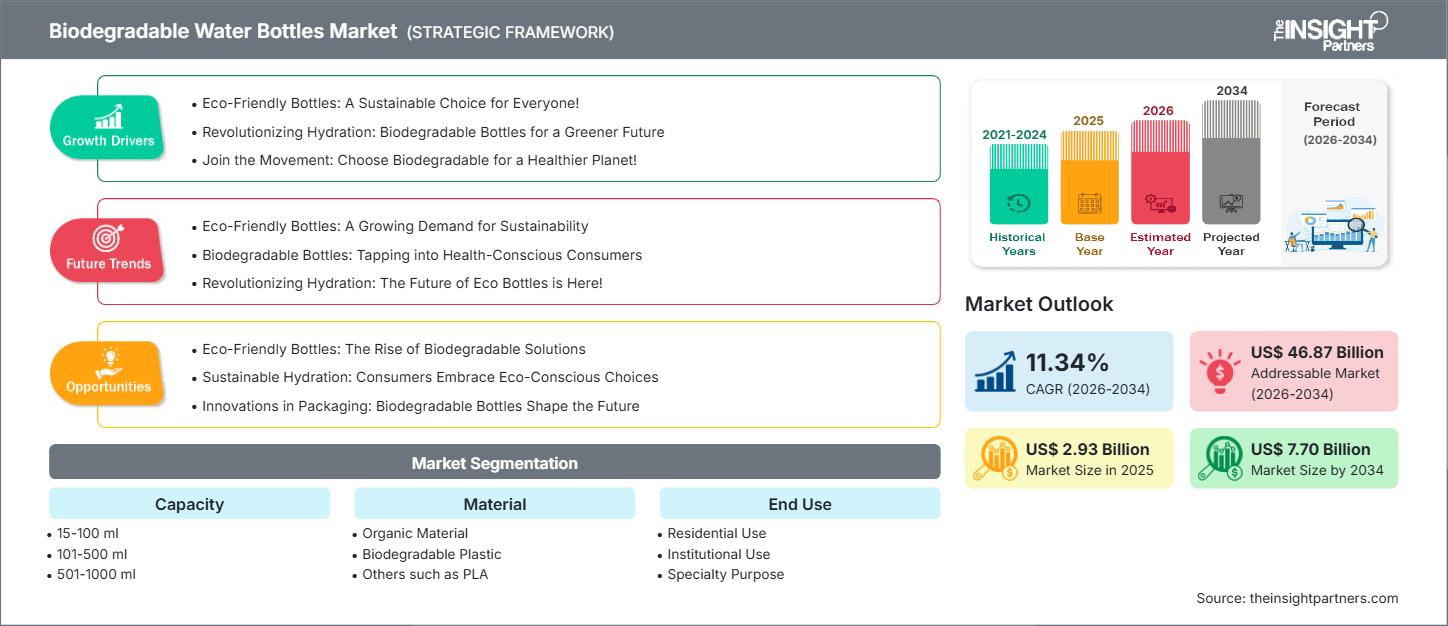
The global biodegradable water bottles market size is projected to reach US$ 7.70 billion by 2034 from US$ 2.93 billion in 2025. The market is anticipated to register a CAGR of 11.34% during the forecast period 2026–2034.
Key market dynamics include a heightening global focus on plastic-free environmental solutions, rising consumer awareness regarding the ecological impact of single-use PET bottles, and a significant shift toward circular economy packaging. Additionally, the market is expected to benefit from stringent government regulations banning non-biodegradable plastics, the expansion of eco-friendly retail channels across emerging economies, and the increasing inclusion of plant-based materials in high-volume beverage segments.
Biodegradable Water Bottles Market Analysis
The biodegradable water bottles market analysis shows a shift toward high-performance biopolymers as brands prioritize both shelf-life stability and compostability. The market is diversifying into established Polylactic Acid sectors and high-growth PHA markets that offer superior marine biodegradability. Strategic opportunities are emerging in institutional sectors and corporate hospitality, where zero-waste mandates provide a clear competitive advantage for biodegradable alternatives. The analysis also notes that market expansion depends on heat-resistance improvements for hot-fill applications and the scaling of industrial composting infrastructure. Competitive differentiation now stands out depending on branding that highlights the carbon-neutral footprint, ocean-safe certifications, and farm-to-bottle traceability of plant-based resins. This approach helps premium eco-brands justify higher price points in a market increasingly sensitive to greenwashing.
Biodegradable Water Bottles Market Overview
Sustainable packaging has evolved from niche experimental prototypes to mainstream industrial solutions. The biodegradable water bottles include algae-based edible membranes, paper-composite bottles with bio-liners, and advanced starch-based resins. Both global beverage giants and sustainability-focused startups compete in this market, using renewable sources such as sugarcane, bamboo, and corn starch. Growing demand for portable hydration options among environmentally conscious consumers in North America and Europe has increased the popularity of biodegradable bottles as a visible symbol of corporate responsibility. North America leads in revenue due to its robust regulatory tailwinds and established sustainable retail networks, while Asia-Pacific is advancing in material science and biopolymer manufacturing. The US market is highly developed, driven by plastic bans in major cities and the broad availability of compostable consumer goods. Competition among brands is fueling greater aesthetic variety and the integration of smart-sorting labels to ensure proper end-of-life disposal.
Market Assessment and Insights
- Global market for Biodegradable Water Bottles was valued at US$ 2.93 Billion in 2025
- Annual market size is expected to reach US$ 7.70 Billion by 2034
- Total addressable market (TAM) during 2026-2034 is projected to reach approximately US$ 46.87 Billion
- Market is anticipated to register a CAGR of 11.34% during the forecast period
- The United States represents a key market, supported by Eco-Friendly Bottles: A Sustainable Choice for Everyone!, Revolutionizing Hydration: Biodegradable Bottles for a Greener Future, Join the Movement: Choose Biodegradable for a Healthier Planet!, as well as evolving industry dynamics
- Market analysis covers North America, Europe, Asia-Pacific, South and Central America, Middle East and Africa, with growth evaluated across the forecast period
- Market opportunities such as Eco-Friendly Bottles: The Rise of Biodegradable Solutions, Sustainable Hydration: Consumers Embrace Eco-Conscious Choices, Innovations in Packaging: Biodegradable Bottles Shape the Future are expected to influence market dynamics and addressable market
- Report profiles industry participants, including Paper water bottle, Choose Water, Lyspackaging, Raepack Ltd., Ecologic Brands Inc., Montana Private Reserve, Cove, Just Water, Mitsubishi Chemicals (MCPP), TSL Plastics Ltd., while analyzing competitive strategies and innovation developments
-
Source: The Insight Partners' analysis based on proprietary research, government publications, company annual reports, investor presentations, industry databases, and expert interviews.
● REPORT CUSTOMIZATION
Tailor This Report To Align With Your Specific Business Requirements
This report can be customized to align precisely with your business objectives, scope, and target markets. Customization options include tailored segmentation, geography, competitive analysis, and strategic insights to support informed decision-making.
Customize This Report →WHAT YOU CAN ADJUST
- ● Segmentations
- ● Geography
- ● Competitive Analysis
- ● Language Preferences
Biodegradable Water Bottles Market: Strategic Insights
-
Get Top Key Market Trends of this report.This FREE sample will include data analysis, ranging from market trends to estimates and forecasts.
Biodegradable Water Bottles Market Drivers and Opportunities
Market Drivers:
- Stringent Regulatory Pressure on Single-Use Plastics: Global mandates, such as the EU’s Single-Use Plastics Directive and various regional bans on PET bottles, are forcing beverage companies to adopt biodegradable alternatives to maintain market access.
- Rising Consumer Preference for Circular Products: As Gen Z and Millennial demographics prioritize the environment, there is a sustained demand for packaging that leaves no microplastic residue. This conscious consumption trend is driving volume gains for certified compostable bottles.
- Technological Breakthroughs in Barrier Properties: Innovations in nanocellulose and bio-based coatings have improved the oxygen and moisture barriers of biodegradable bottles. This allows them to compete with traditional plastic in terms of shelf-life and product freshness.
Market Opportunities:
- Expansion into Marine-Degradable Solutions: Developing PHA-based bottles that can break down in seawater offers significant opportunities in coastal tourism, cruise lines, and island nations where plastic waste management is a critical challenge.
- Growth in Closed-Loop Venues: Forming strategic partnerships with stadiums, music festivals, and university campuses creates captive markets where biodegradable bottles can be collected and composted efficiently on-site.
- Customization for Specialty Purpose Brands: There is a growing opportunity to target high-end alkaline and spring water brands through aesthetic, paper-feel biodegradable designs that align with a luxury, natural brand image.
Biodegradable Water Bottles Market Report Segmentation Analysis
The Biodegradable Water Bottles Market share is analyzed across various segments to provide a clearer understanding of its structure, growth potential, and emerging trends. Below is the standard segmentation approach used in most industry reports:
By Capacity:
- 15 ml – 100 ml (Small): Primarily used for concentrated energy shots, travel-sized toiletries, and airline hospitality services.
- 101 ml – 500 ml (Medium): The dominant volume driver, catering to the standard on-the-go hydration segment and individual retail sales in convenience stores.
- 501 ml – 1000 ml (Large): Significant in the sports and fitness segment, where larger volumes are required for workout sessions and outdoor activities.
- Above 1000 ml: Primarily used for bulk residential storage, institutional supply, and multi-serve household options.
By Material:
- Organic Material: Includes innovative Paper-based composites and bamboo-derived structures that offer a plastic-free tactile experience.
- Biodegradable Plastic: Dominated by Polylactic Acid (PLA), which is preferred for its clarity and compatibility with existing manufacturing equipment.
- Others: Includes advanced biopolymers like PHA and PHB, which are gaining traction due to their ability to degrade in a wider range of natural environments.
By End Use:
- Residential Use: Driven by eco-conscious households looking to replace traditional bulk plastic bottle purchases with sustainable alternatives.
- Institutional Use: Includes high-volume demand from corporate offices, schools, and government buildings aiming to meet sustainability targets.
- Specialty Purpose: Focuses on niche applications such as medical-grade hydration, premium hospitality, and extreme outdoor sports where specialized packaging is required.
By Geography:
- North America
- Europe
- Asia Pacific
- South & Central America
- Middle East & Africa
Biodegradable Water Bottles Market Report Scope
| Report Attribute | Details |
|---|---|
| Market size in 2025 | US$ 2.93 Billion |
| Market Size by 2034 | US$ 7.70 Billion |
| Global CAGR (2026 - 2034) | 11.34% |
| Historical Data | 2021-2024 |
| Forecast period | 2026-2034 |
| Segments Covered |
By Capacity
|
| Regions and Countries Covered |
North America
|
| Market leaders and key company profiles |
|
Biodegradable Water Bottles Market Players Density: Understanding Its Impact on Business Dynamics
The Biodegradable Water Bottles Market is growing rapidly, driven by increasing end-user demand due to factors such as evolving consumer preferences, technological advancements, and greater awareness of the product's benefits. As demand rises, businesses are expanding their offerings, innovating to meet consumer needs, and capitalizing on emerging trends, which further fuels market growth.
Biodegradable Water Bottles Market Share Analysis by Geography
Asia-Pacific is expected to grow fastest in the coming years, driven by massive manufacturing scaling in China and India’s burgeoning domestic demand for sustainable alternatives. Emerging markets in South & Central America, the Middle East, and Africa also have many untapped opportunities for premium eco-packaging producers and beverage manufacturers to expand as infrastructure for organic waste management improves.
The biodegradable water bottles market is undergoing a significant transformation, moving from a niche novelty to a mainstream industrial standard. Growth is driven by the rising prevalence of single-use plastic bans, a surge in eco-conscious consumerism, and the expansion of the high-end functional beverage sector. Below is a summary of market share and trends by region:
1. North America
- Market Share: Holds a significant share, driven by a robust culture of environmental advocacy and state-level legislative support for compostable materials.
- Key Drivers:
- Rising consumer preference for carbon-neutral packaging in major urban hubs
- Mainstreaming of plant-based bottles in high-end grocery chains and health-focused retail outlets
- Increased adoption of biodegradable solutions by major beverage corporations to meet ESG (Environmental, Social, and Governance) targets
- Trends: Scaling of campus-wide plastic bans and the successful adoption of specialty certifications like PFAS-free and certified compostable to appeal to health-conscious demographics.
2. Europe
- Market Share: Commands the second-largest share, anchored by the EU Green Deal and stringent mandates for a 50% reduction in single-use plastics.
- Key Drivers:
- High domestic demand for plastic-free alternatives in Germany, France, and the UK
- Established industrial composting infrastructure and strict regulatory frameworks for bioplastics
- Robust government subsidies for small-scale biopolymer innovators and circular economy startups
- Trends: A strategic shift toward prioritizing marine-degradable PHA resins and the increasing focus on paper-composite bottle technology to meet the demands of eco-conscious European consumers.
3. Asia-Pacific
- Market Share: The fastest-growing region, with China leading the world in the production and export of Polylactic Acid (PLA) resins.
- Key Drivers:
- Massive consumer base in China and Southeast Asia seeking premium, clean-label packaging for infant and wellness products
- Rapid urbanization and rising disposable incomes leading to a preference for westernized luxury eco-friendly hydration
- Trends: Heavy reliance on e-commerce platforms and B2B contracts for biodegradable packaging used in the hospitality and fitness industries.
4. South and Central America
- Market Share: Emerging market with a growing sector in countries like Brazil and Chile, focusing on sugarcane-based bio-resins.
- Key Drivers:
- Increasing awareness of the impact of plastic pollution on regional biodiversity and marine life
- Modernization of local manufacturing plants to process organic raw materials into commercial-grade bottles
- Rising interest in zero-waste lifestyles among middle-to-high income urban segments
- Trends: Growth of farm-to-bottle boutique brands and the introduction of artisanal paper-based water bottles to differentiate from the dominant PET market.
5. Middle East and Africa
- Market Share: Developing market with potential rooted in strategic investments in sustainable smart cities and tourism.
- Key Drivers:
- Presence of biodegradable solutions in high-end tourism zones and luxury resorts
- High demand for shelf-stable biodegradable options that can withstand high temperatures
- Trends: Implementation of modern waste-sorting technologies to capture and process biodegradable materials, coupled with a focus on sustainable hydration for the major sporting events segment.
High Market Density and Competition
Competition is intensifying due to the presence of established leaders such as Danimer Scientific, Cove, and Paper Water Bottle. Regional experts and niche players like Lyspackaging (France) and Biopac India, alongside North American innovators such as Choose Water and Just Water, also contribute to a diverse and rapidly expanding market landscape.
This competitive environment pushes vendors to differentiate through:
- Premiumization and functional branding: Positioning biodegradable bottles as superior nutritional and safety alternatives to traditional plastic by emphasizing the absence of microplastics and BPA.
- Expanded Product Portfolios: Offerings now include more than just standard water bottles; companies provide specialty-purpose small bottles for energy shots, large fitness jugs, and custom-branded event packaging.
- Vertical Integration: Producers manage the entire supply chain, from sourcing organic feedstock like corn and sugarcane to in-house manufacturing, ensuring quality, transparency, and ethical standards.
Opportunities and Strategic Moves
- Partner with high-end retail and events: Tap into the surging demand for zero-waste hydration in the sports and corporate sectors by offering closed-loop composting solutions.
- Incorporate smart packaging: Integrate QR codes and tracking technology to provide consumers with transparency regarding the bottle’s origin and proper disposal instructions.
Major Companies operating in the Biodegradable Water Bottles Market are:
- Paper water bottle
- Choose Water
- Lyspackaging
- Raepack Ltd.
- Ecologic Brands Inc.
- Montana Private Reserve
- Cove
- Just Water
- Mitsubishi Chemicals (MCPP)
- TSL Plastics Ltd.
Disclaimer: The companies listed above are not ranked in any particular order.
Biodegradable Water Bottles Market News and Recent Developments
- In February 2026, Hilly Aqua, the State’s public-sector drinking water brand, introduced biodegradable bottles. As part of a pilot project, the biodegradable option will initially be available in 300 ml bottles.
- In February 2025, Win Win Water launched its bottled water featuring ‘100% plant-based’ fully biodegradable bottles made from TotalEnergies Corbion’s Luminy PLA material, aiming to address the environmental challenges of traditional plastic bottles while providing consumers with high-quality alkaline electrolyte water.
Biodegradable Water Bottles Market Report Coverage and Deliverables
The Biodegradable Water Bottles Market Size and Forecast (2021–2034) report provides a detailed analysis of the market covering below areas:
- Biodegradable Water Bottles Market size and forecast at global, regional, and country levels for all the key market segments covered under the scope
- Biodegradable Water Bottles Market trends, as well as market dynamics such as drivers, restraints, and key opportunities
- Detailed PEST and SWOT analysis
- Biodegradable Water Bottles Market analysis covering key market trends, global and regional framework, major players, regulations, and recent market developments
- Industry landscape and competition analysis covering market concentration, heat map analysis, prominent players, and recent developments in the Biodegradable Water Bottles Market.
- Detailed company profiles
Frequently Asked Questions

- Comprehensive Market Sizing and Forecast Analysis
- Detailed Segmentation Analysis
- In-Depth Market Dynamics Assessment
- Regional and Country-Level Insights
- Competitive Landscape and Company Benchmarking
- Strategic Business Intelligence
Recent Reports
Testimonials

The Insight Partners' SCADA System Market report is comprehensive, with valuable insights on current trends and future forecasts. The team was highly professional, responsive, and supportive throughout. We are very satisfied and highly recommend their services.
RAN KEDEM Partner, Reali Technologies LTDs
I requested a report on a very specific software market and the team produced the report in a few days. The information was very relevant and well presented. I then requested some changes and additions to the report. The team was again very responsive and I got the final report in less than a week.
JEAN-HERVE JENN Chairman, Future Analytica
We worked with The Insight Partners for an important market study and forecast. They gave us clear insights into opportunities and risks, which helped shape our plans. Their research was easy to use and based on solid data. It helped us make smart, confident decisions. We highly recommend them.
PIYUSH NAGPAL Sr. Vice President, High Beam Global
The Insight Partners delivered insightful, well-structured market research with strong domain expertise. Their team was professional and responsive throughout. The user-friendly website made accessing industry reports seamless. We highly recommend them for reliable, high-quality research services
YUKIHIKO ADACHI CEO, Deep Blue, LLC.
This is the first time I have purchased a market report from The Insight Partners.While I was unsure at first, I visited their web site and felt more comfortable to take the risk and purchase a market report.I am completely satisfied with the quality of the report and customer service. I had several questions and comments with the initial report, but after a couple of dialogs over email with their analyst I believe I have a report that I can use as input to our strategic planning process.Thank you so much for taking the extra time and making this a positive experience.I will definitely recommend your service to others and you will be my first call when we need further market data.
JOHN SUZUKI President and Chief Executive Officer, Board Director, BK Technologies
I wish to appreciate your support and the professionalism you displayed in the course of attending to my request for information regarding to infectious disease IVD market in Nigeria. I appreciate your patience, your guidance, and the fact that you were willing to offer a discount, which eventually made it possible for us to close a deal. I look forward to engaging The Insight Partners in the future, all thanks to the impression you have created in me as a result of this first encounter.
DR CHIJIOKE ONYIA MANAGING DIRECTOR, PineCrest Healthcare Ltd.Reason to Buy
- Informed Decision-Making
- Understanding Market Dynamics
- Competitive Analysis
- Identifying Emerging Markets
- Customer Insights
- Market Forecasts
- Risk Mitigation
- Boosting Operational Efficiency
- Strategic Planning
- Investment Justification
- Tracking Industry Innovations
- Aligning with Regulatory Trends





 Get Free Sample for