
Agricultural Testing Market Growth, Trends & Demand by 2034
Agricultural Testing Market Size and Forecasts (2021 - 2034), Global and Regional Share, Trends, and Growth Opportunity Analysis Report Coverage : by Sample (Soil, Water, Seed, Compost, Manure, Biosolids, Plant Tissue); Application (Saftey Testing, Quality Assurance); Technology (Conventional, Rapid); and Geography (North America, Europe, Asia Pacific, and South and Central America)
- Status : Data Released
- Report Code : TIPRE00040460
- Category : Consumer Goods
- No. of Pages : 150
- Available Report Formats :


- Last update date : August 10, 2026


2025 Market Size
US$ 7.54 Bn
Base year value
2034 Forecast
US$ 14.10 Bn
Projected by 2034
CAGR 2026-2034
7.21 %
Growth rate
Addressable Market
US$ 97.68 Bn
(2026-2034)
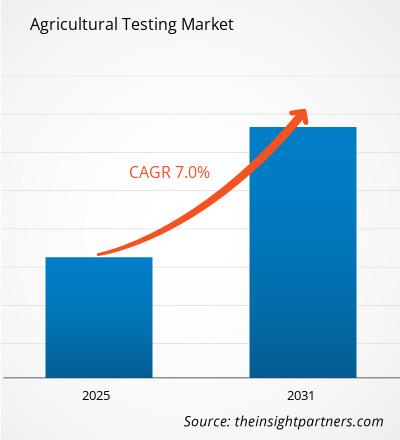
The agricultural testing market was valued at US$ 7.54 Billion in 2025 and is projected to reach US$ 14.10 Billion by 2034, registering a CAGR of 7.21% during 2026–2034. Market expansion is being supported by increasing regulatory oversight of agricultural inputs, rising pressure to improve crop productivity, and wider adoption of laboratory-based and rapid testing methods across commercial farming systems. Demand continues to strengthen across developed and emerging agricultural economies as producers seek greater product quality, safety, and yield optimization.
Across North America, laboratory modernization, precision agriculture adoption, and stricter nutrient management regulations continue to support testing demand. The agricultural testing market size in the region benefits from strong institutional support, advanced agronomy practices, and extensive commercial farming activity. Regional growth is projected in the range of 6.8–7.4% CAGR through 2034, supported by increasing soil health monitoring and water quality assessment programs.
Agricultural Testing Market Assessment and Insights
- North America: Share in 2025 estimated at 34–38% and expected to grow at a CAGR of 6.8–7.4% during 2026–2034. Demand is supported by precision agriculture adoption, nutrient management regulations, and strong laboratory infrastructure.
- US: Accounts for 72–76% of North America in 2025 and is projected to expand at a CAGR of 6.9–7.5% during 2026–2034 due to the commercialization of advanced agricultural analytics and testing services.
- Europe: Holds 26–30% share in 2025 and is anticipated to grow at a CAGR of 6.5–7.1% during 2026–2034. Germany, France, the UK, Italy, and Spain remain key demand centers.
- Asia Pacific: Represents 24–28% share in 2025 and is expected to register the fastest regional growth at a CAGR of 8.0–8.8% during 2026–2034, led by China, India, Japan, and Australia.
- Largest Segment: Soil testing accounts for 38–42% market share in 2025 and is projected to expand at a CAGR of 6.8–7.4% due to nutrient optimization requirements.
- High Growth Segment: Rapid technology holds 28–32% share in 2025 and is forecast to grow at a CAGR of 8.4–9.2% based on faster turnaround and on-site decision support.
- Key companies analyzed in detail: SGS SA, Eurofins Scientific SE, Intertek Group plc, Bureau Veritas SA, ALS Limited, TÜV NORD GROUP, Mérieux NutriSciences Corporation, AsureQuality Limited, RJ Hill Laboratories Limited, SCS Global Services.
Source: The Insight Partners' analysis based on proprietary research, government publications, company annual reports, investor presentations, industry databases, and expert interviews.
With the evolution of technology, testing services have shifted from the traditional laboratory systems towards technology-enabled diagnostic systems. The need for soil testing, water testing, and plant testing services has grown with the increased efficiency in the use of fertilizers, sustainability goals, and initiatives for precision agriculture.
The future growth in the market will be driven by investment in biotechnology, climate-resistant farming practices, and traceability systems. Emerging markets are developing their lab facilities, whereas governments are adopting more stringent food safety and environmental monitoring regulations. This is anticipated to generate consistent demand for innovative testing services.
Agricultural Testing Market Report Scope
| Report Attribute | Details |
|---|---|
| Market size in 2025 | US$ 7.54 Billion |
| Market Size by 2034 | US$ 14.10 Billion |
| Global CAGR (2026 - 2034) | 7.21% |
| Historical Data | 2021-2024 |
| Forecast period | 2026-2034 |
Agricultural Testing Market Analysis
The agricultural testing market growth trajectory is closely tied to rising concerns regarding resource efficiency, food security, and sustainable agricultural production. Testing has been gaining prominence among farmers in the optimization of nutrient application, minimizing risks in farming and improving the quality of crops. The rise in attention on regenerative agriculture and environmental sustainability is fueling the demand for testing in soil, water, compost, and biosolids applications even further.
Data has become crucial within supply chains, making laboratory testing important at different steps of agricultural farming. Testing firms are increasing their analytical skills to deal with different contaminations, nutrient balance and pathogen presence, as well as crop health.
The Agricultural Testing Market Analysis reveals that it is increasingly becoming a competitive market due to lab growth, acquisitions, and technological developments. The players globally are concentrating on geographical diversification and wider analysis portfolios in order to meet the changing customer demands. They have also been developing their rapid testing skills.
Some of the prominent players like SGS SA, Eurofins Scientific SE, Intertek Group plc, Bureau Veritas SA, ALS Limited, and TÜV NORD GROUP, are continuously investing in lab improvement and advanced analytical services. Competition within the market is increasingly becoming a combination of accreditation services, accurate analyses, geographic coverage, and online availability services.
● REPORT CUSTOMIZATION
Tailor This Report To Align With Your Specific Business Requirements
This report can be customized to align precisely with your business objectives, scope, and target markets. Customization options include tailored segmentation, geography, competitive analysis, and strategic insights to support informed decision-making.
Customize This Report →WHAT YOU CAN ADJUST
- ● Segmentations
- ● Geography
- ● Competitive Analysis
- ● Language Preferences
Agricultural Testing Market: Strategic Insights

Regional Insights
North America Agricultural Testing Market
North America accounted for approximately 34–38% agricultural testing market share in 2025 and is forecast to grow at a CAGR of 6.8–7.4% through 2034. Strong regulatory oversight related to nutrient management, groundwater protection, and crop quality assurance continues to support laboratory demand. Commercial farming operations increasingly depend on analytical services to improve productivity and environmental compliance.
The region benefits from extensive adoption of precision agriculture technologies and digital agronomy tools. Expanding use of variable-rate fertilizer application systems and sustainability certification requirements is increasing testing frequency. Public and private investments in agricultural innovation further reinforce long-term market development.
U.S. Agricultural Testing Market
The United States represented approximately 72–76% of North American demand in 2025 and is projected to grow at a CAGR of 6.9–7.5%. High adoption of data-driven farming techniques, advanced laboratory networks, and commercial crop production supports sustained testing requirements across multiple agricultural applications.
Federal conservation programs and increasing emphasis on soil health continue supporting testing activity. Leading market participants maintain significant operational footprints in the country, while growers continue expanding use of analytical tools for fertilizer efficiency, contamination assessment, and crop management planning.
Europe Agricultural Testing Market
Europe held approximately 26–30% share in 2025 and is expected to register a CAGR of 6.5–7.1% during the forecast period. Environmental regulations, sustainable farming objectives, and quality assurance requirements remain key demand drivers across the region.
The UK demonstrates a stable demand for analytical services due to advanced agricultural practices and increasing focus on soil health management. Germany remains the largest national market owing to its strong agricultural infrastructure and environmental compliance programs. France, Italy, and Spain continue expanding testing requirements as producers pursue productivity improvements and sustainability targets, supporting wider adoption of laboratory-based analytical solutions.
APAC Agricultural Testing Market
Asia Pacific accounted for approximately 24–28% share in 2025 and is forecast to achieve a CAGR of 8.0–8.8% through 2034. China leads regional demand, followed by India, Japan, Australia, and South Korea. Increasing food production requirements and modernization initiatives continue driving market expansion.
Government programs supporting soil health assessment, fertilizer efficiency, and sustainable farming practices are strengthening adoption. Rapid agricultural commercialization and expanding laboratory infrastructure support long-term growth opportunities across the region.
Middle East & Africa Agricultural Testing Market
The Middle East and Africa market is projected to expand at a CAGR of 6.7–7.3% through 2034. Saudi Arabia, the UAE, and South Africa remain the primary contributors due to growing investment in agricultural productivity and water resource management.
Agricultural diversification initiatives and infrastructure modernization are increasing the demand for analytical services. Water scarcity concerns and food security objectives are further encouraging testing adoption across both commercial agriculture and government-supported development programs.
Segmentation Analysis
Sample
The sample segment is projected to grow at a CAGR of 7.0–7.6%. Demand is driven by increasing emphasis on nutrient optimization, contamination assessment, and sustainable farming. The agricultural testing market scope continues expanding as producers rely on a wider range of sample types to improve productivity and regulatory compliance.
- Soil: Largest sub-segment due to its central role in nutrient management, fertility assessment, and crop productivity planning.
- Water: Increasingly important as irrigation quality monitoring gains attention in water-stressed agricultural regions.
- Seed: Supports quality verification, germination evaluation, and disease prevention across commercial agriculture.
- Compost: Adoption is rising with greater reliance on organic inputs and circular agricultural practices.
- Manure: Helps optimize nutrient utilization while supporting environmental compliance objectives.
- Biosolids: Growing use in sustainable farming programs increases testing requirements for safety verification.
- Plant Tissue: Provides crop-specific nutrient insights and supports precision agriculture strategies.
Application
The application segment is expected to grow at a CAGR of 7.2–7.8%. Regulatory requirements, supply chain transparency, and product quality expectations continue driving analytical service demand across agricultural operations.
- Safety Testing: Essential for identifying contaminants, pathogens, and chemical residues affecting agricultural products.
- Quality Assurance: Supports consistency, productivity, and compliance with commercial and regulatory standards.
Technology
The technology segment is forecast to expand at a CAGR of 7.4–8.2%. Technological innovation is improving the speed, efficiency, and accessibility of analytical services while supporting more informed farm management decisions.
- Conventional: Maintains a substantial position due to established laboratory methodologies and broad analytical capabilities.
- Rapid: Increasing adoption reflects demand for faster decision-making, shorter turnaround times, and field-level diagnostics.
Opportunity Snapshot
| Application | Revenue Contribution | Trend Tag | Adoption Stage |
|---|---|---|---|
| Safety Testing | High | Residue Monitoring | Mature |
| Quality Assurance | High | Traceability Programs | Scaling |
Agricultural Testing Market Growth Drivers and Impact Analysis
Expansion of Precision Agriculture Programs
The use of precision agriculture is leading to a higher need for accuracy in the diagnostics of information. Nutrient mapping of soil, optimization of fertilizers, and crop monitoring require analytical testing services. As more productive use is made of available resources by farmers, the need for testing increases in order to aid in making decisions based on data. The improved analytical understanding helps in cutting down costs and improving environmental results.
Growing Regulatory Attention on Food and Environmental Safety
Agricultural sustainability and contamination prevention regulations have grown even more stringent. Testing services enable farmers to meet government regulations regarding nutrient runoff, soil testing, irrigation water, and agricultural inputs. Regulatory monitoring programs motivate farmers to engage in testing as part of good agricultural practices. The growing focus on agricultural value chain issues has made the need for increased analysis by processors, exporters, and retailers more important than ever.
Need for Higher Agricultural Productivity
There is a rising need for food production, even though there is a limited supply of agricultural land. Testing helps farmers increase their yield by applying appropriate amounts of nutrients and detecting any problems in their fields at an early stage. The information received helps in making decisions about the use of resources in order to achieve sustainable increases in productivity.
Agricultural Testing Market Future Trends
Artificial Intelligence Integration in Agronomic Diagnostics
The agricultural testing market trends increasingly reflect the integration of artificial intelligence and predictive analytics into laboratory workflows. Over the coming years, testing providers are expected to combine analytical data with weather information, historical crop performance, and satellite imagery. This evolution will enable more precise recommendations and support broader adoption of prescriptive agriculture. Improved forecasting capabilities are likely to enhance farm productivity while creating value-added service opportunities for testing providers.
Expansion of Rapid Field-Based Testing Platforms
Rapid diagnostic techniques are anticipated to gain more ground owing to the need for farmers for quick information in making decisions. The use of portable test devices and efficient analysis procedures will help lessen the reliance on laboratory processing in some cases. Usage is likely to be high in areas that seek to enhance production and minimize delay.
Agricultural Testing Market Opportunities
Investment in Emerging Laboratory Networks
Developing economies continue expanding agricultural modernization efforts, creating attractive opportunities for laboratory infrastructure investment. Growing demand for crop productivity enhancement and environmental monitoring is increasing the need for accredited testing facilities. Agricultural testing market Forecasts indicate strong potential for service providers that establish regional laboratory capabilities and localized analytical expertise. Strategic partnerships with governments, agribusiness firms, and agricultural cooperatives can support long-term market penetration and revenue growth.
Specialized Sustainability Verification Services
The efforts towards sustainability are generating the need for sophisticated tests that will help with the carbon management, regenerative farming, and resource efficiency goals. The service companies that have the ability to provide the integrated solution can benefit from the new certification requirements. The growing commitment of corporations towards environmental standards also provides business opportunities in this field.
Frequently Asked Questions

- Comprehensive Market Sizing and Forecast Analysis
- Detailed Segmentation Analysis
- In-Depth Market Dynamics Assessment
- Regional and Country-Level Insights
- Competitive Landscape and Company Benchmarking
- Strategic Business Intelligence
Recent Reports
Testimonials

The Insight Partners' SCADA System Market report is comprehensive, with valuable insights on current trends and future forecasts. The team was highly professional, responsive, and supportive throughout. We are very satisfied and highly recommend their services.
RAN KEDEM Partner, Reali Technologies LTDs
I requested a report on a very specific software market and the team produced the report in a few days. The information was very relevant and well presented. I then requested some changes and additions to the report. The team was again very responsive and I got the final report in less than a week.
JEAN-HERVE JENN Chairman, Future Analytica
We worked with The Insight Partners for an important market study and forecast. They gave us clear insights into opportunities and risks, which helped shape our plans. Their research was easy to use and based on solid data. It helped us make smart, confident decisions. We highly recommend them.
PIYUSH NAGPAL Sr. Vice President, High Beam Global
The Insight Partners delivered insightful, well-structured market research with strong domain expertise. Their team was professional and responsive throughout. The user-friendly website made accessing industry reports seamless. We highly recommend them for reliable, high-quality research services
YUKIHIKO ADACHI CEO, Deep Blue, LLC.
This is the first time I have purchased a market report from The Insight Partners.While I was unsure at first, I visited their web site and felt more comfortable to take the risk and purchase a market report.I am completely satisfied with the quality of the report and customer service. I had several questions and comments with the initial report, but after a couple of dialogs over email with their analyst I believe I have a report that I can use as input to our strategic planning process.Thank you so much for taking the extra time and making this a positive experience.I will definitely recommend your service to others and you will be my first call when we need further market data.
JOHN SUZUKI President and Chief Executive Officer, Board Director, BK Technologies
I wish to appreciate your support and the professionalism you displayed in the course of attending to my request for information regarding to infectious disease IVD market in Nigeria. I appreciate your patience, your guidance, and the fact that you were willing to offer a discount, which eventually made it possible for us to close a deal. I look forward to engaging The Insight Partners in the future, all thanks to the impression you have created in me as a result of this first encounter.
DR CHIJIOKE ONYIA MANAGING DIRECTOR, PineCrest Healthcare Ltd.Reason to Buy
- Informed Decision-Making
- Understanding Market Dynamics
- Competitive Analysis
- Identifying Emerging Markets
- Customer Insights
- Market Forecasts
- Risk Mitigation
- Boosting Operational Efficiency
- Strategic Planning
- Investment Justification
- Tracking Industry Innovations
- Aligning with Regulatory Trends





 Get Free Sample for