
Biopolymer Films Market Demand, Share & Growth by 2034
Coverage: By Raw Material (Bio-based, Microbial Synthesized, Synthetic, Partially Bio-based); Technology (Sol-gel, Atomic Layer Deposition [ALD], Multilayer); Product (PLA, PHB, PHA, PVA, Polyamide, Mulch, Cellophane); End User (Food and Beverage, Home and Personal Care, Medical and Pharmaceutical, Agriculture), and Geography (North America, Europe, Asia Pacific, and South and Central America)
- Status : Data Released
- Report Code : TIPRE00015483
- Category : Chemicals and Materials
- No. of Pages : 150
- Available Report Formats :


- Last update date : July 15, 2026


2025 Market Size
US$ 5.88 Bn
Base year value
2034 Forecast
US$ 11.80 Bn
Projected by 2034
CAGR 2026-2034
8.04 %
Growth rate
Addressable Market
US$ 79.46 Bn
(2026-2034)
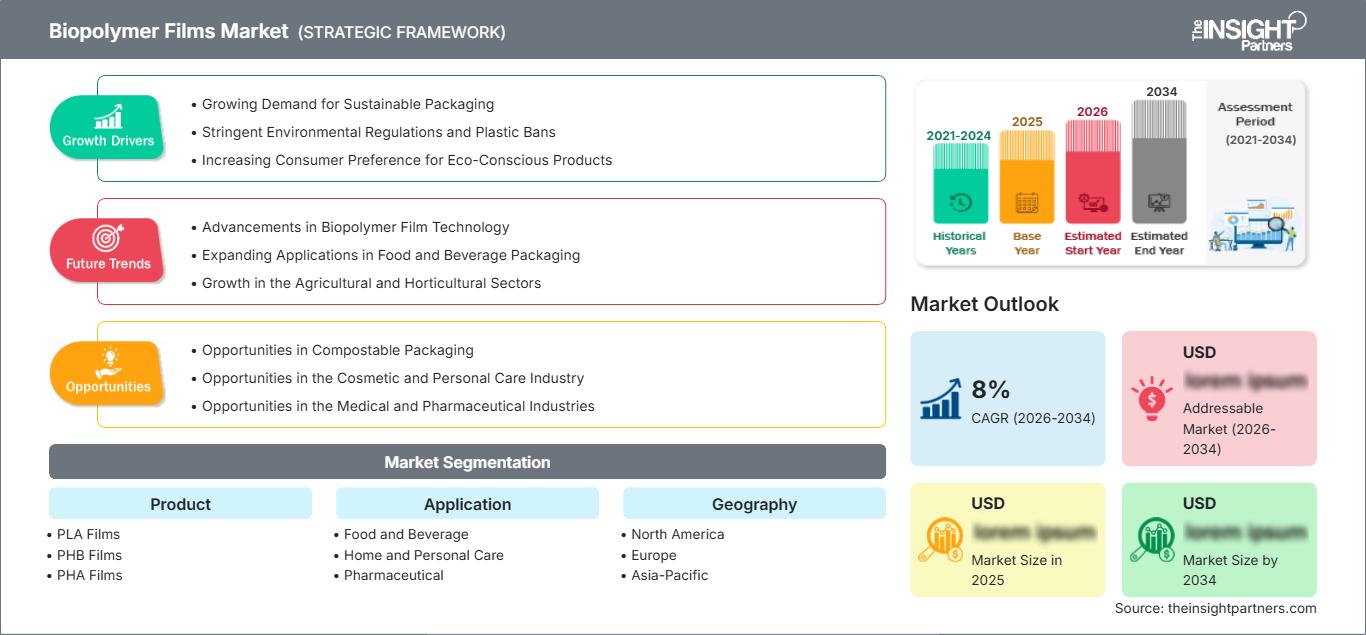
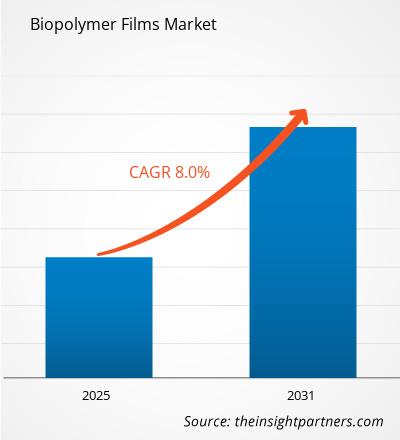
The biopolymer films market was valued at US$ 5.88 Billion in 2025 and is projected to reach US$ 11.80 Billion by 2034; it is expected to register a CAGR of 8.04% during 2026–2034. The increasing need for regulations to minimize the conventional waste generated from plastics, the rising use of compostable packaging, and innovations in bio-based polymers are fueling demand from industries such as food packaging, healthcare, agriculture, and consumer goods as well as prompting manufacturers to develop their capacity and make investments in films made from sustainable films.
In North America, the supportive environment created by regulations that encourage sustainability, growing investments in sustainable packaging, and active participation of food processing and healthcare industries continue to drive demand. The Biopolymer Films Market size will be driven by commercial success of biodegradable packaging and sustainability efforts by corporations. It is forecasted to grow at a CAGR of 7.2%–7.8% during 2026–2034 and the United States will continue to be a key contributor because of advanced manufacturing facilities and usage of sustainable films.
Biopolymer Films Market Assessment and Insights
- North America: Accounted for 34%–37% share in 2025 and is projected to register a CAGR of 7.2%–7.8% during 2026–2034, supported by stringent packaging regulations, mature food processing industries, and sustained investments in biodegradable material innovations.
- US: Represented approximately 72%–76% of the North American market in 2025 and is anticipated to grow at a CAGR of 7.3%–7.9% during 2026–2034, driven by expanding sustainable packaging initiatives and technological leadership in bio-based polymers.
- Europe: Held 29%–32% share in 2025 and is expected to witness a CAGR of 7.8%–8.4% during 2026–2034, with Germany, France, Italy, and the UK leading demand through circular economy policies and high adoption of compostable packaging.
- Asia Pacific: Captured 25%–28% share in 2025 and is forecast to record the fastest regional CAGR of 8.8%–9.5% during 2026–2034, led by China, Japan, India, and South Korea owing to rapid industrialization and increasing environmental awareness.
- Largest Segment: Food and Beverage accounted for 49%–53% market share in 2025 and is anticipated to expand at a CAGR of 8.1%–8.7% during 2026–2034, supported by growing demand for sustainable food packaging and regulatory restrictions on single-use plastics.
- High Growth Segment: PLA Films represented 34%–38% market share in 2025 and are projected to witness a CAGR of 9.1%–9.8% during 2026–2034, driven by enhanced compostability, commercial scalability, and increasing replacement of petroleum-based flexible films.
- Key companies analyzed in detail: Amcor plc, Avery Dennison Corporation, BASF SE, Braskem S.A., BioBag International AS, Bulwark Industrial Solutions, Evonik Industries AG, Innovia Films Ltd., Klöckner Pentaplast Group GmbH, and Hubei HYF Packaging Co., Ltd.
Source: The Insight Partners' analysis based on proprietary research, government publications, company annual reports, investor presentations, industry databases, and expert interviews.
The shift towards renewable raw materials is transforming the Biopolymer Films Market, with an emphasis on bio-based raw materials, increased barrier properties, and industrial compostability. The improvements made through polymer technology have contributed to the increase in strength, clarity, and efficiency of films, contributing to more widespread use in packaging and agriculture. Increased investment in fermentation processes, renewable resin manufacturing, and multi-layer biopolymers has bolstered production capabilities while aligning with the goals of global sustainability. Thus, the Biopolymer Films Market growth will be driven by innovation and legislation in addition to cost-efficiency.
There are efforts being made by all industry players to strengthen regional manufacturing networks to ensure that there is increased security of supply without any transportation emissions. Investments in the business are being made more in Asia Pacific and North America since there are growing packaging sectors and good policies that support the business environment. Partnerships between resin manufacturers, packaging converters and brand owners have been instrumental in ensuring the production of biodegradable films that meet both regulatory standards and consumer standards.
Biopolymer Films Market Report Scope
| Report Attribute | Details |
|---|---|
| Market size in 2025 | US$ 5.88 Billion |
| Market Size by 2034 | US$ 11.80 Billion |
| Global CAGR (2026 - 2034) | 8.04% |
| Historical Data | 2021-2024 |
| Forecast period | 2026-2034 |
Biopolymer Films Market Analysis
Consumer preference for eco-friendly packaging solutions alongside restrictions imposed on the usage of conventional single-use plastic is driving growth opportunities in various industry verticals. Food processing industries, pharma and personal care sectors need renewable film packaging materials that can balance the needs of the environment while protecting their products. Hence, according to the Biopolymer Films Market analysis, there is an increasing uptake of compostable and recyclable films through investment by all supply chain partners including the manufacturers of renewable feedstock, polymer makers, film converters, packaging makers, distributors, and brand holders. Better collaboration between these players is improving the timeline to bring out commercially viable solutions along with reduction in cost of production through economies of scale.
The supply side trends are no less important in that the manufactures are adopting state-of-the-art polymerization technology, extrusion technology, and renewable sources of feedstock for the manufacturing process. The advancements in these areas have made better use of the product in terms of its moisture resistance and oxygen barrier, along with its increased mechanical strength, which will improve the applicability of the films in flexible packaging, agriculture and healthcare.
The Biopolymer Films Market remains highly competitive as traditional packaging players and specialty materials firms continue innovating, making strategic acquisitions and broadening their product range. Leading firms such as Amcor plc, BASF SE, Avery Dennison Corporation, Braskem S.A., Evonik Industries AG, Innovia Films Ltd., and Klöckner Pentaplast Group GmbH continue positioning themselves in the market by developing sustainable materials, advanced barrier capabilities and customer-focused packaging solutions. On the other hand, BioBag International AS, Bulwark Industrial Solutions, and Hubei HYF Packaging Co., Ltd. continue growing in the market through biodegradable film product offerings customized to specific geographic regions.
Capital investments continue being made with increasing focus on renewable polymers production, industrial composting and application of the principles of circular economy in packaging chains. Capital investments into collaboration agreements, pilot manufacturing facilities and processes optimization are set to expedite commercialization of the next generation of bio-based films with improved performance properties. These activities provide a competitive advantage while paving the way for future expansion of the Biopolymer Films Market.
● REPORT CUSTOMIZATION
Tailor This Report To Align With Your Specific Business Requirements
This report can be customized to align precisely with your business objectives, scope, and target markets. Customization options include tailored segmentation, geography, competitive analysis, and strategic insights to support informed decision-making.
Customize This Report →WHAT YOU CAN ADJUST
- ● Segmentations
- ● Geography
- ● Competitive Analysis
- ● Language Preferences
Biopolymer Films Market: Strategic Insights
Regional Insights
North America Biopolymer Films Market
North America accounted for 34%–37% of the global market in 2025 and is projected to expand at a CAGR of 7.2%–7.8% during 2026–2034. The region will have an advantage due to its already established packaging, pharmaceuticals and consumer goods industry sectors, in addition to strong environmental policies that encourage substitution of oil-based plastics. Rising investments in industrial composting infrastructure and the rising pledges from multinationals in consumer goods for sustainable packaging will drive regional demand. Biopolymer Films Market share will be the highest in the world due to early commercialization and maturity in the innovation sector.
Manufacturers are being encouraged through sustainability goals and supportive policies to raise their manufacturing capacities and improve product quality. Increased development of renewable raw materials, recycling processes and films that are biodegradable in line with food safety requirements and packaging standards will drive demand. Further collaborations between polymers manufacturers, packagers, retailers and research institutions will drive innovation.
U.S. Biopolymer Films Market
The United States represented 72%–76% of the North American market in 2025 and is anticipated to register a CAGR of 7.3%–7.9% during 2026–2034. In terms of availability of packaging materials manufacturers, biotech firms, and food processors, the favorable operating environment for commercialization of bio-based films is established in the nation. With regulatory push on sustainability of materials and growth in investment in renewable polymers, there remains constant product innovation in packaging, pharmaceuticals, and agriculture sectors.
Industry leaders keep on enhancing their domestic production capacities along with investments in modern extrusion and barrier film technology. Application of these films in food and beverages represents the largest consumption, driven by growing involvement of retailers in use of recyclable and compostable packaging materials. More cooperation between material innovation firms, consumer products firms, and research institutes will enhance the domestic value chain.
Europe Biopolymer Films Market
Europe held 29%–32% of the global market in 2025 and is expected to expand at a CAGR of 7.8%–8.4% during 2026–2034. Germanys contribution to regional demand can be attributed to its highly developed chemicals industry, research potential, and usage of sustainable packaging systems. United Kingdom continues to focus on promoting bio-based materials through changing packaging regulations and circular economy projects by making investments, thus encouraging the commercialization of compostable and recyclable films.
The combined contributions of France, Italy, and Spain represent a substantial regional demand in the market, driven by the growing food packaging, agriculture, and health care industries. France specializes in sustainable consumer packaging, Italy capitalizes on its biodegradable plastic manufacturing potential, whereas Spain sees growing applications in agricultural films and flexible packaging. All these together help improve Europes competitiveness through constant technological advancements, supportive environmental regulations, and investments in the production of renewables.
APAC Biopolymer Films Market
Asia Pacific accounted for 25%–28% of the global market in 2025 and is projected to register the fastest regional CAGR of 8.8%–9.5% during 2026–2034. With China being the largest regional market owing to its large number of packaging manufacturing facilities, Japan and South Korea keep on developing high-end biodegradable materials and high-performance polymer technology.
India is experiencing rapid acceptance owing to regulations against single-use plastics and increasing consumption of packaged food products. Australia is still promoting sustainable packaging through various measures taken by the government and corporates. Industrialization, disposable income levels, and investment in renewable materials will support growth in the region.
Middle East & Africa Biopolymer Films Market
The Middle East & Africa market is expected to record a CAGR of 6.8%–7.4% during 2026–2034, supported by gradual adoption of sustainable packaging across food processing, healthcare, and consumer goods industries. SAUDI ARABIA is taking the lead when it comes to investment in the region, thanks to its diversification efforts within industry. The UNITED ARAB EMIRATES, on its part, keeps investing in sustainable production of packaging products as well as implementation of circular economy strategies.
South Africa is still significant because of increased environmental awareness and modernizing packaging industry infrastructure. The rest of the countries in the region are slowly but surely embracing the use of biodegradable packaging materials.
Segmentation Analysis
Product
The Product segment is projected to grow at a CAGR of 8.3%–8.9% during 2026–2034. Product innovation remains central to the Biopolymer Films Market scope, with manufacturers focusing on enhanced barrier properties, mechanical strength, compostability, and compatibility with existing packaging processes. Continuous research into renewable feedstocks and polymer blends is expanding commercial applications while improving processing efficiency and product performance across multiple industries.
- PLA Films – Widely adopted across food packaging and consumer products due to excellent transparency, industrial compostability, and scalable manufacturing. Continuous improvements in thermal stability and barrier performance support broader commercial utilization.
- PHB Films – Increasingly preferred for specialized biodegradable packaging and medical applications where high biodegradability and renewable sourcing provide distinct environmental advantages despite comparatively higher production costs.
- PHA Films – Gaining commercial traction owing to marine biodegradability, favorable mechanical characteristics, and expanding research supporting next-generation sustainable packaging and agricultural film applications.
- Polyamide Films – Utilized in applications requiring enhanced mechanical strength, puncture resistance, and barrier performance. Manufacturers continue developing bio-based polyamide formulations to improve sustainability while maintaining functional performance.
Application
The Application segment is anticipated to register a CAGR of 8.2%–8.8% during 2026–2034. Expanding regulatory support for sustainable packaging, increasing consumer preference for environmentally responsible products, and technological advancements in biodegradable films continue to diversify application opportunities across several end-use industries. Food packaging remains the dominant demand center, while healthcare and agriculture present attractive long-term growth prospects.
- Food and Beverage – Represents the leading application owing to rising demand for compostable flexible packaging, fresh produce packaging, and ready-to-eat food solutions that reduce dependence on conventional plastics.
- Home and Personal Care – Growing adoption is supported by sustainability commitments from consumer goods manufacturers seeking renewable packaging materials with improved shelf appeal and functional performance.
- Pharmaceutical – Increasing utilization reflects the need for high-quality packaging offering product protection, hygiene, and compliance with evolving environmental sustainability objectives across healthcare supply chains.
- Agriculture – Adoption continues to expand through biodegradable mulch films and crop protection applications that reduce plastic waste while supporting efficient farming practices and improved soil management.
Opportunity Snapshot
| Application | Revenue Contribution | Trend Tag | Adoption Stage |
| Food and Beverage | High | Compostable Packaging | Mature |
| Home and Personal Care | Medium | Eco Packaging | Scaling |
| Pharmaceutical | Medium | Sterile Films | Scaling |
| Agriculture | Medium | Biodegradable Mulch | Emerging |
Biopolymer Films Market Growth Drivers and Impact Analysis
Expanding regulations supporting sustainable packaging adoption
From the North American, European, and Asia Pacific parts of the world, the governments have kept on formulating legislations that curb the use of traditional single-use plastics and encourage the use of bio-plastics and compostable plastics. The extended producer responsibility systems, plastic consumption reductions, and waste management systems are compelling the packaging companies to explore the alternatives. In addition, the food companies and consumer goods companies have been stepping up their efforts towards being sustainable for regulatory purposes and to cater to the changing demands of the consumers. As a result of all this, there has been an increased effort towards investing in polymer technology, manufacturing facilities, and research and development projects. The increased manufacturing capacity has resulted in increased production and decreased cost due to efficient production. The uniform regulation across different countries is compelling the multinational packaging companies to have uniform sustainable product lines.
Growing demand from food and beverage packaging industries
The food and beverage industry continues to be the leading segment in terms of consumption of biodegradable films, with companies placing emphasis on sustainable packaging that does not compromise on the protective nature of packaging and shelf life of products. The increasing popularity of packaged food, fresh produce, ready-made meals, and e-commerce delivery services has led to the increased need for high-performance flexible packaging. Advancements in technology have improved the oxygen and moisture barrier capabilities of biopolymer films, making them a good alternative to traditional plastics. Brands are using sustainable packaging to improve their environmental reputation and achieve sustainability objectives. More and more retailers are showing preference towards suppliers who can offer compostable or recyclable packaging solutions.
Advancements in bio-based polymer manufacturing technologies
Continuous innovation in fermentation processes, renewable feedstocks, polymer blending, and extrusion technologies is significantly improving the commercial competitiveness of biopolymer films. Manufacturers are developing materials with enhanced durability, transparency, flexibility, and sealing performance while maintaining compostability and renewable content. Production efficiency improvements are helping reduce manufacturing costs, enabling wider adoption across price-sensitive industries. Investments in research collaborations between chemical producers, packaging companies, universities, and technology providers are accelerating commercialization of next-generation film solutions. At the same time, increasing availability of agricultural feedstocks and improved processing technologies strengthen supply chain resilience. These technological developments enable manufacturers to address evolving regulatory requirements while expanding applications across packaging, agriculture, healthcare, and industrial sectors.
Biopolymer Films Market Future Trends
Integration of high-performance biodegradable multilayer films
Development of advanced multilayer biodegradable structures is expected to transform flexible packaging over the coming decade. Manufacturers are combining different renewable polymers to improve oxygen barriers, moisture resistance, heat stability, and sealing performance while maintaining compostability. The Biopolymer Films Market trends indicate that converters will increasingly adopt multilayer bio-based materials capable of replacing conventional plastic laminates in demanding packaging applications. Continued investment in material science, coating technologies, and processing equipment is expected to improve commercial viability while enabling broader adoption across food, healthcare, and premium consumer packaging industries.
Expansion of circular economy partnerships across value chains
Future market development will increasingly depend on collaboration between polymer manufacturers, packaging converters, consumer goods companies, retailers, waste management organizations, and certification agencies. Companies are expected to establish integrated value chains supporting renewable raw materials, efficient manufacturing, product certification, and industrial composting infrastructure. These partnerships will improve traceability, optimize resource utilization, and strengthen consumer confidence in sustainable packaging solutions. As circular economy strategies mature, demand for certified biodegradable films is anticipated to expand across developed and emerging markets, creating new commercial opportunities for technology developers and packaging manufacturers.
Biopolymer Films Market Opportunities
Expansion into emerging food packaging markets
Rapid urbanization, increasing packaged food consumption, and supportive environmental policies across emerging economies create significant investment potential for manufacturers. The Biopolymer Films Market Forecasts indicate that expanding production facilities in Asia Pacific, Latin America, and selected Middle Eastern countries can improve regional supply capabilities while reducing logistics costs. Companies investing in localized manufacturing, strategic distribution partnerships, and application-specific product development will be better positioned to capture demand from expanding food processing industries. Additional opportunities exist in premium packaging formats requiring improved barrier performance, renewable material certification, and compliance with evolving sustainability regulations.
Development of specialty films for healthcare and agriculture
Healthcare and agriculture represent attractive long-term investment opportunities beyond conventional food packaging. Pharmaceutical packaging increasingly requires renewable materials capable of delivering high barrier performance, product safety, and regulatory compliance. In agriculture, biodegradable mulch films and crop protection applications continue gaining acceptance as governments promote environmentally responsible farming practices. Manufacturers investing in advanced formulations, specialty coatings, and customized product development can differentiate themselves through superior performance characteristics. Strategic collaboration with research institutions and end users will accelerate commercialization while supporting expansion into high-value applications requiring specialized biodegradable film technologies.
Recent Developments
- April 2026: BASF SE announced new packaging solutions featuring its certified home-compostable ecovio biopolymer portfolio at Interpack 2026. The company showcased bio-based and mass-balanced materials designed for flexible packaging applications while supporting compliance with evolving European packaging regulations.
- May 2025: Amcor plc partnered with Metsä Group to develop molded fiber-based food packaging solutions combining high-barrier film technology with wood-based fiber structures. The collaboration aims to commercialize recycle-ready food packaging capable of extending shelf life while reducing environmental impact.
Frequently Asked Questions

- Comprehensive Market Sizing and Forecast Analysis
- Detailed Segmentation Analysis
- In-Depth Market Dynamics Assessment
- Regional and Country-Level Insights
- Competitive Landscape and Company Benchmarking
- Strategic Business Intelligence
Recent Reports
Testimonials

The Insight Partners' SCADA System Market report is comprehensive, with valuable insights on current trends and future forecasts. The team was highly professional, responsive, and supportive throughout. We are very satisfied and highly recommend their services.
RAN KEDEM Partner, Reali Technologies LTDs
I requested a report on a very specific software market and the team produced the report in a few days. The information was very relevant and well presented. I then requested some changes and additions to the report. The team was again very responsive and I got the final report in less than a week.
JEAN-HERVE JENN Chairman, Future Analytica
We worked with The Insight Partners for an important market study and forecast. They gave us clear insights into opportunities and risks, which helped shape our plans. Their research was easy to use and based on solid data. It helped us make smart, confident decisions. We highly recommend them.
PIYUSH NAGPAL Sr. Vice President, High Beam Global
The Insight Partners delivered insightful, well-structured market research with strong domain expertise. Their team was professional and responsive throughout. The user-friendly website made accessing industry reports seamless. We highly recommend them for reliable, high-quality research services
YUKIHIKO ADACHI CEO, Deep Blue, LLC.
This is the first time I have purchased a market report from The Insight Partners.While I was unsure at first, I visited their web site and felt more comfortable to take the risk and purchase a market report.I am completely satisfied with the quality of the report and customer service. I had several questions and comments with the initial report, but after a couple of dialogs over email with their analyst I believe I have a report that I can use as input to our strategic planning process.Thank you so much for taking the extra time and making this a positive experience.I will definitely recommend your service to others and you will be my first call when we need further market data.
JOHN SUZUKI President and Chief Executive Officer, Board Director, BK Technologies
I wish to appreciate your support and the professionalism you displayed in the course of attending to my request for information regarding to infectious disease IVD market in Nigeria. I appreciate your patience, your guidance, and the fact that you were willing to offer a discount, which eventually made it possible for us to close a deal. I look forward to engaging The Insight Partners in the future, all thanks to the impression you have created in me as a result of this first encounter.
DR CHIJIOKE ONYIA MANAGING DIRECTOR, PineCrest Healthcare Ltd.Reason to Buy
- Informed Decision-Making
- Understanding Market Dynamics
- Competitive Analysis
- Identifying Emerging Markets
- Customer Insights
- Market Forecasts
- Risk Mitigation
- Boosting Operational Efficiency
- Strategic Planning
- Investment Justification
- Tracking Industry Innovations
- Aligning with Regulatory Trends





 Get Free Sample for