
Metallized Film Market Size, Trends & Growth by 2034
Metallized Film Market Size and Forecasts (2021–2034), Global and Regional Share, Trends, and Growth Opportunity Analysis Report Coverage : by Material (Polypropylene, Polyethylene Terephthalate); Metal (Aluminum, Nylon); End Use Industry (Food & Beverages, Healthcare, Personal Care, Electrical & Electronics); and Geography (North America, Europe, Asia Pacific, and South and Central America)
- Status : Data Released
- Report Code : TIPRE00040317
- Category : Chemicals and Materials
- No. of Pages : 150
- Available Report Formats :


- Last update date : August 07, 2026


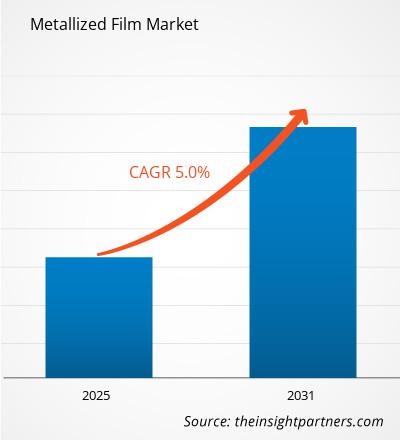
2025 Market Size
US$ 4.24 Bn
Base year value
2034 Forecast
US$ 7.4 Bn
Projected by 2034
CAGR 2026-2034
6.38 %
Growth rate
Addressable Market
US$ 52.65 Bn
(2026-2034)
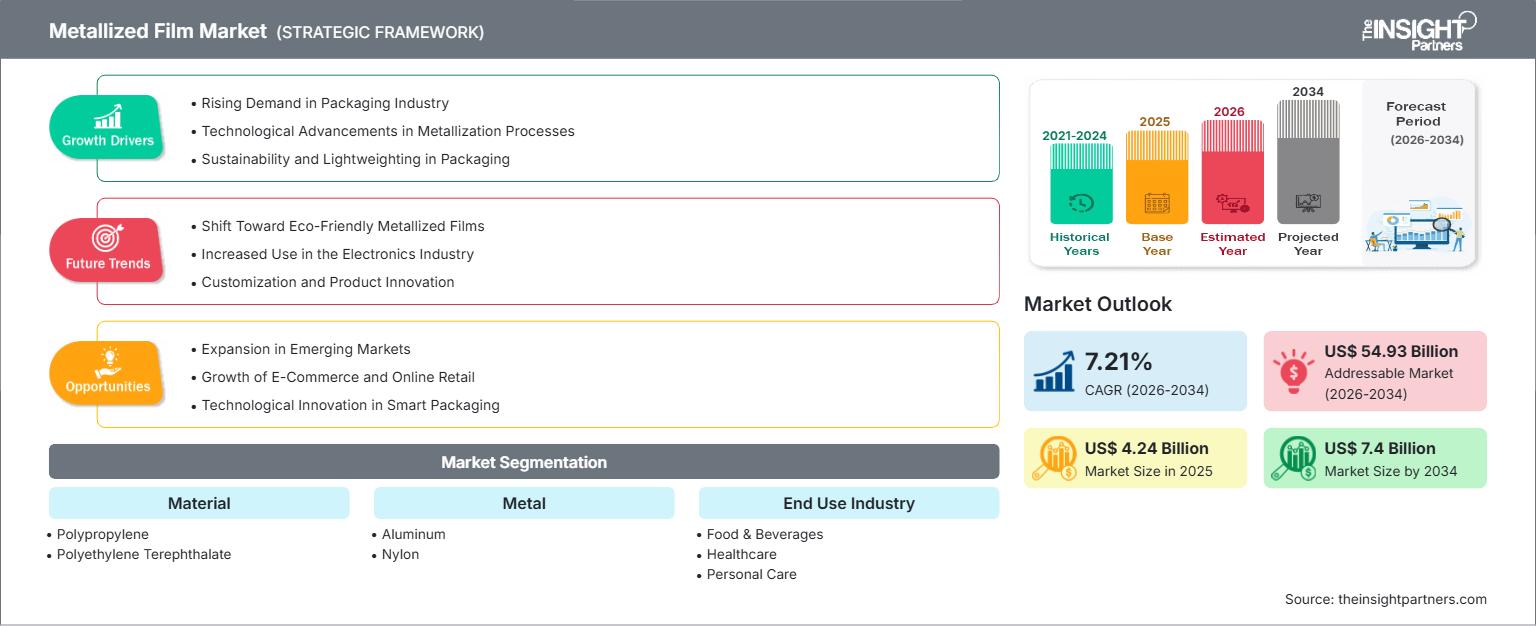
The Metallized Film market was valued at US$ 4.24 billion in 2025 and is expected to reach US$ 7.4 billion by 2034; it is estimated to record a CAGR of 6.38% during 2026-2034.
Metallized Film Market Assessment and Insights
- North America: Accounted for 31–33% share in 2025 and is anticipated to expand at a 6.5–7.0% CAGR during 2026–2034, supported by mature flexible packaging industries, strong food processing activities, healthcare packaging demand, and increasing investments in recyclable high-barrier film technologies.
- U.S.: Represented 79–82% of North American demand in 2025 and is expected to register a 6.6–7.1% CAGR owing to technological leadership in specialty films, electronics manufacturing, and premium packaged food applications.
- Europe: Held approximately 25–27% share in 2025 while expanding at a 6.3–6.8% CAGR, driven by Germany, Italy, France, the UK, and Spain, where sustainability regulations are accelerating demand for recyclable flexible packaging.
- Asia Pacific: Captured 34–36% share in 2025 and is forecast to witness the highest regional CAGR of 8.2–8.7%, supported by rapid industrialization across China, India, Japan, and South Korea together with growing food processing and electronics manufacturing sectors.
- Largest Segment: Food & Beverages represented 44–47% market share in 2025 and is expected to grow at a 7.0–7.4% CAGR, supported by increasing demand for moisture-resistant, oxygen-barrier, and shelf-life-enhancing packaging solutions.
- High Growth Segment: Healthcare accounted for 16–18% share in 2025 and is projected to expand at a 7.9–8.4% CAGR, driven by rising pharmaceutical production and stringent packaging quality standards.
- Key companies analyzed in detail: Kolon Industries, Inc., Olunro Corporation, Oben Holding Group, Tawazon Chemical Company LLC, Cosmo First Limited (formerly Cosmo Films Limited), Jindal Poly Films Limited, Polinas Plastik Sanayi ve Ticaret A.Ş., Toray Industries, Inc., Griff Paper and Film, Grafix Plastics, and UFlex Limited.
Source: The Insight Partners' analysis based on proprietary research, government publications, company annual reports, investor presentations, industry databases, and expert interviews.
Advances in vacuum metallization equipment, aluminum deposition techniques, and polymer engineering have significantly improved barrier properties while reducing coating thickness and overall material usage. Producers increasingly focus on multilayer structures capable of extending shelf life without compromising flexibility or printability. Simultaneously, demand from electronics, decorative laminates, and industrial insulation applications has diversified revenue streams beyond traditional food packaging, encouraging continuous investments in process automation and precision coating technologies.
Future expansion in the Metallized Film Market is expected to originate from Southeast Asia, Latin America, and selected Middle Eastern manufacturing hubs where packaged food consumption and pharmaceutical production continue to increase. Investments in recyclable mono-material packaging, bio-based polymer substrates, and energy-efficient metallization lines are expected to improve competitiveness. Regulatory initiatives encouraging circular packaging solutions and extended producer responsibility programs will further stimulate product innovation while supporting long-term industry profitability.
Metallized Film Market Report Scope
| Report Attribute | Details |
|---|---|
| Market size in 2025 | US$ 4.24 Billion |
| Market Size by 2034 | US$ 7.4 Billion |
| Global CAGR (2026 - 2034) | 6.38% |
| Historical Data | 2021-2024 |
| Forecast period | 2026-2034 |
Metallized Film Market Analysis
Growing demand for sustainable flexible packaging continues to strengthen metallized film market growth across multiple industries. Food processors increasingly prefer metallized films because they provide superior oxygen, moisture, aroma, and light barriers while using considerably less aluminum than conventional foil laminates. The expanding pharmaceutical industry also requires high-performance barrier materials capable of protecting moisture-sensitive medicines. Rising consumption of ready-to-eat meals, snack foods, confectionery products, coffee, and dairy products has further accelerated the adoption of metallized flexible packaging worldwide.
Beyond packaging, the Metallized Film Market is increasingly utilized in capacitor films, decorative laminates, labels, insulation materials, and electronic shielding products. Continuous improvements in polymer processing, aluminum deposition uniformity, and surface treatment technologies have enabled manufacturers to deliver thinner, lighter, and stronger film structures with improved functional performance. The availability of polypropylene and polyethylene terephthalate substrates further enhances application diversity while supporting cost optimization throughout the packaging value chain.
Competitive intensity remains high as global manufacturers pursue capacity expansion, product differentiation, and sustainability initiatives. The metallized film market analysis indicates that leading participants such as Toray Industries, Inc., Cosmo First Limited, Jindal Poly Films Limited, Oben Holding Group, Kolon Industries, Inc., and UFlex Limited continue investing in advanced metallization equipment capable of producing high-barrier recyclable structures. At the same time, regional suppliers are working towards customized packaging technologies for the food, pharmaceutical and industrial sectors to build strong customer ties.
In terms of investments, there is a shift towards efficient vacuum metallization systems, digitization of process control, and recyclable mono material packaging designs. There are some suppliers who are building up their manufacturing capacity in the Asia Pacific region to cater to the increasing local demand, thereby cutting down on logistics costs. Collaboration between resin suppliers, converters and consumer goods manufacturers is enabling the faster adoption of new barrier films.
● REPORT CUSTOMIZATION
Tailor This Report To Align With Your Specific Business Requirements
This report can be customized to align precisely with your business objectives, scope, and target markets. Customization options include tailored segmentation, geography, competitive analysis, and strategic insights to support informed decision-making.
Customize This Report →WHAT YOU CAN ADJUST
- ● Segmentations
- ● Geography
- ● Competitive Analysis
- ● Language Preferences
Metallized Film Market: Strategic Insights
Regional Insights
North America Metallized Film Market
North America accounted for approximately 31–33% of the metallized film market share in 2025 and is projected to expand at a CAGR of 6.5–7.0% through 2034. The region benefits from advanced flexible packaging infrastructure, strong food processing industries, and increasing pharmaceutical manufacturing. High consumer demand for packaged convenience foods and premium packaging formats continues to encourage investments in high-performance metallized film technologies.
The manufacturers have started using lightweight metallized plastic films in place of foil laminates to become more environmentally friendly and to save money on shipping costs. There is an increase in the use of recyclable mono-material packaging in the United States and Canada due to the environmental commitment of retailers and environmental regulations.
U.S. Metallized Film Market
The United States represented approximately 79–82% of North American demand in 2025 and is expected to register a CAGR of 6.6–7.1% during the forecast period. Leadership in the nation is derived from the presence of an extremely well-established packaging industry, polymer processing industry, and pharmaceuticals industry. Leading consumer packaged goods companies are using metallized flexible packaging to increase shelf life while minimizing the weight of the packaging.
Domestic companies are constantly investing in high-tech coatings, digitization of processes, and recycling-friendly film constructions in line with sustainability concerns. Increasing uses of capacitor films, industrial insulation, and electronic components are creating new avenues for growth. Innovations backed by alliances between resin companies, converters, and packagers are helping the U.S. establish its leadership as the largest producer and consumer in the region.
Europe Metallized Film Market
Europe captured approximately 25–27% of global demand in 2025 and is anticipated to grow at a CAGR of 6.3–6.8% through 2034. Germany remains the regional leader due to its advanced packaging manufacturing base and strong automotive and electronics industries. The UK will be able to enjoy the growing demand for premium food packaging, whereas France, Italy, and Spain will be working on increasing their production capacities in order to produce sustainable flexible packaging.
Investments in packaging that can be recycled are becoming increasingly popular in the UK as retailers try to minimize the waste from packaging without compromising on the protection of their products. Germany remains technologically ahead because of its ability to manufacture high-performing films and vacuum metallization technology.
APAC Metallized Film Market
Asia Pacific accounted for 34–36% of global demand in 2025 and is projected to record the fastest CAGR of 8.2–8.7% during the forecast period. China continues to hold its ground as the highest producing country, while India shows rapid consumer growth thanks to growing food processing and drug production industries. Japan and South Korea have made significant investments in electronic materials, while Australia has focused on meeting its demand through high-quality food exports and packaging.
Middle East & Africa Metallized Film Market
The Middle East & Africa market is projected to expand at a CAGR of 6.4–6.9% through 2034. Saudi Arabia and the UAE continue investing in downstream petrochemical industries that strengthen polymer film manufacturing, while South Africa remains an important consumer market for packaged food and healthcare products.
Growing investments in food security, pharmaceutical manufacturing, and industrial diversification are encouraging regional production of flexible packaging materials. Increasing infrastructure development and abundant polymer feedstock availability further improve long-term manufacturing competitiveness.
Segmentation Analysis
Material
Polymer selection directly influences the performance, cost, and end-use suitability of metallized films. The material segment is projected to grow at a CAGR of 7.2–7.6% during 2026–2034, supported by rising demand for lightweight, high-barrier packaging and continuous innovations in film processing technologies. Manufacturers increasingly optimize substrate selection to balance barrier performance, printability, mechanical strength, recyclability, and processing efficiency. The metallized film market scope continues to expand as packaging converters develop application-specific film structures that meet evolving sustainability requirements without compromising product protection.
- Polypropylene (PP): Widely adopted owing to its excellent moisture barrier, lightweight nature, cost efficiency, and superior machinability. The material remains the preferred substrate for snack foods, confectionery, bakery products, labels, and flexible consumer packaging.
- Polyethylene Terephthalate (PET): Preferred where higher tensile strength, dimensional stability, temperature resistance, and oxygen barrier properties are essential. PET-based metallized films are extensively utilized in pharmaceutical packaging, premium food products, electrical insulation, and industrial laminates.
Metal
Metal coatings determine barrier efficiency, conductivity, reflectivity, and decorative appearance of metallized films. This segment is anticipated to register a CAGR of 6.9–7.3% during 2026–2034, supported by advances in vacuum deposition processes and increasing demand for functional barrier materials. Continuous improvements in coating uniformity and deposition efficiency enable manufacturers to reduce material usage while maintaining product performance across packaging, electronics, and industrial applications.
- Aluminum: The dominant metallization material because of its exceptional barrier performance, high reflectivity, excellent adhesion, and cost effectiveness. Aluminum-coated films remain the industry standard for food packaging, pharmaceutical laminates, labels, and capacitor applications.
- Nylon: Utilized in specialized applications requiring enhanced puncture resistance, durability, and mechanical performance. Nylon-based metallized structures are increasingly selected for premium packaging, industrial laminates, and demanding transportation applications requiring superior structural integrity.
End Use Industry
The end-use industry segment represents the primary source of commercial demand and is expected to grow at a CAGR of 7.4–7.8% during 2026–2034. Expanding packaged food consumption, increasing pharmaceutical production, rising electronics manufacturing, and growing consumer preference for sustainable packaging continue to support long-term demand. Continuous product innovation enables converters to customize barrier performance according to application-specific requirements while improving manufacturing efficiency and regulatory compliance.
- Food & Beverages: The largest application segment due to widespread use in snack foods, confectionery, coffee, dairy products, frozen foods, and ready-to-eat meals. Superior moisture and oxygen barriers significantly extend shelf life while reducing food waste.
- Healthcare: Demand continues to increase with expanding pharmaceutical production, medical devices, diagnostic products, and sterile packaging. High barrier protection against moisture, oxygen, and contaminants supports stringent quality and regulatory requirements.
- Personal Care: Cosmetic products, wipes, sachets, shampoos, lotions, and premium beauty products increasingly utilize metallized films for enhanced product protection, decorative appeal, and extended storage stability across retail channels.
- Electrical & Electronics: Metallized films are utilized in capacitors, insulation materials, electromagnetic shielding, and specialty electronic components where conductivity, thermal stability, and dimensional precision remain critical performance requirements.
Opportunity Snapshot
| End Use Industry | Revenue Contribution | Trend Tag | Adoption Stage |
|---|---|---|---|
| Food & Beverages | High | Shelf Extension | Mature |
| Healthcare | High | Sterile Packs | Scaling |
| Personal Care | Medium | Premium Sachets | Scaling |
| Electrical & Electronics | Medium | Capacitor Films | Mature |
Metallized Film Market Growth Drivers and Impact Analysis
Expansion of High-Barrier Flexible Packaging Across Food Industries
The global food industry still undergoes change in its trend from hard containers to lighter flexible packages, which are not only capable of increasing shelf-life but also decreasing logistical expenses. Metallized films show high levels of resistance towards oxygen, humidity, smell and ultraviolet rays without needing to have thick foil barriers. According to associations of food manufacturers in North America and Europe, the need for packaged convenience foods is still growing due to urbanization, the small size of households and changing consumer lifestyles. Meanwhile, brand owners decrease the packaging weight in order to enhance sustainability and logistics efficiency. This makes converters switch from traditional lamination to metallized films which offer the same barrier features and are more efficient.
Growing Pharmaceutical Manufacturing and Regulatory Packaging Standards
Manufacturers of the healthcare industry need packaging that would allow preserving the quality of their products during the course of storage and transportation. Metallized films provide an excellent level of protection against moisture and oxygen for tablets, capsules, diagnostic kits, and other products used in medicine. Organizations such as the World Health Organization continue insisting on the development of more efficient pharmaceutical quality management systems with the promotion of advanced materials for packaging. The increase in the production of generic drugs, vaccines, and other biologicals is creating a rising demand for multilayer packaging with high performance. Manufacturers of films are introducing new methods of metallization that would be cleaner, with better coating and sealing.
Increasing Demand from Electronics and Industrial Applications
Beyond the use in packaging, metallized films have emerged to be of significance in electrical insulation, capacitor construction, electromagnetic shielding, and industrial laminates. The growing production of electric cars, renewable energy components, consumer electronics, and industrial automation devices will further drive the demand for metallized films that are specifically engineered. Upgradation in properties such as dielectric capability, thermal resistance, and coating uniformity will allow manufacturers to cater to the more complex industrial requirements. Investments in electronics manufacturing in the Asia Pacific region will drive the need for such films that can provide a constant electrical performance level.
Metallized Film Market Future Trends
Development of Recyclable Mono-Material Barrier Structures
Packaging manufacturers are increasingly designing mono-material flexible packaging capable of improving recyclability without sacrificing barrier performance. Advanced metallization processes now enable polypropylene and polyethylene terephthalate structures to deliver higher protection while reducing overall material complexity. The metallized film market trends increasingly reflect investments in recyclable packaging compatible with evolving circular economy regulations. Brand owners are collaborating with resin producers and converters to commercialize packaging solutions that meet recycling infrastructure requirements while maintaining food safety, product freshness, and attractive shelf appearance. These innovations are expected to reshape product development priorities during the coming decade.
Digital Manufacturing and Intelligent Process Optimization
AI, machine vision inspection systems, preventive maintenance solutions, and automated monitoring tools have been incorporated by manufacturers in metallization lines. Digital manufacturing allows for coating thickness optimization, defect detection, and energy usage monitoring in real time. Moreover, smart manufacturing also helps save on material and reduce machine downtime, thereby improving production efficiency. The application of Industry 4.0 solutions should bring about production flexibility and faster development cycles in the future. Companies using intelligent manufacturing solutions will definitely reap more benefits in terms of improved productivity, minimized costs, and adaptation to customers' demands.
Metallized Film Market Opportunities
Expansion Across Emerging Packaging Manufacturing Hubs
Rapid industrialization throughout Southeast Asia, Latin America, and the Middle East presents attractive investment opportunities for metallized film manufacturers. The metallized film market Forecasts indicate sustained demand growth supported by expanding packaged food industries, pharmaceutical manufacturing, and improving retail infrastructure. Governments continue encouraging domestic manufacturing through industrial development programs, foreign investment incentives, and export-oriented production policies. Establishing regional metallization facilities enables manufacturers to shorten supply chains, improve customer responsiveness, and reduce logistics costs. Companies expanding production capacity within high-growth economies are expected to strengthen long-term competitive positioning while serving rapidly growing domestic and export markets.
Advanced Functional Films for High-Value Industrial Applications
The increasing need for specialty films in energy storage applications, electric vehicles, smart electronics, healthcare devices, and insulation is creating opportunities outside the conventional packaging segment. Companies that can produce coated films with superior dielectric, optical, and thermal characteristics have the potential to tap into these high-value-added applications. Research and technology development in the areas of coating process, as well as the creation of multi-functional products through collaboration, will help companies to meet the technical challenges posed by their customers. With customers demanding more multi-functional materials that increase the functionality of their products, metallized films will play a vital role in industrial manufacturing.
Recent Developments
- July 2026: International Packaging Films Limited announced that Global Packaging Films (Private) Limited (GPAK), a wholly owned subsidiary of the company, has approved the acquisition of a state-of-the-art metallizer at an estimated project cost of approximately Rs1.4 billion.
- May 2026: Surya Global Flexifilms (SGF) based in India invested in an EXPERT K5 3650mm with AlOx capability. The new machine will be installed in their factory at the end of 2026 and will sit alongside their three other BOBST metallizers further cementing the relationship between the two companies.
Frequently Asked Questions

- Comprehensive Market Sizing and Forecast Analysis
- Detailed Segmentation Analysis
- In-Depth Market Dynamics Assessment
- Regional and Country-Level Insights
- Competitive Landscape and Company Benchmarking
- Strategic Business Intelligence
Recent Reports
Testimonials

The Insight Partners' SCADA System Market report is comprehensive, with valuable insights on current trends and future forecasts. The team was highly professional, responsive, and supportive throughout. We are very satisfied and highly recommend their services.
RAN KEDEM Partner, Reali Technologies LTDs
I requested a report on a very specific software market and the team produced the report in a few days. The information was very relevant and well presented. I then requested some changes and additions to the report. The team was again very responsive and I got the final report in less than a week.
JEAN-HERVE JENN Chairman, Future Analytica
We worked with The Insight Partners for an important market study and forecast. They gave us clear insights into opportunities and risks, which helped shape our plans. Their research was easy to use and based on solid data. It helped us make smart, confident decisions. We highly recommend them.
PIYUSH NAGPAL Sr. Vice President, High Beam Global
The Insight Partners delivered insightful, well-structured market research with strong domain expertise. Their team was professional and responsive throughout. The user-friendly website made accessing industry reports seamless. We highly recommend them for reliable, high-quality research services
YUKIHIKO ADACHI CEO, Deep Blue, LLC.
This is the first time I have purchased a market report from The Insight Partners.While I was unsure at first, I visited their web site and felt more comfortable to take the risk and purchase a market report.I am completely satisfied with the quality of the report and customer service. I had several questions and comments with the initial report, but after a couple of dialogs over email with their analyst I believe I have a report that I can use as input to our strategic planning process.Thank you so much for taking the extra time and making this a positive experience.I will definitely recommend your service to others and you will be my first call when we need further market data.
JOHN SUZUKI President and Chief Executive Officer, Board Director, BK Technologies
I wish to appreciate your support and the professionalism you displayed in the course of attending to my request for information regarding to infectious disease IVD market in Nigeria. I appreciate your patience, your guidance, and the fact that you were willing to offer a discount, which eventually made it possible for us to close a deal. I look forward to engaging The Insight Partners in the future, all thanks to the impression you have created in me as a result of this first encounter.
DR CHIJIOKE ONYIA MANAGING DIRECTOR, PineCrest Healthcare Ltd.Reason to Buy
- Informed Decision-Making
- Understanding Market Dynamics
- Competitive Analysis
- Identifying Emerging Markets
- Customer Insights
- Market Forecasts
- Risk Mitigation
- Boosting Operational Efficiency
- Strategic Planning
- Investment Justification
- Tracking Industry Innovations
- Aligning with Regulatory Trends





 Get Free Sample for