
Bio Renewable Chemicals Market Share, Growth & Demand by 2034
Coverage: By Product Type (Bioethanol, Biodiesel, Bioplastics); Feedstock (Agricultural Waste, Biomass, Algae, Sugar Crops); Application (Agriculture, Packaging, Food And Beverages, Personal Care And Cosmetics, Textile, Pharmaceuticals); Geography (North America, Europe, Asia-Pacific, South and Central America, Middle East and Africa)
- Status : Data Released
- Report Code : TIPRE00003671
- Category : Chemicals and Materials
- No. of Pages : 150
- Available Report Formats :


- Last update date : August 27, 2026


2025 Market Size
US$ 4.05 Bn
Base year value
2034 Forecast
US$ 7.46 Bn
Projected by 2034
CAGR 2026-2034
7.95 %
Growth rate
Addressable Market
US$ 54.48 Bn
(2026-2034)
The Bio Renewable Chemicals market was valued at US$ 4.05 Billion in 2025 and is projected to reach US$ 7.46 Billion by 2034, expanding at a CAGR of 7.95% during 2026–2034. The demand is driven by the availability of renewable feedstock, the emergence of industrial biotechnology, decarbonization efforts, and the growing use of petrochemical substitutes in various end-user sectors. The Bio Renewable Chemicals Market is set to play an important role in shifting the focus from fossil fuel-based chemicals to renewable carbon sources.
North America is set to continue being one of the major hubs for production and consumption, fueled by advancements in biotechnology, availability of agricultural feedstock, and research activities backed by the government. The Bio Renewable Chemicals Market Size is shaped by developments in fermentation processes, biomass conversion, waste utilization, and bio-refineries. The demand in North America is projected to grow at a CAGR of 7.2-8.1% between 2026 and 2034, led by the U.S. region.
Bio Renewable Chemicals Market Assessment and Insights
- North America: North America is expected to account for a 24–28% share in 2025, with the regional market growing at approximately 7.5–8.5% CAGR between 2026 and 2034, supported by agricultural feedstocks, biotechnology infrastructure, renewable-fuel programs, and commercial-scale fermentation capabilities.
- U.S.: The U.S. represents the dominant North American market, accounting for approximately 78–84% of the regional share in 2025 and growing at approximately 7.6–8.6% CAGR during 2026–2034, supported by biotechnology investment and renewable feedstock availability.
- Europe: Europe is expected to hold a 35–40% share in 2025 and expand at approximately 7.2–8.2% CAGR during 2026–2034. Germany, France, the UK, Italy, and Spain benefit from bioeconomy policies, circularity initiatives, and industrial biotechnology investments.
- Asia Pacific: Asia Pacific is projected to represent a 21–26% share in 2025 and register approximately 8.5–9.5% CAGR between 2026 and 2034. China, Japan, India, South Korea, and Australia are strengthening bio-based manufacturing through feedstock availability and industrial decarbonization programs.
- Largest Segment: Bioethanol is estimated to represent a 32–36% market share in 2025, with approximately 7.4–8.4% CAGR during 2026–2034, reflecting its established production base and broad industrial integration.
- High Growth Segment: Bioplastics are expected to represent approximately 24–28% share in 2025 and grow at approximately 9.0–10.0% CAGR during 2026–2034, supported by packaging substitution and circular-material initiatives.
- Key companies analyzed in detail: Amyris, Inc.; BASF SE; E. I. du Pont de Nemours and Company; GC America Sustainability Corporation; Genomatica, Inc.; Gevo, Inc.; LanzaTech Global, Inc.; Royal DSM N.V.; Virent, Inc.; Braskem S.A.
Source: The Insight Partners' analysis based on proprietary research, government publications, company annual reports, investor presentations, industry databases, and expert interviews.
Bio Renewable Chemicals are developing from niche sustainable chemicals into input components in the broader chemical value chain. The improvements in fermentation, enzymes, biomass pretreatment, and downstream purification are enhancing product uniformity and economic performance. Companies are using traditional chemical plant facilities together with renewable feedstock pathways to produce lower carbon intermediate compounds. Consequently, agricultural residues, sugar-based feedstocks, algae, and biomass are becoming more relevant for production.
There is growing focus on commercial technologies rather than lab technologies in the Bio Renewable Chemicals market. Europe is bolstering bioeconomy commercialization via public and private investments as well as lead markets, whereas North America is benefitting due to availability of renewable feedstock infrastructures. Asia Pacific is becoming relevant due to manufacturing scales and availability of biomass. All these trends may aid in commercialization, but feedstock competition, scale-up issues, carbon footprint analysis, and costs of production will continue to matter for investors.
Bio Renewable Chemicals Market Report Scope
| Report Attribute | Details |
|---|---|
| Market size in 2025 | US$ 4.05 Billion |
| Market Size by 2034 | US$ 7.46 Billion |
| Global CAGR (2026 - 2034) | 7.95% |
| Historical Data | 2021-2024 |
| Forecast period | 2026-2034 |
Bio Renewable Chemicals Market Analysis
Bio Renewable Chemicals Market growth drivers include increasing use of renewable carbon in chemicals, packaging, agriculture, food, and personal care. The value chain includes growing the biomass or collecting the waste, followed by pretreatment, conversion through fermentation or other means, purification, and then downstream processing of the chemicals. Players in the market will compete on their ability to efficiently convert feedstocks, yield high-purity output, have low carbon intensity, and fit within existing manufacturing processes.
Different feedstocks have varying impact on economics of production. Agricultural waste can help to alleviate dependency on biomass crops, whereas sugar crops provide proven conversion processes and known processing economics. Algae is the option that shows long-term potential of being used in an integrated biorefinery but requires cultivation economics. Biomass can be used to produce multiple products from one feedstock.
Competitive positioning requires more and more the use of proprietary biological conversion technologies, strategic partnerships, and access to commercial-scale production capabilities. For example, BASF SE is introducing renewable resources into existing value chains of chemicals, while Gevo, Inc. is developing renewable fuel and chemical pathways. LanzaTech Global, Inc. is focused on the biological conversion of carbon-containing gases, and Braskem S.A. has industrial-scale production of bio-based polymers.
According to the Bio Renewable Chemicals Market report, there is increasing differentiation in terms of flexibility and low life-cycle carbon. Participants like Genomatica, Inc., Virent, Inc., and others put much emphasis on biological and catalytic approaches to the production of chemical intermediates. Strategic investments are being made into demonstration and commercial facilities. The key factors for the success at these facilities include finance, offtake agreements, feedstock, and regulatory qualification.
● REPORT CUSTOMIZATION
Tailor This Report To Align With Your Specific Business Requirements
This report can be customized to align precisely with your business objectives, scope, and target markets. Customization options include tailored segmentation, geography, competitive analysis, and strategic insights to support informed decision-making.
Customize This Report →WHAT YOU CAN ADJUST
- ● Segmentations
- ● Geography
- ● Competitive Analysis
- ● Language Preferences
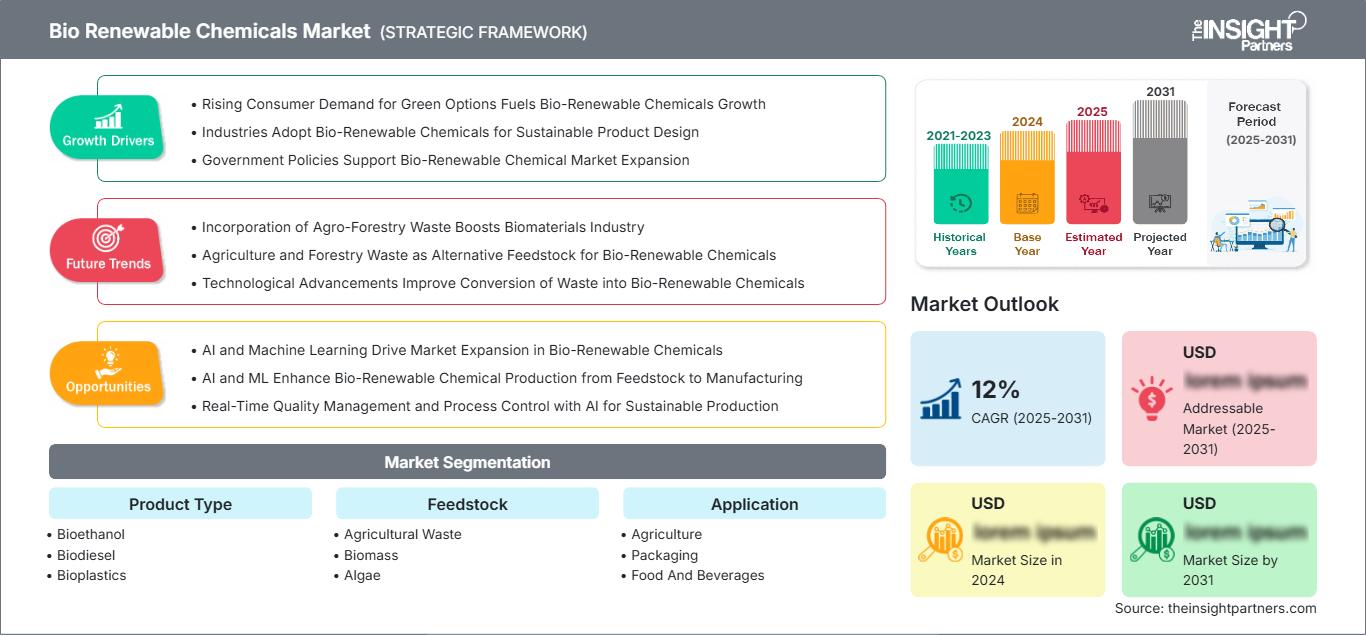
Bio Renewable Chemicals Market: Strategic Insights
Regional Insights
North America Bio Renewable Chemicals Market
North America is estimated to hold a 24–28% Bio Renewable Chemicals Market share in 2025, with the regional market projected to grow at 7.5–8.5% CAGR during 2026–2034. The U.S. dominates regional activity because of its extensive agricultural base, biotechnology ecosystem, chemical manufacturing infrastructure, and established biofuel value chains. Corn, agricultural residues, and other biomass resources provide feedstock flexibility for fermentation and conversion technologies.
Opportunities in the market have evolved from uses in fueling transport to packaging, agriculture, cosmetics, and specialty chemicals. The federal preference for procurement, initiatives involving renewable carbon, and decarbonization strategies of companies can be beneficial for such bio-based materials as satisfy certain requirements. Canada contributes to biomass and eco-friendly technology, although its market is smaller than that of the United States.
U.S. Bio Renewable Chemicals Market
The U.S. accounts for approximately 78–84% of the North American share in 2025, with a projected 7.6–8.6% CAGR during 2026–2034. The industry leaders have characteristics such as good agriculture, good infrastructure for ethanol, biotech capability, and capital availability for scaling up renewable chemical technologies. Corn and agricultural waste are still valuable sources of materials used in the process of making the material.
Firms are diversifying their activities beyond fuels into polymers, specialty chemicals, packaging, and agricultural products. Some of the technology companies like Gevo, Inc., BASF SE, Genomatica, Inc., among others, are involved in various parts of the value chain. Purchasers of industrial products are basing their analysis of renewable products on carbon intensity, sustainability of the supply, performance in use, and lifecycle assessment.
Europe Bio Renewable Chemicals Market
Europe is estimated to hold a 35–40% share in 2025, with growth of approximately 7.2–8.2% CAGR during 2026–2034. Germany is leading the pack thanks to its large chemical industry, biotech capacity, and sustainable industrial policies. The UK, France, Italy, and Spain are exploring complementary applications in packaging, agriculture, personal care, and specialty chemicals.
The UK is expanding its capacity in biotechnology and industrial decarbonization, whereas the demand for renewable raw materials is increasingly tied to companies’ carbon reduction targets. Germany is leveraging its chemical production industry and research environment. France is relying on its agricultural feedstock and industrial biotechnology capacity. Italy and Spain are presenting opportunities in packaging, agriculture, food processing, and renewable resource utilization, backed by broader European efforts for circular economy.
European regulations continue to influence the market significantly. In the EU Bioeconomy Strategy 2025 of the European Commission, bio-based chemicals, plastics, textiles, construction materials, and biorefineries are named as lead markets and technologies. The European bioeconomy creates a significant economic output and facilitates investments that are intended to cover commercialization challenges. Such factors help with increasing demand visibility for renewable chemicals manufacturers and can positively impact investment environment.
APAC Bio Renewable Chemicals Market
APAC is projected to account for a 21–26% share in 2025 and expand at approximately 8.5–9.5% CAGR during 2026–2034. China is the leader, thanks to large-scale chemicals production, biomasses, and packaging needs. Japan, South Korea, India, and Australia are involved in the sector because of biotechnology, renewable sources, innovations, and sustainability policy.
China is able to combine the industrial capacity with increased bio-based materials production. India has an advantage in agricultural wastes and sugarcane production. Japan and South Korea focus on technologies and applications. Australia may have an advantage with respect to biomass and agricultural wastes conversion.
Middle East & Africa Bio Renewable Chemicals Market
The Middle East & Africa represents an emerging regional market, with growth estimated at approximately 7.0–8.0% CAGR during 2026–2034. Saudi Arabia and UAE have plans for circular economy and low carbon industrial systems while South Africa contributes agricultural waste and chemical processing expertise. Rest of MEA region has potential but it is relatively immature since bio-based facilities are not yet well-developed.
Diversification of energy sources is an important strategic factor in the Gulf regions. Developments in biotech and sustainable manufacturing technologies may gradually increase renewable chemicals production. South Africa has agricultural/biomass inputs available while infrastructure improvements in the region may lead to improved logistics and processing capacities.
Segmentation Analysis
Product Type
The Product Type segment encompasses established renewable fuels and emerging bio-derived materials. Bioethanol currently holds the largest position because of mature production infrastructure, while bioplastics are gaining strategic importance as packaging and consumer-goods manufacturers seek renewable material alternatives. The segment is expected to expand at approximately 7.5–8.5% CAGR during 2026–2034. This Bio Renewable Chemicals Market scope increasingly encompasses both established conversion routes and advanced biological platforms.
- Bioethanol: Bioethanol remains strategically important because of established fermentation infrastructure, extensive agricultural feedstock availability, and integration with transportation-fuel systems. Its existing commercial scale also provides a platform for downstream chemical conversion.
- Biodiesel: Biodiesel supports renewable-carbon substitution in transportation and industrial applications. Its demand is influenced by blending requirements, feedstock availability, fuel specifications, and the economics of vegetable oils and waste-derived lipid resources.
- Bioplastics: Bioplastics provide a major route for renewable carbon into packaging and consumer products. Their strategic importance is increasing as manufacturers seek recyclable, compostable, or bio-derived materials that can meet application-specific performance requirements.
Feedstock
Feedstock availability and conversion efficiency directly influence production economics, carbon intensity, and supply reliability. Agricultural waste and biomass can support circular production by converting residues into higher-value chemicals, while sugar crops provide established fermentation pathways. Algae offers longer-term potential for integrated production but requires improvements in cultivation, harvesting, and processing economics. The segment is projected to grow at approximately 7.8–8.8% CAGR during 2026–2034.
- Agricultural Waste: Agricultural residues can provide low-value feedstock for higher-value chemical production while reducing waste disposal requirements. Their decentralized availability creates logistics challenges but supports circular-resource strategies and non-food feedstock development.
- Biomass: Biomass provides a broad renewable-carbon platform encompassing forestry residues, organic materials, and other biological resources. Its strategic value increases when integrated biorefineries extract several products from a common feedstock stream.
- Algae: Algae provides opportunities for renewable chemical production without relying exclusively on conventional agricultural land. Commercial development remains dependent on cultivation productivity, harvesting economics, downstream processing, and reliable large-scale supply systems.
- Sugar Crops: Sugar crops offer established fermentation pathways and predictable carbohydrate availability. Their importance is strongest in regions with mature sugar industries, where integrated ethanol and chemical production can improve feedstock utilization.
Application
The Application segment spans agriculture, packaging, food and beverages, personal care and cosmetics, textiles, and pharmaceuticals. Packaging and agriculture provide important demand bases because renewable materials can replace fossil-derived inputs in large-volume applications. Pharmaceutical and personal-care uses provide opportunities for higher-value products where purity, consistency, and formulation performance can support stronger economics. The segment is expected to grow at approximately 7.6–8.6% CAGR during 2026–2034.
- Agriculture: Bio-derived chemicals support fertilizers, crop-protection formulations, coatings, and agricultural inputs. Demand is linked to sustainable farming practices and increasing interest in renewable feedstock-based products.
- Packaging: Packaging provides significant substitution potential because bio-based polymers and intermediates can enter high-volume material applications. Brand sustainability commitments and regulatory pressure support continued adoption.
- Food and Beverages: Renewable chemicals can serve processing, packaging, additives, and functional-material applications. Food-contact requirements and product safety standards remain important barriers to commercial qualification.
- Personal Care and Cosmetics: Personal-care manufacturers increasingly use renewable ingredients and bio-derived intermediates in formulations. Traceability, natural-origin content, performance, and certification influence supplier selection.
- Textile: Bio-based chemicals support fibers, coatings, dyes, finishing agents, and other textile processes. Demand is strengthened by sustainable-material targets and growing interest in renewable fiber value chains.
- Pharmaceuticals: Pharmaceutical applications prioritize purity, consistency, regulatory qualification, and supply security. Bio-derived chemicals can provide renewable alternatives in selected excipients, intermediates, solvents, and specialty formulations.
Opportunity Snapshot
| Application | Revenue Contribution | Trend Tag | Adoption Stage |
|---|---|---|---|
| Agriculture | High | Bio Inputs | Scaling |
| Packaging | High | Bio Polymers | Scaling |
| Food And Beverages | Medium | Renewable Inputs | Scaling |
| Personal Care And Cosmetics | Medium | Bio Ingredients | Scaling |
| Textile | Medium | Bio Fibers | Emerging |
| Pharmaceuticals | Medium | Bio Intermediates | Emerging |
Bio Renewable Chemicals Market Growth Drivers and Impact Analysis
Expansion of renewable feedstock conversion technologies
Fermentation, enzymatic processing, catalytic conversion, and biomass pretreatment advancements are making it easier to manufacture chemicals via renewable means. Modern technology seeks to increase yield, minimize energy input, and increase flexibility in relation to the feedstocks used by manufacturers, who are increasingly able to rely on agricultural waste, biomass, sugar, and other renewable sources of carbon. This change will be significant throughout the value chain, as manufacturers will be able to rely on more than one feedstock and optimize the use of their facilities. The significance of waste to value conversions lies in the fact that they add value to materials whose previous uses were limited from an economic point of view.
Increasing corporate demand for lower-carbon chemical inputs
There is a growing trend in the purchases of chemicals whereby carbon intensity, renewables content, and performance over the lifecycle are being taken into consideration. This means that rather than making purchases based on the pricing factor alone, purchasing involves cost and performance. Leading firms in consumer goods, packaging, automobile, and chemicals industries have set out to develop their own targets concerning the usage of renewable materials, which means that there is increasing visibility of demand for bio-based intermediates. With this in mind, firms with clear feedstock sources and production capabilities will be able to have more stable commercial relationships. This trend goes beyond the finished products since downstream users want information about carbon of the products.
Policy support for circular and bio-based industrial production
The adoption of government policies in favor of renewable carbon pathways is rising with respect to bioeconomy, sustainable procurement, renewable energy, and industrial decarbonization. The lead markets identified under the bioeconomy initiative launched by the European Commission in 2025 include bio-based chemicals and biorefineries, whereas the industrial initiatives are meant to foster improved investment and competitiveness. Similarly, renewable feedstock usage and low-carbon manufacturing are promoted with the help of policy instruments in North America and the Asia Pacific. This can mitigate risks in the initial stages of commercialization, create demonstration plants, and foster offtake agreements. Nevertheless, the effect is jurisdiction-specific.
Bio Renewable Chemicals Market Future Trends
Expansion of Waste-Derived Renewable Chemical Platforms
Bio Renewable Chemicals Market trends increasingly favor waste and residue feedstocks because producers seek renewable carbon sources with lower land-use implications. Agricultural residues, municipal waste, industrial waste gases, forestry by-products, and other underutilized resources are becoming strategic inputs for advanced conversion technologies. This trend is encouraging investment in pretreatment, gas fermentation, enzymatic conversion, and catalytic upgrading. Commercial platforms are likely to focus on feedstock flexibility rather than relying on one crop or biomass source. Improved logistics, preprocessing, and digital traceability will further support commercialization. As conversion yields improve, waste-derived renewable chemicals could move from demonstration projects toward larger industrial applications, particularly in packaging, polymers, fuels, and specialty chemical intermediates.
Integration of Renewable Chemicals With Circular Carbon Systems
A second emerging direction involves connecting renewable chemical production with circular carbon systems. Producers are increasingly examining combinations of biomass, waste carbon, recycled materials, and captured biogenic or industrial carbon to reduce dependence on virgin fossil resources. Such systems can broaden feedstock availability while supporting more efficient carbon utilization. The commercial emphasis is shifting toward measurable lifecycle performance, renewable-carbon content, and traceability across the value chain. Chemical companies are expected to develop portfolios that combine bio-based and circular products rather than relying on a single sustainability pathway. This approach can create greater flexibility for packaging, polymers, textiles, and specialty applications while aligning production strategies with evolving carbon-accounting frameworks.
Bio Renewable Chemicals Market Opportunities
Development of waste-based chemical production platforms
Investors can target conversion platforms that transform agricultural residues, food waste, and industrial biomass into higher-value chemical intermediates. These technologies offer potential advantages because they can reduce competition with food-oriented feedstocks while improving resource utilization. Commercial projects should prioritize locations with concentrated biomass supplies, established logistics, and nearby chemical customers. Technology selection should consider conversion yield, pretreatment complexity, water requirements, energy intensity, and product purification costs. Partnerships with agricultural processors and chemical manufacturers can reduce feedstock and market risks. Projects capable of producing multiple products from a common feedstock may offer stronger economics than single-product facilities. This opportunity is particularly relevant in regions where agricultural waste is abundant but remains underutilized.
Expansion into high-value specialty chemical applications
Higher-value applications provide an opportunity to improve the economics of renewable chemical production beyond large-volume commodity markets. Pharmaceutical, personal-care, specialty packaging, food-processing, and advanced-material applications can place greater emphasis on purity, traceability, performance, and renewable content. Producers can therefore differentiate through application-specific formulations rather than competing solely on feedstock cost. Investment priorities should include purification technology, regulatory qualification, formulation development, and customer-specific technical support. Partnerships with downstream manufacturers can accelerate product validation and shorten commercialization cycles. The Bio Renewable Chemicals Market Forecasts indicate that broader adoption will depend not only on production scale but also on the ability of suppliers to demonstrate consistent quality, reliable supply, and measurable environmental performance.
Recent Developments
- May 2026: Trillium Renewable Chemicals — Trillium raised US$13 million in Series B financing, led by HS Hyosung Advanced Materials, to support Project Falcon, its demonstration plant for 100% bio-based acrylonitrile. The facility uses Trillium's glycerol-to-acrylonitrile technology, with commissioning targeted for Q2 2026 and product shipments expected later in the year. The funding also supports engineering for the company's first commercial-scale plant.
- December 2025: UPM — UPM's Leuna biorefinery in Germany began production and commercialization of industrial sugars derived from wood, marking the first commercial product from the facility. UPM reported that the refinery had achieved stable separation of lignin and sugars, enabling subsequent production of renewable glycols and renewable functional fillers. The development represents a major step toward industrial-scale wood-based biochemical production.
Frequently Asked Questions

- Comprehensive Market Sizing and Forecast Analysis
- Detailed Segmentation Analysis
- In-Depth Market Dynamics Assessment
- Regional and Country-Level Insights
- Competitive Landscape and Company Benchmarking
- Strategic Business Intelligence
Recent Reports
Testimonials

The Insight Partners' SCADA System Market report is comprehensive, with valuable insights on current trends and future forecasts. The team was highly professional, responsive, and supportive throughout. We are very satisfied and highly recommend their services.
RAN KEDEM Partner, Reali Technologies LTDs
I requested a report on a very specific software market and the team produced the report in a few days. The information was very relevant and well presented. I then requested some changes and additions to the report. The team was again very responsive and I got the final report in less than a week.
JEAN-HERVE JENN Chairman, Future Analytica
We worked with The Insight Partners for an important market study and forecast. They gave us clear insights into opportunities and risks, which helped shape our plans. Their research was easy to use and based on solid data. It helped us make smart, confident decisions. We highly recommend them.
PIYUSH NAGPAL Sr. Vice President, High Beam Global
The Insight Partners delivered insightful, well-structured market research with strong domain expertise. Their team was professional and responsive throughout. The user-friendly website made accessing industry reports seamless. We highly recommend them for reliable, high-quality research services
YUKIHIKO ADACHI CEO, Deep Blue, LLC.
This is the first time I have purchased a market report from The Insight Partners.While I was unsure at first, I visited their web site and felt more comfortable to take the risk and purchase a market report.I am completely satisfied with the quality of the report and customer service. I had several questions and comments with the initial report, but after a couple of dialogs over email with their analyst I believe I have a report that I can use as input to our strategic planning process.Thank you so much for taking the extra time and making this a positive experience.I will definitely recommend your service to others and you will be my first call when we need further market data.
JOHN SUZUKI President and Chief Executive Officer, Board Director, BK Technologies
I wish to appreciate your support and the professionalism you displayed in the course of attending to my request for information regarding to infectious disease IVD market in Nigeria. I appreciate your patience, your guidance, and the fact that you were willing to offer a discount, which eventually made it possible for us to close a deal. I look forward to engaging The Insight Partners in the future, all thanks to the impression you have created in me as a result of this first encounter.
DR CHIJIOKE ONYIA MANAGING DIRECTOR, PineCrest Healthcare Ltd.Reason to Buy
- Informed Decision-Making
- Understanding Market Dynamics
- Competitive Analysis
- Identifying Emerging Markets
- Customer Insights
- Market Forecasts
- Risk Mitigation
- Boosting Operational Efficiency
- Strategic Planning
- Investment Justification
- Tracking Industry Innovations
- Aligning with Regulatory Trends





 Get Free Sample for