
Blow Molded Plastic Bottles Market Trends, Size & Forecast by 2034
Coverage: By Polymer (Polyethylene (PE), Polyethylene terephthalate (PET), Polyvinyl chloride (PVC), Polyethylene naphthalate Polypropylene (PP), High and low density polycarbonate, Polysulfone, Butadiene-styrene); Application (Beverage, Dairy, Pharmaceutical, Automobile), and Geography (North America, Europe, Asia Pacific, and South and Central America)
- Status : Data Released
- Report Code : TIPRE00015484
- Category : Chemicals and Materials
- No. of Pages : 150
- Available Report Formats :


- Last update date : November 05, 2026


2025 Market Size
US$ 22.45 Bn
Base year value
2034 Forecast
US$ 38.59 Bn
Projected by 2034
CAGR 2026-2034
6.21 %
Growth rate
Addressable Market
US$ 276.39 Bn
(2026-2034)
The blow molded plastic bottles market was valued at US$ 22.45 Billion in 2025 and is projected to reach US$ 38.59 Billion by 2034, expanding at a CAGR of 6.21% from 2026 to 2034. Growth is supported by rising demand for lightweight rigid packaging, expansion of packaged beverages and dairy products, pharmaceutical packaging requirements, and increasing adoption of recyclable and resource-efficient bottle designs. Advances in blow molding equipment, material distribution, lightweighting, and recycled-content integration are also improving the performance and sustainability of plastic bottles across major end-use industries.
Across North America, the blow molded plastic bottles market size is supported by established packaging manufacturing infrastructure, high penetration of rigid plastic containers, and continued demand for convenient formats in beverage, healthcare, personal care, and household applications. The regional market is expected to expand at a CAGR of ~5% through 2034, with replacement of heavier packaging, resin optimization, and greater use of recycled content supporting incremental volume and value growth.
Blow Molded Plastic Bottles Market Assessment and Insights
Regional Outlook
- North America: ~27% of the global market in 2025 | ~5% CAGR through 2034. Market position: North America remains a major established market, supported by large-scale packaging converters, strong beverage and pharmaceutical consumption, sophisticated bottle design capabilities, and continued investment in lightweighting and recycled-content manufacturing.
- US: ~86% of North American market revenue in 2025 | ~5% CAGR through 2034. Market position: The US represents the leading country in North America, supported by extensive beverage, healthcare, food, automotive, and consumer-product packaging demand. Advanced molding capabilities and sustainability requirements encourage continued resin optimization and bottle redesign.
- Europe: ~22% of the global market in 2025 | ~5% CAGR through 2034. Market position: Europe is a mature packaging market led by Germany, the UK, France, Italy, and Spain. Regulatory pressure around packaging waste, recycled content, recyclability, and resource efficiency encourages investment in lightweight containers and circular material systems.
- Asia Pacific: ~39% of the global market in 2025 | ~8% CAGR through 2034. Market position: Asia Pacific is the fastest-growing region, led by China, India, Japan, South Korea, and Australia. Expanding packaged beverage consumption, pharmaceutical manufacturing, urbanization, and domestic packaging capacity are supporting rapid market development.
Segment Outlook
- Polymer: ~63% Share in 2025 | ~6% CAGR through 2034. Market position: Polymer selection remains central to bottle performance because resin characteristics determine stiffness, clarity, barrier properties, chemical resistance, processability, and recyclability. Broad availability of established packaging polymers supports the category's leading commercial position.
- Application: ~19% Share in 2025 | ~8% CAGR through 2034. Market position: Pharmaceutical packaging is emerging as the high-growth application because of increasing demand for secure, lightweight, chemically compatible containers and expanding pharmaceutical manufacturing, while beverage packaging continues to provide the largest demand base.
Competitive Coverage
Alpha Packaging, Amcor Limited, APEX Plastics, Berry Global Group, Inc., First American Plastic Molding Enterprise, Graham Packaging Company, L.P., HTI Plastics, Milacron LLC, Plastipak Holdings, Sidel
Methodology
The Insight Partners follows Data Collection & Secondary Research, Primary Research, Data Analysis, and Data Triangulation & Final Review to validate market estimates and insights.
Source: The Insight Partners' analysis based on proprietary research, government publications, company annual reports, investor presentations, industry databases, and expert interviews.
This has been achieved through advances in extrusion blow molding, injection blow molding and stretch blow molding that help in reducing the amount of resin used, improved wall thickness and geometric complexity. PET has helped to increase the use of lightweight and transparent bottles while polyolefin bottles still find application for products that require strength, chemical resistance, squeezable or opaque containers. This is because manufactures are now combining the design of their bottles with tooling, process controls, the use of recycle content and tests on the performance of the bottles.
For 2034, production will be localized more in the areas where there is high volume of consumption and at sites where there are integrated filling operations. The Asia-Pacific region is likely to gain from increased consumption of beverages, dairy, pharmaceutical manufacture and modern retail. On the other hand, the developed regions are likely to focus on material reduction, use of recycled resin, reusable bottles and design for easy recycling. Initiatives by the governments on packaging waste and the responsibility of producers on packaging will also be critical when making investments especially for converters.
Blow Molded Plastic Bottles Market Report Scope
| Report Attribute | Details |
|---|---|
| Market size in 2025 | US$ 22.45 Billion |
| Market Size by 2034 | US$ 38.59 Billion |
| Global CAGR (2026 - 2034) | 6.21% |
| Historical Data | 2021-2024 |
| Forecast period | 2026-2034 |
Blow Molded Plastic Bottles Market Analysis
The demand exists within consumer and industrial packaging industries with bottle manufacturers occupying an intermediate position between polymers, mold and machinery, fillers, brand owners, and recyclers. The beverage producers still play a crucial role as volume buyers due to the benefits of plastic bottles in terms of low weight, efficient transportation, toughness, and suitability for fast filling. The dairy and pharmaceutical users pay more attention to barrier properties, hygiene, uniformity, closure compatibility, and chemical resistance. Such different demands lead converters to the possession of various polymer and molding options instead of just one bottle design.
The supply is influenced by the factors such as availability of polymers, mold capacity, machines utilization, electricity cost, labor, and location in relation to clients. Regional production is commercially significant since the empty bottles take up a lot of transportation space in comparison to their value. Therefore, large converters often set up their production facilities close to fillers and manufacturers. Graham Packaging offers extrusion and stretch blow molding technology for the production of PET and polyolefin bottles, whereas Sidel offers high-output PET blowing machines.
According to the Blow Molded Plastic Bottles Market Report, competition is built on factors of scale, design engineering, production performance, materials optimization, customer responsiveness, and sustainability performance, not simply the price of the bottle. Amcor Limited and Berry Global Group, Inc. have improved the packaging portfolio they now share after the merger between the two firms, and Graham Packaging Company, L.P. relies on unique container design, process technology, recycled materials content, and lightweighting in its competitive strategy, while APEX Plastics concentrates on custom blow molded bottles and smaller production runs.
Capital investment is increasingly going into automated material handling systems, high cavitation tools, process monitoring, PCR blending, efficient blowing machinery, and digital quality control systems. Positioning thus requires being able to achieve material reduction without sacrificing top load strength, impact resistance, shelf stability, or fill line performance. Engineering capability across bottle design and production allows for securing higher-end projects, while regional converters get the advantage of proximity to customers and more economical packaging costs.
● REPORT CUSTOMIZATION
Tailor This Report To Align With Your Specific Business Requirements
This report can be customized to align precisely with your business objectives, scope, and target markets. Customization options include tailored segmentation, geography, competitive analysis, and strategic insights to support informed decision-making.
Customize This Report →WHAT YOU CAN ADJUST
- ● Segmentations
- ● Geography
- ● Competitive Analysis
- ● Language Preferences
Blow Molded Plastic Bottles Market: Strategic Insights
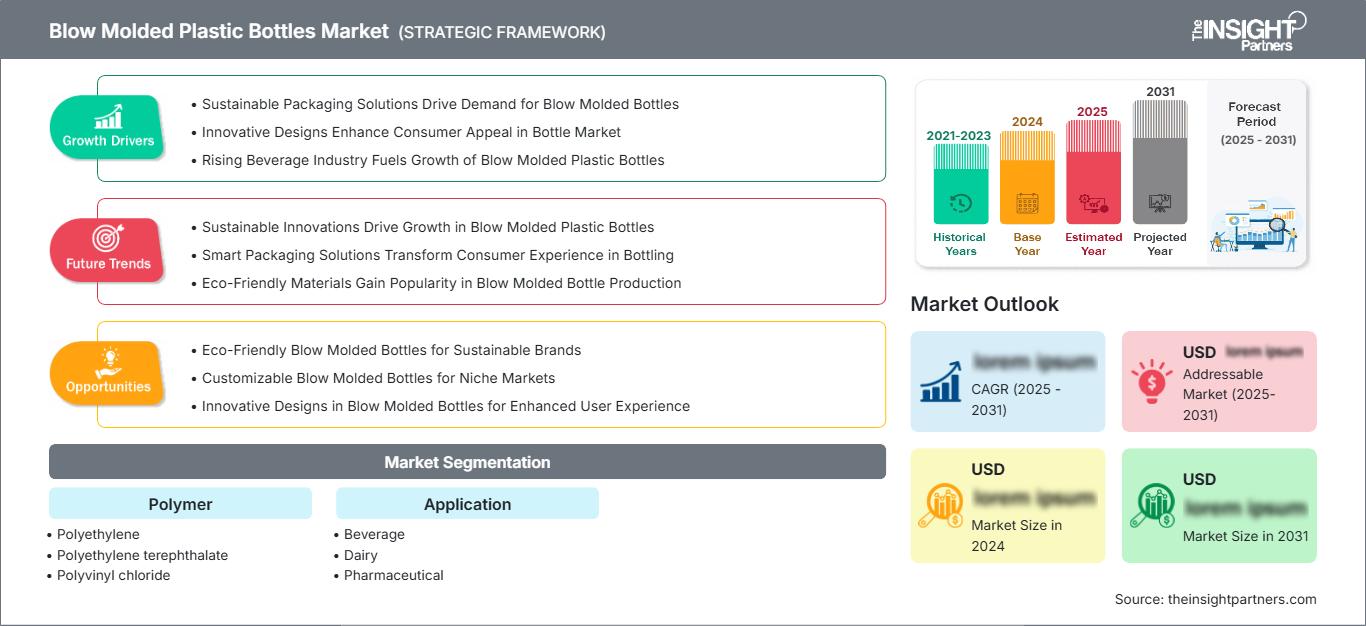
Regional Insights
North America blow molded plastic bottles market
North America represents an established packaging ecosystem with strong demand from beverages, food, healthcare, household products, and industrial applications. The regional market is projected to expand at a CAGR of ~5% through 2034 as packaging producers continue to improve material efficiency and respond to customer requirements for lighter, recyclable containers. The US accounts for ~86% of North American revenue, giving the region a concentrated production and consumption structure.
This supply chain can take advantage of sophisticated molding machinery, reliable distribution systems for polymers, mold fabrication, and tight linkages between bottle converters and fillers. The beverage industry keeps opting for light-weight PET bottles, whereas HDPE and other polyolefin bottles still have value in dairy, household, chemical, and personal care products. Availability of post-consumer recycled content and producer responsibility programs also play an important role in resin selection and bottle design. Major suppliers are now competing in terms of engineering assistance, tailored packaging, and PCR integration.
U.S. blow molded plastic bottles market
The United States is the most prominent player in North America and accounted for ~86% of regional market revenue in 2025. The US market growth projection of ~5% up to 2034 is backed by the scale of packaged beverages production, pharmaceuticals manufacturing, food processing, household items, and consumer goods. Volume filling operations require containers that would ensure uniformity and speediness of their manufacturing and handling.
Blow Molded Plastic Bottles Market players cover standard stock containers as well as custom-made packaging products. Amcor Limited offers an extensive range of bottles and vials for use in food, spirits, home care, personal care, and pharmaceutical industries, whereas APEX Plastics specializes in custom injection and extrusion blow-molding of containers. Graham Packaging Company, L.P. operates on both PET and polyolefin technologies.
Europe blow molded plastic bottles market
Europe accounted for ~22% of the global Blow Molded Plastic Bottles Market Share in 2025 and is expected to grow at a CAGR of ~5% through 2034. Germany is the leading country in Europe, supported by a large industrial base, sophisticated packaging manufacturing, strong beverage and food sectors, and extensive recycling infrastructure. The UK and France also maintain substantial demand from beverage, food, healthcare, personal-care, and household-product manufacturers.
German engineering capabilities facilitate high levels of automation and efficiency in processes, whereas UK packaging is highly focused on recycling capability of packaging materials and use of recycled materials. French consumer packaging base is diversified, whereas Italian and Spanish packaging markets benefit from beverage, food, tourism, and pharmaceutical products related packaging demand. In general, there is increasing pressure on producers to reduce material usage, ensure better recyclability, and use recycled polymers while not compromising the performance of the package.
It affects competitive priorities in the industry. More and more bottle producers have to prove compatibility of their bottles with recycling and collection systems without losing protection characteristics of the package and filling-line efficiency. It means that lightweighting, tethered closure, mono-material design, refillable packaging, and better recycling of resins become important directions of engineering development for European converters.
APAC blow molded plastic bottles market
Asia Pacific held ~39% of the global Blow Molded Plastic Bottles Market in 2025 and is forecast to expand at a CAGR of ~8% through 2034, making it the fastest-growing region. China is the leading country in Asia Pacific, while India is an important growth engine because of expanding packaged beverages, pharmaceutical production, food processing, and consumer-product manufacturing.
China, Japan, South Korea, India, and Australia collectively provide a diversified demand base. Growth is supported by urbanization, modern retail, rising packaged-product consumption, local manufacturing investment, and increasing adoption of automated filling and molding systems. Packaging policies and waste-reduction initiatives are also encouraging producers to improve recyclability and reduce material intensity. Local production of bottles, preforms, molds, and processing equipment further supports regional supply resilience.
Middle East & Africa blow molded plastic bottles market
Middle East & Africa represents a developing packaging market with demand concentrated around beverages, food, pharmaceuticals, personal care, and household products. The regional market is expected to expand at a CAGR of ~6% through 2034. Saudi Arabia is the leading country in the Middle East & Africa region where evidence supports a strong position, supported by industrial diversification, beverage production, and investment in manufacturing infrastructure.
The UAE benefits from its logistics position and concentration of regional consumer-product distribution, while South Africa provides an established packaging manufacturing base serving food, beverages, healthcare, and household applications. Infrastructure investment, expanding domestic production, and efforts to localize manufacturing can support additional bottle capacity. Energy availability and resin import costs remain important competitive variables, particularly for converters operating in markets with limited domestic polymer production.
Segmentation Analysis
Polymer
The Polymer category forms the core material dimension of the blow molded plastic bottles market because resin selection determines process compatibility, mechanical performance, appearance, chemical resistance, barrier characteristics, and end-of-life options. Demand increasingly favors polymers that can deliver lower bottle weight while maintaining structural performance. Among the listed materials, polyethylene terephthalate is expected to show a CAGR of ~7% through 2034, supported by beverage packaging and continued development of recycled-content formats.
- Polyethylene: Polyethylene remains important for durable and flexible bottle structures because of its toughness, chemical resistance, and suitability for extrusion blow molding. It is widely relevant to household, food, dairy, personal-care, and industrial packaging requirements.
- Polyethylene terephthalate: PET is strongly associated with transparent, lightweight bottles and high-speed beverage packaging. Its established recycling infrastructure and compatibility with recycled resin make it increasingly important for brands pursuing lower material intensity and circular packaging systems.
- Polyvinyl chloride: PVC provides useful barrier and processing characteristics for selected packaging formats, although its application base is constrained by material-policy considerations and competition from PET and polyolefins in several consumer packaging categories.
- Polyethylene naphthalate: PEN offers stronger barrier and thermal characteristics than conventional PET and is suited to specialized applications where enhanced performance justifies higher material costs. Adoption remains focused on technically demanding packaging rather than mass-market bottle volumes.
- Polypropylene: Polypropylene combines low density, chemical resistance, and thermal performance, making it relevant for selected food, pharmaceutical, and specialty containers. Its compatibility with certain high-performance packaging applications supports continued development.
- High and low density polycarbonate: Polycarbonate provides impact resistance and dimensional stability for specialized packaging requirements. Its use is more application-specific because of cost, regulatory, and material-selection considerations compared with commodity bottle polymers.
- Polysulfone: Polysulfone is a high-performance engineering polymer used where thermal and chemical resistance are important. Its comparatively high cost limits broad bottle adoption, but specialized applications can justify the material where conventional polymers are inadequate.
- Butadiene-styrene: Butadiene-styrene-based materials provide impact and processing characteristics useful in selected packaging and technical applications. Their role remains niche compared with major bottle polymers and depends on specific performance requirements.
Application
The Application category in the Blow Molded Plastic Bottles Market captures the downstream industries that determine bottle specifications, production volumes, and material requirements. Beverage packaging remains a major volume contributor because of high consumption and rapid filling operations, while pharmaceutical demand places greater emphasis on product protection, chemical compatibility, cleanliness, and dimensional precision. Pharmaceutical applications are expected to expand at a CAGR of ~8% through 2034 as drug manufacturing capacity and demand for convenient packaged healthcare products increase.
- Beverage: Beverage applications represent a major demand base because plastic bottles support high-speed filling, portability, low transportation weight, and convenient consumer handling. Carbonated and still beverages continue to drive innovation in lightweight PET designs.
- Dairy: Dairy packaging requires containers that provide appropriate barrier performance, handling strength, and product protection. Growth in processed dairy, flavored beverages, and convenient single-serve formats supports continued use of blow-molded containers.
- Pharmaceutical: Pharmaceutical bottles require consistent dimensions, material compatibility, secure closure interfaces, and reliable product protection. Increasing drug manufacturing and consumer healthcare consumption are supporting demand for engineered plastic containers.
- Automobile: Automotive applications use blow-molded plastic containers for selected fluid, chemical, and maintenance-related products. Resistance to fuels, oils, chemicals, and temperature variation can be more important than appearance, creating opportunities for specialized bottle designs.
Opportunity Snapshot
| Application | Revenue Contribution | Trend Tag | Adoption Stage |
| Beverage | High | Lightweight PET | Mature |
| Dairy | Medium | Barrier Packaging | Scaling |
| Pharmaceutical | Medium | Secure Packaging | Scaling |
| Automobile | Low | Chemical Resistance | Mature |
Blow Molded Plastic Bottles Market Growth Drivers and Impact Analysis
Expansion of Packaged Beverage and Convenient Consumption Formats
Growing consumption of packaged water, carbonated beverages, juices, functional drinks, and other ready-to-drink products directly expands the addressable base for plastic bottles. Bottles offer manufacturers a combination of low weight, break resistance, efficient transport, rapid filling, and flexible design that is difficult to replicate across all beverage formats using rigid alternatives. The commercial impact is strongest in emerging markets where urbanization and modern retail increase the penetration of packaged beverages. Producers are responding with thinner preforms, optimized bottle bases, improved material distribution, and higher-speed blowing systems. This demand mechanism supports volume growth while simultaneously pushing converters toward equipment capable of maintaining structural performance with less resin. The result is a market where packaging efficiency becomes an increasingly important purchasing criterion alongside bottle price.
Lightweighting and Recycled-Content Requirements
Bottle manufacturers are under growing pressure to reduce resin consumption and increase recycled content while preserving mechanical strength and production reliability. Lightweighting directly reduces material consumption, transport weight, and packaging costs, creating an economic incentive that complements environmental objectives. At the same time, recycled resin integration requires improved process control because recycled feedstocks can introduce variation in color, viscosity, moisture, and mechanical properties. Graham Packaging has highlighted technologies that strategically distribute material to reinforce structural areas while reducing overall bottle weight, while Amcor has invested in systems supporting flexible PCR blending for rigid packaging. These developments encourage converters to invest in better process monitoring, tooling, resin preparation, and bottle simulation.
Growth of Pharmaceutical and Healthcare Packaging Demand
Pharmaceutical manufacturing expansion is creating demand for plastic bottles that provide predictable dimensions, chemical compatibility, product protection, and user convenience. Blow-molded containers can be customized around closure systems, dispensing requirements, labeling, and product-specific barrier needs, allowing manufacturers to serve diverse pharmaceutical and healthcare products. Growth is particularly relevant in Asia Pacific, where pharmaceutical production and healthcare access are expanding, while developed markets continue to require highly controlled packaging systems. Amcor's recent healthcare packaging activities illustrate the shift toward patient-oriented designs, material optimization, and specialized rigid packaging solutions. For bottle manufacturers, pharmaceutical demand can also improve product mix because technically demanding containers generally require stronger quality assurance and closer collaboration with customers than standardized commodity packaging.
Blow Molded Plastic Bottles Market Future Trends
Integration of Circular-Design Principles into Bottle Engineering
Future bottle development in the Blow Molded Plastic Bottles Market Trends is expected to move beyond simply reducing resin weight toward designing the complete package around collection, sorting, recycling, and repeated material use. This will encourage greater use of compatible polymer structures, simplified material combinations, recycled-content-ready designs, and bottle geometries that maintain performance at lower material intensity. Blow molding equipment will increasingly be evaluated according to its ability to process variable recycled feedstocks while maintaining consistent wall thickness and appearance. Brand owners are also likely to place greater emphasis on traceable recycled content and packaging designs that fit established recycling streams. The commercial implication is that bottle engineering, resin selection, mold design, and recycling considerations will become more closely integrated during product development rather than being treated as separate stages.
High-Speed Flexible Manufacturing for Multiple Bottle Formats
Manufacturers are expected to adopt more flexible production architectures capable of handling multiple bottle sizes, shapes, resin compositions, and recycled-content levels with limited downtime. This trend will be driven by brand owners seeking differentiated packaging while maintaining manufacturing efficiency. Advanced blowers, modular tooling, automated material handling, digital quality inspection, and faster changeovers can reduce the economic penalty associated with shorter production runs. Sidel's recent development activity illustrates this direction, including blowing technologies designed around lightweighting, recycled PET, energy efficiency, and flexible bottle production. Over time, production flexibility should become particularly valuable for pharmaceutical, personal-care, specialty beverage, and premium food applications where packaging differentiation is commercially important.
Blow Molded Plastic Bottles Market Opportunities
Regionalized Bottle Production Near High-Growth Consumption Centers
Expanding beverage, pharmaceutical, dairy, and consumer-product manufacturing in Asia Pacific creates opportunities for converters to establish production capacity closer to filling and manufacturing locations. Localized bottle production can reduce empty-container transportation, shorten lead times, improve supply reliability, and enable faster packaging customization. India and Southeast Asian markets are particularly attractive where packaged-product consumption and manufacturing capacity are expanding simultaneously. Investment opportunities extend beyond bottle molding itself to preform production, mold manufacturing, automated inspection, resin handling, and recycling integration. Companies that establish flexible facilities near large customers can also reduce dependence on long-distance supply chains and respond more rapidly to changes in bottle formats. The opportunity in the Blow Molded Plastic Bottles Market Forecast is strongest where domestic packaging demand is expanding faster than existing converter capacity.
Specialized High-Performance Bottles for Healthcare and Technical Products
Higher-value opportunities are emerging in pharmaceutical, healthcare, specialty chemical, automotive-fluid, and technically demanding packaging where bottle performance is more important than commodity pricing. These applications can require resistance to chemicals, pressure, temperature, oxygen, moisture, or aggressive formulations, creating demand for engineered materials, multilayer structures, specialized geometries, and tighter process control. Suppliers can differentiate through co-development, prototyping, material selection, tooling engineering, and qualification support rather than competing solely on production cost. Amcor's development of specialized retort packaging demonstrates how bottle engineering can address demanding product conditions while creating differentiated packaging functionality. This segment therefore provides opportunities for converters that combine molding expertise with material science, testing, and application engineering.
Recent Developments
- May 5, 2026: Amcor plc announced the continuation of its partnership with Ocado Retail and the Refill Coalition to manufacture refillable blow molded containers for reusable grocery packaging. The initiative expands reusable packaging across the UK using durable containers designed for multiple refill cycles, supporting circular economy objectives and reducing single-use plastic consumption.
- February 3, 2026: FirmaPak acquired Easy Plastic Containers Corporation, expanding its manufacturing footprint into Canada and strengthening its capabilities in blow-molded plastic packaging for personal care, pharmaceutical, food and beverage, industrial, and automotive applications. The acquisition adds two production facilities near Toronto and supports FirmaPak's strategy to broaden its North American manufacturing network and customer relationships.
Frequently Asked Questions

- Comprehensive Market Sizing and Forecast Analysis
- Detailed Segmentation Analysis
- In-Depth Market Dynamics Assessment
- Regional and Country-Level Insights
- Competitive Landscape and Company Benchmarking
- Strategic Business Intelligence
Recent Reports
Testimonials

The Insight Partners provided valuable market intelligence that supported our global go-to-market strategy. Their team was professional, responsive, and attentive to our feedback, providing thoughtful analysis and helpful methodological clarifications throughout the project.
Junmo Kim Chief Financial Officer (CFO), Enertech Co., Ltd.
The Insight Partners' SCADA System Market report is comprehensive, with valuable insights on current trends and future forecasts. The team was highly professional, responsive, and supportive throughout. We are very satisfied and highly recommend their services.
RAN KEDEM Partner, Reali Technologies LTDs
I requested a report on a very specific software market and the team produced the report in a few days. The information was very relevant and well presented. I then requested some changes and additions to the report. The team was again very responsive and I got the final report in less than a week.
JEAN-HERVE JENN Chairman, Future Analytica
We worked with The Insight Partners for an important market study and forecast. They gave us clear insights into opportunities and risks, which helped shape our plans. Their research was easy to use and based on solid data. It helped us make smart, confident decisions. We highly recommend them.
PIYUSH NAGPAL Sr. Vice President, High Beam Global
The Insight Partners delivered insightful, well-structured market research with strong domain expertise. Their team was professional and responsive throughout. The user-friendly website made accessing industry reports seamless. We highly recommend them for reliable, high-quality research services
YUKIHIKO ADACHI CEO, Deep Blue, LLC.
This is the first time I have purchased a market report from The Insight Partners.While I was unsure at first, I visited their web site and felt more comfortable to take the risk and purchase a market report.I am completely satisfied with the quality of the report and customer service. I had several questions and comments with the initial report, but after a couple of dialogs over email with their analyst I believe I have a report that I can use as input to our strategic planning process.Thank you so much for taking the extra time and making this a positive experience.I will definitely recommend your service to others and you will be my first call when we need further market data.
JOHN SUZUKI President and Chief Executive Officer, Board Director, BK Technologies
I wish to appreciate your support and the professionalism you displayed in the course of attending to my request for information regarding to infectious disease IVD market in Nigeria. I appreciate your patience, your guidance, and the fact that you were willing to offer a discount, which eventually made it possible for us to close a deal. I look forward to engaging The Insight Partners in the future, all thanks to the impression you have created in me as a result of this first encounter.
DR CHIJIOKE ONYIA MANAGING DIRECTOR, PineCrest Healthcare Ltd.Reason to Buy
- Informed Decision-Making
- Understanding Market Dynamics
- Competitive Analysis
- Identifying Emerging Markets
- Customer Insights
- Market Forecasts
- Risk Mitigation
- Boosting Operational Efficiency
- Strategic Planning
- Investment Justification
- Tracking Industry Innovations
- Aligning with Regulatory Trends





 Get Free Sample for