
Building Thermal Insulation Market Size, Share & Demand by 2034
Coverage: By Product (Glass Wool, Mineral Wool, EPS, XPS, Others); Application (Roof, Wall, Floor); End-Use (Residential, Commercial) , and Geography (North America, Europe, Asia Pacific, and South and Central America)
- Status : Data Released
- Report Code : TIPRE00003785
- Category : Chemicals and Materials
- No. of Pages : 150
- Available Report Formats :


- Last update date : July 15, 2026


2025 Market Size
US$ 37,298.74 Mn
Base year value
2034 Forecast
US$ 53,586.43 Mn
Projected by 2034
CAGR 2026-2034
4.11 %
Growth rate
Addressable Market
US$ 412,804.89 Mn
(2026-2034)
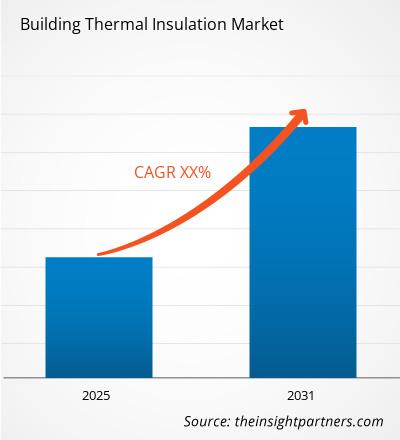
The Building Thermal Insulation Market size was valued at US$ 37.30 Billion in 2025 and is projected to reach US$ 53.59 Billion by 2034, expanding at a CAGR of 4.11% during 2026–2034. The demand is expected to grow further owing to government, developer, and building owner focus on constructing energy-efficient structures, reducing carbon emissions, and optimizing lifecycle costs. The use of insulation materials in residential and commercial buildings is complemented by stricter building energy codes and sustainable building renovations.
In North America, the Building Thermal Insulation Market is driven by existing construction standards, regular building retrofits, and incentive policies favoring energy-efficient infrastructures. The region is estimated to record a growth rate of 3.8%-4.3% during 2022-2034, fueled by growing investments in residential building renovations, commercial green buildings, and new thermal requirements through evolving building efficiency regulations.
Building Thermal Insulation Market Assessment and Insights
- North America: Accounted for 33–36% of the Building Thermal Insulation Market share in 2025 and is projected to expand at a CAGR of 3.8–4.3% during 2026–2034. Stable residential renovation activity, commercial retrofits, and increasingly stringent energy efficiency regulations continue to support sustained demand for advanced thermal insulation materials.
- U.S.: Represented 80–84% of the North American market in 2025 and is expected to register a CAGR of 3.9–4.4% during 2026–2034, supported by green building certifications, federal infrastructure investments, and continuous adoption of high-performance insulation products.
- Europe: Held 28–31% share in 2025 while growing at a CAGR of 3.9–4.4% during 2026–2034. Germany, France, the UK, Italy, and Spain continue to lead regional demand through energy renovation programs, decarbonization targets, and high-performance building envelope standards.
- Asia Pacific: Captured 27–30% share in 2025 and is forecast to expand at a CAGR of 4.8–5.4% during 2026–2034. China, India, Japan, South Korea, and Australia are investing heavily in sustainable urban infrastructure, industrial facilities, and energy-efficient residential developments.
- Largest Segment: Residential accounted for 54–58% market share in 2025 and is anticipated to grow at a CAGR of 4.0–4.4% during 2026–2034, driven by new housing construction, renovation programs, and stricter residential energy conservation standards.
- High Growth Segment: Wall applications represented 36–40% market share in 2025 and are projected to register a CAGR of 4.6–5.1% during 2026–2034, supported by increasing adoption of insulated façade systems and high-performance exterior wall assemblies.
- Key companies analyzed in detail: PAROC Group Oy, Compagnie de Saint-Gobain S.A., BASF SE, Huntsman Corporation, Holcim Building Envelope, Cabot Corporation, Owens Corning, Atlas Roofing Corporation, Johns Manville Corporation, URSA Insulation, S.A.
Source: The Insight Partners' analysis based on proprietary research, government publications, company annual reports, investor presentations, industry databases, and expert interviews.
Advancementss in material science, manufacturing process improvements, and changing criteria for building performance have made the Building Thermal Insulation sector a vital part of the worldwide construction materials market. Further investments by companies are being made into greener manufacturing processes, use of recycled materials, improved fire safety, moisture protection and increased thermal conductivity. At the same time, development of digital design solutions for buildings and modular construction processes have created growing demand for insulation products which can ensure consistent quality of installation, compliance with regulations and energy savings throughout the life of the building.
In the future, there will be increasing investment opportunities in countries from Southeast Asia, the Middle East, Eastern Europe and selected countries in Latin America, where processes of urbanization, infrastructure development and stricter regulations for building efficiency are developing concurrently. Government initiatives favoring net zero buildings, better insulation and green construction have led companies to increase production capabilities, create new types of biodegradable insulation and develop regional logistics capabilities.
Building Thermal Insulation Market Report Scope
| Report Attribute | Details |
|---|---|
| Market size in 2025 | US$ 37,298.74 Million |
| Market Size by 2034 | US$ 53,586.43 Million |
| Global CAGR (2026 - 2034) | 4.11% |
| Historical Data | 2021-2024 |
| Forecast period | 2026-2034 |
Building Thermal Insulation Market Analysis
Increasing focus on energy conservation within buildings keeps propelling the Building Thermal Insulation Market growth owing to increased stringent regulations for energy performance from governments for both residential and commercial buildings and increasing use of high-performing insulations by developers to cut down costs and improve performance. Increasing prices of electricity, commitment towards carbon reduction and increasing popularity of green building rating systems are other factors propelling product adoption within new constructions as well as renovations.
The value chain within the industry is becoming more integrated starting from procurement of mineral inputs, petroleum inputs, recyclable raw materials and other speciality chemicals to manufacturing, distribution, installation, construction and renovation after construction. The manufacturers are increasingly automating the manufacturing process and focusing on digital quality assurance. In addition to this, circular economy practices are being adopted within the manufacturing process in terms of using recycled glass, mineral wool and polymers.
A Comprehensive Building Thermal Insulation Market report suggests that rivalry among industry participants is currently based on innovations, environmental friendliness, manufacturing capabilities, and geographical reach rather than on price only. The leading manufacturers like PAROC Group Oy, Compagnie de Saint-Gobain S.A., BASF SE, Huntsman Corporation, Holcim Building Envelope, Owens Corning, Johns Manville Corporation, URSA Insulation, S.A., Atlas Roofing Corporation, and Cabot Corporation keep on developing their insulation portfolios through research of new materials and technologies, and use manufacturing process improvements aimed at producing more environmentally friendly materials.
Growing capital investment is spent on expanding capacity and modernization of manufacturing process and development of insulation material that is less carbon-intensive and more recyclable. The increasing customer demand for building insulation products that not only provide better thermal efficiency but also meet all other requirements such as fire-resistance, moisture-resistance, sound absorption properties, and long lifecycle period is responded by the manufacturers. Geographical expansion into countries that experience fast economic growth and have more favorable regulation on energy-efficient buildings can be expected to increase rivalry and drive innovation in glass wool, mineral wool, expanded polystyrene (EPS), and extruded polystyrene (XPS).
● REPORT CUSTOMIZATION
Tailor This Report To Align With Your Specific Business Requirements
This report can be customized to align precisely with your business objectives, scope, and target markets. Customization options include tailored segmentation, geography, competitive analysis, and strategic insights to support informed decision-making.
Customize This Report →WHAT YOU CAN ADJUST
- ● Segmentations
- ● Geography
- ● Competitive Analysis
- ● Language Preferences
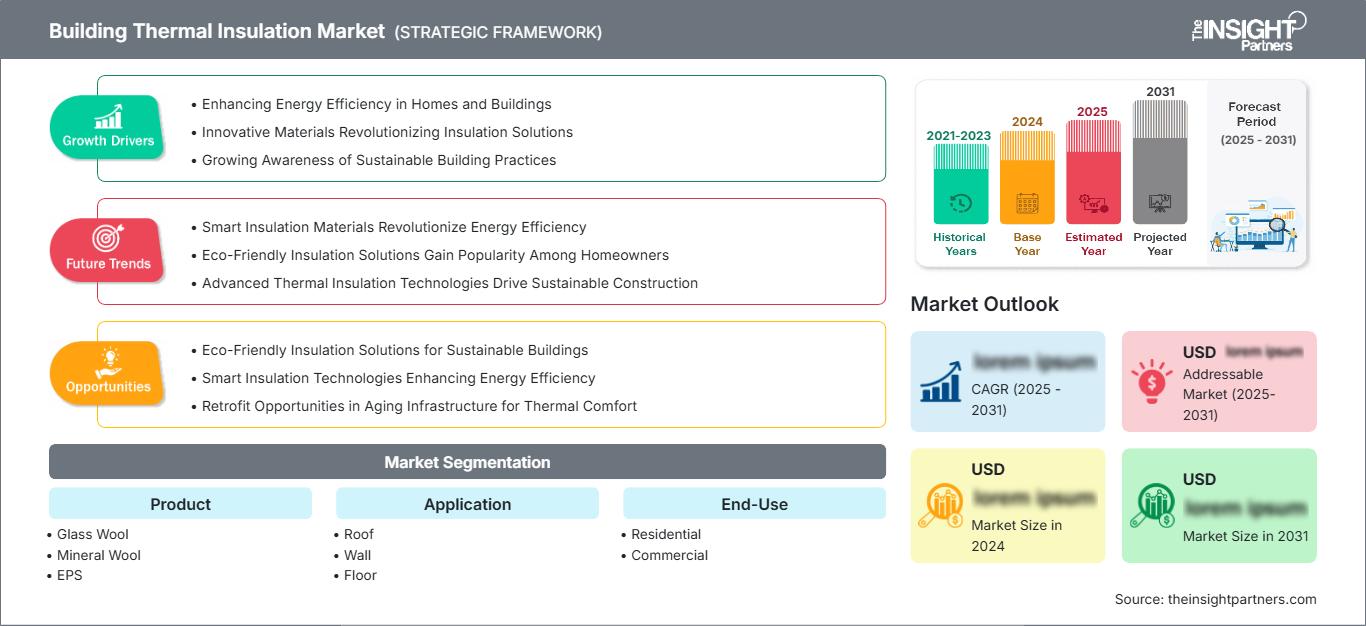
Building Thermal Insulation Market: Strategic Insights
Regional Insights
North America Building Thermal Insulation Market
North America accounted for 33–36% of the global Building Thermal Insulation Market share in 2025 and is projected to register a CAGR of 3.8–4.3% during 2026–2034. There is an abundance of mature construction practices, high renovation levels, and a lot of strict building energy codes in the regional market. Governmental programs encouraging energy-efficient houses and businesses renovation further drive demand for modern insulation materials.
People invest in modern insulation solutions which ensure thermal efficiency, comfortable living conditions, and cost savings in the future. Glass wool, mineral wool, and rigid foam insulation solutions for roofs, walls, and floors are especially in high demand. Sustainable construction practices together with high carbon emissions reduction targets and resilient buildings design will further fuel steady market growth.
U.S. Building Thermal Insulation Market
The United States represented 80–84% of the North American market in 2025 and is anticipated to expand at a CAGR of 3.9–4.4% during 2026–2034. Increased housing development, commercial modernization, and retrofits are driving insulation needs into the future. The federal and state-level push for energy-efficient solutions prompts the use of more effective insulation systems that minimize heating and cooling needs and satisfy growing building performance standards.
Prominent players, such as Owens Corning, Johns Manville Corporation, Holcim Building Envelope, Atlas Roofing Corporation, and BASF SE have strong representation throughout the nation thanks to their robust production, distribution, and contractor network. Growing popularity of prefabricated buildings, net-zero architecture, and advanced facade materials opens up new prospects for new types of insulation that balance energy-efficiency with other qualities.
Europe Building Thermal Insulation Market
Europe captured 28–31% of the global market in 2025 and is expected to record a CAGR of 3.9–4.4% during 2026–2034, supported by ambitious decarbonization policies and extensive building renovation initiatives. Germany remains the leading national market due to strong industrial capability, high construction quality standards, and widespread adoption of energy-efficient building materials. The country's commitment to improving building energy performance continues to sustain demand across residential, commercial, and industrial projects.
The United Kingdom is experiencing consistent demand driven by residential retrofit schemes, commercial refurbishment, and stricter building regulations emphasizing improved thermal performance. France continues expanding energy renovation programs for public and private buildings, while Italy and Spain benefit from increasing investment in sustainable housing, tourism infrastructure, and commercial developments. Together, these markets support stable regional demand for advanced insulation technologies that deliver improved energy efficiency and reduced lifecycle emissions.
APAC Building Thermal Insulation Market
Asia Pacific accounted for 27–30% of the global market in 2025 and is forecast to grow at a CAGR of 4.8–5.4% during 2026–2034, making it the fastest-expanding regional market. China leads regional demand, followed by India, Japan, South Korea, and Australia, supported by rapid urbanization, industrial expansion, and increasing adoption of green construction practices.
Government policies promoting energy-efficient buildings, together with significant investments in residential housing, industrial facilities, and commercial infrastructure, continue to strengthen insulation demand. Rising awareness of building sustainability and long-term energy savings is encouraging broader adoption of advanced thermal insulation products throughout the region.
Middle East & Africa Building Thermal Insulation Market
The Middle East & Africa market is projected to expand at a CAGR of 4.2–4.7% during 2026–2034, supported by growing investments in commercial buildings, smart cities, industrial developments, and large-scale infrastructure projects. Saudi Arabia leads regional demand, followed by the United Arab Emirates and South Africa, where energy-efficiency initiatives are becoming increasingly important within national development strategies.
Extreme climatic conditions across much of the region continue to encourage adoption of high-performance insulation materials capable of reducing cooling energy consumption. Ongoing diversification of regional economies, coupled with sustainable construction policies and expanding urban infrastructure, is expected to create favorable long-term opportunities for thermal insulation manufacturers and technology providers.
Segmentation Analysis
Product
The Product segment is projected to expand at a CAGR of 4.1–4.5% during 2026–2034. The Building Thermal Insulation Market forecast continues to broaden as manufacturers develop insulation materials offering improved thermal conductivity, fire resistance, moisture protection, and sustainability. Product selection is increasingly influenced by regulatory compliance, lifecycle cost considerations, environmental performance, and compatibility with modern building envelope systems across residential and commercial construction.
- Glass Wool – Widely utilized for roof, wall, and floor insulation because of its excellent thermal and acoustic performance, lightweight characteristics, competitive pricing, and increasing use of recycled glass content that supports circular construction practices.
- Mineral Wool – Preferred for applications requiring high fire resistance, sound insulation, and dimensional stability. Commercial buildings, industrial facilities, and high-rise structures increasingly adopt mineral wool to comply with stringent fire safety and energy efficiency regulations.
- EPS – Expanded polystyrene remains a cost-effective insulation solution for exterior wall systems, flooring, and foundation applications due to its lightweight structure, moisture resistance, installation flexibility, and favorable thermal insulation performance.
- XPS – Extruded polystyrene is extensively used in below-grade construction, roofs, and flooring systems where high compressive strength, low water absorption, and long-term thermal stability are critical performance requirements.
Application
The Application segment in the Building Thermal Insulation Market is anticipated to register a CAGR of 4.4–4.8% during 2026–2034. Demand continues to increase as architects and developers prioritize optimized building envelopes capable of minimizing energy loss while improving occupant comfort and long-term operational efficiency. Advanced insulation solutions are increasingly integrated across multiple building components to meet evolving energy performance standards.
- Roof – Roofing insulation plays a critical role in reducing heat transfer, lowering cooling and heating requirements, and improving building energy performance. Adoption continues to expand across residential, commercial, and institutional construction projects.
- Wall – Wall insulation represents the largest application owing to its significant contribution to overall building thermal performance. Continuous improvements in façade technologies and external insulation systems continue supporting long-term demand.
- Floor – Floor insulation enhances indoor comfort while reducing heat loss through building foundations. Growing use in energy-efficient residential developments and commercial buildings supports stable adoption across developed and emerging markets.
End-Use
The End-Use segment is projected to grow at a CAGR of 4.2–4.6% during 2026–2034. Increasing investment in sustainable construction, stricter building regulations, and higher energy efficiency standards continue driving insulation adoption across diverse building categories. Market participants are introducing application-specific solutions designed to meet varying structural, environmental, and operational requirements.
- Residential – The largest end-use category benefits from expanding housing construction, government-supported renovation initiatives, improved homeowner awareness regarding energy savings, and increasing implementation of net-zero residential building concepts.
- Commercial – Offices, healthcare facilities, educational institutions, retail developments, hospitality projects, and mixed-use complexes increasingly require high-performance insulation systems to reduce operating costs while complying with advanced building energy regulations.
Opportunity Snapshot
| End-Use | Revenue Contribution | Trend Tag | Adoption Stage |
| Roof | High | Cool Roofs | Mature |
| Wall | High | Insulated Facades | Scaling |
| Floor | Medium | Foundation Insulation | Scaling |
Building Thermal Insulation Market Growth Drivers and Impact Analysis
Stringent building energy efficiency regulations accelerating insulation adoption
Building energy code regulations continue to be tightened by governments in North America, Europe, and Asia Pacific in order to curb emissions of greenhouse gases and achieve energy savings. Zero-emission building regulations, minimum energy performance standards, and insulation requirements have helped stimulate adoption of high-end insulation materials during construction and renovations. Institutions such as the International Energy Agency (IEA) believe that buildings contribute substantially to energy use across the globe, which makes effective building shells vital. The increased demand for glass wool, mineral wool, EPS, and XPS insulation materials will be stimulated by these regulatory actions, while at the same time encouraging manufacturers to develop low-carbon manufacturing processes.
Expansion of green building construction and large-scale retrofit programs
Sustainability-oriented developments in the residential and commercial property market have led to an increasing demand for innovative insulation materials in the coming years. The emphasis on thermal efficiency, indoor environment quality, and reduction of life-cycle emissions in green building standards like LEED, BREEAM, and local energy efficiency schemes has been coupled with the need for extensive renovation work in old properties across developed economies in an effort to increase their efficiency and reduce costs of heating and air-conditioning.The public funding of energy-efficient upgrades adds to this effect. Suppliers have come up with thermal efficient, fire retardant, soundproofing, and recyclable insulating materials to meet the needs of the builders.
Growing urbanization and infrastructure investments across emerging economies
Urban development in the Asia Pacific region, Middle East, and some selected economies in Africa has kept up the trend of constructing houses, commercial properties, health centers, educational institutions, and industries. The growth in population in urban areas calls for efficient building infrastructure that can help cut down costs as well as contribute to the national goals of addressing the climate. Increased spending in smart cities and new building technologies has resulted in more use of advanced insulation products. With an increase in disposable incomes and improvement of construction standards by governments, high-efficiency insulation products are set to be adopted even faster.
Building Thermal Insulation Market Future Trends
Rising adoption of low-carbon and circular insulation materials
The Building Thermal Insulation Market Trends are moving more towards sustainability and the principles of the circular economy. The manufacturers are focusing on insulation that uses recycled glass, recycled mineral fibers, and bio-based raw materials while keeping carbon footprint low through their production process. EPD, life cycle assessment, and carbon footprint have become significant procurement criteria for developers, architects, and governmental institutions. Recyclable insulation technology innovations will not only increase resource efficiency but will help buildings reach their net-zero carbon targets.
Digital construction and prefabricated building systems reshaping insulation demand
In terms of innovations related to the insulation industry, Building Information Modeling (BIM), modular construction, and off-site prefabrication play a major role in changing the ways in which insulation products are designed and installed. More and more companies tend to produce insulation products that would be able to become an organic part of prefabricated walls and roofs, reducing the risks of installation errors and construction waste. Besides, digital planning allows for making thermal performance simulation more accurate, prompting to select high-quality insulation products at the design phase.
Building Thermal Insulation Market Opportunities
Expansion of energy-efficient renovation programs in emerging economies
Increased government funding towards building modernization creates an enormous chance for insulation manufacturers to move out of saturated markets. Building Thermal Insulation Market Forecasts state that many countries in Southeast Asia, Eastern Europe, Middle East, and Latin America will continue implementing tougher building efficiency standards combined with subsidies for retrofitting homes and offices. This is likely to spur the adoption of innovative insulating materials that help lower energy usage and boost comfort of living spaces. Organizations willing to manufacture locally, educate their contractors, and create insulation products tailored to local climates will enjoy long-term gains.
Development of high-performance insulation for net-zero buildings
Rising popularity of net-zero energy buildings presents immense opportunities for manufacturers to bring the next generation of insulation solutions to the market. There is a growing need for insulation materials that provide enhanced thermal performance, fire resistance, moisture protection, and reduced carbon footprint without sacrificing longevity. It is anticipated that further integration with smart building systems, modular building construction, and innovative façade assembly will provide added value in both residential and commercial applications. Manufacturing companies that focus on innovation, sustainable sourcing, digitization of their products and partnerships with architecture and engineering firms will gain a competitive edge.
Recent Developments
- October 2025: ArcelorMittal Building Solutions launched Helioroof, an all-in-one low-carbon insulated steel roofing system integrating thermal insulation, steel panels, and photovoltaic cells. The solution is designed to improve building energy efficiency, reduce embodied carbon by approximately 25% compared with conventional insulated steel roofs, and accelerate installation for commercial and industrial buildings.
- August 2025: Compagnie de Saint-Gobain S.A. commenced construction of its seventh float glass production line and fifth mineral wool insulation line in Chennai, India. The investment expands regional manufacturing capacity for high-performance insulation materials, strengthens the company's presence in the Indian construction sector, and supports rising demand for energy-efficient building envelope solutions.
- June 2026: Qazaq Stroy announced plans to establish Kazakhstan's first stone wool thermal insulation manufacturing facility with an annual production capacity of approximately 50,000 tons. The project is expected to reduce import dependence, strengthen domestic insulation supply, and support energy-efficient building construction across Central Asia.
Frequently Asked Questions

- Comprehensive Market Sizing and Forecast Analysis
- Detailed Segmentation Analysis
- In-Depth Market Dynamics Assessment
- Regional and Country-Level Insights
- Competitive Landscape and Company Benchmarking
- Strategic Business Intelligence
Recent Reports
Testimonials

The Insight Partners' SCADA System Market report is comprehensive, with valuable insights on current trends and future forecasts. The team was highly professional, responsive, and supportive throughout. We are very satisfied and highly recommend their services.
RAN KEDEM Partner, Reali Technologies LTDs
I requested a report on a very specific software market and the team produced the report in a few days. The information was very relevant and well presented. I then requested some changes and additions to the report. The team was again very responsive and I got the final report in less than a week.
JEAN-HERVE JENN Chairman, Future Analytica
We worked with The Insight Partners for an important market study and forecast. They gave us clear insights into opportunities and risks, which helped shape our plans. Their research was easy to use and based on solid data. It helped us make smart, confident decisions. We highly recommend them.
PIYUSH NAGPAL Sr. Vice President, High Beam Global
The Insight Partners delivered insightful, well-structured market research with strong domain expertise. Their team was professional and responsive throughout. The user-friendly website made accessing industry reports seamless. We highly recommend them for reliable, high-quality research services
YUKIHIKO ADACHI CEO, Deep Blue, LLC.
This is the first time I have purchased a market report from The Insight Partners.While I was unsure at first, I visited their web site and felt more comfortable to take the risk and purchase a market report.I am completely satisfied with the quality of the report and customer service. I had several questions and comments with the initial report, but after a couple of dialogs over email with their analyst I believe I have a report that I can use as input to our strategic planning process.Thank you so much for taking the extra time and making this a positive experience.I will definitely recommend your service to others and you will be my first call when we need further market data.
JOHN SUZUKI President and Chief Executive Officer, Board Director, BK Technologies
I wish to appreciate your support and the professionalism you displayed in the course of attending to my request for information regarding to infectious disease IVD market in Nigeria. I appreciate your patience, your guidance, and the fact that you were willing to offer a discount, which eventually made it possible for us to close a deal. I look forward to engaging The Insight Partners in the future, all thanks to the impression you have created in me as a result of this first encounter.
DR CHIJIOKE ONYIA MANAGING DIRECTOR, PineCrest Healthcare Ltd.Reason to Buy
- Informed Decision-Making
- Understanding Market Dynamics
- Competitive Analysis
- Identifying Emerging Markets
- Customer Insights
- Market Forecasts
- Risk Mitigation
- Boosting Operational Efficiency
- Strategic Planning
- Investment Justification
- Tracking Industry Innovations
- Aligning with Regulatory Trends





 Get Free Sample for