
Building Thermal Insulation Material Market Size, Growth & Demand by 2034
Coverage: By Material (Plastic Foam, Glass Wool, Stone Wool, Others); Building Type (Residential Building, Non-Residential Building); Application (Roof Insulation, Wall Insulation, Floor Insulation), and Geography (North America, Europe, Asia Pacific, and South and Central America)
- Status : Data Released
- Report Code : TIPRE00014781
- Category : Chemicals and Materials
- No. of Pages : 150
- Available Report Formats :


- Last update date : July 15, 2026


2025 Market Size
US$ 35.95 Bn
Base year value
2034 Forecast
US$ 54.11 Bn
Projected by 2034
CAGR 2026-2034
4.65 %
Growth rate
Addressable Market
US$ 408.91 Bn
(2026-2034)
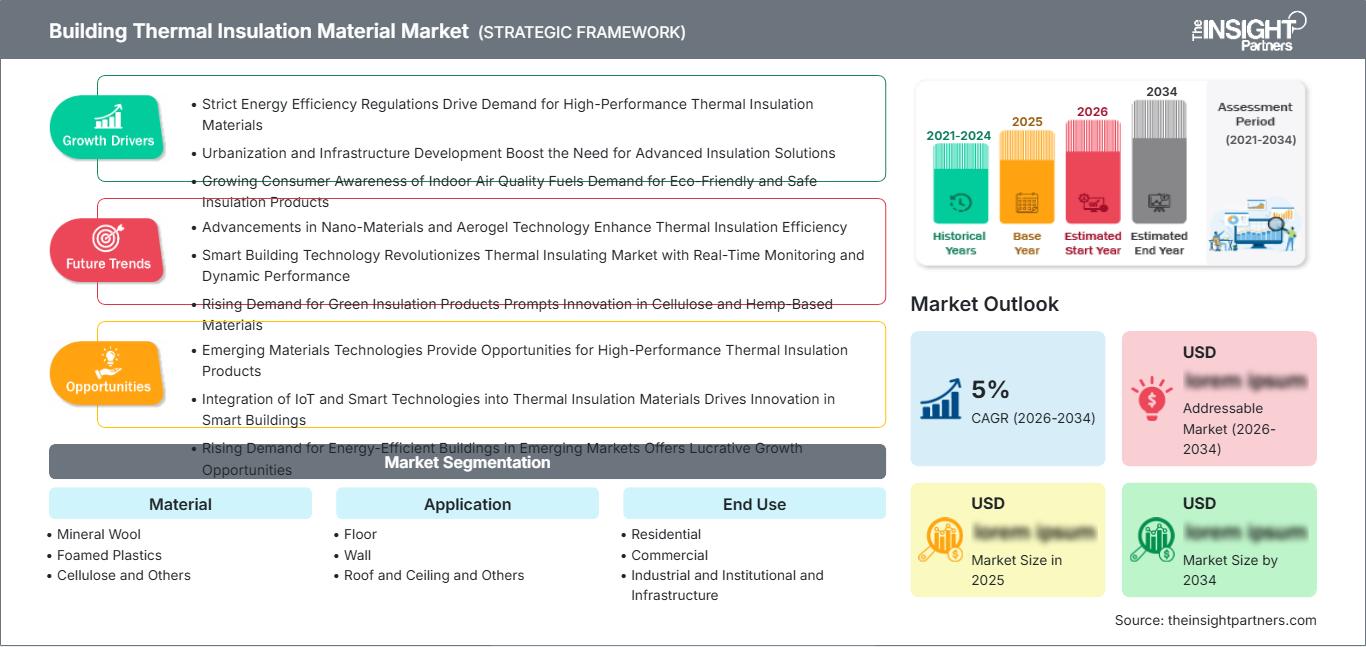
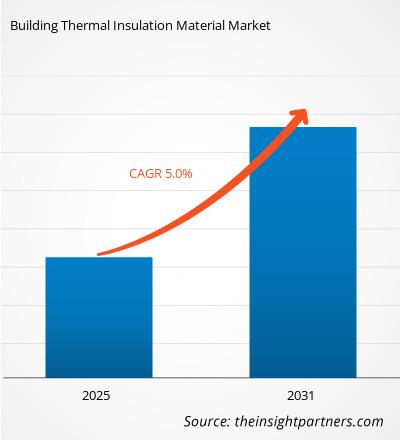
The Building Thermal Insulation Material Market size was valued at US$ 35.95 Billion in 2025 and is projected to reach US$ 54.11 Billion by 2034, expanding at a CAGR of 4.65% during 2026–2034. The market is supported by rising investments in energy-efficient construction, stricter building energy performance regulations, and increasing adoption of sustainable insulation solutions across residential, commercial, industrial, and infrastructure projects. Continuous innovations in mineral wool, foamed plastics, and bio-based insulation materials are further enhancing thermal performance, durability, and lifecycle efficiency across global construction activities.
Across North America, the Building Thermal Insulation Material Market size continues to benefit from stringent building energy codes, large-scale renovation activities, and growing investments in net-zero construction. The region is anticipated to expand at a CAGR of 4.1–4.6% through 2034, supported by federal and state incentives promoting energy-efficient buildings, modernization of commercial facilities, and increasing adoption of advanced insulation systems capable of reducing operational energy consumption and improving indoor environmental quality.
Building Thermal Insulation Material Market Assessment and Insights
- North America: Accounted for 31–35% of the Building Thermal Insulation Material Market share in 2025 and is projected to register a CAGR of 4.1–4.6% during 2026–2034. Demand remains supported by strict energy efficiency regulations, residential retrofit programs, and commercial green building certifications across the U.S. and Canada.
- US: Represented 74–78% of the North American market in 2025 and is expected to expand at a CAGR of 4.2–4.7% during 2026–2034, driven by high renovation spending, sustainable construction policies, and adoption of advanced insulation technologies.
- Europe: Held 28–32% share in 2025 and is forecast to grow at a CAGR of 4.4–4.9% during 2026–2034. Germany, France, the UK, Italy, and Nordic countries continue to lead demand through ambitious decarbonization targets and energy-efficient building renovation initiatives.
- Asia Pacific: Captured 25–29% share in 2025 and is anticipated to witness the fastest regional expansion at a CAGR of 5.2–5.8% during 2026–2034. China, India, Japan, and South Korea remain major contributors owing to rapid urbanization, industrial construction, and government-backed green infrastructure programs.
- Largest Segment: Material accounted for 42–46% market share in 2025 and is expected to record a CAGR of 4.5–4.9% during 2026–2034, supported by continuous innovations in high-performance mineral wool and foamed plastic insulation products.
- High Growth Segment: Residential accounted for 34–38% market share in 2025 and is projected to expand at a CAGR of 5.0–5.5% during 2026–2034, fueled by increasing demand for energy-efficient housing, stricter residential energy codes, and government incentive programs.
- Key companies analyzed in detail: BASF SE, Beijing New Building Material (Group) Co., Ltd., GAF Materials LLC, Johns Manville Corporation, Kingspan Group plc, Knauf Insulation GmbH, Owens Corning, PAROC Group Oy, ROCKWOOL A/S, Compagnie de Saint-Gobain S.A.
Source: The Insight Partners' analysis based on proprietary research, government publications, company annual reports, investor presentations, industry databases, and expert interviews.
Building Thermal Insulation Material Growth has developed from providing traditional building insulators to offering energy-efficient solutions that help in complying with the stringent environmental standards. Manufacturing organizations are continuing to increase their capacities and working on recyclable materials, carbon-free manufacturing, and innovative insulation systems, which help in enhancing insulation performance in terms of increased thermal resistance, enhanced fire safety properties, better moisture control, and improved structure stability. Digitization, automated manufacturing lines, and better supply chain integration are contributing in increasing manufacturing efficiency and ensuring consistent product quality in the residential and commercial construction markets globally.
Sustainability in construction is going to bring new competitive environment in the coming years. Emerging economies of Asia Pacific and Middle East regions are experiencing rapid development of infrastructure and implementation of strict building performance regulations at the same time, which is creating a positive situation for manufacturers of building thermal insulators. Adoption of the concept of the circular economy, recyclable insulation materials, and low emission technologies is likely to be the driver of long-term investments and cooperation of construction firms, material providers, and technology developers.
Building Thermal Insulation Material Market Report Scope
| Report Attribute | Details |
|---|---|
| Market size in 2025 | US$ 35.95 Billion |
| Market Size by 2034 | US$ 54.11 Billion |
| Global CAGR (2026 - 2034) | 4.65% |
| Historical Data | 2021-2024 |
| Forecast period | 2026-2034 |
Building Thermal Insulation Material Market Analysis
Energy efficiency goals, stringent building codes, and increased life-cycle costs are some of the factors that are fueling the Building Thermal Insulation Material Market in both developed and developing countries. The governments are making strict building energy codes, and developers are focusing on insulation products that help in saving operational energy and reduction in carbon dioxide emission during the lifespan of the building. As per the International Energy Agency (IEA), buildings consume nearly one-third of the world’s final energy demand, which emphasizes the importance of better thermal insulation material in helping to achieve future decarbonization plans. Increased investments in residential renovations, commercial improvements, and infrastructural projects are driving the demand across the entire construction sector.
On the supply side, there are changes in the market dynamics as well. Manufacturers are adding more capacities for mineral wool, foamed plastics, and cellulose thermal insulation, along with raw materials sources to avoid fluctuations in the prices. Moreover, the increase in automation and digitization is minimizing the waste generation and maintaining the consistent quality of the product. On the other hand, procurement practices are changing owing to an increased focus on recycled materials, bio-based feedstocks, and low-carbon manufacturing process.
Building Thermal Insulation Material Market Report reveals that competition is progressively moving from pricing to technological advancements, sustainability performance, and local manufacturing capabilities. BASF SE further builds on its advanced polymer insulation material line by developing innovative materials. On the other hand, Compagnie de Saint-Gobain S.A., ROCKWOOL A/S, and Knauf Insulation GmbH retain strong competitive advantage through their diverse product range and geographically dispersed manufacturing operations. Owens Corning and Johns Manville Corporation develop high-end insulation materials for use in residential and commercial buildings. Paroc Group Oy continues to build up its market position in specialty stone wool insulation within Europe.
Increasing investments involve capacity enhancement and environmental-friendly insulation material products that comply with new regulations. Beijing New Building Material (Group) Co., Ltd. keeps increasing its manufacturing capacity to cater to increased construction activities in Asia. On the other hand, Kingspan Group plc invests in premium insulation material with higher thermal performance and lower carbon footprint. GAF Materials LLC continues to improve roofing insulation material through building envelope technologies. Across the competitive landscape, companies are prioritizing research partnerships, digital manufacturing, supply-chain optimization, and sustainable product development to secure long-term market positioning while addressing increasing customer expectations for energy-efficient, durable, and environmentally compliant construction materials.
● REPORT CUSTOMIZATION
Tailor This Report To Align With Your Specific Business Requirements
This report can be customized to align precisely with your business objectives, scope, and target markets. Customization options include tailored segmentation, geography, competitive analysis, and strategic insights to support informed decision-making.
Customize This Report →WHAT YOU CAN ADJUST
- ● Segmentations
- ● Geography
- ● Competitive Analysis
- ● Language Preferences
Building Thermal Insulation Material Market: Strategic Insights
Regional Insights
North America Building Thermal Insulation Material
North America accounted for 31–35% of the global Building Thermal Insulation Material Market share in 2025 and is projected to register a CAGR of 4.1–4.6% during 2026–2034. Demand is supported by stringent building energy efficiency standards, widespread renovation of aging residential and commercial buildings, and increasing investments in net-zero construction. Federal and state incentive programs encouraging energy-efficient retrofits continue to stimulate adoption of advanced insulation materials across new construction and refurbishment projects. Increasing awareness of lifecycle energy savings further strengthens long-term market demand.
Apart from that, there is an already existing manufacturing environment and a well-established presence of international insulation manufacturers in the area. Growing investments in sustainable construction material, increasing green buildings certification like LEED, and modernizing public infrastructure are driving the demand. Increasing use of mineral wool, rigid foam, and composite insulation products is likely to drive steady market growth in the coming years.
U.S. Building Thermal Insulation Material Market
The U.S. represented 74–78% of the North American market in 2025 and is anticipated to expand at a CAGR of 4.2–4.7% during 2026–2034. Demand is supported by stringent building energy efficiency standards, widespread renovation of aging residential and commercial buildings, and increasing investments in net-zero construction. Federal and state incentive programs encouraging energy-efficient retrofits continue to stimulate adoption of advanced insulation materials across new construction and refurbishment projects. Increasing awareness of lifecycle energy savings further strengthens long-term market demand.
Apart from that, there is an already existing manufacturing environment and a well-established presence of international insulation manufacturers in the area. Growing investments in sustainable construction material, increasing green buildings certification like LEED, and modernizing public infrastructure are driving the demand. Increasing use of mineral wool, rigid foam, and composite insulation products is likely to drive steady market growth in the coming years.
Europe Building Thermal Insulation Material Market
Europe held 28–32% of the global Building Thermal Insulation Material market in 2025 and is expected to record a CAGR of 4.4–4.9% during 2026–2034, supported by ambitious climate objectives, stringent building renovation policies, and widespread adoption of energy-efficient construction materials. Germany stays on top regionally owing to the country's capacity to manufacture high-quality products and invests constantly in creating residential and commercial developments that are sustainable.
The UK has been working on its building retrofit schemes to improve the energy efficiency of homes while meeting the net-zero carbon targets. France has been increasingly using the insulation materials in green public infrastructure projects, while Italy and Spain have been benefiting from building renovation policies, tourism-driven commercial construction, and renovation of public buildings. Companies such as Compagnie de Saint-Gobain S.A., ROCKWOOL A/S, Knauf Insulation GmbH, and PAROC Group Oy are continuously improving their production capacities in the region.
APAC Building Thermal Insulation Material Market
Asia Pacific accounted for 25–29% of the global Building Thermal Insulation Material market in 2025 and is projected to register the highest regional CAGR of 5.2–5.8% during 2026–2034. Despite that, China will continue to dominate the regional market, with India, Japan, South Korea, and Australia continuing to increase their consumption through urbanization and industrialization as well as sustainable infrastructure.
Various government policies favoring green buildings, increased housing construction activities, and industrial expansions will continue to underpin insulation demand over the long term. Regional manufacturers will be increasing their production capabilities while multinational corporations will also be expanding their production bases locally.
Middle East & Africa Building Thermal Insulation Material Market
The Middle East & Africa Building Thermal Insulation Material Market forecast is expected to expand at a CAGR of 4.8–5.3% during 2026–2034, supported by growing investments in smart cities, commercial developments, industrial projects, and energy-efficient infrastructure. Saudi Arabia remains the largest regional market, followed by the UAE and South Africa, owing to large-scale construction initiatives and stricter building performance standards.
Increasing adoption of thermal insulation solutions across residential, hospitality, healthcare, and logistics infrastructure is improving regional demand prospects. Government-backed sustainability initiatives, rising cooling energy requirements, and diversification of non-oil economies continue encouraging wider use of advanced insulation materials throughout the region.
Segmentation Analysis
Material
The Material segment in the Building Thermal Insulation Material Market is expected to register a CAGR of 4.5–4.9% during 2026–2034 and represents the largest revenue contributor within the Building Thermal Insulation Material Market scope. Continuous product innovation, stricter energy-efficiency standards, and increasing demand for durable, fire-resistant, and sustainable insulation materials are supporting market expansion. Manufacturers are investing in recyclable materials, low-carbon production technologies, and enhanced thermal performance to meet evolving construction regulations and green building certification requirements.
- Mineral Wool – Widely adopted across commercial, industrial, and residential buildings due to its excellent thermal insulation, fire resistance, acoustic performance, and long service life. Demand continues to increase through stringent building safety standards and sustainable construction practices.
- Foamed Plastics – Maintains strong adoption owing to lightweight characteristics, superior thermal resistance, moisture protection, and ease of installation. Increasing utilization in wall insulation, roofing systems, and energy-efficient buildings continues supporting long-term market demand.
- Cellulose – Growing preference for environmentally responsible construction materials is encouraging adoption of cellulose insulation manufactured from recycled paper and renewable resources. The material provides effective thermal performance while supporting circular economy initiatives and sustainable building certifications.
Application
The Application segment is projected to grow at a CAGR of 4.7–5.1% during 2026–2034, supported by increasing emphasis on improving building envelope efficiency across residential, commercial, industrial, and institutional developments. Architects and developers continue integrating advanced insulation systems to reduce heating and cooling loads while enhancing indoor comfort, energy efficiency, and regulatory compliance throughout modern construction projects.
- Floor – Floor insulation improves thermal efficiency, minimizes heat loss, enhances occupant comfort, and supports energy-saving objectives across residential housing, commercial facilities, and institutional buildings with varying climatic conditions.
- Wall – Wall insulation remains one of the most extensively adopted applications due to its significant contribution toward reducing energy consumption, improving acoustic insulation, and complying with increasingly stringent building energy regulations.
- Roof and Ceiling – Roof and ceiling insulation continues experiencing strong demand because these building components account for significant thermal losses. High-performance insulation products help reduce cooling and heating requirements while improving overall building efficiency.
End Use
The End Use segment is expected to record a CAGR of 4.8–5.2% during 2026–2034, with demand driven by stricter energy codes, sustainability commitments, and increasing investments in both new construction and renovation activities. Building owners are prioritizing insulation solutions that improve operational efficiency, reduce carbon emissions, and lower long-term maintenance costs across diverse infrastructure projects.
- Residential – Residential buildings remain the largest end-use category as homeowners increasingly invest in energy-efficient homes, renovation projects, and insulation upgrades to reduce utility costs and improve indoor comfort throughout the building lifecycle.
- Commercial – Commercial facilities including offices, retail centers, hotels, healthcare facilities, and educational institutions increasingly adopt advanced insulation systems to achieve sustainability certifications and improve operational energy performance.
- Industrial and Institutional – Industrial plants, warehouses, manufacturing facilities, hospitals, research centers, and educational campuses continue expanding insulation adoption to improve process efficiency, thermal management, workplace safety, and environmental compliance.
- Infrastructure – Infrastructure projects such as airports, railway stations, logistics hubs, public buildings, tunnels, and transportation facilities increasingly utilize high-performance insulation materials to improve durability, energy efficiency, and long-term operational sustainability.
Opportunity Snapshot
| End Use | Revenue Contribution | Trend Tag | Adoption Stage |
| Residential | High | Green Homes | Mature |
| Commercial | High | Net Zero | Scaling |
| Industrial and Institutional | Medium | Energy Retrofit | Scaling |
| Infrastructure | Medium | Smart Infrastructure | Emerging |
Building Thermal Insulation Material Market Growth Drivers and Impact Analysis
Stringent Building Energy Efficiency Regulations Accelerating Insulation Adoption
Building energy efficiency regulation is being strengthened in North America, Europe, and the Asia Pacific in an effort to minimize emissions from operation and maximize energy security. Building codes are now demanding increased levels of thermal resistance, building envelope efficiency, and sustainability requirements. Green building programs, renovation programs, and energy performance certificates are driving property developers and homeowners to adopt new types of insulation materials. According to the International Energy Agency, enhancing the efficiency of buildings continues to be one of the most cost-efficient ways of reducing the use of energy and emissions on a global scale. This will drive the demand for mineral wool, foamed plastic, and cellulose insulations and at the same time encourage manufacturers to innovate in the area of fire safety, low embodied carbon, and high recycled content.
Rapid Urbanization and Infrastructure Investments Supporting Construction Activity
The process of urbanization and increased economic development is leading to constant investments in residential, commercial, and infrastructure projects throughout the world. Nations in the Asia Pacific, Middle East, and Africa are developing their housing projects, industrial zones, transport infrastructures, health care services, and educational establishments in order to facilitate economic growth. Every new construction project needs proper insulation to ensure better comfort and energy efficiency, apart from meeting the present-day construction requirements. Moreover, increased refurbishment work in the mature markets is contributing to increased replacement insulation demand. Such construction trends have helped the value chain of this industry in its overall development and encouraged geographical expansion of production and distribution.
Growing Focus on Sustainable and Low-Carbon Construction Materials
Sustainability has become one of the key areas of strategic importance for both governments and the other stakeholders such as property developers, investors, and even building owners. The green certification systems for buildings increasingly focus on the emissions in the lifecycle of a material, recycling rates, resource efficiency, and savings in energy consumption during use when choosing construction materials. In response to this trend, manufacturers have invested in recyclable mineral wool, biobased insulations, and lower-emission technologies for manufacturing processes. At the same time, digital product declarations and lifecycle assessments are becoming more prevalent in the construction supply chains. Increased environmental targets for companies and more aggressive decarbonization strategies will result in the procurement of sustainable insulation products.
Building Thermal Insulation Material Market Future Trends
Expansion of Smart and Sustainable Building Envelope Technologies
Some of the prominent Building Thermal Insulation Material Market Trends include the growing incorporation of building thermal insulation material with innovative envelope systems that help in providing better thermal, moisture, indoor air quality, and structural performance. Manufacturers are producing multifunctional systems of thermal insulation which include fire protection, acoustic insulation, vapor barrier, and improved thermal efficiency in one system. Digital platforms for designing the building and BIM are helping in selecting insulation products in an optimal manner during the design stage of projects. With continuous promotion of net-zero buildings by governments, integration technology in insulation is becoming a norm for construction projects across the globe.
Increasing Investment in Circular Economy Manufacturing
The concept of circularity has become highly significant in the manufacturing industry of insulating materials. Companies have been focusing on using recycled raw materials, developing waste recovery technologies, adopting closed-loop manufacturing systems, and setting up product recycling programs to decrease their impact on the environment while increasing efficiency in their operations. Increasing customer preference for sustainable construction materials has motivated the manufacturers to diversify their low carbon range of products by issuing Environmental Product Declarations (EPDs).
Building Thermal Insulation Material Market Opportunities
Accelerating Investment in Energy-Efficient Residential Renovation Programs
The increased focus on enhancing the energy efficiency of existing buildings offers a major opportunity for insulation producers and building professionals. There are millions of housing units built in North America and Europe before energy efficiency requirements became mandatory, and this is a huge market for retrofits. According to the Building Thermal Insulation Material Market Forecasts, government-sponsored renovation schemes, financial assistance programs, and more stringent building requirements will keep driving investments in thermal insulation improvements. Manufacturers able to produce easy-to-install, eco-friendly, and efficient insulation materials can reinforce their competitive advantage, while meeting the growing demands of homeowners for affordable energy bills, higher comfort levels, and reduction of carbon footprint.
Expansion Opportunities Through Sustainable Construction in Emerging Economies
Urbanization and growth in infrastructure development in the Asia-Pacific region, Middle East, and parts of Latin America present significant business opportunities for manufacturers of insulating materials worldwide. There is a trend towards increased usage of sustainable architecture standards in addition to encouraging energy efficiency in public infrastructures, industries, hospitals, educational institutions, and housing. Building regional production capacity and distribution system, as well as manufacturing climate-appropriate products, will enhance competitiveness in the long term. Manufacturers that practice sustainable production alongside localized product design and technical expertise services should be in a position to benefit from increased construction efforts and regulatory environment conducive to energy savings throughout developing nations.
Recent Developments
- July 2026: Compagnie de Saint-Gobain S.A. reaffirmed its focus on sustainable building materials by expanding low-carbon product offerings and investing in energy-efficient construction solutions to address rising global demand for sustainable buildings and stricter environmental regulations.
- February 2025: Researchers at ETH Zurich developed an ultra-thin aerogel insulation material capable of delivering high thermal performance with significantly reduced thickness. The innovation has the potential to improve energy-efficient building renovations and space-constrained construction applications where conventional insulation materials are difficult to install.
- June 2026: Vietnam accelerated the adoption of green building materials through government-backed sustainable construction initiatives, encouraging wider use of energy-efficient insulation products, recycled materials, and environmentally responsible construction practices across residential and commercial developments.
Frequently Asked Questions

- Comprehensive Market Sizing and Forecast Analysis
- Detailed Segmentation Analysis
- In-Depth Market Dynamics Assessment
- Regional and Country-Level Insights
- Competitive Landscape and Company Benchmarking
- Strategic Business Intelligence
Recent Reports
Testimonials

The Insight Partners provided valuable market intelligence that supported our global go-to-market strategy. Their team was professional, responsive, and attentive to our feedback, providing thoughtful analysis and helpful methodological clarifications throughout the project.
Junmo Kim Chief Financial Officer (CFO), Enertech Co., Ltd.
The Insight Partners' SCADA System Market report is comprehensive, with valuable insights on current trends and future forecasts. The team was highly professional, responsive, and supportive throughout. We are very satisfied and highly recommend their services.
RAN KEDEM Partner, Reali Technologies LTDs
I requested a report on a very specific software market and the team produced the report in a few days. The information was very relevant and well presented. I then requested some changes and additions to the report. The team was again very responsive and I got the final report in less than a week.
JEAN-HERVE JENN Chairman, Future Analytica
We worked with The Insight Partners for an important market study and forecast. They gave us clear insights into opportunities and risks, which helped shape our plans. Their research was easy to use and based on solid data. It helped us make smart, confident decisions. We highly recommend them.
PIYUSH NAGPAL Sr. Vice President, High Beam Global
The Insight Partners delivered insightful, well-structured market research with strong domain expertise. Their team was professional and responsive throughout. The user-friendly website made accessing industry reports seamless. We highly recommend them for reliable, high-quality research services
YUKIHIKO ADACHI CEO, Deep Blue, LLC.
This is the first time I have purchased a market report from The Insight Partners.While I was unsure at first, I visited their web site and felt more comfortable to take the risk and purchase a market report.I am completely satisfied with the quality of the report and customer service. I had several questions and comments with the initial report, but after a couple of dialogs over email with their analyst I believe I have a report that I can use as input to our strategic planning process.Thank you so much for taking the extra time and making this a positive experience.I will definitely recommend your service to others and you will be my first call when we need further market data.
JOHN SUZUKI President and Chief Executive Officer, Board Director, BK Technologies
I wish to appreciate your support and the professionalism you displayed in the course of attending to my request for information regarding to infectious disease IVD market in Nigeria. I appreciate your patience, your guidance, and the fact that you were willing to offer a discount, which eventually made it possible for us to close a deal. I look forward to engaging The Insight Partners in the future, all thanks to the impression you have created in me as a result of this first encounter.
DR CHIJIOKE ONYIA MANAGING DIRECTOR, PineCrest Healthcare Ltd.Reason to Buy
- Informed Decision-Making
- Understanding Market Dynamics
- Competitive Analysis
- Identifying Emerging Markets
- Customer Insights
- Market Forecasts
- Risk Mitigation
- Boosting Operational Efficiency
- Strategic Planning
- Investment Justification
- Tracking Industry Innovations
- Aligning with Regulatory Trends





 Get Free Sample for