
Bulk Container Packaging Market Size, Share & Trends by 2034
Coverage: By Product (Flexitanks, Flexible Intermediate Bulk Container [FIBC], Bulk Container Liners); Material (Plastic, Metals, Wood, Others ); Applications (Industrial Chemicals, Food and Beverages, Paints Inks and Dyes, Pharmaceutical, Others) , and Geography (North America, Europe, Asia Pacific, and South and Central America)
- Status : Data Released
- Report Code : TIPRE00023351
- Category : Chemicals and Materials
- No. of Pages : 150
- Available Report Formats :


- Last update date : July 15, 2026


2025 Market Size
US$ 22,148.38 Mn
Base year value
2034 Forecast
US$ 30,995.01 Mn
Projected by 2034
CAGR 2026-2034
3.80 %
Growth rate
Addressable Market
US$ 241,314.25 Mn
(2026-2034)
The Bulk Container Packaging Market size was valued at US$ 22.14 Billion in 2025 and is projected to reach US$ 30.99 Billion by 2034, expanding at a CAGR of 3.80% during 2026–2034. The market is continuing to enjoy increased demand for packaging that is safe, economical, and reusable. The rising international trade of chemicals, food additives, medicines, and specialty items is leading to an increase in the uptake of advanced bulk packaging options which are designed to ensure efficiency, minimize losses, and meet sustainability goals during logistics processes.
Industrial reshoring activities, development of modern chemical manufacturing plants, and exportation of processed food items are the factors driving investments in bulk packaging across North America. The size of the Bulk Container Packaging Market in the region is projected to grow at a CAGR of 3.2%–3.8% in the coming years due to the focus on packaging options which are durable, recyclable, and compliance-friendly. Growth will be further augmented by increasing automation of warehouse operations and demand from the pharmaceuticals and specialty chemicals industry sectors.
Bulk Container Packaging Market Assessment and Insights
- North America: Accounted for 33%–36% of the Bulk Container Packaging Market share in 2025 and is projected to expand at a CAGR of 3.2%–3.8% during 2026–2034. Growth is supported by advanced industrial logistics, established chemical manufacturing, expanding food exports, and higher adoption of reusable bulk transportation systems.
- US: Represented 74%–78% of the North American market in 2025 and is anticipated to register a CAGR of 3.3%–3.9% during 2026–2034, supported by industrial automation, pharmaceutical production, and investments in sustainable packaging infrastructure.
- Europe: Held 27%–30% share in 2025 and is forecast to grow at a CAGR of 3.4%–4.0% during 2026–2034. Germany, France, Italy, the UK, and Spain continue to lead demand through strong manufacturing activity, circular economy initiatives, and export-oriented packaging requirements.
- Asia Pacific: Captured 28%–31% share in 2025 and is expected to witness the fastest regional expansion at a CAGR of 4.5%–5.2% during 2026–2034. China, India, Japan, South Korea, and Australia are benefiting from industrial expansion, growing chemical production, and rising international trade volumes.
- Largest Segment: Flexible Intermediate Bulk Container accounted for 46%–50% market share in 2025 and is expected to expand at a CAGR of 3.8%–4.4% during 2026–2034, owing to its versatility, lightweight construction, and cost-efficient transportation advantages.
- High Growth Segment: Pharmaceutical applications represented 11%–14% market share in 2025 and are projected to grow at a CAGR of 5.4%–6.1% during 2026–2034, supported by stringent quality requirements, increasing biologics production, and secure bulk material handling.
- Key companies analyzed in detail: Amcor plc, Berry Global Group, Inc., DS Smith Plc, Greif, Inc., Hoover CS, International Paper Company, Mauser Packaging Solutions Holding Company, Mondi plc, Sealed Air Corporation, Winpak Ltd.
Source: The Insight Partners' analysis based on proprietary research, government publications, company annual reports, investor presentations, industry databases, and expert interviews.
The Bulk Container Packaging market forecast has shifted from traditional means of industrial transport towards packaging systems that are durable, traceable, and sustainable. Manufacturers are using recyclable polymers, digital tracking technology, material engineering, and reusability of containers to increase efficiency in transporting products while reducing logistics expenses. Automation in warehousing and filling activities has further boosted the demand for standard bulk packaging which will help to support the global supply chain and the increasing demands of safety of products in industrial chemicals, food processing, and pharmaceutical industries.
For the future, the investments are likely to be higher in emerging economies in terms of their development in manufacturing capabilities, exports, and improvement in logistics infrastructures. The regulatory focus on the concept of circular economy, extended producer responsibility schemes, and the reduction of packaging waste is likely to result in more usage of recyclable and reusable bulk container packaging systems.
Bulk Container Packaging Market Report Scope
| Report Attribute | Details |
|---|---|
| Market size in 2025 | US$ 22,148.38 Million |
| Market Size by 2034 | US$ 30,995.01 Million |
| Global CAGR (2026 - 2034) | 3.80% |
| Historical Data | 2021-2024 |
| Forecast period | 2026-2034 |
Bulk Container Packaging Market Analysis
With the rise in industrial production levels, global trading activities, and efficient bulk logistics needs, the development of Bulk Container Packaging Market has been witnessing further impetus across various end-use sectors. Companies operating in industries like chemical, food & beverages, pharmaceuticals, and industrials are now demanding packaging systems that would be able to transport large quantities of products in a safe manner without any risk of contamination and minimized costs. The need for flexible and recyclable bulk packaging systems is increasing due to optimization in inventory movement, warehouse management, and multimodal transport network.
Moreover, developments in supply chain have also brought in changes in the market scenario. Resin suppliers, packaging converters, logistics firms, and end-users have collaborated together for the innovation in flexible intermediate bulk containers, flexitanks, and bulk container liners. Through such collaborations, manufacturers can provide customized solutions for hazardous chemicals, food ingredients, pharmaceutical ingredients, and specialty industrial products. High-strength woven fabric technology, multi-layered barrier packaging system, and digital identification solutions have been making significant developments in the packaging industry.
As seen from the Bulk Container Packaging Market report, competition becomes more focused on sustainability capabilities, geographical manufacturing footprint, customization options, and logistics integration as opposed to purely relying on prices. The top players Amcor plc, Berry Global Group, Inc., Greif, Inc., Mauser Packaging Solutions Holding Company, Mondi plc, Sealed Air Corporation, DS Smith Plc, International Paper Company, Hoover CS, and Winpak Ltd. have increased the breadth of their offerings by developing more sustainable packaging solutions, carrying out acquisitions, increasing manufacturing capacity, and offering engineering services.
Investments in material innovations, smart packaging and the implementation of circular economy practices are among the key areas of spending of the companies that manufacture bulk containers. In particular, packaging companies are investing in using recycled polymer materials, lightweight composites, and technology to increase the efficiency of reusing packaging assets. The process is being made more efficient with automation within the facilities producing packaging. Partnerships with industrial customers will be important for accelerating innovations in high-end applications where contamination control and compliance with regulations are required.The market is ready to experience stable growth due to increasing demand for operational resiliency and cost efficiency in industrial supply chains.
● REPORT CUSTOMIZATION
Tailor This Report To Align With Your Specific Business Requirements
This report can be customized to align precisely with your business objectives, scope, and target markets. Customization options include tailored segmentation, geography, competitive analysis, and strategic insights to support informed decision-making.
Customize This Report →WHAT YOU CAN ADJUST
- ● Segmentations
- ● Geography
- ● Competitive Analysis
- ● Language Preferences
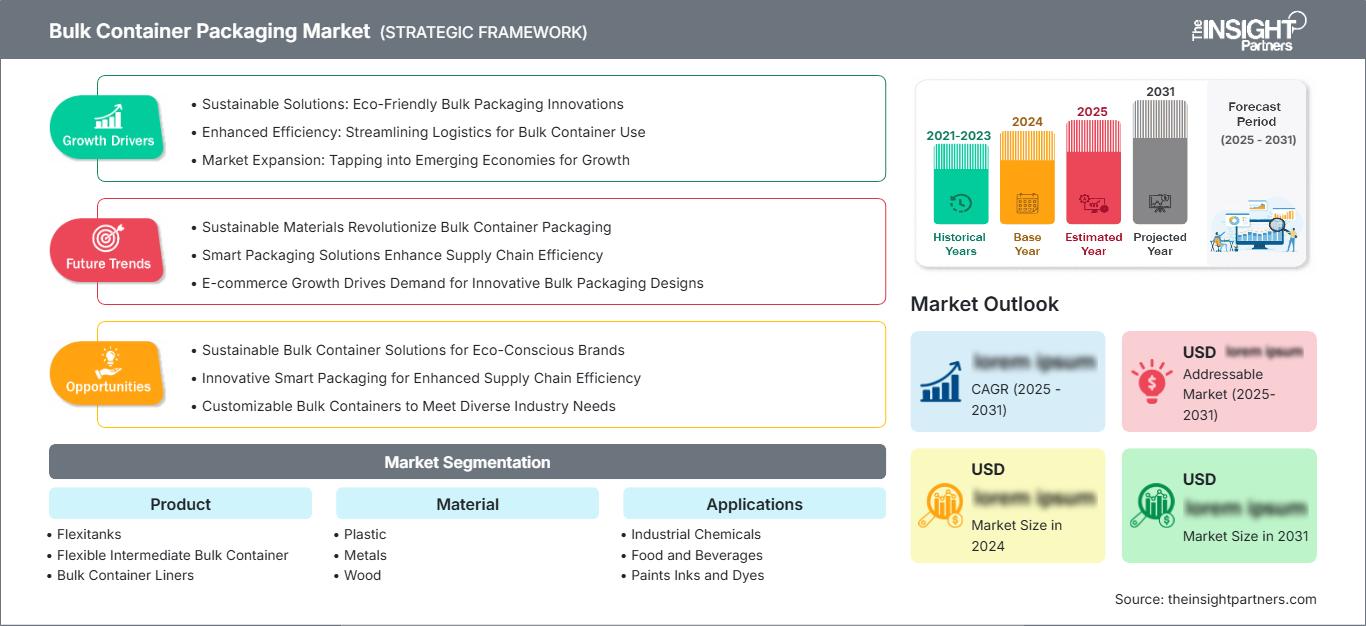
Bulk Container Packaging Market: Strategic Insights
Regional Insights
North America Bulk Container Packaging Market
North America accounted for 33%–36% of the global Bulk Container Packaging Market share in 2025 and is projected to register a CAGR of 3.2%–3.8% during 2026–2034. The region benefits from mature industrial infrastructure, well-established chemical manufacturing, and an extensive freight transportation network. Rising investments in warehouse automation, sustainable logistics, and reusable industrial packaging are increasing the adoption of flexible intermediate bulk containers, flexitanks, and bulk container liners across multiple industries.
There have been efforts in response to strict environmental regulations through development of recyclable materials as well as returnable packaging systems. High demand for the product by the chemicals industry, food processing, pharmaceuticals, and specialty materials will drive growth in the market. Increased cross-border trade within North America and improved operations in distribution centers and supply chain management through digitalization will drive demand for high-performing bulk packaging over the long term.
U.S. Bulk Container Packaging Market
The U.S. represented 74%–78% of the North American market in 2025 and is anticipated to grow at a CAGR of 3.3%–3.9% during 2026–2034. The nation continues to be the biggest buyer due to the country's high capacity of manufacturing chemicals, food products, and pharmaceuticals. Constantly expanding investments in industrial automation and export-oriented manufacturing have been further contributing towards the demand for more durable and reusable bulk packaging containers.
Some of the leading manufacturers such as Greif, Inc., International Paper Company, Sealed Air Corporation, Berry Global Group, Inc., and Hoover CS possess well-established manufacturing and distribution facilities in the nation. The rising trend of using automated filling machines, stringent rules regarding transport safety, and sustainable bulk packaging has been fostering innovations in the industry. Demand exists in the areas of industrial chemicals, processed foods, specialty foods, and pharmaceutical raw materials.
Europe Bulk Container Packaging Market
Europe accounted for 27%–30% of the global Bulk Container Packaging market in 2025 and is forecast to expand at a CAGR of 3.4%–4.0% during 2026–2034. Germany remains the leading market because of its large chemical manufacturing base, advanced industrial exports, and extensive packaging innovation ecosystem. Strong sustainability regulations and circular economy initiatives continue encouraging investments in recyclable and reusable industrial packaging across manufacturing industries.
The United Kingdom is witnessing consistent demand driven by pharmaceutical production, food processing, and modern logistics infrastructure. France, Italy, and Spain continue expanding bulk packaging adoption as manufacturers increase exports of chemicals, agricultural products, and processed food. Regional producers are emphasizing lightweight packaging, recycled content integration, and automation-compatible container systems that reduce transportation costs while complying with increasingly stringent environmental regulations across the European Union.
APAC Bulk Container Packaging Market
Asia Pacific captured 28%–31% of the global Bulk Container Packaging market in 2025 and is expected to record the fastest regional expansion at a CAGR of 4.5%–5.2% during 2026–2034. China leads regional demand through its large manufacturing sector, while India continues benefiting from expanding industrial production and chemical exports.
Japan, South Korea, and Australia contribute through advanced manufacturing capabilities, food exports, and pharmaceutical production. Government support for industrial development, logistics modernization, and export competitiveness continues to strengthen adoption of flexible and sustainable bulk packaging solutions throughout the region.
Middle East & Africa Bulk Container Packaging Market
The Middle East & Africa market is projected to expand at a CAGR of 3.7%–4.3% during 2026–2034. Saudi Arabia and the UAE remain the leading contributors owing to petrochemical production, industrial diversification strategies, and infrastructure investments supporting regional manufacturing and export activities.
South Africa continues to represent an important industrial hub, while the Rest of MEA is gradually increasing adoption through mining, chemicals, and food processing industries. Expanding logistics infrastructure and growing emphasis on efficient industrial transportation are expected to create additional opportunities for advanced bulk packaging solutions.
Segmentation Analysis
Product
The Product segment in the Bulk Container Packaging Market is expected to register a CAGR of 3.9%–4.5% during 2026–2034. Product innovation remains central to market competitiveness as manufacturers develop lighter, stronger, and more sustainable packaging formats. Rising demand for safe transportation of chemicals, food ingredients, and pharmaceutical materials continues to accelerate adoption of specialized bulk packaging systems. The Bulk Container Packaging Market scope continues to broaden as industries seek packaging solutions that improve operational efficiency while reducing transportation costs and environmental impact.
- Flexitanks – Designed for transporting non-hazardous liquid products in standard shipping containers, flexitanks improve freight efficiency, reduce handling requirements, and are increasingly adopted for edible oils, industrial liquids, and liquid chemicals.
- Flexible Intermediate Bulk Container – The dominant product category owing to its high load capacity, lightweight structure, cost efficiency, and broad application across chemicals, agriculture, food ingredients, pharmaceuticals, and industrial minerals.
- Bulk Container Liners – Widely used to protect dry bulk materials during transportation while minimizing contamination risks. Their compatibility with standard shipping containers makes them attractive for international logistics operations.
Material
The Material segment is projected to expand at a CAGR of 3.4%–4.0% during 2026–2034. Material selection is increasingly influenced by sustainability objectives, durability requirements, product compatibility, and lifecycle cost considerations. Manufacturers continue investing in recyclable materials and lightweight engineering to improve environmental performance while maintaining packaging strength and regulatory compliance.
- Plastic – Remains the leading material because of its lightweight properties, excellent chemical resistance, design flexibility, and suitability for reusable and recyclable industrial packaging applications.
- Metals – Preferred for transporting hazardous materials and high-value industrial products requiring exceptional structural strength, long service life, and resistance to demanding operating conditions.
- Wood – Continues serving selected industrial applications where structural stability, heavy-load handling capability, and compatibility with existing logistics systems remain important purchasing considerations.
Applications
The Applications segment is forecast to record a CAGR of 4.1%–4.8% during 2026–2034. Growing industrialization, expanding global trade, and increasingly stringent product safety requirements continue to diversify demand across multiple application sectors. Companies are selecting bulk packaging solutions based on product sensitivity, transportation distance, regulatory requirements, and sustainability objectives.
- Industrial Chemicals – Represents the largest application due to high-volume transportation requirements, strict handling regulations, and increasing international movement of specialty and commodity chemicals.
- Food and Beverages – Growing demand for hygienic, contamination-resistant, and recyclable packaging supports increasing adoption across food ingredients, edible oils, beverages, and agricultural processing.
- Paints Inks and Dyes – Industrial manufacturers increasingly utilize specialized bulk packaging solutions to improve product protection, reduce leakage risks, and optimize transportation efficiency across domestic and international supply chains.
- Pharmaceutical – The fastest-growing application driven by expanding biologics manufacturing, stringent quality regulations, increasing global pharmaceutical trade, and growing demand for contamination-controlled packaging systems.
Opportunity Snapshot
| Applications | Revenue Contribution | Trend Tag | Adoption Stage |
| Industrial Chemicals | High | Hazardous Logistics | Mature |
| Food and Beverages | High | Food Safety | Scaling |
| Paints Inks and Dyes | Medium | Coating Exports | Scaling |
| Pharmaceutical | Medium | Sterile Supply | Emerging |
Bulk Container Packaging Market Growth Drivers and Impact Analysis
Expansion of Global Chemical Manufacturing and Cross-Border Trade
An increase in the chemical manufacturing industry's capacities in Asia Pacific, North America, and the Middle East has been generating constant demand for bulk transportation systems. Special chemicals, petrochemicals, industrial intermediates, and agricultural chemicals often need packing that can retain their quality during transport over large distances and meet the international standards of safety. An increase in exports and imports via containerized transport has been prompting producers to use intermediate bulk containers, flexitanks, and liners that can lower the cost of transport and make it more efficient. Investments in integrated logistic parks, automatic filling plants, and other multimodal transport infrastructures contribute to demand as well. With industrial production getting more and more globalized, packaging companies which can offer standardized, reusable and sustainable bulk packing systems will be able to get a competitive advantage.
Growing Sustainability Requirements Across Industrial Packaging
Increased environmental regulations and sustainability commitments by businesses are driving the shift towards recyclable and reusable bulk packaging solutions. Producers have reduced their use of raw materials through the use of recycled plastics, increased strength of packaging products, and closed loop recycling processes. Consumers in the industrial sector have started to look at packaging from the perspective of lifecycle efficiency, carbon footprint reductions, and waste prevention rather than just looking at costs. The impact of regulations promoting circular economy is still affecting purchasing decisions in chemicals, food production, and pharmaceutical sectors. Packaging firms that are investing in light-weight engineering, reusable containers, and recyclable materials stand to benefit from increasing consumer demands.
Automation and Digital Supply Chain Integration
The quick uptake of warehouse automation, robotics, and digital logistics management is leading to changes in bulk packaging needs. More companies are requiring standardized packaging designs that will work with automated filling, storing, monitoring, and loading processes. Smart identification techniques, such as RFID and digital asset monitoring, enhance the visibility of the shipments, inventory management, and the use of reusable bulk packaging. Such techniques lower product losses and provide an efficient logistics process. As firms invest more into Industry 4.0 activities and smart warehouses, there will be rising demand for advanced bulk packaging solutions.
Bulk Container Packaging Market Future Trends
Expansion of Circular Packaging Ecosystems
Manufacturing enterprises are increasingly favoring reusable packaging solutions backed up by systems of collection, refurbishment, and redistribution. The the Bulk Container Packaging Market trends are compelling manufacturing companies to make use of robust packaging materials with longer lifespans and improved recyclability upon the end of their use. Recycling of raw material for the creation of packaging solutions is one such effort on the part of companies. Reverse logistics solutions have been invested in by companies to reduce the overall life cycle costs. Efficient tracking systems using digital solutions are helping companies track the reuse of these containers during global transport operations.
Advanced Barrier Materials and Smart Packaging Technologies
Developments of future products are going to be centered around multilayer barrier films, light-weighted composite structures, and smart packaging solutions able to protect products better during transit. Packaging manufacturers are developing digital technologies that allow monitoring the transport process in real time, as well as making repairs and enhancing traceability in international logistics. The developments in material science help create stronger, lighter, and chemically resistant packaging products able to operate under tough industrial conditions. Such an approach will enhance packaging performance and lower transport costs in the future.
Bulk Container Packaging Market Opportunities
Expanding Pharmaceutical Manufacturing Capacity in Emerging Economies
Rapid investments in pharmaceutical manufacturing across India, China, Southeast Asia, Latin America, and selected Middle Eastern countries are creating long-term opportunities for suppliers of advanced bulk packaging solutions. The increasing production of active pharmaceutical ingredients, biologics, specialty chemicals, and nutraceutical ingredients requires contamination-resistant packaging capable of maintaining strict quality standards throughout transportation and storage. Bulk Container Packaging Market Forecasts indicate that companies investing in clean manufacturing environments, high-barrier packaging materials, and regulatory-compliant bulk handling systems will be well positioned to capitalize on expanding pharmaceutical exports. Strategic partnerships with pharmaceutical manufacturers and logistics providers can further strengthen market penetration while supporting long-term revenue growth.
Development of High-Performance Sustainable Packaging Materials
Continuous innovation in recyclable polymers, bio-based materials, lightweight composites, and reusable industrial packaging creates attractive investment opportunities throughout the value chain. Manufacturers are increasingly seeking packaging that balances durability, chemical resistance, environmental performance, and lower lifecycle costs. Research into advanced woven fabrics, multilayer barrier structures, and high-strength recyclable materials is expected to improve operational efficiency while supporting circular economy objectives. Companies capable of commercializing sustainable packaging technologies without compromising product safety or logistics performance are likely to secure stronger customer relationships and differentiate themselves within an increasingly competitive global Bulk Container Packaging market.
Recent Developments
- April 2026: Gravis acquired Western Packaging Solutions to strengthen its industrial bulk packaging capabilities and expand its product portfolio for FIBC and flexible packaging customers across North America. The acquisition enhances Gravis' manufacturing footprint and supports its long-term growth strategy in sustainable bulk packaging.
- July 2026: WERIT Kunststoffwerke W. Schneider GmbH & Co. KG partnered with Ellseys to promote reusable Intermediate Bulk Containers (IBCs) aimed at reducing single-use packaging waste and improving circularity in industrial liquid transportation across the UK packaging sector.
- February 2025: ORBIS Corporation announced the development of a new manufacturing plant in Texas, United States, to expand production capacity for reusable plastic packaging solutions, including bulk containers and pallets, supporting growing demand from industrial, food, and beverage supply chains.
Frequently Asked Questions

- Comprehensive Market Sizing and Forecast Analysis
- Detailed Segmentation Analysis
- In-Depth Market Dynamics Assessment
- Regional and Country-Level Insights
- Competitive Landscape and Company Benchmarking
- Strategic Business Intelligence
Recent Reports
Testimonials

The Insight Partners' SCADA System Market report is comprehensive, with valuable insights on current trends and future forecasts. The team was highly professional, responsive, and supportive throughout. We are very satisfied and highly recommend their services.
RAN KEDEM Partner, Reali Technologies LTDs
I requested a report on a very specific software market and the team produced the report in a few days. The information was very relevant and well presented. I then requested some changes and additions to the report. The team was again very responsive and I got the final report in less than a week.
JEAN-HERVE JENN Chairman, Future Analytica
We worked with The Insight Partners for an important market study and forecast. They gave us clear insights into opportunities and risks, which helped shape our plans. Their research was easy to use and based on solid data. It helped us make smart, confident decisions. We highly recommend them.
PIYUSH NAGPAL Sr. Vice President, High Beam Global
The Insight Partners delivered insightful, well-structured market research with strong domain expertise. Their team was professional and responsive throughout. The user-friendly website made accessing industry reports seamless. We highly recommend them for reliable, high-quality research services
YUKIHIKO ADACHI CEO, Deep Blue, LLC.
This is the first time I have purchased a market report from The Insight Partners.While I was unsure at first, I visited their web site and felt more comfortable to take the risk and purchase a market report.I am completely satisfied with the quality of the report and customer service. I had several questions and comments with the initial report, but after a couple of dialogs over email with their analyst I believe I have a report that I can use as input to our strategic planning process.Thank you so much for taking the extra time and making this a positive experience.I will definitely recommend your service to others and you will be my first call when we need further market data.
JOHN SUZUKI President and Chief Executive Officer, Board Director, BK Technologies
I wish to appreciate your support and the professionalism you displayed in the course of attending to my request for information regarding to infectious disease IVD market in Nigeria. I appreciate your patience, your guidance, and the fact that you were willing to offer a discount, which eventually made it possible for us to close a deal. I look forward to engaging The Insight Partners in the future, all thanks to the impression you have created in me as a result of this first encounter.
DR CHIJIOKE ONYIA MANAGING DIRECTOR, PineCrest Healthcare Ltd.Reason to Buy
- Informed Decision-Making
- Understanding Market Dynamics
- Competitive Analysis
- Identifying Emerging Markets
- Customer Insights
- Market Forecasts
- Risk Mitigation
- Boosting Operational Efficiency
- Strategic Planning
- Investment Justification
- Tracking Industry Innovations
- Aligning with Regulatory Trends





 Get Free Sample for