
Busbar Market Trends, Share & Demand by 2034
Coverage: By Conductor (Copper, Aluminum); Power Rating (Low, Medium, High); Application (Commercial Buildings, Residential Buildings, Industrial Infrastructure, Others) , and Geography (North America, Europe, Asia Pacific, and South and Central America)
- Status : Data Released
- Report Code : TIPRE00006312
- Category : Electronics and Semiconductor
- No. of Pages : 150
- Available Report Formats :


- Last update date : July 21, 2026


2025 Market Size
US$ 15,664.03 Mn
Base year value
2034 Forecast
US$ 31,660.36 Mn
Projected by 2034
CAGR 2026-2034
8.13 %
Growth rate
Addressable Market
US$ 212,659.59 Mn
(2026-2034)
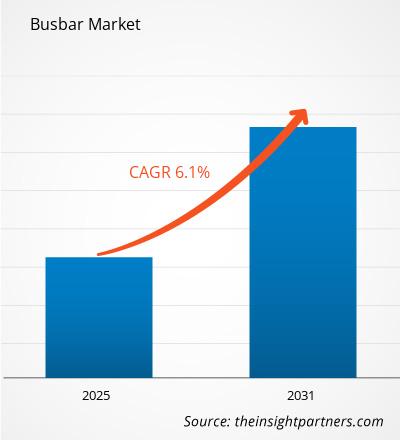
The Busbar Market Size is projected to grow from US$ 15,664.03 Million in 2025 to US$ 31,660.36 Million by 2034, registering a CAGR of 8.13% during 2026–2034. Growth would be driven by increasing electrification, compact energy distribution demands, and ongoing investments in electrical infrastructure within commercial buildings, residential buildings, and industrial complexes.
North America continues to be an important strategic region where the Busbar Market Size is being propelled by smart grids, data centers, electrification of buildings, and upgrading the existing switchgears. North America is expected to grow at a CAGR of 7.6% to 8.2% between 2026 and 2034.
Busbar Market Assessment and Insights
- North America accounted for 27–30% share in 2025 and is projected to grow at a 7.6–8.2% CAGR between 2026–2034, led by grid upgrades, data centers, and resilient building electrification.
- US represented 78–82% of North America in 2025 and is expected to expand at a 7.7–8.3% CAGR between 2026–2034 on utility and industrial demand.
- Europe held 22–25% share in 2025 and is set to grow at a 7.1–7.8% CAGR between 2026–2034, led by Germany, the UK, France, Italy, and Spain.
- Asia Pacific contributed 35–39% share in 2025 and is forecast to post an 8.6–9.3% CAGR between 2026–2034, with China, India, Japan, and South Korea leading deployment.
- Largest Segment Copper held 58–63% market share in 2025 and is forecast to grow at a 7.7–8.4% CAGR between 2026–2034, supported by high-conductivity applications.
- High Growth Segment High power rating held 24–28% market share in 2025 and is projected to grow at an 8.9–9.6% CAGR between 2026–2034.
- Key companies analyzed in detail: ABB Ltd., Eaton Corporation plc, General Electric Company, IUSA Group, Larsen and Toubro Limited, Legrand SA, Methode Electronics, Inc., Rittal GmbH and Co. KG, Schneider Electric SE, Siemens AG.
Source: The Insight Partners' analysis based on proprietary research, government publications, company annual reports, investor presentations, industry databases, and expert interviews.
Traditional busbars have evolved from simple conductive devices into power distribution systems with integrated insulation features, modular tapping systems, compact trunking, and thermal management systems. Producers are adapting their manufacturing operations for better utilization of copper material, optimizing the use of aluminum materials, and manufacturing tested assemblies to minimize installation time. The market is becoming more influenced by market trends like the need for rapid electrical room setup, prefabricated switchgears, and systems for dense power load distribution.
In the coming years, the industry will experience expansion in areas other than mature construction markets due to factors such as the development of industrial belts, renewable energy sources, and urban infrastructure projects in the Asia Pacific, Middle East regions, and certain African economies. The emphasis on energy efficiency and electrical safety is increasing the appeal of enclosed busbar systems.
Busbar Market Report Scope
| Report Attribute | Details |
|---|---|
| Market size in 2025 | US$ 15,664.03 Million |
| Market Size by 2034 | US$ 31,660.36 Million |
| Global CAGR (2026 - 2034) | 8.13% |
| Historical Data | 2021-2024 |
| Forecast period | 2026-2034 |
Busbar Market Analysis
Busbar Market Demand growth phase is driven by high current density, restricted floorspace, and reduced voltage drop requirements on account of increasing energy consumption. In comparison to cable systems, busbar trunking provides better system integration, easy load increase, and maintenance efficiency. It has significant implications in commercial buildings, manufacturing plants, hospitals, logistics parks, and data centers where operational downtime losses can be considerable.
The value chain encompasses metals suppliers, insulators, switchgear assembly units, panel manufacturers, electrical contractors, and end-users. Copper price fluctuation is a key driver in product design and manufacturing; however, use of aluminum is rising in applications that require lightweight and low-cost solutions. Lead-time management is a critical factor for manufacturers with automated manufacturing facilities, test facilities, and local inventories.
Positioning in the market is based on the number of rating types, safety approvals, enclosures, and compatibility with switchgear platforms. Competition is between ABB Ltd., Schneider Electric SE, Siemens AG, Eaton Corporation plc, Legrand SA, and Rittal GmbH and Co. KG, based on standardized design and distribution, and also Methode Electronics, Inc. and IUSA Group with specific conductor designs.
Money is being spent in modular power distribution systems, insulated busbars, and systems with heavy current for industrial applications. The competitive advantage of Larsen and Toubro Limited is project execution skills in large electrical applications, while General Electric Company is involved through electrical systems. Differentiation is becoming more dependent on lifecycle support, documentation, digital designing capability, and servicing multinational clients.
● REPORT CUSTOMIZATION
Tailor This Report To Align With Your Specific Business Requirements
This report can be customized to align precisely with your business objectives, scope, and target markets. Customization options include tailored segmentation, geography, competitive analysis, and strategic insights to support informed decision-making.
Customize This Report →WHAT YOU CAN ADJUST
- ● Segmentations
- ● Geography
- ● Competitive Analysis
- ● Language Preferences
Busbar Market: Strategic Insights
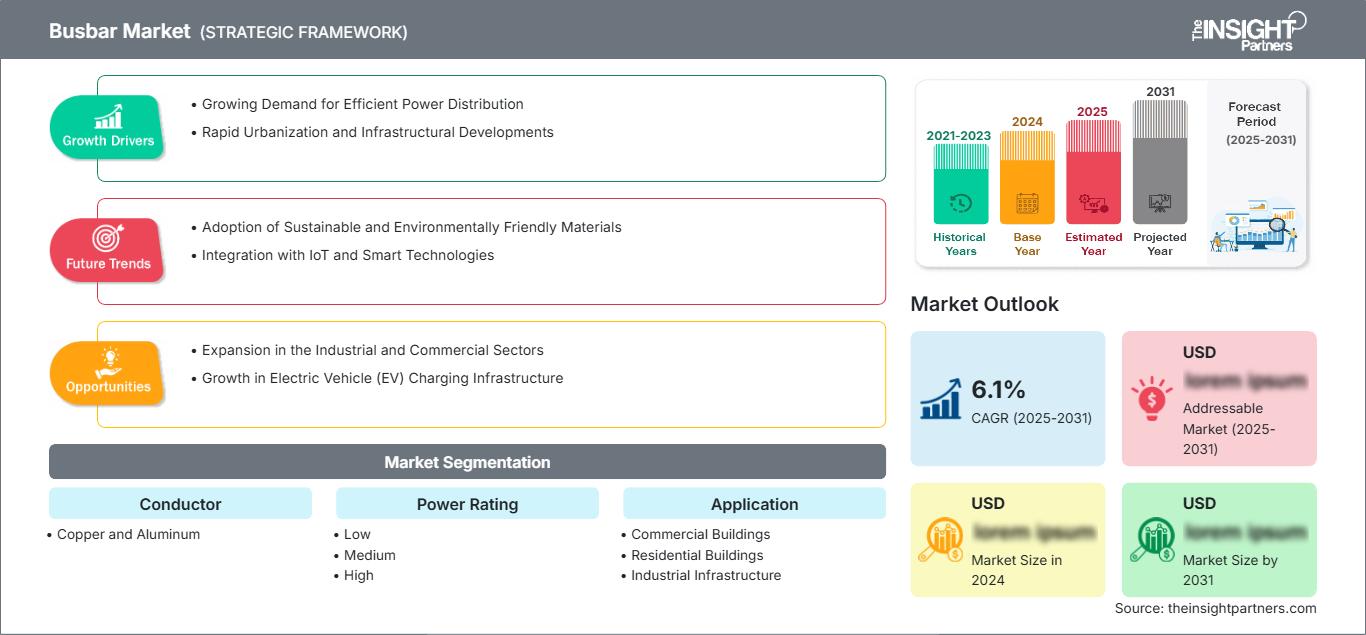
Regional Insights
North America Busbar Market
North America accounted for 27–30% share in 2025 and is expected to grow at a 7.6–8.2% CAGR through 2034. Demand in the region is driven by utilities' grid hardening efforts, buildings electrification, and power density in data centers. Busbar Market share in the region is skewed towards the US where bigger electrical contractors have a preference for certified products and reliable installation timelines.
The success of the project in Canada and Mexico is dependent on investment in manufacturing, renewable energy, and industrial parks. The busbar applications include safety specifications, prefab electrical rooms, and replacing cable installations. Manufacturers with inventory in the region and UL certified assemblies can greatly benefit from repeated orders by contractors serving the healthcare, logistics, and manufacturing industries.
U.S. Busbar Market
The US represented 78–82% of North America in 2025 and is forecast to advance at a 7.7–8.3% CAGR during 2026–2034. There is a need for high current distributions in applications such as data centers, semiconductor plants, EV battery factories, and hospitals. Large players like ABB Ltd., Eaton Corporation plc, Schneider Electric SE, Siemens AG, and Legrand SA have good channel coverage.
Current trends include an increase in the use of plug-in busways for flexible tenant spaces and mission-critical applications. The advantage for industrial applications lies in the use of modular installation that helps minimize downtime while expanding. Private investment in manufacturing industry and public money spent on infrastructure enable acquisition of higher-rated tested and maintainable busbar systems.
Europe Busbar Market
Europe held 22–25% share in 2025 and is expected to grow at a 7.1–7.8% CAGR between 2026–2034. Germany dominates regional demand through automation, manufacturing, and grid upgrade. The UK takes advantage of commercial regeneration and data center clusters, whereas France, Italy, and Spain bring in demand for renewable energy incorporation and infrastructural refurbishment.
The strength of the Germany electrical equipment industry and the country’s energy efficiency in industry make the use of enclosed and highly conductive systems feasible. In the UK, the focus is on retrofit-capable busway for office buildings, logistics parks, and healthcare premises. In France, Italy, and Spain, there will be an increasing uptake in railway, commercial, and industrial applications.
APAC Busbar Market
Asia Pacific contributed 35–39% share in 2025 and is projected to grow at an 8.6–9.3% CAGR through 2034. China is still the top-ranked country owing to investments made in the grid, industries, and renewables. India has added demand generated by commercial building construction, metro, and manufacturing corridors.
Japan and South Korea focus on high reliability for electronics, data centers, and automation in industries. The contributions from Australia come from mining, commercial buildings, and renewable transmission. The regional players compete based on pricing, and the international companies compete on certifications and system integration.
Middle East & Africa Busbar Market
Middle East and Africa is forecast to grow at a 7.9–8.6% CAGR during 2026–2034, supported by energy infrastructure, airports, hospitals, and large commercial developments. Saudi Arabia is the leading country, followed by the UAE, where mega projects require compact and resilient electrical distribution.
South Africa and the Rest of MEA show demand from grid reliability initiatives, mining, and industrial modernization. Project owners prioritize systems that reduce installation complexity and withstand harsh operating conditions. Certified enclosures, after-sales service, and contractor training remain important purchasing criteria across the region.
Segmentation Analysis
Conductor
The conductor segment is projected to grow at a 7.8–8.5% CAGR during 2026–2034, with selection driven by conductivity, cost, weight, and installation environment. The Busbar Market report is shaped by copper’s performance in high-load applications and aluminum’s appeal in cost-sensitive distribution systems, particularly where weight reduction improves handling.
- Copper remains the preferred option for dense electrical rooms, critical facilities, and industrial loads because its conductivity supports lower losses, compact designs, and dependable thermal performance.
- Aluminum gains traction in commercial buildings and large infrastructure projects where lower weight, material efficiency, and cost control support broad adoption without compromising engineered safety.
Power Rating
The power rating segment is expected to grow at an 8.1–8.8% CAGR during 2026–2034 as end users match ratings to electrical load profiles, expansion plans, and safety margins. Low and medium ratings serve buildings and panels, while high ratings support industrial infrastructure, utilities, data centers, and renewable interconnection environments.
- Low power systems serve lighting, small commercial panels, and residential distribution where compact routing, safety, and ease of maintenance influence electrical design decisions.
- Medium power ratings are widely used in commercial buildings, factories, and institutional facilities because they balance load capacity, modularity, installation speed, and total system cost.
- High power ratings are strategically important for substations, process industries, data centers, and large infrastructure where high current, reliability, and thermal stability are essential.
Application
The application segment is projected to expand at an 8.0–8.7% CAGR during 2026–2034 as owners replace cable-heavy layouts with modular, testable systems. Commercial buildings lead adoption due to flexible tenancy, while residential towers and industrial infrastructure increasingly use busbars to manage compact risers, higher loads, and safer distribution.
- Commercial Buildings generate strong demand from offices, hospitals, malls, and data centers where scalable distribution, faster installation, and reduced electrical room congestion improve project execution.
- Residential Buildings use busbars in high-rise developments and premium housing projects where vertical riser efficiency, safety, and reliable metering infrastructure support modern electrification.
- Industrial Infrastructure remains strategically important because factories, warehouses, refineries, and processing sites require durable conductors for high loads, expansion flexibility, and controlled maintenance windows.
Opportunity Snapshot
| Application | Revenue Contribution | Trend Tag | Adoption Stage |
| Commercial Buildings | High | Data Centers | Mature |
| Residential Buildings | Medium | High-Rise | Scaling |
| Industrial Infrastructure | High | Process Power | Mature |
| Others | Medium | Transit Power | Emerging |
Busbar Market Growth Drivers and Impact Analysis
Grid Modernization and Electrified Infrastructure
Modernization of the grid is creating the need for more efficient, safer, and more powerful distribution solutions. Electrical networks are being modernized in order to accommodate renewable energy production, EV charging stations, and increased capacity of buildings. Busbar systems facilitate this process by optimizing routing, decreasing the installation time and making expansion possible. In the Busbar Market, the above driver directly affects sales since infrastructure development projects tend to use standardized components for many installations. Manufacturers that have their products certified along with engineering expertise and project experience become the suppliers of choice.
Expansion of Data Centers and High-Load Facilities
The electrical requirements of data centers, semiconductor facilities, hospitals, and automatic warehousing are characterized by the necessity to supply high current with a low risk of downtime. The busbar is especially appropriate in such cases due to its load predictability, modularity, and ease of maintenance compared to cable installations. There is an effect on the market since high-load facilities generally use premium products with testing, certification, and after-sales service. The need for phase expansion of capacities favors busway and increases the sales volume as well.
Shift Toward Modular Construction and Faster Installation
There is now an increase in the constriction schedule timeframes in both commercial, residential and industrial construction, thus the need for prefabricated electrical systems that minimize manpower on-site. Busbar trunking system works within this premise since it has the ability to be factory tested, comes in standard modules and minimal terminations on-site. This would help contractors to have less congestion, easier routing and quality control. The faster commissioning could mean no delays and the asset ready to perform its functions. It makes the market stronger through purchase decision based on total installed cost.
Busbar Market Future Trends
Smart and Sensor-Enabled Busbar Systems
Busbar Market trends are shifting toward sensor-enabled systems that monitor temperature, load imbalance, and connection health. As buildings and industrial sites digitize power management, busbars will increasingly integrate with supervisory platforms and energy dashboards. This trend supports predictive maintenance, early fault detection, and better utilization of installed capacity. Future procurement will likely favor systems that combine mechanical robustness with data visibility. Manufacturers that embed monitoring without adding installation complexity can differentiate in data centers, healthcare, and high-value manufacturing where reliability metrics influence capital spending decisions.
Material Optimization and Low-Carbon Manufacturing
Material strategy will become more important as customers evaluate embodied carbon, metal price exposure, and lifecycle efficiency. Copper will remain critical in compact high-current systems, while aluminum and hybrid designs will gain attention where weight and cost flexibility matter. Suppliers are expected to improve conductor geometry, insulation performance, and recyclability. Low-carbon manufacturing claims will require credible documentation, especially in Europe and multinational projects. This trend may reshape bids by adding sustainability evidence to traditional criteria such as rating, safety, price, and delivery time.
Busbar Market Opportunities
Localized Assembly for Emerging Infrastructure Markets
Busbar Market Forecasts indicate strong opportunity for suppliers that localize assembly near fast-growing infrastructure markets. Local production can reduce freight costs, improve delivery certainty, and help meet public procurement preferences. The opportunity is especially relevant in India, Southeast Asia, the Gulf, and selected African economies where commercial buildings, transit systems, and industrial zones are expanding. Companies can invest in regional fabrication, certified testing, and contractor training to build repeat demand. Partnerships with panel builders and EPC firms can also convert project pipelines into long-term channel relationships.
Retrofit Solutions for Aging Electrical Assets
Aging electrical assets create a practical opportunity for retrofit-oriented busbar systems that fit constrained spaces and minimize shutdown time. Commercial towers, hospitals, factories, and public buildings often need higher electrical capacity without complete redesign. Suppliers can address this need through modular busway, custom adapters, installation planning, and phased commissioning support. Retrofit demand is attractive because it values engineering assistance and reliability more than lowest component cost. Companies that document energy savings, safety improvements, and installation speed can strengthen conversion rates among facility owners and electrical consultants.
Recent Developments
- June 2026: Molex, a global electronics leader and connectivity innovator, will showcase its latest thermal management innovations at Computex 2026 (booth M1330, 4F. TAINEX 1), led by the debut of the new Multi-Channel Liquid Cooled Busbars. As intensive AI workloads drive rack power requirements toward the 1-megawatt (MW) threshold, traditional air-cooled infrastructure has hit a physical limit. Molex bridges this “AI Thermal Gap” by extending liquid cooling into the power-distribution layer, supporting currents up to 15,000 Amps today with a strategic design roadmap to 25,000 Amps.
- April 2026: Honeywell Intelligent Control Electrical Solutions Division has officially launched a busbar trunking product solution. The release follows the recent introduction of intelligent circuit breakers and marks the accelerated transformation of the intelligent control electrical business toward smart power distribution and comprehensive energy management solutions.
- Jul 2026: Suzhou Kiande Electric Co., Ltd., a specialized R&D and manufacturing company focused on intelligent automation equipment for electrical busbar and switchgear production, has officially announced its participation in Middle East Energy Dubai 2026 at Booth Z3.A53. The exhibition, the region’s largest event for power, lighting, and new energy, will take place at the Dubai World Trade Centre from September 1 to September 3, 2026. The company will showcase its full range of products, including busbar processing machinery, automated busduct production lines, intelligent busbar storage loading systems, matching busbar supporting accessories, and complete switchgear manufacturing lines.
Frequently Asked Questions

- Comprehensive Market Sizing and Forecast Analysis
- Detailed Segmentation Analysis
- In-Depth Market Dynamics Assessment
- Regional and Country-Level Insights
- Competitive Landscape and Company Benchmarking
- Strategic Business Intelligence
Recent Reports
Testimonials

The Insight Partners' SCADA System Market report is comprehensive, with valuable insights on current trends and future forecasts. The team was highly professional, responsive, and supportive throughout. We are very satisfied and highly recommend their services.
RAN KEDEM Partner, Reali Technologies LTDs
I requested a report on a very specific software market and the team produced the report in a few days. The information was very relevant and well presented. I then requested some changes and additions to the report. The team was again very responsive and I got the final report in less than a week.
JEAN-HERVE JENN Chairman, Future Analytica
We worked with The Insight Partners for an important market study and forecast. They gave us clear insights into opportunities and risks, which helped shape our plans. Their research was easy to use and based on solid data. It helped us make smart, confident decisions. We highly recommend them.
PIYUSH NAGPAL Sr. Vice President, High Beam Global
The Insight Partners delivered insightful, well-structured market research with strong domain expertise. Their team was professional and responsive throughout. The user-friendly website made accessing industry reports seamless. We highly recommend them for reliable, high-quality research services
YUKIHIKO ADACHI CEO, Deep Blue, LLC.
This is the first time I have purchased a market report from The Insight Partners.While I was unsure at first, I visited their web site and felt more comfortable to take the risk and purchase a market report.I am completely satisfied with the quality of the report and customer service. I had several questions and comments with the initial report, but after a couple of dialogs over email with their analyst I believe I have a report that I can use as input to our strategic planning process.Thank you so much for taking the extra time and making this a positive experience.I will definitely recommend your service to others and you will be my first call when we need further market data.
JOHN SUZUKI President and Chief Executive Officer, Board Director, BK Technologies
I wish to appreciate your support and the professionalism you displayed in the course of attending to my request for information regarding to infectious disease IVD market in Nigeria. I appreciate your patience, your guidance, and the fact that you were willing to offer a discount, which eventually made it possible for us to close a deal. I look forward to engaging The Insight Partners in the future, all thanks to the impression you have created in me as a result of this first encounter.
DR CHIJIOKE ONYIA MANAGING DIRECTOR, PineCrest Healthcare Ltd.Reason to Buy
- Informed Decision-Making
- Understanding Market Dynamics
- Competitive Analysis
- Identifying Emerging Markets
- Customer Insights
- Market Forecasts
- Risk Mitigation
- Boosting Operational Efficiency
- Strategic Planning
- Investment Justification
- Tracking Industry Innovations
- Aligning with Regulatory Trends





 Get Free Sample for