
Camera Heads Market Trends, Size & Forecast by 2034
Coverage: By Type (4K UHD Camera Head, Full HD Camera Head); Application (Laparoscopic, Arthroscopic, Gynecological, Urological, ENT, Neuro endoscopic) , and Geography (North America, Europe, Asia Pacific, and South and Central America)
- Status : Data Released
- Report Code : TIPRE00023801
- Category : Life Sciences
- No. of Pages : 150
- Available Report Formats :


- Last update date : August 12, 2026


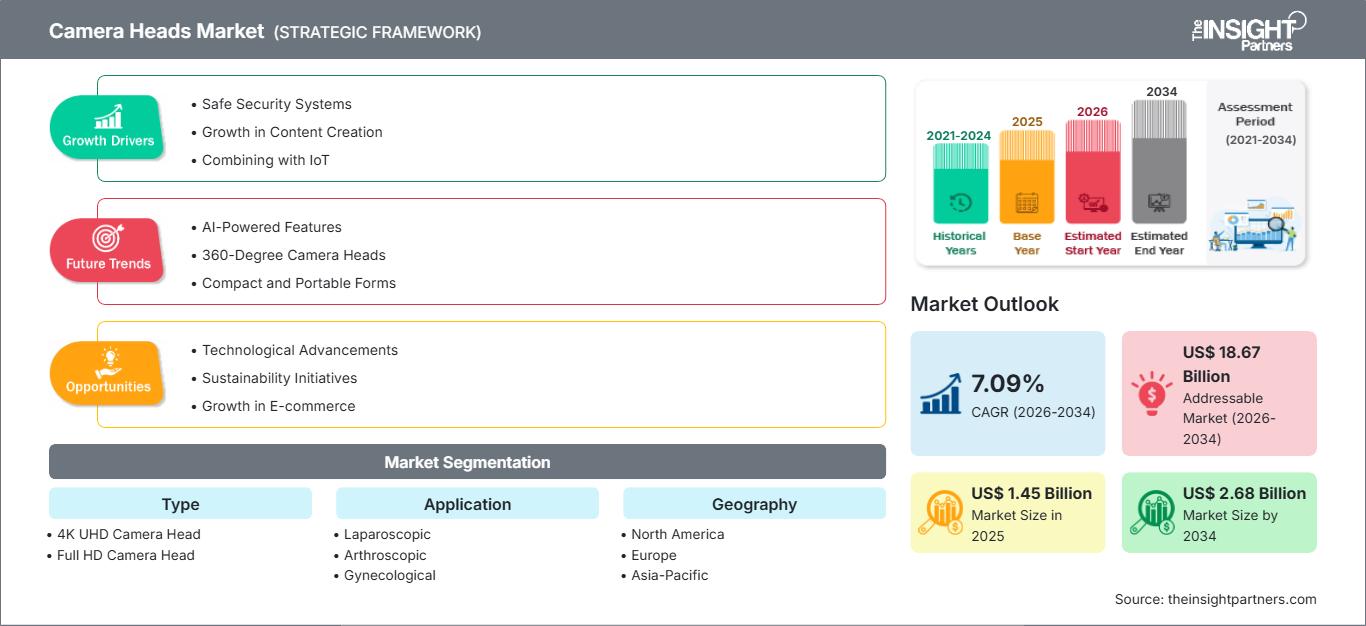
2025 Market Size
US$ 1.45 Bn
Base year value
2034 Forecast
US$ 2.68 Bn
Projected by 2034
CAGR 2026-2034
7.09 %
Growth rate
Addressable Market
US$ 18.67 Bn
(2026-2034)
The Camera Heads Market is projected to grow from US$ 1.45 Billion in 2025 to US$ 2.68 Billion by 2034, registering a CAGR of 7.09% during 2026–2034. The market is shaped by rising adoption of minimally invasive procedures, wider integration of 4K visualization platforms, and the need for camera heads that support precise tissue differentiation across laparoscopic, arthroscopic, gynecological, urological, ENT, and neuro endoscopic procedures.
North America remains the most mature revenue base, supported by hospital replacement cycles, higher operating-room digitization, and strong procurement of surgical visualization systems. The Camera Heads Market size in the region is expected to expand at an estimated CAGR of 6.7–7.2% during 2026–2034, as ambulatory surgery centers and tertiary hospitals standardize 4K UHD platforms for multi-specialty use.
Camera Heads Market Assessment and Insights
- North America accounted for 36–38% share in 2025 and is expected to grow at a CAGR of 6.7–7.2% between 2026–2034, supported by installed base upgrades and strong minimally invasive surgery volumes.
- US represented 78–82% of North America in 2025 and is projected to grow at a CAGR of 6.8–7.3% between 2026–2034, driven by hospital capital equipment replacement.
- Europe held 27–29% share in 2025 and is forecast to grow at a CAGR of 6.3–6.8% between 2026–2034, led by Germany, the UK, France, Italy, and Spain.
- Asia Pacific captured 23–26% share in 2025 and is expected to grow at a CAGR of 8.4–9.0% between 2026–2034, with China, Japan, South Korea, and India leading adoption.
- Largest Segment 4K UHD Camera Head held 58–62% market share in 2025 and is projected to grow at a CAGR of 7.5–8.1% during 2026–2034.
- High Growth Segment Neuro endoscopic applications held 8–10% share in 2025 and are expected to grow at a CAGR of 8.8–9.5% during 2026–2034.
- Key companies analyzed in detail: Olympus Corporation, FUJIFILM Holdings Corporation, Stryker Corporation, SCHÖLLY Fiberoptic GmbH, KARL STORZ SE & Co. KG, Richard Wolf GmbH, Smith & Nephew plc, CONMED Corporation, Arthrex Inc., B. Braun SE, HOYA Corporation, and Medtronic plc.
Source: The Insight Partners' analysis based on proprietary research, government publications, company annual reports, investor presentations, industry databases, and expert interviews.
Migratory trends in technology include transitioning from surgical imaging capabilities of Full HD to 4K UHD, broadened color gamut processing, fluorescence-enabled systems, and autoclavable lighter systems. Production trends are also shifting, and include alignment of camera heads with processors, light sources, scopes, and operating room integration systems by OEM professionals and brand medtech firms. These changes make interoperability, sterilization resilience, durability of cables, and sensors key procurement considerations for hospitals.
In the forecasted period, rising markets will see increased purchases of modular endoscopy tower systems, while mature markets will be characterized by purchases of premium visualization, workflow efficiency, and specialty-specific configuration devices. Issues related to device reprocessing, electrical safety, and clinical documentation will benefit companies that have sterilization credentials and scalable imaging solutions.
Camera Heads Market Report Scope
| Report Attribute | Details |
|---|---|
| Market size in 2025 | US$ 1.45 Billion |
| Market Size by 2034 | US$ 2.68 Billion |
| Global CAGR (2026 - 2034) | 7.09% |
| Historical Data | 2021-2024 |
| Forecast period | 2026-2034 |
Camera Heads Market Analysis
Growing procedure numbers in general surgery, urology, orthopedics, and gynecology segments are driving Market due to increasing preference of hospitals for good visualization capabilities of surgical procedures using minimally invasive techniques. Value chain participants include manufacturers of CMOS sensors, suppliers of optics parts, designers of camera control units, firms specializing in sterilization validation and clinical distributors. High demand comes from segments where camera heads are used as a part of integrated imaging chains and not as separate accessories.
Key supply factors continue to include availability of high quality optics, electronics manufacturing capacity and ability to operate after multiple sterilization procedures. With more hospitals considering costs of operations rather than pure prices, high and medium-level suppliers are favored since their solutions provide both 4K systems and Full HD platforms.
According to the Camera Heads Market Report, some of the major players in the market include Olympus Corporation, Stryker Corporation, KARL STORZ SE & Co. KG, Richard Wolf GmbH, and FUJIFILM Holdings Corporation; while SCHÖLLY Fiberoptic GmbH has an important position among OEMs. Smith & Nephew plc, CONMED Corporation, Arthrex Inc., B. Braun SE, HOYA Corporation, and Medtronic plc compete via specialty offerings and portfolio integration.
Positioning in terms of strategy will become more and more influenced by visualization capabilities, specialty capabilities, and service capability. Companies which have multi-modal imaging capability, 4K video output capability, fluorescence visualization capability, or image processing capability will be in a good position to gain from the budget available. Investment is going to focus on ergonomic heads, single-cable heads, software-controlled image processing, and compatibility with digital operating rooms.
● REPORT CUSTOMIZATION
Tailor This Report To Align With Your Specific Business Requirements
This report can be customized to align precisely with your business objectives, scope, and target markets. Customization options include tailored segmentation, geography, competitive analysis, and strategic insights to support informed decision-making.
Customize This Report →WHAT YOU CAN ADJUST
- ● Segmentations
- ● Geography
- ● Competitive Analysis
- ● Language Preferences
Camera Heads Market: Strategic Insights
Regional Insights
North America Camera Heads Market
North America held a market share of 36–38% in 2025 and is expected to register a CAGR of 6.7–7.2% over the forecast period of 2026–2034. High volumes of surgeries, quick adoption of 4K UHD systems, and the preference for established workflows are strengths for North America. Replacement demand is more noticeable among hospitals upgrading old Full HD towers.
The Camera Heads market share in North America is driven by group purchasing organizations’ agreements, expansion of ASCs, and existing service infrastructure. The need for camera heads is highest in laparoscopy, arthroscopy, urology, and ENT surgery because of the preference for brightness, focus stability, and faster setup. Premium vendors benefit from processors compatibility.
U.S. Camera Heads Market
The USA accounted for 78-82% of North America in 2025 and is expected to grow at a CAGR of 6.8-7.3% between 2026 and 2034. Growth drivers include high penetration rate of ambulatory surgical procedures, growing number of robotic surgeries and laparoscopic surgeries, and hospitals spending on visualization solutions. Large healthcare organizations usually purchase cameras under contract terms.
Market leadership belongs to Olympus Corporation, Stryker Corporation, KARL STORZ SE & Co. KG, CONMED Corporation, Arthrex Inc., and Smith & Nephew plc. Demand for applications is driven by laparoscopy and arthroscopy, while urology and gynecology are benefiting from improved visualization of tissues using 4K technology, fluorescence workflows, and operating room preparation time reduction.
Europe Camera Heads Market
Europe held 27–29% share in 2025 and is expected to grow at a CAGR of 6.3–6.8% during 2026–2034, with Germany as the leading country. Germany and the UK show strong adoption because of advanced hospital infrastructure, established endoscopy manufacturers, and procurement focus on clinically validated visualization systems.
The UK is still working on developing its minimally invasive surgery capabilities, especially within NHS trusts and private hospitals. The demand is dependent on the equipment standardization process, fast theater turnover, and replacement of old Full HD platforms. Germany enjoys robust medtech manufacturing expertise, expertise of surgeons in premium endoscopy solutions, and higher procedure frequency.
France, Italy, and Spain are the stable demand centers, whose demand is influenced by public tenders, health care budgeting in the regions, and surgical centers. France is focused on technology validation and hospital modernization processes, while Italy enjoys demand from gynecology and urology specialties. Spain can boast of growing number of procedures in laparoscopy and ENT.
APAC Camera Heads Market
APAC captured 23–26% share in 2025 and is projected to grow at a CAGR of 8.4–9.0% during 2026–2034, making it the fastest-growing region. China is the leading country, supported by hospital expansion, domestic imaging capability, and broader access to minimally invasive surgery.
There is considerable uptake in Japan and South Korea of 4K platforms, whereas India, Australia, and Southeast Asia are growing through tertiary hospital funding. Domestic policy support for medical device manufacturing, growth of private hospitals, and surgeon training programs are making multi-speciality endoscopic visualization more affordable and accessible.
Middle East & Africa Camera Heads Market
Middle East & Africa is expected to grow at a CAGR of 5.8–6.4% during 2026–2034. Saudi Arabia is the leading country, followed by the UAE, South Africa, and the Rest of MEA. Hospital infrastructure programs and specialty center development are supporting demand for modern endoscopy systems.
The energy-related fiscal capacity of Gulf nations helps in acquiring high-quality OR equipment, and South Africa continues to play an important role in the procedural process. The uptake of such OR equipment is not uniform, as it depends on the budgetary provisions, availability of services, and trained manpower in each country.
Segmentation Analysis
Type
The Type segment is expected to grow at a CAGR of 7.1–7.6% during 2026–2034. The Camera Heads Market scope across type is defined by resolution migration, processor compatibility, sterilization endurance, and clinical usability. 4K UHD systems are gaining share in high-acuity hospitals, while Full HD systems remain relevant for cost-sensitive facilities and routine surgical use.
- 4K UHD Camera Head holds the strongest position because it supports superior image clarity, greater anatomical detail, and improved confidence during complex minimally invasive procedures requiring precise tissue and vessel visualization.
- Full HD Camera Head remains important in community hospitals, ambulatory facilities, and replacement purchases where affordability, familiar workflows, and compatibility with existing imaging towers outweigh the need for premium resolution.
Application
The Application segment is expected to grow at a CAGR of 6.9–7.4% during 2026–2034. Demand is distributed across high-volume abdominal, orthopedic, gynecological, urological, ENT, and neurosurgical procedures. Application-specific needs differ by field, but all depend on reliable image capture, ergonomic handling, sterilization resilience, and integration with scopes, light sources, and recording systems.
- Laparoscopic applications generate the largest revenue contribution because general surgery and abdominal procedures require high-resolution visualization, wide field clarity, stable focus, and dependable equipment performance across frequent operating-room use.
- Arthroscopic applications show sustained adoption as sports medicine, joint repair, and orthopedic centers require compact camera heads that support fluid environments, fine tissue differentiation, and consistent image quality.
- Gynecological procedures use camera heads across hysteroscopy and laparoscopy, with demand linked to fertility care, minimally invasive hysterectomy, diagnostic visualization, and outpatient procedural expansion.
- Urological applications are strategically important because cystoscopy, bladder cancer assessment, and stone management benefit from enhanced visualization modes, 4K detail, and compatibility with rigid endoscopic instruments.
- ENT procedures require small, ergonomic camera heads that enable clear visualization in narrow anatomical spaces, supporting sinus, laryngeal, and otologic interventions in hospitals and specialty clinics.
- Neuro endoscopic applications represent the high-growth opportunity because procedures demand exceptional detail, low latency, precise illumination, and reliable visualization in confined, high-risk anatomical areas.
Opportunity Snapshot
| Application | Revenue Contribution | Trend Tag | Adoption Stage |
| Laparoscopic | High | 4K Surgery | Mature |
| Arthroscopic | Medium | Sports Repair | Scaling |
| Gynecological | Medium | Outpatient Gyn | Scaling |
| Urological | High | Bladder Imaging | Scaling |
| ENT | Medium | Office ENT | Scaling |
| Neuro endoscopic | Low | Micro Visualization | Emerging |
Camera Heads Market Growth Drivers and Impact Analysis
Shift Toward High-Resolution Minimally Invasive Surgery
Hospitals are upgrading visualization systems because minimally invasive surgery depends on reliable image detail, depth perception, and tissue contrast. 4K UHD camera heads allow surgeons to identify fine vessels, planes, and anatomical structures with greater confidence than older Full HD platforms. The impact is strongest in laparoscopy, urology, and gynecology, where image quality directly influences procedural efficiency and intraoperative decision-making. As surgical departments standardize operating rooms, camera heads are increasingly purchased with processors, light sources, monitors, and documentation systems. This creates bundled procurement opportunities for suppliers and raises switching barriers once hospitals commit to a visualization ecosystem.
Rising Procedure Volumes in Ambulatory Surgical Settings
Ambulatory surgery centers are increasing demand for compact, durable, and easy-to-clean camera heads that support rapid case turnover. These facilities prioritize predictable performance, lower maintenance downtime, and compatibility with multi-specialty endoscopy systems. Camera heads used in outpatient laparoscopy, arthroscopy, ENT, and gynecology must balance image quality with practical workflow needs. The commercial impact is visible in higher demand for modular systems that can serve several procedure rooms without major infrastructure changes. Suppliers that offer efficient service, validated sterilization instructions, and training support can gain share because ambulatory buyers are highly sensitive to equipment uptime and operating cost.
Integration of Imaging Platforms with Digital Operating Rooms
Digital OR adoption is increasing the strategic relevance of camera heads as connected visualization endpoints. Hospitals want devices that integrate with monitors, recorders, image management systems, and surgical documentation tools. This driver favors camera heads with stable signal transmission, programmable controls, and compatibility with advanced processors. The market impact extends beyond hardware sales because integration increases demand for software upgrades, service agreements, and platform-based procurement. Vendors with complete visualization chains can differentiate through workflow efficiency, reduced cable complexity, and specialty-specific presets. This improves customer retention and supports recurring revenue from maintenance and accessories.
Camera Heads Market Future Trends
AI-Assisted Image Optimization at the Camera Platform Level
Future Camera Heads Market trends will include AI-assisted optimization embedded within imaging platforms rather than only external software systems. Next-generation camera heads and processors are expected to adjust brightness, reduce noise, enhance contrast, and stabilize images dynamically during surgery. This will be particularly useful in procedures where smoke, bleeding, fluid, or narrow spaces can reduce visibility. Suppliers may differentiate through algorithms trained for specific surgical specialties, improving visualization without adding steps for surgeons. Adoption will depend on clinical validation, cybersecurity readiness, regulatory clearance, and integration with existing OR imaging infrastructure.
Greater Use of Multi-Modal Visualization
Surgical visualization is moving toward camera heads that support white light, fluorescence, narrow-band imaging, and specialty contrast modes through unified platforms. This trend will gradually reduce reliance on separate systems for different procedures and improve capital efficiency for hospitals. Multi-modal devices can support oncology, perfusion assessment, urology, gynecology, ENT, and complex laparoscopic workflows. The commercial opportunity is strongest where hospitals seek flexible systems for different departments. Manufacturers will need to balance image performance, heat management, sterilization durability, and regulatory claims across each visualization mode.
Camera Heads Market Opportunities
Premium Replacement Programs in Established Hospital Networks
A major opportunity lies in structured replacement programs for hospitals operating mixed generations of camera heads and processors. Suppliers can convert fragmented installed bases into standardized 4K UHD ecosystems by offering compatibility assessments, trade-in programs, training, and service bundles. Camera Heads Market Forecasts indicate that decision-makers will prioritize total cost of ownership, uptime, and interoperability over one-time pricing. Vendors that support staged upgrades can reduce budget friction and capture multi-year procurement contracts. This approach is especially attractive in North America and Europe, where facilities already have mature endoscopy volumes and established capital planning cycles.
Localized Manufacturing and Service Partnerships in APAC
APAC offers investment opportunities through localized assembly, distributor training, and service infrastructure. Many hospitals in China, India, and Southeast Asia are expanding minimally invasive surgery capacity but require reliable after-sales support and price-appropriate configurations. Suppliers can strengthen adoption by pairing 4K and Full HD portfolios with local repair capability, clinical education, and financing options. Partnerships with domestic medtech firms may improve tender access and reduce lead times. The opportunity is not limited to premium systems, as mid-tier camera heads can scale rapidly when aligned with hospital modernization and surgeon training programs.
Recent Developments
- October 2025: FUJIFILM Healthcare Americas Corporation unveiled the ELUXEO 8000 Endoscopic Imaging System, featuring 4K resolution output, Triple Noise Reduction, Extended Dynamic Range, and Amber-red Color Imaging. The launch strengthened Fujifilm’s advanced endoscopic imaging portfolio and supported broader compatibility with diagnostic and therapeutic endoscopes.
- June 2026: Stryker Corporation updated its AIM 4K Autoclavable Camera product information for the 1688 AIM 4K platform, highlighting 4K resolution, advanced imaging modalities, and autoclavable design. The update reinforced Stryker’s positioning in multi-specialty surgical visualization and operating-room workflow efficiency.
- September 2024: Olympus Corporation launched the CH-S700-08-LB 4K camera head for urological and gynecological endoscopy in Europe, with planned sequential availability in Japan, Hong Kong, and Singapore. The product combines True 4K imaging, 4K Narrow Band Imaging, and blue light observation for bladder cancer-related visualization.
Frequently Asked Questions

- Comprehensive Market Sizing and Forecast Analysis
- Detailed Segmentation Analysis
- In-Depth Market Dynamics Assessment
- Regional and Country-Level Insights
- Competitive Landscape and Company Benchmarking
- Strategic Business Intelligence
Recent Reports
Testimonials

The Insight Partners' SCADA System Market report is comprehensive, with valuable insights on current trends and future forecasts. The team was highly professional, responsive, and supportive throughout. We are very satisfied and highly recommend their services.
RAN KEDEM Partner, Reali Technologies LTDs
I requested a report on a very specific software market and the team produced the report in a few days. The information was very relevant and well presented. I then requested some changes and additions to the report. The team was again very responsive and I got the final report in less than a week.
JEAN-HERVE JENN Chairman, Future Analytica
We worked with The Insight Partners for an important market study and forecast. They gave us clear insights into opportunities and risks, which helped shape our plans. Their research was easy to use and based on solid data. It helped us make smart, confident decisions. We highly recommend them.
PIYUSH NAGPAL Sr. Vice President, High Beam Global
The Insight Partners delivered insightful, well-structured market research with strong domain expertise. Their team was professional and responsive throughout. The user-friendly website made accessing industry reports seamless. We highly recommend them for reliable, high-quality research services
YUKIHIKO ADACHI CEO, Deep Blue, LLC.
This is the first time I have purchased a market report from The Insight Partners.While I was unsure at first, I visited their web site and felt more comfortable to take the risk and purchase a market report.I am completely satisfied with the quality of the report and customer service. I had several questions and comments with the initial report, but after a couple of dialogs over email with their analyst I believe I have a report that I can use as input to our strategic planning process.Thank you so much for taking the extra time and making this a positive experience.I will definitely recommend your service to others and you will be my first call when we need further market data.
JOHN SUZUKI President and Chief Executive Officer, Board Director, BK Technologies
I wish to appreciate your support and the professionalism you displayed in the course of attending to my request for information regarding to infectious disease IVD market in Nigeria. I appreciate your patience, your guidance, and the fact that you were willing to offer a discount, which eventually made it possible for us to close a deal. I look forward to engaging The Insight Partners in the future, all thanks to the impression you have created in me as a result of this first encounter.
DR CHIJIOKE ONYIA MANAGING DIRECTOR, PineCrest Healthcare Ltd.Reason to Buy
- Informed Decision-Making
- Understanding Market Dynamics
- Competitive Analysis
- Identifying Emerging Markets
- Customer Insights
- Market Forecasts
- Risk Mitigation
- Boosting Operational Efficiency
- Strategic Planning
- Investment Justification
- Tracking Industry Innovations
- Aligning with Regulatory Trends





 Get Free Sample for