
Camera Technology Market Trends, Size & Forecast by 2034
Coverage: by Component (Microcontrollers and Microprocessors, Sensors, Integrated Circuits, Other); Technology (ACT Technology Market, 3D Depth Sensing Technology, Infrared Thermal Technology, Scientific Cmos Image Sensor Technology, Others); Application (Consumer Electronics, Robotics and Gaming, Media and Entertainment, Automotive, Healthcare, Defense and Aerospace, Others) , and Geography (North America, Europe, Asia Pacific, and South and Central America)
- Status : Data Released
- Report Code : TIPRE00012243
- Category : Electronics and Semiconductor
- No. of Pages : 150
- Available Report Formats :


- Last update date : July 17, 2026


2025 Market Size
US$ 5.02 Bn
Base year value
2034 Forecast
US$ 7.81 Bn
Projected by 2034
CAGR 2026-2034
5.03 %
Growth rate
Addressable Market
US$ 58.21 Bn
(2026-2034)
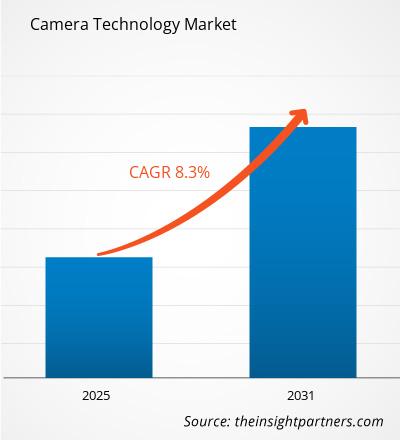
The global Camera Technology market was valued at US$ 5.02 billion in 2025 and is expected to reach US$ 7.81 billion by 2034; it is estimated to record a CAGR of 5.03% during 2026-2034.
Camera Technology Market Assessment and Insights
- North America held 29–33% of the Camera Technology Market share in 2025 and is growing at a CAGR of 5.3–6.1% during 2026–2034, supported by security modernization, edge analytics, automotive sensing, and defense imaging.
- US represented 78–82% of North American revenue in 2025 and is growing at a CAGR of 5.4–6.2% during 2026–2034, led by surveillance and autonomous systems.
- Europe accounted for 23–27% share in 2025 and is growing at a CAGR of 4.8–5.6% during 2026–2034, with Germany, the UK, France, Italy, and Spain leading adoption.
- Asia Pacific held 34–38% share in 2025 and is growing at a CAGR of 6.2–7.0% during 2026–2034, led by China, Japan, South Korea, India, and Taiwan.
- Largest Segment Sensors held 36–40% market share in 2025 and are growing at a CAGR of 5.9–6.7% during 2026–2034 as imaging performance defines system value.
- High Growth Segment 3D Depth Sensing Technology represented 18–22% market share in 2025 and is growing at a CAGR of 7.0–7.8% during 2026–2034.
- Key companies analyzed in detail: Axis Communications AB, Bosch Sicherheitssysteme GmbH, Teledyne FLIR LLC, Infineon Technologies AG, Nikon Corporation, Occipital Inc., Panasonic Holdings Corporation, Pelco, Inc., PrimeSense Ltd., SoftKinetic Systems S.A., Sony Semiconductor Solutions Corporation, Canon Inc.
Source: The Insight Partners' analysis based on proprietary research, government publications, company annual reports, investor presentations, industry databases, and expert interviews.
The market has shifted from standalone image-sensing devices to integrated sensing solutions with optics, processing, software, analysis, and communication components. The areas showing the fastest development in Camera Technology are those that require reliable perception in low-light conditions, depth detection, thermal imaging, and automated decision-making. Manufacturing processes will become more reliant on CMOS sensors manufacturing capabilities, edge AI chips, optical module design, and firmware availability.
Future demands will be driven by automotive safety standards, smart cities infrastructure, medical data digitization, robot navigation, and quality control in industry. New markets will provide opportunities for surveillance systems, consumer electronic device assembly, and healthcare delivery, while developed customers will value privacy management, power savings, and life-cycle support. Suppliers of Camera Technology with pre-tested sensor stacks, reference platforms, and application-specific software can claim advantage over others.
Camera Technology Market Report Scope
| Report Attribute | Details |
|---|---|
| Market size in 2025 | US$ 5.02 Billion |
| Market Size by 2034 | US$ 7.81 Billion |
| Global CAGR (2026 - 2034) | 5.03% |
| Historical Data | 2021-2024 |
| Forecast period | 2026-2034 |
Camera Technology Market Analysis
The Camera Technology Market growth is fueled by the move from capturing to perception. The demand has increased in applications such as autonomous navigation, factory inspections, patient monitoring, traffic management, immersive media, and perimeter security. End users will consider sensitivity, latency, depth precision, dynamic range, integrated analytics, and cybersecurity since cameras will make safety and continuity decisions.
Wafer providers, image sensor suppliers, optics suppliers, microcontrollers suppliers, module assembly firms, software suppliers, device OEMs, system integrators, and end users are among the participants in the value chain. Supply is dependent on the availability of semiconductors, the capability for precision optics, the skill in calibration and compliance testing.
The Camera Technology Market Report reveals the competitive environment characterized by the level of performance of the sensors, edge processing capabilities, vertical integration, and control of the ecosystem. The Axis Communications AB, Bosch Sicherheitssysteme GmbH, Teledyne FLIR LLC, Panasonic Holdings Corporation, Pelco, Inc., and Canon Inc. engage in competition in the fields of security and surveillance, thermal imaging, and professional capture, whereas Nikon Corporation enhances imaging capability in creation and industrial use cases.
The Infineon Technologies AG, Sony Semiconductor Solutions Corporation, SoftKinetic Systems S.A., Occipital Inc., and PrimeSense Ltd. serve as key players in the segment of enabling technologies, which include depth-sensing, image sensors, and embedded vision. The investments go to AI processors, multispectral fusion, thermal-visible modules, privacy-preserving analysis, and reference platforms.
● REPORT CUSTOMIZATION
Tailor This Report To Align With Your Specific Business Requirements
This report can be customized to align precisely with your business objectives, scope, and target markets. Customization options include tailored segmentation, geography, competitive analysis, and strategic insights to support informed decision-making.
Customize This Report →WHAT YOU CAN ADJUST
- ● Segmentations
- ● Geography
- ● Competitive Analysis
- ● Language Preferences
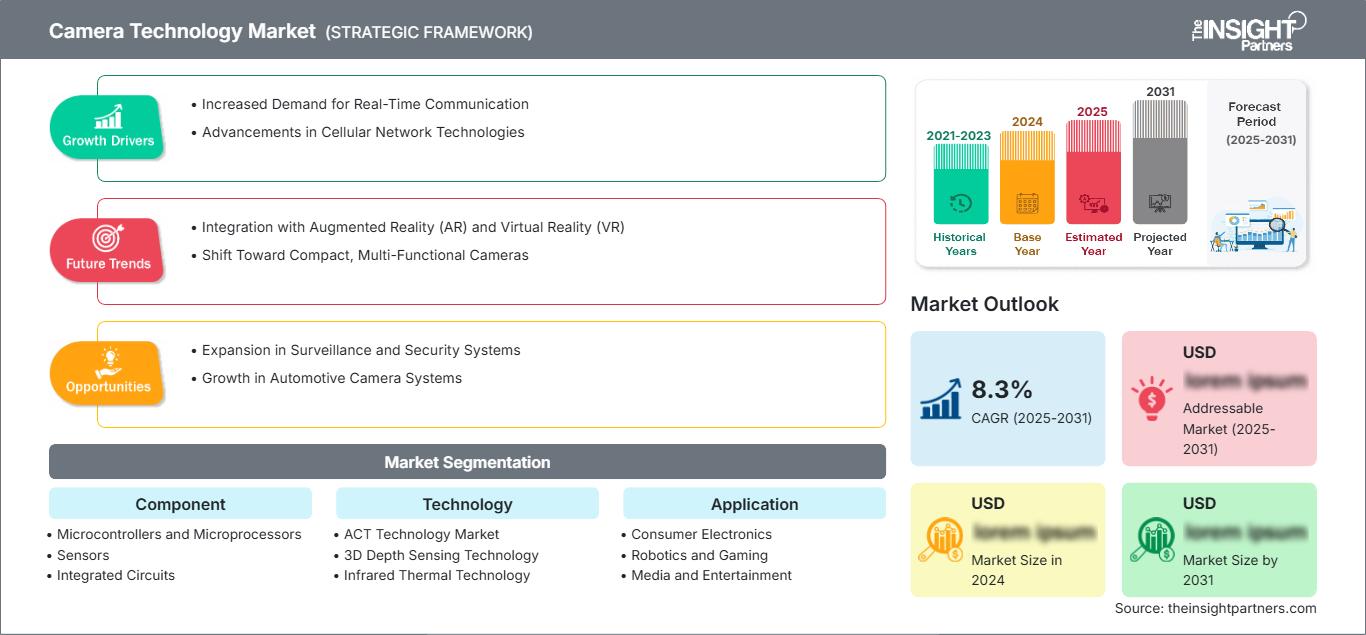
Camera Technology Market: Strategic Insights
Regional Insights
North America Camera Technology Market
North America accounted for 29–33% of Camera Technology share in 2025 and is projected to expand at a CAGR of 5.3–6.1% during 2026–2034. Demand reflects public safety video, data center security, healthcare imaging, defense surveillance, automotive perception, and robotics programs that require high reliability and secure device management.
The region benefits from strong software ecosystems, advanced semiconductor design, cloud video infrastructure, and systems integration expertise. Procurement favors edge analytics, thermal-visible fusion, and cyber-hardened cameras. Public infrastructure funding, warehouse automation, and hospital digitization support steady refresh cycles across enterprise, industrial, and mission-critical environments.
U.S. Camera Technology Market
The U.S. represented 78–82% of North American revenue in 2025 and is expected to grow at a CAGR of 5.4–6.2% during 2026–2034. Application trends center on AI-enabled surveillance, autonomous vehicles, defense imaging, surgical visualization, smart retail, and industrial machine vision.
Company presence includes Axis Communications AB, Bosch Sicherheitssysteme GmbH, Teledyne FLIR LLC, Panasonic Holdings Corporation, Pelco, Inc., Canon Inc., Nikon Corporation, and Sony Semiconductor Solutions Corporation. Federal infrastructure security, transportation safety, and healthcare modernization create recurring demand for cameras that combine analytics, storage efficiency, and secure lifecycle management.
Europe Camera Technology Market
Europe held 23–27% share in 2025 and is projected to grow at a CAGR of 4.8–5.6% during 2026–2034. Germany leads through automotive imaging, factory automation, and industrial inspection. The UK supports security, media production, and smart infrastructure, while France, Italy, and Spain add demand through transport, healthcare, and public safety.
Regional procurement emphasizes GDPR-aligned video analytics, low-power operation, and dependable integration with existing building and mobility systems. European OEMs also seek component traceability and long availability cycles. Camera Technology adoption is strongest where quality inspection, vehicle safety, and urban security converge with stricter privacy and sustainability expectations.
APAC Camera Technology Market
Asia Pacific accounted for 34–38% share in 2025 and is forecast to grow at a CAGR of 6.2–7.0% during 2026–2034. China leads through electronics manufacturing, surveillance infrastructure, and robotics supply chains, while Japan and South Korea strengthen premium imaging, image sensors, and automotive camera integration.
India, Taiwan, and Australia add momentum through smartphone assembly, semiconductor packaging, smart cities, and industrial inspection. Policy support for electronics localization and factory automation sustains camera module procurement. Regional buyers are price sensitive, but demand for depth, thermal, and AI-enabled features is increasing in higher-value applications.
Middle East & Africa Camera Technology Market
The Middle East & Africa market is projected to grow at a CAGR of 4.6–5.4% during 2026–2034. Saudi Arabia leads through smart city, tourism, airport, energy, and stadium security programs. The UAE supports premium surveillance, logistics, and media infrastructure, while South Africa remains important for mining safety and public monitoring.
Rest of MEA demand depends on ruggedized systems, remote monitoring, and reliable thermal imaging for energy assets, borders, and infrastructure corridors. Buyers prioritize durability, service access, and integration with command centers, creating opportunities for vendors that can support harsh environments and long operating cycles.
Segmentation Analysis
Component
Component is projected to grow at a CAGR of 5.5–6.3% during 2026–2034. The Camera Technology scope spans sensing, control, processing, and interface electronics that determine image quality, power consumption, latency, and reliability. Sensors remain the largest value pool, while microcontrollers, microprocessors, and integrated circuits enable edge analytics, connectivity, calibration, and secure firmware across industrial and consumer devices.
- Microcontrollers and Microprocessors coordinate image capture, compression, connectivity, and AI workloads, making them strategically important as cameras shift from recording devices to intelligent edge nodes.
- Sensors hold the strongest market position because resolution, sensitivity, dynamic range, and thermal response determine performance in smartphones, vehicles, robots, medical systems, and surveillance.
- Integrated Circuits support timing, power management, signal conversion, and security functions, helping manufacturers reduce module size while improving efficiency and operational stability.
Technology
Technology is forecast to grow at a CAGR of 6.0–6.8% during 2026–2034. Adoption is moving toward depth, thermal, and scientific imaging because applications need perception beyond standard visible capture. 3D depth sensing gains traction in robotics, automotive cabins, gesture interfaces, and spatial computing, while infrared thermal technology remains essential in defense, industrial maintenance, healthcare screening, and energy inspection.
- ACT Technology Market supports specialized camera performance where adaptive control, calibration, and timing accuracy improve image capture under variable movement, lighting, and environmental conditions.
- 3D Depth Sensing Technology is strategically important for spatial mapping, face authentication, obstacle detection, robotics navigation, and human-machine interaction requiring accurate distance perception.
- Infrared Thermal Technology delivers strong demand in low-visibility monitoring, predictive maintenance, fire detection, border security, and medical temperature assessment where visible cameras are insufficient.
- Scientific Cmos Image Sensor Technology serves high-performance research, microscopy, astronomy, inspection, and medical imaging applications requiring sensitivity, low noise, high frame rates, and measurement precision.
Application
Application is projected to grow at a CAGR of 5.4–6.2% during 2026–2034. Consumer electronics remains broad, but faster value creation is emerging in robotics, automotive safety, healthcare visualization, and defense surveillance. Camera Technology use cases increasingly require continuous sensing, analytics, and secure image pipelines rather than isolated capture functions.
- Consumer Electronics drives high-volume adoption through smartphones, laptops, tablets, wearables, and smart home devices that require improved imaging, depth effects, authentication, and video communication.
- Robotics and Gaming depends on depth, motion tracking, gesture recognition, and environmental mapping, supporting immersive interaction and autonomous navigation across consumer and industrial platforms.
- Media and Entertainment requires professional capture, virtual production, cinema workflows, sports broadcasting, and content creation tools that prioritize dynamic range, color accuracy, and compact form factors.
- Automotive uses cameras for driver monitoring, parking assistance, surround view, ADAS, cabin sensing, and future automated mobility, making reliability and environmental robustness critical.
- Healthcare applies camera systems in diagnostics, endoscopy, patient monitoring, telemedicine, surgical visualization, and laboratory imaging where accuracy, hygiene, and data integrity matter.
- Defense and Aerospace prioritizes thermal imaging, target detection, navigation, surveillance, unmanned systems, and situational awareness, requiring rugged modules with secure processing and low-light performance.
Opportunity Snapshot
| Application | Revenue Contribution | Trend Tag | Adoption Stage |
| Consumer Electronics | High | Edge Imaging | Mature |
| Robotics and Gaming | Medium | Depth Mapping | Scaling |
| Media and Entertainment | Medium | Virtual Capture | Scaling |
| Automotive | High | Cabin Sensing | Scaling |
| Healthcare | Medium | Surgical Vision | Scaling |
| Defense and Aerospace | High | Thermal Fusion | Mature |
Camera Technology Market Growth Drivers and Impact Analysis
Edge AI turns cameras into decision systems
Edge AI changes procurement as cameras today can be used for classifying objects, detecting abnormalities, counting movements, and initiating workflows without having to transmit all frames to the main server. It helps save bandwidth, increases reaction speed, and facilitates privacy-sensitive deployment. Edge AI has the most influence in security, retailing, factories, traffic control, and healthcare monitoring, which require immediate action. Companies, which combine processors, analytics, and device management, have an opportunity to earn greater margins compared with the vendors who sell hardware only. Users also decrease operational expenses because there is no need to have many people analyzing the video.
Depth and thermal sensing expand machine perception
Depth and thermal imaging increase the capabilities of camera technology by adding functionalities beyond just the capture of the visual scene. The applications of depth imaging range from robot navigation, monitoring of vehicle interiors, user authentication, and motion tracking in games. Thermal imaging finds use in fire detection, industry maintenance, perimeter protection, and health screening where light does not provide enough contrast or is completely unavailable. Increased market impact is reflected in higher average sales prices, increasing numbers of specialized modules, and the need for calibration software. Companies capable of multisensor fusion will find many applications possible within one device.
Automotive and healthcare require validated imaging reliability
Imaging solutions in automotive and healthcare generate robust demand since image quality can be safety-related and diagnostic. In the former industry, imaging is needed for the purposes of driver monitoring, parking assistance, surround view, and advanced driver assistance systems, while in the latter, imaging serves as a key tool in surgeries, diagnostics, telemedicine, and laboratory automation. This generates high demands on reliability, supply, traceability, and security of data. The impact on the market is a transition from simple camera modules to validated platforms providing documentation and testing support.
Camera Technology Market Future Trends
Multisensor fusion becomes standard in premium systems
The Camera Technology Market Trends indicate that the future is heading towards camera technologies which integrate visible light, infrared, depth, radar, sound, and environment into one operating plane. Future implementations would prefer cameras that provide contextual certainty rather than video alone. Security facilities may confirm an intrusion using thermal imaging and visible light. Robots may integrate depth perception along with object recognition, while vehicles would benefit from integrating interior as well as exterior perception. It would be about synchronization, calibration, AI algorithms, and cybersecurity to distinguish vendors.
Privacy-preserving analytics shape procurement criteria
Privacy-aware analytics will be at the heart of procurement requirements as video use cases increase in the public domain, work environments, healthcare, and for consumers. Future camera models will require redaction capabilities, anonymization, encryption, and proper data governance in addition to secure booting. It will impact procurement because buyers have to walk the fine line between gaining insights into operations while managing risk. The European Union will be one of the first markets to see this trend develop, but it is already happening worldwide.
Camera Technology Market Opportunities
Reference platforms for robotics and automation OEMs
The Camera Technology Market forecast is expected to encourage OEMs of robotics and automation to invest in reference platforms, since they need to be able to rely on perception technology without developing every sensing layer themselves. The vendors will be able to offer OEMs a set of depth sensing technologies, processors, optics, firmware, calibration software, and SDKs for robots used in warehouses, cleaning, agriculture, inspection processes, and collaborative robots. It would be easy to make such an opportunity profitable, considering the fact that OEMs want to reduce engineering risks and development periods.
Thermal-visible security for critical infrastructure
Critical Infrastructure providers require dependable detection through darkness, fog, heat, range, and restricted zones. Thermal-visible technology offers an opening in utilities, port facilities, airports, data centers, refineries, border crossings, railroad lines, and military bases. Companies can bundle durable cameras with analytics, cybersecurity, bandwidth compression, and command center integration capabilities. The most compelling offer will decrease false alerts while increasing the speed of verification. Service-based offerings involving installation, calibration, monitoring, and lifecycle management may help customers deal with risks and budgetary challenges.
Recent Developments
- March 2026: Rapidise, an India-based Original Design Manufacturer (ODM) specializing in AI-enabled hardware and electronics manufacturing, announced the expansion of its Vision AI and intelligent camera platform capabilities. This enables global companies to design, develop, and manufacture next-generation camera systems for industries including transportation, security, smart infrastructure, and industrial automation.
- July 2025: Hikvision today announced the launch of its new DeepinViewX-Series Bullet Cameras, powered by the advanced Guanlan large-scale AI models. These smart cameras are designed to provide better perimeter protection with longer video content analysis (VCA) range and fewer false and repeated alarms.
- April 2025: Kyocera Corporation (President: Hideo Tanimoto; "Kyocera") announced that HAPTIVITY, its proprietary tactile technology that replicates realistic touch sensations, has been integrated into the Sigma BF, a full-size mirrorless camera to be released this month. This is the first application of HAPTIVITY in a mirrorless camera.
Frequently Asked Questions

- Comprehensive Market Sizing and Forecast Analysis
- Detailed Segmentation Analysis
- In-Depth Market Dynamics Assessment
- Regional and Country-Level Insights
- Competitive Landscape and Company Benchmarking
- Strategic Business Intelligence
Recent Reports
Testimonials

The Insight Partners provided valuable market intelligence that supported our global go-to-market strategy. Their team was professional, responsive, and attentive to our feedback, providing thoughtful analysis and helpful methodological clarifications throughout the project.
Junmo Kim Chief Financial Officer (CFO), Enertech Co., Ltd.
The Insight Partners' SCADA System Market report is comprehensive, with valuable insights on current trends and future forecasts. The team was highly professional, responsive, and supportive throughout. We are very satisfied and highly recommend their services.
RAN KEDEM Partner, Reali Technologies LTDs
I requested a report on a very specific software market and the team produced the report in a few days. The information was very relevant and well presented. I then requested some changes and additions to the report. The team was again very responsive and I got the final report in less than a week.
JEAN-HERVE JENN Chairman, Future Analytica
We worked with The Insight Partners for an important market study and forecast. They gave us clear insights into opportunities and risks, which helped shape our plans. Their research was easy to use and based on solid data. It helped us make smart, confident decisions. We highly recommend them.
PIYUSH NAGPAL Sr. Vice President, High Beam Global
The Insight Partners delivered insightful, well-structured market research with strong domain expertise. Their team was professional and responsive throughout. The user-friendly website made accessing industry reports seamless. We highly recommend them for reliable, high-quality research services
YUKIHIKO ADACHI CEO, Deep Blue, LLC.
This is the first time I have purchased a market report from The Insight Partners.While I was unsure at first, I visited their web site and felt more comfortable to take the risk and purchase a market report.I am completely satisfied with the quality of the report and customer service. I had several questions and comments with the initial report, but after a couple of dialogs over email with their analyst I believe I have a report that I can use as input to our strategic planning process.Thank you so much for taking the extra time and making this a positive experience.I will definitely recommend your service to others and you will be my first call when we need further market data.
JOHN SUZUKI President and Chief Executive Officer, Board Director, BK Technologies
I wish to appreciate your support and the professionalism you displayed in the course of attending to my request for information regarding to infectious disease IVD market in Nigeria. I appreciate your patience, your guidance, and the fact that you were willing to offer a discount, which eventually made it possible for us to close a deal. I look forward to engaging The Insight Partners in the future, all thanks to the impression you have created in me as a result of this first encounter.
DR CHIJIOKE ONYIA MANAGING DIRECTOR, PineCrest Healthcare Ltd.Reason to Buy
- Informed Decision-Making
- Understanding Market Dynamics
- Competitive Analysis
- Identifying Emerging Markets
- Customer Insights
- Market Forecasts
- Risk Mitigation
- Boosting Operational Efficiency
- Strategic Planning
- Investment Justification
- Tracking Industry Innovations
- Aligning with Regulatory Trends





 Get Free Sample for