
Capacitive Sensor Market Size, Share & Forecast by 2034
Coverage: By Type (Touch Sensors, Motion Sensors, Position Sensors, Others); End-user (Consumer Electronics, Automotive, Oil and Gas, Healthcare, Food and Beverages, Aerospace and Defense, Others) , and Geography (North America, Europe, Asia Pacific, and South and Central America)
- Status : Data Released
- Report Code : TIPRE00008263
- Category : Electronics and Semiconductor
- No. of Pages : 150
- Available Report Formats :


- Last update date : July 28, 2026


2025 Market Size
US$ 33.36 Bn
Base year value
2034 Forecast
US$ 65.87 Bn
Projected by 2034
CAGR 2026-2034
7.85 %
Growth rate
Addressable Market
US$ 446.48 Bn
(2026-2034)
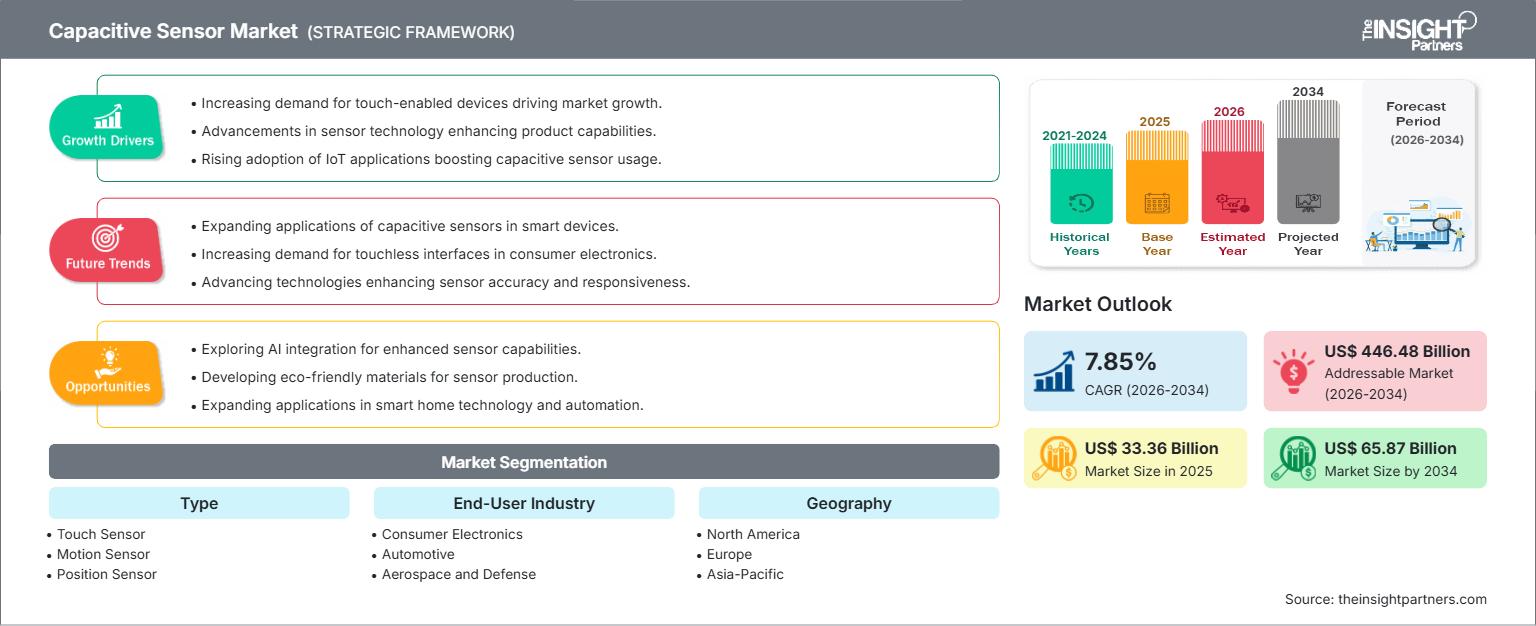
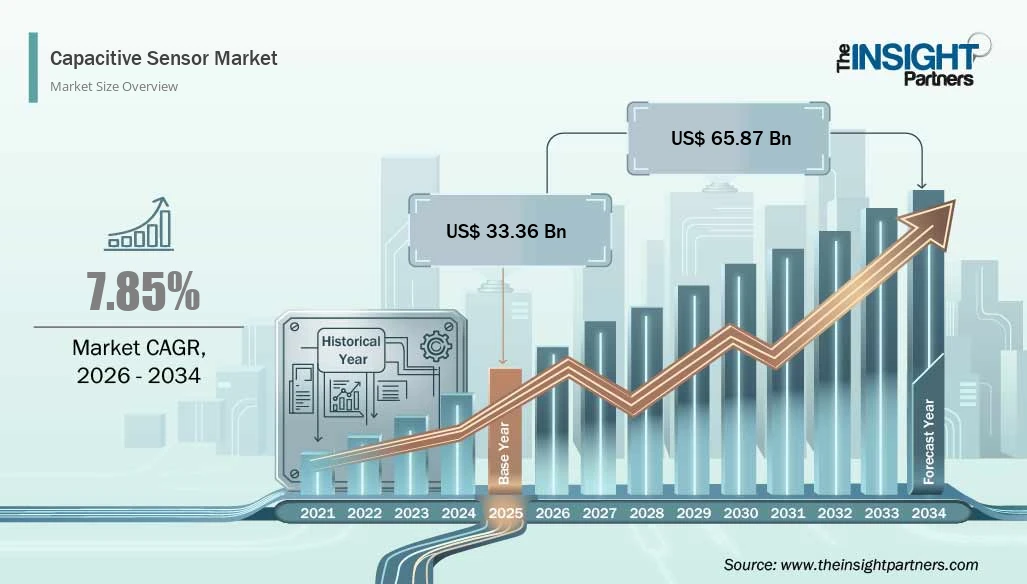
The Capacitive Sensor Market size was worth US$ 33.36 billion in 2025 and estimated to grow up to US$ 65.87 billion by 2034 with an impressive compound annual growth rate (CAGR) of 7.85% from 2026 to 2034. The need for these sensors is driven by the usage of touch, positional sensing, movement detection, and non-contact measurement in consumer electronics, automotive industry, healthcare sector, aerospace & defense, food and beverages, oil and gas, and process control applications.
In North America, the implementation of capacitive sensors is anticipated to show growth at a rate between 7.1% and 7.8% per year. This market will be propelled by the use of advanced automotive cockpit electronics, digitalization of medical devices, smart home appliances, and semiconductor development in the region for power saving and noise immune sensor systems.
Capacitive Sensor Market Assessment and Insights
- North America: The region holds 24–27% share in 2025 and grows at a CAGR range of 7.1–7.8% during 2026–2034, supported by automotive HMI, medical electronics, and smart home device integration.
- US: The country represents 78–82% of North America in 2025 and grows at a CAGR range of 7.0–7.7% during 2026–2034, led by semiconductor design and EV cockpit electronics.
- Europe: The region accounts for 20–23% share in 2025 and grows at a CAGR range of 6.8–7.4% during 2026–2034, with Germany, France, the UK, Italy, and Spain leading automotive and industrial adoption.
- Asia Pacific: The region holds 43–46% share in 2025 and grows at a CAGR range of 8.4–9.1% during 2026–2034, led by China, Japan, South Korea, India, and Taiwan electronics manufacturing clusters.
- Largest Segment: Touch Sensor holds 36–39% market share in 2025 and grows at a CAGR range of 7.6–8.3% during 2026–2034 due to consumer and automotive interfaces.
- High Growth Segment: Position Sensor holds 20–23% market share in 2025 and grows at a CAGR range of 8.6–9.3% during 2026–2034 through automation, robotics, and EV applications.
- Key companies analyzed in detail: Infineon Technologies AG; Microchip Technology Incorporated; Micro-Epsilon Messtechnik GmbH & Co. KG; NXP Semiconductors N.V.; OMRON Corporation; Renesas Electronics Corporation; STMicroelectronics N.V.; Synaptics Incorporated; Texas Instruments Incorporated; Cypress Semiconductor Corporation.
Source: The Insight Partners' analysis based on proprietary research, government publications, company annual reports, investor presentations, industry databases, and expert interviews.
Capacitive Sensing technology has grown beyond its button replacement capability to become a platform technology for touchscreen, proximity sensing, liquid-level sensing, gesture control, and precise displacement measurements. The production dynamics are favoring embedded sensor controller capabilities, enhanced signal-to-noise ratio, slim electrode structure, and software calibration since there is the need for operation via glass, plastic, metal, moisture, and electromagnetic interference. The Capacitive Sensor Market will be influenced by miniaturization, automotive software-based interior designs, medical usability requirements, and factory automation considerations.
The forward motion will be propelled by manufacturing in Asia Pacific, automotive electronic investments in North America, and industrial automation programs in Europe. Vehicle safety design, medical device design, and hygiene considerations are among the regulatory winds supporting the market since these aspects prefer sealed contactless interfaces. Investments are being made in calibration through artificial intelligence, power saving controller, and toughened sensors allowing operation in wet gloves, vibratory, and electromagnetic environments.
Capacitive Sensor Market Report Scope
| Report Attribute | Details |
|---|---|
| Market size in 2025 | US$ 33.36 Billion |
| Market Size by 2034 | US$ 65.87 Billion |
| Global CAGR (2026 - 2034) | 7.85% |
| Historical Data | 2021-2024 |
| Forecast period | 2026-2034 |
Capacitive Sensor Market Analysis
Capacitive Sensor Market growth comes from consumer products with touch capabilities, digital cockpit in vehicles, industrial automation applications, and non-contact interface in the health care sector. Capabilities offered by capacitive sensors such as enabling sealed surface, reduction in mechanical wear and tear, thin product design and flexibility in interacting with users make these sensors valuable for OEMs.
Value chain participants include electrode material manufacturers, semiconductor manufacturers, firmware provider for controllers, display manufacturers, module assembler, test equipment providers, and OEM system designer. Supplier dynamics give advantage to those suppliers who provide reference designs, safety documentation, libraries of algorithms and scalable manufacturing. Selection of components takes into account immunity, calibration time and qualification among others in addition to touch sensitivity.
The competitive positioning within the Capacitive Sensor Market results from a combination of semiconductor size, application software, and specialty measurement technology. Infineon Technologies AG, Microchip Technology Incorporated, NXP Semiconductors N.V., Renesas Electronics Corporation, STMicroelectronics N.V., and Texas Instruments Incorporated are competing using embedded sensor control, MCU environment, automotive certification, and OEM design capability for consumer, automobile, and industrial applications.
These include specialists such as Micro-Epsilon Messtechnik GmbH & Co. KG, OMRON Corporation, Synaptics Incorporated, and Cypress Semiconductor Corporation, which provide specialized measurement capabilities in precise displacement, factory sensing, touch-controller intellectual property, and legacy capacitive sensors. Investment trend demonstrates that companies have invested in areas such as automotive displays, smart appliances, medical devices, EV batteries, and industrial robots.
● REPORT CUSTOMIZATION
Tailor This Report To Align With Your Specific Business Requirements
This report can be customized to align precisely with your business objectives, scope, and target markets. Customization options include tailored segmentation, geography, competitive analysis, and strategic insights to support informed decision-making.
Customize This Report →WHAT YOU CAN ADJUST
- ● Segmentations
- ● Geography
- ● Competitive Analysis
- ● Language Preferences
Capacitive Sensor Market: Strategic Insights
Regional Insights
North America Capacitive Sensor Market
North America holds 24–27% share in 2025 and is projected to grow at a CAGR range of 7.1–7.8% during 2026–2034. Capacitive Sensor Market share is supported by automotive cockpit digitization, smart home devices, medical electronics, and industrial automation. Regional demand is strengthened by semiconductor design ecosystems, safety-oriented vehicle electronics, and premium consumer device adoption.
Procurement priorities focus on low-power scanning, moisture tolerance, electromagnetic compatibility, and long product lifecycles. Automotive suppliers are adopting capacitive touch sliders, displays, and proximity detection, while healthcare device makers use sealed interfaces to support cleaning and usability. Industrial users deploy position and level sensors where non-contact measurement improves reliability and reduces maintenance exposure.
U.S. Capacitive Sensor Market
The U.S. constitutes 78 to 82 percent of North America in 2025 and witnesses a CAGR of 7.0 to 7.7 percent in 2026 to 2034. Applications include vehicle infotainment systems, medical monitoring devices, intelligent home appliances, military electronics, and automated manufacturing. The companies providing solutions for touch controllers, MCUs, and interfaces include Microchip Technology Incorporated, Texas Instruments Incorporated, Synaptics Incorporated, and Cypress Semiconductor Corporation.
The application area includes curved automotive screens, knob on display controls, health wearable interfaces, and sealed control panels used in food processing and laboratory instruments. There are concerns about security, firmware updates, and functional safety documents for sensors that operate with the vehicle or medical applications. Domestic design capability helps to deliver top engineering capabilities despite the module assembly in Asia.
Europe Capacitive Sensor Market
Europe holds a market share of 20-23% in 2025 and records growth at CAGR 6.8-7.4% from 2026 to 2034. Germany leads the Europe market due to its need for automotive electronics, robotics, and industrial machinery that necessitate reliable touch, motion, and positioning sensors. The United Kingdom participates through medical equipment, military electronics, and intelligent building control systems that prefer hermetically-sealed user interfaces.
France, Italy, and Spain contribute to demand through aerospace technology, food-processing machinery, appliance production, and energy networks. European buyers attach great importance to reliability, functional safety, electromagnetic compatibility, and sustainable designs. Infineon Technologies AG, STMicroelectronics N.V., Micro-Epsilon Messtechnik GmbH & Co. KG, and OMRON Corporation stand to gain where accuracy and engineering proximity affect qualification criteria.
APAC Capacitive Sensor Market
The APAC region accounts for a 43-46% market share in 2025 and is expected to experience growth within a CAGR of 8.4-9.1% through 2026-2034. The major contributors are China, Japan, South Korea, India, Taiwan, and Australia. The production of consumer electronics, manufacture of electric vehicles, displays, and industrial automation necessitates touch and position sensors.
Regional policies in place for electronic localization, semiconductor packaging, smart factories, and electric mobility promote usage in the region. In Japan and South Korea, precision, reliability, and advanced displays form the basis of usage, whereas India focuses on production of appliances, smartphones, and automotive electronics.
Middle East & Africa Capacitive Sensor Market
Growth of the Middle East and Africa market is estimated to be at a CAGR range between 6.5% to 7.2% during 2026-2034. The key growth driver countries in the region include Saudi Arabia driven by industrial automation, smart infrastructure, and monitoring in the energy industry; UAE through smart buildings and healthcare sector; and South Africa in terms of manufacturing and process industry.
In the Rest of the MEA market, adoption of oil & gas equipment, water systems, food processing, and infrastructure control panels is among the end-user applications. Rugged sensors that can survive dusty, humid, and high-heat environments are preferred. In situations where mechanical switches are prone to contamination, non-contact sensing solutions become more popular.
Segmentation Analysis
Type
Type is projected to grow at a CAGR range of 7.7–8.4% during 2026–2034. Capacitive Sensor Market scope is strongest where designers need touch, motion, and position sensing without mechanical wear. Adoption depends on signal processing accuracy, electrode design, environmental compensation, and the ability to integrate sensing into compact devices, vehicles, medical equipment, and automation panels.
- Touch Sensor: Touch sensors hold the largest position because smartphones, appliances, automotive displays, wearables, and industrial panels require responsive, sealed, and design-flexible interfaces.
- Motion Sensor: Motion sensors support gesture, displacement, and activity detection where compact electronics need reliable movement awareness for consumer devices, vehicles, robotics, and healthcare equipment.
- Position Sensor: Position sensors gain strategic importance in automation, EV systems, liquid-level measurement, and precision equipment where non-contact feedback improves durability and measurement consistency.
End-User Industry
End-User Industry is expected to grow at a CAGR range of 7.4–8.1% during 2026–2034. Demand varies by interface density, reliability needs, qualification burden, and price sensitivity. Consumer electronics delivers volume, automotive adds safety and display complexity, healthcare prioritizes sealed usability, and process industries use capacitive sensors for level, proximity, and contamination-resistant measurement.
- Consumer Electronics: Consumer electronics leads adoption through smartphones, tablets, wearables, gaming devices, smart appliances, and home controls that depend on compact touch and proximity interfaces.
- Automotive: Automotive demand rises with digital cockpits, EV controls, infotainment displays, smart keys, occupancy interfaces, and sealed panels that must tolerate vibration and temperature variation.
- Aerospace and Defense: Aerospace and defense use capacitive sensing in rugged controls, cockpit interfaces, secure equipment, and monitoring systems where reliability and low-maintenance operation are critical.
- Healthcare: Healthcare adoption is shaped by patient monitors, diagnostic instruments, wearables, and sealed control surfaces that support cleaning, usability, and reduced mechanical failure.
- Food and Beverage: Food and beverage facilities use capacitive sensors for level detection, packaging automation, hygiene-sensitive controls, and non-contact measurement in wet or contamination-prone environments.
- Oil and Gas: Oil and gas applications include tank monitoring, process control, proximity detection, and ruggedized instrumentation where corrosion, dust, and maintenance access influence sensor choice.
Opportunity Snapshot
| End-User Industry | Revenue Contribution | Trend Tag | Adoption Stage |
| Consumer Electronics | High | Smart Touch | Mature |
| Automotive | High | Digital Cockpit | Scaling |
| Aerospace and Defense | Medium | Rugged HMI | Scaling |
| Healthcare | Medium | Sealed Care | Scaling |
| Food and Beverage | Medium | Hygienic Control | Scaling |
| Oil and Gas | Medium | Tank Sensing | Mature |
| Other End-User Industries | Low | Custom Sensing | Emerging |
Capacitive Sensor Market Growth Drivers and Impact Analysis
Expansion of Touch Interfaces in Connected Devices
Touch-based interfaces are emerging as standard components of smartphones, wearable devices, home appliances, medical devices, and industrial control panels owing to their lower mechanical component count and thin, sealed construction. The effects of this market driver can be seen from rising controller purchases, increased firmware capabilities, and rising need for water resistance, glove-sensing capabilities, and EM immunity. Another important effect of this market driver on suppliers is seen in the form of OEMs using capacitive touch controls to offer distinctive designs by using no moving parts at all. This market driver leads to recurring business opportunities as products undergo redesigning cycles.
Automotive Digital Cockpit and EV Electronics Adoption
As software-driven vehicles become the norm, automotive interiors will increasingly consist of large displays, capacitive sliders, intelligent surfaces, and integrated controls. Capacitive sensing technology enables the functionality of infotainment systems, climate control, steering, door handle, seats, proximity applications, etc., while aiding designers in reducing the number of mechanical switches. In electric vehicles, the need for small, robust, and power-efficient solutions is critical for cockpit electronics and battery sensing technologies. Qualification requirements increase the hurdles to entering the market, yet also ensure long-lasting projects and recurring revenue after the platforms enter production.
Non-Contact Measurement in Automation and Process Industries
Industrial automation, food processing, oil and gas, and healthcare equipment increasingly need sensors that detect position, level, or proximity without direct mechanical contact. Capacitive sensors are valuable because they can detect conductive and non-conductive materials through container walls or protective surfaces. The real-world impact includes lower maintenance, fewer contamination risks, and improved uptime in wet, dusty, corrosive, or hard-to-access environments. Adoption also supports predictive maintenance when sensors feed data into connected control systems. Suppliers that offer rugged housings, stable calibration, and application engineering can capture demand beyond consumer touch applications.
Capacitive Sensor Market Future Trends
AI-Assisted Calibration and Environmental Compensation
Capacitive Sensor Market trends will increasingly favor controllers that use adaptive algorithms to compensate for humidity, temperature, water films, foam, residue, and display noise. Future products will learn baseline shifts faster, reduce false triggers, and simplify tuning for OEMs producing multiple device variants. This direction is important for appliances, vehicles, healthcare devices, and industrial panels that operate in unpredictable conditions. Suppliers will differentiate through software libraries, development tools, and embedded intelligence rather than electrode hardware alone. Better calibration will also reduce engineering effort during product qualification and improve field reliability after deployment.
Touch on Metal and Flexible Surface Integration
Future device designs will move capacitive sensing beyond flat glass into metal overlays, curved displays, flexible substrates, and decorative surfaces. This will enable cleaner appliance fronts, robust industrial panels, premium vehicle interiors, and wearable interfaces that blend sensing with product aesthetics. The shift requires stronger noise rejection, improved shielding, and combined capacitive-inductive approaches. Vendors that support touch-through-metal, force-like interaction, and proximity detection will gain design influence earlier in product development. As surfaces become multifunctional, sensing performance, industrial design, and manufacturability will be evaluated together rather than as separate engineering choices.
Capacitive Sensor Market Opportunities
Automotive Display Controller and Smart Surface Programs
Capacitive Sensor Market Forecasts point to an actionable opportunity in automotive display controllers, curved panels, and smart surfaces. Suppliers can target OEMs and Tier 1 integrators with reference designs that combine capacitive touch, haptic feedback, knob-on-display control, firmware security, and safety documentation. The investment case is strongest where common controller platforms can scale across vehicle trims and regions. Vendors should also support OLED, microLED, and wide-format display integration because advanced cockpits increase electrode count and noise challenges. Qualification support, long-term supply commitments, and fast tuning tools will be decisive for converting design interest into platform awards.
Industrial Level and Position Sensing Modernization
Industrial modernization creates an opportunity for capacitive sensors in tanks, packaging lines, robotics, conveyors, food equipment, and process control panels. End users want fewer mechanical switches, lower maintenance, and better sensing in wet, dusty, or corrosive environments. Suppliers can package sensors with rugged enclosures, teach-in calibration, IO-Link connectivity, and application-specific mounting accessories. The opportunity is attractive because industrial customers often value reliability and service support over the lowest component price. Partnerships with machine builders and automation distributors can accelerate adoption by embedding capacitive sensing into standard equipment designs and retrofit kits.
Recent Developments
- July 2026: Infineon Technologies completed the acquisition of the non-optical analog/mixed-signal sensor portfolio from ams OSRAM, strengthening its sensor capabilities across automotive, industrial, and medical markets. The acquisition adds advanced position, angle, temperature, and sensor interface technologies, along with approximately 230 employees and additional R&D capabilities. The expanded portfolio supports applications including vehicle chassis sensing, robotics, industrial automation, building systems, and medical imaging, enabling Infineon to deliver more integrated edge solutions combining sensing, processing, connectivity, and security technologies.
- March 2025: Infineon Technologies announced the expansion of its PSOC™ 4 microcontroller family with new Multi-Sense capabilities, combining fifth-generation CAPSENSE™ capacitive sensing, proprietary inductive sensing, and non-contact liquid sensing technologies. The PSOC™ 4 Multi-Sense platform enables advanced human-machine interfaces (HMI), proximity detection, touch-over-metal applications, and industrial sensing solutions with improved noise immunity, lower power consumption, and higher signal-to-noise performance. The technology targets consumer, industrial, and IoT applications requiring integrated sensing and control capabilities.
- June 2025: UltraSense Systems launched CapForce™ Edge, an integrated capacitive and force sensing controller designed for advanced smart surface applications across automotive, consumer electronics, industrial, medical, and robotics markets. The controller combines 24-channel capacitive touch sensing with 8-channel piezoelectric force sensing on a single chip, enabling precise touch and press detection through materials such as metal and glass. Featuring EMI mitigation, embedded sensor-fusion processing, and multi-protocol support, CapForce™ Edge enables durable, buttonless human-machine interfaces for applications requiring compact, reliable, and sealed control surfaces.
Frequently Asked Questions

- Comprehensive Market Sizing and Forecast Analysis
- Detailed Segmentation Analysis
- In-Depth Market Dynamics Assessment
- Regional and Country-Level Insights
- Competitive Landscape and Company Benchmarking
- Strategic Business Intelligence
Recent Reports
Testimonials

The Insight Partners' SCADA System Market report is comprehensive, with valuable insights on current trends and future forecasts. The team was highly professional, responsive, and supportive throughout. We are very satisfied and highly recommend their services.
RAN KEDEM Partner, Reali Technologies LTDs
I requested a report on a very specific software market and the team produced the report in a few days. The information was very relevant and well presented. I then requested some changes and additions to the report. The team was again very responsive and I got the final report in less than a week.
JEAN-HERVE JENN Chairman, Future Analytica
We worked with The Insight Partners for an important market study and forecast. They gave us clear insights into opportunities and risks, which helped shape our plans. Their research was easy to use and based on solid data. It helped us make smart, confident decisions. We highly recommend them.
PIYUSH NAGPAL Sr. Vice President, High Beam Global
The Insight Partners delivered insightful, well-structured market research with strong domain expertise. Their team was professional and responsive throughout. The user-friendly website made accessing industry reports seamless. We highly recommend them for reliable, high-quality research services
YUKIHIKO ADACHI CEO, Deep Blue, LLC.
This is the first time I have purchased a market report from The Insight Partners.While I was unsure at first, I visited their web site and felt more comfortable to take the risk and purchase a market report.I am completely satisfied with the quality of the report and customer service. I had several questions and comments with the initial report, but after a couple of dialogs over email with their analyst I believe I have a report that I can use as input to our strategic planning process.Thank you so much for taking the extra time and making this a positive experience.I will definitely recommend your service to others and you will be my first call when we need further market data.
JOHN SUZUKI President and Chief Executive Officer, Board Director, BK Technologies
I wish to appreciate your support and the professionalism you displayed in the course of attending to my request for information regarding to infectious disease IVD market in Nigeria. I appreciate your patience, your guidance, and the fact that you were willing to offer a discount, which eventually made it possible for us to close a deal. I look forward to engaging The Insight Partners in the future, all thanks to the impression you have created in me as a result of this first encounter.
DR CHIJIOKE ONYIA MANAGING DIRECTOR, PineCrest Healthcare Ltd.Reason to Buy
- Informed Decision-Making
- Understanding Market Dynamics
- Competitive Analysis
- Identifying Emerging Markets
- Customer Insights
- Market Forecasts
- Risk Mitigation
- Boosting Operational Efficiency
- Strategic Planning
- Investment Justification
- Tracking Industry Innovations
- Aligning with Regulatory Trends





 Get Free Sample for