
Ceiling Tiles Market Size, Demand & Growth by 2034
Coverage: by Material Type (Mineral Fiber, Metal, Gypsum, Others); Type (Acoustic Ceiling Tiles, Non-Acoustic Ceiling Tiles); End-Use Application (Residential, Industrial, Commercial) , and Geography (North America, Europe, Asia Pacific, and South and Central America)
- Status : Data Released
- Report Code : TIPRE00004042
- Category : Chemicals and Materials
- No. of Pages : 150
- Available Report Formats :


- Last update date : September 22, 2026


2025 Market Size
US$ 9.07 Bn
Base year value
2034 Forecast
US$ 15.62 Bn
Projected by 2034
CAGR 2026-2034
6.23 %
Growth rate
Addressable Market
US$ 111.78 Bn
(2026-2034)
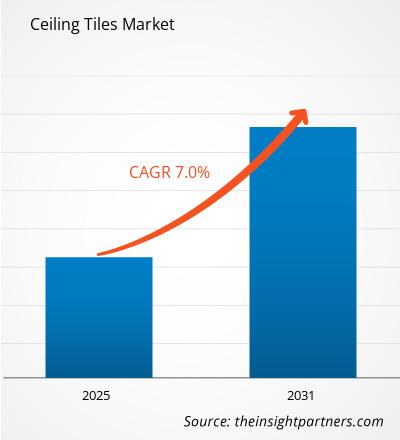
The Ceiling Tiles Market was valued at US$ 9.07 Billion in 2025 and is projected to reach US$ 15.62 Billion by 2034, expanding at a CAGR of 6.23% during 2026–2034. Demand continues to strengthen as commercial construction, institutional infrastructure, and residential renovation projects increasingly prioritize durable, fire-resistant, and acoustically optimized ceiling systems. Manufacturers are introducing lightweight, recyclable, and high-performance products that support modern building standards and evolving architectural requirements.
Across North America, sustained investment in commercial renovations, healthcare infrastructure, and educational facilities continues to reinforce regional demand. The Ceiling Tiles Market size in the region benefits from stringent building regulations encouraging energy-efficient and acoustic interior solutions. Accelerating refurbishment of aging office buildings, coupled with the adoption of sustainable construction materials, is expected to support regional expansion at an estimated CAGR of 5.7–6.1% through the forecast period.
Ceiling Tiles Market Assessment and Insights
- North America: Accounted for a 31–34% share in 2025 and is anticipated to expand at a CAGR of 5.7–6.1% during 2026–2034. Strong institutional construction, office refurbishment, and sustainable building certifications continue to support product adoption across commercial and public infrastructure projects.
- U.S.: Represented 78–82% of the North American market in 2025 and is projected to grow at a CAGR of 5.8–6.2% during 2026–2034. Demand remains supported by healthcare modernization, educational infrastructure, and premium commercial developments emphasizing acoustic performance.
- Europe: Held 27–30% share in 2025 and is expected to register a CAGR of 5.5–5.9% during 2026–2034. Germany, the UK, and France continue to lead demand owing to renovation activity, energy-efficient construction practices, and stringent building regulations.
- Asia Pacific: Captured 28–31% share in 2025 and is forecast to expand at a CAGR of 7.2–7.7% during 2026–2034. China, India, Japan, and South Korea are driving regional expansion through rapid urbanization, commercial construction, and public infrastructure investments.
- Largest Segment: Commercial accounted for 48–52% of the Ceiling Tiles Market share in 2025 and is expected to record a CAGR of 6.0–6.4% during 2026–2034, supported by office modernization, retail developments, healthcare facilities, and hospitality construction.
- High Growth Segment: Metal is projected to register the fastest expansion, holding 22–26% market share in 2025 while advancing at a CAGR of 7.1–7.6% during 2026–2034, driven by superior durability, moisture resistance, and recyclable material characteristics.
- Key companies analyzed in detail: Saint-Gobain, SAS International, Armstrong World Industries, Inc., Byucksan Corporation, CertainTeed LLC, CSR Limited, Hunter Douglas Inc., Knauf Group, USG Corporation, ROCKWOOL International A/S.
Source: The Insight Partners' analysis based on proprietary research, government publications, company annual reports, investor presentations, industry databases, and expert interviews.
Continuous innovation in manufacturing technologies has transformed production capabilities across the industry. Automated forming, precision surface finishing, advanced mineral fiber processing, and digital quality inspection systems have improved manufacturing efficiency while reducing material waste. Product portfolios increasingly incorporate recycled raw materials, enhanced fire resistance, antimicrobial coatings, and improved acoustic performance to satisfy evolving commercial and institutional building requirements. Growing certification under sustainable construction frameworks has further encouraged manufacturers to optimize production processes and strengthen supply chain resilience.
Future industry expansion is expected to be supported by infrastructure investments across emerging economies, modernization of educational and healthcare facilities, and stricter environmental regulations promoting recyclable construction materials. Digital building design platforms and prefabricated construction techniques are also encouraging greater adoption of standardized ceiling systems. Increasing collaboration between manufacturers, architects, and contractors is expected to accelerate product customization while improving installation efficiency and lifecycle performance across diverse building applications.
Ceiling Tiles Market Report Scope
| Report Attribute | Details |
|---|---|
| Market size in 2025 | US$ 9.07 Billion |
| Market Size by 2034 | US$ 15.62 Billion |
| Global CAGR (2026 - 2034) | 6.23% |
| Historical Data | 2021-2024 |
| Forecast period | 2026-2034 |
Ceiling Tiles Market Analysis
Growing investments in commercial buildings, healthcare facilities, airports, educational campuses, and hospitality projects continue to stimulate the Ceiling Tiles Market growth worldwide. Expanding urban populations and increasing renovation activities are generating sustained replacement demand, particularly in mature economies. Rising awareness regarding indoor environmental quality, acoustic comfort, and energy-efficient building envelopes has further strengthened product adoption across institutional and commercial sectors. Green building certifications increasingly recognize ceiling systems manufactured using recycled content and low-emission materials, encouraging wider market penetration.
The industry value chain includes raw material suppliers, mineral fiber and gypsum processors, metal sheet manufacturers, component fabricators, ceiling system manufacturers, distributors, contractors, architects, and building owners. Stable sourcing of gypsum, steel, aluminum, and mineral wool remains essential for maintaining production efficiency. Manufacturers continue strengthening regional supply chains through localized production facilities to reduce transportation costs, improve delivery reliability, and respond more effectively to fluctuations in construction activity.
Comprehensive Ceiling Tiles Market analysis indicates that competition increasingly focuses on product differentiation, sustainability credentials, and integrated ceiling system solutions rather than pricing alone. Leading manufacturers continue investing in research, digital manufacturing technologies, and environmentally responsible production processes to strengthen competitive positioning. Product innovation now emphasizes enhanced acoustics, moisture resistance, modular installation, and compatibility with modern lighting and HVAC systems.
Major participants, including Saint-Gobain, Armstrong World Industries, Inc., Knauf Group, USG Corporation, ROCKWOOL International A/S, Hunter Douglas Inc., SAS International, CertainTeed LLC, Byucksan Corporation, and CSR Limited, continue expanding manufacturing capabilities and premium product portfolios. Strategic investments emphasize recyclable materials, low-carbon manufacturing technologies, and integrated ceiling solutions designed for healthcare, education, commercial offices, and public infrastructure. Partnerships with architects and construction firms further strengthen long-term market positioning while supporting regional expansion strategies.
● REPORT CUSTOMIZATION
Tailor This Report To Align With Your Specific Business Requirements
This report can be customized to align precisely with your business objectives, scope, and target markets. Customization options include tailored segmentation, geography, competitive analysis, and strategic insights to support informed decision-making.
Customize This Report →WHAT YOU CAN ADJUST
- ● Segmentations
- ● Geography
- ● Competitive Analysis
- ● Language Preferences
Ceiling Tiles Market: Strategic Insights
Regional Insights
North America Ceiling Tiles
North America accounted for 31–34% of the global Ceiling Tiles Market share in 2025 and is projected to expand at a CAGR of 5.7–6.1% through 2034. Renovation of aging commercial buildings, expansion of healthcare infrastructure, and modernization of educational facilities continue to support regional demand. Building owners increasingly prioritize ceiling systems that improve acoustic performance, fire safety, indoor air quality, and maintenance efficiency while complying with evolving sustainability standards.
The region also benefits from stringent construction regulations encouraging energy-efficient building materials and recyclable interior products. Growing investment in data centers, transportation terminals, hospitality projects, and government infrastructure further supports market expansion. Manufacturers continue strengthening regional production capacity while introducing modular ceiling systems compatible with digital building management technologies, improving installation speed and long-term operational efficiency.
U.S. Ceiling Tiles Market
The United States represented 78–82% of North America's market during 2025 and is expected to register a CAGR of 5.8–6.2% through the forecast period. Demand remains concentrated across commercial offices, hospitals, educational institutions, retail developments, and government buildings. Rising renovation activity supports the replacement of conventional ceiling materials with higher-performing acoustic and fire-resistant systems that satisfy increasingly stringent construction requirements.
Leading suppliers, including Armstrong World Industries, Inc., USG Corporation, CertainTeed LLC, and Saint-Gobain, maintain strong manufacturing and distribution networks throughout the country. Architects increasingly specify suspended ceiling systems supporting integrated lighting, ventilation, and digital building technologies. Federal and state investments in healthcare modernization, educational infrastructure, and public transportation continue to create stable long-term demand for premium ceiling products.
Europe Ceiling Tiles Market
Europe accounted for 27-30% of global demand in 2025 and is expected to grow at a CAGR of 5.5-5.9% over the forecast period. Germany remains the most prominent national market due to ongoing commercial construction, industrial upgrading, and the adoption of energy-efficient building codes. Various renovation programs for public facilities boost future demand for products.
The United Kingdom still benefits from considerable adoption fueled by office renovations, educational investments, and healthcare infrastructure upgradation. France, Italy, and Spain together make considerable contributions to demand via hospitality projects, commercial renovation, transportation infrastructure, and public building renovation. Regional players tend to focus on recycled products and lower carbon footprints in line with new environmental standards in Europe.
APAC Ceiling Tiles Market
Asia Pacific held a Ceiling Tiles Market share of 28-31% in 2025 and is projected to grow at a CAGR of 7.2-7.7% until 2034. Consumption in China dominates this region, while India, Japan, South Korea, and Australia follow. Factors responsible for growth include urbanization, construction of commercial buildings, investment in manufacturing, and development of transportation infrastructure.
Government infrastructure schemes, smart city initiatives, and the use of sustainable construction materials are continually driving the installation of contemporary ceilings. Growing disposable income and commercial real estate developments have also been driving the use of high-end acoustic and decorative ceilings.
Middle East & Africa Ceiling Tiles Market
The Middle East & Africa region is expected to grow at a CAGR of 6.3–6.8%. Saudi Arabia and the UAE remain key drivers, driven by commercial projects, tourism facilities, healthcare investments, and massive urban infrastructure projects. South Africa remains a contributor to demand through institutional and commercial remodeling activities.
Airport, hospitality, mixed-use, and other public infrastructure projects continue to drive consumption in the region. Government diversification policies and energy-efficient building practices are driving demand for fire-resistant, durable, and recyclable ceiling systems suitable for modern commercial environments.
Segmentation Analysis
Material Type
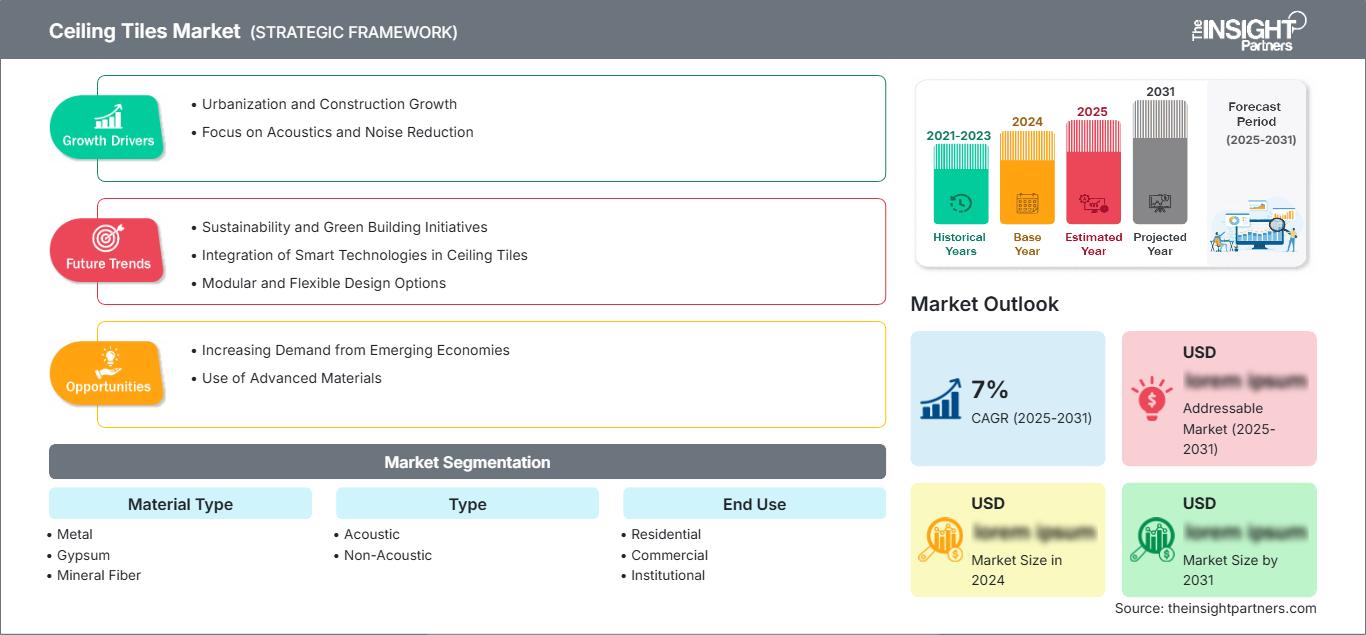
The material type segment is estimated to experience a CAGR of 6.4–6.8% from 2026 to 2034. Material choice is based on acoustics, fire retardancy, longevity, moisture resistance, cost, and sustainability. Recyclable, lightweight materials are being developed by manufacturers to comply with ever more demanding building codes and improve installation efficiency. The ceiling tiles market scope is continually expanding as projects require specialized materials.
- Metal: Metal ceiling tiles are widely used in airports, hospitals, transportation hubs, and premium commercial buildings because of their durability, corrosion resistance, ease of maintenance, and compatibility with integrated lighting and ventilation systems.
- Gypsum: Gypsum ceiling tiles remain extensively adopted across residential developments, offices, hotels, and educational facilities owing to their cost efficiency, smooth finish, fire resistance, and straightforward installation in suspended ceiling systems.
- Mineral Fiber: Mineral fiber ceiling tiles are preferred where superior acoustic absorption and thermal insulation are required. Healthcare facilities, educational institutions, offices, and government buildings increasingly utilize these products to improve occupant comfort.
Type
The Type segment category is expected to grow at a CAGR of 6.2% – 6.6% for the period 2026 – 2034. Product differentiation is now based on factors such as acoustics, aesthetics, indoor environment, and compatibility with building services. Ongoing product innovations help expand its use across commercial buildings, public infrastructure, educational campuses, and residential renovation projects requiring specialized ceiling solutions.
- Acoustic: Acoustic ceiling tiles reduce reverberation and improve speech clarity, making them highly suitable for offices, hospitals, schools, conference centers, and entertainment venues where sound management directly influences occupant experience.
- Non-Acoustic: Non-acoustic ceiling tiles continue serving applications where appearance, moisture resistance, hygiene, and maintenance are prioritized over advanced sound absorption, including residential buildings, utility spaces, retail outlets, and industrial facilities.
End Use
The End Use segment Category is forecasted to grow at a CAGR of 6.5–6.9% for 2026-2034. Rising spending on commercial construction, institutional upgrades, and home renovations will continue to drive steady demand across all end users. There is a growing focus on sustainable interiors, energy efficiency, and occupant comfort, which is encouraging the widespread use of suspended ceiling systems across global markets.
- Residential: Residential demand continues to increase through home remodeling, apartment construction, and premium housing developments seeking decorative ceiling finishes, moisture-resistant products, and improved thermal and acoustic performance.
- Commercial: Commercial buildings represent the largest revenue contributor, supported by office developments, retail complexes, hospitality facilities, healthcare infrastructure, airports, and mixed-use projects requiring durable, visually appealing, and high-performance ceiling systems.
- Institutional: Institutional applications remain strategically important across schools, universities, government buildings, healthcare facilities, and public infrastructure, where fire safety, acoustics, hygiene, and lifecycle durability remain primary purchasing considerations.
Opportunity Snapshot
| End Use | Revenue Contribution | Trend Tag | Adoption Stage |
| Residential | Medium | Home Renovation | Scaling |
| Commercial | High | Smart Offices | Mature |
| Institutional | Medium | Healthcare Upgrade | Scaling |
Ceiling Tiles Market Growth Drivers and Impact Analysis
Expansion of Commercial and Institutional Infrastructure
There is a growing trend towards commercial construction in office buildings, health-care facilities, educational institutions, airports, hotels, and retail centers, resulting in a continued need for superior ceiling systems. There is increased government spending on infrastructure for health care improvements, education, and transportation, while the private sector is placing greater focus on interior construction materials that enhance occupant comfort and improve efficiency. It is easier for ceiling manufacturers because of increased product specifications for fire and water resistance, and better acoustical properties, in larger developments. With the advent of modular construction techniques, there will be increased adoption of products due to shorter installation periods and fewer labor needs.
Growing Adoption of Sustainable Building Materials
Regulations and green building certification programs continually encourage the use of recycled, low-emission, and resource-efficient building materials. Recycled mineral fiber, aluminum, steel, and gypsum are used in production, and the amount of embodied carbon in the process is minimized through advanced technology. Developers seeking green building certifications are opting for ceiling systems that affect indoor environmental quality and energy efficiency. The investment in environmentally friendly production helps companies to gain a competitive advantage through meeting the procurement standards of government organizations and multinational developers. The emphasis on circular economy principles will further drive demand for recyclable ceiling products.
Advancements in Acoustic and Functional Ceiling Systems
Modern commercial building structures demand ceiling system solutions that offer several more functions than just an attractive appearance. Current innovations in product design include providing a ceiling structure with improved sound-absorption characteristics and lighting, ventilation, fire safety, air-handling, and building information technology capabilities. Hospitals, schools, and corporate workplaces especially need the benefits that efficient sound management can offer to increase productivity and comfort for their occupants. Further developments involve creating new ceiling panels that allow easier maintenance and are compatible with the existing building information infrastructure.
Ceiling Tiles Market Future Trends
Integration of Smart and High-Performance Interior Ceiling Systems
Commercial and institutional buildings are increasingly incorporating ceiling systems that support integrated lighting, HVAC distribution, sensors, fire suppression, and digital building management platforms. This shift in Ceiling Tiles Market trends can be attributed to the rising trend towards intelligent buildings that emphasize efficiency and occupant comfort. The companies are working on modular ceiling designs that offer superior acoustic performance, antimicrobial coatings, and easier maintenance. There is also a growing preference for adaptive ceiling tiles that allow future installation of new technologies without any structural changes. This will lead to higher demand for multifunctional ceiling tiles as buildings' digital infrastructure expands.
Growing Adoption of Circular Manufacturing and Low-Carbon Materials
Sustainability objectives continue to reshape manufacturing strategies throughout the construction materials industry. Ceiling tile manufacturers are expanding the use of recycled mineral fiber, aluminum, steel, and gypsum while reducing manufacturing emissions through energy-efficient production technologies. The process of developing products is now focused on being more recyclable, less carbon-intensive, and adhering to changing environmental laws. The certification process for green buildings will ensure that more environmentally friendly ceiling systems are specified. It is anticipated that continued investments in the circular manufacturing model and sustainable sources of raw materials will lead to greater competitiveness.
Ceiling Tiles Market Opportunities
Expansion Across Emerging Urban Infrastructure Projects
Rapid urbanization in the Asia-Pacific region, the Middle East, and selected Latin American countries is creating numerous business opportunities for companies manufacturing advanced ceiling systems. The commercial and institutional sectors, including hospitals, universities, airports, and public transport systems, have become more demanding of sophisticated suspended ceiling systems. The Ceiling Tiles Market Forecasts reveal that manufacturers that increase their production capacity, establish alliances with distributors, and develop regional products will be well positioned to meet the needs of government-funded construction projects. Establishing regional production will further minimize logistical costs and increase flexibility in meeting customers' demands.
Premium Solutions for Renovation and Retrofit Markets
Renovation activity across mature economies represents an attractive long-term opportunity for manufacturers specializing in high-performance ceiling systems. Aging office buildings, hospitals, schools, shopping centers, and hotels need to be renovated using materials that enhance energy efficiency, indoor air quality, and acoustics without making extensive structural changes. The increasing use of modular renovation methods will allow for quicker installation while reducing the disruptions caused by the process. Firms that focus on lighter, recyclable, antimicrobial, and digital ceiling materials will gain a competitive advantage as renovations increasingly prioritize sustainability and efficiency, and lifecycle value over initial installation costs.
Recent Developments
- May 2026: Zentia introduced Ebro AB, a true black mineral ceiling tile designed for exposed soffit and open-ceiling architectural applications. The product combines high acoustic performance with a deep black finish, enabling designers to achieve consistent aesthetics in commercial interiors while maintaining functional ceiling performance.
- March 2026: Saint-Gobain Gyproc India commissioned India's first near-net-zero gypsum ceiling tiles manufacturing plant in Visakhapatnam. Commissioned in December 2025, the facility has an annual production capacity of approximately 5 million square meters of Gyprex PVC laminated gypsum ceiling tiles, strengthening the company's low-carbon manufacturing footprint and domestic supply capabilities.
- May 2025: AVALT and VantEdge launched Wall Works Holdings through the acquisition of Optimum Building Systems, expanding their portfolio of interior architectural solutions. The transaction strengthens capabilities in specialty ceilings and wall systems while enhancing manufacturing capacity and customer reach across commercial construction markets.
Frequently Asked Questions

- Comprehensive Market Sizing and Forecast Analysis
- Detailed Segmentation Analysis
- In-Depth Market Dynamics Assessment
- Regional and Country-Level Insights
- Competitive Landscape and Company Benchmarking
- Strategic Business Intelligence
Recent Reports
Testimonials

The Insight Partners' SCADA System Market report is comprehensive, with valuable insights on current trends and future forecasts. The team was highly professional, responsive, and supportive throughout. We are very satisfied and highly recommend their services.
RAN KEDEM Partner, Reali Technologies LTDs
I requested a report on a very specific software market and the team produced the report in a few days. The information was very relevant and well presented. I then requested some changes and additions to the report. The team was again very responsive and I got the final report in less than a week.
JEAN-HERVE JENN Chairman, Future Analytica
We worked with The Insight Partners for an important market study and forecast. They gave us clear insights into opportunities and risks, which helped shape our plans. Their research was easy to use and based on solid data. It helped us make smart, confident decisions. We highly recommend them.
PIYUSH NAGPAL Sr. Vice President, High Beam Global
The Insight Partners delivered insightful, well-structured market research with strong domain expertise. Their team was professional and responsive throughout. The user-friendly website made accessing industry reports seamless. We highly recommend them for reliable, high-quality research services
YUKIHIKO ADACHI CEO, Deep Blue, LLC.
This is the first time I have purchased a market report from The Insight Partners.While I was unsure at first, I visited their web site and felt more comfortable to take the risk and purchase a market report.I am completely satisfied with the quality of the report and customer service. I had several questions and comments with the initial report, but after a couple of dialogs over email with their analyst I believe I have a report that I can use as input to our strategic planning process.Thank you so much for taking the extra time and making this a positive experience.I will definitely recommend your service to others and you will be my first call when we need further market data.
JOHN SUZUKI President and Chief Executive Officer, Board Director, BK Technologies
I wish to appreciate your support and the professionalism you displayed in the course of attending to my request for information regarding to infectious disease IVD market in Nigeria. I appreciate your patience, your guidance, and the fact that you were willing to offer a discount, which eventually made it possible for us to close a deal. I look forward to engaging The Insight Partners in the future, all thanks to the impression you have created in me as a result of this first encounter.
DR CHIJIOKE ONYIA MANAGING DIRECTOR, PineCrest Healthcare Ltd.Reason to Buy
- Informed Decision-Making
- Understanding Market Dynamics
- Competitive Analysis
- Identifying Emerging Markets
- Customer Insights
- Market Forecasts
- Risk Mitigation
- Boosting Operational Efficiency
- Strategic Planning
- Investment Justification
- Tracking Industry Innovations
- Aligning with Regulatory Trends





 Get Free Sample for