
Chemical Protective Clothing Market Trends, Size & Growth by 2034
Coverage: by Type (Aramid and Blends, Polybenzimidazole, Polyamide, Cotton Fiber, Laminated Polyesters, Polyolefin and Blends, UHMW Polyethylene, Others ); End-Use Industry (Construction and Manufacturing, Oil and Gas, Healthcare and Medical, Firefighting and Law Enforcement, Defense, Mining, Others) , and Geography (North America, Europe, Asia Pacific, and South and Central America)
- Status : Data Released
- Report Code : TIPRE00010418
- Category : Chemicals and Materials
- No. of Pages : 150
- Available Report Formats :


- Last update date : September 01, 2026


2025 Market Size
US$ 1,070.28 Mn
Base year value
2034 Forecast
US$ 1,454.61 Mn
Projected by 2034
CAGR 2026-2034
3.47 %
Growth rate
Addressable Market
US$ 11,468.20 Mn
(2026-2034)
The Chemical Protective Clothing Market is valued at US$ 1.07 Billion in 2025 and is projected to reach US$ 1.45 Billion by 2034, registering a CAGR of 3.47% during 2026–2034. Growth is backed by steady demands in chemical processing, oil and gas, health care, defense, mining, and industries. The market is gaining momentum due to stringent chemical exposure controls, better barrier performance, and demand for clothing with protection, mobility, and thermal comfort.
Demand from North America is driven by workplace exposure control demands, replacement needs, and utilization of chemical resistant clothing in industrial processes, remediation, energy, and emergency situations. It is estimated that North America Chemical Protective Clothing Market size will witness a model CAGR of 3.2–3.8% between 2026 and 2034. Growth in preference of Type 3, 4, 5, and 6 clothing along with increased focus on user comfort will drive market growth.
Chemical Protective Clothing Market Assessment and Insights
- North America: North America is estimated to account for a 31–35% share in 2025 and is projected to grow at a CAGR of 3.2–3.8% between 2026 and 2034, supported by industrial safety requirements, replacement demand, and chemical-processing applications.
- U.S.: The U.S. is estimated to represent 79–83% of the North American share in 2025, with a CAGR of 3.1–3.7% during 2026–2034, led by industrial, energy, remediation, and emergency-response applications.
- Europe: Europe is estimated to hold a 25–29% share in 2025 and register a CAGR of 3.0–3.6% during 2026–2034, with Germany, the UK, France, Italy, and Spain supporting demand through industrial protection and stringent workplace standards.
- Asia Pacific: APAC is estimated to represent a 25–29% share in 2025 and expand at a CAGR of 4.0–4.7% during 2026–2034, with China, Japan, India, South Korea, and Australia benefiting from manufacturing, mining, chemicals, and energy investment.
- Largest Segment: Construction and Manufacturing is estimated to command a 25–29% market share in 2025, expanding at a CAGR of 3.5–4.0% through 2034 as chemical handling and industrial maintenance remain core applications.
- High Growth Segment: Polyolefin and Blends are estimated to hold a 14–18% market share in 2025 and grow at a CAGR of 4.2–4.9%, supported by lightweight disposable and multi-layer barrier applications.
- Key companies analyzed in detail: Ansell Limited, Lakeland Industries, Inc., Corbion N.V., 3M Company, Sioen Industries NV, W. L. Gore & Associates, Inc., Kappler, Inc., DuPont de Nemours, Inc., Delta Plus Group, Protective Industrial Products, Inc.
Source: The Insight Partners' analysis based on proprietary research, government publications, company annual reports, investor presentations, industry databases, and expert interviews.
The sector is transitioning from traditional single-hazard protective clothing to engineered solutions that provide protection from chemical permeation, liquid splash, particulates, flame, static, and thermal stress hazards. Laminates, seam sealing, breathable fabrics, and nonwovens are becoming key differentiation factors. The increasing use of laboratory permeation tests, along with design of application specific garments by manufacturers, and consideration of protection, durability, comfort, washing and cost factors other than the price of the material by purchasing departments, is observed.
During the forecast period, the use of this type of protective clothing should increase in developing manufacturing facilities and resource-rich countries where there is growth in chemical processes, mining, pharmaceutical operations and energy infrastructure. Improved enforcement and more formalized occupational safety programs are likely to boost the demand for replacements. Meanwhile, manufacturers will probably develop recycling technologies, lighter weight barriers, digital selection tools and garments engineered to withstand longer wear without jeopardizing the level of chemical protection.
Chemical Protective Clothing Market Report Scope
| Report Attribute | Details |
|---|---|
| Market size in 2025 | US$ 1,070.28 Million |
| Market Size by 2034 | US$ 1,454.61 Million |
| Global CAGR (2026 - 2034) | 3.47% |
| Historical Data | 2021-2024 |
| Forecast period | 2026-2034 |
Chemical Protective Clothing Market Analysis
There is an intimate relationship between demand and risk of workplace exposure in chemical manufacturing, construction, oil and gas, healthcare, firefighting, mining, and defense. Chemical Protective Clothing Market growth is thus contingent upon both the levels of employment in hazardous activities and extent of implementation of exposure control programs in organizations. The industry supply chain consists of specialty polymer manufacturers, textile/membrane fabricators, coatings/laminates producers, garment assemblers, certification labs, distributors, and industrial users. Material choice will depend on chemical concentration, exposure time, permeation resistance, physical stress, temperature and garment category needed.
The supply chain continues to become more differentiated in terms of barrier effectiveness rather than just garment design. Nonwovens made from polyolefins are still significant for disposable CPGs. Aramid, polyamide, ultrahigh molecular weight polyethylene, and laminated polyester solutions are suitable for high-performance requirements. In-house testing capabilities and comprehensive databases of chemical compatibility among CPG manufacturers enable quicker specification processes. Regional CPG supply chains continue to be vulnerable to polymer, specialty textiles, energy, and transportation costs.
The competitive environment includes material experts, manufacturers of protective apparel, and industrial suppliers with diversified portfolios. According to Chemical Protective Clothing Market Report, competition in the market requires differentiation through effective barriers, ergonomic designs of clothing, certification compliance, and customization of protection against certain hazards. Among Ansell Limited, Lakeland Industries, Inc., Kimberly-Clark Corporation, 3M Company, Honeywell International Inc., Sioen Industries NV, W. L. Gore & Associates, Inc., Kappler, Inc., DuPont de Nemours, Inc., and Delta Plus Group, the companies complement each other in industrial, emergency response, medical, and military applications.
Strategic positioning is becoming more and more dependent upon broad certification, engineering, product customization, and distribution scope. Protective Industrial Products, Inc. increased the number of products in the chemical-resistant clothing category and multi-hazard garments due to the company's acquisition of the PPE business of Honeywell. This transaction has transformed the competitive environment by moving Honeywell's previous PPE capabilities to a separate PPE platform. Investments in databases of chemical compatibilities, electronic selection systems, breathable materials, and light constructions differentiate companies in ways other than the cost of the garments.
● REPORT CUSTOMIZATION
Tailor This Report To Align With Your Specific Business Requirements
This report can be customized to align precisely with your business objectives, scope, and target markets. Customization options include tailored segmentation, geography, competitive analysis, and strategic insights to support informed decision-making.
Customize This Report →WHAT YOU CAN ADJUST
- ● Segmentations
- ● Geography
- ● Competitive Analysis
- ● Language Preferences
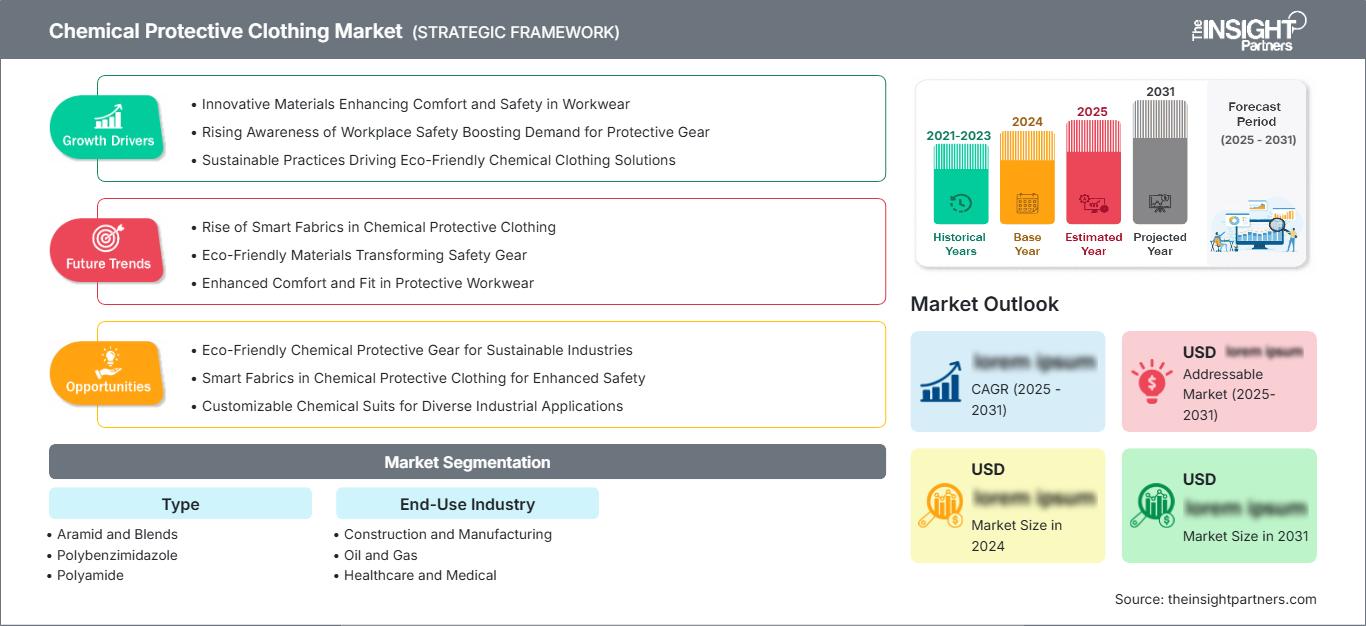
Chemical Protective Clothing Market: Strategic Insights
Regional Insights
North America Chemical Protective Clothing Market
The North America Chemical Protective Clothing Market Share is estimated to be in the range of 31%-35% by 2025 and will experience a CAGR between 3.2%-3.8% in the period of 2026-2034. The U.S. is responsible for the largest part of the demand on the regional level due to chemical processing and refinement, construction, pharmaceutical industries, mining and emergency responses, which need certified protective systems.
Canada contributes in energy production, mining, chemical processes and industrial maintenance. Buyers tend to opt for garments that have both barrier protection from liquids and particulates and breathability properties, since they need to stay in enclosed factories in warm environment. Lakeland Industries, Inc., Ansell Limited, 3M Company and Protective Industrial Products, Inc. have strong presence of products in North America industrial sector. The chemical resistant clothing is often included in personal protective equipment programs.
U.S. Chemical Protective Clothing Market
The United States is expected to hold between 79% and 83% of North America's market by 2025 and grow with a CAGR of 3.1%-3.7% until 2034. The main areas of application include industrial chemicals, oil and gas, hazard waste clean-up, pharmaceutical industries, and emergencies. Increasingly, the selection of procurement is influenced by permeation resistance data, seaming design, and classification as well as their compatibility with respiratory protection devices.
Some other positive points worth mentioning are the availability of specialized products. For example, Lakeland Industries, Inc., offers chemical barrier suits for medium and high-level protection, whereas the 3M Company supplies Type 3, 4, 5, and 6 protection coveralls. DuPont de Nemours, Inc., retains its prominent position in Tychem and Tyvek products. Hence, there is an increasing trend towards specialized coveralls.
Europe Chemical Protective Clothing Market
A share of 25-29% is projected for Europe in 2025, growing at a CAGR of 3.0-3.6% for 2026-2034. The major markets of Europe include Germany, the UK, France, Italy, and Spain. Recurring needs of certified garments are supported by industrial manufacturing, chemicals, pharmaceuticals, energy, and public safety.
The UK will continue to have a need for high-performance clothing for chemical processing, utilities, emergency response, and industrial maintenance. Germany gets an advantage out of the presence of a large chemical and manufacturing base; France – through the combination of chemicals, energy, transportation, and public sectors; Italy and Spain – via manufacturing, construction, petrochemicals, and industrial services. Sioen Industries NV improves its position in Europe thanks to multinorm protective clothing that provides protection against chemicals, heat and flames, electrical arc, static electricity, and cold.
APAC Chemical Protective Clothing Market
APAC is expected to account for 25–29% of the market in 2025 and is forecast to grow at a CAGR of 4.0–4.7% during 2025-2034. China dominates regional consumption, followed by Japan, South Korea, India, and Australia. The manufacturing, semiconductors, chemicals, pharmaceuticals, mining, and energy sectors fuel the demand.
The region’s chemical risk assessment is improving in Japan, whereas India and China are working on expanding their industrial capacities. Australia is contributing in terms of mining and energy projects. Ansell Limited is paying more attention to Japan due to the growth in chemical-related risk assessment and the demand for chemical protection.
Middle East & Africa Chemical Protective Clothing Market
The Middle East & Africa is expected to record a CAGR of 3.4–4.0% during 2026–2034, led by Saudi Arabia. UAE demand is supported by energy, construction, chemicals, and industrial services, while South Africa contributes through mining and manufacturing. The rest of the MEA demand remains linked to infrastructure and resource projects.
The need for chemical resistant, fire-resistant, and multifunctional garments is a result of the petrochemical and energy industry chain in Saudi Arabia. In the UAE, procurement of projects leads to a need for certified industrial protective equipment. In South Africa, the mining industry needs reliable protective wear. The market tends to favor companies that can produce multifunctional protective garments.
Segmentation Analysis
Type
The Type segment is expected to expand at a CAGR of 3.2–3.9% during 2026–2034. Material selection is increasingly application-driven, with buyers balancing chemical barrier performance, mechanical durability, heat management, weight, and reuse potential. The Chemical Protective Clothing Market scope, therefore, spans both advanced high-performance fibers and lower-cost disposable constructions.
- Aramid and Blends: Aramid systems remain important where chemical exposure intersects with heat and flame hazards. Their strategic value is strongest in applications requiring durable multi-hazard protection and extended garment service.
- Polybenzimidazole: Polybenzimidazole serves specialized high-temperature environments where exceptional thermal stability is required. Its premium positioning limits volume but supports high-value applications involving extreme heat and demanding emergency-response conditions.
- Polyamide: Polyamide constructions provide a balance of strength, flexibility, and processability. They are useful where protective apparel must withstand repeated mechanical stress while maintaining acceptable wearer mobility.
- Cotton Fiber: Treated cotton remains relevant for workwear requiring comfort and familiarity. Its role is strongest when chemical resistance is combined with flame, thermal, or task-specific finishing requirements.
- Laminated Polyesters: Laminated polyester systems provide engineered barriers for liquid and particulate exposure. Their versatility supports applications where manufacturers need controlled protection, structural durability, and scalable garment production.
- Polyolefin and Blends: Polyolefin systems benefit from lightweight construction, scalable manufacturing, and strong disposable-apparel economics. Their adoption is expanding in applications requiring chemical splash and particulate barriers with reduced garment weight.
- UHMW Polyethylene: UHMW polyethylene provides exceptional strength-to-weight performance and abrasion resistance. Its strategic importance is increasing in demanding environments where chemical protection must coexist with mechanical durability and mobility.
End-Use Industry
The End-Use Industry segment is projected to grow at a CAGR of 3.4–4.1% during 2026–2034. Demand differs significantly by exposure type, work duration, regulatory requirements, and garment reuse. Industrial users generally prioritize chemical compatibility and durability, while healthcare and emergency-response users place greater emphasis on contamination control, mobility, and rapid deployment.
- Construction and Manufacturing: This category represents the largest application base because workers encounter solvents, coatings, acids, cleaning agents, dusts, and industrial chemicals. Replacement demand is supported by large workforces and varied task profiles.
- Oil and Gas: Oil and gas operations require protection from hydrocarbons, process chemicals, corrosive substances, and combined fire hazards. Offshore and remote operations further increase the value of durable, multi-hazard garments.
- Healthcare and Medical: Healthcare applications emphasize contamination control, liquid barriers, and wearer comfort. Pharmaceutical manufacturing is particularly important because chemical handling and controlled environments require carefully specified protective apparel.
- Firefighting and Law Enforcement: Emergency responders require rapid-deployment garments capable of addressing chemical exposure alongside heat, flame, biological, and particulate hazards. Multi-hazard construction is therefore strategically important in this segment.
- Defense: Defense applications require specialized protection against chemical and hazardous-agent exposure, often combined with thermal, flame, mechanical, and mobility requirements. Procurement tends to favor tested systems with long service lives.
- Mining: Mining demand is linked to exposure from processing chemicals, fuels, dusts, and maintenance operations. Australia, North America, South Africa, and other mining-intensive markets support recurring requirements for durable protective apparel.
Opportunity Snapshot
| End-Use Industry | Revenue Contribution | Trend Tag | Adoption Stage |
|---|---|---|---|
| Construction and Manufacturing | High | Industrial Barrier | Mature |
| Oil and Gas | High | Multi-Hazard | Mature |
| Healthcare and Medical | Medium | Pharma Protection | Scaling |
| Firefighting and Law Enforcement | Medium | Hazmat Response | Scaling |
| Defense | Medium | Agent Protection | Mature |
| Mining | Medium | Chemical Exposure | Scaling |
Chemical Protective Clothing Market Growth Drivers and Impact Analysis
Stricter Chemical Exposure Management Across Industrial Workplaces
Stronger chemical risk assessment and workplace exposure-management practices are increasing the need for documented protective solutions. Japan provides a clear example, with the number of chemicals subject to risk assessment increasing from 674 to approximately 2,900 following regulatory changes, according to Ansell's 2025 discussion of the Japanese market. Such expansion encourages employers to reassess existing PPE specifications instead of relying on generalized protective garments. The impact extends beyond garment volumes because buyers increasingly request documented permeation performance, appropriate classifications, compatible gloves and respiratory equipment, and task-specific selection guidance. This favors suppliers that can provide integrated protection programs and technical support rather than companies competing only on garment cost.
Expansion of Chemical-Intensive Manufacturing and Resource Industries
Chemical manufacturing, refining, pharmaceuticals, mining, and energy production create recurring exposure to corrosive liquids, solvents, hydrocarbons, toxic substances, and contaminated materials. Expansion or modernization of these facilities increases demand for both disposable and reusable protective apparel. Industrial users also require multiple garment classes because exposure varies between routine handling, maintenance, cleaning, emergency response, and confined-space activities. The resulting purchasing pattern is broader than a single protective suit specification. Suppliers capable of offering low-level splash garments alongside high-barrier encapsulating systems can capture multiple points in the same facility. This portfolio effect supports demand for companies with broad product families, chemical compatibility data, and distribution networks capable of serving large industrial accounts.
Shift Toward Lightweight Multi-Hazard Protective Systems
End users increasingly expect protective garments to address several hazards without imposing excessive weight or heat burden. This requirement is stimulating the development of breathable laminates, advanced nonwovens, sealed seams, and fabrics combining chemical splash protection with flame or arc resistance. The commercial impact is significant because comfort affects correct wear, mobility, and duration of use. Manufacturers, therefore, compete on the combination of protection and ergonomics rather than barrier performance alone. PIP's GORE-TEX PYRAD multi-hazard garments illustrate this direction by combining chemical splash protection with breathability and arc or flame-related performance. Such systems can command greater specification attention in demanding workplaces where workers face overlapping hazards.
Chemical Protective Clothing Market Future Trends
Digital Chemical Compatibility and Garment Selection
Chemical Protective Clothing Market trends are moving toward digital tools that help safety managers match garments with chemical exposure scenarios. Instead of relying solely on generic garment classifications, users increasingly need chemical-specific permeation information, breakthrough times, temperature considerations, and safe-use guidance. Digital selection platforms can consolidate this information and reduce specification errors. Lakeland Industries, Inc. already provides PermaSURE, which calculates safe-use times for more than 4,000 chemicals while considering environmental conditions. Similar tools should become more common as industrial customers seek auditable PPE-selection processes. Integration with procurement platforms, worker training, inspection records, and facility chemical inventories could further increase the value of digital protection ecosystems and strengthen supplier relationships.
Breathability and Sustainability in High-Barrier Garments
Future product development is likely to prioritize lower garment weight, improved moisture management, longer service life, and reduced material intensity. The challenge is maintaining chemical barrier performance while improving comfort and reducing environmental burden. DuPont's introduction of Tyvek APX in November 2025 demonstrates this direction, combining higher breathability with protection and durability objectives. Sioen Industries NV has similarly emphasized updated fabrics and fittings within its multinorm portfolio. Over time, buyers are expected to evaluate protection, comfort, durability, reuse potential, and end-of-life considerations together, particularly in Europe and developed industrial markets where sustainability requirements increasingly influence corporate PPE procurement.
Chemical Protective Clothing Market Opportunities
Premium Multi-Hazard Garments for Energy and Process Industries
Suppliers can capture higher-value demand by developing garments that simultaneously address chemical splash, flame, arc, heat, particulate, and visibility hazards. Such products are particularly relevant to refineries, petrochemical facilities, utilities, mining operations, and emergency response teams, where workers can encounter several hazards during a single task. The opportunity is not limited to new garment sales. Manufacturers can build recurring revenue through technical assessments, replacement planning, chemical compatibility services, laundering guidance, and training. Companies with strong textile engineering capabilities can further differentiate through lightweight designs that improve mobility and reduce heat stress. Strategic partnerships with industrial distributors and safety consultants can accelerate adoption by embedding premium garments into facility-wide PPE specifications.
Expansion of Application-Specific PPE Programs in APAC and MEA
APAC and MEA offer opportunities where industrial expansion is creating new demand for certified protective equipment. Manufacturers can target chemical plants, pharmaceutical facilities, mining operations, oil and gas projects, and industrial maintenance contractors with application-specific product bundles. Chemical Protective Clothing Market Forecasts should therefore consider not only garment replacement but also the formalization of PPE programs in developing industrial economies. Local technical support, regional inventories, chemical compatibility databases, and distributor training can reduce barriers to adoption. Companies can further improve competitiveness by adapting garment weight and thermal characteristics to local climates. Partnerships with major engineering, procurement, and construction contractors could provide access to large projects while helping suppliers establish long-term replacement relationships.
Recent Developments
- November 2025: DuPont de Nemours, Inc. introduced Tyvek APX, a new protective apparel platform designed to enhance worker safety in hazardous environments. The product combines lightweight protection with improved garment design and mobility, supporting applications where workers require protection against hazardous particles, liquids, and other workplace risks. The launch strengthens DuPont's portfolio of advanced protective materials for industrial safety applications.
- March 2025: PFAS restrictions on firefighter protective gear gained attention in the U.S. following proposed legislation seeking to phase out intentionally added PFAS chemicals in firefighter protective equipment by 2027. The development highlights increasing regulatory pressure on manufacturers to develop fluorine-free alternatives while maintaining resistance to heat, chemicals, and other hazards required for emergency-response applications.
Frequently Asked Questions

- Comprehensive Market Sizing and Forecast Analysis
- Detailed Segmentation Analysis
- In-Depth Market Dynamics Assessment
- Regional and Country-Level Insights
- Competitive Landscape and Company Benchmarking
- Strategic Business Intelligence
Recent Reports
Testimonials

The Insight Partners provided valuable market intelligence that supported our global go-to-market strategy. Their team was professional, responsive, and attentive to our feedback, providing thoughtful analysis and helpful methodological clarifications throughout the project.
Junmo Kim Chief Financial Officer (CFO), Enertech Co., Ltd.
The Insight Partners' SCADA System Market report is comprehensive, with valuable insights on current trends and future forecasts. The team was highly professional, responsive, and supportive throughout. We are very satisfied and highly recommend their services.
RAN KEDEM Partner, Reali Technologies LTDs
I requested a report on a very specific software market and the team produced the report in a few days. The information was very relevant and well presented. I then requested some changes and additions to the report. The team was again very responsive and I got the final report in less than a week.
JEAN-HERVE JENN Chairman, Future Analytica
We worked with The Insight Partners for an important market study and forecast. They gave us clear insights into opportunities and risks, which helped shape our plans. Their research was easy to use and based on solid data. It helped us make smart, confident decisions. We highly recommend them.
PIYUSH NAGPAL Sr. Vice President, High Beam Global
The Insight Partners delivered insightful, well-structured market research with strong domain expertise. Their team was professional and responsive throughout. The user-friendly website made accessing industry reports seamless. We highly recommend them for reliable, high-quality research services
YUKIHIKO ADACHI CEO, Deep Blue, LLC.
This is the first time I have purchased a market report from The Insight Partners.While I was unsure at first, I visited their web site and felt more comfortable to take the risk and purchase a market report.I am completely satisfied with the quality of the report and customer service. I had several questions and comments with the initial report, but after a couple of dialogs over email with their analyst I believe I have a report that I can use as input to our strategic planning process.Thank you so much for taking the extra time and making this a positive experience.I will definitely recommend your service to others and you will be my first call when we need further market data.
JOHN SUZUKI President and Chief Executive Officer, Board Director, BK Technologies
I wish to appreciate your support and the professionalism you displayed in the course of attending to my request for information regarding to infectious disease IVD market in Nigeria. I appreciate your patience, your guidance, and the fact that you were willing to offer a discount, which eventually made it possible for us to close a deal. I look forward to engaging The Insight Partners in the future, all thanks to the impression you have created in me as a result of this first encounter.
DR CHIJIOKE ONYIA MANAGING DIRECTOR, PineCrest Healthcare Ltd.Reason to Buy
- Informed Decision-Making
- Understanding Market Dynamics
- Competitive Analysis
- Identifying Emerging Markets
- Customer Insights
- Market Forecasts
- Risk Mitigation
- Boosting Operational Efficiency
- Strategic Planning
- Investment Justification
- Tracking Industry Innovations
- Aligning with Regulatory Trends





 Get Free Sample for