
Chemical Surface Treatment Market Growth, Trends & Demand by 2034
Coverage: By Chemical Type (Cleaners, Plating Chemicals, Conversion Coating, Others); Base Material (Metals, Plastics, Others); End User Industry (Transportation, Construction, General Industry, Packaging, Industrial Machinery, Others) , and Geography (North America, Europe, Asia Pacific, and South and Central America)
- Status : Data Released
- Report Code : TIPRE00005475
- Category : Chemicals and Materials
- No. of Pages : 150
- Available Report Formats :


- Last update date : August 28, 2026


2025 Market Size
US$ 18.29 Bn
Base year value
2034 Forecast
US$ 29.22 Bn
Projected by 2034
CAGR 2026-2034
5.34 %
Growth rate
Addressable Market
US$ 215.44 Bn
(2026-2034)
The Chemical Surface Treatment Market was valued at US$ 18.29 Billion in 2025 and is projected to reach US$ 29.22 Billion by 2034, registering a CAGR of 5.34% during 2026–2034. Demand will be driven by factors like corrosion resistance, adhesion improvement, durability needs, and higher performance material standards. The Market includes a crucial set of chemical treatments that facilitate the cleaning, modification, protection, and functionalization of material surfaces within manufacturing companies.
Modernization efforts in North American manufacturing companies have created a positive climate for pretreatments, plating, and conversion processes. The Chemical Surface Treatment Market size forecast depends on the investments made in the fields of automotive electrification, aerospace production, semiconductors manufacturing, and industrial equipment. The need for the reduction of harmful materials, along with lower sludge and energy treatment processes, is anticipated to boost regional growth by 5.0–5.8% CAGR between 2026 and 2034.
Chemical Surface Treatment Market Assessment and Insights
- North America: North America is estimated to hold a 25–29% share in 2025, supported by automotive, aerospace, electronics, and industrial manufacturing. The region is expected to expand at a 5.4–6.1% CAGR between 2026 and 2034 as advanced pretreatment and environmentally improved chemistries gain adoption.
- U.S.: The U.S. represents approximately 80–84% of North America's market, with a 20–24% global share in 2025 and an estimated 5.5–6.2% CAGR during 2026–2034, supported by aerospace, EV, and electronics production.
- Europe: Europe is estimated to account for a 22–26% share in 2025, with Germany, France, Italy, the UK, and Spain representing important demand centers. The regional market is projected to grow at a 4.7–5.5% CAGR during 2026–2034, driven by environmental compliance and automotive manufacturing.
- Asia Pacific: Asia Pacific is estimated to command a 40–44% share in 2025, led by China, Japan, South Korea, and India. Expanding automotive, electronics, machinery, and construction manufacturing supports an estimated 6.0–7.0% CAGR between 2026 and 2034.
- Largest Segment: Conversion Coating is estimated to hold a 40–44% market share in 2025, reflecting extensive corrosion-protection and adhesion applications, with a projected 5.0–5.8% CAGR during 2026–2034.
- High Growth Segment: Cleaners are expected to represent approximately 18–22% share in 2025 and record a comparatively faster 6.5–7.3% CAGR during 2026–2034, supported by precision manufacturing requirements.
- Key companies analyzed in detail: Advanced Chemical Company, MKS Atotech, BASF Chemetall GmbH, Dow Inc., Elementis plc, Henkel AG & Co. KGaA, Nihon Parkerizing Co., Ltd., Nippon Paint Holdings Co., Ltd., NOF Corporation, and PPG Industries, Inc.
Source: The Insight Partners' analysis based on proprietary research, government publications, company annual reports, investor presentations, industry databases, and expert interviews.
The industry has moved away from traditional phosphate, chromate, and solvent-based coatings towards more sophisticated materials that offer better performance in terms of corrosion prevention, as well as lower environmental impact. Technologies like zirconium and titanium conversion treatments, new types of cleaners, lower temperatures and better plating additives are becoming increasingly significant. These trends are especially applicable to EV body designs, aluminum parts, electronics, and machinery that often involve mixed material assemblies.
Further growth will increasingly rely on localized chemical production, application engineering and regulatory compliance. Manufacturing in Asia-Pacific is expected to grow, while North America and Europe will pay greater attention to creating resilient supply chains and safer chemicals. Chromium-, fluoride-, sludge-, and energy-reduced products will be a good tool for differentiation of chemical suppliers. The activities by Chemetall show an example of how environmental compliance is being built into manufacturing strategies and products.
Chemical Surface Treatment Market Report Scope
| Report Attribute | Details |
|---|---|
| Market size in 2025 | US$ 18.29 Billion |
| Market Size by 2034 | US$ 29.22 Billion |
| Global CAGR (2026 - 2034) | 5.34% |
| Historical Data | 2021-2024 |
| Forecast period | 2026-2034 |
Chemical Surface Treatment Market Analysis
Since surface preparation needs to be performed before any painting, bonding, plating, welding or assembly process, there is a close link between demand and manufacturing output in this sector. Hence, the market growth of Chemical Surface Treatment will receive a boost from car production, aerospace parts, heavy industrial machinery, electronics as well as metal containers. The supply chain consists of the chemical suppliers, equipment manufacturers, applicators, OEMs, finishing facilities and waste processors.
The supply situation is influenced by the availability of raw materials, formulation skills, regulations and qualifications procedures of customers. Metals continue to play an important role in the market; however, plastics are becoming increasingly significant since manufacturers look for adhesion and conductivity properties for light weight parts. Large global suppliers of the chemicals with diverse technical offerings can include cleaners, conversion coatings, and other treatment processes in their portfolios, whereas more focused suppliers compete in their specific applications.
The competitive positioning strategy requires technology diversity, geographical spread, and validation by the customer base. According to the Chemical Surface Treatment Market report, MKS Atotech, BASF Chemetall GmbH, Henkel AG & Co. KGaA, and PPG Industries, Inc. gain from industrial partnerships and broad range of formulations. The specialty chemistry expertise is brought in by Dow Inc. and Elementis plc, and the strong presence in Asian and global manufacturing network is kept by Nihon Parkerizing Co., Ltd. and Nippon Paint Holdings Co., Ltd.
There is also room for differentiation via customized solutions and targeted formulations provided by Advanced Chemical Company, NOF Corporation, and similar specialists. More and more money is invested into chromium-free formulations, low temperature treatment, plating chemicals, and technologies with minimized sludge and water usage. Partnerships grow not only in number but also become increasingly regional. Chemetall and Azelis expanded the agreement about the supply chain in Southeast Asia to Thailand and the Philippines in 2025.
● REPORT CUSTOMIZATION
Tailor This Report To Align With Your Specific Business Requirements
This report can be customized to align precisely with your business objectives, scope, and target markets. Customization options include tailored segmentation, geography, competitive analysis, and strategic insights to support informed decision-making.
Customize This Report →WHAT YOU CAN ADJUST
- ● Segmentations
- ● Geography
- ● Competitive Analysis
- ● Language Preferences
Chemical Surface Treatment Market: Strategic Insights
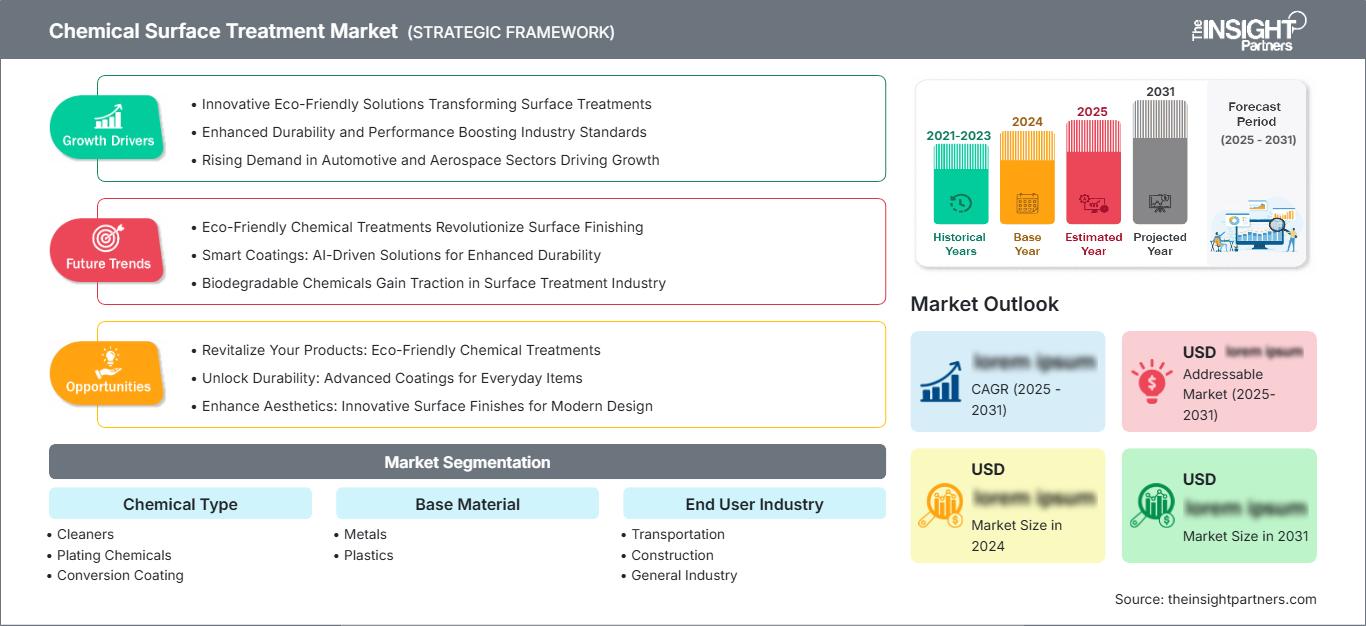
Regional Insights
North America Chemical Surface Treatment Market
North America is estimated to represent 25–29% of the Chemical Surface Treatment Market Share in 2025 and is expected to grow at a 5.4–6.1% CAGR through 2034. The U.S. remains the principal market because of its extensive automotive, aerospace, defense, electronics, machinery, and packaging manufacturing base. Demand is increasingly tied to EV production and lightweight aluminum structures.
Regulations are pushing for the substitution of toxic formulations with chromium-free, low VOC, low sludge, and lower energy ones. In Canada, these industries include aerospace, automotive, and industrial manufacturing, whereas Mexico is favored by automotive and electronics suppliers. Regional suppliers are concentrating on process efficiency, bath monitoring, and local technical support. North American manufacturers are more inclined towards the assessment of treatment chemistry based on lifecycle costs, wastewater generation, worker exposure, and compliance requirements rather than just purchase cost.
U.S. Chemical Surface Treatment Market
The U.S. represents approximately 20–24% of the global Chemical Surface Treatment Market share and around 80–84% of North America's consumption. Its market is expected to expand at a 5.5–6.2% CAGR during 2026–2034. Aerospace, automotive, semiconductor, industrial machinery, and defense manufacturing create sustained demand for cleaning, plating, and conversion technologies.
These companies include MKS Atotech, BASF Chemetall GmbH, Henkel AG & Co. KGaA, Dow Inc., and PPG Industries, Inc. Battery component parts, aluminum construction elements, electronics, and high-end machinery are some of the products that are increasingly becoming part of the applications requirements. The shift to less hazardous chemistry becomes very relevant in that the manufacturers have to retain their corrosion resistance and adhesive properties.
Europe Chemical Surface Treatment Market
Europe is estimated to hold a 22–26% share in 2025 and is projected to grow at a 4.7–5.5% CAGR through 2034. Germany is the leading country, supported by automotive and industrial manufacturing. The UK remains important in aerospace, automotive, and engineering applications, while France benefits from aerospace and transportation production.
Germany has large auto, machinery, aircraft, and metal working industries, which produce a great need for surface preparation and conversion technologies. The manufacturers are placing emphasis on the development of chromium-free technologies, less waste water production, and more efficient processes. France and Italy have demand for aerospace, auto, machinery, and packaging industries. Spain produces demand through auto assembly and industry manufacturing. One important strategic issue is European legislation, since the suppliers have to constantly change their formulations due to the chemical regulations.
APAC Chemical Surface Treatment Market
The APAC region will be responsible for 40-44% of the world's requirement in 2025, and is anticipated to expand at a CAGR of 6.0-7.0% from 2024 to 2034. China continues to be the largest market, with Japan, South Korea, India, and Australia coming next. The automobile industry, electronics, machinery, construction, and metal fabrication form the base of regional consumption.
EV and electronics manufacturing growth in China, Japan, and South Korea contribute to high-end precision uses, whereas, India's development and expansion in the automobile sector and electronics are contributing to more investments in this segment. Australia is relatively small compared to other countries but holds technical importance in the context of mining equipment, infrastructure, and maintenance.
Middle East & Africa Chemical Surface Treatment Market
The Middle East & Africa are projected to grow at approximately 4.2–5.1% CAGR through 2034. Saudi Arabia and the UAE lead regional demand through industrial diversification, energy infrastructure, metal processing, construction, and manufacturing investments. South Africa remains an important center for automotive, mining, and industrial equipment applications.
There is an intimate relationship between the region’s chemical treatment needs and corrosion protection in difficult climate and industrial conditions. Oil and gas production facilities, desalination plants, power stations, construction machinery, and transport contribute to the ongoing need for cleaning, plating, and protective conversion chemical treatments. There should be opportunities in Saudi Arabia due to its industrial diversification and investment in manufacturing in the UAE. There will be opportunities in South Africa.
Segmentation Analysis
Chemical Type
Chemical type represents a core competitive dimension because different manufacturing processes require specific levels of cleaning, corrosion protection, conductivity, and adhesion. The Chemical Surface Treatment Market scope includes Cleaners, Plating Chemicals, and Conversion Coating, exactly as defined in the market segmentation. The segment is projected to expand at approximately 5.0–5.8% CAGR during 2026–2034, with conversion technologies remaining strategically important.
- Cleaners: Cleaning chemicals remove oils, oxides, residues, and contaminants before subsequent processing. Demand is strengthened by precision manufacturing, electronics, automotive aluminum processing, and tighter requirements for consistent coating adhesion.
- Plating Chemicals: Plating chemicals support the deposition of protective or functional metallic layers. Their strategic importance remains high in automotive components, electronics, industrial machinery, connectors, and applications requiring improved wear or conductivity.
- Conversion Coating: Conversion coatings chemically modify substrate surfaces to improve corrosion resistance and coating adhesion. Their extensive use in automotive and industrial pretreatment makes them a central treatment technology.
Base Material
Base material selection determines chemistry compatibility, pretreatment sequence, process temperature, and final performance. Metals remain the dominant substrate, while plastic treatment is gaining importance as lightweighting and mixed-material construction expand. The segment is estimated to grow at approximately 5.1–6.0% CAGR through 2034 as manufacturers seek durable surfaces across increasingly complex assemblies.
- Metals: Metals represent the principal treatment substrate because steel, aluminum, copper, and zinc components require corrosion protection, paint adhesion, conductivity, and wear resistance across transportation and industrial applications.
- Plastics: Plastic treatment supports adhesion, coating compatibility, conductivity, and surface activation for lightweight components. Increasing use of polymers in transportation, electronics, and consumer products expands specialized treatment requirements.
End User Industry
End-user demand reflects manufacturing intensity and the technical requirements of each industry. Transportation remains strategically significant, while construction, general industry, packaging, and industrial machinery create diversified demand. The segment is expected to expand at approximately 5.2–6.1% CAGR during 2026–2034 as manufacturers prioritize durability and lifecycle performance.
- Transportation: Automotive, commercial vehicles, rail, and aerospace applications require corrosion resistance, paint adhesion, and lightweight-material compatibility. Electrification is adding demand for treatments suitable for aluminum and battery-related components.
- Construction: Construction applications use surface treatments to improve corrosion resistance and coating adhesion in structural components, architectural products, fasteners, and metal building systems.
- General Industry: General industrial manufacturing requires cleaning, conversion, plating, and protective treatment across fabricated metal components, equipment, tools, and engineered products.
- Packaging: Metal packaging uses surface treatment to improve corrosion resistance, coating adhesion, appearance, and compatibility with filling and forming processes.
- Industrial Machinery: Machinery manufacturers rely on surface treatment to improve wear resistance, corrosion protection, dimensional performance, and service life across components exposed to demanding operating environments.
Opportunity Snapshot
| End User Industry | Revenue Contribution | Trend Tag | Adoption Stage |
|---|---|---|---|
| Transportation | High | EV Pretreatment | Scaling |
| Construction | Medium | Corrosion Control | Mature |
| General Industry | High | Process Automation | Mature |
| Packaging | Medium | Metal Protection | Scaling |
| Industrial Machinery | High | Wear Protection | Scaling |
Chemical Surface Treatment Market Growth Drivers and Impact Analysis
Expansion of Electric Vehicle and Lightweight Manufacturing
The transition toward EVs is changing substrate combinations and surface-treatment requirements. Aluminum, galvanized steel, copper, and engineered plastics increasingly coexist within vehicles, creating challenges around pretreatment compatibility and coating adhesion. Manufacturers need chemistries capable of treating mixed-metal assemblies while maintaining corrosion protection and paint performance. Battery enclosures, copper foils, power-electronics components, and structural parts are generating additional treatment applications. Chemetall's 2025 launch of a chromium- and fluoride-free passivation solution for copper foils demonstrates how suppliers are adapting chemistry to battery and energy-storage applications. This shift expands demand for specialized formulations and creates opportunities for suppliers that can qualify chemistry rapidly across high-volume automotive production lines.
Stricter Environmental and Chemical Compliance Requirements
Environmental regulation is accelerating the replacement of legacy treatment chemistries. Restrictions on chromium compounds, hazardous substances, wastewater discharge, and volatile chemicals are encouraging manufacturers to adopt zirconium, titanium, chromium-free, fluoride-free, and lower-sludge alternatives. The impact extends beyond formulation development because treatment suppliers must support customers through qualification, process conversion, bath control, and production validation. European requirements are particularly influential for multinational manufacturers seeking globally consistent processes. Chemetall's move toward renewable electricity at its Langelsheim facility also illustrates the broader shift toward reducing manufacturing-related environmental impacts. Suppliers able to combine compliance with equivalent or improved technical performance can gain customer retention during chemistry conversion programs.
Increasing Demand for Durable and High-Performance Components
Longer component life is becoming an important manufacturing objective because corrosion, wear, poor adhesion, and contamination can increase maintenance requirements and warranty exposure. Surface treatments provide relatively efficient methods for improving component performance without replacing the underlying material. Automotive, aerospace, industrial machinery, construction, and electronics manufacturers, therefore, continue to invest in controlled cleaning, plating, and conversion processes. The requirement is particularly strong where components operate under humidity, temperature cycling, chemicals, salt exposure, or mechanical stress. Suppliers increasingly differentiate through process stability, coating uniformity, chemical consumption, and waste reduction. This creates a market environment in which technical support and application engineering are increasingly important alongside formulation performance.
Chemical Surface Treatment Market Future Trends
Low-Hazard and Resource-Efficient Formulations
The Chemical Surface Treatment Market trends landscape is moving toward formulations that reduce hazardous substances, water consumption, sludge generation, and process energy. Chromium-free and fluoride-free systems are gaining strategic attention, particularly for automotive, electronics, and battery applications. Suppliers are developing chemistries that operate at lower temperatures and provide comparable corrosion protection and adhesion. Digital bath monitoring is expected to complement these formulations by controlling concentration and contamination more precisely. This can reduce chemical consumption and improve process consistency. Over time, sustainability will become increasingly connected with total process economics rather than being treated solely as an environmental requirement. Manufacturers are therefore likely to evaluate chemistry based on chemical use per component, wastewater burden, energy consumption, regulatory longevity, and ease of integration into existing production lines.
Advanced Treatment for Mixed Materials and Precision Manufacturing
Future treatment systems are expected to become more specialized as manufacturers combine metals, polymers, composites, and electronic materials within the same products. EVs and advanced electronics are particularly important because surface compatibility can influence adhesion, conductivity, corrosion behavior, and component reliability. Precision applications will require tighter control of bath chemistry, surface cleanliness, and deposited-layer characteristics. Semiconductor packaging and high-density electronic assemblies are creating demand for high-purity plating additives and specialized cleaning systems. Aerospace additive manufacturing is another developing application where pickling, electropolishing, and passivation can support consistent component quality. These developments should favor suppliers capable of combining chemistry, process engineering, analytical testing, and customer qualification into integrated treatment solutions.
Chemical Surface Treatment Market Opportunities
Expansion of Surface Treatment Solutions in Emerging Manufacturing Hubs
Investment in localized treatment-chemical production and application systems can address rising demand from automotive, machinery, construction, and packaging manufacturers across emerging economies. Suppliers can prioritize formulations that reduce hazardous substances, improve bath-life efficiency, and support lower-temperature processing while maintaining coating performance. Chemical Surface Treatment Market Forecasts indicate that demand will increasingly favor suppliers capable of combining chemical formulation expertise with process monitoring, waste reduction, and application support. Partnerships with regional distributors and metal-processing companies can accelerate market entry, particularly where manufacturers are upgrading production lines without replacing entire pretreatment systems. Strategic investments in environmentally compliant cleaners, conversion coatings, and plating chemistries can strengthen customer retention while creating recurring revenue from replenishment and technical services. This opportunity is particularly relevant for companies seeking scalable positions across transportation, industrial machinery, and general manufacturing applications.
Localized Production and Technical Service in Emerging Manufacturing Hubs
Manufacturing expansion in India, Southeast Asia, Mexico, and selected Middle Eastern economies creates opportunities for regionalized chemical supply and technical support. Local production can reduce transportation lead times, improve inventory resilience, and allow formulations to be adapted to regional substrate and process requirements. Distributors and specialty chemical suppliers can strengthen their positions by combining local inventory with laboratory testing, bath analysis, application engineering, and regulatory support. Southeast Asia is particularly attractive because automotive and electronics manufacturers are establishing regional production networks. Chemetall's expanded distribution agreement covering Thailand and the Philippines demonstrates how suppliers are using regional partnerships to broaden market access while maintaining technical specialization.
Recent Developments
- April 2026: Azelis and Chemetall, BASF's surface treatment business, expanded their strategic distribution partnership in Canada, effective April 1, 2026. Under the agreement, Azelis distributes Chemetall's surface treatment technologies for general industrial applications across Canada. The partnership combines Chemetall's surface treatment portfolio with Azelis's regional customer network, technical expertise, and digital ordering capabilities, strengthening access to surface treatment solutions for Canadian industrial manufacturers.
- October 2025: BASF agreed to sell its coatings business to private equity firm Carlyle in a transaction valuing the business at €7.7 billion. The transaction covered automotive and refinishing coatings and followed BASF's decision to carve out the coatings operation as a standalone business. The transaction represents a significant strategic restructuring of BASF's coatings activities and reshapes the competitive landscape for automotive and industrial surface treatment technologies.
Frequently Asked Questions

- Comprehensive Market Sizing and Forecast Analysis
- Detailed Segmentation Analysis
- In-Depth Market Dynamics Assessment
- Regional and Country-Level Insights
- Competitive Landscape and Company Benchmarking
- Strategic Business Intelligence
Recent Reports
Testimonials

The Insight Partners' SCADA System Market report is comprehensive, with valuable insights on current trends and future forecasts. The team was highly professional, responsive, and supportive throughout. We are very satisfied and highly recommend their services.
RAN KEDEM Partner, Reali Technologies LTDs
I requested a report on a very specific software market and the team produced the report in a few days. The information was very relevant and well presented. I then requested some changes and additions to the report. The team was again very responsive and I got the final report in less than a week.
JEAN-HERVE JENN Chairman, Future Analytica
We worked with The Insight Partners for an important market study and forecast. They gave us clear insights into opportunities and risks, which helped shape our plans. Their research was easy to use and based on solid data. It helped us make smart, confident decisions. We highly recommend them.
PIYUSH NAGPAL Sr. Vice President, High Beam Global
The Insight Partners delivered insightful, well-structured market research with strong domain expertise. Their team was professional and responsive throughout. The user-friendly website made accessing industry reports seamless. We highly recommend them for reliable, high-quality research services
YUKIHIKO ADACHI CEO, Deep Blue, LLC.
This is the first time I have purchased a market report from The Insight Partners.While I was unsure at first, I visited their web site and felt more comfortable to take the risk and purchase a market report.I am completely satisfied with the quality of the report and customer service. I had several questions and comments with the initial report, but after a couple of dialogs over email with their analyst I believe I have a report that I can use as input to our strategic planning process.Thank you so much for taking the extra time and making this a positive experience.I will definitely recommend your service to others and you will be my first call when we need further market data.
JOHN SUZUKI President and Chief Executive Officer, Board Director, BK Technologies
I wish to appreciate your support and the professionalism you displayed in the course of attending to my request for information regarding to infectious disease IVD market in Nigeria. I appreciate your patience, your guidance, and the fact that you were willing to offer a discount, which eventually made it possible for us to close a deal. I look forward to engaging The Insight Partners in the future, all thanks to the impression you have created in me as a result of this first encounter.
DR CHIJIOKE ONYIA MANAGING DIRECTOR, PineCrest Healthcare Ltd.Reason to Buy
- Informed Decision-Making
- Understanding Market Dynamics
- Competitive Analysis
- Identifying Emerging Markets
- Customer Insights
- Market Forecasts
- Risk Mitigation
- Boosting Operational Efficiency
- Strategic Planning
- Investment Justification
- Tracking Industry Innovations
- Aligning with Regulatory Trends





 Get Free Sample for