
Chip Scale Package LED Market Demand, Share & Growth by 2034
Coverage: By Power Range (Low and Mid-Power, High-Power); Application (Backlighting Unit, General Lighting, Automotive Lighting, Flash Lighting) , and Geography (North America, Europe, Asia Pacific, and South and Central America)
- Status : Data Released
- Report Code : TIPRE00004343
- Category : Electronics and Semiconductor
- No. of Pages : 150
- Available Report Formats :


- Last update date : July 28, 2026


2025 Market Size
US$ 1.93 Bn
Base year value
2034 Forecast
US$ 5.05 Bn
Projected by 2034
CAGR 2026-2034
11.25 %
Growth rate
Addressable Market
US$ 30.73 Bn
(2026-2034)
The Chip Scale Package LED Market is worth US$ 1.93 Billion in 2025 and expected to be worth US$ 5.05 Billion by 2034 with a CAGR of 11.25% during 2026-2034. Drivers include light engines of small size, wafer level packaging, and increasing demand for luminous parts in backlighting, automotive module applications, flash, and general lighting fixtures.
In the case of North America, Chip Scale Package LED Market size is driven by innovative vehicle lighting initiatives, premium displays, and commercial lighting retrofit installations that require thermal efficiency and component size reduction. This region is expected to grow at CAGR of 10.2-10.8% during 2026-2034.
Chip Scale Package LED Market Assessment and Insights
- North America: The region is estimated to hold 24–28% share in 2025 and grow at a CAGR of 10.2–10.8% during 2026–2034, supported by automotive lighting, premium displays, and efficient commercial illumination.
- US: The country represents 76–80% of North America in 2025 and is projected to grow at a CAGR of 10.4–11.0% during 2026–2034.
- Europe: Europe accounts for 18–22% share in 2025 and is expected to grow at a CAGR of 9.8–10.4% during 2026–2034, led by Germany, the UK, France, Italy, and Spain.
- Asia Pacific: Asia Pacific represents 42–46% share in 2025 and is forecast to grow at a CAGR of 11.9–12.6% during 2026–2034, with China, Japan, South Korea, India, and Taiwan anchoring scale.
- Largest Segment: BLU holds 34–38% market share in 2025 and is expected to grow at a CAGR of 10.6–11.2% during 2026–2034.
- High Growth Segment: Automotive Lighting holds 18–22% market share in 2025 and is expected to grow at a CAGR of 12.5–13.2% during 2026–2034.
- Key companies analyzed in detail: Cree LED, Inc.; Genesis Photonics Inc.; LG Innotek Co., Ltd.; Lumens Co., Ltd.; Lumileds Holding B.V.; NICHIA CORPORATION; ams-OSRAM AG; Samsung Electronics Co., Ltd.; Semileds Corporation; Seoul Semiconductor Co., Ltd.
Source: The Insight Partners' analysis based on proprietary research, government publications, company annual reports, investor presentations, industry databases, and expert interviews.
CSP LED Market development has been a journey from traditional packaged LED replacement to wafer-level light source development that minimizes the package size, thermal resistance, and allows for higher optical density. Manufacturing trends are more and more focused on accuracy in phosphor coating process, flip-chip technology, binning process standardization, minimal substrates, and automated testing. Display manufacturers, automotive lighting providers, and general illumination OEMs started to analyze CSP LEDs early during the design stage due to direct dependence of package design on heat dissipation pathways, lens development, color mixing, and board mounting yield.
Future market drivers are mini-LED backlighting, advanced headlight system, smartphone cameras, industrial luminaires, and energy efficiency legislation. New manufacturing centers in Asia are developing packaging capabilities, whereas North America and Europe focus on automotive qualification and premium lighting products. Energy efficiency policies and company’s own energy targets facilitate adoption of LED lighting and provide tailwinds for small-size, high-efficient packages minimizing luminaire size and improving thermal properties.
Chip Scale Package LED Market Report Scope
| Report Attribute | Details |
|---|---|
| Market size in 2025 | US$ 1.93 Billion |
| Market Size by 2034 | US$ 5.05 Billion |
| Global CAGR (2026 - 2034) | 11.25% |
| Historical Data | 2021-2024 |
| Forecast period | 2026-2034 |
Chip Scale Package LED Market Analysis
Growth Drivers of the Chip Scale Package LED Market are the needs for thin displays, small and more effective automotive lighting modules, flash lighting applications, and small luminaires with high lumen density. The value chain of the CSP LED technology market comprises epitaxy, wafer processing, phosphor conversion, chip singulation, testing, optics, driving electronics, module assembly, and OEM qualification.
It is favorable for vendors to control chip and packaging quality, since the quality of CSP LED depends on thermal management, current spreading, and color stability issues.
The procurement process is still complicated because customers compare luminous efficacy, beam angle, thermal management, color rendering capabilities, binning capabilities, solderability, and compatibility with high-density PCBs. According to the Chip Scale Package LED Market report, more and more module manufacturers tend to buy products from companies which can provide stable batches of products, technical support, and rapid customization.
Competitors include innovators of LEDs, suppliers with displays as their specialty, and experts with automotive-grade components. The competitors are NICHIA CORPORATION, Lumileds Holding B.V., Samsung Electronics Co., Ltd., ams-OSRAM AG, LG Innotek Co., Ltd., Seoul Semiconductor Co., Ltd., Cree LED, Inc., Genesis Photonics Inc., Lumens Co., Ltd., and Semileds Corporation. They offer superior chip efficiency, optical performance consistency, qualification capabilities, and customer specific packaging technology.
Investment trends include capacity for wafer-level packaging, manufacturing process line for mini-LED chips, automotive reliability test, and improved phosphor coating technology. Strategic focus is moving from providing diodes alone to offering full light engine capability. Buyers require optical simulation capability, thermal testing, compatibility with the drivers, and supply chain assurance before adopting CSP LEDs.
● REPORT CUSTOMIZATION
Tailor This Report To Align With Your Specific Business Requirements
This report can be customized to align precisely with your business objectives, scope, and target markets. Customization options include tailored segmentation, geography, competitive analysis, and strategic insights to support informed decision-making.
Customize This Report →WHAT YOU CAN ADJUST
- ● Segmentations
- ● Geography
- ● Competitive Analysis
- ● Language Preferences
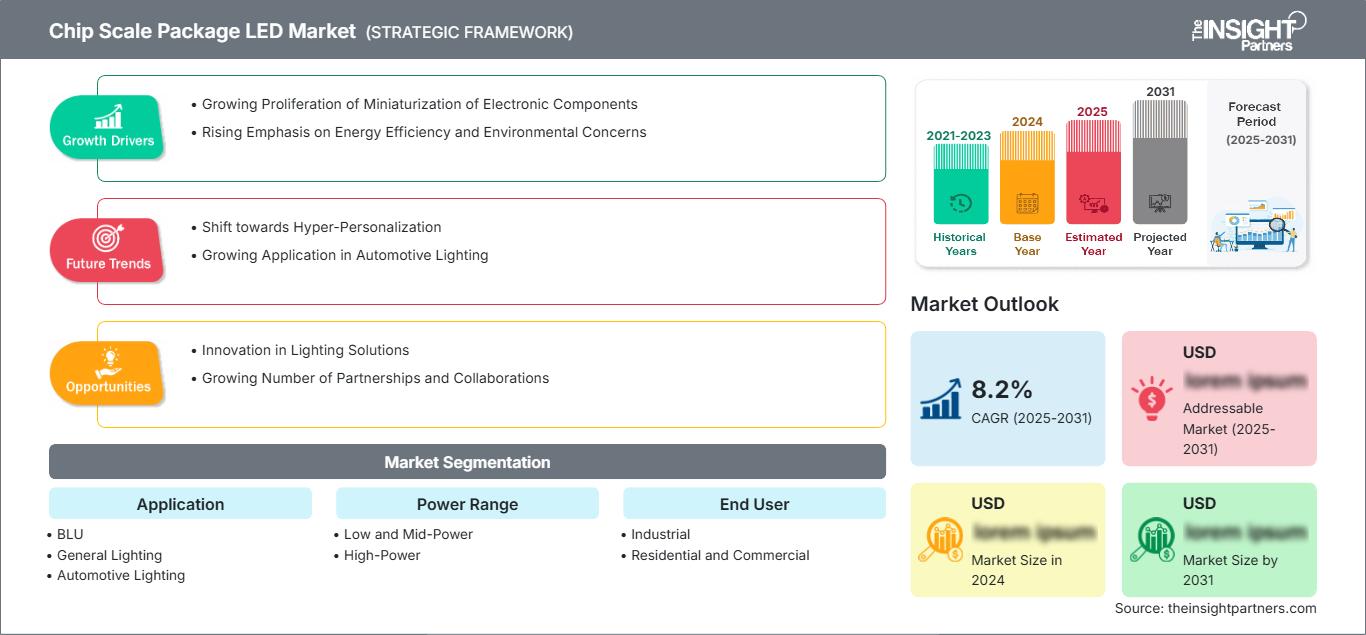
Chip Scale Package LED Market: Strategic Insights
Regional Insights
North America Chip Scale Package LED Market
Share of North America in 2025 is estimated at 24–28%, while expected growth during 2026–2034 is CAGR 10.2-10.8%. Key market drivers include the use of chip scale package LEDs in automobile lighting, high-end TV backlighting, smartphones’ flashlight module, and high efficacy commercial lighting. Consumers value color bin stability, thermal efficiency, and certification documentation.
Drivers of regional demand include the use of chip scale package LEDs in electric car designs, advanced driver assistance lighting systems, upgrading retail lighting, and display data ecosystem. Manufacturers that participate in North American LED chip market development include Cree LED, Inc., Lumileds Holding B.V., Samsung Electronics Co., Ltd., and ams-OSRAM AG.
U.S. Chip Scale Package LED Market
The US represents 76%-80% of North America demand in 2025 and is projected to grow at a CAGR of 10.4-11.0% in the period from 2026 to 2034. The strongest application areas include automotive headlamps, flash lighting, premium displays, horticulture fixtures, and industrial lighting, where the size of the light source makes a difference in optics.
The market presence is guaranteed by such players as Cree LED, Inc., Lumileds Holding B.V., and global companies, which supply OEMs based in the US. Trends in applications involve miniaturization of the light engine, adaptive beam arrays, and high-brightness modules with a decrease in board real estate without compromising on the thermal budget.
Europe Chip Scale Package LED Market
Europe accounts for 18%-22% share in 2025 and is forecasted to witness a CAGR of 9.8%-10.4% in the period of 2026-2034. Germany drives due to the automotive lighting, machine vision, and high-end industrial lights segments. UK adds demand from specialty displays, medical and architectural lighting applications, whereas France provides demand from transportation, infrastructure, and efficiency programs
There is an impact of Italy and Spain on the demand of commercial retrofits, retail lighting, and automotive components supply. Ecodesign directives, lumen maintenance, substance restriction, and traceability create demands in Europe. ams-OSRAM AG, Lumileds Holding B.V., NICHIA CORPORATION, and Seoul Semiconductor Co., Ltd. benefit from their alliances with the automotive Tier suppliers and design studios.
APAC Chip Scale Package LED Market
APAC holds a 42% to 46% market share in 2025 and projects to have a CAGR of 11.9% to 12.6% between 2026 and 2034. China is the leading APAC region because of display production, LED packaging capabilities, and automotive lighting volume.
The two countries, Japan and South Korea, help drive the growth through high demands of cars, cellphones, and televisions. India, Taiwan, and Australia provide growth through electronics assembly capability, industrial lighting, and energy efficiency regulations. The regional suppliers are preferred owing to their proximity to the panel producers, phone brands, and lighting modules producers.
Middle East & Africa Chip Scale Package LED Market
The Middle East & Africa is forecasted to have a CAGR between 8.5-9.1% from 2026-2034. Saudi Arabia will be the dominant country because of smart city lighting, commercial constructions, and energy-efficient infrastructures. The contribution of the UAE will include hospitality, aviation, and retail lighting, while South Africa will provide industrial and municipal applications.
Rest of MEA applications will remain project-based, with CSP LEDs selected for those projects that require compact lighting solutions, higher luminous intensity, and lower maintenance. The energy diversification program, airport expansion, and outdoor lighting retrofitting initiatives will generate selective demand, but high price sensitivity of buyers will keep manufacturers concentrated on reliable mid-power solutions.
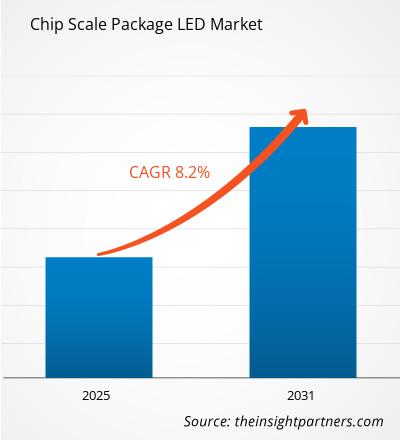
Segmentation Analysis
Application
The Application segment is projected to grow at a CAGR of 11.0–11.6% during 2026–2034 as display makers, lighting OEMs, and vehicle suppliers adopt compact light sources. Chip Scale Package LED Market scope spans BLU, general lighting, automotive lighting, flash lighting, and other specialized uses where size, thermal efficiency, and optical density influence design decisions.
- BLU leads demand as televisions, monitors, tablets, and notebooks require thinner backlight units, uniform luminance, and efficient thermal behavior for higher-resolution displays.
- General Lighting benefits from compact luminaire design, lower material intensity, and improved optical control in residential, commercial, and industrial fixtures seeking energy savings.
- Automotive Lighting is strategically important as adaptive headlamps, daytime running lights, interior ambience, and electric vehicle styling need small, bright, and thermally stable sources.
- Flash Lighting serves smartphones, tablets, wearables, and compact imaging devices where higher brightness from limited board space improves camera performance and product design flexibility.
Power Range
The Power Range segment is estimated to grow at a CAGR of 11.2–11.8% during 2026–2034 as customers choose different CSP LED classes for display density, optical intensity, and thermal budgets. Low and mid-power devices remain volume-oriented, while high-power devices gain traction in automotive, industrial, and specialized illumination.
- Low and Mid-Power devices support high-volume backlighting, general lighting, and compact electronics where cost efficiency, uniform color, and package consistency guide purchasing decisions.
- High-Power devices address automotive headlamps, projection lighting, industrial fixtures, and high-brightness modules where thermal management and luminous intensity are critical differentiators.
End User
The End User segment is projected to grow at a CAGR of 10.9–11.5% during 2026–2034 as industrial, residential, and commercial buyers move toward smaller, efficient lighting systems. Industrial users value durability and optical precision, while residential and commercial customers emphasize energy savings, fixture aesthetics, and lower maintenance.
- Industrial users adopt CSP LEDs in machine vision, inspection lighting, warehouses, and rugged fixtures where brightness density and thermal reliability support uptime.
- Residential and Commercial users drive broader deployment through downlights, retail displays, office fixtures, hospitality lighting, and architectural products requiring compact optics and high efficacy.
Opportunity Snapshot
| Application | Revenue Contribution | Trend Tag | Adoption Stage |
| BLU | High | Mini-LED | Scaling |
| General Lighting | High | Compact Fixtures | Mature |
| Automotive Lighting | High | Adaptive Beams | Scaling |
| Flash Lighting | Medium | Camera Flash | Mature |
| Others | Low | Specialty Optics | Emerging |
Chip Scale Package LED Market Growth Drivers and Impact Analysis
Miniaturized Displays and Higher Backlight Density
Display manufacturers are increasing the number of light sources behind thinner televisions, monitors, tablets, and notebooks to improve brightness, contrast, and local dimming. CSP LEDs support this transition because their compact footprint allows dense layouts while reducing package-related optical losses. The real-world impact is stronger demand from BLU suppliers that need predictable binning, high assembly yield, and stable color across large panels. Chip Scale Package LED Market suppliers that align with panel makers can capture recurring volume as premium display features migrate into mid-range devices. The driver also encourages investment in automated inspection, phosphor uniformity, and thermal simulation.
Automotive Lighting Architecture Redesign
Vehicle lighting is moving from basic illumination toward adaptive, brand-defining, and safety-linked systems. CSP LEDs enable smaller optical modules, higher luminance, and flexible placement in headlamps, daytime running lights, interior lighting, and rear combinations. The market impact is visible in longer qualification cycles and higher technical barriers, because automotive buyers require thermal endurance, vibration resistance, color stability, and traceability. Suppliers with automotive-grade quality systems and co-development capability can secure multi-year platforms. Electric vehicles further reinforce demand, since designers use lighting for efficiency, aerodynamics, signaling, and differentiated user experience.
Energy-Efficient Lighting Replacement Cycles
Residential, commercial, and industrial customers continue replacing legacy lighting with efficient LED fixtures as electricity costs, building standards, and sustainability targets shape procurement. CSP LEDs help luminaire makers reduce fixture depth, improve thermal paths, and create compact optical systems without sacrificing brightness. The impact is strongest in applications such as retail, hospitality, offices, warehouses, and task lighting where aesthetics and operating cost are both important. Suppliers can benefit by offering reliable mid-power packages, consistent color rendering, and documentation aligned with regional efficiency rules. This driver broadens demand beyond displays and vehicles.
Chip Scale Package LED Market Future Trends
Mini-LED Backlighting Integration
Chip Scale Package LED Market trends will increasingly align with mini-LED backlighting as panel makers seek higher contrast, thinner modules, and better power efficiency without fully shifting to emissive displays. CSP LEDs fit this roadmap because they support dense array placement and effective heat dissipation. Future differentiation will depend on tighter color control, lower defect rates, and compatibility with automated mass transfer or high-speed placement equipment. Suppliers that work closely with driver IC, optics, and panel partners can influence design standards and secure repeat business across television, monitor, automotive display, and tablet platforms.
Wafer-Level Process Optimization
Manufacturers will invest in wafer-level coating, metallization, testing, and singulation improvements to raise yield and reduce variation. As CSP LEDs remove much of the traditional package structure, small process deviations can affect color, solder reliability, and heat dissipation. Future competitiveness will therefore depend on advanced inspection, inline metrology, and statistical process control. This trend will favor companies with deep semiconductor manufacturing discipline and capital strength. It will also push buyers to audit upstream process capability rather than relying only on finished module testing.
Chip Scale Package LED Market Opportunities
Automotive Matrix and Adaptive Lighting Platforms
Chip Scale Package LED Market Forecasts point to a strong opportunity in matrix headlamps, adaptive beams, interior personalization, and electric vehicle lighting signatures. Suppliers should invest in high-power CSP LEDs with robust thermal performance, tight binning, and automotive qualification support. The opportunity is attractive because lighting platforms remain in production for several years once approved. Early engagement with tier suppliers and optical design teams improves design-in probability, while application engineering can reduce validation risk for OEMs. Companies that combine chip performance with module-level knowledge can capture higher-margin automotive programs.
Commercial Retrofit and Smart Fixture Programs
Commercial retrofit programs create an actionable opportunity for CSP LED suppliers because offices, hotels, retail stores, schools, and industrial sites continue replacing older luminaires with efficient, compact fixtures. Suppliers can target fixture makers with mid-power products that balance efficacy, cost, color rendering, and thermal reliability. Smart lighting programs also require compact sources that leave room for sensors, wireless modules, and drivers. Channel strategy should emphasize reference designs, regional compliance documentation, and dependable availability. The opportunity becomes stronger where energy performance contracts and building upgrades shorten replacement cycles.
Recent Developments
- January 2024: Nichia Corporation launched the NFSWL11A-D6 Cube Direct Mountable Chip, a new chip-scale white LED designed to create soft, low-glare lighting environments through a unique horizontal light distribution. The LED combines Nichia’s phosphor and LED technologies to provide wider light spread, enabling thinner and lighter luminaire designs while reducing the need for complex secondary optics. The product is targeted at architectural and general lighting applications where improved visual comfort, reduced fixture thickness, and resource-efficient designs are increasingly important.
- September 2022: Bridgelux launched a new series of Chip Scale Package (CSP) LEDs designed for commercial, industrial, outdoor, and entertainment lighting applications. The CSP LED portfolio uses flip-chip technology and phosphor coating without bond wires or plastic molds, enabling high-density LED clustering, tunable color temperature, improved thermal performance, and compact luminaire designs. The series covers a wide range of options from 1800K to 6500K CCT, CRI 70 to CRI 95, RGB color solutions, and multiple package sizes from 1.1 mm to 2.7 mm, supporting applications such as COB modules, linear lighting, flexible strips, and smart lighting systems. The launch reflects the industry's shift toward miniaturized, high-efficiency LED architectures that provide greater design flexibility and improved performance for next-generation commercial lighting solutions.
Frequently Asked Questions

- Comprehensive Market Sizing and Forecast Analysis
- Detailed Segmentation Analysis
- In-Depth Market Dynamics Assessment
- Regional and Country-Level Insights
- Competitive Landscape and Company Benchmarking
- Strategic Business Intelligence
Recent Reports
Testimonials

The Insight Partners' SCADA System Market report is comprehensive, with valuable insights on current trends and future forecasts. The team was highly professional, responsive, and supportive throughout. We are very satisfied and highly recommend their services.
RAN KEDEM Partner, Reali Technologies LTDs
I requested a report on a very specific software market and the team produced the report in a few days. The information was very relevant and well presented. I then requested some changes and additions to the report. The team was again very responsive and I got the final report in less than a week.
JEAN-HERVE JENN Chairman, Future Analytica
We worked with The Insight Partners for an important market study and forecast. They gave us clear insights into opportunities and risks, which helped shape our plans. Their research was easy to use and based on solid data. It helped us make smart, confident decisions. We highly recommend them.
PIYUSH NAGPAL Sr. Vice President, High Beam Global
The Insight Partners delivered insightful, well-structured market research with strong domain expertise. Their team was professional and responsive throughout. The user-friendly website made accessing industry reports seamless. We highly recommend them for reliable, high-quality research services
YUKIHIKO ADACHI CEO, Deep Blue, LLC.
This is the first time I have purchased a market report from The Insight Partners.While I was unsure at first, I visited their web site and felt more comfortable to take the risk and purchase a market report.I am completely satisfied with the quality of the report and customer service. I had several questions and comments with the initial report, but after a couple of dialogs over email with their analyst I believe I have a report that I can use as input to our strategic planning process.Thank you so much for taking the extra time and making this a positive experience.I will definitely recommend your service to others and you will be my first call when we need further market data.
JOHN SUZUKI President and Chief Executive Officer, Board Director, BK Technologies
I wish to appreciate your support and the professionalism you displayed in the course of attending to my request for information regarding to infectious disease IVD market in Nigeria. I appreciate your patience, your guidance, and the fact that you were willing to offer a discount, which eventually made it possible for us to close a deal. I look forward to engaging The Insight Partners in the future, all thanks to the impression you have created in me as a result of this first encounter.
DR CHIJIOKE ONYIA MANAGING DIRECTOR, PineCrest Healthcare Ltd.Reason to Buy
- Informed Decision-Making
- Understanding Market Dynamics
- Competitive Analysis
- Identifying Emerging Markets
- Customer Insights
- Market Forecasts
- Risk Mitigation
- Boosting Operational Efficiency
- Strategic Planning
- Investment Justification
- Tracking Industry Innovations
- Aligning with Regulatory Trends





 Get Free Sample for