
Clinical Research Management Systems (CRMS) Market Demand, Share & Growth by 2034
Clinical Research Management Systems (CRMS) Market Size and Forecasts (2021–2034), Global and Regional Share, Trends, and Growth Opportunity Analysis Report Coverage : by Deployment Type (Cloud-Based, On-Premises); End User (Pharmaceutical Companies, Contract Research Organizations); and Geography (North America, Europe, Asia Pacific, and South and Central America)
- Status : Data Released
- Report Code : TIPRE00039938
- Category : Life Sciences
- No. of Pages : 150
- Available Report Formats :


- Last update date : November 09, 2026


2025 Market Size
US$ 2.46 Bn
Base year value
2034 Forecast
US$ 7.41 Bn
Projected by 2034
CAGR 2026-2034
13.03 %
Growth rate
Addressable Market
US$ 42.92 Bn
(2026-2034)
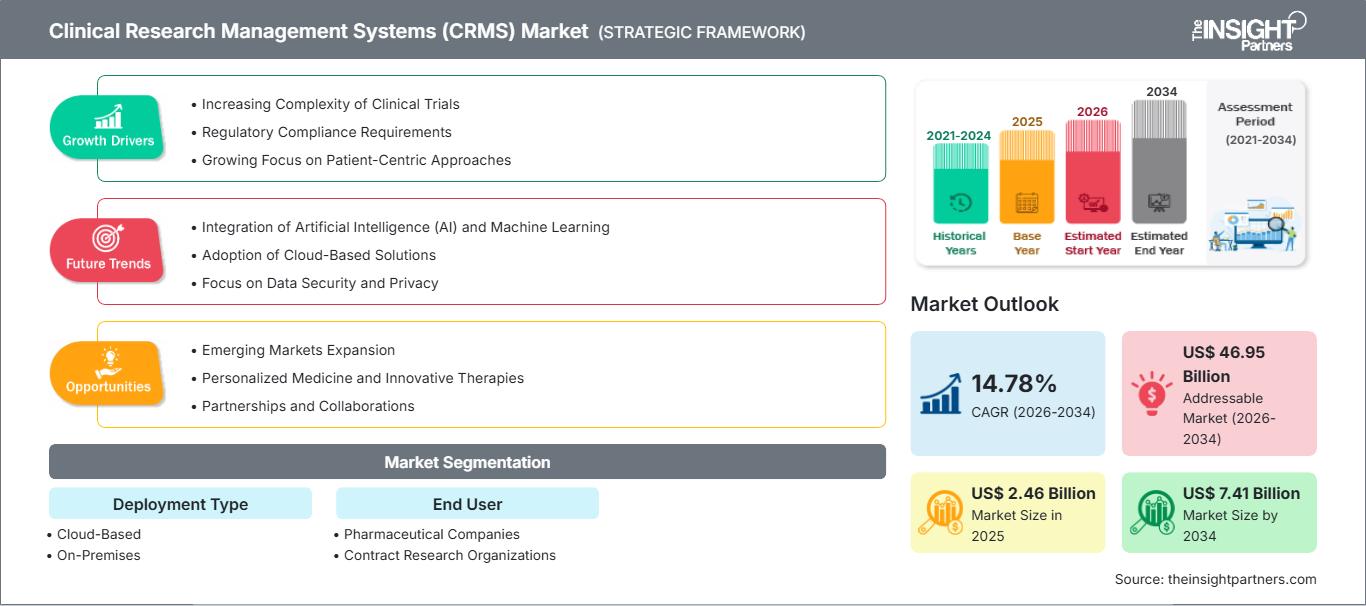
The Clinical Research Management Systems Market was valued at US$ 2.46 Billion in 2025 and is projected to reach US$ 7.41 Billion by 2034, registering a CAGR of 13.03% during 2026–2034. Growth is supported by increasingly complex study protocols, larger volumes of digital clinical data, stricter evidence-governance requirements, and sponsor efforts to coordinate global studies through connected workflows. Artificial intelligence, remote monitoring, electronic source data, and risk-based oversight are further expanding the strategic role of clinical research platforms.
Across North America, the Clinical Research Management Systems Market size is expected to expand at a CAGR of ~12% through 2034. The region benefits from extensive biopharmaceutical research activity, established contract research organization networks, and early adoption of cloud-based trial technologies. Regulatory acceptance of decentralized trial elements also encourages sponsors to integrate electronic data capture, trial management, participant engagement, and remote oversight tools within controlled digital environments.
Clinical Research Management Systems (CRMS) Market Assessment and Insights
Regional Outlook
- North America: ~42% of the global Clinical Research Management Systems Market share in 2025 | ~12% CAGR through 2034. Market position: North America leads owing to concentrated pharmaceutical research expenditure, extensive multinational studies, mature CRO capabilities, and strong adoption of interoperable clinical operations platforms.
- US: ~84% of North American market revenue in 2025 | ~12% CAGR through 2034. Market position: The US leads North America through its large sponsor base, technology ecosystem, regulatory infrastructure, and sustained demand for data-driven management of complex therapeutic studies.
- Europe: ~27% of the global market in 2025 | ~12% CAGR through 2034. Market position: Europe represents a mature, compliance-oriented market, led by the UK and Germany, with France, Italy, and Spain supporting multinational research and digital study administration.
- Asia Pacific: ~23% of the global market in 2025 | ~16% CAGR through 2034. Market position: Asia Pacific is the fastest-growing region as China, Japan, South Korea, India, and Australia attract more studies, expand research infrastructure, and modernize regulatory processes.
Segment Outlook
- Cloud-Based: ~72% Share in 2025 | ~16% CAGR through 2034. Market position: Cloud-based deployment leads because sponsors and CROs require scalable access, faster implementation, centralized upgrades, distributed collaboration, and easier integration across global trial ecosystems.
- Contract Research Organizations: ~35% Share in 2025 | ~15% CAGR through 2034. Market position: CRO adoption is increasing as outsourced study volumes rise and service providers standardize technology across sponsors, therapeutic areas, countries, and investigative sites.
Competitive Coverage
Medidata Solutions, Inc., Oracle Corporation, Veeva Systems Inc., Castor, Clario, Medpace Holdings, Inc., Parexel International Corporation, REDCap, IQVIA Inc., Clinical Ink, Inc.
Methodology
The Insight Partners follows Data Collection & Secondary Research, Primary Research, Data Analysis, and Data Triangulation & Final Review to validate market estimates and insights.
Source: The Insight Partners' analysis based on proprietary research, government publications, company annual reports, investor presentations, industry databases, and expert interviews.
Clinical trial technologies have gone from being disparate databases and repositories into integrated platforms that integrate planning, activation of sites, data acquisition, monitoring, safety, remuneration, and close out. Cloud computing technology has minimized the need for local infrastructure, with application programming interfaces connecting electronic medical records, labs, image systems, wearable devices, and applications designed to interact with participants. As such, suppliers are shifting away from separate software tools and towards integrated platforms with flexible workflows, subscription delivery models, and implementation services. This will transform procurement from departmental software purchase to organizational clinical development transformation.
In the coming years, investment will expand into Asia Pacific, the Middle East, and selected emerging research centers in Europe as sponsors seek to source patients from more diverse locations. Traceability, data integrity, transparency, and risk-based quality management requirements will provide the basis for the demand for validated platforms. Suppliers of validated platforms offering regional hosting, multi-language capabilities, cybersecurity measures, and implementation services will be able to cater to sponsors and organizations looking to move beyond Excel and standalone legacy software.
Clinical Research Management Systems (CRMS) Market Report Scope
| Report Attribute | Details |
|---|---|
| Market size in 2025 | US$ 2.46 Billion |
| Market Size by 2034 | US$ 7.41 Billion |
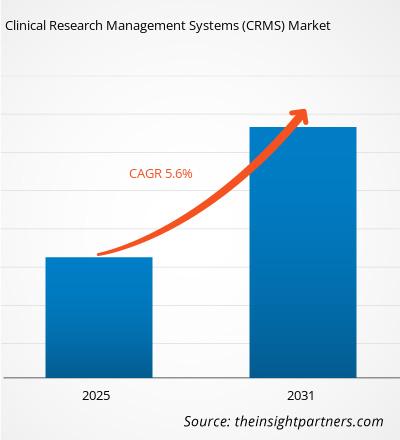
| Global CAGR (2026 - 2034) | 13.03% |
| Historical Data | 2021-2024 |
| Forecast period | 2026-2034 |
Clinical Research Management Systems (CRMS) Market Analysis
The Clinical Research Management Systems Market will be influenced by increasing protocol complexities, trials that span many geographic locations, growing source of data diversity, and the requirement to reduce start-up and database-lock durations. Increasing demand for pharmaceutical sponsors of greater visibility of their operations on a global scale has necessitated visibility into multiple countries, locations, vendors, individuals, milestones, and budgets. On the supply side, software suppliers offer clinical research management systems infrastructure, while implementation providers handle configuration and migration, CROs orchestrate execution, and sites provide data.
Preference for demand side would be towards companies that are able to leverage validated technology and particular domain expertise. Pure performance of the system does not suffice because such evaluation involves audit trail capabilities, security, system flexibility, training, compliance documentation, and maintenance. Switching providers may be associated with switching costs due to historical data, SOPs, customized reports, and other downstream processes.
As it follows from the Clinical Research Management Systems Market report, competition takes place between platform companies and specialists focused on e-data capture, patient engagement, site operations, analytics, and particular study model. Medidata Solutions, Oracle Corporation, and Veeva Systems Inc. compete on integrated portfolios, whereas Castor, Clinical Ink, Inc., and REDCap cover particular customer, research, and workflow needs.
There is increasing focus of investments in artificial intelligence, automated study setup, risk signals, integrated data review, and study templates. Clario brings endpoint and clinical data capabilities to the table, while Medpace Holdings, Inc. and Parexel International Corporation combine technology and execution of operations. IQVIA Inc. applies its data and service assets during trials development. Strategic positioning of companies will depend on their ability to minimize fragmentation without constraining sponsors and interoperability.
● REPORT CUSTOMIZATION
Tailor This Report To Align With Your Specific Business Requirements
This report can be customized to align precisely with your business objectives, scope, and target markets. Customization options include tailored segmentation, geography, competitive analysis, and strategic insights to support informed decision-making.
Customize This Report →WHAT YOU CAN ADJUST
- ● Segmentations
- ● Geography
- ● Competitive Analysis
- ● Language Preferences
Clinical Research Management Systems (CRMS) Market: Strategic Insights
Regional Insights
North America Clinical Research Management Systems Market
North America accounted for approximately ~42% of global revenue in 2025 and is projected to expand at a CAGR of ~12% through 2034. The Clinical Research Management Systems Market share reflects the region’s concentration of pharmaceutical sponsors, biotechnology companies, CRO headquarters, academic medical centers, specialized investigative sites, and clinical technology suppliers. Digitally mature buyers increasingly seek enterprise platforms capable of replacing disconnected trial management, document, data, and participant systems.
Regulatory guidance on decentralized study components includes provisions for remote visits, participation by local medical care providers, digital data collection, and risk-based management, while retaining participant safety and data integrity considerations. The demands result in increased spending on security, tracking, remote monitoring, digital consents, and integration. Canada makes contributions from its research hospitals and multinational studies; however, the US is the main money maker in the region.
U.S. Clinical Research Management Systems Market
The US represented approximately ~84% of North American revenue in 2025 and is expected to record a CAGR of ~12% through 2034. Its position is supported by a large biopharmaceutical pipeline, extensive federal and academic research activity, experienced CRO networks, and a dense ecosystem of software developers, implementation specialists, laboratories, and clinical sites. Sponsors use management systems to coordinate oncology, rare disease, immunology, neuroscience, vaccine, and medical-device studies.
Medidata Solutions, Oracle Corporation, Veeva Systems Inc., IQVIA Inc., Parexel International Corporation, Medpace Holdings, Inc., and Clinical Ink, Inc. maintain material commercial or operational presence in the country. Adoption is shifting toward connected platforms that consolidate study planning, site selection, monitoring, data review, and participant-facing processes. Demand is also influenced by electronic health record interoperability and the need to reduce repetitive data entry for site personnel.
Europe Clinical Research Management Systems Market
Europe held approximately ~27% of global revenue in 2025 and is projected to grow at a CAGR of ~12% through 2034. Regional uptake is influenced by multinational trials administration, data protection compliance, systematic sponsor supervision, and the move towards harmonized clinical trial procedures. The Clinical Trials Information System facilitates sponsor-EU/EEA authority interaction, emphasizing the importance of controlled submissions of data, document tracking, and collaboration in regulatory processes.
The UK emerges as the country that stands out in Europe due to existing life sciences clusters, research-oriented universities, the NHS setting, and the presence of CROs and biotech companies. Germany is second due to the pharmaceutical manufacturing industry, university hospitals, and needs for enterprise validation systems. France represents an example of public research infrastructure in addition to multinational sponsorship and increased interest in e-trial coordination.
Italy and Spain make up for their contribution to trials due to networks of investigators, clinical research in hospitals, and competitiveness in recruiting patients. Spanish attractiveness for multinational studies makes it a good platform for tools that facilitate site activation, oversight of recruitment, and trial communication, whereas Italian fragmentation of the institutional setting contributes to the need for standardized processes. Cloud adoption takes place across Europe, however, buyers often have regional requirements for data hosting, fine access control, multilingual support, customizable data retention policy, and regulatory/safety compliance.
APAC Clinical Research Management Systems Market
Asia Pacific represented approximately ~23% of global revenue in 2025 and is forecast to grow at a CAGR of ~16% through 2034, making it the fastest-growing region. China is the leading country in Asia Pacific, supported by its pharmaceutical development pipeline, hospital network, expanding sponsor base, and increasing use of digital research infrastructure.
Sponsor demand and quality procurement is provided by Japan, digital advanced hospitals and multinational research are provided by South Korea. The investigator, CRO, and technological capabilities help India to conduct scalable study management. Early phase studies and international biotechnology are facilitated by Australia. Further growth in the region is possible by localized work flow, language capability, regulatory compliance, cyber security, and scalable cloud availability.
Middle East & Africa Clinical Research Management Systems Market
The Middle East & Africa market is expected to register a CAGR of ~15% through 2034 as governments and private healthcare groups expand research infrastructure, specialist hospitals, data platforms, and life-sciences investment. The UAE is positioned as the leading country in the Middle East & Africa through digitally connected healthcare systems, international partnerships, and efforts to attract pharmaceutical innovation.
Saudi Arabia is strengthening research capacity through healthcare transformation and biotechnology investment. South Africa contributes established academic and investigator networks, especially for infectious disease and population-based research. The rest of the region remains heterogeneous, with adoption dependent on connectivity, skilled research personnel, regulatory capacity, and sponsor confidence in site-level data quality.
Segmentation Analysis
Deployment Type
Deployment Type is central to the Clinical Research Management Systems Market scope because it determines implementation speed, scalability, infrastructure responsibility, integration design, and long-term operating cost. Buyers increasingly evaluate deployment according to security policies, validation requirements, geographic access, data residency, and internal information technology capacity. Cloud-Based solutions are projected to record a CAGR of ~16% during 2026–2034 as sponsors and CROs prioritize distributed access, standardized upgrades, and scalable study environments.
- Cloud-Based: Cloud-Based systems support rapid provisioning, subscription-based procurement, remote access, centralized maintenance, and collaboration across sponsors, CROs, sites, and vendors. Adoption is strongest where customers require portfolio-wide visibility and frequent scaling across countries or study phases.
- On-Premises: On-Premises solutions remain relevant for organizations maintaining strict internal infrastructure controls, established validated environments, or customized legacy integrations. Demand is comparatively concentrated among large institutions with dedicated information technology, security, and system-validation resources.
End User
End User requirements vary by portfolio ownership, operating model, therapeutic specialization, outsourcing strategy, and the number of simultaneous studies under management. Pharmaceutical Companies seek governance across internal teams and external service providers, whereas outsourced research organizations emphasize repeatable delivery, customer reporting, workforce utilization, and multi-sponsor separation. Contract Research Organizations are expected to expand at a CAGR of ~15% during 2026–2034 as sponsors outsource operational functions and require partners to provide technology-enabled oversight.
- Pharmaceutical Companies: Pharmaceutical Companies use management platforms to govern development portfolios, standardize study execution, oversee outsourced activities, consolidate performance indicators, and preserve inspection-ready records. Enterprise adoption is influenced by integration with regulatory, safety, quality, and financial systems.
- Contract Research Organizations: Contract Research Organizations require configurable, multi-tenant capabilities that support different sponsor procedures, therapeutic models, and reporting obligations. Technology selection affects bid competitiveness, delivery consistency, resource planning, site coordination, and the ability to demonstrate measurable operational performance.
Opportunity Snapshot
| End Users | Revenue Contribution | Trend Tag | Adoption Stage |
| Pharmaceutical Companies | High | Portfolio Integration | Mature |
| Contract Research Organizations | High | Outsourced Digitization | Scaling |
Clinical Research Management Systems (CRMS) Market Growth Drivers and Impact Analysis
Increasing Complexity of Multicountry Clinical Trials
Modern clinical studies involve more countries, specialized endpoints, external laboratories, imaging providers, wearable devices, patient applications, and regulatory deliverables than traditional site-centered trials. This complexity increases the number of dependencies that study teams must track and makes spreadsheet-based oversight progressively less reliable. Clinical research management systems create a controlled operational layer for milestones, issues, documents, monitoring activities, enrollment, and vendor performance. Their impact is particularly significant in oncology, rare diseases, and precision medicine, where protocols may involve biomarker testing, adaptive decisions, and narrowly defined patient populations. By improving cross-functional visibility, these platforms help sponsors identify delayed sites, incomplete documentation, and enrollment risks before they affect broader development timelines.
Expansion of Decentralized and Hybrid Study Models
Decentralized and hybrid models distribute trial activities among research sites, participants’ homes, local healthcare providers, mobile professionals, and digital technology suppliers. This structure requires systems capable of coordinating remote visits, electronic consent, participant communication, device data, home health activities, and exceptions requiring site intervention. Regulatory acceptance of decentralized elements supports adoption, but it also reinforces requirements for investigator oversight, data reliability, privacy, training, and auditable responsibilities. Management platforms therefore serve as integration and governance environments rather than simple administrative tools. Suppliers that connect participant-facing applications with site and sponsor workflows can reduce fragmented handoffs and provide a more complete operational record of how protocol activities were performed.
Pressure to Improve Site Productivity and Data Quality
Investigative sites frequently work across multiple sponsor portals, authentication methods, document repositories, payment processes, and data-entry applications. Administrative burden can delay activation, reduce investigator engagement, and divert staff from participant-facing work. Sponsors and CROs are responding by prioritizing single sign-on, reusable site profiles, standardized document exchange, electronic source capture, and direct data transfer from health records. These capabilities reduce repeated entry and reconciliation while making study status more visible. The market impact extends beyond software procurement because buyers increasingly assess platforms according to site experience, implementation support, training effort, and workflow simplicity. Vendors reducing site burden can improve adoption consistency and strengthen sponsor relationships with high-performing research centers.
Clinical Research Management Systems (CRMS) Market Future Trends
AI-Assisted Study Configuration and Risk Management
Clinical Research Management Systems Market trends are moving toward artificial intelligence embedded within validated operational workflows. Future platforms will increasingly extract structured requirements from protocols, recommend study configurations, generate draft forms, identify inconsistent data, and prioritize operational risks. The value proposition will shift from passive recordkeeping toward decision support that helps teams focus attention on sites, milestones, or data patterns requiring intervention. Adoption will depend on explainability, controlled model changes, human review, validation evidence, and traceable outputs. Providers possessing extensive historical study data and domain-specific models may gain an advantage, although sponsors will continue to evaluate whether automated recommendations are reproducible, secure, and appropriate for regulated decisions.
Unified Data Fabrics Connecting Sites, Sponsors, and Regulators
The next platform generation will place greater emphasis on reusable data structures and bidirectional interoperability. Electronic health records, laboratory systems, imaging platforms, wearable sensors, safety databases, regulatory repositories, and trial applications will feed governed data environments rather than requiring repeated manual transfers. Standardized interfaces could reduce reconciliation, accelerate review, and enable near-real-time study oversight. Regulatory submissions may also benefit when operational records, source lineage, and transformation histories remain connected. However, implementation will require common terminology, consent-aware data exchange, identity management, cybersecurity, and clear accountability among technology vendors and study stakeholders. Platforms capable of supporting open integration without weakening validation controls will be strategically favored.
Clinical Research Management Systems (CRMS) Market Opportunities
Scalable Platforms for Emerging Biotechnology Companies
Emerging biotechnology companies frequently manage small internal teams, outsourced studies, limited technology resources, and rapidly changing development plans. This creates an opportunity for vendors to provide preconfigured, modular platforms that can be deployed without lengthy enterprise transformation programs. Commercial offerings can combine study planning, electronic trial master files, site management, dashboards, and vendor oversight with implementation guidance suited to first-time sponsors. Clinical Research Management Systems Market Forecasts indicate that subscription packaging, reusable templates, and managed administration can lower adoption barriers while retaining expansion paths for additional studies. Suppliers should align pricing with portfolio stage, provide inspection-readiness support, and enable straightforward data migration if a biotechnology company enters a partnership or acquisition.
Localization Across Asia Pacific and the Middle East
Growth markets create investment opportunities for providers offering regional hosting, multilingual interfaces, locally aligned workflows, and partnerships with domestic CROs or healthcare technology integrators. Success requires more than translating established products. Vendors must account for country-specific ethics processes, regulatory submissions, privacy requirements, site capabilities, payment practices, and user-support expectations. The Clinical Research Management Systems Market Opportunities are strongest where expanding clinical research capacity intersects with government-backed digital health investment and sponsor demand for more diverse patient populations. Establishing regional implementation teams, validated cloud environments, and integration connectors can improve adoption while helping global sponsors maintain consistent governance across established and newer research locations.
Recent Developments
- July 2026: Medidata Solutions, Inc. – Medidata launched Medidata Plus, an AI-native layer designed to extend artificial intelligence across study build, data management, operational monitoring, and portfolio workflows. The product supports automated electronic data capture and electronic clinical outcome assessment configuration, no-code data transformation, and proactive identification of enrollment or safety risks.
- August 2025: Veeva Systems Inc. – Veeva announced a collaboration with Amgen to deploy the Veeva Clinical Platform across clinical trial processes. The platform connects clinical operations and data applications, including CTMS, EDC, clinical data workbench, randomization and trial supply management, eCOA, eTMF, site connectivity, and study training.
- August 2025: Oracle Corporation – Oracle introduced enhancements to Oracle Clinical One Data Collection, including AI-enabled interoperability between electronic health records and electronic data capture, expanded site and subject document management, and integration with safety reporting systems. The release aims to reduce manual data transfer and centralize structured and unstructured study information.
Frequently Asked Questions

- Comprehensive Market Sizing and Forecast Analysis
- Detailed Segmentation Analysis
- In-Depth Market Dynamics Assessment
- Regional and Country-Level Insights
- Competitive Landscape and Company Benchmarking
- Strategic Business Intelligence
Recent Reports
Testimonials

The Insight Partners provided valuable market intelligence that supported our global go-to-market strategy. Their team was professional, responsive, and attentive to our feedback, providing thoughtful analysis and helpful methodological clarifications throughout the project.
Junmo Kim Chief Financial Officer (CFO), Enertech Co., Ltd.
The Insight Partners' SCADA System Market report is comprehensive, with valuable insights on current trends and future forecasts. The team was highly professional, responsive, and supportive throughout. We are very satisfied and highly recommend their services.
RAN KEDEM Partner, Reali Technologies LTDs
I requested a report on a very specific software market and the team produced the report in a few days. The information was very relevant and well presented. I then requested some changes and additions to the report. The team was again very responsive and I got the final report in less than a week.
JEAN-HERVE JENN Chairman, Future Analytica
We worked with The Insight Partners for an important market study and forecast. They gave us clear insights into opportunities and risks, which helped shape our plans. Their research was easy to use and based on solid data. It helped us make smart, confident decisions. We highly recommend them.
PIYUSH NAGPAL Sr. Vice President, High Beam Global
The Insight Partners delivered insightful, well-structured market research with strong domain expertise. Their team was professional and responsive throughout. The user-friendly website made accessing industry reports seamless. We highly recommend them for reliable, high-quality research services
YUKIHIKO ADACHI CEO, Deep Blue, LLC.
This is the first time I have purchased a market report from The Insight Partners.While I was unsure at first, I visited their web site and felt more comfortable to take the risk and purchase a market report.I am completely satisfied with the quality of the report and customer service. I had several questions and comments with the initial report, but after a couple of dialogs over email with their analyst I believe I have a report that I can use as input to our strategic planning process.Thank you so much for taking the extra time and making this a positive experience.I will definitely recommend your service to others and you will be my first call when we need further market data.
JOHN SUZUKI President and Chief Executive Officer, Board Director, BK Technologies
I wish to appreciate your support and the professionalism you displayed in the course of attending to my request for information regarding to infectious disease IVD market in Nigeria. I appreciate your patience, your guidance, and the fact that you were willing to offer a discount, which eventually made it possible for us to close a deal. I look forward to engaging The Insight Partners in the future, all thanks to the impression you have created in me as a result of this first encounter.
DR CHIJIOKE ONYIA MANAGING DIRECTOR, PineCrest Healthcare Ltd.Reason to Buy
- Informed Decision-Making
- Understanding Market Dynamics
- Competitive Analysis
- Identifying Emerging Markets
- Customer Insights
- Market Forecasts
- Risk Mitigation
- Boosting Operational Efficiency
- Strategic Planning
- Investment Justification
- Tracking Industry Innovations
- Aligning with Regulatory Trends





 Get Free Sample for