
Coal Mining Market Size, Share & Forecast to 2034
Coverage: By Coal Type (Thermal Coal, Coking Coal and Lignite), Mining Technique (Surface Mining and Underground Mining), Application (Power Generation, Steel and Metallurgy, Cement, Fertilizers, and Others), and Geography
- Status : Published
- Report Code : TIPRE00003563
- Category : Manufacturing and Construction
- No. of Pages : 253
- Available Report Formats :


- Last update date : November 03, 2026


2025 Market Size
US$ 946.4 Bn
Base year value
2034 Forecast
US$ 1,326.29 Bn
Projected by 2034
CAGR 2026-2034
3.82 %
Growth rate
Addressable Market
US$ 10,321.79 Bn
(2026-2034)
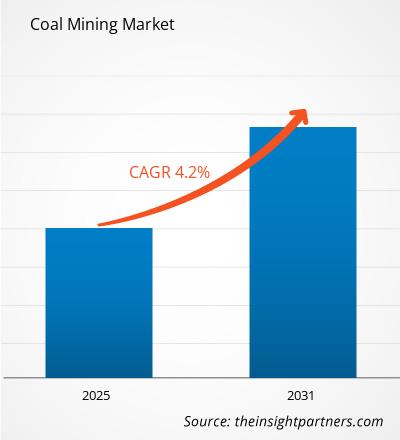
The Coal Mining Market was valued at US$ 946.4 Billion in 2025 and is projected to reach US$ 1,326.29 Billion by 2034, expanding at a CAGR of 3.82% during 2026–2034. Demand will be supported by the continued use of coal for electricity generation, steel production, cement production, and industrial processes in leading nations. Optimization of production and mining using advanced equipment, and the continued development of infrastructure in developing nations are ensuring stability in the industry and helping generate revenue for the future.
In North America, the sector is supported by existing mining infrastructure, substantial reserves, and the demand for metallurgical coal from domestic as well as exporting steel producers. In the region, the Coal Mining Market Size is sustained by effective logistics and high mining efficiency. Growth is anticipated at a CAGR of 2.78% through 2034 as the focus on improving productivity, extending mine life, and exporting premium metallurgical coal increases.
Coal Mining Market Assessment and Insights
Regional Outlook
- North America: 10.23% of the global market in 2025 | 2.78% CAGR through 2034. Market position: A mature market supported by established mining assets, advanced extraction technologies, and strong metallurgical coal exports. Demand from steelmaking industries helps sustain regional revenue generation despite energy-transition pressures.
- US: 84.42% of North American market revenue in 2025 | 2.90% CAGR through 2034. Market position: The country benefits from substantial coal reserves, highly productive mining regions, and strong metallurgical coal exports serving domestic and international steel producers.
- Europe: 11.42% of the global market in 2025 | 3.30% CAGR through 2034. Market position: A mature market characterized by declining thermal coal dependence but continued demand for metallurgical coal. Germany remains the leading country in Europe, supported by industrial activity.
- Asia Pacific: 73.36% of the global market in 2025 | 4.15% CAGR through 2034. Market position: Largest and fastest-growing region due to extensive coal production and consumption across China, India, Indonesia, Australia, Japan, and South Korea.
Segment Outlook
- Power Generation: 62.71% Share in 2025 | 3.09% CAGR through 2034. Market position: Coal continues to serve as a major baseload fuel in several developing economies where electricity demand growth remains strong and renewable integration is still evolving.
- Steel and Metallurgical Operations: 17.94% Share in 2025 | 5.33% CAGR through 2034. Market position: Growth is supported by coking coal requirements for blast-furnace steelmaking and sustained infrastructure investments across industrializing nations.
Competitive Coverage
China Shenhua Energy Company Limited, Coal India Limited, Glencore plc, BHP Group Limited, Peabody Energy Corporation, Arch Resources Inc., Yancoal Australia Ltd, PT Bumi Resources Tbk, Anglo American plc, Teck Resources Limited
Methodology
The Insight Partners follows Data Collection & Secondary Research, Primary Research, Data Analysis, and Data Triangulation & Final Review to validate market estimates and insights.
Source: The Insight Partners' analysis based on proprietary research, government publications, company annual reports, investor presentations, industry databases, and expert interviews.
There has been a marked improvement in the mining sector through the introduction of automation, real-time monitoring systems, predictive maintenance systems, and advanced geological survey technology. Efficiency gains have helped mining companies improve their extraction processes while increasing safety standards for workers and resource recovery rates. Increased industrial activity in developing countries, along with the need for continued steel production, will provide strong fundamentals amid evolving energy transition policies.
In the coming years, investments will continue to favor Asia Pacific, selected African mining countries, and metallurgical coal mines. Policy regimes focusing on efficiency, environment, land rehabilitation, and methane management are influencing investment strategies. Construction of new transport infrastructure and export routes for resource development will help improve supply and expand the industry.
Coal Mining Market Report Scope
| Report Attribute | Details |
|---|---|
| Market size in 2025 | US$ 946.4 Billion |
| Market Size by 2034 | US$ 1,326.29 Billion |
| Global CAGR (2026 - 2034) | 3.82% |
| Historical Data | 2021-2024 |
| Forecast period | 2026-2034 |
Coal Mining Market Analysis
The Coal Mining Market growth trajectory is primarily influenced by global electricity requirements, industrialization trends, and steel manufacturing activity. Coal remains a critical energy source for numerous emerging economies where energy security and affordability remain policy priorities. The industry value chain connects mining companies, logistics providers, processing facilities, utilities, steel producers, and industrial manufacturers. Efficient transportation networks and port infrastructure play a significant role in determining market competitiveness and export performance.
On the supply side, producers are focusing on productivity enhancement through technological integration and operational optimization. Large reserves in Asia Pacific, North America, and Australia continue to support long-term production potential. Mine expansion projects, equipment modernization initiatives, and workforce efficiency programs are helping operators maintain profitability despite regulatory and environmental pressures.
The Coal Mining Market analysis indicates that competition is shaped by reserve quality, production costs, logistics capabilities, export access, and long-term customer relationships. Companies such as China Shenhua Energy Company Limited, Coal India Limited, Glencore plc, BHP Group Limited, and Peabody Energy Corporation maintain strong positions through diversified asset portfolios and extensive distribution networks.
Strategic investments increasingly target digital mining technologies, automation systems, emissions reduction initiatives, and infrastructure upgrades. Anglo American plc, Teck Resources Limited, Yancoal Australia Ltd, PT Bumi Resources Tbk, and Arch Resources Inc. continue strengthening operational resilience through productivity-focused investments and portfolio optimization strategies.
● REPORT CUSTOMIZATION
Tailor This Report To Align With Your Specific Business Requirements
This report can be customized to align precisely with your business objectives, scope, and target markets. Customization options include tailored segmentation, geography, competitive analysis, and strategic insights to support informed decision-making.
Customize This Report →WHAT YOU CAN ADJUST
- ● Segmentations
- ● Geography
- ● Competitive Analysis
- ● Language Preferences
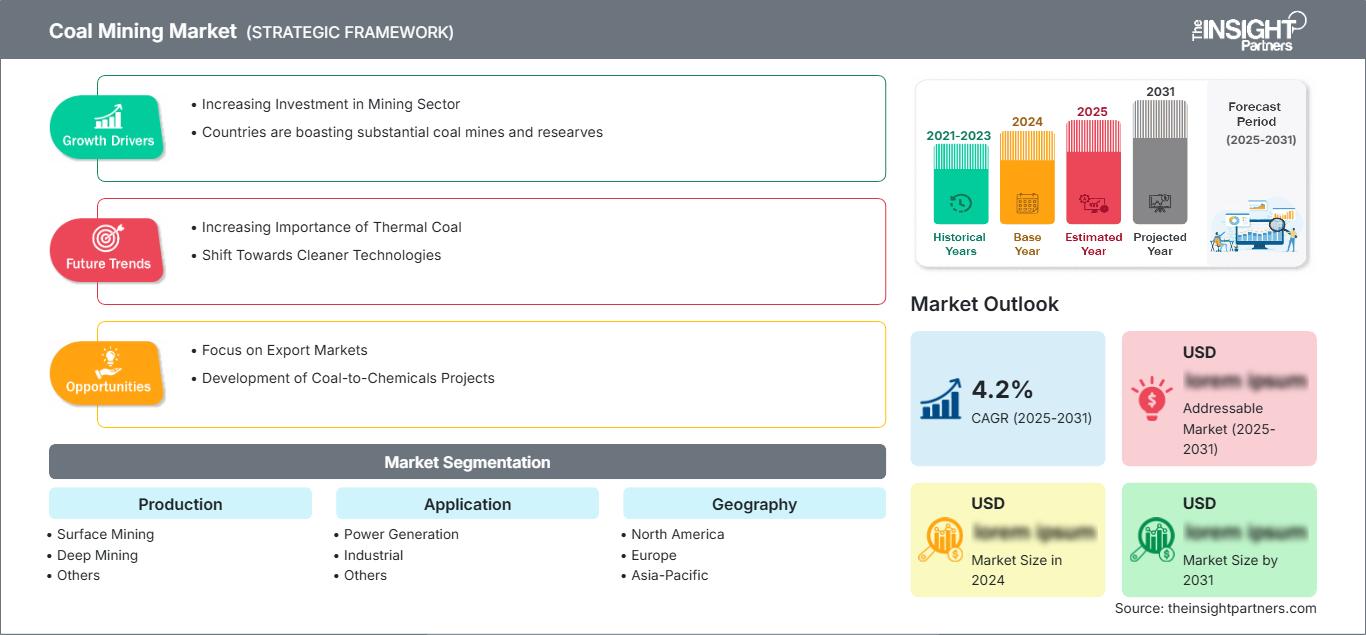
Coal Mining Market: Strategic Insights
Regional Insights
North America Coal Mining Market
North America accounted for approximately 10.23% of global revenue in 2025 and is projected to expand at a CAGR of 2.78% through 2034. The region benefits from extensive coal reserves, developed transportation infrastructure, and technologically advanced mining operations. Demand for metallurgical coal remains an important growth contributor, particularly through exports supporting global steel production.
The region also maintains strong operational capabilities supported by automation, advanced geological modeling, and productivity-focused mining practices. The Coal Mining Market share in North America continues to be reinforced by established mining companies, integrated logistics systems, and growing international demand for premium-grade metallurgical coal.
U.S. Coal Mining Market
The United States represented approximately 84.42% of North American market revenue in 2025 and is anticipated to grow at a CAGR of 2.90% through 2034. Large coal reserves, sophisticated mining infrastructure, and export-oriented operations support sustained industry relevance. Metallurgical coal remains particularly important due to its critical role in steel production.
Major mining operators actively invest in automation, safety improvements, and equipment modernization. Export demand from Asia and Europe continues supporting production activity in leading coal-producing regions. The country's advanced rail and port networks enhance global competitiveness while facilitating efficient movement of coal to domestic and international markets.
Europe Coal Mining Market
Europe held approximately 11.42% of global revenue in 2025 and is expected to register a CAGR of 3.30% through 2034. The regional industry is characterized by changing energy policies and reduced reliance on thermal coal in several countries. Nevertheless, metallurgical coal remains strategically important for steel production and industrial applications.
Germany remains the leading country in Europe due to its industrial base and demand from manufacturing sectors. The UK continues prioritizing energy transition objectives, while France maintains limited coal-related activity compared with other major economies.
Italy and Spain contribute through industrial demand linked to manufacturing, construction materials, and steel-related activities. Across the region, companies increasingly prioritize operational efficiency, environmental compliance, and secure supply chains to maintain competitiveness amid evolving regulatory frameworks.
APAC Coal Mining Market
Asia Pacific accounted for approximately 73.36% of global revenue in 2025 and is forecast to expand at a CAGR of 4.15% through 2034. The region represents the largest and fastest-growing market due to extensive coal production and consumption. China remains the leading country in Asia Pacific, supported by large-scale industrial activity and significant power-generation requirements.
India continues expanding mining capacity to meet rising electricity demand, while Australia remains a major exporter of premium metallurgical coal. Japan and South Korea maintain significant import requirements to support industrial and energy applications. Government policies focused on energy security and industrial growth continue supporting demand fundamentals.
Middle East & Africa Coal Mining Market
The Middle East & Africa market is anticipated to record a CAGR of 2.06% through 2034. South Africa remains the leading country in the region due to its established mining sector, export infrastructure, and extensive reserve base. Coal continues supporting industrial activity and electricity generation in several parts of the region.
Saudi Arabia and the UAE influence mining-related investment through broader industrial development and infrastructure expansion initiatives. Other African economies are exploring resource development opportunities supported by transportation improvements and international investment partnerships.
Segmentation Analysis
Coal Type
Coal type remains fundamental to purchasing decisions because end-use performance requirements vary significantly across industrial sectors. Demand patterns are influenced by power generation requirements, steel manufacturing needs, fuel costs, and regional resource availability. Within this segment, coking coal is expected to register a CAGR of 3.82% through 2034 due to sustained steelmaking demand. The Coal Mining Market scope continues to expand across diverse coal grades serving multiple industrial applications.
- Thermal Coal: Widely utilized in electricity generation facilities, supported by its availability, established supply chains, and suitability for large-scale power production in developing and industrialized economies.
- Coking Coal: Essential for blast-furnace steel production, making it strategically important for infrastructure development, manufacturing growth, and industrial expansion activities.
- Lignite: Primarily consumed near production locations because of transportation economics and lower energy density, supporting regional power generation operations.
Mining Technique
Mining techniques directly influence productivity, safety outcomes, operating costs, and resource recovery efficiency. Investment decisions increasingly focus on technologies that improve extraction performance while reducing environmental impact. Surface mining-related activity is expected to grow at approximately 3.82% CAGR through 2034 due to efficiency advantages in suitable geological conditions.
- Surface Mining: Preferred where deposits are accessible, enabling higher production efficiency, large-scale operations, and cost-effective resource extraction.
- Underground Mining: Remains essential for deeper reserves and supports access to strategically important coal resources unavailable through surface techniques.
Application
Applications determine overall demand distribution across the industry, with energy generation and industrial manufacturing representing the primary consumption categories. Long-term demand patterns are influenced by industrial output, infrastructure development, urbanization, and national energy strategies. Steel and Metallurgical Operations are projected to expand at 3.8% CAGR through 2034 due to ongoing industrial investment.
- Power Generation: Continues providing dependable baseload electricity across many developing economies where affordability and reliability remain critical considerations.
- Steel and Metallurgical Operations: Supports infrastructure construction, transportation equipment manufacturing, and industrial development through coking coal utilization.
- Cement Manufacturing: Relies on coal as an energy source for high-temperature production processes.
- Fertilizer Manufacturing: Uses coal-derived inputs and energy resources in selected production pathways.
Opportunity Snapshot
| Application | Revenue Contribution | Trend Tag | Adoption Stage |
|---|---|---|---|
| Power Generation | High | Baseload Power | Mature |
| Steel and Metallurgical Operations | High | Steel Expansion | Scaling |
| Cement Manufacturing | Low | Infra Build | Mature |
| Fertilizer Manufacturing | Low | Feedstock Security | Scaling |
Coal Mining Market Growth Drivers and Impact Analysis
Industrialization and Infrastructure Expansion Across Emerging Economies
Industrialization and Infrastructure Expansion Across Emerging Economies
Urbanization and industrialization are the key factors behind the ongoing increase in demand for electricity, steel, cement, and construction materials in Asia Pacific, Africa, and a few Middle Eastern countries. Growing manufacturing operations have a need for steady sources of energy and substantial amounts of raw materials. Coal is an integral part of the development programs of many countries due to the cost-efficiency factor. Infrastructure development related to transport routes, industrial sites, residential areas, and utility facilities also increases the demand for steel and cement, which contributes to mining operations.
Persistent Demand for Metallurgical Coal in Steel Production
Steel plays an important role in the formation of infrastructure, vehicle production, equipment production, and urbanization. Even though there have been advances in the production of steel that don’t require the use of the blast furnace, the process of steel production in the blast furnace is responsible for a large percentage of the world’s total production of steel. This makes metallurgical coal very strategic in terms of industrial value chains. The material is essential as far as the production of high-quality coke is concerned, which is used in the production of iron. Industrial growth, construction activity, and investment in transportation, energy, and manufacturing infrastructures in the developing nations will continue to create demand for steel production in the future.
Mining Automation and Operational Efficiency Improvements
There is an increasing trend for mining companies to adopt automated processes, advanced analytics tools, remote-operated equipment, and predictive maintenance solutions to boost operational efficiency. This approach improves productivity, reduces downtime, ensures efficient use of resources, and increases safety results. With increased competition, operational efficiency is becoming one of the main factors that can provide a significant advantage. Producers who can keep extraction costs low and maximize recovery can preserve their profitability and capitalize on market opportunities. Furthermore, the introduction of artificial intelligence, autonomous haulage systems, real-time monitoring, and digital mine management tools is dramatically changing the nature of mining operations worldwide.
Coal Mining Market Future Trends
Digital Transformation of Mining Operations
The Coal Mining Market trends indicate growing adoption of artificial intelligence, autonomous haulage systems, digital twins, and real-time operational analytics. Mining companies are incorporating technology in various processes, including exploration, extraction, maintenance, and logistics. The technology helps in improving the process of resource planning, productivity, and safety management. By 2034, digitalization will become a key determinant of competitiveness as producers strive for efficiency and resilience. In addition, innovative technologies, including surveying by drones, IoT-enabled systems, data platforms hosted in clouds, and machine learning, have been helping to increase visibility of mines and planning processes. Such technologies facilitate the continuous monitoring of the assets, identification of risks promptly, and prediction of production results.
Increasing Focus on Premium Metallurgical Coal Assets
Future investments will likely be in metallurgical coal mining, which supports steel making, as opposed to thermal coal assets that may not be as valuable. Investments are being made in companies with the following attributes; quality of resource, exportability, reserve life and competitiveness. This is set to influence future investments within the industry, as well as drive consolidation. Furthermore, investments are being made in mines with good logistics networks, favorable regulations, and access to key markets for steel production. Investments include acquisition of assets, joint ventures and resource development activities. Since demand for steel is dependent on industrialization and infrastructure, the future is expected to see high investments in high grade metallurgical coal assets.
Coal Mining Market Opportunities
Expansion of Export-Oriented Metallurgical Coal Projects
There are ample opportunities arising from the rising demand for steel in developing economies for companies that provide high-quality coking coal. According to Coal Mining Market Forecasts, there is ample potential to attract investment in export-oriented projects with logistics connectivity and excellent-quality resources. There is an opportunity for companies to increase their production capacity without being wasteful or extravagant. Additionally, investments in port facilities, rail transport, and bulk commodity transportation will help improve producers' export capacity and provide better access to steel-producing countries. Producers with strategically situated reserves and strong logistical networks will benefit from the rising demand in the Asia-Pacific region and other emerging economies.
Development of Mining Assets in Emerging Resource Regions
A number of nations have coal deposits that are not yet fully developed but could be expanded commercially. With the advent of new transport links, capital investment possibilities, and mining innovations, the prospects of establishing new projects look increasingly promising. Through collaboration among the mining companies, the government, and infrastructure suppliers, greater production capacity and potential diversification of future supplies can be realized. In addition, improvements in regulation, foreign direct investment schemes, and advances in geologic exploration have increased the business attractiveness of previously undeveloped coal deposits. Regions where new mines are being established and that are rich in coal resources are gaining popularity among foreign operators seeking to secure their raw material supplies and gain export access.
Recent Developments
- February 2026: China Shenhua made acquisitions of interests in 12 more mining regions in the first half of 2026. Among the mentioned mining regions there are Yushen Mines in Shaanxi, Hequ-Baode-Piantouguan Mines in Shanxi, several mines in Inner Mongolia, and mining regions in Heilongjiang and Xinjiang.
- Septmber 2026: Exxaro Resources Limited has signed an agreement to sell its interest in the Moranbah South metallurgical coal project in Queensland, Australia, to Stanmore Resources for US$105 million. In order to sell Moranbah South to Stanmore Resources, Exxaro will have to purchase Anglo American’s 50% share by utilizing its right of pre-emption based on joint venture agreement.
- September 2026: Yancoal Australia is going ahead and developing its production capacity despite the weak performance of earnings. Acquisition of Kestrel will diversify Yancoal Australia's metallurgical coal portfolio by means of acquisition of a productive asset, whereas early shutdown of Ashton is a signal of leaving less promising mining projects.
Frequently Asked Questions

- Comprehensive Market Sizing and Forecast Analysis
- Detailed Segmentation Analysis
- In-Depth Market Dynamics Assessment
- Regional and Country-Level Insights
- Competitive Landscape and Company Benchmarking
- Strategic Business Intelligence
Recent Reports
Testimonials

The Insight Partners provided valuable market intelligence that supported our global go-to-market strategy. Their team was professional, responsive, and attentive to our feedback, providing thoughtful analysis and helpful methodological clarifications throughout the project.
Junmo Kim Chief Financial Officer (CFO), Enertech Co., Ltd.
The Insight Partners' SCADA System Market report is comprehensive, with valuable insights on current trends and future forecasts. The team was highly professional, responsive, and supportive throughout. We are very satisfied and highly recommend their services.
RAN KEDEM Partner, Reali Technologies LTDs
I requested a report on a very specific software market and the team produced the report in a few days. The information was very relevant and well presented. I then requested some changes and additions to the report. The team was again very responsive and I got the final report in less than a week.
JEAN-HERVE JENN Chairman, Future Analytica
We worked with The Insight Partners for an important market study and forecast. They gave us clear insights into opportunities and risks, which helped shape our plans. Their research was easy to use and based on solid data. It helped us make smart, confident decisions. We highly recommend them.
PIYUSH NAGPAL Sr. Vice President, High Beam Global
The Insight Partners delivered insightful, well-structured market research with strong domain expertise. Their team was professional and responsive throughout. The user-friendly website made accessing industry reports seamless. We highly recommend them for reliable, high-quality research services
YUKIHIKO ADACHI CEO, Deep Blue, LLC.
This is the first time I have purchased a market report from The Insight Partners.While I was unsure at first, I visited their web site and felt more comfortable to take the risk and purchase a market report.I am completely satisfied with the quality of the report and customer service. I had several questions and comments with the initial report, but after a couple of dialogs over email with their analyst I believe I have a report that I can use as input to our strategic planning process.Thank you so much for taking the extra time and making this a positive experience.I will definitely recommend your service to others and you will be my first call when we need further market data.
JOHN SUZUKI President and Chief Executive Officer, Board Director, BK Technologies
I wish to appreciate your support and the professionalism you displayed in the course of attending to my request for information regarding to infectious disease IVD market in Nigeria. I appreciate your patience, your guidance, and the fact that you were willing to offer a discount, which eventually made it possible for us to close a deal. I look forward to engaging The Insight Partners in the future, all thanks to the impression you have created in me as a result of this first encounter.
DR CHIJIOKE ONYIA MANAGING DIRECTOR, PineCrest Healthcare Ltd.Reason to Buy
- Informed Decision-Making
- Understanding Market Dynamics
- Competitive Analysis
- Identifying Emerging Markets
- Customer Insights
- Market Forecasts
- Risk Mitigation
- Boosting Operational Efficiency
- Strategic Planning
- Investment Justification
- Tracking Industry Innovations
- Aligning with Regulatory Trends





 Get Free Sample for