
CMOS Image Sensors Market Growth, Trends & Forecast by 2034
Coverage: by Communication Type (Wired, Wireless); Application (Automotive, Aerospace and Defense, Industrial, Surveillance, Others) , and Geography (North America, Europe, Asia Pacific, and South and Central America)
- Status : Data Released
- Report Code : TIPRE00010102
- Category : Electronics and Semiconductor
- No. of Pages : 150
- Available Report Formats :


- Last update date : July 21, 2026


2025 Market Size
US$ 23.87 Bn
Base year value
2034 Forecast
US$ 50.34 Bn
Projected by 2034
CAGR 2026-2034
8.65 %
Growth rate
Addressable Market
US$ 332.78 Bn
(2026-2034)
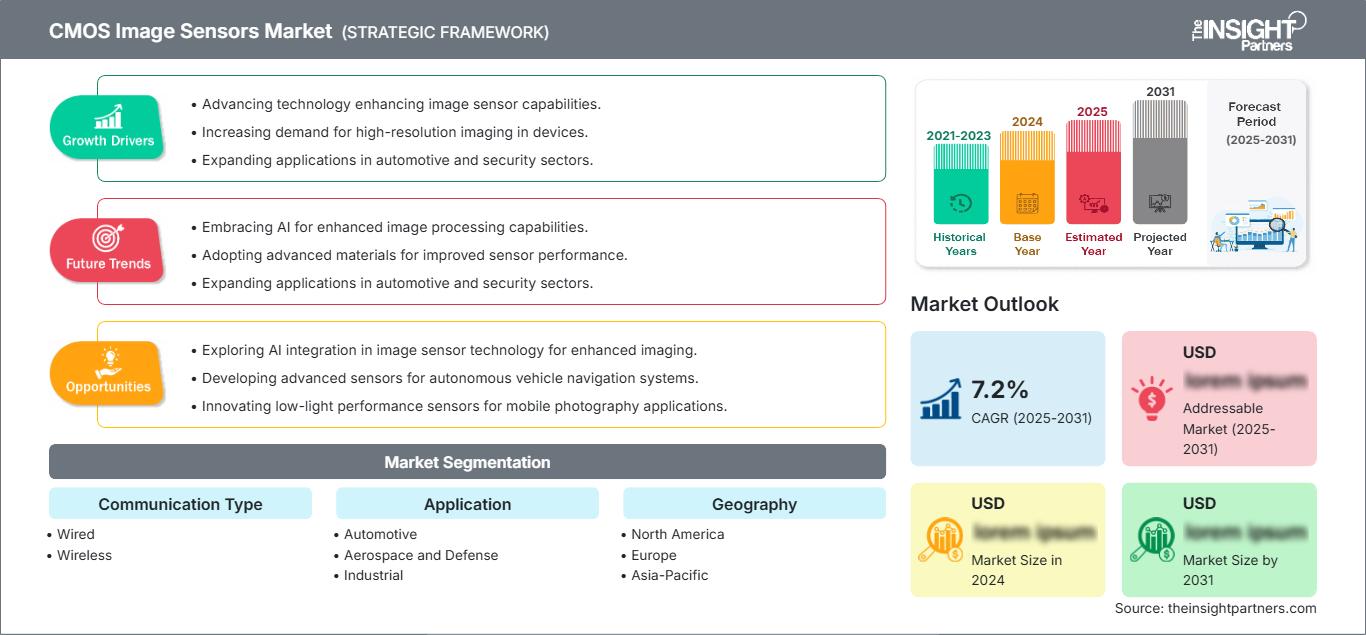
The CMOS Image Sensors market was valued at US$ 23.87 Billion in 2025 and is projected to reach US$ 50.34 Billion by 2034, registering a CAGR of 8.65% during 2026–2034. The market includes complementary metal-oxide-semiconductor imaging devices used to convert light into electronic signals for automotive, aerospace and defense, industrial, surveillance, and other machine-vision applications.
North America CMOS Image Sensors Market size is expected to expand at a CAGR of 7.8–8.6% during 2026–2034, supported by automotive safety regulations, defense imaging modernization, factory automation, and smart infrastructure surveillance. Demand is concentrated around high dynamic range, global shutter, near-infrared sensitivity, rugged packaging, and secure supply chains for industrial and mission-critical systems.
CMOS Image Sensors Market Assessment and Insights
- North America held 24–28% share in 2025 and is growing at a CAGR of 7.8–8.6% during 2026–2034, led by automotive safety cameras, defense electro-optics, and industrial automation.
- US represented 76–80% of North American revenue in 2025 and is growing at a CAGR of 8.0–8.8% during 2026–2034, supported by ADAS, robotics, and aerospace programs.
- Europe accounted for 18–22% share in 2025 and is growing at a CAGR of 7.2–8.0% during 2026–2034, with Germany, France, the UK, Italy, and Spain leading demand.
- Asia Pacific held 42–46% share in 2025 and is growing at a CAGR of 9.0–9.8% during 2026–2034, driven by China, Japan, South Korea, India, and Taiwan.
- Largest Segment Wired communication held 62–66% market share in 2025 and is growing at a CAGR of 7.9–8.7% during 2026–2034 due to deterministic industrial links.
- High Growth Segment Automotive represented 26–30% market share in 2025 and is growing at a CAGR of 10.8–11.8% during 2026–2034 on ADAS and cabin monitoring.
- Key companies analyzed in detail: ams-OSRAM AG; Banpil Photonics, Inc.; Canon U.S.A., Inc.; FUJIFILM Corporation; OMNIVISION Technologies, Inc.; onsemi; Photonfocus AG; Sharp Corporation; STMicroelectronics N.V.; Teledyne UK Limited; Sony Semiconductor Solutions Corporation; Samsung Electronics Co., Ltd.
Source: The Insight Partners' analysis based on proprietary research, government publications, company annual reports, investor presentations, industry databases, and expert interviews.
CMOS Image Sensors have evolved from commodity camera components into differentiated sensing platforms that combine stacked pixels, backside illumination, global shutter designs, embedded processing, and application-specific interfaces. Within the CMOS Image Sensors Market, production dynamics are increasingly shaped by 300 mm wafer availability, automotive qualification cycles, and foundry partnerships. Suppliers are balancing consumer-scale manufacturing with rising demand for lower-volume, higher-reliability sensors used in vehicles, surveillance networks, medical equipment, drones, robotics, and defense imaging systems.
Future demand for forward sensors will be driven by incentives for semiconductors in the region, regulations for safety, investments in smart cities, and automation in emerging manufacturing centers. Adoption of CMOS Image Sensors will grow due to a need for reduced power consumption, decreased size, and increased frame rates in comparison with existing image sensing solutions. Investments will be made in automotive high dynamic range, short-wave infrared, event-based sensors, and security vision systems.
CMOS Image Sensors Market Report Scope
| Report Attribute | Details |
|---|---|
| Market size in 2025 | US$ 23.87 Billion |
| Market Size by 2034 | US$ 50.34 Billion |
| Global CAGR (2026 - 2034) | 8.65% |
| Historical Data | 2021-2024 |
| Forecast period | 2026-2034 |
CMOS Image Sensors Market Analysis
CMOS Image Sensors' growth is driven by the shift from passive image capture to perception-enabled electronics across vehicles, factories, public infrastructure, and defense platforms. Automotive programs use multiple exterior and interior cameras for lane keeping, automated braking, surround view, driver monitoring, and occupancy detection. Industrial buyers require high-speed inspection, barcode reading, robotics guidance, and process control, while surveillance users need low-light sensitivity, wide dynamic range, and efficient edge processing.
The ecosystem spans pixel architecture, wafer fabrication, color filters, lenses, processors, modules, software, qualification labs, and system integrators. Supply dynamics remain tied to semiconductor capacity, yield stability, and automotive-grade testing. CMOS Image Sensors Market analysis also shows that buyers evaluate lifecycle support, interface standards, cyber resilience, thermal performance, and long-term availability because embedded vision systems often remain in service for several product generations.
Market positioning varies depending on the end-user market. Both Sony Semiconductor Solutions Corporation and Samsung Electronics Co., Ltd. are leading players in mass-market imaging products, whereas OMNIVISION Technologies, Inc., onsemi, and STMicroelectronics N.V. pose strong competition in automotive, industrial, and embedded vision applications. Specialized sensors, scientific, industrial and imaging sub-systems can be obtained from such companies as Canon U.S.A., Inc., FUJIFILM Corporation, ams-OSRAM AG, Photonfocus AG, Sharp Corporation and Teledyne UK Limited.
Investment trends include stackable BSI sensors, global shutter pixels, near-infrared sensitivity, on-chip artificial intelligence, and reduced latency in data transfer paths. Companies like Banpil Photonics, Inc. demonstrate the need for advanced photonics technologies for niche sensing applications. The future of the industry belongs to application engineering services, automotive safety certification, specialized packaging services, and alignment of sensor roadmaps with electronics architectures.
● REPORT CUSTOMIZATION
Tailor This Report To Align With Your Specific Business Requirements
This report can be customized to align precisely with your business objectives, scope, and target markets. Customization options include tailored segmentation, geography, competitive analysis, and strategic insights to support informed decision-making.
Customize This Report →WHAT YOU CAN ADJUST
- ● Segmentations
- ● Geography
- ● Competitive Analysis
- ● Language Preferences
CMOS Image Sensors Market: Strategic Insights
Regional Insights
North America CMOS Image Sensors Market
North America accounted for 24–28% of CMOS Image Sensors Market share in 2025 and is projected to expand at a CAGR of 7.8–8.6% during 2026–2034. Demand is supported by ADAS mandates, aerospace imaging, industrial robotics, warehouse automation, and smart-security upgrades. Buyer needs include reliability, traceability, and imaging performance that is consistent in terms of temperature changes, vibrations, and poor lighting environments.
Procurement requirements from the automotive and defense industries influence regional specifications since they need more time to qualify than consumer electronics. CMOS Image Sensors providers operating in this region place importance on functional safety, security compliance, and longevity of their products. Moreover, there is an increasing demand from the industrial segment due to use cases related to machine vision.
U.S. CMOS Image Sensors Market
The U.S. represented 76–80% of North American revenue in 2025 and is expected to grow at a CAGR of 8.0–8.8% during 2026–2034. Within the CMOS Image Sensors Market, application demand is concentrated in automotive perception, robotics, semiconductor inspection, video surveillance, aerospace payloads, and medical imaging devices. Buyers emphasize domestic engineering support, secure supply, and sensor traceability.
Company presence includes OMNIVISION Technologies, Inc., onsemi, Canon U.S.A., Inc., Sony Semiconductor Solutions Corporation, Samsung Electronics Co., Ltd., STMicroelectronics N.V., and Teledyne UK Limited through sales, design, support, or customer programs. Adoption trends favor global shutter sensors, HDR automotive cameras, low-power embedded modules, and wireless vision nodes for infrastructure monitoring, where cable installation is costly.
Europe CMOS Image Sensors Market
Europe held 18–22% share in 2025 and is projected to grow at a CAGR of 7.2–8.0% during 2026–2034. Germany is the leading country because automotive OEMs, Tier 1 suppliers, machine-vision integrators, and robotics manufacturers require qualified imaging components. The UK contributes through defense, aerospace, research imaging, and high-value surveillance projects, supporting the continued expansion of the CMOS Image Sensors Market across the region.
France supports demand through aerospace, industrial automation, and public infrastructure programs, while Italy and Spain add machine vision, transport safety, and security installations. European procurement places strong weight on product longevity, environmental compliance, and trusted sourcing. CMOS Image Sensors demand also benefits from EU safety rules, connected mobility projects, and factory modernization across automotive, packaging, and electronics manufacturing.
APAC CMOS Image Sensors Market
Asia Pacific accounted for 42–46% share in 2025 and is forecast to grow at a CAGR of 9.0–9.8% during 2026–2034. China leads regional volume through electronics manufacturing, security infrastructure, electric vehicles, and industrial automation. Japan and South Korea add advanced sensor design, automotive electronics, and high-resolution imaging ecosystems.
India, Taiwan, and Australia contribute through electronics assembly, smart infrastructure, defense surveillance, and mining automation. Policy support for semiconductor manufacturing and digital infrastructure strengthens regional demand. CMOS Image Sensors procurement in APAC favors scalable pricing, high-volume supply, compact modules, and designs that can support wired factory systems as well as wireless smart-city deployments.
Middle East & Africa CMOS Image Sensors Market
The Middle East & Africa market is projected to grow at a CAGR of 6.6–7.4% during 2026–2034. Saudi Arabia and the UAE lead adoption through smart-city surveillance, transport infrastructure, oil and gas monitoring, and aviation security. South Africa contributes through industrial inspection, mining safety, border security, and public safety applications.
The rest of MEA demand remains project-led, with system integrators selecting sensors based on thermal stability, dust tolerance, night performance, and serviceability. Energy and infrastructure projects create recurring opportunities for fixed surveillance, thermal-assisted inspection, and remote asset monitoring. Wireless camera nodes are gaining relevance where long-distance cabling is impractical or expensive.
Segmentation Analysis
Communication Type
Communication Type is projected to grow at a CAGR of 8.1–8.9% during 2026–2034. Within the CMOS Image Sensors Market, the scope covers wired interfaces for deterministic, high-bandwidth industrial and automotive systems and wireless links for distributed surveillance, smart-city nodes, and battery-powered monitoring. Interface selection depends on latency, cable length, electromagnetic interference, security, installation cost, and edge-processing requirements.
- Wired sensors dominate machine vision, automotive, aerospace, and industrial inspection because they deliver stable bandwidth, synchronized timing, lower latency, and predictable performance in safety-critical or high-throughput environments.
- Wireless sensors are expanding in surveillance, remote infrastructure, agriculture, logistics, and temporary deployments where installation flexibility, lower cabling cost, and edge compression support scalable vision coverage.
Application
Application is forecast to grow at a CAGR of 8.7–9.5% during 2026–2034. Within the CMOS Image Sensors Market, automotive remains the most strategic demand pool because safety functions require multiple cameras per vehicle, while aerospace and defense emphasize ruggedization and trusted supply. Industrial and surveillance applications prioritize uptime, low-light performance, and analytics-ready output for automation, inspection, situational awareness, and perimeter monitoring.
- Automotive demand is led by ADAS, surround view, driver monitoring, and occupancy sensing, making HDR, global shutter performance, safety documentation, and long-term supply critical buying factors.
- Aerospace and Defense applications require rugged sensors for surveillance, targeting, navigation, unmanned platforms, and space-adjacent imaging, where reliability, low noise, secure sourcing, and harsh-environment operation guide selection.
- Industrial systems use CMOS imaging for machine vision, robotics, measurement, barcode reading, packaging inspection, and semiconductor processing, with demand centered on speed, synchronization, repeatability, and lifecycle availability.
- Surveillance adoption is supported by smart cities, transport hubs, border security, commercial facilities, and critical infrastructure, where low-light sensitivity, edge analytics, and cost-efficient deployment are strategic requirements.
Opportunity Snapshot
| Application | Revenue Contribution | Trend Tag | Adoption Stage |
| Automotive | High | ADAS Cameras | Scaling |
| Aerospace and Defense | Medium | Rugged Vision | Scaling |
| Industrial | High | Machine Vision | Mature |
| Surveillance | Medium | Edge Analytics | Scaling |
CMOS Image Sensors Market Growth Drivers and Impact Analysis
Vehicle safety electronics increase sensor content per platform
Car manufacturers are upping the number of cameras used for safety scores, driver assistance systems, and automation features, transitioning from luxury models to economy lines. Cameras at the front, rear, all-around, driver-monitoring, and occupant-monitoring applications require CMOS Image Sensors that have high dynamic range, minimal motion artifacts, functional safety records, and reliable operation at extreme temperatures. The effect is strategic because once qualified by car program developers, CMOS Image Sensor suppliers become committed to those vehicle lines for a few years at least. This means long payback periods, but also higher barriers to entry for non-qualified suppliers.
Factory automation expands demand for deterministic machine vision
Cameras are being used by manufacturers to boost quality inspection, cut down on scrap, guide robots, inspect labeling, and track fast-paced processes. For this purpose, the preferred camera technology is Wired CMOS Image Sensors, which need synchronization, determinate latency, and immunity to electromagnetic interference. Market implications can be seen in various industries, including electronics, automotive parts, pharma, food packaging, and logistics, where vision information serves both as control inputs and as traceability information. Sensor manufacturers gain an advantage if their sensors come with global shutter, fast frame rates, small form factor, and industrial software capabilities.
Security infrastructure shifts toward analytics-ready imaging
There is an evolution in public authorities, transportation, businesses, and owners of critical infrastructure from simple recording to cameras capable of performing analytics, low-light recognition, and real-time notifications. It places greater demands on CMOS Image Sensors for better sensitivity, wide dynamic range, near-infrared performance, and efficient data transfer to edge computing devices. One can see the effect of that development in smart city applications, airports, railways, utility networks, and perimeter protection solutions. Wireless technology provides an opportunity to increase coverage where cabling is problematic, whereas a wired solution is the preferred choice in places that require reliability.
CMOS Image Sensors Market Future Trends
On-sensor intelligence reduces system latency
CMOS Image Sensors Market trends point toward greater integration of processing near the pixel array, including event detection, exposure optimization, region-of-interest readout, and compressed metadata. This approach reduces bandwidth, improves response time, and lowers power consumption in vehicles, robots, drones, and surveillance cameras. Future designs will not replace external processors, but they will filter and prioritize visual data before transmission. Suppliers that combine imaging expertise with embedded logic, software tools, and developer support can influence system architecture decisions earlier in the design cycle.
Non-visible imaging becomes more commercially accessible
Short-wave infrared, near-infrared, and spectral sensing technology is set to migrate from expensive scientific applications to industrial, automotive, security, and healthcare processes. This transition will be based on cheaper sensor prices, increased quantum efficiency, and ease of module integration. Examples of such applications include sorting materials, viewing at night, monitoring drivers, inspecting wafers, detecting moisture, and biometrics. In addition to growing these applications, vendors who can deliver application design references, optics collaboration, and calibrated modules will offer a faster design cycle and higher margins, in addition to traditional visible imaging.
CMOS Image Sensors Market Opportunities
Automotive-grade imaging platforms for software-defined vehicles
CMOS Image Sensors Market Forecasts indicate a strong opportunity in automotive-grade platforms that support multiple camera positions, shared processing, and software-defined feature updates. Suppliers can invest in sensors optimized for HDR, low-light cabin monitoring, global shutter perception, and standardized high-speed interfaces. The commercial opportunity improves when vendors provide safety documentation, reference modules, and long product lifecycles that reduce OEM validation effort. Partnerships with Tier 1 suppliers, processor makers, and lens providers can help turn individual components into scalable perception platforms aligned with future vehicle architectures.
Industrial vision modules for small and mid-sized factories
Small and medium-sized manufacturing plants have begun to use inspection and robotics technology; however, most do not have imaging skills in their organization. This presents an opportunity to develop a package for vision modules, which incorporates CMOS image sensor technology, optics, illumination guidance, processing, and software templates. This is an avenue through which vendors can market their products in applications such as packaging, electronics manufacturing, pharmaceuticals, food manufacturing, and logistics, among others. The importance of distributors and system integrators in such packages cannot be underestimated since customers will be buying an end-to-end solution and not just sensors.
Recent Developments
- June 2026: Sony Semiconductor Solutions Corporation (Sony) announced the upcoming release, mass production, and shipment of the IMX711 direct conversion charge-integrating X-ray CMOS image sensor. The IMX711 is an X-ray image sensor for inspection and measurement instrumentation, which directly detects X-rays and outputs signals proportional to their energy. The new sensor offers the industry’s fastest*1 maximum 26,100 fps high-speed imaging, achieved thanks to Sony’s proprietary circuit technology, suppressing charge saturation for accurate measurements. It also significantly reduces noise to enable improved signal detection precision in low-flux conditions, detecting differences in photon energy. It provides both high-accuracy measurements of integrated X-ray energy at a wide dynamic range and energy information acquisition at the photon level on a single sensor, a feat that has been difficult with conventional sensors. This unique feature will contribute to the advancement and diversification of X-ray inspection and measurement technologies, which are used in a wide variety of applications, from cutting-edge device inspection to scientific measurements
- May 2026: indie Semiconductor (Nasdaq: INDI), an automotive solutions innovator, has announced the signing of a definitive agreement to acquire the fabless CMOS image sensor group from ams OSRAM AG for a total consideration of 40 million euros. With primary operations in Belgium and Portugal, this product line includes intelligent, high‑performance CMOS image sensors for a broad range of industrial, automation, and physical artificial intelligence (AI) applications. This portfolio of products, IP, and designs aligns with Indie’s automotive ADAS sensing solutions and further strengthens the Company’s multimodal sensing capabilities across radar, vision, LiDAR, and ultrasonic.
- October 2025: STMicroelectronics (NYSE: STM), a global semiconductor leader serving customers across the spectrum of electronics applications, introduces a new family of 5MP CMOS image sensors: VD1943, VB1943, VD5943, and VB5943. These advanced ST BrightSense sensors are designed to accelerate the development of innovative vision applications across industries, including advanced industrial automation with enhanced machine and robotic vision, next-generation security, including biometric identification and traffic management, and smart retail applications such as inventory management and automated checkout. A longtime leader in optical sensing technology for consumer applications, ST continues to expand its offering for new applications with its industry-leading design, 3D stacking expertise, and high-volume manufacturing for market-leading performance.
Frequently Asked Questions

- Comprehensive Market Sizing and Forecast Analysis
- Detailed Segmentation Analysis
- In-Depth Market Dynamics Assessment
- Regional and Country-Level Insights
- Competitive Landscape and Company Benchmarking
- Strategic Business Intelligence
Recent Reports
Testimonials

The Insight Partners' SCADA System Market report is comprehensive, with valuable insights on current trends and future forecasts. The team was highly professional, responsive, and supportive throughout. We are very satisfied and highly recommend their services.
RAN KEDEM Partner, Reali Technologies LTDs
I requested a report on a very specific software market and the team produced the report in a few days. The information was very relevant and well presented. I then requested some changes and additions to the report. The team was again very responsive and I got the final report in less than a week.
JEAN-HERVE JENN Chairman, Future Analytica
We worked with The Insight Partners for an important market study and forecast. They gave us clear insights into opportunities and risks, which helped shape our plans. Their research was easy to use and based on solid data. It helped us make smart, confident decisions. We highly recommend them.
PIYUSH NAGPAL Sr. Vice President, High Beam Global
The Insight Partners delivered insightful, well-structured market research with strong domain expertise. Their team was professional and responsive throughout. The user-friendly website made accessing industry reports seamless. We highly recommend them for reliable, high-quality research services
YUKIHIKO ADACHI CEO, Deep Blue, LLC.
This is the first time I have purchased a market report from The Insight Partners.While I was unsure at first, I visited their web site and felt more comfortable to take the risk and purchase a market report.I am completely satisfied with the quality of the report and customer service. I had several questions and comments with the initial report, but after a couple of dialogs over email with their analyst I believe I have a report that I can use as input to our strategic planning process.Thank you so much for taking the extra time and making this a positive experience.I will definitely recommend your service to others and you will be my first call when we need further market data.
JOHN SUZUKI President and Chief Executive Officer, Board Director, BK Technologies
I wish to appreciate your support and the professionalism you displayed in the course of attending to my request for information regarding to infectious disease IVD market in Nigeria. I appreciate your patience, your guidance, and the fact that you were willing to offer a discount, which eventually made it possible for us to close a deal. I look forward to engaging The Insight Partners in the future, all thanks to the impression you have created in me as a result of this first encounter.
DR CHIJIOKE ONYIA MANAGING DIRECTOR, PineCrest Healthcare Ltd.Reason to Buy
- Informed Decision-Making
- Understanding Market Dynamics
- Competitive Analysis
- Identifying Emerging Markets
- Customer Insights
- Market Forecasts
- Risk Mitigation
- Boosting Operational Efficiency
- Strategic Planning
- Investment Justification
- Tracking Industry Innovations
- Aligning with Regulatory Trends





 Get Free Sample for