
Cold Chain Tracking and Monitoring Devices Market Growth, Size, Share, Trends, Key Players Analysis, and Forecast till 2034
Coverage: by Offerings (Solution, Service); Application (Storage Units and Warehouse, Freight Transportation); End user (Healthcare and Pharmaceutical, Food and Beverage, Chemicals, Others) , and Geography (North America, Europe, Asia Pacific, and South and Central America)
- Status : Data Released
- Report Code : TIPRE00004818
- Category : Electronics and Semiconductor
- No. of Pages : 150
- Available Report Formats :


- Last update date : July 28, 2026


2025 Market Size
US$ 9.08 Bn
Base year value
2034 Forecast
US$ 25.58 Bn
Projected by 2034
CAGR 2026-2034
12.2 %
Growth rate
Addressable Market
US$ 151.81 Bn
(2026-2034)
The Cold Chain Tracking and Monitoring Devices Market was valued at US$ 9.08 Billion in 2025 and is projected to reach US$ 25.58 Billion by 2034, registering a CAGR of 12.2% during 2026–2034. With the need for temperature-controlled pharmaceutical products, vaccines, biologics, perishable foods, and specialty chemicals rising continuously, the market is witnessing significant growth.
North America continues to be a key market for adoption of the technology due to market size advantages from pharmaceutical supply chain management, online grocery sales, and large-scale refrigerated warehouse infrastructure in the region. North America is expected to expand at a CAGR of 10.8-11.6% between 2026 and 2034, fueled by validation of life sciences logistics operations, improved food safety management, and sensor technology-based vehicle modernization.
Cold Chain Tracking and Monitoring Devices Market Assessment and Insights
- North America held a 34–37% share in 2025 and is expected to grow at a CAGR of 10.8–11.6% between 2026–2034, driven by pharma GDP compliance, refrigerated food logistics, and advanced telematics.
- US represented 78–82% of North America in 2025 and is projected to grow at a CAGR of 10.5–11.2% during 2026–2034, supported by biologics distribution and FSMA-led traceability.
- Europe accounted for 24–27% share in 2025 and is forecast to grow at a CAGR of 10.2–10.9% through 2034, with Germany, the UK, France, Italy, and Spain leading validated pharma and food-chain monitoring.
- Asia Pacific captured a 25–28% share in 2025 and is anticipated to grow at a CAGR of 13.8–14.6% during 2026–2034, led by China, India, Japan, South Korea, and Australia.
- Largest Segment Solution held a 66–70% market share in 2025 and is expected to grow at a CAGR of 11.8–12.5%, reflecting demand for sensors, gateways, data loggers, and platforms.
- High Growth Segment Freight Transportation held a 43–47% share in 2025 and is forecast to grow at a CAGR of 13.0–13.8%, driven by cross-border pharma, frozen food, and last-mile visibility.
- Key companies analyzed in detail: Americold Logistics, LLC, Berlinger & Co. AG, Infratab, Inc., Controlant hf., ELPRO-BUCHS AG, Lineage, Inc., Monnit Corporation, ORBCOMM Inc., Sensitech Inc., and Velvetech LLC.
Source: The Insight Partners' analysis based on proprietary research, government publications, company annual reports, investor presentations, industry databases, and expert interviews.
Equipment adoption has transitioned from simple logging of temperature to intelligent, rules-based control systems. Former methods would detect whether an excursion occurred only after delivery, while current tools transmit information about temperature, humidity, shock, light, and positioning during both storage and transportation of products. Changes in the production industry push for adoption of calibrated sensors, battery-powered data loggers, cloud-based dashboards, and interfacing with warehouse management software because drug release and food claims depend on condition history.
Future adoption of equipment will be motivated by the transportation of biologicals, cellular therapies, premium frozen foods, and specialty chemicals through intricate distribution chains. Efforts are focused on the creation of reusable, real-time equipment, automated decisions on product release, predictive analytics, and power efficient monitoring of high-throughput processes. Future regulatory demands stemming from pharmaceutical GDP, vaccine storage guidance, and food safety tracking requirements will push for hardware and data handling reliability.
Cold Chain Tracking and Monitoring Devices Market Report Scope
| Report Attribute | Details |
|---|---|
| Market size in 2025 | US$ 9.08 Billion |
| Market Size by 2034 | US$ 25.58 Billion |
| Global CAGR (2026 - 2034) | 12.2% |
| Historical Data | 2021-2024 |
| Forecast period | 2026-2034 |
Cold Chain Tracking and Monitoring Devices Market Analysis
The market is growing due to the increasing value of temperature-controlled products and the costs associated with product spoilage. The highest demand will come from the healthcare and pharma industries, where vaccines and other biological substances require temperature control between 2°C-8°C or ultra-cold conditions. In food and beverage industries, there is a need for temperature monitoring in order to minimize losses and react to any problems during transport or in the warehouse.
Ecosystem participants include sensor makers, connectivity service providers, cloud software companies, refrigerated warehouses, freight forwarders, packaging companies, and quality departments. Supply side prefers companies that can provide sensors with calibration, auditable logs, and API integrations. The need for IATA requirements for temperatures of healthcare cargo and WHO’s cold chain tooling increases the demand for documented condition monitoring.
The Cold Chain Tracking and Monitoring Devices Market report reveals a market environment segmented between providers of cold storage facilities, monitoring firms, and software developers. These include Sensitech Inc., Controlant hf., ORBCOMM Inc., ELPRO-BUCHS AG, Berlinger & Co. AG, Infratab, Inc., Monnit Corporation, and Velvetech LLC, all competing on accuracy of devices, real-time alerts, analytics, and regulatory reports.
Positioning depends on the size of existing infrastructure as well. Lineage, Inc. and Americold Logistics, LLC maintain large networks of temperature-controlled warehouses, making it necessary to have site-level monitoring, energy management, and reporting capabilities. Investments go toward reusable IoT devices, lane risk analytics solutions, automatic pharmaceutical release systems, and integrated service offerings reducing manual check-ups.
● REPORT CUSTOMIZATION
Tailor This Report To Align With Your Specific Business Requirements
This report can be customized to align precisely with your business objectives, scope, and target markets. Customization options include tailored segmentation, geography, competitive analysis, and strategic insights to support informed decision-making.
Customize This Report →WHAT YOU CAN ADJUST
- ● Segmentations
- ● Geography
- ● Competitive Analysis
- ● Language Preferences
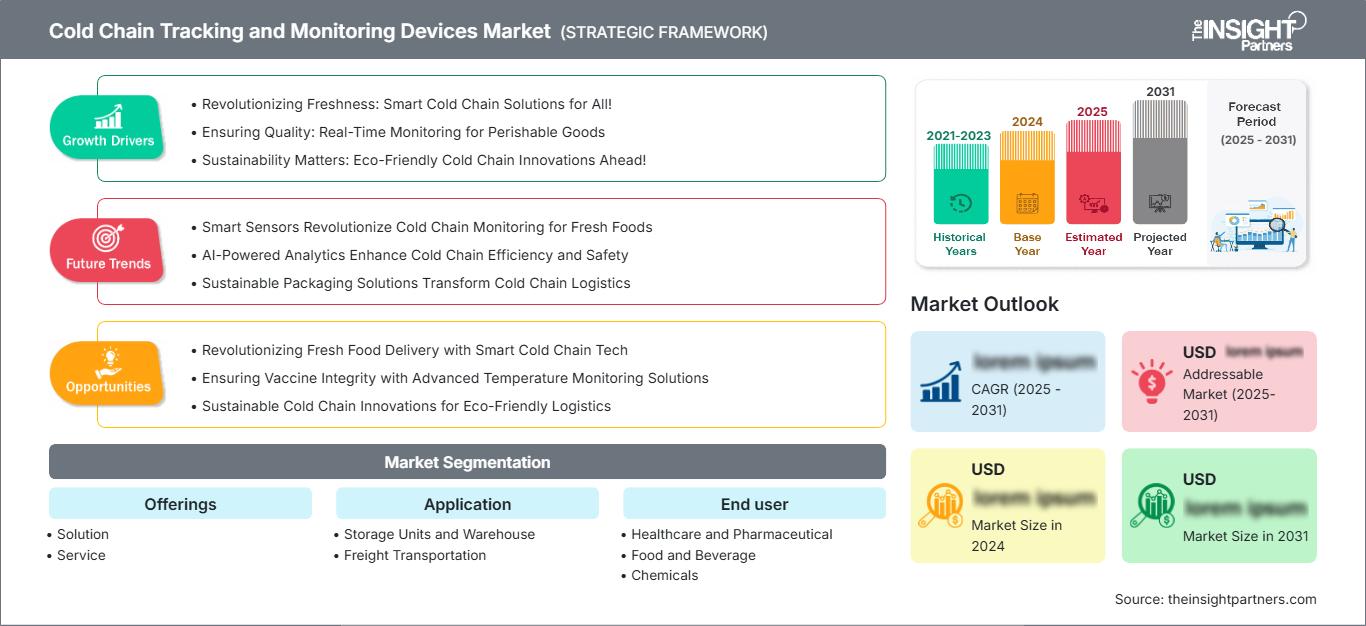
Cold Chain Tracking and Monitoring Devices Market: Strategic Insights
Regional Insights
North America Cold Chain Tracking and Monitoring Devices Market
North America accounted for a market share of 34-37% in 2025 and will experience growth at a CAGR of 10.8-11.6% until 2034. The adoption of this equipment is seen in the transport of pharmaceuticals, frozen/chilled foods, and valuable clinical trials. There are large-scale warehouse facilities such as Americold Logistics, LLC and Lineage, Inc., which drive the demand for site monitoring in refrigerated warehouses and automated warehouses.
Structural factors that favor adoption include FDA documentation for food safety, storage of vaccines, DSCSA for traceability, and pressures from retailers for fresh deliveries. Real-time devices are experiencing increased adoption since operators require notifications prior to making release decisions. There are rising demands for freight transport with the transport of biologics, seafood, meats, dairy, and frozen foods.
U.S. Cold Chain Tracking and Monitoring Devices Market
The US constituted 78%-82% of North American revenue in 2025 and is expected to register a growth rate of CAGR of 10.5-11.2% between 2026-2034. There is wide-ranging presence of players in the country in terms of offering their solutions related to monitoring, telematics, and refrigeration infrastructure with ORBCOMM Inc., Monnit Corporation, Sensitech Inc., Americold Logistics, LLC, and Lineage, Inc.
As far as trends of applications are concerned, the applications are moving from being compliance based towards more automatic intervention. The cellular, Bluetooth, and cloud-based monitoring is increasingly used by refrigerated trucks, reefer containers, cold rooms, and pharma level shipment parcels. Validation of calibration, auditability, chain of custody tracking, and connectivity with the enterprise logistics system are essential to US buyers.
Europe Cold Chain Tracking and Monitoring Devices Market
Europe accounted for 24-27% in 2025 and is estimated to grow with a CAGR of 10.2-10.9% till 2034. Germany leads in Europe owing to its pharmaceutical exports, biopharmaceutical manufacturing and logistics automation. The UK drives demand through clinical trials distribution and cold chain logistics in the grocery industry. The Swiss have improved their regional capacity by ELPRO-BUCHS AG and Berlinger & Co. AG.
France, Italy, and Spain drive the demand through vaccines, specialty drugs, dairy products, fish, and chilled prepared foods. The GDP growth projections in the EU region and national-level food safety regulations have led buyers to demand temperature monitoring documentation in storage facilities and transportation. Buyers are looking to increase the use of reusable data loggers, lane qualification solutions, and cloud-based dashboards for audits in transshipment.
APAC Cold Chain Tracking and Monitoring Devices Market
The Asia Pacific region accounted for 25-28% market share in 2025 and is forecast to have the highest CAGR between 13.8%-14.6%. The region includes China where sensors are adopted due to pharmaceutical production, cold chain frozen food distribution, and e-commerce grocery logistics. Japan and South Korea focus on precise monitoring in biologics and seafood, and India builds up their capability in vaccine, dairy, and horticulture cold chain.
In Australia, there is also a boost in sensors owing to long distance meat, dairy, and pharmaceutical transportation. Government policy towards reducing food waste, vaccine cold chain, and logistics digitization boosts sensors’ adoption. There is an increase in devices for chemicals with temperature and humidity control due to industrial growth.
Middle East & Africa Cold Chain Tracking and Monitoring Devices Market
Middle East & Africa is expected to grow at a CAGR of 11.4–12.2% through 2034, led by Saudi Arabia and the UAE. Healthcare logistics, food imports, aviation cargo hubs, and new cold-storage facilities support adoption. South Africa contributes demand from retail food distribution, vaccines, and mining-area healthcare supply chains.
Energy and infrastructure context matters because extreme ambient temperatures raise excursion risk during loading, customs clearance, and last-mile delivery. Monitoring devices help operators verify refrigeration performance, document handoffs, and protect high-value pharmaceutical shipments. Rest of MEA demand is developing through humanitarian healthcare logistics, cold food imports, and regional distribution hubs.
Segmentation Analysis
Offerings
Offerings are projected to grow at a CAGR of 11.9–12.7% during 2026–2034. The Cold Chain Tracking and Monitoring Devices Market scope by offerings is shaped by the need for calibrated sensing, connectivity, cloud analytics, device lifecycle management, and validation support. Buyers increasingly combine physical devices with services that manage configuration, data review, compliance reporting, and exception response.
- Solution: Solutions dominate because sensors, data loggers, gateways, and platforms create the primary evidence layer for temperature, humidity, location, and shock visibility across storage and transportation workflows.
- Service: Services are strategically important as customers require device calibration, installation, validation, data interpretation, compliance documentation, and technical support to maintain reliable monitoring programs across complex logistics networks.
Application
Application segment in the Cold Chain Tracking and Monitoring Devices Market is forecast to grow at a CAGR of 12.0–12.8% during 2026–2034. Storage units and warehouses require continuous site monitoring, while freight transportation needs mobile devices that withstand vibration, network gaps, and route variability. Adoption is rising as operators connect facility data with shipment-level visibility to reduce release delays, quality disputes, and product waste.
- Storage Units and Warehouse: This sub-segment remains essential because cold rooms, freezers, and automated warehouses require continuous temperature mapping, alarm escalation, and audit records for pharmaceutical, food, and chemical inventory.
- Freight Transportation: Freight transportation is strategically important as reefer trucks, air cargo, ocean containers, and last-mile parcels require real-time condition data to prevent excursions before delivery or release.
End user
End user segment in the Cold Chain Tracking and Monitoring Devices Market is expected to grow at a CAGR of 12.1–12.9% during 2026–2034. Healthcare and pharmaceutical users prioritize validated records, food and beverage users focus on spoilage reduction, and chemical users require condition assurance for sensitive materials. The segment’s adoption is moving from basic compliance toward risk-based visibility, automated alerts, and supplier accountability across distribution networks.
- Healthcare and Pharmaceutical: This sub-segment leads strategic adoption because vaccines, biologics, cell therapies, and clinical trial materials require documented temperature control, chain-of-custody visibility, and validated release decisions.
- Food and Beverage: Food and beverage demand is expanding as meat, seafood, dairy, frozen meals, and fresh produce supply chains use monitoring to reduce waste and strengthen retailer assurance.
- Chemicals: Chemicals require tracking where temperature, humidity, or shock can affect stability, viscosity, safety, or performance, making monitoring valuable for specialty materials and regulated industrial shipments.
Opportunity Snapshot
| End Users | Revenue Contribution | Trend Tag | Adoption Stage |
| Healthcare and Pharmaceutical | High | Biologic Visibility | Scaling |
| Food and Beverage | High | Fresh Assurance | Mature |
| Chemicals | Medium | Stability Tracking | Emerging |
Cold Chain Tracking and Monitoring Devices Market Growth Drivers and Impact Analysis
Biologics and Vaccines Require Verified Temperature Integrity
Increased monitoring is becoming necessary in pharmaceutical cold chains due to increased movement of vaccines, biologics, insulin, and cell-based therapies on a more extensive network. The guidance from WHO and CDC stresses the importance of ensuring that potency is not lost if the products are outside the recommended temperatures, and therefore accuracy, skilled personnel, and good record keeping is key. The commercial impact of this driver is the need for distributors to have real-time alarms, accuracy, and readiness to document products to avoid wastage and delays due to regulations. The Cold Chain Tracking and Monitoring Devices Market sees an increase in reusable devices and sensor-equipped parcels among others.
Food Safety Rules Push Continuous Visibility
Monitoring is used by food and beverage logistics chains to guarantee freshness, lower spoilage and manage liability in refrigerated warehouses, reefer trucks and the last mile. Documentation requirements like those of FSMA, retailer scorecards and consumer needs for safe chilled foods are making temperature histories more important in the pallet, trailer and warehouse levels. Market implications include the increased adoption of wireless sensors and telematics solutions for identifying refrigeration problems, open doors and delays on the routes. Device demand is repetitive for suppliers as it involves large volumes of shipments that need monitoring.
Warehouse Automation Expands Site-Level Monitoring Demand
The large-scale refrigerated warehouses are now becoming automated, dense and energy-sensitive, making it even more important to conduct continuous monitoring in different parts of the warehouse, such as rooms, racks, dock doors, and equipment areas. Americold Logistics, LLC and Lineage, Inc., for example, run significant worldwide cold storage facilities that demonstrate the size of infrastructure where the mapping, alarm escalation and reporting of incidents to the customers are required. This affects the number of devices in a structural way because the warehouse requires permanent devices, gateway integration, calibration procedures and software integrations.
Cold Chain Tracking and Monitoring Devices Market Future Trends
AI-Led Exception Prediction
Cold Chain Tracking and Monitoring Devices Market trends are moving from descriptive reporting to predictive exception management. Future platforms will combine lane history, weather, dwell time, refrigeration performance, and product stability data to estimate excursion risk before shipment departure. This will help quality teams select packaging, routing, and monitoring intensity based on risk rather than applying the same control model everywhere. AI-led alerts will also reduce alarm fatigue by distinguishing temporary door openings from conditions likely to damage products. Suppliers that prove model transparency and validation will gain preference in regulated healthcare logistics.
Reusable Real-Time Devices with Lower Environmental Burden
Device design will increasingly emphasize reuse, rechargeable power, recyclable materials, and lower communication energy. Pharmaceutical and food shippers want real-time visibility, but single-use electronics create cost and sustainability concerns when shipment volumes scale. Reusable devices with reverse logistics support can reduce waste while improving total cost per monitored lane. The challenge will be balancing battery life, sensor accuracy, cleaning validation, and global connectivity. Providers with device recovery services, lifecycle analytics, and durable hardware will be positioned to support both environmental targets and regulated supply-chain assurance.
Cold Chain Tracking and Monitoring Devices Market Opportunities
Automated Pharma Release Workflows
Cold Chain Tracking and Monitoring Devices Market Forecasts point to strong opportunity in automating pharmaceutical product release evaluations. Today, many quality teams still review temperature files manually after shipments arrive, which delays inventory availability and increases labor burden. Vendors can create value by linking device data, stability profiles, route history, and deviation rules inside validated workflows. This opportunity is investment-oriented because it supports premium software pricing, long-term customer contracts, and integration with enterprise quality systems. Companies that demonstrate compliance with electronic record expectations and provide configurable release logic can move beyond hardware sales into decision-support platforms.
Cold Chain Visibility for Emerging Food Corridors
Emerging food corridors in Asia Pacific, the Middle East, and Africa create opportunities for scalable monitoring programs tied to seafood, meat, dairy, frozen foods, and fresh produce exports. Many lanes face long dwell times, customs variability, and high ambient temperatures, making excursion prevention commercially important. Device suppliers can partner with cold-storage operators, freight forwarders, retailers, and insurers to provide lane-level risk data and exception reporting. The opportunity is strongest where governments are investing in cold-chain infrastructure to reduce food loss and support higher-value agricultural trade.
Recent Developments
- March 2025: Sensitech Inc. launched Lynx FacTOR, a SaaS solution designed to automate pharmaceutical product release evaluations by reducing manual temperature data review, accelerating batch release cycles, and supporting regulatory compliance for life-science logistics customers. The launch strengthens Sensitech’s role in validated cold-chain visibility and exception management.
- August 2024: Sensitech Inc. completed the acquisition of Berlinger & Co. AG’s Monitoring Solutions business, adding Fridge-tag, Q-tag, SmartMonitor, and SmartView capabilities for pharmaceutical, clinical trial, and global health cold chains. The transaction expanded Sensitech’s end-to-end monitoring portfolio and added employees in Switzerland, the Netherlands, and the US.
- February 2024: Sensitech Inc. launched TempTale GEO X for real-time pharmaceutical cold-chain visibility and logistics management. The solution supports condition and location monitoring for temperature-sensitive shipments, helping life-science customers identify route risks, investigate excursions, and maintain better shipment-level documentation across global logistics networks.
Frequently Asked Questions

- Comprehensive Market Sizing and Forecast Analysis
- Detailed Segmentation Analysis
- In-Depth Market Dynamics Assessment
- Regional and Country-Level Insights
- Competitive Landscape and Company Benchmarking
- Strategic Business Intelligence
Recent Reports
Testimonials

The Insight Partners provided valuable market intelligence that supported our global go-to-market strategy. Their team was professional, responsive, and attentive to our feedback, providing thoughtful analysis and helpful methodological clarifications throughout the project.
Junmo Kim Chief Financial Officer (CFO), Enertech Co., Ltd.
The Insight Partners' SCADA System Market report is comprehensive, with valuable insights on current trends and future forecasts. The team was highly professional, responsive, and supportive throughout. We are very satisfied and highly recommend their services.
RAN KEDEM Partner, Reali Technologies LTDs
I requested a report on a very specific software market and the team produced the report in a few days. The information was very relevant and well presented. I then requested some changes and additions to the report. The team was again very responsive and I got the final report in less than a week.
JEAN-HERVE JENN Chairman, Future Analytica
We worked with The Insight Partners for an important market study and forecast. They gave us clear insights into opportunities and risks, which helped shape our plans. Their research was easy to use and based on solid data. It helped us make smart, confident decisions. We highly recommend them.
PIYUSH NAGPAL Sr. Vice President, High Beam Global
The Insight Partners delivered insightful, well-structured market research with strong domain expertise. Their team was professional and responsive throughout. The user-friendly website made accessing industry reports seamless. We highly recommend them for reliable, high-quality research services
YUKIHIKO ADACHI CEO, Deep Blue, LLC.
This is the first time I have purchased a market report from The Insight Partners.While I was unsure at first, I visited their web site and felt more comfortable to take the risk and purchase a market report.I am completely satisfied with the quality of the report and customer service. I had several questions and comments with the initial report, but after a couple of dialogs over email with their analyst I believe I have a report that I can use as input to our strategic planning process.Thank you so much for taking the extra time and making this a positive experience.I will definitely recommend your service to others and you will be my first call when we need further market data.
JOHN SUZUKI President and Chief Executive Officer, Board Director, BK Technologies
I wish to appreciate your support and the professionalism you displayed in the course of attending to my request for information regarding to infectious disease IVD market in Nigeria. I appreciate your patience, your guidance, and the fact that you were willing to offer a discount, which eventually made it possible for us to close a deal. I look forward to engaging The Insight Partners in the future, all thanks to the impression you have created in me as a result of this first encounter.
DR CHIJIOKE ONYIA MANAGING DIRECTOR, PineCrest Healthcare Ltd.Reason to Buy
- Informed Decision-Making
- Understanding Market Dynamics
- Competitive Analysis
- Identifying Emerging Markets
- Customer Insights
- Market Forecasts
- Risk Mitigation
- Boosting Operational Efficiency
- Strategic Planning
- Investment Justification
- Tracking Industry Innovations
- Aligning with Regulatory Trends





 Get Free Sample for