
Collision Avoidance Sensor Market Size, Trends & Demand by 2034
Coverage: by Technology (Radar, LiDAR, Ultrasound, Others); Application (Adaptive Cruise Control, Blind Spot Detection, Forward Collision Warning System, Lane Departure Warning System, Parking Assistance, Others); Industry Vertical (Marine, Aerospace and Defense, Automotive, Others) , and Geography (North America, Europe, Asia Pacific, and South and Central America)
- Status : Data Released
- Report Code : TIPRE00010530
- Category : Electronics and Semiconductor
- No. of Pages : 150
- Available Report Formats :


- Last update date : July 21, 2026


2025 Market Size
US$ 7.06 Bn
Base year value
2034 Forecast
US$ 18.21 Bn
Projected by 2034
CAGR 2026-2034
11.10 %
Growth rate
Addressable Market
US$ 111.57 Bn
(2026-2034)
Collision Avoidance Sensor market was valued at US$ 7.06 Billion in 2025 and is projected to reach US$ 18.21 Billion by 2034, registering a CAGR of 11.10% during 2026–2034. Demand is driven by car safety legislation, the proliferation of ADAS features, automation in aircraft and marine vessels, and the application of radar, LiDAR, and ultrasound sensors in applications where obstacle detection and automated systems are needed.
North America’s collision avoidance sensor market size is projected to increase at a CAGR of 10.2%-11.0% during 2026-2034 due to changes in NCAPs in the U.S., rules for automatic emergency braking, and high-end cars using sensor fusion technology. Modernization in aviation, automated marine pilots, and truck safety are behind structural demand.
Collision Avoidance Sensor Market Assessment and Insights
- North America held 27–31% share in 2025 and is growing at a CAGR of 10.2–11.0% during 2026–2034, led by ADAS regulation, aerospace programs, and safety-led fleet upgrades.
- US represented 78–82% of North American revenue in 2025 and is growing at a CAGR of 10.4–11.2% during 2026–2034, supported by OEM sensor integration.
- Europe accounted for 22–26% share in 2025 and is growing at a CAGR of 9.8–10.6% during 2026–2034, with Germany, France, the UK, Italy, and Spain leading safety adoption.
- Asia Pacific held 36–40% share in 2025 and is growing at a CAGR of 11.8–12.7% during 2026–2034, led by China, Japan, South Korea, and India.
- Largest Segment Radar held 43–47% market share in 2025 and is growing at a CAGR of 10.6–11.5% during 2026–2034 due to all-weather sensing reliability.
- High Growth Segment LiDAR represented 16–20% market share in 2025 and is growing at a CAGR of 13.4–14.6% during 2026–2034 as autonomy programs expand.
- Key companies analyzed in detail: Autoliv Inc.; Continental AG; DENSO Corporation; General Electric Company; Honeywell International Inc.; Infineon Technologies AG; NXP Semiconductors N.V.; Robert Bosch GmbH; Siemens Aktiengesellschaft; Texas Instruments Incorporated.
Source: The Insight Partners' analysis based on proprietary research, government publications, company annual reports, investor presentations, industry databases, and expert interviews.
Market development trends range from parking aid and proximity detection to multi-sensor solutions with a combination of radar, LiDAR, ultrasonics, cameras, inertial sensors, and embedded processors. The Collision Avoidance Sensor market momentum is fueled by increasing ADAS adoption, aerospace situation awareness, marine navigation automation, and ruggedness. Development trends include shift towards software-defined safety stack, regional semiconductor supply chain, and modular offerings for passenger cars, commercial vehicles, aerospace, maritime, and defense segments.
Future demand drivers include electrification of vehicles, increased NCAP requirements, autonomy of logistics, airport ground safety, and maritime collision prevention programs. New geographies are developing vehicle safety and transport automation technologies, and regulations encourage broader implementation of forward collision warnings, lane support, and blind spot assistance. Market participants should invest into sensor fusion, low power processing, cybersecurity, functional safety, and calibration services.
Collision Avoidance Sensor Market Report Scope
| Report Attribute | Details |
|---|---|
| Market size in 2025 | US$ 7.06 Billion |
| Market Size by 2034 | US$ 18.21 Billion |
| Global CAGR (2026 - 2034) | 11.10% |
| Historical Data | 2021-2024 |
| Forecast period | 2026-2034 |
Collision Avoidance Sensor Market Analysis
Factors that are driving demand for Collision Avoidance Sensors include the need for crash risk reduction by OEMs, regulatory scoring advantages, and increased automation capabilities. There is a high demand wherever sensors can enable adaptive cruise control, blind-spot detection, forward collision warning, lane departure warning, and parking assistance. The NHTSA's recently revised 5-Star Safety Ratings now include blind spot warning, blind spot intervention, lane keeping assist, and pedestrian automatic emergency braking in their consumer program.
Some participants in the value chain include semiconductor vendors, RF components suppliers, optics suppliers, sensor module suppliers, software developers, tier-one suppliers, OEM engineering teams, test labs, and fleet installation providers for the aftermarket. Market dynamics are affected by 77 GHz radar availability, automotive-grade microcontrollers, reduced LiDAR costs, ultrasound miniaturization, and functional safety requirements. Increasingly, buyers are evaluating perception capability, weather robustness, calibration needs, size, and cost of systems.
The Collision Avoidance Sensor market features intense competition among companies offering integrated solutions comprising sensors, processors, software, and integration with original equipment manufacturers. This group includes Continental AG, Robert Bosch GmbH, DENSO Corporation, Autoliv Inc., and Honeywell International Inc. Other players that offer more specialized solutions for safety applications include Infineon Technologies AG, NXP Semiconductors N.V., and Texas Instruments Incorporated, which build the semiconductor layer.
Adjacent industrial, aerospace, and automation industries, which have their own safety requirements and ecosystems, benefit from General Electric Company and Siemens Aktiengesellschaft, which have an adjacent business. Current investment trends in this segment are directed at imaging radar, solid-state LiDAR, sensor fusion middleware, over-the-air calibration, and safety validation services. Strategic positioning requires cross-domain credibility, as automotive volumes make the technology cheaper, while aerospace and defense customers appreciate reliability and compliance discipline.
● REPORT CUSTOMIZATION
Tailor This Report To Align With Your Specific Business Requirements
This report can be customized to align precisely with your business objectives, scope, and target markets. Customization options include tailored segmentation, geography, competitive analysis, and strategic insights to support informed decision-making.
Customize This Report →WHAT YOU CAN ADJUST
- ● Segmentations
- ● Geography
- ● Competitive Analysis
- ● Language Preferences
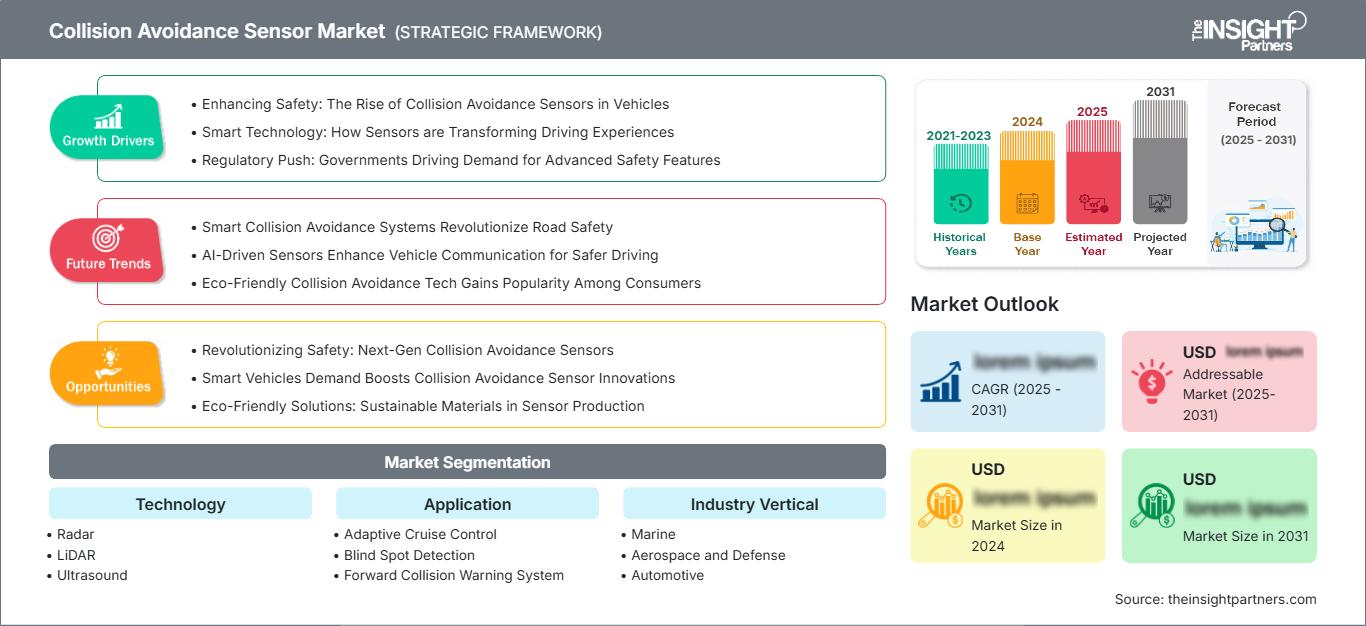
Collision Avoidance Sensor Market: Strategic Insights
Regional Insights
North America Collision Avoidance Sensor Market
North America accounted for 27–31% of Collision Avoidance Sensor share in 2025 and is projected to expand at a CAGR of 10.2–11.0% during 2026–2034. The demand is enabled by the ADAS standardization, fleet risk reduction, aerospace modernization, and advanced marine navigation applications. The safety policy in the U.S. is the driving factor, since the government consumer ratings increasingly consider crash avoidance technology.
OEM automotive makers utilize radar and ultrasound for their mass-produced models and LiDAR for the automation pilots and robotics mobility in the premium segment. For defense and aviation applications, redundant sensors and ruggedized packaging and certified electronics are important. Regional manufacturers have an advantage because of semiconductor design know-how, validation services, and the presence of OEM design centers.
U.S. Collision Avoidance Sensor Market
The U.S. represented 78–82% of North American revenue in 2025 and is expected to grow at a CAGR of 10.4–11.2% during 2026–2034. Trends in applications include forward collision warning, blind-spot detection, adaptive cruise control, automatic emergency braking, retrofit kits for fleets, airport ground vehicles, and defense mobility systems that rely upon accurate object detection.
Firms such as Autoliv Inc., Honeywell International Inc., Texas Instruments Incorporated, NXP Semiconductors N.V., and U.S.-based operations of Continental AG and Robert Bosch GmbH provide assistance via safety electronics, sensing devices, and integration know-how. Customers appreciate local engineering expertise, cybersecurity, software upgradability, and compliance information because collision avoidance results are becoming more important in determining vehicle rankings, insurance rates, and procurement.
Europe Collision Avoidance Sensor Market
Europe held 22–26% share in 2025 and is projected to grow at a CAGR of 9.8–10.6% during 2026–2034. Germany stands out due to premium vehicle manufacturing, first-tier suppliers presence, and Euro NCAP standards of 2026 that require crash-avoidance capabilities, which generates demand for radar, LiDAR, and ultrasound in both passenger vehicles and trucks.
The UK provides assistance by virtue of automotive engineering, defense electronics, and testing of assisted driving technology. Demand from France, Italy, and Spain is due to OEM facilities, aerospace industry, rail industry expertise, and urban mobility initiatives. European consumers place great emphasis on functional safety, protection of pedestrians, low false positives, and validation due to consumer ratings rewarding crash avoidance capability.
APAC Collision Avoidance Sensor Market
Asia Pacific accounted for 36–40% share in 2025 and is forecast to grow at a CAGR of 11.8–12.7% during 2026–2034. China leads through EV scale, local ADAS suppliers, and smart-vehicle policy support.
Japan and South Korea support high-reliability radar, electronics, and automated parking applications. India is scaling safety features as premium and mid-segment vehicles add ADAS, while Australia supports mining, marine, and fleet safety use cases. Regional growth is strengthened by semiconductor packaging, vehicle electrification, and expanding validation capacity.
Middle East & Africa Collision Avoidance Sensor Market
The Middle East & Africa segment in the Collision Avoidance Sensor Market is projected to grow at a CAGR of 8.4–9.3% during 2026–2034. The UAE leads regional adoption through smart mobility pilots, port automation, aviation infrastructure, and premium vehicle demand.
Saudi Arabia adds demand through logistics modernization, industrial diversification, and airport investments, while South Africa remains important for mining vehicles, fleet safety, and port operations. Rest of MEA adoption depends on infrastructure budgets, insurance incentives, and availability of calibration and maintenance services for rugged operating environments.
Segmentation Analysis
Technology
Technology segment in the Collision Avoidance Sensor Market is projected to grow at a CAGR of 11.0–11.9% during 2026–2034. The Collision Avoidance Sensor scope covers radar, LiDAR, and ultrasound platforms selected according to range, resolution, weather tolerance, packaging, and cost. Radar leads volume programs because it works in poor visibility, while LiDAR improves object classification and ultrasound remains essential for low-speed proximity detection.
- Radar holds the strongest position in high-volume safety systems because long-range detection, speed measurement, and all-weather performance support adaptive cruise control and forward collision warning.
- LiDAR is strategically important for higher automation, mapping-grade perception, and dense object classification, although cost, cleaning, and integration requirements still limit broad mass-market penetration.
- Ultrasound remains critical for parking assistance, low-speed maneuvering, blind-zone detection, and near-field obstacle sensing where compact form factor and cost efficiency determine adoption.
Application
Application segment in the Collision Avoidance Sensor Market is forecast to grow at a CAGR of 10.8–11.7% during 2026–2034. Adaptive cruise control and forward collision warning anchor high-value demand because they require longer-range perception and reliable response logic. Blind spot detection, lane departure warning, and parking assistance broaden volume deployment by addressing common crash scenarios, urban maneuvering, and insurance-sensitive use cases.
- Adaptive Cruise Control uses radar-led sensing to maintain distance and speed control, making it a core feature for highway assistance, premium vehicles, and commercial fleet safety packages.
- Blind Spot Detection addresses lane-change risk through side and rear sensing, giving suppliers a scalable application across passenger vehicles, trucks, buses, marine craft, and industrial mobility platforms.
- Forward Collision Warning System remains a priority application because it connects sensor detection with driver alerts and braking logic, supporting safety ratings and reducing severe frontal crash exposure.
- Lane Departure Warning System supports lane monitoring and driver alerting, often working with camera and radar inputs to improve highway safety and strengthen assisted-driving feature bundles.
- Parking Assistance relies on ultrasound and short-range sensing to detect close obstacles, improving urban usability, reducing low-speed damage, and supporting automated parking functions.
Industry Vertical
Industry Vertical segment in the Collision Avoidance Sensor Market is expected to grow at a CAGR of 11.2–12.1% during 2026–2034. Automotive dominates revenue because ADAS fitment expands across vehicle classes, while aerospace and defense require certified, redundant sensing for aircraft, ground vehicles, and unmanned platforms. Marine adoption is rising as ports, offshore vessels, and autonomous navigation programs seek better obstacle awareness.
- Marine uses collision sensing for port operations, autonomous navigation, docking assistance, offshore support vessels, and ferries where visibility constraints and traffic density increase operational risk.
- Aerospace and Defense values rugged sensors for aircraft, drones, armored vehicles, and base operations, with procurement shaped by reliability, certification, redundancy, and mission-specific environmental performance.
- Automotive remains the largest vertical because passenger cars, commercial fleets, and electric vehicles increasingly integrate radar, LiDAR, and ultrasound for active safety and automation.
Opportunity Snapshot
| Application | Revenue Contribution | Trend Tag | Adoption Stage |
| Adaptive Cruise Control | High | Highway Assist | Mature |
| Blind Spot Detection | High | Lane Safety | Scaling |
| Forward Collision Warning System | High | Crash Alert | Mature |
| Lane Departure Warning System | Medium | Lane Support | Scaling |
| Parking Assistance | Medium | Urban Parking | Mature |
Collision Avoidance Sensor Market Growth Drivers and Impact Analysis
Safety regulation accelerates ADAS sensor fitment
Safety regulations are shifting active safety from being an optional feature to becoming a standard component. According to NHTSA, there were 39,254 fatalities on U.S. roads in 2024, while the new rating system of NHTSA includes blind spot alert, blind spot mitigation, lane keeping assist, and pedestrian AEB systems. Euro NCAP's 2026 rating system puts even more weight on crash avoidance, vulnerable road user protection, and robustness tests. From practical perspective, the number of sensors per car will grow; sensors will be implemented earlier in the vehicle development process, and the need for validated radar, LiDAR, and ultrasound systems will rise.
Sensor fusion improves detection reliability
Single sensor systems have trouble with weather, object detection, distance limitations, and blind zones, so there is a move by OEMs toward fusion architectures involving radar, LIDAR, ultrasonic, and camera sensors. Radar provides distance and speed measurements in adverse weather conditions, while LIDAR enhances shape detection, and ultrasonics detect nearby objects during low-speed operations. These developments will increase the amount of electronics, software, and calibration in the system, but will make automated braking, lane assist, and parking features more reliable. From a market perspective, the development results in moving from component buys to perception systems, where embedded processors, algorithms, validation data, and safety are key.
Automation expands beyond passenger vehicles
Obstacle avoidance technology is now being extended to commercial trucks, military vehicles, ports equipment, automated ships, drones, airport vehicles, and other industrial mobile machinery. In such use cases, there is a need for robust sensors capable of detecting obstacles in vibrating, dusty, foggy, rainy, dazzling, and cluttered environments. The drivers are the dearth of laborers, insurance considerations, and the desire to cut down on losses resulting from avoidable accidents. The result is a much larger market segment than light vehicles where customizing sensors in terms of detection distance, rugged casing, redundant processor and software tailored for the specific environment becomes possible.
Collision Avoidance Sensor Market Future Trends
Imaging radar becomes a mainstream perception layer
Collision Avoidance Sensor Market trends indicate that imaging radar will become a central perception layer as OEMs seek better angular resolution without the cost and environmental sensitivity of some optical systems. Higher-channel radar can improve object separation in dense traffic, support highway automation, and reduce reliance on cameras in low visibility. Future platforms will combine radar point clouds with LiDAR and camera data for richer scene interpretation. This trend should benefit semiconductor suppliers, antenna specialists, and tier-one integrators that can manage signal processing, heat, packaging, and software updates within strict vehicle cost targets.
Software-defined safety enables post-sale upgrades
With safety sensing, the technology is moving towards software-defined architecture, whereby perception algorithms, calibration, diagnostic and feature thresholding become more advanced post-deployment. The new model makes business sense in that the vehicle manufacturers and fleet owners could pay for hardware headroom up front, and unlock the advanced capabilities through over-the-air updates and other services. This means increased demand for cybersecurity, validation traceability and fail-safes. Suppliers with a combination of sensor hardware and software stack could benefit from ongoing revenues, while assisting their customers to adapt to new test regimes and requirements without hardware platform changes.
Collision Avoidance Sensor Market Opportunities
Fleet retrofit and risk analytics packages
Collision Avoidance Sensor Market Forecasts support investment in retrofit packages for commercial fleets that need measurable safety improvement without waiting for full vehicle replacement cycles. Suppliers can combine forward sensing, blind spot alerts, driver coaching, telematics integration, and incident analytics into subscription-based offerings. This opportunity is attractive for logistics, public transport, mining, ports, and municipal fleets where low-speed collisions, lane-change events, and reversing incidents create recurring costs. Vendors should emphasize installation speed, ruggedness, false-alert reduction, and data privacy. Partnerships with insurers and fleet management platforms can convert sensor performance into lower risk premiums and stronger procurement justification.
Certified sensing for aerospace and autonomous marine systems
The aerospace and marine applications present a higher value proposition, where customers demand not only affordability but also redundancy and environmental survivability, as well as proven reliability. This technology can be useful for the safety of the runways, drones, maritime docking, autonomous navigation of harbors and offshore vessels. The companies must consider certifiable electronics, sensor cleaning capabilities, environmentally durable packaging and systems integration. This technology holds the highest potential where automation comes together with the highly dynamic environment with limited human vision. Those who will be able to transfer the economics of automotive sensors to mission-proven systems will find themselves in good shape..
Recent Developments
- August 2025: Hindustan Zinc, part of Vedanta Group, is India’s only and the world’s largest integrated zinc producer. The companies signed a Memorandum of Agreement under which Epiroc will provide its Collision Avoidance System to all of Hindustan Zinc’s five underground mines, located across the state of Rajasthan in northwestern India. The system will be deployed in phases, beginning with the Sindesar Khurd Mine, one of the world’s top five silver-producing mines. In the pilot phase, the Collision Avoidance System will be implemented on 30 low-profile dump trucks and 100 pedestrians.
- May 2025: Next generation Cat medium wheel loaders are infused with the latest technologies to advance safety and help customers work faster and with greater accuracy. Fully integrated for optimal performance, the wheel loaders can be easily upgraded with optional technologies as work demands it. Caterpillar announces new technology options available for next generation Cat 950, 962, 966, 966 XE, 972, 972 XE, 980, 980 XE, 982 and 982 XE wheel loaders.
- September 2024: Hexagon, the global leader in digital reality solutions, announced the newest generation of its advanced Hexagon Collision Avoidance System (CAS), now supporting 4D radar technology, enhanced insights, and interoperability with the Hexagon Personal Alert tagging system. The significant upgrade positions Hexagon CAS as the most advanced collision prevention system on the market.
Frequently Asked Questions

- Comprehensive Market Sizing and Forecast Analysis
- Detailed Segmentation Analysis
- In-Depth Market Dynamics Assessment
- Regional and Country-Level Insights
- Competitive Landscape and Company Benchmarking
- Strategic Business Intelligence
Recent Reports
Testimonials

The Insight Partners' SCADA System Market report is comprehensive, with valuable insights on current trends and future forecasts. The team was highly professional, responsive, and supportive throughout. We are very satisfied and highly recommend their services.
RAN KEDEM Partner, Reali Technologies LTDs
I requested a report on a very specific software market and the team produced the report in a few days. The information was very relevant and well presented. I then requested some changes and additions to the report. The team was again very responsive and I got the final report in less than a week.
JEAN-HERVE JENN Chairman, Future Analytica
We worked with The Insight Partners for an important market study and forecast. They gave us clear insights into opportunities and risks, which helped shape our plans. Their research was easy to use and based on solid data. It helped us make smart, confident decisions. We highly recommend them.
PIYUSH NAGPAL Sr. Vice President, High Beam Global
The Insight Partners delivered insightful, well-structured market research with strong domain expertise. Their team was professional and responsive throughout. The user-friendly website made accessing industry reports seamless. We highly recommend them for reliable, high-quality research services
YUKIHIKO ADACHI CEO, Deep Blue, LLC.
This is the first time I have purchased a market report from The Insight Partners.While I was unsure at first, I visited their web site and felt more comfortable to take the risk and purchase a market report.I am completely satisfied with the quality of the report and customer service. I had several questions and comments with the initial report, but after a couple of dialogs over email with their analyst I believe I have a report that I can use as input to our strategic planning process.Thank you so much for taking the extra time and making this a positive experience.I will definitely recommend your service to others and you will be my first call when we need further market data.
JOHN SUZUKI President and Chief Executive Officer, Board Director, BK Technologies
I wish to appreciate your support and the professionalism you displayed in the course of attending to my request for information regarding to infectious disease IVD market in Nigeria. I appreciate your patience, your guidance, and the fact that you were willing to offer a discount, which eventually made it possible for us to close a deal. I look forward to engaging The Insight Partners in the future, all thanks to the impression you have created in me as a result of this first encounter.
DR CHIJIOKE ONYIA MANAGING DIRECTOR, PineCrest Healthcare Ltd.Reason to Buy
- Informed Decision-Making
- Understanding Market Dynamics
- Competitive Analysis
- Identifying Emerging Markets
- Customer Insights
- Market Forecasts
- Risk Mitigation
- Boosting Operational Efficiency
- Strategic Planning
- Investment Justification
- Tracking Industry Innovations
- Aligning with Regulatory Trends





 Get Free Sample for