
Colon Hydrotherapy Market Size, Growth & Demand by 2034
Colon Hydrotherapy Market Size and Forecasts (2021–2034), Global and Regional Share, Trends, and Growth Opportunity Analysis Report Coverage : by Type (Mobile Hydrotherapy and Fixed Hydrotherapy); System Type (Open and Closed); End User (Hospitals, Therapy Centers, Other End Users); and Geography (North America, Europe, Asia Pacific, and South and Central America)
- Status : Data Released
- Report Code : TIPRE00040857
- Category : Life Sciences
- No. of Pages : 150
- Available Report Formats :


- Last update date : October 30, 2026


2025 Market Size
US$ 708.86 Mn
Base year value
2034 Forecast
US$ 1,265.15 Mn
Projected by 2034
CAGR 2026-2034
6.65 %
Growth rate
Addressable Market
US$ 8,924.65 Mn
(2026-2034)
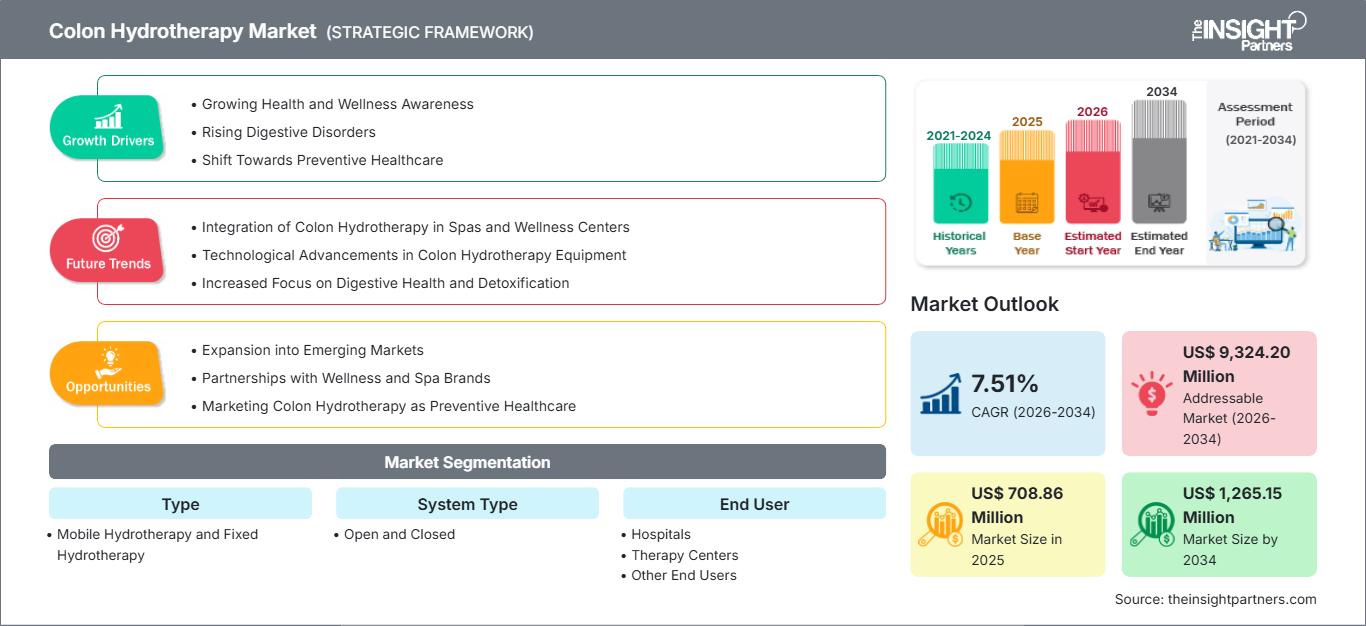
The Colon Hydrotherapy Market was valued at US$ 708.86 Million in 2025 and is expected to reach US$ 1,265.15 Million by 2034, registering a CAGR of 6.65% during 2026–2034. Expansion is supported by rising interest in digestive wellness, broader availability of complementary therapies, and investment in equipment with controlled water temperature, filtration, pressure regulation, and sanitation functions. Growth nevertheless depends on practitioner training, responsible clinical positioning, and compliance with country-specific medical-device requirements.
North America remains a commercially important region, with the Colon Hydrotherapy Market size supported by an estimated ~7% CAGR through 2034. The region benefits from established wellness-center networks, comparatively high spending on complementary health services, and access to professional-grade systems. Regulatory scrutiny also encourages clinics to prioritize controlled-flow equipment, disposable treatment components, documented sanitation procedures, and clearly defined intended use. In the US, medically indicated colonic irrigation systems fall within the FDA’s Class II framework, while devices promoted for other uses may face more stringent requirements.
Colon Hydrotherapy Market Assessment and Insights
Regional Outlook
- North America: ~39% of the global Colon Hydrotherapy Market share in 2025 | ~7% CAGR through 2034. Market position: North America ranks first because of mature complementary-wellness infrastructure, strong practitioner networks, higher discretionary healthcare expenditure, and established demand for professional equipment with sanitation and operating safeguards.
- US: ~82% of North American market revenue in 2025 | ~7% CAGR through 2034. Market position: The US leads North America through its large wellness-services economy, specialist clinics, equipment availability, and structured medical-device oversight governing pressure, temperature, flow, labeling, and intended use.
- Europe: ~29% of the global market in 2025 | ~6% CAGR through 2034. Market position: Europe represents a mature market shaped by integrative wellness practices, cautious clinical adoption, and equipment replacement demand. The UK and Germany are the leading country markets, followed by France, Italy, and Spain.
- Asia Pacific: ~22% of the global market in 2025 | ~8% CAGR through 2034. Market position: Asia Pacific is the fastest-growing region, supported by wellness tourism, urban clinic expansion, domestic equipment manufacturing, and rising preventive-health expenditure in China, Japan, India, South Korea, and Australia.
Segment Outlook
- Fixed Hydrotherapy: ~71% Share in 2025 | ~6% CAGR through 2034. Market position: Fixed installations lead because established therapy centers favor permanently connected systems offering consistent water treatment, controlled operation, dedicated drainage, and repeatable workflows for higher procedure volumes.
- Therapy Centers: ~58% Share in 2025 | ~7% CAGR through 2034. Market position: Therapy centers combine specialist practitioner access with recurring appointments and wellness-oriented service bundles, positioning the segment to capture demand beyond the narrower medically indicated use cases found in hospitals.
Competitive Coverage
HydroCare, EnemaKit, PureLife, Cleanse Life, Colonic Health Centers, Colon Therapy of America, AquaMed Technologies, Prime Pacific Health Innovations Inc., Tathya Wellness Pvt. Ltd., MAIKONG Co., Ltd.
Methodology
The Insight Partners follows Data Collection & Secondary Research, Primary Research, Data Analysis, and Data Triangulation & Final Review to validate market estimates and insights.
Source: The Insight Partners' analysis based on proprietary research, government publications, company annual reports, investor presentations, industry databases, and expert interviews.
This industry has moved beyond basic gravity fed setups into systems that integrate filtering, UV disinfection, automatic temperature control, pressure control, backflow control, and disposable contact parts. Manufacturing considerations have become reliant on using medical grade parts, dependable valves and sensors, compatibility with existing plumbing fixtures, and good water paths. Fixed installations continue to be important for higher throughput operations, whereas portable and modular equipment increases site flexibility. Thus, the Colon Hydrotherapy Market is moving towards being more driven by equipment and procedures, albeit with different levels of medical acceptance depending on application and geographic location.
Through 2034, suppliers are expected to focus on Asia Pacific and selected urban wellness centers of the Middle East through distribution networks, training relationships, service capability, and configurable equipment. Investment will focus on equipment that reduces installation difficulty and measures water quality and system performance. Favorable regulatory winds do not apply across the board, but improved product classification, better infection control, and stricter claim handling could give established equipment manufacturers an advantage over equipment sellers.
Colon Hydrotherapy Market Report Scope
| Report Attribute | Details |
|---|---|
| Market size in 2025 | US$ 708.86 Million |
| Market Size by 2034 | US$ 1,265.15 Million |
| Global CAGR (2026 - 2034) | 6.65% |
| Historical Data | 2021-2024 |
| Forecast period | 2026-2034 |
Colon Hydrotherapy Market Analysis
Market growth of Colon Hydrotherapy is a result of overlapping interests in digestive health, alternative medicine spending, and expanding capacities of specialized therapy centers. Demand starts with the consumer and referral doctors, while the purchase of equipment depends on the economics of the clinic, volumes of treatments expected, room facilities, energy supplies, and personnel capabilities. The market includes manufacturers of the equipment, filtration components, disposables, installers, training services, therapists, clinics, and maintenance companies.
The favorable supply environment exists for manufacturers who can integrate their equipment, accessories, technical documentation, training of practitioners, and after-sales support. Purchasers evaluate the product beyond its purchase price due to such factors as downtime, filter change, sanitation processes, pipe changes, and disposables availability that determine total costs of ownership. Modern systems include temperature and pressure regulation, UV processing, and use of medical-grade disposables. Current equipment offered by Prime Pacific includes controlled pressure, thermoprotection, filtration, UV processing, and disposable speculum compatibility.
According to the Colon Hydrotherapy Market, a highly fragmented competitive environment exists where equipment manufacturers compete alongside clinics, consumable manufacturers, distributors, and health/wellness service providers. Prime Pacific Health Innovations competes with its products through several configuration options, whereas Tathya Wellness highlights automation, multistage filtration, UV sterilization, customizable operations, and sensors. MAIKONG is characterized by configurable equipment and distributor-private label arrangements.
Competitive positioning in today’s market will revolve around safety and operational design. HydroCare, EnemaKit, PureLife, Cleanse Life, Colonic Health Centers, Colon Therapy of America, and AquaMed Technologies are all represented in the equipment and therapy accessories markets. Channel development, practitioner training, supply chain for consumables, remote diagnostics, and local documentation requirements are all important investment areas. Vendors whose business models integrate equipment sales with installation and ongoing supply chain will be able to generate more consistent revenue than those who don’t.
● REPORT CUSTOMIZATION
Tailor This Report To Align With Your Specific Business Requirements
This report can be customized to align precisely with your business objectives, scope, and target markets. Customization options include tailored segmentation, geography, competitive analysis, and strategic insights to support informed decision-making.
Customize This Report →WHAT YOU CAN ADJUST
- ● Segmentations
- ● Geography
- ● Competitive Analysis
- ● Language Preferences
Colon Hydrotherapy Market: Strategic Insights
Regional Insights
North America Colon Hydrotherapy Market
North America accounted for an estimated ~39% of global revenue in 2025 and is projected to expand at approximately ~7% through 2034. Market shares in the Colon Hydrotherapy market region are facilitated by already existing wellness centers, naturopathic centers, medical spas, and consumers who have an understanding of complementary health services. Equipment upgrading and renovation will be factors contributing to continued growth for systems with enclosed waste channels, controllable operation systems, and easier cleaning procedures.
Development in the region is hindered by the different regulations of medically indicated colon cleansing versus well-being positioning of colon hydrotherapy in the region. In the United States, a colon hydrotherapy system operates and regulates the temperature, pressure, or flow rate of water, depending on its usage. This is very important for labeling and promotion. The adoption of the technology is high in urban locations in Canada.
U.S. Colon Hydrotherapy Market
The US represented approximately ~82% of North American revenue in 2025 and is expected to record an estimated ~7% CAGR through 2034. The demand is mainly seen in specialist therapy facilities, wellness centers, integrative health clinics, and certain medical establishments. These facilities consider the temperature stability, water treatment, pressure management, waste management, disposables, and cleaning before purchasing any equipment.
Presence of the manufacturer and distributor helps in ensuring availability of the equipment, availability of replacement, technical support, and practitioner education. Prim Pacific Health Innovations provides pressure-based, gravity-based, and both modes of equipment that show the variety of systems in use in the US market. The regulations play an important role because medically indicated systems are recognized by the code KPL as class II devices needing 510(k) approval.
Europe Colon Hydrotherapy Market
Europe held an estimated ~29% of global revenue in 2025 and is projected to grow at approximately ~6% through 2034. The area is made up of complementary therapy traditions along with relatively conservative health care claims and varied nation controls. The demand for equipment is driven by the need to replace old setups, the concern for hygiene of the practitioners, and the gradual inclusion of digestive wellness therapy into multi-disciplinary clinics.
The UK ranks as the most advanced country in Europe due to its visible practitioner base and consumer knowledge about colonic irrigation. Germany is ranked next due to its developed naturopathy and wellness system, engineered buyers, and preference for robust systems that have clear servicing needs. France has selective adoption through urban wellness and preventative health care centers.
Spa and wellness contribute to Italy’s advantage, but availability of equipment both locally and from outside is necessary for specialized centers. Spain is a favorable place for major cities and wellness destinations, but at the same time, demand is very sensitive to the discretionary budgets of professionals. In both countries, the Colon Hydrotherapy Market is becoming more focused on controlled systems, sanitation procedures, and one-use patient contact items. The suppliers must have localized distributors since plumbing codes, languages, training, and maintenance differ. Hence, the growth of the market will benefit vendors providing these services.
APAC Colon Hydrotherapy Market
Asia Pacific represented an estimated ~22% of global revenue in 2025 and is forecast to post an approximately ~8% CAGR, making it the fastest-growing region through 2034. China is assessed as the leading country in Asia Pacific because of its manufacturing base, broad urban wellness economy, distributor capacity, and equipment affordability.
Japan, South Korea, and Australia exhibit quality-driven adoptions in the form of professional facilities, whereas India is aided by increasing wellness centers and domestically produced equipment. The portfolio of Tathya Wellness operating in India is an example of regional localization via automation, filtration, sterilization, and flexible design. Quality of medical devices, wellness tourism, investments in urban health care facilities, and domestic manufacturing should drive the supply chain, despite differing evidence standards and regulatory practices.
Middle East & Africa Colon Hydrotherapy Market
The Middle East & Africa market is expected to register an estimated ~7% CAGR through 2034. The UAE is positioned as the leading country in the Middle East & Africa due to its premium wellness infrastructure, medical-tourism activity, expatriate population, and high concentration of private clinics. Saudi Arabia offers expansion potential through private healthcare and hospitality investment.
South Africa anchors demand in the African subregion through established urban wellness services and practitioner availability. Across the Rest of MEA, adoption remains selective because equipment imports, specialist training, water-treatment quality, installation costs, and servicing access can constrain expansion. Commercial potential is strongest in high-income cities where dependable utilities, premium wellness facilities, and distributor-led maintenance can support professionally operated systems.

Segmentation Analysis
Type
Type is central to the Colon Hydrotherapy Market scope because installation format influences facility planning, practitioner mobility, water access, maintenance, and capital expenditure. Buyers select equipment according to treatment volume, available space, utility connections, and the need to relocate systems. Adoption favors durable configurations in established centers, while flexible equipment supports newer and multi-room practices. Fixed Hydrotherapy is projected to expand at approximately ~6% during 2026–2034, supported by replacement demand and purpose-built treatment facilities.
- Mobile Hydrotherapy: Mobile equipment supports practitioners requiring flexible room allocation, temporary installations, or lower initial infrastructure commitment. Adoption depends on compact dimensions, safe transport, rapid setup, dependable connections, and the ability to maintain hygiene across changing treatment environments.
- Fixed Hydrotherapy: Permanently installed equipment is preferred by higher-volume facilities seeking stable water supply, dedicated drainage, consistent operating conditions, and efficient treatment-room workflows. Its strategic value lies in durability, integrated utilities, and suitability for recurring supervised procedures.
System Type
System Type determines how water is delivered, how waste is evacuated, and how actively the practitioner manages a session. Procurement decisions reflect desired workflow, patient privacy, practitioner involvement, cleaning requirements, and the facility’s treatment philosophy. Modern platforms increasingly combine controlled delivery with temperature safeguards and treated water. Closed systems are expected to record an estimated ~7% CAGR through 2034 as centers prioritize enclosed waste handling and practitioner-controlled operation.
- Open: Open systems use a basin-based evacuation arrangement and generally emphasize patient-led release. Demand is associated with privacy-oriented treatment formats, low-pressure water delivery, simpler rectal tips, and centers whose practitioners support the session without continuously controlling evacuation cycles.
- Closed: Closed systems route inflow and waste through dedicated tubing and a speculum, keeping discharge enclosed. They are relevant where practitioners require direct control over filling and release, structured monitoring, odor management, and contained waste transfer throughout treatment.
End User
End User segmentation reflects differences in clinical governance, purchasing criteria, procedure frequency, and revenue models. The Colon Hydrotherapy Market serves institutional healthcare facilities as well as wellness-oriented specialist centers, with each setting applying distinct equipment, training, and claims requirements. Therapy Centers are projected to grow at approximately ~7% during 2026–2034 because focused service delivery, recurring appointments, and practitioner specialization support higher equipment utilization.
- Hospitals: Hospitals represent a selective end-user base in which procurement depends on medically justified use, infection-control review, documented device status, trained personnel, and compatibility with clinical workflows. Adoption is narrower than in dedicated wellness-oriented facilities.
- Therapy Centers: Therapy centers form the primary commercial channel because they provide dedicated rooms, practitioner-led sessions, recurring client programs, and complementary services. Their equipment choices emphasize throughput, sanitation, consumable continuity, comfort, and dependable technical support.
- Other End Users: Other end users include wellness resorts, medical spas, naturopathic practices, integrative clinics, and selected rehabilitation facilities. Their demand varies by local regulation, customer profile, treatment positioning, available space, and ability to maintain professional operating protocols.
Opportunity Snapshot
| End Users | Revenue Contribution | Trend Tag | Adoption Stage |
| Hospitals | Low | Clinical Governance | Emerging |
| Therapy Centers | High | Specialist Care | Mature |
| Other End Users | Medium | Wellness Integration | Scaling |
Colon Hydrotherapy Market Growth Drivers and Impact Analysis
Expansion of Specialized Digestive-Wellness Services
Increasing numbers of therapy clinics, medical spas, natural medicine facilities, and integrative health centers mean that the pool of potential buyers of colon hydrotherapy machines is increasing. The clinics utilize their unique gastrointestinal wellness programs to increase visits and support nutrition, massage, weight reduction, or preventive health care. The commercial value of this market goes beyond the sales of machines since any operational unit creates opportunities for sales of filters, tubes, speculums, sanitation supplies, training and service. However, continued growth needs careful screening and open communication, because untrained claims of detoxification or treatment of diseases can raise clinical and legal concerns.
Replacement of Basic Equipment with Controlled Systems
A transition is being made from older or simpler equipment that lacks automated temperature controls, pressure or flow regulation, ultraviolet purification, multi-step filtration, safety shutdowns, and washable water lines to newer equipment featuring those technologies. This transition helps with the consistency of operations and allows practitioners to better describe the capabilities of the equipment. It also enables higher pricing on the basis of the installation, maintenance, spares, and disposables offered alongside systems. Existing systems showcase steps towards pressure sensing, gravity flow control, and operational modes that help solve facility problems with comfort, water, operator control, and repeatability.
Recurring Consumables and After-Sales Service Requirements
Each professional installation creates continuing demand for single-use patient-contact kits, filtration replacements, hoses, maintenance components, disinfection supplies, and technical inspection. This recurring requirement improves the economic attractiveness of the sector for manufacturers and distributors compared with one-time equipment-only sales. Clinics also prefer dependable consumable availability because supply disruption can suspend procedures and reduce client confidence. Vendors can therefore differentiate through subscription-style replenishment, scheduled maintenance, remote troubleshooting, and inventory planning. The market impact is a gradual shift from transactional hardware selling toward lifecycle account management, where installed-base retention, technician coverage, practitioner support, and compatible accessories influence long-term revenue and customer switching costs.
Colon Hydrotherapy Market Future Trends
Digitally Monitored Treatment Parameters
Colon Hydrotherapy Market trends are moving toward digitally displayed temperature, flow, pressure, session duration, filter status, and sanitation-cycle information. Future systems may extend this approach through maintenance alerts, usage histories, fault diagnostics, and service notifications, helping facilities standardize operations across multiple practitioners or locations. Digital functions will be most commercially relevant when they improve safety oversight, reduce downtime, or simplify preventive maintenance rather than making unsupported therapeutic claims. Equipment designers are likely to prioritize intuitive interfaces, locked operating limits, multilingual software, and exportable service records. This progression could strengthen manufacturer relationships with clinic groups seeking consistent equipment governance across expanding networks.
Convergence of Open and Closed Treatment Configurations
Facilities increasingly value flexibility because patient preferences, practitioner techniques, and room workflows differ. Dual-configuration systems and adaptable treatment tables can allow providers to support more than one delivery approach without purchasing entirely separate infrastructure. Prime Pacific’s dual-mode and configurable equipment demonstrates how manufacturers are addressing this requirement. Through 2034, design convergence may encourage modular accessories, selectable gravity or pressure-assisted delivery, and layouts compatible with both open-style and closed-style treatment. The trend favors vendors capable of combining flexibility with sanitation controls, clear instructions, and reliable servicing, while facilities benefit from improved asset utilization and broader practitioner acceptance.
Colon Hydrotherapy Market Opportunities
Distribution and Localization in Asia Pacific
The Colon Hydrotherapy Market Forecasts indicate actionable opportunity for manufacturers establishing distributors, installation partners, spare-parts inventory, and practitioner training in India, China, Southeast Asia, South Korea, Japan, and Australia. Market entry should be localized rather than based solely on exports. Companies need country-specific labeling, electrical and plumbing compatibility, multilingual interfaces, responsive servicing, and pricing suited to clinic economics. Investment in local assembly or selected component sourcing can reduce lead times and improve distributor margins. Partnership targets include wellness-center chains, integrative clinics, hospitality groups, and medical-equipment distributors capable of supporting installation and post-sale maintenance.
Lifecycle Revenue from Consumables and Technical Support
A scalable opportunity exists in converting equipment accounts into long-term service relationships. Manufacturers can bundle installation, operator training, planned maintenance, filter replacement, sanitation supplies, disposable kits, software support, and periodic equipment inspection. This approach improves revenue visibility and reduces the operational burden for independent therapy centers. Colon Hydrotherapy Market Opportunities are particularly attractive where imported systems lack dependable local support, leaving clinics exposed to prolonged downtime and unavailable components. Suppliers should build regional service hubs, standardized consumable packs, digital reorder systems, and technician-certification programs. The resulting ecosystem can raise customer retention while reinforcing consistent equipment operation.
Recent Developments
- August 2025: MAIKONG Co., Ltd. – The company announced broader global availability of its advanced colon hydrotherapy equipment and expanded engagement with international distributors. The initiative emphasized configurable appearance, software interfaces, private-label support, OEM and ODM services, rapid delivery, and technical assistance for agents entering regional wellness-equipment channels.
- 2025: Prime Pacific Health Innovations Inc. – Prime Pacific expanded its current Aquanet equipment presentation around three configurations: the APS-100 pressure-controlled platform, GRY-500 gravity-assisted device, and EC-2000 dual-mode system. The portfolio highlights pressure and flow control, automatic temperature management, filtration, UV treatment, sanitation capability, and service support.
- December 2024: Tathya Wellness Pvt. Ltd. – Tathya strengthened the market visibility of its colon hydrotherapy portfolio, including the OD100 and ECO10 systems. The equipment positioning emphasizes multi-stage filtration, UV or UVC sterilization, automated operation, water-quality and temperature interlocks, touchscreen control, configurable dimensions, and India-based delivery and support.
Frequently Asked Questions

- Comprehensive Market Sizing and Forecast Analysis
- Detailed Segmentation Analysis
- In-Depth Market Dynamics Assessment
- Regional and Country-Level Insights
- Competitive Landscape and Company Benchmarking
- Strategic Business Intelligence
Recent Reports
Testimonials

The Insight Partners provided valuable market intelligence that supported our global go-to-market strategy. Their team was professional, responsive, and attentive to our feedback, providing thoughtful analysis and helpful methodological clarifications throughout the project.
Junmo Kim Chief Financial Officer (CFO), Enertech Co., Ltd.
The Insight Partners' SCADA System Market report is comprehensive, with valuable insights on current trends and future forecasts. The team was highly professional, responsive, and supportive throughout. We are very satisfied and highly recommend their services.
RAN KEDEM Partner, Reali Technologies LTDs
I requested a report on a very specific software market and the team produced the report in a few days. The information was very relevant and well presented. I then requested some changes and additions to the report. The team was again very responsive and I got the final report in less than a week.
JEAN-HERVE JENN Chairman, Future Analytica
We worked with The Insight Partners for an important market study and forecast. They gave us clear insights into opportunities and risks, which helped shape our plans. Their research was easy to use and based on solid data. It helped us make smart, confident decisions. We highly recommend them.
PIYUSH NAGPAL Sr. Vice President, High Beam Global
The Insight Partners delivered insightful, well-structured market research with strong domain expertise. Their team was professional and responsive throughout. The user-friendly website made accessing industry reports seamless. We highly recommend them for reliable, high-quality research services
YUKIHIKO ADACHI CEO, Deep Blue, LLC.
This is the first time I have purchased a market report from The Insight Partners.While I was unsure at first, I visited their web site and felt more comfortable to take the risk and purchase a market report.I am completely satisfied with the quality of the report and customer service. I had several questions and comments with the initial report, but after a couple of dialogs over email with their analyst I believe I have a report that I can use as input to our strategic planning process.Thank you so much for taking the extra time and making this a positive experience.I will definitely recommend your service to others and you will be my first call when we need further market data.
JOHN SUZUKI President and Chief Executive Officer, Board Director, BK Technologies
I wish to appreciate your support and the professionalism you displayed in the course of attending to my request for information regarding to infectious disease IVD market in Nigeria. I appreciate your patience, your guidance, and the fact that you were willing to offer a discount, which eventually made it possible for us to close a deal. I look forward to engaging The Insight Partners in the future, all thanks to the impression you have created in me as a result of this first encounter.
DR CHIJIOKE ONYIA MANAGING DIRECTOR, PineCrest Healthcare Ltd.Reason to Buy
- Informed Decision-Making
- Understanding Market Dynamics
- Competitive Analysis
- Identifying Emerging Markets
- Customer Insights
- Market Forecasts
- Risk Mitigation
- Boosting Operational Efficiency
- Strategic Planning
- Investment Justification
- Tracking Industry Innovations
- Aligning with Regulatory Trends





 Get Free Sample for