
Commercial Lighting Market Growth, Trends & Demand by 2034
Coverage: By Offering (Hardware, Software, Services); Installation Type (New Installation, Retrofit Installation); Communication Technology (Wired, Wireless); Application (Indoor, Outdoor), and Geography (North America, Europe, Asia Pacific, and South and Central America)
- Status : Data Released
- Report Code : TIPRE00015321
- Category : Electronics and Semiconductor
- No. of Pages : 150
- Available Report Formats :


- Last update date : August 04, 2026


2025 Market Size
US$ 20.24 Bn
Base year value
2034 Forecast
US$ 201.37 Bn
Projected by 2034
CAGR 2026-2034
29.08 %
Growth rate
Addressable Market
US$ 803.89 Bn
(2026-2034)
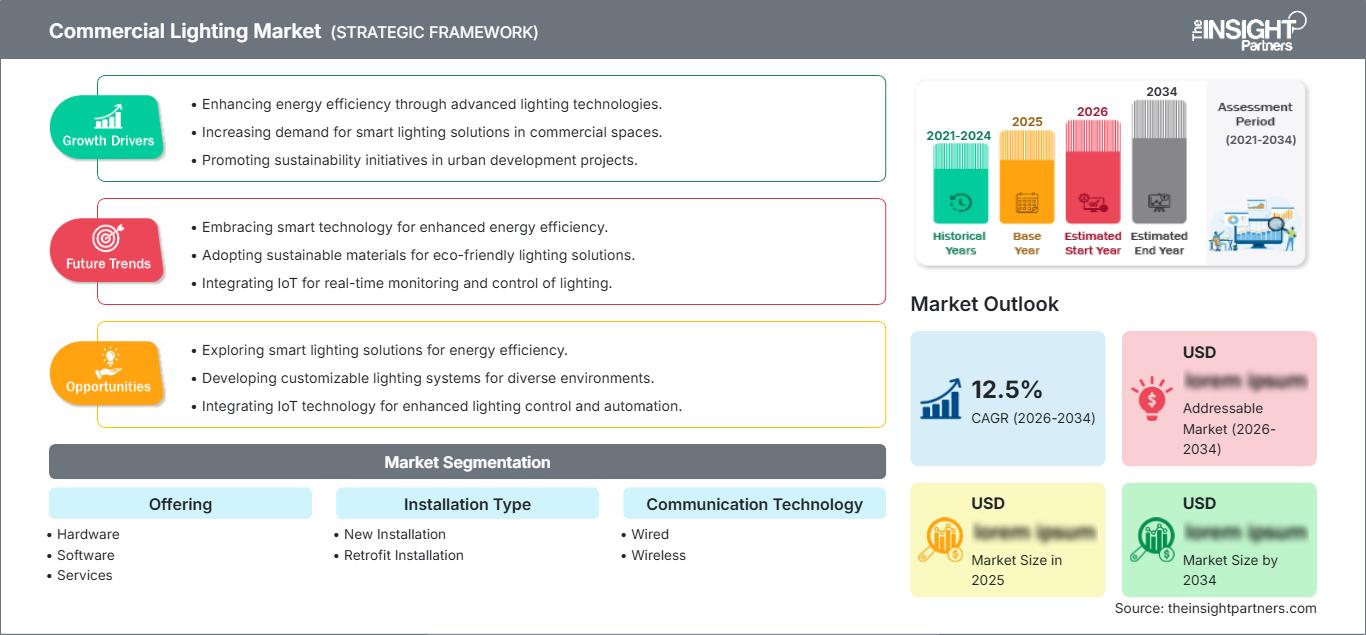
The Commercial Lighting Market size reached US$ 20.24 billion in 2025 and is expected to grow at a CAGR of 29.08% during 2026-2034, reaching US$ 201.37 billion by 2034. This growth is largely driven by an increasing replacement of traditional lighting fixtures with energy-efficient and sensor-based lighting solutions for various commercial spaces.
In North America, the Commercial Lighting Market will be boosted by faster LED upgrades, stringent energy requirements, and deployment of smart-building platforms. The region is projected to exhibit a growth rate of 26%-28% CAGR over 2026-2034, wherein demand will come from offices, warehousing, healthcare campus, airports, and municipal outdoor facilities.
Commercial Lighting Market Assessment and Insights
- North America held 34–36% Commercial Lighting Market share in 2025 and is projected to grow at a 26–28% CAGR during 2026–2034, driven by retrofits, code compliance, and connected building modernization.
- US accounted for 78–80% of North America in 2025 and is forecast to grow at a 26–28% CAGR, supported by large commercial floor space.
- Europe represented 24–26% share in 2025 and is expected to expand at a 27–29% CAGR during 2026–2034, led by Germany, the UK, France, Italy, and Spain.
- Asia Pacific captured 29–31% share in 2025 and is projected to grow at a 31–33% CAGR, with China, Japan, South Korea, India, and Australia leading deployments.
- Largest Segment Hardware held 63–66% market share in 2025 and is expected to grow at a 27–29% CAGR, supported by luminaires, sensors, drivers, and control devices.
- High Growth Segment Wireless communication technology held 37–40% market share in 2025 and is forecast to grow at a 34–36% CAGR as retrofit projects prioritize low-disruption connectivity.
- Key companies analyzed in detail: Acuity Inc., Cree Lighting USA LLC, Current Lighting Solutions, LLC, Hubbell Incorporated, Legrand S.A., Leviton Manufacturing Co., Inc., Lutron Electronics Co., Inc., ams-OSRAM AG, Signify Holding B.V., Zumtobel Group AG.
Source: The Insight Partners' analysis based on proprietary research, government publications, company annual reports, investor presentations, industry databases, and expert interviews.
Technological migration is transforming the Commercial Lighting Market as consumers shift from fixture replacement to lighting infrastructure integration. The efficiency of LEDs, sensor technology, digital driving and open protocol control are influencing manufacturing trends for companies. The hardware continues to be critical, but software and services are gaining importance as the facility owner requires occupancy data, predictive maintenance and centralized control of dispersed portfolios of buildings.
According to the Commercial Lighting Market forecast, future demands will expand into Asia Pacific region, Middle East and energy-intensive industrial complexes where government policies focus on energy-efficient buildings and robust infrastructure. Investments are shifting towards scalable retrofit projects, interoperable controls, and lighting-as-a-service. Regulations about lighting power density and the commitment from organizations to reduce their carbon footprints are expected to transform deferred replacement cycles to planned upgrade budgets.
Commercial Lighting Market Report Scope
| Report Attribute | Details |
|---|---|
| Market size in 2025 | US$ 20.24 Billion |
| Market Size by 2034 | US$ 201.37 Billion |
| Global CAGR (2026 - 2034) | 29.08% |
| Historical Data | 2021-2024 |
| Forecast period | 2026-2034 |
Commercial Lighting Market Analysis
The market is expected to grow due to cost pressures around energy consumption, sustainability reporting, smart building renovation efforts, and higher standards of occupant well-being. The industry trend is that facility managers look at lighting systems from the point of view of an operational platform and not just an electrical component, particularly when we consider office spaces, warehouses, healthcare facilities, and public sector buildings where lighting density, usage times, and maintenance costs influence their economics.
The value chain consists of LED chip manufacturers, luminaire makers, controls vendors, software developers, electrical contractors, distributors, ESCOs, and building management system integrators. Increasingly, supply chains in this industry become more favorable thanks to modular construction, standardization of drivers, and wireless controls components which make installations easier. Still, purchasing is vulnerable to semiconductor supply and energy codes.
Commercial Lighting Market analysis reveals a competitive environment that is segmented among lighting players, lighting control companies, and building technology platforms. Acuity Inc., Signify Holding B.V., Legrand S.A., Lutron Electronics Co., Inc., Leviton Manufacturing Co., Inc., and Hubbell Incorporated are expanding their businesses by means of connected fixtures and controls, cloud dashboards, and partnership programs.
Trends in investments point toward integration that leverages high margins in hardware products and continuous software services and other revenues. Currently, Lighting Solutions, LLC, Cree Lighting USA LLC, ams-OSRAM AG, and Zumtobel Group AG continue to highlight application-based performance. While incumbents leverage acquisitions and digital technology to sustain their specification power.
● REPORT CUSTOMIZATION
Tailor This Report To Align With Your Specific Business Requirements
This report can be customized to align precisely with your business objectives, scope, and target markets. Customization options include tailored segmentation, geography, competitive analysis, and strategic insights to support informed decision-making.
Customize This Report →WHAT YOU CAN ADJUST
- ● Segmentations
- ● Geography
- ● Competitive Analysis
- ● Language Preferences
Commercial Lighting Market: Strategic Insights
Regional Insights
North America Commercial Lighting Market
North America captured 34-36% market share of Commercial Lighting in 2025 and is estimated to grow at 26-28% CAGR till 2034. The demand is driven by commercial lighting retrofit regulations, utility rebates, and energy code requirements favoring LED lighting with daylight harvesting, occupancy sensing, and networked controls.
North America leverages an existing distribution channel and robust specification efforts in office spaces, educational institutions, healthcare facilities, airports, logistics, and retail establishments. The United States dominates in procurement, while Canada makes its contribution through net zero building and public infrastructure initiatives.
U.S. Commercial Lighting Market
The U.S. constituted 78–80% of North American region in 2025 and is expected to expand at 26–28% CAGR during 2026–2034. Presence of large office, retail, warehousing, healthcare, and educational spaces will ensure consistent requirement for LED retrofits, compliance controls, and central facility monitoring.
Acuity Inc., Leviton Manufacturing Co., Inc., Lutron Electronics Co., Inc., Hubbell Incorporated, and Cree Lighting USA LLC have high domestic presence through specification and contractor distribution channels. Application preferences include indoor retrofits, high bay warehouse lights, smart campuses, parking lots, and outdoor area lighting related to security and energy management systems.
Europe Commercial Lighting Market
In 2025, Europe accounted for 24-26% market share and is projected to grow at 27-29% CAGR between 2026-2034. In Europe, Germany is the market leader due to industrial buildings, logistics park, and building renovations based on sustainability. The UK has focus on office building retrofits and improvements in public sectors.
There is a rise in Europe due to initiatives in hospitality, retail, transportation, and municipal lighting among others. In Europe, market demand is driven by energy performance, carbon reduction, and circular product design directive. The players with significant positions in Europe include Signify Holding B.V., Zumtobel Group AG, Legrand S.A., and ams-OSRAM AG.
APAC Commercial Lighting Market
Share of APAC stood at 29-31% in 2025, and is expected to expand at a CAGR of 31-33% till 2034. China is the largest regional market, followed by Japan, South Korea, India and Australia, where lighting technology is installed in manufacturing hubs, metro railways, airports, shopping complexes, and data centers.
Government initiatives for promoting energy-efficient buildings and industrial development aid the market in APAC. The Indian commercial building pipeline, smart city projects of China, facility automation in Japan, and sustainable requirements in Australia are leading towards adoption of connected LED lighting, wireless controls, and remote management solutions.
Middle East & Africa Commercial Lighting Market
Middle East & Africa is forecast to grow at a 28–30% CAGR during 2026–2034, led by Saudi Arabia and the UAE. Large infrastructure, hospitality, airports, mixed-use districts, and sports venues are creating demand for high-efficiency indoor and outdoor lighting.
South Africa and the rest of MEA add retrofit opportunities where power reliability and operating costs remain central purchasing criteria. Energy diversification strategies, urban development, and smart-infrastructure programs encourage adoption of LED luminaires, solar streetlighting, and controls that reduce maintenance visits across dispersed assets.
Segmentation Analysis
Offering
Offering is expected to grow at a 28–30% CAGR during 2026–2034. The Commercial Lighting Market scope across this segment includes luminaires, controls, platforms, commissioning, maintenance, and analytics. Buyers increasingly combine efficient hardware with software-enabled operation, creating bundled procurement models that improve system uptime and building performance.
- Hardware remains the largest revenue contributor as luminaires, sensors, drivers, gateways, and control panels form the physical foundation for energy savings, safety compliance, and lighting quality.
- Software is gaining strategic relevance as building owners require dashboards, scheduling, analytics, fault detection, and integration with enterprise facility systems across multiple properties.
- Services support audits, design, installation, commissioning, maintenance, and performance verification, helping buyers manage complex retrofits and comply with evolving energy codes.
Installation Type
Installation Type is projected to grow at a 29–31% CAGR during 2026–2034. New projects embed lighting controls at the design stage, while retrofits dominate near-term activity because commercial owners seek energy savings without full building reconstruction. Retrofit demand is strongest where fluorescent systems remain installed.
- New Installation benefits from greenfield offices, data centers, hospitals, transport hubs, and retail developments where integrated LEDs and controls are specified during architectural planning.
- Retrofit Installation is strategically important because existing buildings can reduce energy use, maintenance cost, and compliance risk through phased luminaire and control upgrades.
Communication Technology
Communication Technology is forecast to grow at a 30–32% CAGR during 2026–2034. Wired systems remain preferred for high-reliability facilities, while wireless networks are expanding because they reduce installation disruption. Interoperability, cybersecurity, latency, and commissioning simplicity increasingly influence buyer decisions.
- Wired communication supports large campuses, hospitals, airports, and industrial environments where deterministic performance, centralized control, and long system life are primary requirements.
- Wireless communication is expanding in retrofits, offices, retail, and distributed facilities because installation is faster, cabling requirements are lower, and scalability is stronger.
Application
Application is anticipated to grow at a 29–31% CAGR during 2026–2034. Indoor lighting accounts for higher installation density across commercial interiors, while outdoor systems gain importance in campuses, parking, streetscapes, logistics yards, and public safety applications. The segment is shifting toward adaptive lighting and remote diagnostics.
- Indoor demand is concentrated in offices, retail stores, healthcare facilities, education buildings, hotels, and warehouses where comfort, energy savings, and compliance guide purchasing decisions.
- Outdoor applications include parking areas, campuses, streets, façade lighting, transport facilities, and industrial yards where durability, visibility, safety, and remote monitoring drive adoption.
Opportunity Snapshot
| Application | Revenue Contribution | Trend Tag | Adoption Stage |
| Indoor | High | Smart Interiors | Scaling |
| Outdoor | Medium | Solar Controls | Emerging |
Commercial Lighting Market Growth Drivers and Impact Analysis
Energy Codes and Operating Cost Reduction
Energy efficiency is a constant challenge for commercial structures, and the lighting system continues to be the easiest way to achieve this goal. Codes are becoming stricter regarding lower lighting power density, presence detection, daylight harvesting, and commissioning. Thus, the customer's interest in basic LED upgrades becomes interest in compliant solutions with sensors, ballasts, control devices, and software. The effect is the most pronounced for office, educational, retail, health care, and warehouse facilities due to high hours of operation and corresponding payback. Manufacturers with certified products and contractor services get ahead due to customers' needs for compliance, savings, and hassle-free installation.
Smart Buildings and Occupancy Intelligence
Lighting networks will be data collectors in terms of occupancy, space utilization, reaction to environment, and maintenance planning. This is the driver that makes the dialogue around procurement different, as now the owners will have an opportunity to justify their expenses on operations intelligence, not just energy savings anymore. Thanks to sensors built into luminaires, lighting networks are capable of providing comprehensive building coverage; therefore, they serve as an excellent source for analytics. For the Commercial Lighting Market, it means additional revenue through software, services, and controls on top of hardware.
Retrofit Economics Across Aging Building Stock
Large portions of commercial building stock still contain legacy fluorescent, HID, or early-generation LED systems with limited controllability. Retrofit economics are improving as LED fixture costs decline, wireless controls reduce cabling needs, and financing models spread capital expenditure across contract periods. Owners can phase upgrades by floor, building, or site portfolio, making modernization easier to approve. The market impact is a broader buyer base that includes mid-sized offices, regional retail chains, hospitals, universities, warehouses, and municipalities. Retrofit programs also create recurring service demand for audits, commissioning, maintenance, and performance verification.
Commercial Lighting Market Future Trends
AI-Enabled Lighting Operations
Commercial Lighting Market trends are moving toward AI-enabled operations that automatically tune lighting based on occupancy, daylight availability, utility tariffs, and maintenance history. Instead of static schedules, facilities will use predictive algorithms to optimize comfort and energy performance across multiple sites. This trend will favor vendors that provide secure data architecture, integration with building systems, and explainable recommendations for facility teams. Over time, lighting platforms may become part of broader digital twins, allowing operators to test efficiency measures before implementation and coordinate lighting with HVAC, security, and space planning.
Circular and Service-Based Lighting Models
Future purchasing models are expected to place greater emphasis on repairability, modular design, recyclable materials, and performance-based contracts. Commercial buyers are beginning to evaluate lighting systems through carbon impact, maintenance frequency, component replacement, and lifecycle cost. Service-based models can align vendor incentives with system uptime and energy savings, particularly for campuses, municipalities, and distributed retail networks. Manufacturers that design upgradeable luminaires and transparent lifecycle documentation will be better positioned as procurement teams incorporate environmental criteria into specifications and capital planning.
Commercial Lighting Market Opportunities
Portfolio-Wide Retrofit Programs
Multi-site owners in retail, healthcare, education, logistics, and government can create significant value by shifting from project-by-project upgrades to standardized portfolio retrofits. This approach improves procurement leverage, simplifies maintenance, and enables consistent performance measurement across properties. Lighting suppliers can capture this opportunity by offering audits, financing support, phased implementation plans, and analytics dashboards that compare energy savings by site. The opportunity is especially attractive where facilities operate long hours and where energy codes or sustainability goals require documented reductions. Standardization also supports faster contractor training and lower spare-parts complexity.
Outdoor Connected Infrastructure
Outdoor lighting offers an investment opportunity as cities, campuses, airports, ports, and industrial parks modernize infrastructure for safety, resilience, and energy efficiency. Connected poles and area lights can support adaptive dimming, fault detection, asset mapping, and integration with cameras or environmental sensors where regulations permit. Solar and hybrid systems also help reduce grid dependence in remote or high-cost power locations. Suppliers that combine rugged hardware with remote monitoring and service contracts can differentiate beyond fixture pricing. The opportunity is strongest where public infrastructure funding aligns with energy-security and urban-development priorities.
Recent Developments
- April 2026: Panasonic introduced the ENERGY STAR-certified EcoVent ventilation fan with integrated LED lighting for residential applications. The new solution combines quiet operation, adjustable airflow, and energy-efficient illumination to improve indoor air quality while reducing power consumption.
- September 2025: Itron and Current Lighting announced a collaboration to deliver an end-to-end smart lighting solution that combines intelligent lighting controls with high-efficiency LED luminaires. The integrated platform enables adaptive lighting, remote monitoring, fault detection, and IoT sensor integration to help cities improve energy efficiency and public safety.
- February 2026: Sollum Technologies introduced the SF-INFINITE LED lighting platform, designed to provide adaptable, future-ready lighting for greenhouse operations. Integrated with the company's SUNaaS cloud platform, it offers up to four independently controlled lighting channels per zone, AI-driven optimisation, and edge computing to improve crop performance, energy efficiency, and long-term operational flexibility.
Frequently Asked Questions

- Comprehensive Market Sizing and Forecast Analysis
- Detailed Segmentation Analysis
- In-Depth Market Dynamics Assessment
- Regional and Country-Level Insights
- Competitive Landscape and Company Benchmarking
- Strategic Business Intelligence
Recent Reports
Testimonials

The Insight Partners' SCADA System Market report is comprehensive, with valuable insights on current trends and future forecasts. The team was highly professional, responsive, and supportive throughout. We are very satisfied and highly recommend their services.
RAN KEDEM Partner, Reali Technologies LTDs
I requested a report on a very specific software market and the team produced the report in a few days. The information was very relevant and well presented. I then requested some changes and additions to the report. The team was again very responsive and I got the final report in less than a week.
JEAN-HERVE JENN Chairman, Future Analytica
We worked with The Insight Partners for an important market study and forecast. They gave us clear insights into opportunities and risks, which helped shape our plans. Their research was easy to use and based on solid data. It helped us make smart, confident decisions. We highly recommend them.
PIYUSH NAGPAL Sr. Vice President, High Beam Global
The Insight Partners delivered insightful, well-structured market research with strong domain expertise. Their team was professional and responsive throughout. The user-friendly website made accessing industry reports seamless. We highly recommend them for reliable, high-quality research services
YUKIHIKO ADACHI CEO, Deep Blue, LLC.
This is the first time I have purchased a market report from The Insight Partners.While I was unsure at first, I visited their web site and felt more comfortable to take the risk and purchase a market report.I am completely satisfied with the quality of the report and customer service. I had several questions and comments with the initial report, but after a couple of dialogs over email with their analyst I believe I have a report that I can use as input to our strategic planning process.Thank you so much for taking the extra time and making this a positive experience.I will definitely recommend your service to others and you will be my first call when we need further market data.
JOHN SUZUKI President and Chief Executive Officer, Board Director, BK Technologies
I wish to appreciate your support and the professionalism you displayed in the course of attending to my request for information regarding to infectious disease IVD market in Nigeria. I appreciate your patience, your guidance, and the fact that you were willing to offer a discount, which eventually made it possible for us to close a deal. I look forward to engaging The Insight Partners in the future, all thanks to the impression you have created in me as a result of this first encounter.
DR CHIJIOKE ONYIA MANAGING DIRECTOR, PineCrest Healthcare Ltd.Reason to Buy
- Informed Decision-Making
- Understanding Market Dynamics
- Competitive Analysis
- Identifying Emerging Markets
- Customer Insights
- Market Forecasts
- Risk Mitigation
- Boosting Operational Efficiency
- Strategic Planning
- Investment Justification
- Tracking Industry Innovations
- Aligning with Regulatory Trends





 Get Free Sample for