
Commercial Roofing Materials Market Size, Share & Growth by 2034
Coverage: By Material Type (Metal Roofing, Built-Up Roofing, Bitumen Roofing, Thermoplastic Roofing, Others); End-Use (Office Buildings, Retail, Hospitality, Others) , and Geography (North America, Europe, Asia Pacific, and South and Central America)
- Status : Data Released
- Report Code : TIPRE00022642
- Category : Chemicals and Materials
- No. of Pages : 150
- Available Report Formats :


- Last update date : August 17, 2026


2025 Market Size
US$ 136.92 Bn
Base year value
2034 Forecast
US$ 213.55 Bn
Projected by 2034
CAGR 2026-2034
5.06 %
Growth rate
Addressable Market
US$ 1,590.08 Bn
(2026-2034)
The commercial roofing materials market size stood at US$ 136.92 billion in 2025 and is estimated to be US$ 213.55 billion by 2034 growing at a CAGR of 5.06%. Growth in the market is backed by rising investments in commercial infrastructure, renovations of old buildings, increasing demand for energy-efficient roofs, and regulations regarding building performance. Innovative developments of durable, weather-resistant, and sustainable roofing materials have also added strength to the demand for such products in developed and developing countries.
North America remains one of the biggest regional markets for commercial roofing materials due to constant commercial construction, considerable reroofing demand, and strict building codes. The growth of the North America commercial roofing materials market value can be attributed to the increasing use of cool roofs, durable roofing membranes, and energy-efficient insulation systems in commercial buildings. North America is expected to grow with a CAGR of 4.7–5.2% between 2026 and 2034.
Commercial Roofing Materials Market Assessment and Insights
- North America: Accounted for 35–37% commercial roofing materials market share in 2025, driven by extensive commercial reroofing projects, institutional construction, and demand for energy-efficient roofing systems. The regional market is projected to grow at a CAGR of 4.7–5.2% during 2026–2034.
- U.S.: Represented 84–86% of the North American market in 2025, supported by commercial building renovation, warehouse construction, and advanced roofing manufacturing capabilities. The country is expected to record a CAGR of 4.8–5.3% during 2026–2034.
- Europe: Held 26–28% share in 2025, led by Germany, the United Kingdom, France, Italy, and Spain. Increasing building renovation programs and sustainability regulations are anticipated to support a CAGR of 4.8–5.3% during 2026–2034.
- Asia Pacific: Captured 25–27% share in 2025, with China, India, Japan, South Korea, and Australia driving commercial construction activities. The region is forecast to expand at a CAGR of 5.9–6.5% during 2026–2034.
- Largest Segment: Thermoplastic Roofing dominated the market with a market share of 34–37% in 2025, owing to excellent weather resistance, energy efficiency, and long service life. The segment is projected to expand at a CAGR of 5.4–5.9% during 2026–2034.
- High Growth Segment: Office Buildings accounted for 39–42% market share in 2025 and are expected to register the fastest expansion with a CAGR of 5.6–6.1% during 2026–2034, supported by increasing investments in premium commercial infrastructure and workplace modernization.
- Key companies analyzed in detail: GAF Materials LLC, Atlas Roofing Corporation, CertainTeed LLC, Owens Corning, BMI Group (formerly Braas Monier Building Group S.A.), Etex NV, Fletcher Building Limited, TAMKO Building Products LLC, Icopal ApS, North American Roofing Services Inc.
Source: The Insight Partners' analysis based on proprietary research, government publications, company annual reports, investor presentations, industry databases, and expert interviews.
The commercial roofing material has undergone significant transformation through polymer science advances, coatings, incorporation of insulation, and digital fabrication processes. In recent times, roofing systems have been designed and incorporated to provide water repellency, energy efficiency, UV resistance, and enhanced longevity while minimizing the need for maintenance. Continued development is being focused on recyclable products, reflective roofing membranes, and roofing system installation technologies.
Demand will be increasing in the future for roofing material in Asia Pacific, the Middle East, and certain parts of Latin America due to increased commercial construction activities coupled with industrialization and urbanization. Policies that encourage efficient buildings, emission reductions, and infrastructure resilience are fostering wider adoption and investments in manufacturing facilities and innovative roofing technologies.
Commercial Roofing Materials Market Report Scope
| Report Attribute | Details |
|---|---|
| Market size in 2025 | US$ 136.92 Billion |
| Market Size by 2034 | US$ 213.55 Billion |
| Global CAGR (2026 - 2034) | 5.06% |
| Historical Data | 2021-2024 |
| Forecast period | 2026-2034 |
Commercial Roofing Materials Market Analysis
Increasing investments in commercial real estate, logistics centers, healthcare facilities, schools, and organized retail developments will keep the market growing globally. The increasing need for energy-efficient buildings will boost the adoption of reflective roof systems, thermoplastic membranes, and insulated roof systems that can help save on energy requirements. Increasing cases of natural calamities have led to an increasing adoption of roofing materials that can withstand wind damage, are waterproof, and can last for longer periods.
Value chain dynamics are continuing to change with greater cooperation between raw material providers, roof membrane manufacturers, insulation providers, contractors, architects, and commercial builders. Manufacturing companies are incorporating automated manufacturing processes, local manufacturing plants, and recycled materials to increase efficiency in production. Innovation of products will continue to center around increasing service life, ease of installation, and minimizing maintenance costs during their lifecycles.
High levels of competitiveness prevail in the market since market leaders increase their product ranges through innovations and expansion of geographical boundaries. In the light of commercial roofing materials market analysis, it should be stressed that differentiation among companies is based on such criteria as performance of roofing systems, energy efficiency, warranties and capabilities of technical support. Premium products that are aimed at meeting new regulations on thermal insulation, fire safety, and environmental requirements are also being developed by companies.
The following companies include industry participants that are actively developing their manufacturing, introducing advanced technologies in roofing, and collaborating with commercial contractors: GAF Materials LLC, Atlas Roofing Corporation, CertainTeed LLC, Owens Corning, BMI Group, Etex NV, Fletcher Building Limited, TAMKO Building Products LLC, Icopal ApS, and North American Roofing Services Inc. Product launches focused on cool roofing, recyclability and membrane strength contribute to competitive positions of companies and market development.
● REPORT CUSTOMIZATION
Tailor This Report To Align With Your Specific Business Requirements
This report can be customized to align precisely with your business objectives, scope, and target markets. Customization options include tailored segmentation, geography, competitive analysis, and strategic insights to support informed decision-making.
Customize This Report →WHAT YOU CAN ADJUST
- ● Segmentations
- ● Geography
- ● Competitive Analysis
- ● Language Preferences
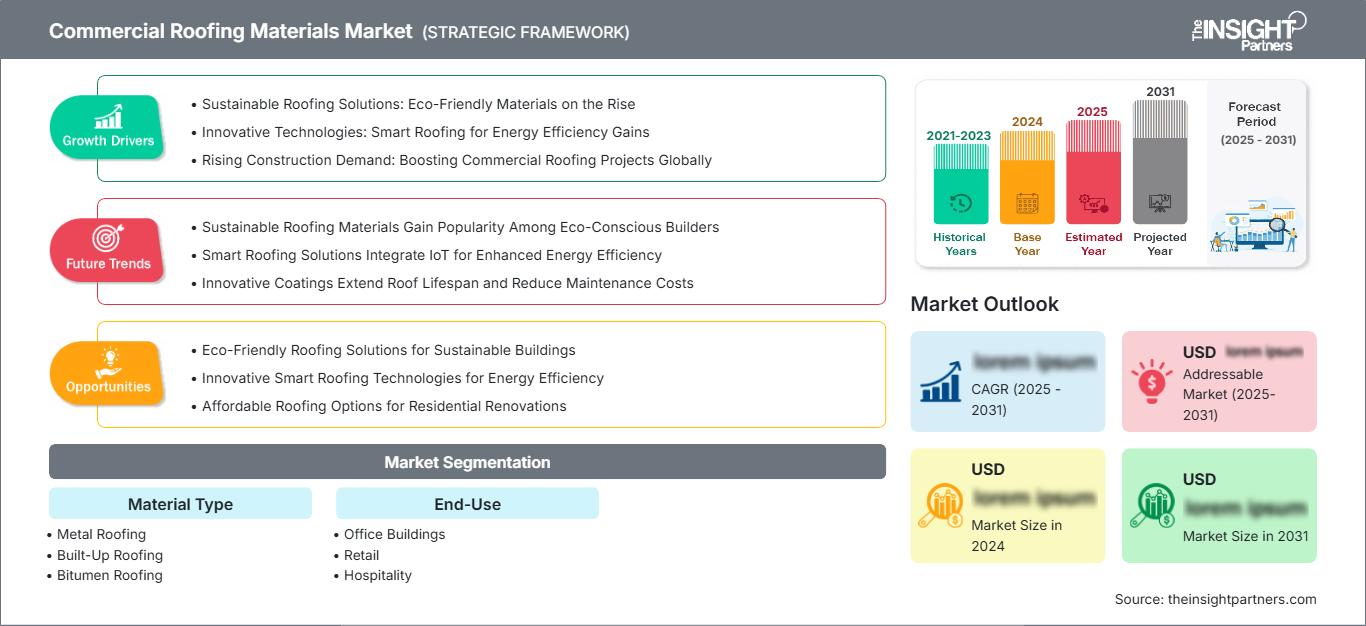
Commercial Roofing Materials Market: Strategic Insights
Regional Insights
North America Commercial Roofing Materials Market
The share of North America in the global commercial roofing materials market stood at 35-37% in 2025 and remains the leading regional market. Continued growth in the investment for commercial building refurbishment and construction projects in warehouses, hospitals, schools, and logistics centers ensures a steady demand. The region is estimated to grow at a CAGR of 4.7-5.2% during 2026-2034 driven by the increasing use of energy-efficient roofing systems and strict energy codes in buildings and the replacement of old commercial roofs in the United States and Canada.
Increasing focus on energy efficiency, durability, and lifecycle maintenance costs of roofing systems has led to increased demand for thermoplastic membranes, insulated roofing systems, and reflective roofing systems due to the government's focus on sustainability policy initiatives and stringent building performance standards. Other factors driving the growth include investments in industrial facilities, data centers, health care, and public infrastructure.
U.S. Commercial Roofing Materials Market
In 2025, the U.S. was responsible for 84-86% of the North American market and is expected to remain so because it has a large number of commercial buildings in addition to their consistent renovations. The industry is estimated to experience a CAGR of 4.8-5.3% between 2026-2034 owing to investment in office buildings, warehouses, shopping centers, hospitals, and educational institutions. Leading manufacturers and dedicated roofing contractors help the domestic market gain competitiveness.
Product innovation in the industry has been centered on reflective roofing systems, superior waterproofing technology, and more durable membranes that increase building performance in terms of energy efficiency. There have been many sustainability programs from both federal and state governments which promote the use of cool roofing products that can lower cooling loads and carbon dioxide emissions. Insurance requirements for roofing systems resistant to bad weather and increased usage of digital roof monitoring systems are other major factors boosting the commercial roofing industry in the country.
Europe Commercial Roofing Materials Market
The European region accounted for 26-28% share of the global market in 2025 and expected to grow with a CAGR of 4.8-5.3% during 2026-2034. Germany is dominating the regional market by having robust construction activities in the industrial, commercial and manufacturing sectors. The UK is also contributing to the growth of the market through commercial retrofitting and sustainable roofing systems.
France, Italy and Spain together are also contributing to the growth through various activities such as commercial renovation, hotels development, logistics and development of public infrastructure. In Europe, strict regulations on energy efficiency and increasing trends of the circular economy are driving the need for recyclable roofing materials and insulation systems.
APAC Commercial Roofing Materials Market
Asia Pacific accounted for 25–27% of the market in 2025 and is anticipated to record the fastest regional expansion with a CAGR of 5.9–6.5% during 2026–2034. China remains the largest contributor, while India, Japan, South Korea, and Australia continue increasing investments in commercial buildings, logistics facilities, and industrial infrastructure.
Government support for sustainable urban development, rapid industrialization, expanding retail infrastructure, and increasing foreign direct investment continue strengthening commercial construction activity. Adoption of advanced roofing membranes and energy-efficient roofing systems is rising steadily as developers focus on long-term operational savings and compliance with modern building standards.
Middle East & Africa Commercial Roofing Materials Market
The Middle East & Africa is expected to register a CAGR of 5.2–5.7% during 2026–2034, supported by commercial real estate expansion, industrial diversification, and infrastructure investments. Saudi Arabia leads regional demand through large-scale urban development projects, while the UAE continues investing in commercial, hospitality, and mixed-use developments.
South Africa remains the largest established market in Sub-Saharan Africa, supported by commercial renovation and industrial construction activities. Across the broader region, increasing adoption of thermally efficient roofing materials capable of withstanding extreme climatic conditions is expected to support long-term demand, particularly within commercial offices, retail developments, logistics facilities, and hospitality infrastructure.
Segmentation Analysis
Material Type
The Material Type segment is projected to expand at a CAGR of 5.2–5.6% during 2026–2034. The commercial roofing materials market scope continues to broaden as commercial developers prioritize roofing systems offering durability, weather resistance, thermal insulation, and lower lifecycle costs. Product innovation focusing on recyclable materials, enhanced membrane performance, and simplified installation is supporting wider adoption across both new construction and reroofing projects.
- Metal Roofing: Widely adopted for warehouses, industrial buildings, and institutional facilities due to its long operational life, corrosion resistance, structural strength, and compatibility with reflective coatings that improve overall building energy efficiency.
- Built-Up Roofing: Continues to maintain demand across large commercial buildings requiring proven waterproofing performance, multiple protective layers, and reliable resistance against varying weather conditions, making it suitable for low-slope roof installations.
- Bitumen Roofing: Preferred for commercial reroofing projects because of its flexibility, moisture resistance, cost-effectiveness, and dependable performance in demanding environmental conditions requiring durable waterproof roofing solutions.
- Thermoplastic Roofing: Represents the leading material category owing to excellent ultraviolet resistance, heat reflectivity, chemical resistance, ease of installation, and increasing compliance with commercial green building standards.
End-Use
The End-Use segment is anticipated to register a CAGR of 5.4–5.8% during 2026–2034. Commercial infrastructure investment, modernization of existing facilities, and growing sustainability requirements continue driving roofing replacement and new installation activities. Building owners increasingly prioritize roofing systems capable of improving energy efficiency while minimizing long-term maintenance expenditure and operational disruptions.
- Office Buildings: The largest end-use category, supported by extensive construction of premium office spaces and modernization of existing commercial buildings emphasizing energy-efficient roofing systems with extended service life.
- Retail: Retail developments increasingly adopt advanced roofing materials that improve thermal performance, reduce operating costs, and provide enhanced durability for shopping centers, supermarkets, and mixed-use commercial complexes.
- Hospitality: Hotels, resorts, and convention facilities continue investing in aesthetically appealing, durable, and weather-resistant roofing systems capable of reducing maintenance costs while supporting sustainable building certification initiatives.
Opportunity Snapshot
| End-Use | Revenue Contribution | Trend Tag | Adoption Stage |
|---|---|---|---|
| Office Buildings | High | Green Retrofit | Mature |
| Retail | Medium | Energy Roofs | Scaling |
| Hospitality | Medium | Cool Roofing | Scaling |
Commercial Roofing Materials Market Growth Drivers and Impact Analysis
Expansion of Commercial Construction and Infrastructure Investment
Growing investments in office complexes, logistics parks, industrial facilities, educational institutions, and healthcare infrastructure continue to support long-term demand for commercial roofing materials. Rapid urbanization across Asia Pacific, the Middle East, and selected Latin American economies has accelerated commercial building activity, while developed economies continue investing in replacement and modernization of aging infrastructure. Government-backed infrastructure programs, expanding industrial corridors, and increasing foreign direct investment have strengthened commercial construction pipelines. Roofing manufacturers are responding through capacity expansion, localized production, and development of high-performance systems capable of delivering longer service life, improved weather resistance, and reduced lifecycle costs. These factors collectively create a stable demand environment across both new construction and reroofing applications.
Growing Adoption of Energy-Efficient and Sustainable Roofing Systems
Increasing emphasis on carbon reduction, energy conservation, and sustainable construction practices is transforming roofing material selection worldwide. Building owners are increasingly installing reflective roofing membranes, insulated roofing systems, and recyclable materials that improve thermal performance while lowering heating and cooling costs. Green building certification programs, stricter building energy regulations, and corporate sustainability commitments continue accelerating adoption across commercial facilities. Manufacturers are introducing products with lower embodied carbon, improved recyclability, and higher solar reflectance to meet evolving environmental requirements. These developments support long-term market expansion while creating opportunities for premium roofing products offering measurable operational and environmental benefits.
Increasing Replacement of Aging Commercial Roofing Infrastructure
A substantial portion of commercial buildings across North America and Europe require roof replacement because of aging infrastructure, severe weather exposure, and changing building performance standards. Property owners increasingly prioritize preventive maintenance and complete reroofing projects to minimize operational disruptions and avoid expensive structural repairs. Insurance requirements, improved building safety standards, and increasing demand for resilient construction further encourage investment in modern roofing systems. Roofing manufacturers benefit from sustained replacement demand supported by technological improvements in installation methods, longer product warranties, enhanced waterproofing performance, and greater resistance to ultraviolet radiation, moisture penetration, and temperature fluctuations.
Commercial Roofing Materials Market Future Trends
Digital Technologies Driving Predictive Roof Asset Management
Digitalization is becoming an important differentiator across the commercial roofing industry. Commercial roofing materials market trends increasingly reflect adoption of drone inspections, artificial intelligence-based condition assessment, smart sensors, and cloud-based asset management platforms that improve roof maintenance planning. These technologies enable property owners to identify defects earlier, optimize maintenance schedules, extend roof service life, and reduce lifecycle costs. Roofing manufacturers are also integrating digital support services into their product offerings to strengthen customer relationships and differentiate premium roofing systems through enhanced monitoring capabilities.
Growing Preference for Circular and Low-Carbon Roofing Materials
Manufacturers are increasingly investing in recyclable membranes, bio-based raw materials, lower-carbon production technologies, and closed-loop recycling initiatives to support circular economy objectives. Commercial developers increasingly evaluate roofing systems using lifecycle assessment criteria rather than upfront installation costs alone. Future product development is expected to prioritize reduced environmental impact, improved material recovery, and compatibility with renewable energy installations such as rooftop solar systems. These developments are likely to reshape procurement strategies across commercial construction markets.
Commercial Roofing Materials Market Opportunities
Expansion of Sustainable Commercial Retrofit Programs
Commercial building owners are increasingly allocating capital toward renovation programs that improve energy efficiency and extend asset life. Commercial roofing materials market Forecasts indicate that retrofit demand will continue rising as governments strengthen building decarbonization policies and financial incentives supporting energy-efficient renovation projects. Roofing manufacturers capable of supplying integrated roofing, insulation, and waterproofing solutions can strengthen market positioning through value-added offerings, technical support services, and long-term warranty programs. Expansion of retrofit activity also creates opportunities for contractors specializing in low-disruption installation methods and sustainable roofing technologies.
Increasing Integration of Roofing Systems with Renewable Energy Infrastructure
Growing deployment of rooftop solar photovoltaic systems creates significant opportunities for advanced commercial roofing materials designed to support long-term structural performance and energy generation. Manufacturers are developing roofing solutions compatible with photovoltaic mounting systems while improving waterproofing, insulation, and durability. Commercial property developers increasingly seek integrated roofing solutions that reduce operating costs, improve sustainability performance, and enhance building value. Strategic collaboration between roofing manufacturers, solar technology providers, and engineering firms is expected to generate new revenue streams while supporting long-term market expansion across commercial infrastructure sectors.
Recent Developments
- July 2026: Skybound Service Partners (“Skybound”), a leading commercial roofing services platform backed by Garnett Station Partners that partners with best-in-class commercial roofing companies, announced three recent acquisitions and accompanying growth initiatives highlighting its significant progress in building the premier commercial roofing platform in the United States.
- April 2026: QXO, Inc. (NYSE: QXO) entered into a definitive agreement to acquire TopBuild Corp. (NYSE: BLD) (“TopBuild”) for approximately $17 billion, significantly expanding QXO’s scale and capabilities across the building products value chain. Upon completion of the TopBuild transaction, QXO will operate in an addressable market of more than $300 billion and hold leadership positions in key building product verticals in North America: insulation, roofing, and waterproofing, and lumber and building materials sector, in key geographies served.
Frequently Asked Questions

- Comprehensive Market Sizing and Forecast Analysis
- Detailed Segmentation Analysis
- In-Depth Market Dynamics Assessment
- Regional and Country-Level Insights
- Competitive Landscape and Company Benchmarking
- Strategic Business Intelligence
Recent Reports
Testimonials

The Insight Partners' SCADA System Market report is comprehensive, with valuable insights on current trends and future forecasts. The team was highly professional, responsive, and supportive throughout. We are very satisfied and highly recommend their services.
RAN KEDEM Partner, Reali Technologies LTDs
I requested a report on a very specific software market and the team produced the report in a few days. The information was very relevant and well presented. I then requested some changes and additions to the report. The team was again very responsive and I got the final report in less than a week.
JEAN-HERVE JENN Chairman, Future Analytica
We worked with The Insight Partners for an important market study and forecast. They gave us clear insights into opportunities and risks, which helped shape our plans. Their research was easy to use and based on solid data. It helped us make smart, confident decisions. We highly recommend them.
PIYUSH NAGPAL Sr. Vice President, High Beam Global
The Insight Partners delivered insightful, well-structured market research with strong domain expertise. Their team was professional and responsive throughout. The user-friendly website made accessing industry reports seamless. We highly recommend them for reliable, high-quality research services
YUKIHIKO ADACHI CEO, Deep Blue, LLC.
This is the first time I have purchased a market report from The Insight Partners.While I was unsure at first, I visited their web site and felt more comfortable to take the risk and purchase a market report.I am completely satisfied with the quality of the report and customer service. I had several questions and comments with the initial report, but after a couple of dialogs over email with their analyst I believe I have a report that I can use as input to our strategic planning process.Thank you so much for taking the extra time and making this a positive experience.I will definitely recommend your service to others and you will be my first call when we need further market data.
JOHN SUZUKI President and Chief Executive Officer, Board Director, BK Technologies
I wish to appreciate your support and the professionalism you displayed in the course of attending to my request for information regarding to infectious disease IVD market in Nigeria. I appreciate your patience, your guidance, and the fact that you were willing to offer a discount, which eventually made it possible for us to close a deal. I look forward to engaging The Insight Partners in the future, all thanks to the impression you have created in me as a result of this first encounter.
DR CHIJIOKE ONYIA MANAGING DIRECTOR, PineCrest Healthcare Ltd.Reason to Buy
- Informed Decision-Making
- Understanding Market Dynamics
- Competitive Analysis
- Identifying Emerging Markets
- Customer Insights
- Market Forecasts
- Risk Mitigation
- Boosting Operational Efficiency
- Strategic Planning
- Investment Justification
- Tracking Industry Innovations
- Aligning with Regulatory Trends





 Get Free Sample for