
Communication Processor Market Trends, Size & Forecast by 2034
Coverage: By Component Type (Transistor, Diode, Rectifier, Power IC, Others); Communication System (Wired, Wireless); End User (IT and Telecom munication, Automotive, Consumer Electronics, Healthcare, Industrial, Others) , and Geography (North America, Europe, Asia Pacific, and South and Central America)
- Status : Data Released
- Report Code : TIPRE00026572
- Category : Electronics and Semiconductor
- No. of Pages : 150
- Available Report Formats :


- Last update date : July 21, 2026


2025 Market Size
US$ 41.99 Bn
Base year value
2034 Forecast
US$ 68.56 Bn
Projected by 2034
CAGR 2026-2034
5.6 %
Growth rate
Addressable Market
US$ 501.18 Bn
(2026-2034)
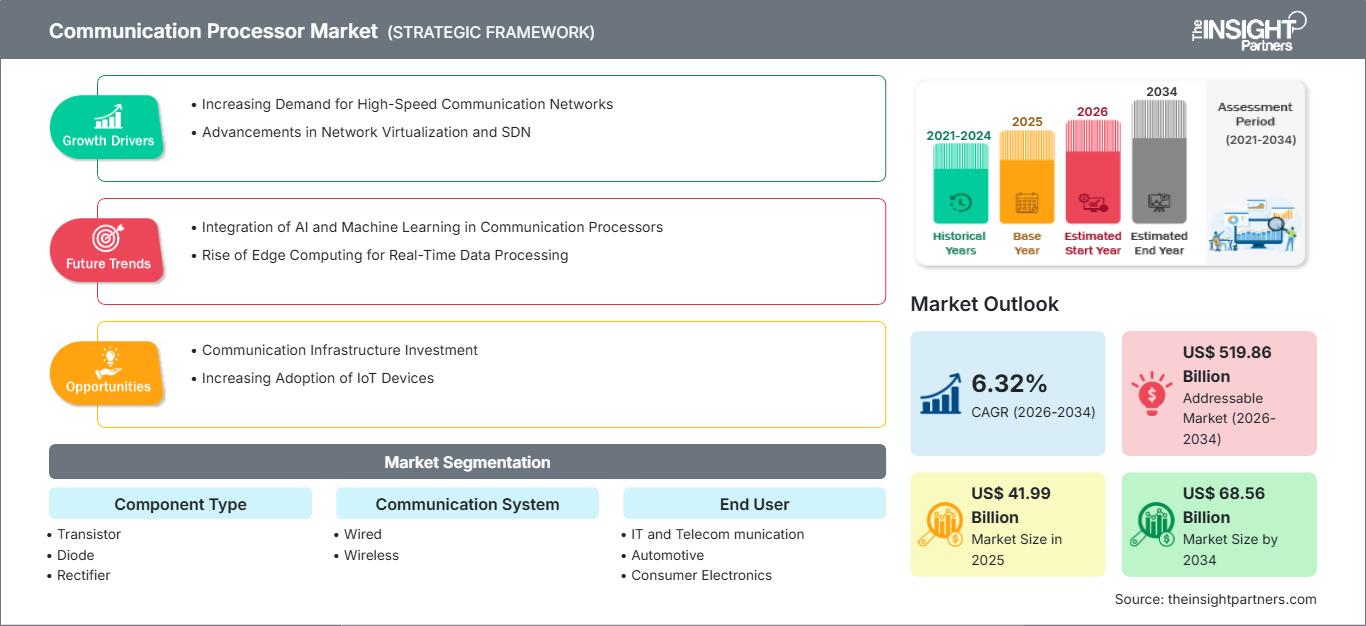
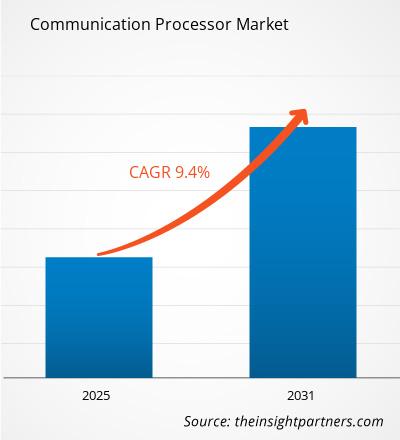
The Communication Processor market was valued at US$ 41.99 billion in 2025 and is expected to reach US$ 68.56 billion by 2034; it is estimated to record a CAGR of 5.6% during 2026-2034.
Communication Processor Market Assessment and Insights
- North America held 24–28% of the Communication Processor Market share in 2025 and is growing at a CAGR of 5.8–6.5% during 2026–2034, supported by cloud networking, 5G, automotive electronics, and secure edge systems.
- US represented 80–84% of North American revenue in 2025 and is growing at a CAGR of 5.9–6.6% during 2026–2034, led by data centers and telecom infrastructure.
- Europe accounted for 16–20% share in 2025 and is growing at a CAGR of 5.1–5.8% during 2026–2034, with Germany, France, the UK, Italy, and Spain supporting demand.
- Asia Pacific held 44–48% share in 2025 and is growing at a CAGR of 6.8–7.6% during 2026–2034, led by China, Japan, South Korea, Taiwan, and India.
- Largest Segment Power IC held 34–38% market share in 2025 and is growing at a CAGR of 6.3–7.0% during 2026–2034 as integrated power and signal control expand.
- High Growth Segment Wireless represented 46–50% market share in 2025 and is growing at a CAGR of 7.0–7.8% during 2026–2034, helped by 5G, Wi-Fi, V2X, and IoT adoption.
- Key companies analyzed in detail: Broadcom Inc.; IXYS Corporation; Intel Corporation; Microchip Technology Incorporated; Motorola Solutions, Inc.; Marvell Technology, Inc.; MACOM Technology Solutions Holdings, Inc.; MaxLinear, Inc.; NXP Semiconductors N.V.; Texas Instruments Incorporated.
Source: The Insight Partners' analysis based on proprietary research, government publications, company annual reports, investor presentations, industry databases, and expert interviews.
Today's processor architectures consist of integrated platforms capable of providing features including packet processing, signaling functionality, encryption, security offloading, and power management. The growth of the Communication Processor market is driven by high bandwidth networks, increased contents of automotive electronics, and industrial machines connectivity. Manufacturing of Communication Processors is becoming increasingly dependent on foundries, firmware, qualification schedules, and collaboration between semiconductor manufacturers, module providers, OEMs, telecommunications firms, and cloud providers.
The future demand will be driven by AI traffic, software-defined cars, industrial Ethernet networks, satellite backhaul services, and medical connectivity devices requiring deterministic, secure, and low-latency communications. Emerging regions will build electronic manufacturing capabilities where cyber security and energy efficiency standards will affect processors. Resources need to be invested in programmable solutions minimizing board complexity and qualification schedules and providing extended lifecycle.
Communication Processor Market Report Scope
| Report Attribute | Details |
|---|---|
| Market size in 2025 | US$ 41.99 Billion |
| Market Size by 2034 | US$ 68.56 Billion |
| Global CAGR (2026 - 2034) | 5.6% |
| Historical Data | 2021-2024 |
| Forecast period | 2026-2034 |
Communication Processor Market Analysis
The expansion of CP is driven by the rise in traffic in cloud, telecommunication, manufacturing plant, vehicular, and consumer networks. The need is more in the areas where latency, protocol translation, encryption, and deterministic transport of data affect the performance of the systems. Edge AI is another factor that contributes to the increase in the requirement of local processing.
Value Chain players include semiconductor companies, foundry houses, OSAT, firmware providers, module makers, networking OEMs, vehicle platform makers, and industrial automation integration companies. Market dynamics are driven by advances in packaging, mixed-signal integration, reliability testing, and qualification cycles. Buyers are becoming increasingly focused on lifecycle support, software tools, certification, and thermal performance beyond mere price.
The Communication Processor Market Report indicates competition within broad band SoC, Ethernet controller, embedded processor, radio frequency communication integrated circuit, power management, and automobile networking sectors. Broadcom Inc., Intel Corporation, Marvell Technology Inc., and NXP Semiconductors NV operate in the domain of advanced networking and automobiles, while Microchip Technology Incorporated and Texas Instruments Incorporated operate in the embedded sector and industrial field.
Capital allocation is inclined towards Wi-Fi 8, 5G edge solutions, deterministic Ethernet, security gateways, and power efficient data center connectivity. MACOM Technology Solutions Holdings, Inc., MaxLinear, Inc., IXYS Corporation, and Motorola Solutions, Inc. are providing specific application related RF, broad band, power and mission critical communications technology. Strategic positioning involves reference design, software ecosystem, customer engineering services and reliable performance in challenging environments.
● REPORT CUSTOMIZATION
Tailor This Report To Align With Your Specific Business Requirements
This report can be customized to align precisely with your business objectives, scope, and target markets. Customization options include tailored segmentation, geography, competitive analysis, and strategic insights to support informed decision-making.
Customize This Report →WHAT YOU CAN ADJUST
- ● Segmentations
- ● Geography
- ● Competitive Analysis
- ● Language Preferences
Communication Processor Market: Strategic Insights
Regional Insights
North America Communication Processor Market
North America accounted for 24–28% of Communication Processor Market share in 2025 and is projected to expand at a CAGR of 5.8–6.5% during 2026–2034. Demand includes applications for AI data centers, 5G core enhancements, enterprise security gateways, aerospace communication solutions, and automotive electronics that depend on robust wired and wireless data transmission capabilities.
In the region, there is an increasing need for cybersecurity, high-performance switching, protocol versatility, and consistent supplies. The United States dominates design and implementation, while Canada assists with telecommunications equipment and Mexico offers electronic manufacturing capabilities. The industry is aided by standards-based upgrades, cloud capex, and extended duration industrial programs.
U.S. Communication Processor Market
The U.S. represented 80–84% of North American revenue in 2025 and is expected to grow at a CAGR of 5.9–6.6% during 2026–2034. Trends in application areas include the cloud routers, artificial intelligence clusters, gateways, critical radios, vehicular communications, health care devices, and industrial control networks.
Domestic demand is supported by Broadcom Inc., Intel Corporation, Texas Instruments Incorporated, Microchip Technology Incorporated, and Marvell Technology, Inc. Buyers value supply stability, long-term support, cryptography support, and low heat dissipation, as failure to communicate can interfere with operations in automobiles, plants, hospitals, and the cloud.
Europe Communication Processor Market
Europe held 16–20% share in 2025 and is projected to grow at a CAGR of 5.1–5.8% during 2026–2034. Germany leads the pack, thanks to automotive networking, automation, and factory Ethernet technologies. Aerospace and defense communications from France, together with telecoms, medical, and smart infrastructure from the UK, Italy, and Spain, complete the European portfolio.
Functional safety, cybersecurity, energy savings, and standards compliance are critical factors for European customers. Vehicles have zonal control and deterministic in-vehicle communication requirements, whereas industrial applications have real-time Ethernet and remote secure connectivity needs. Electronics modernization in the region provides an opportunity for suppliers with local engineering support, automotive certification, and long-term product life cycles.
APAC Communication Processor Market
Asia Pacific accounted for 44–48% share in 2025 and is forecast to grow at a CAGR of 6.8–7.6% during 2026–2034. China, Japan, South Korea, Taiwan, and India lead through electronics manufacturing, 5G equipment, automotive systems, smartphones, and industrial automation.
Policy support for semiconductor localization, export resilience, and smart manufacturing strengthens regional demand. APAC buyers require high-volume availability, cost efficiency, and broad protocol support. Communication Processor Market adoption is strongest in consumer electronics, telecom infrastructure, factory networks, and vehicle electronics where product cycles are fast and scale advantages are material.
Middle East & Africa Communication Processor Market
The Middle East & Africa market is projected to grow at a CAGR of 4.9–5.7% during 2026–2034. Data Centers, 5G Networks, Energy, Smart Cities, and Secure Government Communications drive regional demand from Saudi Arabia and UAE.
South Africa & Rest of MEA are driving adoption via Telecommunication Upgrades, Mining Automation, Utility Monitoring, and Enterprise Connectivity. Implementation will require capital budgeting, system integrators, and available expertise. Early implementations will need rugged processors for remote installations, private wireless communication systems, and energy vertical communication gateways.
Segmentation Analysis
Component Type
Component Type segment in the Communication Processor Market is projected to grow at a CAGR of 5.9–6.7% during 2026–2034. Communication Processor scope includes discrete and integrated semiconductor components used to manage signal flow, protection, power conversion, and data handling. Demand is shifting toward higher integration because OEMs need smaller boards, lower losses, easier certification, and fewer sourcing dependencies.
- Transistor demand remains tied to switching, amplification, and RF front-end functions in routers, radios, industrial gateways, and automotive modules where reliability and thermal behavior are critical.
- Diode components support protection, rectification, and signal conditioning in communication boards, helping designers manage voltage spikes, reverse polarity, and interface stability across connected equipment.
- Rectifier devices are important for power conversion in telecom, industrial, and consumer communication systems, especially where efficient supply rails support continuous network availability.
- Power IC leads demand as processors integrate power management, control, and monitoring functions that reduce board area, improve efficiency, and simplify embedded communication designs.
Communication System
Communication System segment in the Communication Processor Market is forecast to grow at a CAGR of 6.2–7.0% during 2026–2034. Wired systems remain essential for deterministic, secure, high-throughput links, while wireless systems are expanding through mobility, IoT, private networks, and vehicle connectivity. Designers increasingly combine both approaches to balance latency, coverage, redundancy, and cost.
- Wired systems dominate mission-critical infrastructure, factories, data centers, and vehicles where latency, determinism, electromagnetic resilience, and bandwidth predictability matter more than mobility.
- Wireless systems expand through Wi-Fi, Bluetooth, cellular, satellite, and private network deployments, creating demand for integrated processors that combine connectivity, security, and low-power operation.
End User
End User segment in the Communication Processor Market is projected to grow at a CAGR of 6.0–6.8% during 2026–2034. Demand spans IT and telecommunication, automotive, consumer electronics, healthcare, and industrial systems. Each user group values different attributes, including throughput, certification, functional safety, low power, electromagnetic robustness, lifecycle continuity, and secure device management.
- IT and Telecommunication remains the largest demand base because cloud, carrier, broadband, and enterprise networks require packet processing, encryption, traffic management, and reliable high-speed interfaces.
- Automotive adoption rises as vehicles add zonal architectures, radar, infotainment, V2X, and over-the-air software updates that require secure, deterministic data movement.
- Consumer Electronics uses compact processors for smartphones, routers, wearables, gaming devices, and smart home products where integration, battery life, and wireless performance shape user experience.
- Healthcare demand is linked to connected monitors, imaging systems, diagnostics, and medical gateways that need secure data transfer, reliability, and long qualification cycles.
- Industrial systems require rugged communication processors for factory automation, robotics, power grids, and remote assets where uptime, protocol support, and cybersecurity are decisive.
Opportunity Snapshot
| End User | Revenue Contribution | Trend Tag | Adoption Stage |
| IT and Telecommunication | High | AI Networking | Mature |
| Automotive | Medium | Zonal Control | Scaling |
| Consumer Electronics | High | Wi-Fi 8 | Scaling |
| Healthcare | Low | Secure Monitoring | Emerging |
| Industrial | Medium | Factory Ethernet | Scaling |
Communication Processor Market Growth Drivers and Impact Analysis
AI and cloud traffic increase network processing intensity
Workloads related to artificial intelligence (AI), streaming, enterprise security, and distributed cloud computing are all contributing to greater movement of packets within data centers and at the edge. There is increased demand for Communication Processors due to the need for hardware acceleration of various processes such as routing, encryption, compression, telemetry, and quality of service. There is a clear market influence here, with an increase in the demands for higher bandwidth and reduced latency resulting in an increasing OEM preference for integrated processors to reduce external parts and power usage.
Connected vehicles require deterministic communication platforms
Automobiles will be making a transition from a domain-based electronics architecture to a zonal and central architecture that relies upon secure and deterministic data transfer. The processing needs of cameras, radars, infotainment systems, batteries, and assistance systems would be such that they must be capable of communicating using Ethernet, CAN, wireless communication channels, and functional safety. The effect of this is clear in terms of increased duration of design wins, higher qualification requirements, and requirement of lifecycle support for automotive grade products.
Industrial and medical connectivity raises reliability standards
Industries such as factories, hospitals, utility plants, and logistics systems are deploying greater numbers of sensors, controllers, and gateways, in order to increase monitoring and automation capabilities. In this type of environment, microcontrollers need to withstand electrical noise, temperature changes, constant operation, and secure remote control. This creates a repeatable effect on the market, since already-installed products are expected to have a service life measured in decades and need corresponding replacements. Rugged packaging, industrial standards, and prolonged software support allow deepening dependency and lowering maintenance issues for integrators.
Communication Processor Market Future Trends
AI-aware packet processing moves closer to the edge
Communication Processor Market trends point toward AI-aware packet inspection, adaptive power control, and on-device telemetry that can prioritize traffic before it reaches the cloud. Future devices will combine network processing with lightweight inference, secure boot, and policy enforcement. This shift matters because factories, vehicles, and healthcare systems need local decisions when connectivity is intermittent or latency-sensitive. Vendors that integrate analytics-ready hardware, developer tools, and trusted execution features can become preferred platform partners for edge system designers.
Open networking and software-defined designs gain traction
Software-defined networks, virtualized radio access, and programmable control systems will drive the need for processors with flexible firmware, open APIs, and accelerated data paths. The future procurement process will be in favor of solutions where protocol upgrades can take place without requiring a new hardware design. The future trend will not eliminate the requirement for customized silicon, but will drive value towards solutions with better software ecosystems. Suppliers who have SDKs and security updates, along with partner-certified stacks, mitigate OEM risks and improve customer retention.
Communication Processor Market Opportunities
Secure edge gateways for industrial and healthcare systems
Communication Processor Market Forecasts support investment in secure edge gateways that combine wired interfaces, wireless links, encryption, and device-management functions. Industrial and healthcare customers need validated platforms that connect legacy equipment to modern networks without increasing cyber risk. Suppliers can create value through reference designs, pre-certified wireless modules, and long-lifecycle firmware. The opportunity is strongest where system integrators must reduce installation time and support remote diagnostics across distributed assets. Partnerships with automation vendors and medical device OEMs can turn processor platforms into recurring design wins.
Automotive zonal networking reference platforms
OEMs in the automotive sector require communication platforms that can be scaled as the architecture of cars becomes centralized and moves towards software-defined architecture using zonal controllers. Chip manufacturers can stand out through Ethernet switching, secure gateways, wireless coexistence, and functional safety documents within their validated reference platforms. This will benefit those who invest in car projects at an early stage since the time for design is long while the risk of having to replace the product after qualification is also high.
Recent Developments
- May 2026: Broadcom Inc. (NASDAQ: AVGO), a global technology leader that designs, develops, and supplies semiconductor and infrastructure software solutions, announced the expansion of its Wi-Fi 8 portfolio with a new trio of highly integrated systems-on-chip (SoC) devices: BCM6772, BCM6774, and BCM6776. Designed specifically for the high-performance Ethernet router and mesh network markets, these solutions integrate multi-gigabit performance into a compact, power-efficient form factor, enabling the next generation of residential connectivity.
- March 2026: Qualcomm Technologies, Inc. announced the Qualcomm X105 5G Modem-RF, the world’s leading 5G Advanced platform featuring the industry’s first 3GPP Release 19-ready modem, laying the foundation for 6G development and testing. Building on Qualcomm Technologies’ decades of leadership in connectivity, the Qualcomm X105 achieves significant improvements in data speeds and power efficiency, while introducing breakthroughs in quad-band GNSS and integrated NR-NTN support. Its integrated 5th generation AI processor utilizes agentic AI in the modem to detect, classify and optimize data traffic types based on user scenarios, enhancing the user experience across gaming, calling and social media.
- October 2025: Synaptics Incorporated (Nasdaq: SYNA), announces the new Astra SL2600 Series of multimodal Edge AI processors designed to deliver exceptional power and performance. The Astra SL2600 series enables a new generation of cost-effective intelligent devices that make the cognitive Internet of Things (IoT) possible. The SL2600 Series will launch with the SL2610 product line, featuring five processor families tailored for diverse Edge AI applications. These processors are purpose-built for the next wave of smart appliances, home and factory automation equipment, charging infrastructure, healthcare devices, retail point of sale terminals and scanners, autonomous robotic systems, UAVs, casual gaming devices, and more.
Frequently Asked Questions

- Comprehensive Market Sizing and Forecast Analysis
- Detailed Segmentation Analysis
- In-Depth Market Dynamics Assessment
- Regional and Country-Level Insights
- Competitive Landscape and Company Benchmarking
- Strategic Business Intelligence
Recent Reports
Testimonials

The Insight Partners provided valuable market intelligence that supported our global go-to-market strategy. Their team was professional, responsive, and attentive to our feedback, providing thoughtful analysis and helpful methodological clarifications throughout the project.
Junmo Kim Chief Financial Officer (CFO), Enertech Co., Ltd.
The Insight Partners' SCADA System Market report is comprehensive, with valuable insights on current trends and future forecasts. The team was highly professional, responsive, and supportive throughout. We are very satisfied and highly recommend their services.
RAN KEDEM Partner, Reali Technologies LTDs
I requested a report on a very specific software market and the team produced the report in a few days. The information was very relevant and well presented. I then requested some changes and additions to the report. The team was again very responsive and I got the final report in less than a week.
JEAN-HERVE JENN Chairman, Future Analytica
We worked with The Insight Partners for an important market study and forecast. They gave us clear insights into opportunities and risks, which helped shape our plans. Their research was easy to use and based on solid data. It helped us make smart, confident decisions. We highly recommend them.
PIYUSH NAGPAL Sr. Vice President, High Beam Global
The Insight Partners delivered insightful, well-structured market research with strong domain expertise. Their team was professional and responsive throughout. The user-friendly website made accessing industry reports seamless. We highly recommend them for reliable, high-quality research services
YUKIHIKO ADACHI CEO, Deep Blue, LLC.
This is the first time I have purchased a market report from The Insight Partners.While I was unsure at first, I visited their web site and felt more comfortable to take the risk and purchase a market report.I am completely satisfied with the quality of the report and customer service. I had several questions and comments with the initial report, but after a couple of dialogs over email with their analyst I believe I have a report that I can use as input to our strategic planning process.Thank you so much for taking the extra time and making this a positive experience.I will definitely recommend your service to others and you will be my first call when we need further market data.
JOHN SUZUKI President and Chief Executive Officer, Board Director, BK Technologies
I wish to appreciate your support and the professionalism you displayed in the course of attending to my request for information regarding to infectious disease IVD market in Nigeria. I appreciate your patience, your guidance, and the fact that you were willing to offer a discount, which eventually made it possible for us to close a deal. I look forward to engaging The Insight Partners in the future, all thanks to the impression you have created in me as a result of this first encounter.
DR CHIJIOKE ONYIA MANAGING DIRECTOR, PineCrest Healthcare Ltd.Reason to Buy
- Informed Decision-Making
- Understanding Market Dynamics
- Competitive Analysis
- Identifying Emerging Markets
- Customer Insights
- Market Forecasts
- Risk Mitigation
- Boosting Operational Efficiency
- Strategic Planning
- Investment Justification
- Tracking Industry Innovations
- Aligning with Regulatory Trends





 Get Free Sample for