
Composite Cans Market Size, Trends & Growth by 2034
Coverage: By Type (Spiral Wound Cans, Linear Draw Cans, Others); Closure Type (Aluminium, Paper Board, Others); Application (Food and Beverage, Personal Care and Cosmetics, Others) , and Geography (North America, Europe, Asia Pacific, and South and Central America)
- Status : Data Released
- Report Code : TIPRE00023289
- Category : Chemicals and Materials
- No. of Pages : 150
- Available Report Formats :


- Last update date : August 19, 2026


2025 Market Size
US$ 6.55 Bn
Base year value
2034 Forecast
US$ 13.63 Bn
Projected by 2034
CAGR 2026-2034
8.48 %
Growth rate
Addressable Market
US$ 90.53 Bn
(2026-2034)
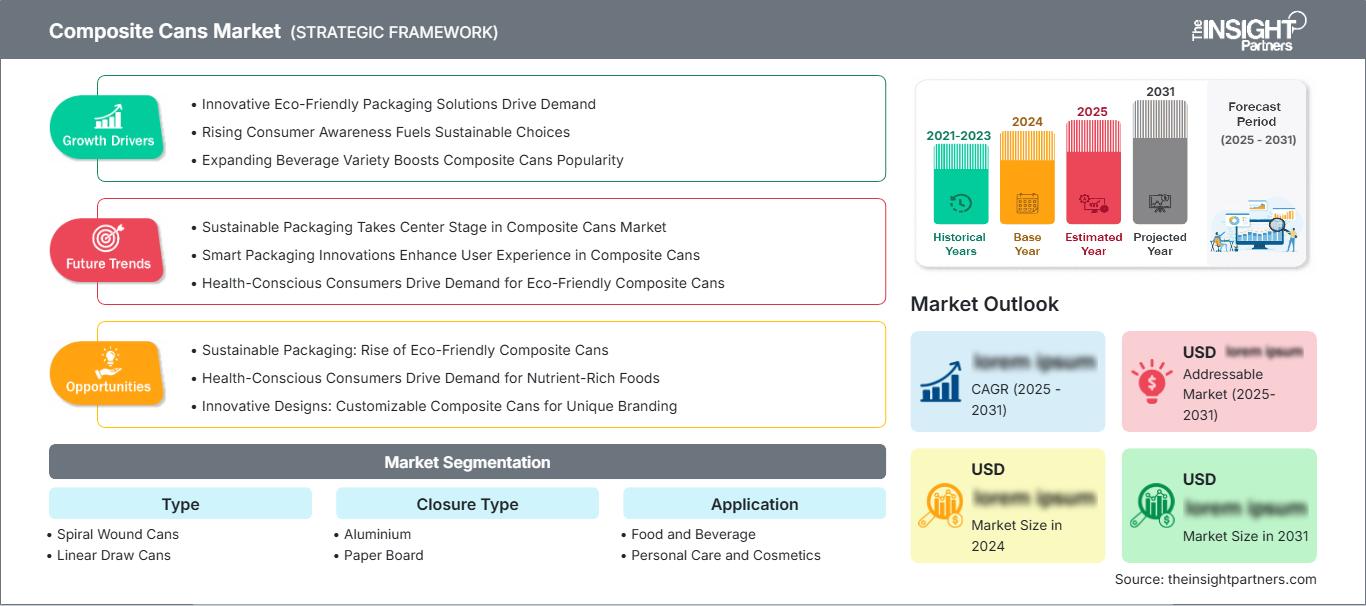
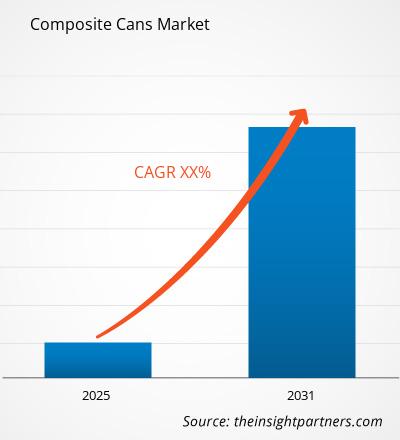
The Composite Cans Market size is worth US$ 6.55 Billion in 2025 and forecasted to be worth US$ 13.63 Billion by 2034 at a CAGR of 8.48% between 2026 and 2034, owing to growth drivers such as preference for light-weight rigid packaging, product protection, easy-open systems, good shelf appeal, and efficient material usage.
North America is set to remain a key demand region, where the growth of Composite Cans Market will be facilitated by already existing packaged food manufacturing industry, high consumption of premium snacks, well-established retail channels, and converting capabilities. Growth in the region will also be driven by demand for customized cylindrical packaging, improved barriers, re-sealing closures, and paper-based structures.
Composite Cans Market Assessment and Insights
- North America: North America is estimated to hold a 32–36% Composite Cans Market share in 2025 and is projected to grow at a 7.7–8.3% CAGR during 2026–2034, supported by packaged foods, snacks, confectionery, and established packaging manufacturing.
- US: The US is estimated to represent 75–79% of North American demand in 2025 and is projected to expand at a 7.8–8.4% CAGR, supported by food, snacks, and specialty consumer products.
- Europe: Europe is estimated to account for a 28–31% share in 2025 and is expected to grow at a 7.9–8.5% CAGR, with Germany, the UK, France, Italy, and Spain supporting demand.
- Asia Pacific: Asia Pacific is estimated to represent a 22–26% share in 2025 and is projected to grow at an 8.8–9.5% CAGR, led by China, Japan, India, South Korea, and Australia.
- Largest Segment: Spiral Wound Cans are estimated to hold a 67–71% market share in 2025 and are projected to grow at an 8.2–8.8% CAGR through 2034.
- High Growth Segment: Personal Care and Cosmetics is estimated to represent a 20–24% market share in 2025 and is projected to grow at a 9.0–9.7% CAGR through 2034.
- Key companies analyzed in detail: Amcor plc, Irwin Packaging Pty Limited, COREX Group, Smurfit Westrock plc, Ace Paper Tube Corporation, Kunert Gruppe, Sonoco Products Company, Mondi plc, CANFAB PACKAGING INC., and Bharath Paper Conversions.
Source: The Insight Partners' analysis based on proprietary research, government publications, company annual reports, investor presentations, industry databases, and expert interviews.
The Composite Cans Market has evolved from simple paperboard tubes to more engineered composite systems that include paperboard tubes, liners, membranes, closures, decoration materials, and barrier layers. The spiral wound technology has proven itself due to the ability to provide efficient cylindrical packaging and flexibility in sizes. Innovations in coatings, adhesives, printing, and closure technologies will enable companies to increase their ability to ensure product safety while taking into account consumer demand for convenience, uniqueness, and efficiency.
The Composite Cans Market forecast indicates that future growth will be more and more oriented at fiber-based packaging, recyclable packaging solutions, regional manufacturing, and application-oriented barrier systems. Increasing penetration of packaged foods in the Asia Pacific will attract more converting capacity to the region, while in Europe there will be more focus on material compatibility and circular solutions. North American packaging providers will pay attention to customization and supply capabilities. Such trends will benefit companies capable of merging all these characteristics within one package.
Composite Cans Market Report Scope
| Report Attribute | Details |
|---|---|
| Market size in 2025 | US$ 6.55 Billion |
| Market Size by 2034 | US$ 13.63 Billion |
| Global CAGR (2026 - 2034) | 8.48% |
| Historical Data | 2021-2024 |
| Forecast period | 2026-2034 |
Composite Cans Market Analysis
Composite Cans Market growth is driven by brand owners who are looking for rigid packages that provide protection, aesthetics, efficient material usage, and convenience. The value chain consists of paperboard makers, providers of aluminum and polymers, manufacturers of coatings and adhesives, can makers, suppliers of closures, printing firms, contract fillers, food companies, personal care brands, and retailers. Package structure is defined by product sensitivity, shelf life, filling conditions, distribution, and opening preferences.
Supply dynamics depend on quality of the board, winding accuracy, liner bonding, closure compatibility, and access to specialty materials. Manufacturers capable of integrating conversion and finishing will be able to offer flexible diameter, height, liner, membrane, labeling, and closure options. Snacks, nuts, powdered foods, candies, and specialty products demand flexible supply as brands usually need varying sizes and graphical designs. Fluctuations in the cost of raw materials are still an important factor since paperboard and barrier materials affect package economics.
According to the Composite Cans Market report, competitive positioning is different in diversified packagers and specialized composite can packagers. Amcor plc merges general packaging know-how with materials and designs while Sonoco Products Company has substantial experience in paper-based consumer packaging products. Smurfit Westrock plc and Mondi plc are experienced in paperboard and sustainable packaging. Irwin Packaging Pty Limited, CANFAB PACKAGING INC., Ace Paper Tube Corporation and Bharath Paper Conversions operate in specialized, custom-made and regional customer oriented packaging solutions.
The Composite Cans Market trends reveal that the industry increasingly favors firms that have the ability to develop application-specific structures rather than providing standardized packages. Key investments include automated winding, precise printing, barrier development, closure integration, and recyclable package manufacturing. The suppliers' competitive position gets reinforced with expertise in paper-based converting with COREX Group and Kunert Gruppe. Specialized packagers can capitalize on short production runs and custom-made dimensions. The qualification process gets speeded up through partnership with food processors and brand owners.
● REPORT CUSTOMIZATION
Tailor This Report To Align With Your Specific Business Requirements
This report can be customized to align precisely with your business objectives, scope, and target markets. Customization options include tailored segmentation, geography, competitive analysis, and strategic insights to support informed decision-making.
Customize This Report →WHAT YOU CAN ADJUST
- ● Segmentations
- ● Geography
- ● Competitive Analysis
- ● Language Preferences
Composite Cans Market: Strategic Insights
Regional Insights
North America Composite Cans Market
North America is expected to represent a 32-36% share of worldwide consumption by 2025 and is anticipated to expand at a CAGR of 7.7-8.3% through 2034. The US stands out as the leading regional market on the back of packaged foods, snacks, confectionery, protein-based products, powdered ingredients, and specialty consumer products. Canada derives its strength from food processing and branded consumer goods, whereas Mexico is set to gain from growing manufacturing and regional distribution. Well-developed converting infrastructure enables swift customization and reliable supply.
Increasingly, purchasing decisions are being influenced by barrier properties, filling suitability, appearance, function of closures, and economics of lifecycle. A spiral wound structure fits perfectly into various applications in dry goods, while foil and polymer liners enable manufacturers to modify their packaging to meet requirements regarding moisture and oxygen resistance. Demand for distinctive shelf structures also motivates the industry to make investments in quality print and specialized closures.
U.S. Composite Cans Market
Estimated to account for 75–79% of total demand in North America in 2025, the US is expected to experience a CAGR of 7.8–8.4% through 2034. The major segments of application include snack, nuts, powdered, confectionery, dry ingredients, and specialty packs. Such companies as Sonoco Products Company, Amcor plc, CANFAB PACKAGING INC., Irwin Packaging Pty Limited, and others serve the regional business ecosystem through their consumer packaging and specialty composite solutions.
The trend of innovation in terms of applications is the development of resealable and easy-to-open solutions that provide good product protection and high visual differentiation. Such solutions as aluminum ends, foil membranes, polymer liners, overcaps, and printing surfaces may be combined depending on the specific product type. Other sources of demand for the market come from personal care and cosmetics, where cylindrical packaging helps create unique shelf solutions. Maturity of the retail channel and contract filling network allows testing new structure solutions.
Europe Composite Cans Market
Europe is expected to represent 28-31% of the global demand in 2025 and be set for growth at 7.9-8.5% CAGR to 2034. The market leader is Germany, thanks to developed engineering of food processing and packaging. There is robust demand for snacks and confectionery in the UK. The contribution of France, Italy, and Spain relates to packaged foods, speciality items, and consumer brands. Material efficiency and circularity become increasingly relevant for procurement.
Germany combines large manufacturing capacity with a highly developed industry of foods and consumer goods, which creates an environment for engineered composite packaging. The strength of the UK lies in its established categories of snacks and confectionery, whereas France has numerous opportunities in both premium foods and consumer products. Italy and Spain are contributing through food processing, private label, and speciality packaging. In Europe, material efficiency of boards, liners, adhesives, closures, and recoverability characteristics are becoming increasingly considered together.
APAC Composite Cans Market
APAC’s share is projected to be at 22-26% in 2025 and is expected to expand at an 8.8–9.5% CAGR till 2034. China accounts for the largest share followed by Japan, India, South Korea, and Australia. Packaged food manufacturing, urban retail development, premium snacks, and diversification of consumer product range aid the demand for APAC region. India is fast developing as a significant market owing to organized food manufacturing and branded consumer products.
While China offers scale owing to large manufacturing base, Japan and South Korea rely on precise packaging. Australia aids with food brands while India gains from the growing packaged food market. Investments in converting capacities and energy efficient packaging are expected to aid adoption. Local players are increasingly becoming well placed to offer custom packaging solutions for brands while global players look to establish production presence in proximity to consumers.
Middle East & Africa Composite Cans Market
Middle East and Africa represent a smaller demand base, with Saudi Arabia serving as a leading market and the UAE functioning as an important commercial and logistics center. Regional demand is projected to grow at a 7.0–7.6% CAGR through 2034. Food manufacturing, imported packaged foods, specialty consumer products, and industrial diversification support demand.
South Africa contributes through food processing and retail packaging, while the Rest of MEA is influenced by distribution networks and developing consumer-product manufacturing. Saudi Arabia's industrial diversification and food-sector investment support packaging requirements, while UAE logistics infrastructure facilitates regional distribution. Composite cans can address demand for lightweight construction, product protection, customized branding, and convenient closure systems in dry foods, snacks, confectionery, and selected personal care products.
Segmentation Analysis
Type
The Type segment comprises Spiral Wound Cans and Linear Draw Cans and is projected to grow at an 8.3–8.9% CAGR during 2026–2034. Spiral winding remains the principal construction approach because it supports efficient production and flexible dimensions, while Linear Draw Cans address selected applications requiring particular forming and structural characteristics. The Composite Cans Market scope is influenced by package geometry, production efficiency, barrier requirements, and customer specifications.
- Spiral Wound Cans: Spiral Wound Cans maintain the leading position because continuous winding supports efficient production, dimensional flexibility, integration of liners and membranes, and compatibility with multiple closure configurations.
- Linear Draw Cans: Linear Draw Cans serve specialized requirements where particular wall construction and forming characteristics are needed. Their strategic value comes from customized structures and selected application-specific packaging formats.
Closure Type
The Closure Type segment is projected to grow at an 8.0–8.6% CAGR during 2026–2034. Closure selection depends on sealing requirements, product protection, opening convenience, tamper evidence, material compatibility, and desired shelf presentation. Aluminum remains important where rigidity and barrier performance are prioritized, while Paper Board supports packaging strategies centered on greater fiber content and paper-forward construction.
- Aluminium: Aluminium closures provide rigidity, strong sealing characteristics, and a premium appearance. They remain important for products requiring robust protection, tamper evidence, and reliable closure performance.
- Paper Board: Paper Board closures support fiber-oriented packaging strategies and can increase the paper content of the package. Their relevance is linked to resource efficiency, lightweight construction, and material compatibility.
Application
The Application segment is projected to grow at an 8.6–9.2% CAGR during 2026–2034, supported by food and beverage as the principal demand category and personal care and cosmetics as a faster-growing application. Product protection, branding, convenience, and package differentiation influence purchasing decisions. Application-specific requirements determine the appropriate body construction, barrier system, dimensions, and closure.
- Food and Beverage: Food and beverage represents the principal application because composite structures protect snacks, nuts, powdered foods, confectionery, spices, and specialty products while supporting strong graphics and convenient closures.
- Personal Care and Cosmetics: Personal care and cosmetics benefits from distinctive cylindrical formats, premium decoration, lightweight construction, and customized closure options. Brand differentiation and consumer experience support wider use.
Opportunity Snapshot
| Application | Revenue Contribution (High/Medium/Low) | Trend Tag | Adoption Stage |
|---|---|---|---|
| Food and Beverage | High | Snack Packaging | Mature |
| Personal Care and Cosmetics | Medium | Premium Formats | Scaling |
Composite Cans Market Growth Drivers and Impact Analysis
Expansion of Premium and Convenient Packaged Foods
Premium snacks, nuts, confectionery, powdered beverages, protein products, and specialty foods create favorable conditions for composite packaging because package appearance and functionality influence purchase decisions. Cylindrical structures provide a large printable surface while allowing brands to differentiate through dimensions, graphics, membranes, overcaps, and opening mechanisms. The commercial impact is particularly relevant for products positioned above mainstream price points, where packaging can reinforce quality and convenience. Contract fillers and specialty food manufacturers can accelerate adoption by supporting multiple dimensions and closure configurations. The resulting demand is not limited to large established brands. Emerging consumer-product companies can use customized composite formats to establish distinctive shelf identities without developing completely unique packaging systems. Suppliers with flexible production and short development cycles can therefore capture incremental demand from premium and specialty categories.
Greater Emphasis on Product Protection and Shelf Life
Food manufacturers increasingly require packaging that protects products throughout transportation, storage, retail handling, and consumer use. Composite cans can incorporate liners, membranes, coatings, and closures selected according to oxygen, moisture, aroma, and light sensitivity. This makes the format particularly relevant to dry foods, snacks, powdered products, and specialty ingredients. The market impact increases when packaging performance helps maintain product quality across extended distribution networks or challenging storage environments. Suppliers that can engineer barrier properties without unnecessarily increasing package complexity can improve both product protection and cost efficiency. Technical qualification is therefore becoming more important in procurement decisions, with converters expected to demonstrate compatibility between package construction and filling conditions. The ability to combine board selection, barrier materials, adhesive systems, and closure design within one specification creates opportunities for higher-value customized packaging solutions.
Growth of Paper-Based Packaging Substitution
Brand owners are evaluating packaging portfolios in response to retailer requirements, consumer expectations, and regulatory attention toward material use and recyclability. Composite cans can provide a paperboard-based structural platform while retaining selected barrier components needed for product protection. The commercial opportunity depends on the ability to design structures that provide adequate performance without creating unnecessary material complexity. Manufacturers are therefore investing in paper-forward constructions, improved coatings, compatible closures, and material combinations that can fit regional recovery systems. Substitution is most feasible where the product does not require the pressure resistance or complete barrier characteristics associated with conventional metal packaging. This creates a targeted rather than universal replacement opportunity. Suppliers that understand local recycling pathways and can provide credible material information will be better positioned as brand owners increasingly evaluate packaging at the system level.
Composite Cans Market Future Trends
Design for Improved Material Compatibility
Future development will increasingly evaluate the complete package rather than treating the paperboard body, liner, adhesive, closure, membrane, and label as separate components. Manufacturers are likely to prioritize constructions that retain necessary barrier and sealing performance while improving compatibility between major materials. This may encourage thinner barrier layers, fiber-compatible coatings, paper-based closures, and adhesive systems that facilitate recovery. Digital engineering can help manufacturers compare alternative constructions against performance, cost, weight, and end-of-life criteria before commercialization. Brand owners are also expected to request clearer information about material composition and recovery pathways when selecting suppliers. The resulting design philosophy could gradually shift the sector away from simply maximizing barrier performance toward balancing product protection with material simplicity. Companies able to demonstrate validated performance across this broader set of criteria should gain stronger access to sustainability-focused packaging programs.
Shorter Development Cycles Through Flexible Manufacturing
Packaging customers increasingly require rapid commercialization for seasonal products, limited editions, private-label launches, and region-specific formats. Flexible winding equipment, digital decoration, modular closure systems, automated inspection, and adaptable tooling can reduce the time required to move from package concept to production. This trend should be especially relevant to smaller brands that need customized packaging but cannot justify extremely large minimum production quantities. Manufacturers may increasingly develop modular platforms in which dimensions, graphics, liners, and closures can be changed without redesigning the complete package. Customer trial data can then be used to refine package geometry and material specifications before volume production. Over time, flexible manufacturing could broaden the addressable customer base while improving capacity utilization. Suppliers that combine customization with predictable production economics are likely to benefit most from this shift.
Composite Cans Market Opportunities
Regional Manufacturing Near Food Processing Clusters
Regional manufacturing represents an attractive investment opportunity because Composite Cans are relatively bulky compared with their material value, making transportation and inventory considerations important. Establishing converting capacity near major food-processing clusters can reduce delivery times and improve responsiveness to customized orders. India, Southeast Asia, Eastern Europe, and selected Middle Eastern markets provide potential locations where packaged-food production and branded consumer products are expanding. Companies should evaluate paperboard availability, converter expertise, logistics infrastructure, customer concentration, and local packaging requirements before committing capital. Partnerships with contract fillers can accelerate market entry because package compatibility can be validated during commercial production trials. A regional strategy can also support smaller order quantities and faster replenishment. For global suppliers, localized finishing combined with centralized procurement of specialized materials can balance customer responsiveness with process control and purchasing efficiency.
Premium Composite Formats for Beauty and Specialty Products
Personal care and cosmetics provide an opportunity to extend composite packaging into higher-value applications where package appearance, tactile quality, and differentiation can justify customized structures. Cylindrical formats can be developed for powders, dry formulations, gift sets, specialty beauty products, and selected consumer applications. Suppliers can combine high-resolution graphics, decorative surfaces, metallic elements, customized closures, and engineered liners to create premium presentations. Commercial development should begin with products whose formulation and distribution conditions are compatible with composite structures. Modular package platforms can reduce development costs by allowing brands to alter dimensions and decoration without changing the fundamental manufacturing process. As beauty companies seek packaging that communicates both premium positioning and responsible material use, composite structures can occupy a specialized position between conventional paper formats and heavier rigid packaging alternatives. Technical validation remains essential before broader commercialization.
Recent Developments
- August 2025: Sonoco partnered with Lorenz Snack-World to provide a rigid paper can for its Crunchips Stackers snacks, designed to be easier to recycle while ensuring the quality and durability consumers expect. Unlike other conventional snack cans, Sonoco says the new can contains no aluminium foil in the inner liner and no metal base. Certified as 88% recyclable by Circular Analytics in Germany, a protective layer on the inside ensures the chips remain fresh, offering the same product protection without compromising on environmental performance.
- June 2025: Sonoco invested in four U.S. facilities to expand manufacturing of its rigid paper cans with paper bottoms. The company has planned to expand production and add new lines at existing manufacturing facilities. It aims to install new paper-bottom presses and can lines at facilities in West Chicago, Illinois; Greenville, Wisconsin; Dayton, New Jersey; and Norwalk, California.
Frequently Asked Questions

- Comprehensive Market Sizing and Forecast Analysis
- Detailed Segmentation Analysis
- In-Depth Market Dynamics Assessment
- Regional and Country-Level Insights
- Competitive Landscape and Company Benchmarking
- Strategic Business Intelligence
Recent Reports
Testimonials

The Insight Partners provided valuable market intelligence that supported our global go-to-market strategy. Their team was professional, responsive, and attentive to our feedback, providing thoughtful analysis and helpful methodological clarifications throughout the project.
Junmo Kim Chief Financial Officer (CFO), Enertech Co., Ltd.
The Insight Partners' SCADA System Market report is comprehensive, with valuable insights on current trends and future forecasts. The team was highly professional, responsive, and supportive throughout. We are very satisfied and highly recommend their services.
RAN KEDEM Partner, Reali Technologies LTDs
I requested a report on a very specific software market and the team produced the report in a few days. The information was very relevant and well presented. I then requested some changes and additions to the report. The team was again very responsive and I got the final report in less than a week.
JEAN-HERVE JENN Chairman, Future Analytica
We worked with The Insight Partners for an important market study and forecast. They gave us clear insights into opportunities and risks, which helped shape our plans. Their research was easy to use and based on solid data. It helped us make smart, confident decisions. We highly recommend them.
PIYUSH NAGPAL Sr. Vice President, High Beam Global
The Insight Partners delivered insightful, well-structured market research with strong domain expertise. Their team was professional and responsive throughout. The user-friendly website made accessing industry reports seamless. We highly recommend them for reliable, high-quality research services
YUKIHIKO ADACHI CEO, Deep Blue, LLC.
This is the first time I have purchased a market report from The Insight Partners.While I was unsure at first, I visited their web site and felt more comfortable to take the risk and purchase a market report.I am completely satisfied with the quality of the report and customer service. I had several questions and comments with the initial report, but after a couple of dialogs over email with their analyst I believe I have a report that I can use as input to our strategic planning process.Thank you so much for taking the extra time and making this a positive experience.I will definitely recommend your service to others and you will be my first call when we need further market data.
JOHN SUZUKI President and Chief Executive Officer, Board Director, BK Technologies
I wish to appreciate your support and the professionalism you displayed in the course of attending to my request for information regarding to infectious disease IVD market in Nigeria. I appreciate your patience, your guidance, and the fact that you were willing to offer a discount, which eventually made it possible for us to close a deal. I look forward to engaging The Insight Partners in the future, all thanks to the impression you have created in me as a result of this first encounter.
DR CHIJIOKE ONYIA MANAGING DIRECTOR, PineCrest Healthcare Ltd.Reason to Buy
- Informed Decision-Making
- Understanding Market Dynamics
- Competitive Analysis
- Identifying Emerging Markets
- Customer Insights
- Market Forecasts
- Risk Mitigation
- Boosting Operational Efficiency
- Strategic Planning
- Investment Justification
- Tracking Industry Innovations
- Aligning with Regulatory Trends





 Get Free Sample for