
Concrete Admixtures Market Size, Segments, and Growth by Forecast by 2034
Concrete Admixtures Market Size and Forecasts (2021 - 2034), Global and Regional Growth Opportunity Analysis, and Geography (North America, Europe, Asia Pacific, and South and Central America)
- Status : Data Released
- Report Code : TIPRE00004666
- Category : Chemicals and Materials
- No. of Pages : 150
- Available Report Formats :


- Last update date : August 27, 2026


2025 Market Size
US$ 21.23 Bn
Base year value
2034 Forecast
US$ 40.04 Bn
Projected by 2034
CAGR 2026-2034
7.3 %
Growth rate
Addressable Market
US$ 276.28 Bn
(2026-2034)
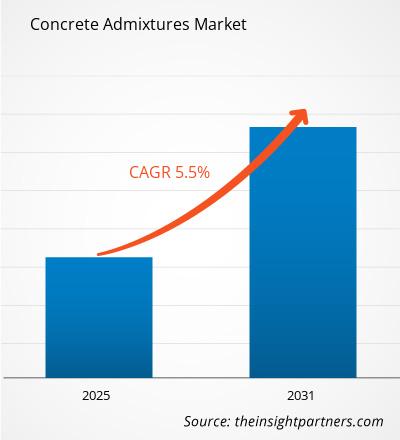
The concrete admixtures market is valued at US$ 21.23 Billion in 2025 and is projected to reach US$ 40.04 Billion by 2034, expanding at a CAGR of 7.3% during 2026–2034. Growth reflects increasing requirements for controlled workability, durability, strength development, and resource efficiency across concrete production. Demand is supported by residential construction, infrastructure renewal, commercial development, and the increasing technical requirements of ready-mix and precast concrete.
The Concrete Admixtures Market size remains structurally attractive in North America, supported by infrastructure modernization, industrial reshoring, transportation investment, and stricter expectations for durable, resource-efficient concrete. Adoption is increasingly shaped by performance-based specifications, project schedules, and lower embodied-carbon objectives, while producers seek admixture systems that improve mix efficiency without compromising strength, placement characteristics, or curing performance.
Concrete Admixtures Market Assessment and Insights
- North America: North America accounted for 24–28% of global demand in 2025 and is projected to expand at a 6.2–6.8% CAGR during 2026–2034, supported by infrastructure renewal and industrial construction.
- US: The US represented 68–72% of North American demand in 2025 and is expected to grow at a 6.3–6.9% CAGR through 2034, led by infrastructure and manufacturing projects.
- Europe: Europe represented 22–26% of global demand in 2025 and is expected to register a 5.8–6.4% CAGR, with Germany, the UK, France, Italy, and Spain supporting demand through renovation and infrastructure activity.
- Asia Pacific: Asia Pacific represented 38–42% of global demand in 2025 and is projected to grow at an 8.0–8.6% CAGR, with China, India, Japan, and South Korea forming major demand centers.
- Largest Segment: Water Reducing Admixture held a 48–52% market share in 2025 and is projected to grow at a 7.5–8.2% CAGR during 2026–2034, reflecting broad ready-mix adoption.
- High Growth Segment: Accelerating Admixture held a 10–14% market share in 2025 and is expected to grow at an 8.0–8.7% CAGR, driven by precast, shotcrete, and rapid construction requirements.
- Key companies analyzed in detail: Arkaz Al Sharq Building Materials, BASF SE, CEMEX SAB de CV, Fosroc Inc, MAPEI SpA, Normet Group, SIKA AG, The Euclid Chemical Company, Thermax Limited, and Yara International ASA.
Source: The Insight Partners' analysis based on proprietary research, government publications, company annual reports, investor presentations, industry databases, and expert interviews.
The concrete admixtures market has evolved from conventional plasticizers and set-control products toward high-performance formulations designed around specific concrete mixes and project conditions. The technology of polycarboxylate ethers, high-range water reducers, viscosity-modifying agents, accelerators, and concrete durability enhancers helps achieve the properties of self-compacting concrete, high-strength concrete, precast concrete, pumped concrete, and sustainable concrete. These technologies are defined by Sika as major requirements for modern admixture technologies.
In terms of future developments, the focus of product development will be on lower CO2 concrete, effective use of cement, digital quality control and localization of production. Producers tend to set up their production sites closer to consumers to avoid risks associated with logistics. The example of Sika's plans to expand the manufacturing facility in the US, Bangladesh, Colombia and Tanzania up until 2026 shows localization trends in admixtures production.
Concrete Admixtures Market Report Scope
| Report Attribute | Details |
|---|---|
| Market size in 2025 | US$ 21.23 Billion |
| Market Size by 2034 | US$ 40.04 Billion |
| Global CAGR (2026 - 2034) | 7.3% |
| Historical Data | 2021-2024 |
| Forecast period | 2026-2034 |
Concrete Admixtures Market Analysis
Demand is closely linked to ready-mix, precast, infrastructure, commercial, and residential construction because admixtures allow concrete producers to modify workability, setting behavior, strength, durability, and water demand without fundamentally changing the concrete production process. The ecosystem includes chemical manufacturers, polymer suppliers, cement producers, ready-mix companies, contractors, engineers, and distributors. The Concrete Admixtures Market share is influenced by the presence of major suppliers such as Sika, Fosroc, MAPEI, BASF, and Normet, which increasingly combine formulations with application engineering and technical services.
The supply of goods is affected by the availability and cost of specialty chemicals, polymers, calcium salts, and other inputs used in formulations. The production facility within the region creates a competitive advantage in cases when supply stability and technical support specific to the area affect buying decisions. For instance, Arkaz produces two Saudi production units and offers a wide variety of formulations suitable for the Gulf environment. At the same time, Thermax offers plasticizers, superplasticizers, hyperplasticizers, air-entraining agents, accelerators, and retarders.
Despite fragmentation by application and geography, the biggest construction chemicals companies enjoy considerable advantages in technology, production, and distribution. BASF offers polymeric intermediates for water reducers, and MAPEI offers a wide variety of formulations for superplasticizers, accelerators, retarders, air-entraining agents, and specialty products. Fosroc stands out from others by offering formulations for particular applications, including ready mix, precast, waterproofing, self-compacting concrete, and high early strength.
Strategic positioning is increasingly based on local production, formulation customization, sustainability, and technical service rather than product breadth alone. SIKA AG is expanding production capacity in growth markets, while Master Builders Solutions' acquisition of Arkaz strengthens its Gulf footprint. Yara International ASA supplies calcium-nitrate-based multifunctional admixture components, illustrating the importance of upstream chemistry in the broader value chain. These developments are shaping the competitive landscape highlighted in the Concrete Admixtures Market report.
● REPORT CUSTOMIZATION
Tailor This Report To Align With Your Specific Business Requirements
This report can be customized to align precisely with your business objectives, scope, and target markets. Customization options include tailored segmentation, geography, competitive analysis, and strategic insights to support informed decision-making.
Customize This Report →WHAT YOU CAN ADJUST
- ● Segmentations
- ● Geography
- ● Competitive Analysis
- ● Language Preferences
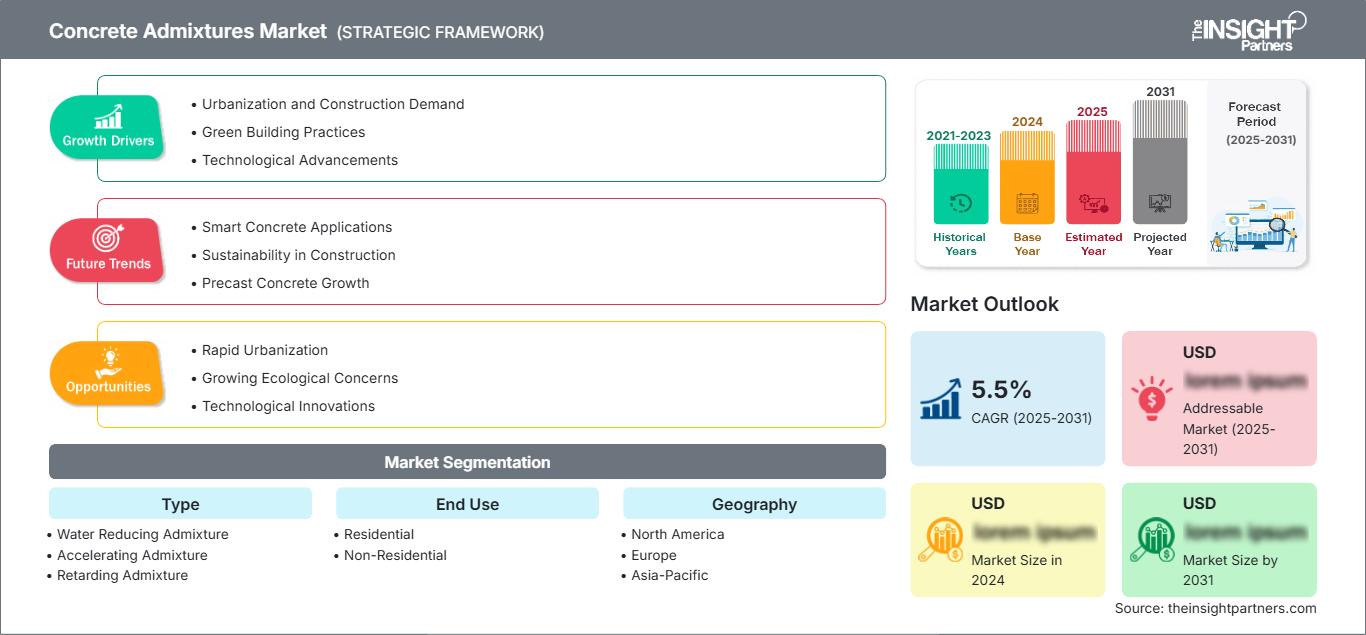
Concrete Admixtures Market: Strategic Insights
Regional Insights
North America Concrete Admixtures Market
North America represented 24–28% of global demand in 2025 and is projected to grow at a 6.2–6.8% CAGR through 2034, according to the Concrete Admixtures Market forecast. The area receives improvements in transportation, water supply infrastructure, industry facilities, data centers, manufacturing reshoring, and commerce redevelopments. The performance requirements have increasingly been inclined to admixtures which lower the need for water, facilitate placing, and retain strength, while helping lower carbon mix designs. Sika's investments in the United States demonstrate the focus on local capacity and responsive supplies.
The regional market environment is developed, with ready-mix suppliers and contractors paying attention to the consistency of their products, technical assistance, and compatibility with supplementary cementitious materials. Infrastructure projects and production facilities give consistent project streams, while harsh winters in some parts of Canada and northern America create a need for accelerating and setting control admixtures. More frequent use of high-performance concretes makes it essential to have water-reducing admixtures and other specialty admixtures to maintain workability during transportation and placing processes.
U.S. Concrete Admixtures Market Market
The U.S. represented 68–72% of North American demand in 2025 and is projected to expand at a 6.3–6.9% CAGR through 2034. Demand is concentrated around transportation, bridges, utilities, industrial facilities, commercial construction, and manufacturing capacity expansion. Infrastructure investment and the reshoring of production are strengthening concrete-intensive project activity, particularly in metropolitan and industrial corridors. Sika has specifically linked U.S. admixture capacity expansion with rising demand and infrastructure investment, reflecting key Concrete Admixtures Market trends.
The direction in which the application trends are heading is towards reducing water content, having high initial strength, and providing durability and automation in quality control. There is an increasing need by ready mix concrete manufacturers for an admixture that can address the variations in the cement, aggregate, supplementary materials used, as well as transport conditions. Some of the main players in the market include BASF SE, SIKA AG, The Euclid Chemical Company, and CEMEX SAB de CV.
Europe Concrete Admixtures Market
Europe accounted for 22–26% of global demand in 2025 and is forecast to grow at a 5.8–6.4% CAGR during 2026–2034. Germany is the leading national market, followed by the UK, France, Italy, and Spain. Demand is influenced by infrastructure refurbishment, building renovation, energy-efficient construction, and regulatory pressure to reduce construction-related emissions. European suppliers also maintain substantial formulation and research capabilities, supporting ongoing Concrete Admixtures Market analysis of performance, sustainability, and application-specific innovation.
The United Kingdom and Germany are key consumers of the products due to the need for infrastructure renewal and developments that require high-quality concrete performance. Demand in Germany comes from the country’s substantial construction market, which provides constant demand for water reduction and durability enhancers, while the United Kingdom derives its demand from infrastructure and urban developments. France, Italy, and Spain provide their share through residential, transportation, and commercial developments, with Italy being a contributor to demand from its production facilities for construction chemicals.
APAC Concrete Admixtures Market
Asia Pacific represented 38–42% of global demand in 2025 and is projected to grow at an 8.0–8.6% CAGR, making it the leading regional growth engine in the Concrete Admixtures Market growth outlook. China remains the largest market, while India, Japan, South Korea, and Australia provide significant demand through infrastructure, housing, industrial development, and urbanization. Local production expansion is increasingly important for service responsiveness.
China and India account for substantial construction activity, while Japan and South Korea emphasize high-performance and durable concrete for sophisticated infrastructure and industrial projects. Australia contributes through infrastructure and mining-related construction. The region's combination of urbanization, public investment, industrial expansion, and adoption of ready-mix and precast concrete supports sustained admixture penetration. Sika's expansion in India and Bangladesh further indicates the importance of localized capacity in APAC growth markets.
Middle East & Africa Concrete Admixtures Market
The Concrete Admixtures Market in the Middle East & Africa is projected to grow at a 7.1–7.8% CAGR through 2034, supported by large infrastructure programs, urban development, industrial diversification, and energy-related construction. Saudi Arabia leads regional demand, followed by the UAE and South Africa, while the rest of the region contributes through transport, utilities, housing, and industrial projects.
The Saudi Arabian megaprojects have facilitated high-performance concrete specifications, while the UAE enjoys the benefit of development in commercial, residential, and infrastructural sectors. South Africa continues to be an important destination in the construction industry. The harsh climatic and tough site conditions lead to the increased demand for special concrete needs. The case of Arkaz in Saudi Arabia shows this very clearly.
Segmentation Analysis
Type
The Concrete Admixtures Market Type segment is expected to expand at a 7.2–7.8% CAGR during 2026–2034. Demand is increasingly shaped by the need to control concrete performance under different climatic, logistical, structural, and production conditions. Water reduction remains central to mix optimization, while acceleration and retardation address project scheduling and placement requirements. Air entrainment remains important where freeze-thaw resistance and durability are priorities.
- Water Reducing Admixture: Water reducing products occupy the broadest application base because they improve workability or reduce water demand while supporting strength and concrete optimization across ready-mix, precast, residential, and infrastructure applications.
- Accelerating Admixture: Accelerators support faster setting and early strength development, making them strategically important for precast production, shotcrete, cold-weather concreting, rapid repairs, and projects where shorter construction cycles improve asset utilization.
- Retarding Admixture: Retarding products extend workable time during hot weather, long transportation, complex placement, and large pours. Their strategic value increases where concrete must remain workable until placement without premature setting.
- Air Entraining Admixture: Air-entraining systems remain important for freeze-thaw durability and controlled pore structure, particularly in colder climates and infrastructure exposed to repeated moisture and temperature cycling.
End Use
The Concrete Admixtures Market End Use segment is expected to register a 6.9–7.5% CAGR during 2026–2034. Non-residential construction generally requires greater technical specialization because infrastructure, commercial, industrial, and institutional projects impose stringent requirements for durability, placement, early strength, and service life. Residential demand remains substantial because admixtures increasingly support faster construction and consistent ready-mix performance.
- Residential: Residential construction represents a broad consumption base, with admixtures increasingly used to improve workability, placement efficiency, durability, and concrete consistency across apartments, housing developments, and individual structures.
- Non-Residential: Non-residential applications have strong strategic importance because infrastructure, commercial buildings, industrial plants, utilities, and institutional facilities frequently require specialized concrete performance and tighter project scheduling.
Opportunity Snapshot
| End Use | Revenue Contribution | Trend Tag | Adoption Stage |
| Residential | Medium | Faster Builds | Scaling |
| Non-Residential | High | Performance Concrete | Mature |
Concrete Admixtures Market Growth Drivers and Impact Analysis
Infrastructure modernization and construction intensity
Infrastructure modernization directly increases consumption of performance-enhancing concrete because bridges, roads, tunnels, rail systems, airports, utilities, and water facilities require durable materials with predictable placement characteristics. Government-led infrastructure programs also create large project pipelines where contractors prioritize productivity and reduced construction time. Admixtures enable water reduction, improved workability, accelerated strength development, and durability without requiring major changes to established concrete production systems. This improves their relevance in rehabilitation as well as new-build projects. The impact is strongest where project schedules are compressed or environmental conditions are difficult. Suppliers with local manufacturing, application laboratories, and technical service teams can capture greater value because large infrastructure projects require formulation consistency across multiple batches, suppliers, and construction phases.
Demand for durable and resource-efficient concrete
Concrete producers are under increasing pressure to deliver durability while reducing material and environmental intensity. Admixtures can support these objectives by reducing water demand, improving cement efficiency, maintaining workability, and enabling the use of alternative cementitious materials. Sika reports that its water-reducing technologies help save more than 6 billion liters of water annually in concrete production, illustrating the scale of resource optimization possible through admixture chemistry. As lower-carbon concrete specifications become more common, admixture compatibility with calcined clay, supplementary cementitious materials, and optimized binder systems becomes increasingly important. This creates demand for formulations designed around changing cement chemistry rather than standardized products alone, encouraging investment in application testing, formulation science, and producer-specific technical support.
Expansion of ready-mix and precast production
The increasing professionalization of concrete production is strengthening demand for admixtures that deliver consistent performance under controlled manufacturing conditions. Ready-mix producers require solutions that preserve workability during transportation and placement, while precast manufacturers prioritize early strength, dimensional consistency, cycle-time reduction, and surface quality. These requirements expand the addressable role of specialized admixtures beyond basic water reduction. Fosroc's portfolio illustrates this application-driven approach through products designed for ready-mix, self-compacting concrete, precast, waterproof concrete, and high-early-strength applications. As batching becomes more automated and quality specifications become tighter, admixture suppliers can differentiate through dosage control, formulation compatibility, technical monitoring, and data-supported mix optimization rather than relying solely on chemical performance.
Concrete Admixtures Market Future Trends
AI-enabled concrete mix optimization
Digitalization is likely to become increasingly integrated with admixture selection and dosage management. Concrete producers can combine batch data, aggregate characteristics, cement variability, weather conditions, transportation time, and strength results to optimize formulations continuously. Sika's 2026 commercial partnership with Giatec demonstrates this direction by combining AI-driven concrete data tools with admixture technologies to improve quality, cost efficiency, and sustainability. Over time, digital platforms may allow suppliers to move from selling individual formulations toward providing measurable performance outcomes. This could increase customer retention, reduce formulation waste, and support more precise adaptation to local raw materials. The strongest opportunities are likely to emerge where large ready-mix networks have sufficient operational data to support automated recommendations and real-time quality control.
Admixtures for lower-carbon binder systems
Future product development will increasingly address concrete mixes containing calcined clays, recycled materials, supplementary cementitious materials, and lower-clinker binders. These materials can change hydration behavior, rheology, setting characteristics, and early strength, requiring admixtures specifically engineered for new binder chemistries. Sika's earlier development of admixture solutions supporting LC3 technology illustrates how suppliers are adapting water reduction and workability technologies to lower-clinker systems. The trend is strategically significant because decarbonization is shifting competitive differentiation toward compatibility with alternative binders. Suppliers able to validate performance across multiple cement chemistries and demonstrate consistent durability will be better positioned as construction specifications increasingly incorporate embodied-carbon considerations.
Concrete Admixtures Market Opportunities
Localized manufacturing in high-growth construction markets
Localized manufacturing represents an attractive opportunity because admixtures are formulation-sensitive products where delivery reliability, technical response, and compatibility with regional cement and aggregates can materially affect customer decisions. Emerging construction markets in South Asia, Southeast Asia, the Middle East, and Africa offer opportunities to establish production and application laboratories close to major concrete-consuming centers. Sika's 2026 expansion into Bangladesh and Tanzania demonstrates the strategic value of placing manufacturing capacity near growth markets. Local plants can reduce transportation exposure, shorten lead times, support customized formulations, and improve customer service. Partnerships with ready-mix producers and contractors can further accelerate qualification of products and establish recurring demand across infrastructure, residential, and industrial projects.
Premium solutions for demanding concrete applications
Specialized applications provide an opportunity to shift competition from price toward measurable performance. Tunnel construction, marine infrastructure, high-rise buildings, precast elements, rapid repairs, cold-weather concreting, and high-strength structures require concrete with tightly controlled rheology, setting, durability, and strength characteristics. Suppliers can target these applications through application-specific formulations supported by laboratory testing, field trials, and technical service. Normet's portfolio, for example, includes high-performance admixtures addressing strength, durability, workability, sprayability, pumpability, and specialized construction environments. Premium solutions can therefore create higher-value customer relationships where performance failures carry significant project costs and where technical expertise is an important part of purchasing decisions.
Recent Developments
- April 2025: Sika opened a new production facility in Ust-Kamenogorsk with production lines for mortar and concrete admixtures, as well as a modern laboratory. The plant is Sika's fourth factory in Kazakhstan and is located in a key industrial region in the eastern part of the country. As a leader in construction chemicals, Sika is also involved in large-scale projects in Kazakhstan, a fast-growing market.
- February 2025: Saint-Gobain completed the acquisition of FOSROC, a leading global construction chemicals player with a strong geographic footprint in India, the Middle East and Asia-Pacific in particular. Following the acquisitions of Chryso, GCP and OVNIVER (Cemix brand), this represents another important step in establishing Saint-Gobain’s worldwide presence in construction chemicals, which will have combined sales of €6.5 billion across 76 countries following the acquisition.
Frequently Asked Questions

- Comprehensive Market Sizing and Forecast Analysis
- Detailed Segmentation Analysis
- In-Depth Market Dynamics Assessment
- Regional and Country-Level Insights
- Competitive Landscape and Company Benchmarking
- Strategic Business Intelligence
Recent Reports
Testimonials

The Insight Partners' SCADA System Market report is comprehensive, with valuable insights on current trends and future forecasts. The team was highly professional, responsive, and supportive throughout. We are very satisfied and highly recommend their services.
RAN KEDEM Partner, Reali Technologies LTDs
I requested a report on a very specific software market and the team produced the report in a few days. The information was very relevant and well presented. I then requested some changes and additions to the report. The team was again very responsive and I got the final report in less than a week.
JEAN-HERVE JENN Chairman, Future Analytica
We worked with The Insight Partners for an important market study and forecast. They gave us clear insights into opportunities and risks, which helped shape our plans. Their research was easy to use and based on solid data. It helped us make smart, confident decisions. We highly recommend them.
PIYUSH NAGPAL Sr. Vice President, High Beam Global
The Insight Partners delivered insightful, well-structured market research with strong domain expertise. Their team was professional and responsive throughout. The user-friendly website made accessing industry reports seamless. We highly recommend them for reliable, high-quality research services
YUKIHIKO ADACHI CEO, Deep Blue, LLC.
This is the first time I have purchased a market report from The Insight Partners.While I was unsure at first, I visited their web site and felt more comfortable to take the risk and purchase a market report.I am completely satisfied with the quality of the report and customer service. I had several questions and comments with the initial report, but after a couple of dialogs over email with their analyst I believe I have a report that I can use as input to our strategic planning process.Thank you so much for taking the extra time and making this a positive experience.I will definitely recommend your service to others and you will be my first call when we need further market data.
JOHN SUZUKI President and Chief Executive Officer, Board Director, BK Technologies
I wish to appreciate your support and the professionalism you displayed in the course of attending to my request for information regarding to infectious disease IVD market in Nigeria. I appreciate your patience, your guidance, and the fact that you were willing to offer a discount, which eventually made it possible for us to close a deal. I look forward to engaging The Insight Partners in the future, all thanks to the impression you have created in me as a result of this first encounter.
DR CHIJIOKE ONYIA MANAGING DIRECTOR, PineCrest Healthcare Ltd.Reason to Buy
- Informed Decision-Making
- Understanding Market Dynamics
- Competitive Analysis
- Identifying Emerging Markets
- Customer Insights
- Market Forecasts
- Risk Mitigation
- Boosting Operational Efficiency
- Strategic Planning
- Investment Justification
- Tracking Industry Innovations
- Aligning with Regulatory Trends





 Get Free Sample for