
Concrete Canvas Market Growth, Trends & Forecast by 2034
Coverage: By Application (Ditch Lining, Slope Protection, Bund Lining), By End User (Roadways Infrastructure, Railways), and Geography
- Status : Data Released
- Report Code : TIPRE00024360
- Category : Chemicals and Materials
- No. of Pages : 150
- Available Report Formats :


- Last update date : August 27, 2026


2025 Market Size
US$ 159.50 Mn
Base year value
2034 Forecast
US$ 332.01 Mn
Projected by 2034
CAGR 2026-2034
8.49 %
Growth rate
Addressable Market
US$ 2,205.57 Mn
(2026-2034)
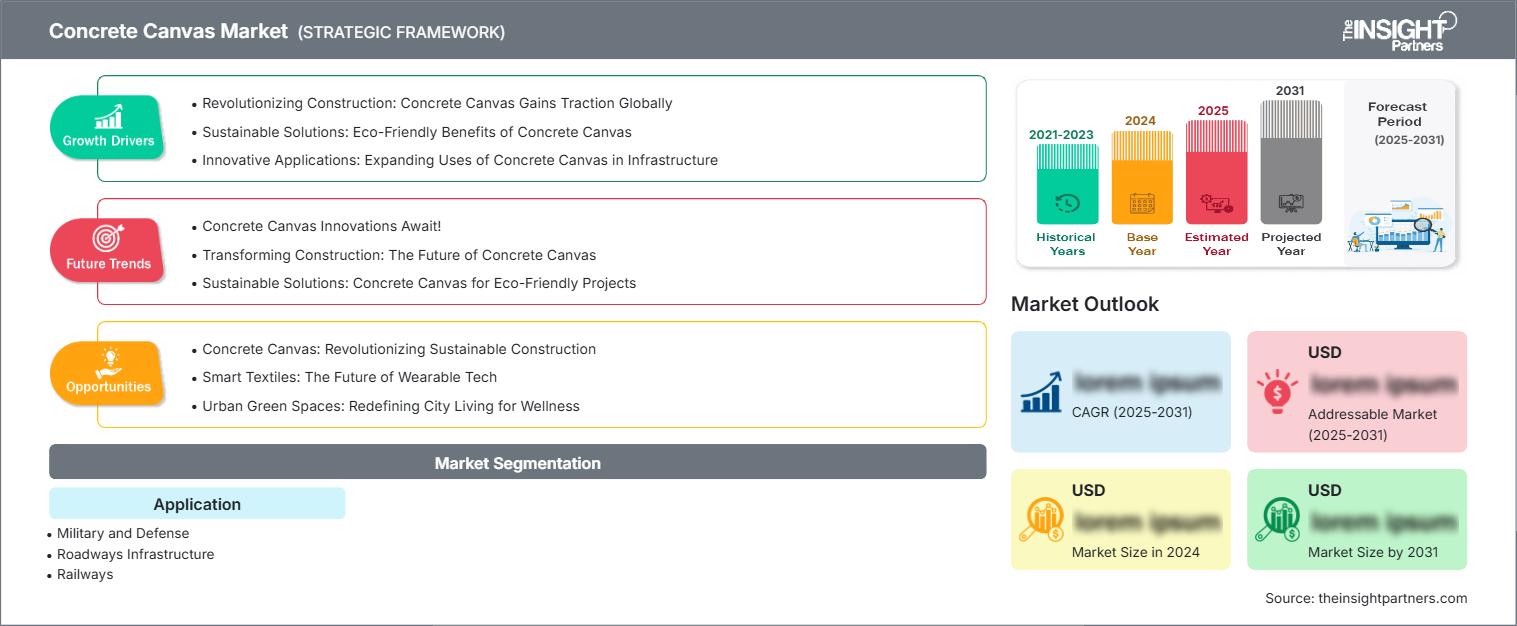
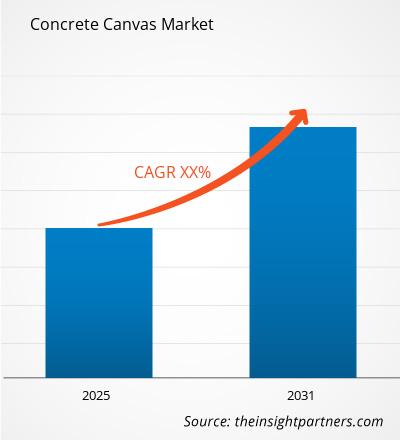
The Concrete Canvas Market is positioned as a specialized infrastructure materials market supporting erosion control, slope stabilization, drainage protection, and rapid surface hardening. The market is valued at US$ 159.50 million in 2025 and is projected to reach US$ 332.01 million by 2034, expanding at a CAGR of 8.49% from 2026 to 2034. Adoption is being supported by infrastructure rehabilitation, installation efficiency, and increasing preference for engineered surface protection systems.
In North America, Concrete Canvas Market size is supported by highway rehabilitation, drainage-channel protection, and asset-management programs emphasizing faster installation with reduced site disruption. The region is estimated to expand at a 6.8–7.6% CAGR between 2026 and 2034, supported by federal transportation funding, aging infrastructure, and demand for erosion-control systems that can be installed with comparatively limited conventional concrete works.
Concrete Canvas Market Assessment and Insights
- North America: The region is estimated to represent a 30–34% share in 2025 and expand at a 6.8–7.6% CAGR between 2026 and 2034, supported by highway rehabilitation, drainage protection, and infrastructure resilience programs.
- US: The US accounts for approximately 25–29% of North America in 2025, with growth of 6.7–7.5% CAGR between 2026 and 2034, driven by federally supported road, bridge, and drainage rehabilitation.
- Europe: Europe is estimated at a 27–31% share in 2025 and a 7.0–7.8% CAGR between 2026 and 2034, led by the UK, Germany, France, Italy, and Spain, where rail, road, canal, and environmental infrastructure programs support adoption.
- Asia Pacific: APAC represents an estimated 22–26% share in 2025 and is projected to grow at 9.0–10.0% CAGR between 2026 and 2034, with China, India, Japan, South Korea, and Australia providing diverse infrastructure opportunities.
- Largest Segment: Ditch Lining is estimated to hold a 42–47% market share in 2025 and expand at 8.0–8.8% CAGR between 2026 and 2034, reflecting recurring drainage and channel-protection applications.
- High Growth Segment: Slope Protection represents approximately 25–30% market share in 2025 and is projected to grow at 9.2–10.2% CAGR between 2026 and 2034, supported by erosion-control requirements.
- Key companies analyzed in detail: Concrete Canvas Ltd., Milliken & Company, NV Bekaert SA, The Euclid Chemical Company, Nycon, Sika Corporation, Geofabrics, Titan Environmental Containment Ltd., Sanbros Spares Private Limited (SSPL), and SPEC BUILT.
Source: The Insight Partners' analysis based on proprietary research, government publications, company annual reports, investor presentations, industry databases, and expert interviews.
Concrete Canvas Market development has progressed from conventional erosion-control applications toward engineered concrete geosynthetic systems capable of combining reinforcement, surface protection, and rapid installation. Controlled concrete loading, flexible composite materials, enhanced curing properties, and specialized formats have been the key areas of manufacturing development. This development is especially applicable in canals, drainage channels, embankments, slopes, and transport assets where regular cast-in-place concrete requires much preparation, formwork, curing time, and equipment usage.
Future growth will likely go beyond the existing European and North American markets into regions such as Asia Pacific and certain Middle Eastern countries characterized by extensive infrastructure needs. Procurement is becoming more dependent on lifecycle performance, installation time, environmental impact, and maintenance considerations. European transport policy also stresses resilient and sustainable networks of infrastructure, including modern railway connections and multimodal transport corridors, and thus supports the demand for engineered protection solutions for transport assets.
Concrete Canvas Market Report Scope
| Report Attribute | Details |
|---|---|
| Market size in 2025 | US$ 159.50 Million |
| Market Size by 2034 | US$ 332.01 Million |
| Global CAGR (2026 - 2034) | 8.49% |
| Historical Data | 2021-2024 |
| Forecast period | 2026-2034 |
Concrete Canvas Market Analysis
Infrastructure rehabilitation is a central demand catalyst because transportation corridors, drainage systems, canals, and embankments require durable surface protection while minimizing construction disruption. This supports Concrete Canvas Market growth across public works and private infrastructure contractors. The value chain includes composite material producers, concrete technology suppliers, distributors, engineering consultants, civil contractors, and asset owners. Demand is therefore influenced by project specifications, installation labor, transportation costs, and local availability.
The supply chain will still be governed by special manufacturing as opposed to mass concrete production. Competition in the industry will be on the basis of fabric engineering, cementitious blend, reinforcement structure, size of the rolls, curing attributes, and installation assistance. More often than not, contractors judge products on the basis of site convenience and quickness of installation, especially in cases where pumping, formwork, and heavy machinery use are problematic.
The competitive landscape in the Concrete Canvas Market share combines specialist GCCM producers with diversified construction-material companies. Concrete Canvas Ltd., on the other hand, achieves a unique position through its specialized concrete canvas technologies, whereas Sika Corporation provides construction chemicals expertise and a wide network of contractors. Milliken & Company and NV Bekaert SA are able to provide textile reinforcement technologies, while The Euclid Chemical Company contributes to the concrete and infrastructure sector. Geofabrics and Titan Environmental Containment Ltd. reinforce the geosynthetic and containment sector.
Investments in this business are being increasingly made in such strategic directions as sustainability, flexibility of production, application engineering and geographic extension. Investments of Sika in this regard show a general trend of construction materials companies towards localization of production and integration of technology, whereas Bekaert continues to innovate concrete reinforcement technologies. Competitive advantage will thus be shifting from material provision to engineering support, specification and technical verification of projects.
● REPORT CUSTOMIZATION
Tailor This Report To Align With Your Specific Business Requirements
This report can be customized to align precisely with your business objectives, scope, and target markets. Customization options include tailored segmentation, geography, competitive analysis, and strategic insights to support informed decision-making.
Customize This Report →WHAT YOU CAN ADJUST
- ● Segmentations
- ● Geography
- ● Competitive Analysis
- ● Language Preferences
Concrete Canvas Market: Strategic Insights
Regional Insights
North America Concrete Canvas Market
North America is estimated to hold a 30–34% share in 2025 and expand at a 6.8–7.6% CAGR through 2034. The USA is still the main center of demand due to the rehabilitation of highways, bridges, drainage systems, and water management. There are still federal programs that invest large funds in transportation infrastructure rehabilitation and in bridge rehabilitation and highway infrastructure. The environment is favorable for fast-installation protective materials.
The demand from Canada comes due to the maintenance of roadways, infrastructure for mining, drainage, and remote site construction. In terms of application trends, there is a preference for the use of ditch lining and slope protection when the logistics of concrete are difficult. It is important to consider installation time, traffic disruption, maintenance exposure, and environmental impact besides initial material cost.
U.S. Concrete Canvas Market
The U.S. represents approximately 82–86% of North America's 2025 share in the Concrete Canvas Market report and is expected to grow at a 6.7–7.5% CAGR through 2034. Demand is concentrated around roadway infrastructure, drainage channels, slope stabilization, bridge approaches, and water-management assets. Federal highway programs provide a significant structural foundation for rehabilitation expenditure, including bridge and freight-related infrastructure allocations.
Organizations such as Concrete Canvas Ltd, Sika Corporation, Milliken & Company, The Euclid Chemical Company, and specialized geosynthetic manufacturers are involved in the larger ecosystem directly or indirectly. Systems that simplify the process of installation are increasingly preferred in terms of application. Installation sites where there is limited access due to traffic management are one of those areas where the simplified system will be beneficial.
Europe Concrete Canvas Market
Europe is estimated to account for 27–31% of the global share in 2025 and is projected to grow at a 7.0–7.8% CAGR through 2034, according to the Concrete Canvas Market report. The UK represents the leading country, while regional demand is supported by transport-network modernization, water infrastructure maintenance, environmental protection requirements, and a growing emphasis on durable construction methods.
There is an existing ecosystem in the UK with respect to Concrete Canvas Ltd., which constitutes an essential reference market for GCCM applications. The demands can be driven by the following areas: canal lining, highway drainage systems, railway engineering, slope stabilization, and erosion control. Germany offers a combination of good road and rail engineering networks, along with stringent technical considerations in favor of proven systems.
APAC Concrete Canvas Market
The Concrete Canvas Market in APAC is estimated to represent 22–26% of the 2025 market and expand at a 9.0–10.0% CAGR through 2034, making it the fastest-growing major region. China is the biggest driver of regional demand; however, there are still other possibilities from India, Japan, South Korea, and Australia due to their road, railway, mining, drainage, and water infrastructure projects.
The process of industrialization and urbanization makes it necessary to have high-quality erosion and surface protection systems. The significant advantage of India is its large construction pipeline of roads and railways. Australia is fortunate because of its mining and remote infrastructure needs.
Middle East & Africa Concrete Canvas Market
The Concrete Canvas Market in the Middle East & Africa represents a smaller but expanding opportunity, supported by infrastructure diversification, water management, and transportation development. Saudi Arabia is at the top of the potential in the region, followed by the UAE and South Africa. The forecasted CAGR of regional market growth during 2019-2034 is 8.0-9.0%, driven by investment in infrastructure and the need for asset resilience.
Saudi Arabia and the UAE are represented by applications in roads, drainage, canals, industrial sites, and large developments, while South Africa includes transport and water infrastructure applications. High temperatures, shortage of water, erosion exposure, and poor construction sites may create additional value in protection systems. The Rest of MEA represents potential markets in the long term due to infrastructure upgrades.
Segmentation Analysis
Application
Application segmentation defines the principal use cases across infrastructure protection. The segment is expected to expand at a 8.3–9.1% CAGR from 2026 to 2034, supported by demand for rapid surface stabilization and lower-disruption construction. The Concrete Canvas Market scope is broadening as infrastructure owners evaluate installation productivity and lifecycle maintenance alongside conventional material costs.
- Ditch Lining: Ditch lining remains the largest application because drainage channels require durable hydraulic protection against erosion and washout. Flexible concrete systems are strategically useful where long channel lengths and difficult access increase conventional construction complexity.
- Slope Protection: Slope protection addresses erosion, runoff, and surface instability across transportation corridors, embankments, mining sites, and industrial assets. Adoption is strengthened where rapid stabilization can reduce exposure to weather-related deterioration.
- Bund Lining: Bund lining supports water retention and containment infrastructure by providing a hardened protective surface. Its strategic importance is increasing, where leakage control, maintenance reduction, and controlled installation are priorities for infrastructure operators.
End User
End-user demand is divided between transportation-related infrastructure owners and contractors. The segment is projected to expand at a 8.0–8.9% CAGR from 2026 to 2034, reflecting increased rehabilitation activity and demand for engineered construction methods. Procurement decisions increasingly emphasize asset durability, construction speed, and operational continuity.
- Roadways Infrastructure: Roadway infrastructure represents a major demand base because drainage channels, embankments, culverts, and roadside slopes require continuous erosion protection. Public infrastructure budgets and rehabilitation cycles support recurring procurement opportunities.
- Railways: Railways require stable slopes, drainage protection, and erosion-control measures around tracks and embankments. Concrete-based flexible protection systems can support maintenance programs where track access windows are constrained and disruption costs are high.
Opportunity Snapshot
| End User | Revenue Contribution | Trend Tag | Adoption Stage |
| Roadways Infrastructure | High | Drainage Protection | Scaling |
| Railways | Medium | Slope Stabilization | Scaling |
Concrete Canvas Market Growth Drivers and Impact Analysis
Expansion of Transportation Infrastructure Rehabilitation
Old infrastructure results in regular needs for drainage protection, embankment reinforcement, and erosion management. In America, the American government continues to allocate funds for bridges, freight routes, and highways, whereas in Europe, transport policy focuses on network efficiency and modernization. This results in a higher number of cases in which construction companies have to protect infrastructure, but at the same time not close the area for a long period of time. The economic effect is felt most strongly by those products that can be delivered quickly, installed quickly, and laid on uneven ground. Therefore, even under conditions in which new construction begins to decrease, the demand may grow due to the constant need to invest in maintenance.
Demand for Faster Installation at Constrained Sites
Construction productivity is increasingly becoming a more significant factor in making purchase decisions due to limitations on access windows, traffic management costs, and labor availability. Flexible concrete-based systems are able to solve problems that arise where conventional cast-in-place concrete is dependent on excavation, formwork, steel positioning, and curing time. Their significance is especially important in channels, steep banks, remote areas, and transport routes where machinery mobility is an issue. The effect is felt over the entire project duration due to the reduced indirect costs resulting from traffic management, supervision, machinery hire, and disruptions to the project’s operations. Manufacturers who are able to show their construction techniques, performance, and productivity for a particular project will be able to get ahead in tender evaluation processes.
Increasing Emphasis on Infrastructure Resilience and Environmental Protection
Weather-based rainfall variation, erosion risks, flooding, and infrastructure exposure have brought focus to resilient surface protection solutions. Agencies and infrastructure owners now view drainage capabilities, slope stability, and resistance to erosion as crucial elements for the resilience of infrastructure. The EU's TEN-T strategy has specifically focused on safety, resilience, and minimal environmental impact, reinforcing the overall trend in infrastructure acquisition. In terms of resilience demands, manufacturers now have the chance to market concrete canvas products as preventive infrastructure solutions rather than reactive repair tools. Environmental aspects will also play a part in adoption, in cases where there is less disruption and excavation, and efficient use of materials.
Concrete Canvas Market Future Trends
Integration of Digital Specification and Asset Monitoring
Concrete Canvas Market trends are likely to increasingly incorporate digital engineering tools that connect material specifications with project design, installation records, and asset-management platforms. Digital modeling can be used by contractors to compute the amount of coverage necessary, recognize the limitations in installation, and establish consistent procurement volumes prior to the commencement of any work. The suppliers can aid in such a transition by developing digital design databases, installation instructions, geographic databases for their projects, and engineering calculators for different applications. In the long run, digitized information could also enable infrastructure owners to keep track of the protected zones and schedule inspections based on the condition of the asset. Such an innovation would result in competition favoring firms offering both products and engineering knowledge.
Development of Lower-Impact Composite Protection Systems
Product innovation in the future will be directed towards the use of less invasive reinforcement and better cementitious blends, recycling of materials, and extended durability of the structures. It will involve the minimization of the materials used with the preservation of hydraulic performance, durability, and mechanical stability. The innovations made by Bekaert in the recycling of the steel-fiber reinforcement demonstrate the wider trend within the building materials industry towards circular use of the inputs and low-carbon reinforcement options. The same approach may be applied to flexible concrete materials with the help of new textile architecture and improved loading of the concrete.
Concrete Canvas Market Opportunities
Expansion into Emerging Infrastructure Rehabilitation Programs
The strongest commercial opportunity lies in expanding into infrastructure markets where road, rail, water, and mining assets are being developed faster than specialized maintenance capabilities. India, Southeast Asia, the Middle East, and selected African markets provide attractive conditions because contractors often face difficult terrain, seasonal rainfall, remote locations, and limited construction access. Concrete Canvas Market Forecasts can benefit from a specification strategy that targets engineering consultants and public agencies before tendering begins. Suppliers should develop local installation partners, region-specific design documentation, and demonstration projects that establish performance credibility. Regional manufacturing or finishing arrangements may further reduce logistics costs as volumes increase. Companies able to combine technical support with reliable project delivery can establish stronger positions than suppliers competing solely on material price.
Partnerships with Transportation and Water Infrastructure Contractors
Strategic partnerships with civil engineering contractors represent another opportunity because contractors directly influence material selection during rehabilitation projects. A partnership model can combine product supply, installation training, technical design assistance, and project documentation into a coordinated offering. Concrete Canvas Market opportunities are particularly relevant for companies seeking to enter countries where infrastructure agencies rely heavily on specialist contractors for maintenance. Manufacturers can prioritize contractors involved in highways, railways, canals, mining infrastructure, and water-management projects. Joint pilot projects can provide performance data and reference installations that support subsequent specifications. The model also creates feedback loops for product improvement because installation teams can identify challenges involving terrain, curing, access, material handling, and project scheduling.
Recent Developments
- February 2026: The government of Kyrgyzstan and British company Concrete Canvas signed an agreement to build a plant in Kyrgyzstan that will produce flexible concrete canvas. Concrete Canvas manufactures waterproof, flexible, concrete-filled geosynthetic composite mats, primarily used to line irrigation canals to prevent erosion and reduce seepage losses. The planned production capacity of the new plant is at least 5 million square meters of concrete canvas per year.
- August 2025: A new collaboration between Norcast Concrete Ltd. and the Meadow Lake Tribal Council Resource Development (MLTC RDI) representing nine member First Nations, announced the acquisition of Heidelberg Materials' ready-mix concrete operations in Meadow Lake, Saskatchewan. This acquisition was completed under Norcast ML Concrete Products LP, a majority Indigenous-owned entity. The transaction reflects a shared vision of advancing Indigenous economic development, strengthening regional infrastructure, and building long-term prosperity through local ownership and investment.
Frequently Asked Questions

- Comprehensive Market Sizing and Forecast Analysis
- Detailed Segmentation Analysis
- In-Depth Market Dynamics Assessment
- Regional and Country-Level Insights
- Competitive Landscape and Company Benchmarking
- Strategic Business Intelligence
Recent Reports
Testimonials

The Insight Partners provided valuable market intelligence that supported our global go-to-market strategy. Their team was professional, responsive, and attentive to our feedback, providing thoughtful analysis and helpful methodological clarifications throughout the project.
Junmo Kim Chief Financial Officer (CFO), Enertech Co., Ltd.
The Insight Partners' SCADA System Market report is comprehensive, with valuable insights on current trends and future forecasts. The team was highly professional, responsive, and supportive throughout. We are very satisfied and highly recommend their services.
RAN KEDEM Partner, Reali Technologies LTDs
I requested a report on a very specific software market and the team produced the report in a few days. The information was very relevant and well presented. I then requested some changes and additions to the report. The team was again very responsive and I got the final report in less than a week.
JEAN-HERVE JENN Chairman, Future Analytica
We worked with The Insight Partners for an important market study and forecast. They gave us clear insights into opportunities and risks, which helped shape our plans. Their research was easy to use and based on solid data. It helped us make smart, confident decisions. We highly recommend them.
PIYUSH NAGPAL Sr. Vice President, High Beam Global
The Insight Partners delivered insightful, well-structured market research with strong domain expertise. Their team was professional and responsive throughout. The user-friendly website made accessing industry reports seamless. We highly recommend them for reliable, high-quality research services
YUKIHIKO ADACHI CEO, Deep Blue, LLC.
This is the first time I have purchased a market report from The Insight Partners.While I was unsure at first, I visited their web site and felt more comfortable to take the risk and purchase a market report.I am completely satisfied with the quality of the report and customer service. I had several questions and comments with the initial report, but after a couple of dialogs over email with their analyst I believe I have a report that I can use as input to our strategic planning process.Thank you so much for taking the extra time and making this a positive experience.I will definitely recommend your service to others and you will be my first call when we need further market data.
JOHN SUZUKI President and Chief Executive Officer, Board Director, BK Technologies
I wish to appreciate your support and the professionalism you displayed in the course of attending to my request for information regarding to infectious disease IVD market in Nigeria. I appreciate your patience, your guidance, and the fact that you were willing to offer a discount, which eventually made it possible for us to close a deal. I look forward to engaging The Insight Partners in the future, all thanks to the impression you have created in me as a result of this first encounter.
DR CHIJIOKE ONYIA MANAGING DIRECTOR, PineCrest Healthcare Ltd.Reason to Buy
- Informed Decision-Making
- Understanding Market Dynamics
- Competitive Analysis
- Identifying Emerging Markets
- Customer Insights
- Market Forecasts
- Risk Mitigation
- Boosting Operational Efficiency
- Strategic Planning
- Investment Justification
- Tracking Industry Innovations
- Aligning with Regulatory Trends





 Get Free Sample for