
Conductive Picking Bins Market Share, Demand & Growth by 2034
Coverage: By Opening (Semi open front storage, Fully open front storage); Structure (Stackable, Non-stackable); End-Users (Workshops, Warehouses, Assembly Plants, Research Labs, Others) , and Geography (North America, Europe, Asia Pacific, and South and Central America)
- Status : Data Released
- Report Code : TIPRE00025596
- Category : Chemicals and Materials
- No. of Pages : 150
- Available Report Formats :


- Last update date : August 27, 2026


2025 Market Size
US$ 9.64 Bn
Base year value
2034 Forecast
US$ 16.02 Bn
Projected by 2034
CAGR 2026-2034
5.81 %
Growth rate
Addressable Market
US$ 116.29 Bn
(2026-2034)
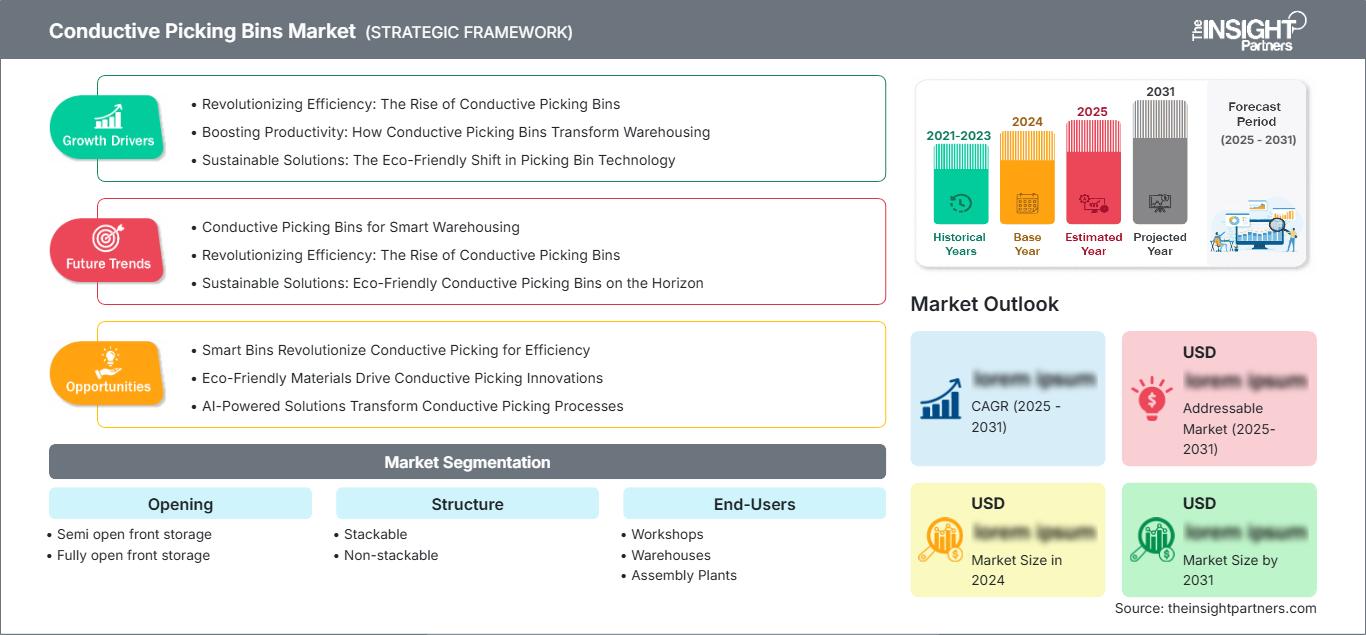
The Conductive Picking Bins Market is positioned as a specialized storage solution for electrostatic-sensitive components, combining controlled charge dissipation with rapid part access. The market is valued at US$ 9.64 Billion in 2025 and is projected to reach US$ 16.02 Billion by 2034, expanding at a CAGR of 5.81% during 2026–2034. Demand is supported by electronics manufacturing, industrial assembly, and increasingly organized warehouse operations requiring ESD-safe component handling.
North America remains an important demand center because electronics production, aerospace programs, medical-device manufacturing, and automated distribution require disciplined ESD control. The Conductive Picking Bins Market size is expected to expand at a 5.6–6.1% CAGR from 2026–2034, supported by semiconductor capacity additions and modernization of industrial storage. Wider adoption of IEC 61340-5-1-aligned practices should reinforce replacement demand and specification-driven purchasing.
Conductive Picking Bins Market Assessment and Insights
- North America: The region represented a 30–34% share in 2025 and is expected to grow at a 5.6–6.1% CAGR between 2026–2034, supported by electronics, aerospace, medical-device, and industrial production requirements.
- US: The US accounted for 82–86% of North America's 2025 demand and is projected to expand at a 5.5–6.0% CAGR between 2026–2034, led by semiconductor and advanced manufacturing investment.
- Europe: Europe held a 25–29% share in 2025 and is projected to grow at a 4.0–4.5% CAGR between 2026–2034, with Germany, the UK, France, Italy, and Spain supporting electronics, automotive, engineering, and industrial demand.
- Asia Pacific: Asia Pacific represented a 28–32% share in 2025 and is expected to grow at a 6.3–6.8% CAGR between 2026–2034, led by China, Japan, South Korea, India, and electronics-oriented manufacturing clusters.
- Largest Segment: Warehouses represented a 32–36% market share in 2025 and are expected to grow at a 6.2–6.7% CAGR during 2026–2034, reflecting structured component storage needs.
- High Growth Segment: Assembly Plants represented an 18–22% market share in 2025 and are projected to grow at a 6.8–7.4% CAGR during 2026–2034, driven by point-of-use component handling.
- Key companies analyzed in detail: Antistatic ESD, Bondline Electronics Ltd, Correct Products, Inc., FAMI S.r.l., GWP Conductive, Nilkamal Limited, Quantum Storage Systems, Rapid Racking Ltd, United States Plastic Corporation, and VODEX Ltd.
Source: The Insight Partners' analysis based on proprietary research, government publications, company annual reports, investor presentations, industry databases, and expert interviews.
The Conductive Picking Bins Market has evolved from basic plastic component storage toward purpose-designed ESD handling systems incorporating conductive polymers, static-dissipative grades, standardized dimensions, dividers, labels, and rail-mounted configurations. Increasing focus is being placed on electrical uniformity, dimensionality, and workstation and shelving compatibility. Molded and conductive corrugated materials are available from suppliers that permit customers to select between options based on toughness, weight, customizability, and reusability in both electronic and industrial settings.
In terms of future outlook, there is anticipated demand growth due to electronics localization, investments into semiconductors, warehouse updates, and control over electrostatic sensitive devices. The APAC region is expected to increase its market share because of the development of manufacturing ecosystems, whereas the demand for North America will continue to be driven by specifications.
Conductive Picking Bins Market Report Scope
| Report Attribute | Details |
|---|---|
| Market size in 2025 | US$ 9.64 Billion |
| Market Size by 2034 | US$ 16.02 Billion |
| Global CAGR (2026 - 2034) | 5.81% |
| Historical Data | 2021-2024 |
| Forecast period | 2026-2034 |
Conductive Picking Bins Market Analysis
Demand is closely linked to the expanding number of components requiring controlled handling from receiving through assembly. The Conductive Picking Bins Market growth is supported by electronics, automotive electronics, aerospace, medical devices, and industrial automation, where component damage can create rework and traceability costs. The value chain is composed of polymer suppliers, molders, converters, distributors, storage system manufacturers, and the end users.
Fragmentation exists in the supply due to the nature of bins, which can be standardized when there is high demand or customized depending on size, mounting, dividing and weight of load. Conductive polypropylene is still applicable where there is frequent handling and cleaning, whereas conductive corrugated is applicable for lighter and more customized applications. The procurement process now looks at surface resistance and other qualities instead of the unit price.
Competitive positioning combines product breadth, material expertise, customization, distribution reach, and ESD compliance knowledge. The Conductive Picking Bins Market analysis considers specialist suppliers, including Antistatic ESD, Bondline Electronics Ltd, Correct Products, Inc., and GWP Conductive, alongside FAMI S.r.l., Quantum Storage Systems, Rapid Racking Ltd, and Nilkamal Limited. United States Plastic Corporation and VODEX Ltd add specialist distribution and ESD-handling capabilities.
Capital investment has been made in catalog expansion, e-commerce orders, scalable storage solutions, and regional distribution. Correct Products has expanded its range of ESD storage, and Quantum Storage Systems still markets itself by emphasizing the broad availability of SKUs. The larger material handling manufacturers have opportunities to bundle bins with shelving, racking, carts, and workstations, but specialty suppliers do so with electricity options and formats.
● REPORT CUSTOMIZATION
Tailor This Report To Align With Your Specific Business Requirements
This report can be customized to align precisely with your business objectives, scope, and target markets. Customization options include tailored segmentation, geography, competitive analysis, and strategic insights to support informed decision-making.
Customize This Report →WHAT YOU CAN ADJUST
- ● Segmentations
- ● Geography
- ● Competitive Analysis
- ● Language Preferences
Conductive Picking Bins Market: Strategic Insights
Regional Insights
North America Conductive Picking Bins Market
North America is estimated at a 30–34% share of the Conductive Picking Bins Market of 2025 global demand and is expected to grow at a 5.6–6.1% CAGR through 2034. The US dominates regional consumption, supported by semiconductor, aerospace, medical-device, automotive-electronics, and industrial automation activity. Canada contributes through electronics, aerospace, and advanced manufacturing clusters. Buyers typically specify permanent conductive or static-dissipative performance where components move repeatedly through protected production areas.
Structural demand also comes from warehouse redesign and point-of-use storage. ESD programs aligned with IEC 61340-5-1 encourage controlled storage, identification, grounding, and material compatibility. The region's mature distributor network supports rapid replenishment, while domestic and nearshore manufacturing reduces lead-time sensitivity for customized bins. Replacement demand is strengthened by damaged, contaminated, or mechanically worn containers, particularly in facilities where repeated handling makes durability and cleanability important purchasing criteria. The Conductive Picking Bins Market share therefore, remains concentrated in advanced manufacturing applications.
U.S. Conductive Picking Bins Market
The US accounts for 82–86% of the North American Conductive Picking Bins Market demand in 2025 and is projected to expand at a 5.5–6.0% CAGR. The semiconductor fabrication facilities, electronics assembly, aerospace, defense, medical equipment, and automation industries generate high demand for bins that provide an ESD safe environment for their components. Standardized bin sizes are preferred in production facilities that make use of such bins in their shelving, stations, carts, and visual inventory systems.
Product adoption is highest where the small parts are often transferred between inventory and production. Both United States Plastic Corporation and Correct Products, Inc. cater to the general demands of ESD safe bins, whereas Quantum Storage Systems provides industrial bins that support the organization of small parts. Modern warehouses and assembly lines make use of hanging, stacking, and shelving bins, thereby placing the frequently picked-up parts near the production process.
Europe Conductive Picking Bins Market
Europe held a 25–29% share of the Conductive Picking Bins Market in 2025 and is forecast to expand at a 4.0–4.5% CAGR, with Germany representing the leading national market. Demand comes from automotive electronics, industrial machinery, aerospace, medical devices, and electronics clusters. Special emphasis has to be placed on demand from the UK and Germany for specialist ESD storage, engineering, and distribution purposes.
The specialist UK market comprises a well-developed ESD ecosystem made up of ESD providers, distributors of industrial storage, and electronic components makers. The German market involves the latest automotive and industrial manufacturing and high engineering standards. French, Italian, and Spanish markets provide additional demand from aerospace, automotive, machinery, electronics, and industrial reconditioning sectors. FAMI S.r.l. boosts the special industrial furnishing industry in Italy, whereas Rapid Racking Ltd caters to the storage needs of the UK market.
APAC Conductive Picking Bins Market
Asia Pacific represented a 28–32% share of the Conductive Picking Bins Market in 2025 and is expected to grow at a 6.3–6.8% CAGR, making it the fastest-growing major region. China leads regional demand, followed by Japan, South Korea, India, and Australia. Electronics, semiconductors, automotive electronics, and industrial automation are central applications.
An industrial policy that is favorable to the localization and manufacturing of electronics should result in higher needs for ESD storage. China, Japan, and South Korea will have an advantage due to their close proximity to the electronics industry and India is developing its electronics industry and organized storage facilities. The contribution of Australia will come from mining equipment and electronics service centers.
Middle East & Africa Conductive Picking Bins Market
The Middle East and Africa Conductive Picking Bins Market is projected to expand at a 4.4–5.0% CAGR, with Saudi Arabia and the UAE leading regional demand. Electronics assembly, industrial maintenance, logistics, energy-related equipment, and emerging manufacturing zones support adoption. South Africa remains an important industrial market because of its automotive and engineering base.
The UAE benefits from logistics infrastructure and re-export activity, while Saudi Arabia's industrial diversification supports warehouse and manufacturing investment. South Africa contributes through established industrial operations, with the rest of MEA representing smaller but developing opportunities. Energy and infrastructure projects can create demand for organized component storage where electronic controls and instrumentation require protected handling.
Segmentation Analysis
Opening
Opening is expected to expand at a 5.3–5.9% CAGR during 2026–2034. Opening design determines accessibility, visual identification, picking speed, and compatibility with shelving or rails. Semi-open formats support controlled access while retaining protection around stored parts, whereas fully open designs prioritize rapid retrieval. Selection therefore, depends on component dimensions, picking frequency, workstation layout, and the degree of physical containment required. This defines an important part of the Conductive Picking Bins Market scope.
- Semi-open front storage: Supports organized access while retaining partial side and rear containment, making it suitable for component-heavy workstations where visibility and controlled handling must coexist.
- Fully open front storage: Maximizes direct access for frequent picking and replenishment, particularly where operators repeatedly handle small parts and need unobstructed visibility during assembly tasks.
Structure
Structure is projected to grow at a 5.6–6.2% CAGR through 2034. Structural design affects storage density, load stability, handling ergonomics, and facility layout. Stackable systems suit compact inventory footprints and modular workstation designs, while non-stackable formats can be preferable where rail mounting, shelf access, or frequent repositioning takes priority. Demand increasingly favors standardized footprints compatible with existing material-handling infrastructure.
- Stackable: Provides vertical storage efficiency and supports modular inventory organization, making it strategically important for warehouses and workshops seeking greater component density without expanding floor area.
- Non-stackable: Enables flexible shelf, wall, or workstation placement and is useful when direct accessibility, dedicated mounting, or rapid component movement is more important than vertical stacking.
End-Users
End-users are expected to expand at a 6.0–6.6% CAGR during 2026–2034. Warehouses represent the largest demand pool because they manage high volumes of small components across receiving, storage, kitting, and replenishment. Assembly plants are the fastest-growing application, supported by point-of-use inventory and ESD-controlled production. Workshops and research labs provide a smaller but specification-sensitive demand.
- Workshops: Require compact, accessible component storage near benches and repair stations, with ESD protection helping reduce handling risks during electronics repair, maintenance, prototyping, and low-volume assembly.
- Warehouses: Generate the greatest demand because bins support SKU segregation, visual identification, picking efficiency, and controlled movement of static-sensitive components across inventory and replenishment processes.
- Assembly Plants: Offer the strongest growth opportunity as manufacturers bring components closer to production cells, increasing the need for repeatable ESD performance, ergonomic access, and standardized replenishment systems.
- Research Labs: Use conductive bins for controlled storage of prototypes, electronic parts, sensors, and specialized components where small quantities and high component sensitivity make organized handling particularly important.
Opportunity Snapshot
| End-Users | Revenue Contribution | Trend Tag | Adoption Stage |
| Workshops | Medium | Bench Access | Scaling |
| Warehouses | High | SKU Control | Mature |
| Assembly Plants | High | Point-of-Use | Scaling |
| Research Labs | Low | Prototype Storage | Emerging |
Conductive Picking Bins Market Growth Drivers and Impact Analysis
Expansion of electronics and semiconductor manufacturing
Semiconductor, electronics, automotive-electronics, and medical device manufacturing create increased static-sensitive parts flowing through receiving, kitting, testing, assembly, and repair processes. Additional production cells create an additional need for dedicated storage at the point of use. The commercial opportunity is not limited to new bins since existing installations must replace contaminated, damaged, and electrically inappropriate bins as well. Manufacturers who can demonstrate proven resistance performance, standard dimensional attributes, and appropriate accessory offerings have an easier time getting into the specification-based purchasing process. Localization programs for manufacturing operations in North America, Europe, and the Asia Pacific Region further increase the market opportunity. As manufacturing automation increases, standardized bins can help standardize operator, cart, and automated handling interfaces.
Warehouse modernization and higher inventory organization requirements
Warehouses of today place increasing importance on the visibility of SKUs, small storage capacity, fast picking, and replenishment. The use of conductive bins makes sense under these conditions when it comes to protecting small electronic, electrical, and precision parts from static charge and their quick identification. The impact on the market will be greatest when it comes to warehouses utilizing modular shelving, flow racks, workstations, and kitting stations, since the size of the bins could be standardized in different storage areas. By placing more commonly used parts nearer to the production or picking areas, warehouse managers will also minimize movements that do not add any value. This way, there will be a chance for suppliers of rails, labels, dividers, carts, and shelving compatible with the bins, but not just the bins themselves.
Stronger emphasis on ESD process discipline and component protection
Electrostatic controls are now being considered in terms of process requirements rather than as mere packaging considerations. IEC 61340-5-1 gives guidance for electrostatic protected areas, suggesting that companies consider controlling material, personnel actions, ground systems, storage, and handling practices. Therefore, the value of containers whose electrical performance is known and predictable becomes more important, as does their ability to be reused. Consumers are now able to assess surface resistivity, decay properties, durability, labeling, and compatibility with the overall ESD system. The business impact will be that the move away from inexpensive standard plastic containers and towards more technical items with well-defined specifications will continue. Companies that supply documentation, education, and ESD storage systems will see increased sales opportunities, especially those in electronics, aerospace, medical, and other high-tech manufacturing facilities.
Conductive Picking Bins Market Future Trends
Material circularity and permanent conductive performance
The Conductive Picking Bins Market trends are likely to prioritize longer service life, recyclable materials, and stable electrical performance over repeated handling cycles. Environmental benefits of manufacturing companies will be realized through the use of strong polypropylene, recyclable conductive corrugated substrates, and reusable accessory components, as opposed to the disposable storage systems. There is also going to be an increased usage of permanent conductive materials in situations where the reliability of performance for the full period of time that the container is in use is required. Fewer combinations of materials are going to be used in product design, making recycling of products easy when the container reaches its end of life. Companies that measure durability, recyclability, and electrical stability are bound to have an edge over their competitors in the environmentally based procurement programs.
Digitally organized bins for connected inventory systems
The next stage of development involves linking up the physical bin arrangement with digital tracking methods. The use of QR code labeling, bar code labels, RFID-capable identification, and electronic shelf labeling technology could enable users to relate each bin to a component part number, location, restock level, or work order number. Conductive properties are still critical since digital identification does not solve the problem of electrostatic discharge hazard. Rather, the use of connected bins would enhance traceability while maintaining static protection capabilities. The connection with warehouse management and manufacturing execution system could enable automatic replenishment signals and improved component genealogy. Suppliers would be able to stand out by offering modular identification components, a uniform size, and compatibility with existing digital systems. This solution would probably start being used in high-value electronic products and semiconductor production before moving to industrial warehouses in general.
Conductive Picking Bins Market Opportunities
Localized supply for fast-growing electronics manufacturing clusters
Regional manufacturing expansion creates an opportunity for suppliers to establish localized production, stocking, or distribution in high-growth electronics clusters. Asia Pacific offers particularly attractive conditions because China, South Korea, Japan, and India combine large electronics ecosystems with expanding industrial capacity. North American reshoring and European supply-chain diversification also create opportunities for shorter lead times and lower logistics exposure. A localized model can combine standard high-volume bins with regional customization for dimensions, dividers, labels, and mounting systems. Manufacturers should prioritize partnerships with industrial distributors, shelving integrators, electronics suppliers, and ESD consultants rather than relying solely on direct online sales. This approach can improve specification visibility and help suppliers secure recurring replenishment contracts from multi-site manufacturing customers.
Integrated ESD storage systems for automated facilities
The Conductive Picking Bins Market Forecasts indicate an opportunity to move from individual bin sales toward integrated storage solutions combining bins, racks, carts, workstations, labels, and ESD accessories. Automated and semi-automated facilities require consistent interfaces between storage locations and material movement processes. Suppliers can capture additional value by designing bin dimensions and mounting arrangements around specific shelving or workstation architectures. Custom engineering is particularly relevant for electronics assembly plants, laboratories, and high-mix warehouses where standard containers may not fully match component geometry or process flow. Strategic investments in modular product families, configuration software, digital catalogs, and technical support can improve order conversion. Over time, integrated solutions may also create recurring revenue through replacement accessories, expansion modules, inspections, and facility redesign projects.
Recent Developments
- February 2026: ORBIS Corporation, a global leader in reusable packaging solutions,has acquired Robinson Industries, a recognized pioneer in thermoforming. ORBIS said the move expands its manufacturing capabilities and accelerates its ability to deliver sustainable packaging solutions across global supply chains.
- July 2025: Nilkamal Limited partnered with SILA to launch material-handling equipment rental solutions, extending its presence across manufacturing and warehousing applications. The initiative introduced an all-electric equipment fleet and reflects broader development of scalable material-handling offerings around organized logistics operations in India.
Frequently Asked Questions

- Comprehensive Market Sizing and Forecast Analysis
- Detailed Segmentation Analysis
- In-Depth Market Dynamics Assessment
- Regional and Country-Level Insights
- Competitive Landscape and Company Benchmarking
- Strategic Business Intelligence
Recent Reports
Testimonials

The Insight Partners' SCADA System Market report is comprehensive, with valuable insights on current trends and future forecasts. The team was highly professional, responsive, and supportive throughout. We are very satisfied and highly recommend their services.
RAN KEDEM Partner, Reali Technologies LTDs
I requested a report on a very specific software market and the team produced the report in a few days. The information was very relevant and well presented. I then requested some changes and additions to the report. The team was again very responsive and I got the final report in less than a week.
JEAN-HERVE JENN Chairman, Future Analytica
We worked with The Insight Partners for an important market study and forecast. They gave us clear insights into opportunities and risks, which helped shape our plans. Their research was easy to use and based on solid data. It helped us make smart, confident decisions. We highly recommend them.
PIYUSH NAGPAL Sr. Vice President, High Beam Global
The Insight Partners delivered insightful, well-structured market research with strong domain expertise. Their team was professional and responsive throughout. The user-friendly website made accessing industry reports seamless. We highly recommend them for reliable, high-quality research services
YUKIHIKO ADACHI CEO, Deep Blue, LLC.
This is the first time I have purchased a market report from The Insight Partners.While I was unsure at first, I visited their web site and felt more comfortable to take the risk and purchase a market report.I am completely satisfied with the quality of the report and customer service. I had several questions and comments with the initial report, but after a couple of dialogs over email with their analyst I believe I have a report that I can use as input to our strategic planning process.Thank you so much for taking the extra time and making this a positive experience.I will definitely recommend your service to others and you will be my first call when we need further market data.
JOHN SUZUKI President and Chief Executive Officer, Board Director, BK Technologies
I wish to appreciate your support and the professionalism you displayed in the course of attending to my request for information regarding to infectious disease IVD market in Nigeria. I appreciate your patience, your guidance, and the fact that you were willing to offer a discount, which eventually made it possible for us to close a deal. I look forward to engaging The Insight Partners in the future, all thanks to the impression you have created in me as a result of this first encounter.
DR CHIJIOKE ONYIA MANAGING DIRECTOR, PineCrest Healthcare Ltd.Reason to Buy
- Informed Decision-Making
- Understanding Market Dynamics
- Competitive Analysis
- Identifying Emerging Markets
- Customer Insights
- Market Forecasts
- Risk Mitigation
- Boosting Operational Efficiency
- Strategic Planning
- Investment Justification
- Tracking Industry Innovations
- Aligning with Regulatory Trends





 Get Free Sample for