
Construction Fabrics Market Share, Demand & Growth by 2034
Coverage: by Material (PVC, PTFE, ETFE, Others); Application (Tensile Architecture, Awnings and Canopies, Facades, Others) , and Geography (North America, Europe, Asia Pacific, and South and Central America)
- Status : Data Released
- Report Code : TIPRE00008568
- Category : Chemicals and Materials
- No. of Pages : 150
- Available Report Formats :


- Last update date : August 27, 2026


2025 Market Size
US$ 5.65 Bn
Base year value
2034 Forecast
US$ 8.66 Bn
Projected by 2034
CAGR 2026-2034
4.86 %
Growth rate
Addressable Market
US$ 64.95 Bn
(2026-2034)
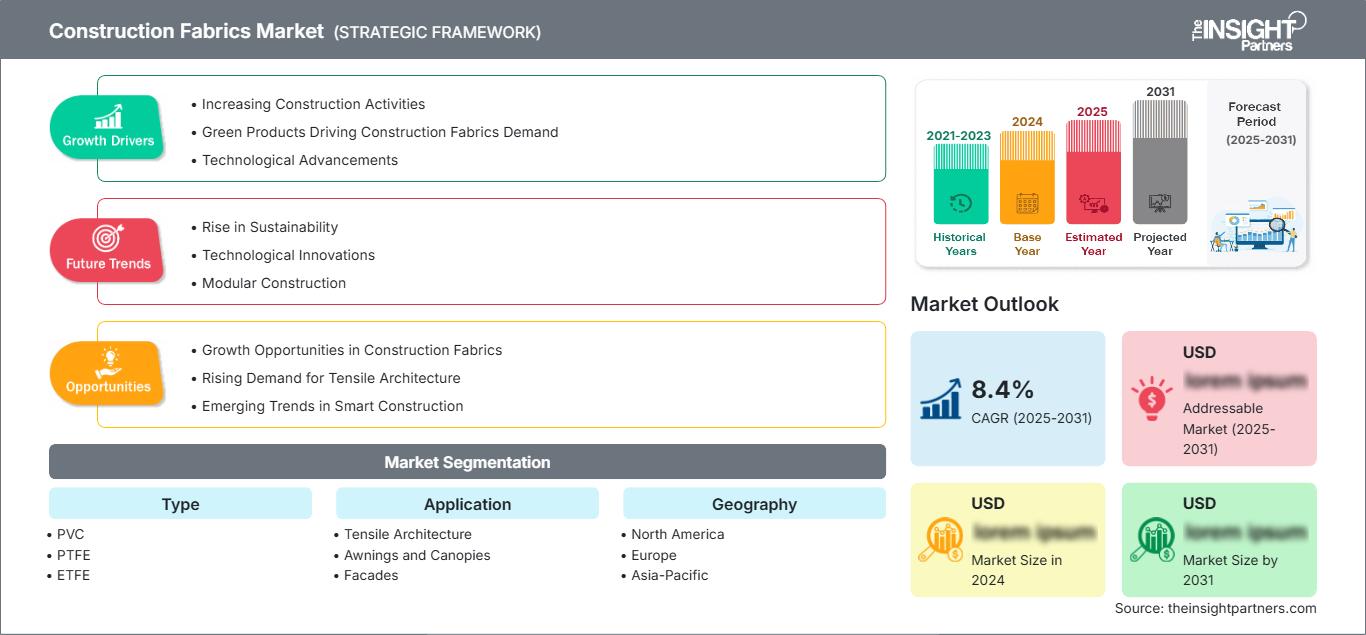
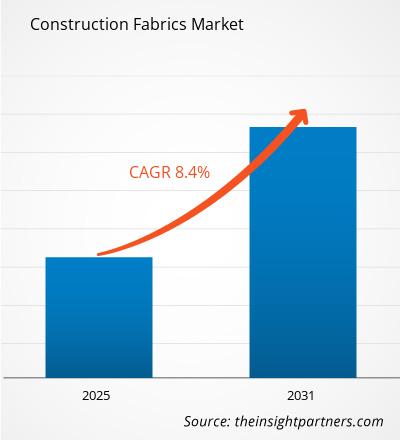
The Construction Fabrics Market was valued at US$ 5.65 Billion in 2025, and it is projected to reach US$ 8.66 Billion by 2034, advancing at a CAGR of 4.86% during 2026–2034. Demand is supported by durable coated fabrics, transparent ETFE systems, and greater acceptance of tensile construction for large-span, visually distinctive spaces.
The Construction Fabrics Market Size in North America is expected to record a 4.5–5.2% CAGR through 2034, supported by renovation of stadiums, transport facilities, retail environments, and public spaces. The construction fabrics' size is also influenced by demand for solar-shading systems and lightweight roofing solutions that can reduce structural loads while meeting durability and weather-resistance requirements.
Construction Fabrics Market Assessment and Insights
- North America: The region is estimated to represent 21–24% share in 2025 and expand at a 4.5–5.2% CAGR between 2026–2034, supported by commercial renovation, sports venues, transit projects, and solar-control applications.
- US: The US represents 16–19% share in 2025 and is expected to grow at a 4.6–5.3% CAGR during 2026–2034, led by public venues, retail, and transportation infrastructure.
- Europe: Europe accounts for 19–22% share in 2025 and is projected to grow at a 4.2–4.9% CAGR, with Germany, France, Italy, Spain, and the UK supporting architectural membrane demand.
- Asia Pacific: Asia Pacific holds 42–45% share in 2025 and is projected to grow at a 5.2–6.0% CAGR, led by China, Japan, India, South Korea, and Australia through infrastructure and urban-development programs.
- Largest Segment: PVC is the largest type, with a 45–50% market share in 2025 and a 4.2–5.0% CAGR during 2026–2034, reflecting broad cost-performance advantages.
- High Growth Segment: ETFE is the high-growth type, holding a 10–14% market share in 2025 and expanding at a 7.8–9.0% CAGR during 2026–2034, supported by daylighting and lightweight design.
- Key companies analyzed in detail: Ashland Global Holdings Inc., BASF SE, MAPEI S.p.A., Linde plc, Sika AG, Fosroc, Inc., Compagnie de Saint-Gobain S.A., Pidilite Industries Limited, Choksey Chemicals Pvt. Ltd., RPM International Inc., Dow Chemical Company, MBCC Group, H.B. Fuller Company, LATICRETE International, Inc., Oriental Yuhong, MC-Bauchemie.
Source: The Insight Partners' analysis based on proprietary research, government publications, company annual reports, investor presentations, industry databases, and expert interviews.
The market has grown beyond traditional coated fabric systems into engineered membrane systems that have better dimensional stability, durability against the elements, translucency, and accuracy in manufacture. While PVC is vital for commercial constructions, PTFE and ETFE cater to more sophisticated needs. Manufacturers are incorporating polymer processing, reinforcement, coating, welding, and architectural design skills to produce advanced systems.
The Construction Fabrics Market Report indicates that forward-looking development is likely to concentrate on Asia Pacific and Gulf construction programs, where transport hubs, sports facilities, tourism assets, and public spaces create opportunities for lightweight structures. Environmental product declarations, recycling initiatives, and energy-performance considerations are also influencing material selection. These factors should encourage suppliers to strengthen technical documentation, lifecycle assessment capabilities, and regional fabrication partnerships.
Construction Fabrics Market Report Scope
| Report Attribute | Details |
|---|---|
| Market size in 2025 | US$ 5.65 Billion |
| Market Size by 2034 | US$ 8.66 Billion |
| Global CAGR (2026 - 2034) | 4.86% |
| Historical Data | 2021-2024 |
| Forecast period | 2026-2034 |
Construction Fabrics Market Analysis
The construction fabrics growth is closely tied to large-span construction, outdoor shading, transport infrastructure, and architectural projects where low dead weight and rapid installation can improve structural economics. Textile suppliers offer either coated fabrics or fluoropolymer films, whereas the converters, structural engineers, fabricators, and specialized installers decide upon the performance of the projects. As such, demand relies not only on the type of materials but also on the presence of design skills.
The value chain focuses on coating uniformity, welding accuracy, translucence, fire safety, and life cycle. PVC is crucial in conventional uses due to the combination of elasticity and affordability that comes with polyester substrate and coating. PTFE and ETFE have a more sophisticated role since their use can be justified by their life cycle or other factors.
The Construction Fabrics Market Forecast suggests that forward-looking development is likely to concentrate on Asia Pacific and Gulf construction programs, where transport hubs, sports facilities, tourism assets, and public spaces create opportunities for lightweight structures. The effect of EPDs, recycling programs, and energy performance is also having an impact on materials selection. This must push suppliers to improve their technical support, life cycle assessment skills, and regional manufacturing partnerships.
Increasing investment is going into membrane performance, recyclability, environmental product declarations, and digital design services. Chukoh Chemical Industries has improved transparency on the environmental impacts of architectural membrane products, while specialist suppliers keep developing lightweight roofs and membrane structures. It means that strategic suppliers now compete by providing engineering services, certification, applicability, and regional fabrication partnerships.
● REPORT CUSTOMIZATION
Tailor This Report To Align With Your Specific Business Requirements
This report can be customized to align precisely with your business objectives, scope, and target markets. Customization options include tailored segmentation, geography, competitive analysis, and strategic insights to support informed decision-making.
Customize This Report →WHAT YOU CAN ADJUST
- ● Segmentations
- ● Geography
- ● Competitive Analysis
- ● Language Preferences
Construction Fabrics Market: Strategic Insights
Regional Insights
North America Construction Fabrics Market
North America represents 21–24% of the Construction Fabrics Market share in 2025 and is expected to grow at a 4.5–5.2% CAGR through 2034. The region benefits from renovation of aging public assets, expansion of sports and entertainment venues, and the demand for lightweight roofing and shading systems. The US remains the principal regional market, while Canada supports specialized commercial and institutional projects.
Regional demand is also influenced by factors such as climate vulnerability, fire performance considerations, and durability of external applications. Cost-effective membrane solutions such as coated-polyester PVC continue to be ideal for less expensive canopy and tensile roof structures, while PTFE and ETFE are more suitable for premium transport, stadium, and public buildings. Membrane structures also ensure repeat business due to the need for maintenance and renewal of assets.
U.S. Construction Fabrics Market
The Construction Fabrics Market Trends indicate that the US accounts for 16–19% of the Construction Fabrics Market share in 2025, equivalent to roughly three-quarters of North American demand, and is projected to grow at a 4.6–5.3% CAGR through 2034. The market includes established suppliers, specialist fabricators, structural consultants, and installation contractors serving sports, transportation, commercial, and institutional projects.
Application patterns increasingly favor daylighting, solar protection, and flexible covered spaces. PVC fabrics remain important for awnings, canopies, and tensile roofs, while PTFE-coated fiberglass and ETFE systems are specified for large-span projects requiring higher durability or transparency. Renovation of stadium roofs, transit facilities, airports, and public spaces provides a diversified project base, reducing reliance on new residential construction.
Europe Construction Fabrics Market
Europe holds 19–22% of the Construction Fabrics Market share in 2025 and is expected to expand at a 4.2–4.9% CAGR through 2034. Germany is a leading market, supported by engineering capability and technical-textile production, while France, Italy, Spain, and the UK contribute through architectural renovation and public infrastructure.
The UK and Germany provide important demand centers. UK projects emphasize weather protection, public-realm improvements, sports facilities, and commercial shading, while German demand benefits from advanced engineering, technical textile manufacturing, and high-performance requirements. France, Italy, and Spain add demand through transportation, tourism, retail, and civic architecture, with tensile roofs and façade systems supporting visually distinctive developments.
APAC Construction Fabrics Market
The Construction Fabrics Market in APAC holds 42–45% share in 2025 and is projected to grow at a 5.2–6.0% CAGR, making it the leading regional market. China leads, while Japan, South Korea, India, and Australia contribute through urban infrastructure, stadiums, transport hubs, and commercial projects.
Industrial expansion and public investment support large membrane structures, while building-efficiency policies encourage daylighting and solar-control solutions. China provides the largest project base, whereas India is a faster-growing market within APAC. Japan has advanced membrane engineering capabilities, South Korea supports high-quality architectural projects, and Australia has sustained demand for shading and outdoor public-space applications.
Middle East & Africa Construction Fabrics Market
The Construction Fabrics Market in the Middle East & Africa is a smaller but project-intensive market, with growth expected at a 4.8–5.6% CAGR through 2034. Saudi Arabia is the leading country, followed by the UAE and South Africa, with major projects emphasizing public venues, tourism, transport, and outdoor climate protection.
Energy-intensive construction environments increase interest in solar shading, durable coatings, and lightweight structures that reduce structural loads. Saudi Arabia and the UAE provide large-scale architectural opportunities, while South Africa contributes through commercial and infrastructure projects. The rest of MEA demand remains more selective and is concentrated around hospitality, transport, industrial shelters, and public facilities.
Segmentation Analysis
Type
The Construction Fabrics Market is significantly influenced by Type, which is a core determinant of performance, cost, fabrication method, and project positioning. The segment is projected to grow at a 4.2–6.0% CAGR during 2026–2034. The construction fabrics scope increasingly spans mainstream PVC systems and premium fluoropolymer membranes, with specification decisions balancing service life, transparency, cleanability, fire behavior, and structural requirements.
- PVC: PVC-coated polyester remains the broadest commercial solution because it combines flexibility, weather resistance, fabrication ease, and comparatively accessible pricing. It is widely specified for tensile roofs, awnings, canopies, temporary structures, and selected façade applications.
- PTFE: PTFE-coated fiberglass targets demanding permanent structures where long service life, ultraviolet resistance, low surface adhesion, and dimensional stability are important. Its positioning is strongest in stadiums, airports, exhibition venues, and other large-span architectural projects.
- ETFE: ETFE provides high light transmission, low weight, and strong resistance to environmental exposure. Its strategic importance is increasing in transparent roofs, cushions, façades, and daylight-oriented structures where architects seek large glazed effects with lower structural mass.
Application
The Construction Fabrics Market application segment is projected to increase at a 4.0–5.8% CAGR during 2026–2034 as membrane systems address roofing, shading, enclosure, and façade requirements. Project selection depends on span, climate, aesthetics, maintenance expectations, and the ability to integrate specialist structural design.
- Tensile Architecture: Tensile architecture remains the principal application because membranes efficiently cover large areas with comparatively low structural weight. Sports venues, transport facilities, public spaces, and commercial developments use these systems for distinctive roofs and sheltered gathering areas.
- Awnings and Canopies: Awnings and canopies serve practical solar and weather-protection needs across retail, hospitality, transport, and residential settings. PVC-based fabrics are particularly suitable where repeatable fabrication, color choice, cleanability, and cost control influence procurement.
- Facades: Fabric façades provide lightweight enclosure, solar control, visual differentiation, and daylight management. ETFE and PTFE systems are particularly relevant to premium projects where transparency, long service life, and architectural expression can outweigh higher material and engineering costs.
Opportunity Snapshot
| Application | Revenue Contribution | Trend Tag | Adoption Stage |
| Tensile Architecture | High | Large Span | Mature |
| Awnings and Canopies | Medium | Solar Shading | Scaling |
| Facades | Medium | Smart Daylighting | Scaling |
Construction Fabrics Market Growth Drivers and Impact Analysis
Expansion of lightweight large-span structures
The adoption of lightweight roofs and enclosures is enhancing addressable demand at transportation facilities, sports complexes, exposition halls, shopping malls, and urban infrastructure installations. The membrane structure may help to lower dead loads compared to traditional opaque roofing or glazing, thus optimizing structural supports and foundations. This benefit becomes especially important when there is a need for long-span structures, quick construction, or complicated geometry. This benefit will not be limited only to sales of membranes since bigger projects imply additional services such as engineering, fabrication, welding, tensioning, and installation. Technical specifications that include complete technical documentation and guaranteed fabrication performance become more significant for suppliers of membrane structures when specifying their products at the early design stage.
Rising demand for solar control and daylighting
Solutions that provide shade but do not compromise natural lighting or the architectural openness of the buildings and infrastructure are becoming more necessary. Construction fabrics can achieve shade, transparency, and proper daylighting without the burden of heavy glass panels. ETFE becomes especially useful when there is a need for transparency in roof and facade construction, and coated fabrics become useful when there is a need to protect against the sun in large-scale outdoor facilities. This driver affects the regions where the sun's radiation is powerful, including Asia, the Middle East, Australia, and the southern United States. For fabric producers, this means that their competition will be based on optical characteristics, coatings, and thermal behavior of the products rather than only tensile strength.
Higher emphasis on lifecycle performance and environmental disclosure
More attention is being paid by project owners and designers to service life, maintenance needs, materials traceability and documentation regarding the environment during the selection process of building materials. As a result, suppliers of membranes are being encouraged to measure the footprints of their products, become more efficient in manufacturing, and devise ways to recycle or recover the products. Environmental declarations of products can be used in procurement as a means of improving the transparency of comparison of the lifecycle impacts of competing products. The economic implication is that there is a move towards the total lifecycle value from the lowest initial cost, especially for those structures whose lifetime is long.
Construction Fabrics Market Future Trends
Photovoltaic and multifunctional membrane integration
The trends in construction fabric materials point toward the development of membranes that have structural, environmental and energy roles within one building system. The research on ETFE, PTFE, and other membrane materials has shown the possibilities for incorporating photovoltaic film into lightweight roofing materials. In the long run, such an approach would lead to the conversion of chosen canopies and tensile roofs into power-generating systems. The practical application of such technology will be dependent on the electrical integrity, fixation mechanisms, performance in case of fire, ease of maintenance, and ability to function reliably under the conditions of continuous stretching and exposure to climatic factors. Companies that will create universal interfaces among membranes, photovoltaics, monitoring and structural systems will win more lucrative contracts.
Digital fabrication and performance-led membrane design
Digital modeling is likely to become more influential in membrane engineering as project geometries become increasingly complex and performance requirements more demanding. Parametric design, automated patterning, digital cutting, and simulation can improve material utilization while reducing fabrication errors. These tools can also connect structural behavior, daylight distribution, wind loading, drainage, and installation sequencing before production begins. The result should be greater predictability for specialist contractors and architects, particularly on projects involving irregular surfaces or large custom-made roofs. Over the forecast period, competitive differentiation may therefore shift toward integrated design-to-fabrication capabilities rather than material supply alone. Companies combining membrane expertise with software-enabled engineering and automated production can improve project margins while shortening the path from concept approval to installation.
Construction Fabrics Market Opportunities
Premium ETFE systems for transparent public architecture
The construction fabrics Forecasts point to attractive opportunities in transparent and translucent architectural systems where designers seek daylight, distinctive geometry, and reduced structural weight. ETFE suppliers can target airports, stadiums, cultural facilities, retail complexes, and transport interchanges where transparent envelopes create recognizable public spaces. Investment should prioritize cushion engineering, solar-control layers, printing technologies, connection systems, and maintenance solutions rather than membrane material alone. Regional expansion should focus on the Asia Pacific and Gulf markets, where major urban projects can support premium architectural specifications. Partnerships with structural engineers and specialist fabricators can improve early-stage specification access. A supplier that combines material performance, fabrication expertise, installation support, and lifecycle documentation can build stronger project-level differentiation than a commodity-focused producer.
Localized fabrication and lifecycle service networks
Construction fabrics Forecasts also indicate opportunities for suppliers to build regional fabrication, inspection, refurbishment, and replacement capabilities near major construction clusters. Local technical centers can reduce transportation time, improve response to project changes, and provide faster support for welding, tensioning, cleaning, and repairs. Such networks are particularly relevant for large permanent structures where membrane maintenance becomes a recurring service requirement after installation. Companies can use regional partnerships with architects, engineering firms, contractors, and facility operators to create specification channels before projects reach procurement. Investment in inspection technologies, digital asset records, and condition-based maintenance can further expand recurring revenue opportunities. This model is suited to mature markets with extensive installed bases as well as rapidly developing regions where specialist local capacity remains limited.
Recent Developments
- July 2026: Compagnie de Saint-Gobain S.A. announced an acquisition to reinforce its North American glass-fiber supply chain. While broader than architectural membranes, the move strengthens access to reinforcement materials relevant to high-performance technical textiles and illustrates continued vertical investment in advanced material supply chains serving construction applications.
- May 2026: Arvind Advanced Materials Limited (AAML), a wholly owned subsidiary of Arvind Limited, announced the acquisition of nearly 61% stake in Dalco-GFT, a U.S.-based manufacturer of specialized needle-punched non-woven specialty fabrics for automotive, industrial, construction and furniture & furnishing industries. This acquisition reinforces Arvind’s strategy of leveraging its integrated supply chain and pursuing value-accretive opportunities to enhance resilience, expand partnerships, and respond to evolving global trade dynamics.
Frequently Asked Questions

- Comprehensive Market Sizing and Forecast Analysis
- Detailed Segmentation Analysis
- In-Depth Market Dynamics Assessment
- Regional and Country-Level Insights
- Competitive Landscape and Company Benchmarking
- Strategic Business Intelligence
Recent Reports
Testimonials

The Insight Partners provided valuable market intelligence that supported our global go-to-market strategy. Their team was professional, responsive, and attentive to our feedback, providing thoughtful analysis and helpful methodological clarifications throughout the project.
Junmo Kim Chief Financial Officer (CFO), Enertech Co., Ltd.
The Insight Partners' SCADA System Market report is comprehensive, with valuable insights on current trends and future forecasts. The team was highly professional, responsive, and supportive throughout. We are very satisfied and highly recommend their services.
RAN KEDEM Partner, Reali Technologies LTDs
I requested a report on a very specific software market and the team produced the report in a few days. The information was very relevant and well presented. I then requested some changes and additions to the report. The team was again very responsive and I got the final report in less than a week.
JEAN-HERVE JENN Chairman, Future Analytica
We worked with The Insight Partners for an important market study and forecast. They gave us clear insights into opportunities and risks, which helped shape our plans. Their research was easy to use and based on solid data. It helped us make smart, confident decisions. We highly recommend them.
PIYUSH NAGPAL Sr. Vice President, High Beam Global
The Insight Partners delivered insightful, well-structured market research with strong domain expertise. Their team was professional and responsive throughout. The user-friendly website made accessing industry reports seamless. We highly recommend them for reliable, high-quality research services
YUKIHIKO ADACHI CEO, Deep Blue, LLC.
This is the first time I have purchased a market report from The Insight Partners.While I was unsure at first, I visited their web site and felt more comfortable to take the risk and purchase a market report.I am completely satisfied with the quality of the report and customer service. I had several questions and comments with the initial report, but after a couple of dialogs over email with their analyst I believe I have a report that I can use as input to our strategic planning process.Thank you so much for taking the extra time and making this a positive experience.I will definitely recommend your service to others and you will be my first call when we need further market data.
JOHN SUZUKI President and Chief Executive Officer, Board Director, BK Technologies
I wish to appreciate your support and the professionalism you displayed in the course of attending to my request for information regarding to infectious disease IVD market in Nigeria. I appreciate your patience, your guidance, and the fact that you were willing to offer a discount, which eventually made it possible for us to close a deal. I look forward to engaging The Insight Partners in the future, all thanks to the impression you have created in me as a result of this first encounter.
DR CHIJIOKE ONYIA MANAGING DIRECTOR, PineCrest Healthcare Ltd.Reason to Buy
- Informed Decision-Making
- Understanding Market Dynamics
- Competitive Analysis
- Identifying Emerging Markets
- Customer Insights
- Market Forecasts
- Risk Mitigation
- Boosting Operational Efficiency
- Strategic Planning
- Investment Justification
- Tracking Industry Innovations
- Aligning with Regulatory Trends





 Get Free Sample for