
Construction Tape Market Share, Demand & Growth by 2034
Coverage: By Product Type (Masking Tape, Duct Tape, High Temperature Polyester Tape, High Temperature Polyimide Tape, Aluminum Tape, Others); Application (Construction, Sports and Recreation, Yachts Builders, Others); and Geography (North America, Europe, Asia Pacific, and South and Central America)
- Status : Data Released
- Report Code : TIPRE00021461
- Category : Chemicals and Materials
- No. of Pages : 150
- Available Report Formats :


- Last update date : September 01, 2026


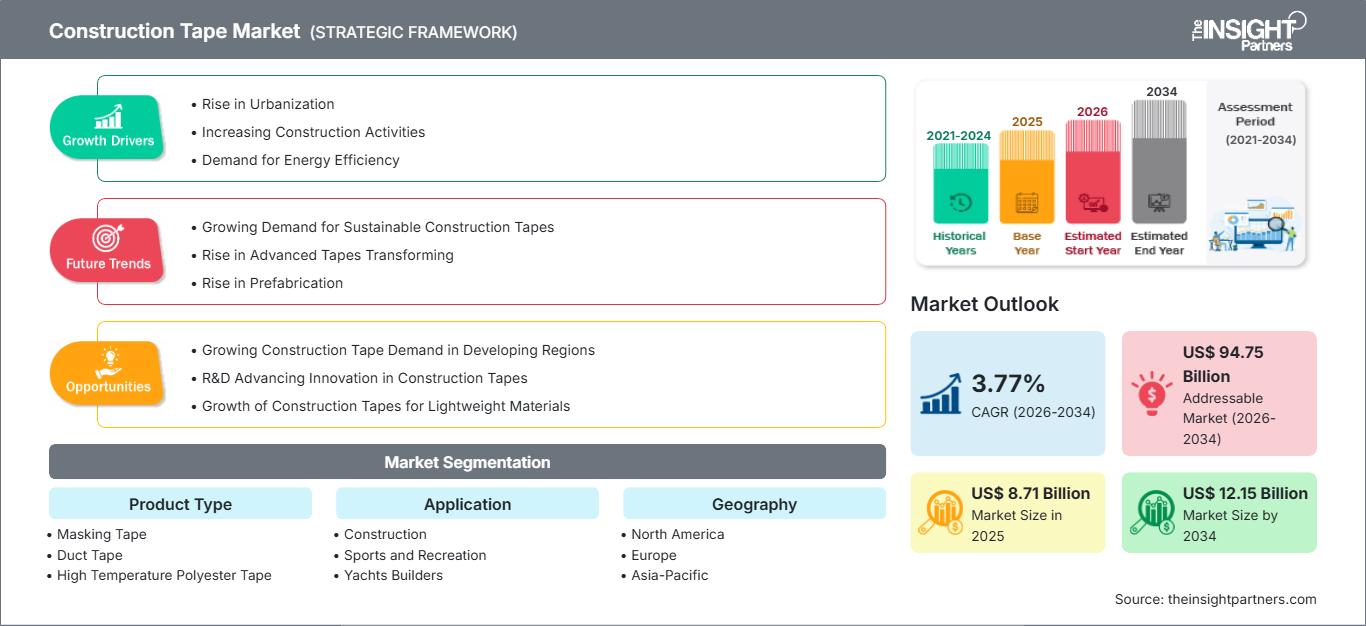
2025 Market Size
US$ 8.71 Bn
Base year value
2034 Forecast
US$ 12.15 Bn
Projected by 2034
CAGR 2026-2034
3.77 %
Growth rate
Addressable Market
US$ 94.75 Bn
(2026-2034)
The Construction Tape Market is expanding from conventional masking and sealing functions toward higher-performance bonding, protection, weather resistance, and specialized construction applications. The market is valued at US$ 8.71 Billion in 2025 and is projected to reach US$ 12.15 Billion by 2034, registering a 3.77% CAGR from 2026 to 2034. Demand is supported by construction activity, refurbishment, infrastructure investment, and wider substitution of mechanical fastening in selected applications.
Across North America, the market benefits from renovation activity, commercial refurbishment, energy-efficiency upgrades, and demand for tapes that improve installation productivity. The regional market is estimated to expand at a 3.9–4.5% CAGR during 2026–2034. The Construction Tape Market size is further supported by stringent building-performance requirements and increasing adoption of specialized masking, duct, aluminum, and high-temperature tapes in professional construction workflows.
Construction Tape Market Assessment and Insights
- North America: North America accounts for a 29–33% Construction Tape Market share in 2025 and is expected to grow at a 3.9–4.5% CAGR between 2026–2034, supported by renovation, commercial construction, infrastructure maintenance, and professional-grade installation requirements.
- US: The US represents 81–85% of North America's 2025 market and is projected to grow at a 4.0–4.6% CAGR between 2026–2034, led by remodeling and commercial construction activity.
- Europe: Europe holds a 30–34% share in 2025 and is projected to grow at a 3.3–3.9% CAGR between 2026–2034, with Germany, the UK, France, Italy, and Spain supporting demand through renovation and energy-efficiency projects.
- Asia Pacific: Asia Pacific represents a 27–31% share in 2025 and is expected to register a 4.0–4.7% CAGR between 2026–2034, with China, Japan, India, South Korea, and Australia providing diverse construction demand.
- Largest Segment: Masking Tape holds an estimated 32–36% market share in 2025 and is expected to grow at a 3.4–4.0% CAGR during 2026–2034, reflecting broad professional usage.
- High Growth Segment: High Temperature Polyimide Tape represents approximately 7–10% market share in 2025 and is projected to grow at a 5.0–6.0% CAGR during 2026–2034, supported by specialized applications.
- Key companies analyzed in detail: 3M Company, Berry Global Group, Inc., Intertape Polymer Group Inc., MBK Tape Solutions, Nitto Denko Corporation, Pro Tapes and Specialties, Inc., Saint-Gobain Performance Plastics Corporation, Scapa Group plc, Shurtape Technologies, LLC, tesa SE Group.
Source: The Insight Partners' analysis based on proprietary research, government publications, company annual reports, investor presentations, industry databases, and expert interviews.
As the technology develops, the manufacture of tapes has been steered towards improving the adhesive formula, coating weight control, higher heat resistance, easy removability and adhesion on tough surfaces. Construction sector customers now seek tapes which are able to save on installation time yet possess dimensional stability and resilience to moisture, UV radiation, wear, and temperature changes. Manufacturers are thus focusing on the polymer choice, backing formulation, adhesive composition, coating accuracy and converting process.
The future trends clearly point to specialization over commoditization of roll products. New construction economies of South and Southeast Asia, chosen parts of the Middle East and Latin America offer further volumes of demand, while mature markets are more concerned about certification and lifecycle. Investments into automated coating, lowering solvent content, recycled material backings and specialized applications are likely to affect the suppliers' competitive position up to 2034.
Construction Tape Market Report Scope
| Report Attribute | Details |
|---|---|
| Market size in 2025 | US$ 8.71 Billion |
| Market Size by 2034 | US$ 12.15 Billion |
| Global CAGR (2026 - 2034) | 3.77% |
| Historical Data | 2021-2024 |
| Forecast period | 2026-2034 |
Construction Tape Market Analysis
The development in demand has been closely linked to residential remodeling, commercial building, infrastructure maintenance, and finishing activities. Construction Tape Market development is further aided by the need for quicker installation techniques that would reduce labor cost. The supply chain consists of polymer & resin suppliers, backing materials producers, adhesives, coating and slitting firms, distributors, hardware stores, and end-users. The supply dynamics are very much influenced by polymer, resin, paper, foil, and energy prices.
According to the Construction Tape Market report, differentiation in terms of products has been increasingly made based on the adhesive and backing used. Masking tapes are differentiated through their clean remove ability and edge quality. On the other hand, duct and aluminum tapes are differentiated through durability and environment-resistance properties. High-temperature polyester and polyimide tapes are meant for specialized applications. Companies that have flexible converting abilities are able to provide various width, length, adhesive strength and application temperatures without making major changes in their production setup.
The competitive environment in the Construction Tape Market consists of diversified adhesive producers and specialized tape converters. The 3M Company has a wide range of products such as masking, industrial adhesives, and tapes, while Nitto Denko Corporation offers specific housing and construction tapes. The tesa SE Group positions itself as a tape provider based on application engineering and sustainability considerations. Berry Global Group, Inc. and Intertape Polymer Group Inc. specialize in converting and adhesive activities, and Shurtape Technologies, LLC concentrates on professional tapes.
Formulation, testing of applications, channel coverage, and production become critical for positioning. The Saint-Gobain Performance Plastics Corporation, Scapa Group plc, Pro Tapes and Specialties, Inc., MBK Tape Solutions, and all other mentioned companies focus on certain performance gaps or customer needs. Investments go into automation, sustainable materials, high-performance adhesives, and regional production, which helps in decreasing lead time and improving product uniformity.
● REPORT CUSTOMIZATION
Tailor This Report To Align With Your Specific Business Requirements
This report can be customized to align precisely with your business objectives, scope, and target markets. Customization options include tailored segmentation, geography, competitive analysis, and strategic insights to support informed decision-making.
Customize This Report →WHAT YOU CAN ADJUST
- ● Segmentations
- ● Geography
- ● Competitive Analysis
- ● Language Preferences
Construction Tape Market: Strategic Insights
Regional Insights
North America Construction Tape Market
North America accounts for a 29-33% Construction Tape Market in 2025, which will experience a 3.9-4.5% CAGR up to 2034. Demand in the region is driven by the US, facilitated by residential remodeling, commercial renovations, maintenance of existing structures, and efficient installation needs. Canada contributes to the demand from residential construction, weatherization, and building envelope applications.
Labor productivity and application dependability become increasingly important for demand growth. Tapes with consistent performance, clean removal capability, moisture resistance, and ability to adhere to concrete, wood, metal, glass, and painted surfaces are preferred by contractors. Construction repairs and renovation are a steady source of demand outside new construction activities. Major suppliers in the region include 3M Company, Shurtape Technologies, LLC, Berry Global Group, Inc., and Nitto Denko Corporation.
U.S. Construction Tape Market
The US accounts for approximately 81–85% of North America's 2025 Construction Tape Market and is projected to grow at a 4.0–4.6% CAGR. Demand is concentrated in residential remodeling, commercial buildings, roofing, painting, insulation installation, and general maintenance. Professional contractors represent an important purchasing group because product reliability directly affects labor efficiency.
The 3M Company boasts robust presence in its domestic market through industrial adhesives and tapes, while Shurtape Technologies, LLC and Berry Global Group, Inc. cater to professional and industrial needs. Masking tapes and duct tapes form large sales volumes, while aluminum tapes and high-temperature tapes are used for specific purposes. Building renovation and building envelope improvements will yield better results than cyclical construction.
Europe Construction Tape Market
Europe accounted for 30-34% Construction Tape Market share in 2025 and is expected to grow at a 3.3-3.9% CAGR, driven by Germany, which is the major market. Building renovations, energy efficiency improvements, maintenance, and stringent performance criteria are expected to contribute to the tape demand. UK and Germany continue to be among the important markets for construction.
The UK will see demand from renovation, installation of insulation, roof maintenance, and improvements in commercial properties. Germany's industrial construction, renovation activities, and manufacturing expertise drive the demand. In addition, France, Italy, and Spain add to the demand by way of renovations of residential buildings, modernization of infrastructure, and commercial constructions. Increasing concerns over sustainability are affecting backing materials, solvents used, packaging, and adhesives.
APAC Construction Tape Market
APAC is estimated to contribute 27–31% of total 2025 demand and will experience growth at a CAGR of 4.0–4.7%. The top country markets are China, Japan, India, South Korea, and Australia. Factors supporting the consumption include industrialization, urbanization, construction, and infrastructure investments.
The demand from China is driven by both large scale constructions and production capabilities within the country. The key demand drivers in Japan include precision and performance focus while India derives its demand from urban infrastructure and housing development. Higher performing tapes would be supported by South Korea and construction activities in Australia.
Middle East & Africa Construction Tape Market
Middle East and Africa is around 5-7% share of the total demand and expected to grow at a CAGR of 3.5-4.2%. In this region, Saudi Arabia and UAE will account for high consumption of tapes used for construction purposes.
South Africa is one of the leading markets in Africa because of maintenance, residential building, and commercial renovation activities. ROAFA is driven by infrastructure investment, industrial developments, and urbanization. Gulf economies are expected to benefit from energy construction and diversification programs and hence high growth in demand for tapes. Harsh climatic conditions and dust in this region make durable tapes more important.
Segmentation Analysis
Product Type
The Product Type segment is expected to expand at a 3.5–4.1% CAGR during 2026–2034. Demand remains broad because different construction stages require different adhesive and backing characteristics. Masking and duct tapes provide volume, while high-temperature and aluminum products offer specialized performance and higher-value applications.
- Masking Tape: Widely used during painting, finishing, surface protection, and renovation. Demand centers on clean removal, sharp paint lines, substrate compatibility, and resistance to bleeding or adhesive transfer.
- Duct Tape: Serves temporary fastening, sealing, bundling, repair, and protective functions. Professional users prioritize tensile strength, conformability, moisture resistance, and dependable adhesion across varied construction substrates.
- High Temperature Polyester Tape: Supports applications requiring dimensional stability and controlled performance under elevated temperatures. Its importance increases where standard tapes can deform, lose adhesion, or leave residue during specialized processes.
- High Temperature Polyimide Tape: Addresses demanding temperature and chemical-resistance requirements. It is strategically important in specialized construction-related processes, electrical work, and applications requiring thin, stable, cleanly removable tape systems.
- Aluminum Tape: Provides reflective, moisture-resistant, and heat-management properties. Demand is associated with insulation, ducting, HVAC-related installation, and building-envelope applications where durability and environmental resistance are important.
Application
The Application segment is forecast to grow at a 3.6–4.2% CAGR during 2026–2034. Construction remains the principal application because tapes are integrated across painting, installation, repair, insulation, sealing, and surface-protection activities. Sports and recreation and yacht-building provide narrower but performance-sensitive demand.
- Construction: Represents the core application base, covering masking, repair, sealing, insulation, surface protection, and temporary fastening. High usage frequency makes contractor distribution and product availability critical competitive factors.
- Sports and Recreation: Demand comes from equipment preparation, surface protection, temporary fixing, and maintenance. Users value lightweight products that combine conformability, strong adhesion, clean handling, and resistance to outdoor exposure.
- Yachts Builders: Requires tapes compatible with composite materials, metals, coatings, and marine environments. Moisture resistance, clean removal, dimensional stability, and reliable adhesion are particularly important during assembly and finishing.
Opportunity Snapshot
| Application | Revenue Contribution (High/Medium/Low) | Trend Tag | Adoption Stage |
|---|---|---|---|
| Construction | High | Retrofit Work | Mature |
| Sports and Recreation | Medium | Outdoor Repair | Scaling |
| Yachts Builders | Low | Marine Assembly | Scaling |
Construction Tape Market Growth Drivers and Impact Analysis
Rising Renovation and Building Maintenance Activity
Renovation increases tape consumption as maintenance projects use tapes through several short cycle processes, rather than one time installation. Painting, insulation, surface preparation, protective covers, repairs, sealing, and finishes provide different applications for the various types of tapes. Aging commercial properties also need maintenance work, which generates the need for replacement, and this need is not tied to the start of new construction projects. In the developed world, renovations now incorporate energy efficiency upgrades, which increase the need for aluminum and specialized tapes in insulation and HVAC applications. Developing countries see increased tape use as urban dwellings expand, and the need for basic tapes such as masks and duct tapes increase.
Demand for Faster and More Reliable Installation
Construction labor constraints are encouraging contractors to evaluate materials according to installation time as well as purchase price. Tape can provide immediate handling, simplify temporary positioning, and reduce the need for mechanical fasteners in selected applications. This creates a measurable value proposition when a tape system reduces preparation, curing, drilling, or cleanup requirements. Product manufacturers are responding through stronger pressure-sensitive adhesives, improved conformability, controlled release characteristics, and application-specific backing materials. The impact is strongest in renovation and finishing work, where productivity gains can influence project economics directly. Suppliers capable of demonstrating application performance rather than only adhesive strength can secure stronger contractor relationships. Over time, this shifts competition toward technical support, product reliability, and application engineering instead of price-based competition alone.
Higher Performance Requirements Across Construction Substrates
Modern construction increasingly combines concrete, glass, coated metals, engineered wood, insulation materials, composites, and synthetic membranes. These substrates can have substantially different surface energies and environmental sensitivities, making universal tape formulations less effective. Demand therefore favors products engineered for specific surfaces, temperature ranges, moisture conditions, and removal requirements. High-temperature polyester and polyimide tapes illustrate the movement toward specialized products, while aluminum and duct tapes address durability and environmental exposure. Manufacturers benefit from formulation platforms that can be adjusted for different substrates without requiring entirely new production systems. For distributors, this trend increases the importance of technical product segmentation and application guidance. The resulting market impact is gradual premiumization, with specialized tapes capturing greater value even when conventional products retain the largest volume base.
Construction Tape Market Future Trends
Bio-Based and Recycled Tape Construction
The Construction Tape Market trends are likely to increasingly reflect recycled backings, bio-based feedstocks, solvent-free adhesive systems, and lower-impact manufacturing. Sustainability requirements are moving beyond finished buildings into the materials used during construction and renovation. Tape producers are therefore likely to optimize the entire product architecture, including carrier, adhesive, release liner, packaging, and production energy. Certification and transparent environmental information may become stronger purchasing criteria for institutional projects. Suppliers that can maintain adhesion, weather resistance, and clean removal while increasing recycled or renewable content will be better positioned for green-building procurement. The transition will not eliminate conventional tapes because cost and performance remain critical, but it should progressively expand the share of lower-impact products within professional and specification-driven channels.
Digitally Assisted Tape Selection and Application
Digital product-selection tools are expected to become more important as tape portfolios become increasingly specialized. Contractors and distributors can benefit from systems that match substrate, temperature, moisture, exposure duration, and required holding performance with an appropriate product. Manufacturers may increasingly provide digital application guides, QR-enabled technical documentation, virtual product selectors, and automated specification support. Such tools can reduce incorrect product selection and improve customer retention because application outcomes become more predictable. Digital integration may also provide manufacturers with anonymized information about frequently requested substrates and performance characteristics, supporting faster product development. Over the longer term, data-driven application engineering could become a competitive differentiator, particularly for high-performance tapes where product failure carries higher project costs.
Construction Tape Market Opportunities
Regional Production for Emerging Construction Economies
The Construction Tape Market Forecasts indicate attractive opportunities for suppliers that establish regional production or converting capabilities closer to high-growth construction economies. India, Southeast Asia, selected Middle Eastern countries, and parts of Latin America offer expanding construction activity while still relying on imported specialty tape products in several applications. Local slitting, coating, and packaging can reduce logistics costs and improve response times for distributors. Partnerships with regional building-material suppliers can further improve access to contractors and project specifications. Investors should prioritize locations offering polymer and adhesive supply, skilled converting labor, reliable utilities, and proximity to major construction clusters. A regional strategy can also allow manufacturers to tailor product widths, roll formats, adhesive strengths, and packaging to local contractor practices.
Premium Tape Platforms for Building-Envelope Applications
Building-envelope applications offer a pathway toward higher-value products because performance requirements are more demanding than those of general-purpose repair applications. Tapes used around insulation, membranes, windows, HVAC components, and exterior interfaces must often withstand moisture, temperature variation, ultraviolet exposure, and substrate movement. Suppliers can pursue premium platforms combining specialized adhesives with aluminum, polyester, or other engineered backings. Certification, compatibility testing, and long-term performance data can support specification by architects, contractors, and building-material manufacturers. Strategic partnerships with insulation, roofing, window, and HVAC companies could embed tape products into broader systems rather than selling individual rolls. This approach increases switching costs and creates opportunities for customized products designed around specific building-envelope assemblies.
Recent Developments
- July 2026: tesa SE Group — tesa presented its HUGO Impact Award 2026, highlighting projects involving more efficient sustainable processes, automated bonding, and digital technologies. The company said its innovation approach combines customer requirements, materials expertise, and application engineering, reinforcing its movement toward tape-enabled solutions beyond conventional adhesive tape products.
- December 2025: Nitto Denko Corporation — Nitto announced construction of a new factory at its Toyohashi Plant with an investment of approximately JPY 39 billion. The facility is intended to expand production capacity for next-generation high-end device applications and incorporate advanced technology and automation, demonstrating continued investment in specialized adhesive-tape manufacturing capabilities.
Frequently Asked Questions

- Comprehensive Market Sizing and Forecast Analysis
- Detailed Segmentation Analysis
- In-Depth Market Dynamics Assessment
- Regional and Country-Level Insights
- Competitive Landscape and Company Benchmarking
- Strategic Business Intelligence
Recent Reports
Testimonials

The Insight Partners' SCADA System Market report is comprehensive, with valuable insights on current trends and future forecasts. The team was highly professional, responsive, and supportive throughout. We are very satisfied and highly recommend their services.
RAN KEDEM Partner, Reali Technologies LTDs
I requested a report on a very specific software market and the team produced the report in a few days. The information was very relevant and well presented. I then requested some changes and additions to the report. The team was again very responsive and I got the final report in less than a week.
JEAN-HERVE JENN Chairman, Future Analytica
We worked with The Insight Partners for an important market study and forecast. They gave us clear insights into opportunities and risks, which helped shape our plans. Their research was easy to use and based on solid data. It helped us make smart, confident decisions. We highly recommend them.
PIYUSH NAGPAL Sr. Vice President, High Beam Global
The Insight Partners delivered insightful, well-structured market research with strong domain expertise. Their team was professional and responsive throughout. The user-friendly website made accessing industry reports seamless. We highly recommend them for reliable, high-quality research services
YUKIHIKO ADACHI CEO, Deep Blue, LLC.
This is the first time I have purchased a market report from The Insight Partners.While I was unsure at first, I visited their web site and felt more comfortable to take the risk and purchase a market report.I am completely satisfied with the quality of the report and customer service. I had several questions and comments with the initial report, but after a couple of dialogs over email with their analyst I believe I have a report that I can use as input to our strategic planning process.Thank you so much for taking the extra time and making this a positive experience.I will definitely recommend your service to others and you will be my first call when we need further market data.
JOHN SUZUKI President and Chief Executive Officer, Board Director, BK Technologies
I wish to appreciate your support and the professionalism you displayed in the course of attending to my request for information regarding to infectious disease IVD market in Nigeria. I appreciate your patience, your guidance, and the fact that you were willing to offer a discount, which eventually made it possible for us to close a deal. I look forward to engaging The Insight Partners in the future, all thanks to the impression you have created in me as a result of this first encounter.
DR CHIJIOKE ONYIA MANAGING DIRECTOR, PineCrest Healthcare Ltd.Reason to Buy
- Informed Decision-Making
- Understanding Market Dynamics
- Competitive Analysis
- Identifying Emerging Markets
- Customer Insights
- Market Forecasts
- Risk Mitigation
- Boosting Operational Efficiency
- Strategic Planning
- Investment Justification
- Tracking Industry Innovations
- Aligning with Regulatory Trends





 Get Free Sample for