
Contact Lenses Market Growth, Demand & Size by 2034
Coverage: By Material (Gas Permeable, Silicone Hydrogel, and Others), Design (Monovision, Spherical, Multifocal, and Toric), Application (Corrective, Therapeutic, Cosmetic, and Others), and Distribution Channel (E-commerce, Hospitals and Clinics, and Retail Stores), and Geography (North America, Europe, Asia Pacific, and South and Central America)
- Status : Data Released
- Report Code : TIPMD00002613
- Category : Life Sciences
- No. of Pages : 150
- Available Report Formats :


- Last update date : March 23, 2026


2025 Market Size
US$ 17.69 Bn
Base year value
2034 Forecast
US$ 30.47 Bn
Projected by 2034
CAGR 2026-2034
6.22 %
Growth rate
Addressable Market
US$ 217.90 Bn
(2026-2034)
The global Contact Lenses Market size is projected to reach US$ 30.47 billion by 2034 from US$ 17.69 billion in 2025. The market is anticipated to register a CAGR of 6.22% during the forecast period 2026–2034
Key market dynamics include a heightening global focus on vision correction due to rising myopia prevalence, increasing consumer preference for daily disposable formats, and a significant shift toward specialized lenses like toric and multifocal designs. Additionally, the market is expected to benefit from the growing popularity of cosmetic and colored lenses, expansion in organized retail and e-commerce channels across emerging economies, and the increasing inclusion of advanced technologies like blue-light filtering and smart monitoring in premium lens segments.
Contact Lenses Market Analysis
The contact lenses market analysis shows a shift toward high-performance materials and specialized designs as consumers prioritize ocular health and long-term comfort. Procurement trends indicate the market is splitting into high-volume daily disposable segments in developed regions and reusable lens markets in cost-sensitive emerging territories. Strategic opportunities are emerging in myopia management for pediatric populations and presbyopia correction for an aging global demographic, where multifocal and orthokeratology lenses offer a clear competitive advantage over traditional spectacles. The analysis also notes that market expansion depends on material innovation, specifically the adoption of silicone hydrogels to improve oxygen permeability. Competitive differentiation now stands out depending on branding that emphasizes hygiene, UV protection, and digital-friendly features. This approach helps market leaders maintain premium pricing while addressing the needs of a technologically integrated consumer base.
Contact Lenses Market Overview
Contact lenses are shifting from a standard corrective tool to a lifestyle-oriented health and beauty commodity. While historically focused on basic spherical correction, the market is expanding into value-added segments like therapeutic lenses for corneal healing and cosmetic lenses for aesthetic enhancement. Both global pharmaceutical giants and niche boutique manufacturers are part of this market, leveraging digital fitting technologies and advanced polymers. More health-conscious consumers in North America and Asia-Pacific are seeking alternatives to bulky eyewear, which has helped contact lenses gain popularity as a versatile choice for sports and professional use. North America remains the main revenue generator, but Asia-Pacific region has become a leader in growth, driven by massive urbanization and rising rates of refractive errors in younger populations. For instance, the market in the US represents a highly mature and dominant market for contact lenses, characterized by high consumer awareness and a robust network of eye care professionals. An active lifestyle culture and the rapid adoption of daily disposables and silicone hydrogel materials fuel demand. The market emphasizes hygiene, technological innovation, and personalized eye care.
Market Research Highlights
- Global market for Contact Lenses was valued at US$ 17.69 Billion in 2025
- Annual market size is expected to reach US$ 30.47 Billion by 2034
- Total addressable market (TAM) during 2026-2034 is projected to reach approximately US$ 217.90 Billion
- Market is anticipated to register a CAGR of 6.22% during the forecast period
- The United States represents a key market, supported by Growing prevalence of myopia, Advancements in Technology, Increasing Awareness of Vision Care, as well as evolving industry dynamics
- Market analysis covers North America, Europe, Asia-Pacific, South and Central America, Middle East and Africa, with growth evaluated across the forecast period
- Market opportunities such as Expansion into emerging markets, Development of smart contact lenses, Increased adoption of online sales are expected to influence market dynamics and addressable market
- Report profiles industry participants, including EssilorLuxottica, Alcon Inc., Johnson & Johnson Services, Inc., Bausch & Lomb Incorporated, The Cooper Companies Inc., HOYA Corporation, SynergEyes, Inc., STAAR Surgical Company, X-Cel Specialty Contacts, Medenniumare, while analyzing competitive strategies and innovation developments
-
Source: The Insight Partners' analysis based on proprietary research, government publications, company annual reports, investor presentations, industry databases, and expert interviews.
● REPORT CUSTOMIZATION
Tailor This Report To Align With Your Specific Business Requirements
This report can be customized to align precisely with your business objectives, scope, and target markets. Customization options include tailored segmentation, geography, competitive analysis, and strategic insights to support informed decision-making.
Customize This Report →WHAT YOU CAN ADJUST
- ● Segmentations
- ● Geography
- ● Competitive Analysis
- ● Language Preferences
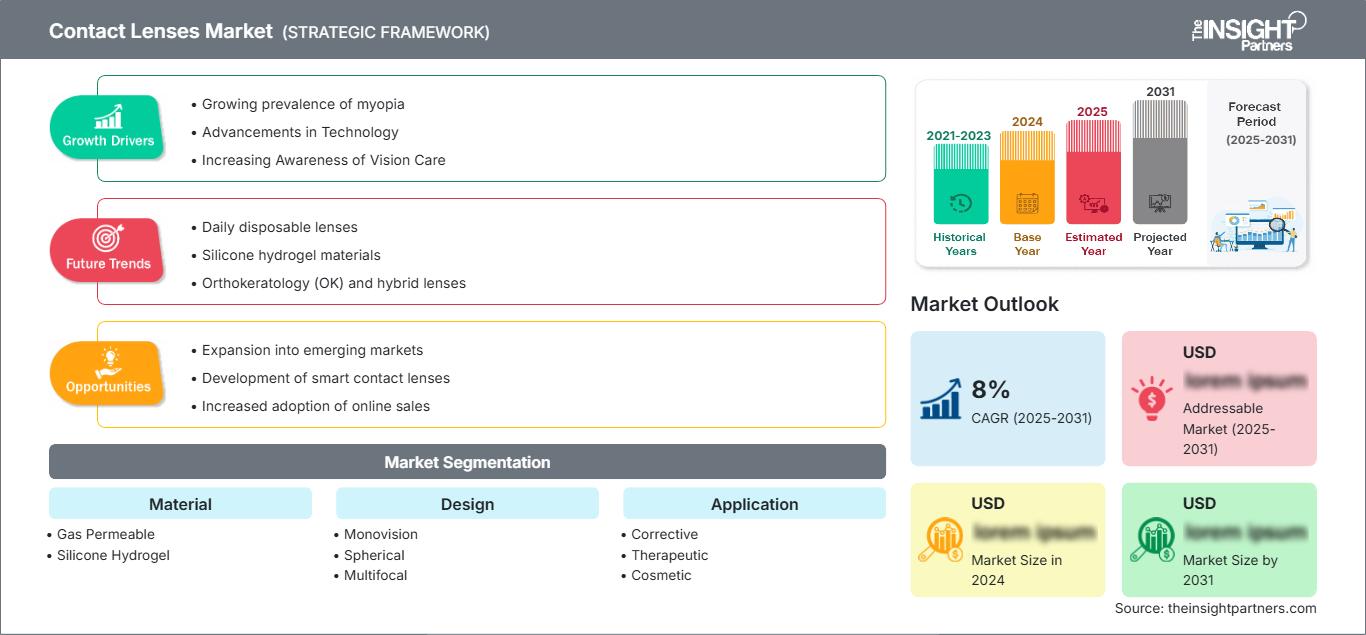
Contact Lenses Market: Strategic Insights
-
Get Top Key Market Trends of this report.This FREE sample will include data analysis, ranging from market trends to estimates and forecasts.
Contact Lenses Market Drivers and Opportunities
Market Drivers:
- Rising Prevalence of Refractive Errors: The global surge in myopia (nearsightedness), hyperopia, and astigmatism, often linked to increased screen time and sedentary lifestyles, is the primary driver for vision correction solutions.
- Trend Towards Daily Disposables: Consumer preference is rapidly shifting toward daily disposable lenses due to their superior hygiene profile and the elimination of maintenance routines, which resonates with busy, modern lifestyles.
- Technological Innovation in Materials: The development of silicone hydrogel and hyper-breathable polymers has significantly reduced complications like eye dryness and hypoxia, encouraging longer wear times and attracting new users.
Market Opportunities:
- Growth in Myopia Management for Children: There is a significant opportunity for specialized lenses designed to slow the progression of myopia in children, a segment currently seeing high investment and clinical focus.
- Integration of Smart Technology: Developing lenses with integrated sensors for glucose monitoring or intraocular pressure tracking offers a futuristic growth path in the medical and nutraceutical industries.
- Expansion of Cosmetic and Aesthetic Segments: Leveraging social media influence and fashion trends to promote colored and circle lenses provides a gateway to younger, style-conscious demographics globally.
Contact Lenses Market Report Segmentation Analysis
The Contact Lenses Market share is analyzed across various segments to provide a clearer understanding of its structure, growth potential, and emerging trends. Below is the standard segmentation approach used in most industry reports:
By Material:
- Silicone Hydrogel: The leading material segment, preferred for its exceptional oxygen permeability and moisture retention, making it the standard for healthy, long-term wear.
- Gas Permeable: Often used for specialized medical conditions, these lenses offer superior durability and crisp vision for users with irregular corneal shapes.
- Others: Includes traditional hydrogel and hybrid materials that cater to specific price points or niche-fitting requirements.
By Design:
- Spherical: The most common design used for standard myopia and hyperopia correction, serving the largest volume of the global consumer base.
- Toric: Specialized lenses designed to correct astigmatism, representing a high-growth segment as diagnostic accuracy for corneal irregularities improves.
- Multifocal: Targeted toward the aging population with presbyopia, allowing for clear vision at multiple distances without the need for reading glasses.
- Monovision: A technique-based design segment where each eye is fitted with a different prescription to manage near and distance vision simultaneously.
By Application:
- Corrective: The dominant application focused on addressing refractive errors to provide functional visual clarity for daily life.
- Therapeutic: Used for medical purposes, such as protecting the cornea during healing or delivering ocular medications directly to the eye surface.
- Cosmetic: A rapidly growing lifestyle segment where lenses are used primarily to change or enhance eye color and appearance.
- Others: Includes specialized prosthetic lenses and emerging smart lenses for health monitoring.
By Distribution Channel:
- Hospitals and Clinics: The primary channel for initial prescriptions and specialty fittings, benefiting from professional trust and medical expertise.
- Retail Stores: Includes optical chains and independent boutiques that offer a convenient physical location for purchasing established brands.
- E-commerce: The fastest-rising channel, driven by subscription models and the ease of repeat ordering for daily and monthly disposables.
By Geography:
- North America
- Europe
- Asia Pacific
- South & Central America
- Middle East & Africa
Contact Lenses Market Report Scope
| Report Attribute | Details |
|---|---|
| Market size in 2025 | US$ 17.69 Billion |
| Market Size by 2034 | US$ 30.47 Billion |
| Global CAGR (2026 - 2034) | 6.22% |
| Historical Data | 2021-2024 |
| Forecast period | 2026-2034 |
| Segments Covered |
By Material
|
| Regions and Countries Covered |
North America
|
| Market leaders and key company profiles |
|
Contact Lenses Market Players Density: Understanding Its Impact on Business Dynamics
The Contact Lenses Market is growing rapidly, driven by increasing end-user demand due to factors such as evolving consumer preferences, technological advancements, and greater awareness of the product's benefits. As demand rises, businesses are expanding their offerings, innovating to meet consumer needs, and capitalizing on emerging trends, which further fuels market growth.
Contact Lenses Market Share Analysis by Geography
Asia-Pacific is expected to grow fastest in the coming years. Emerging markets in South & Central America, the Middle East, and Africa also have many untapped opportunities for premium vision care producers and pediatric myopia management specialists to expand.
The contact lenses market is undergoing a significant transformation, moving from a standard optical corrective to a high-tech lifestyle and medical device. Growth is driven by the rising prevalence of myopia among the youth, a surge in demand for aesthetic enhancements, and the expansion of the digital prescription economy. Below is a summary of market share and trends by region:
North America
- Market Share: Holds the largest share globally, anchored by a mature healthcare system and high consumer spending on advanced daily disposables.
- Key Drivers:
- Rising consumer preference for premium, high-oxygen silicone hydrogel materials.
- Mainstreaming of specialized myopia-control lenses in pediatric ophthalmology.
- Increased adoption of subscription-based e-commerce models for recurring lens delivery.
- Trends: A strategic shift toward smart vision care, including lenses with built-in UV protection and blue-light filtering. There is also a notable increase in the adoption of multifocal designs to address the visual needs of an aging Baby Boomer and Gen X population.
Europe
- Market Share: Holds a significant share globally, driven by well-established optical retail chains and a strong culture of ocular health awareness in countries like Germany and the UK.
- Key Drivers:
- High domestic demand for multifocal and progressive lenses to manage presbyopia.
- Established regulatory frameworks ensuring high-quality standards for medical-grade polymers.
- Robust professional networks of optometrists and ophthalmologists promoting lens adoption.
- Trends: A prioritizing of sustainable and eco-friendly eye care, with manufacturers introducing plastic-neutral and recyclable packaging. There is also a growing focus on custom-fit specialty lenses for irregular corneas over mass-market products.
Asia-Pacific
- Market Share: The fastest-growing region, with major urban centers in China and India acting as the primary engines for both corrective and cosmetic lens volume.
- Key Drivers:
- Massive consumer base seeking affordable yet high-quality alternatives to eyeglasses.
- Rising prevalence of digital myopia among urban youth due to high screen-time exposure.
- Rapid urbanization and increasing disposable incomes are leading to a preference for Western luxury brands.
- Trends: Heavy reliance on mobile-first e-commerce platforms and social media influencers to drive sales of circle lenses and cosmetic variants. The region is also at the forefront of AI-integrated myopia progression tracking for children.
South and Central America
- Market Share: Emerging market with a growing retail sector in countries like Brazil and Argentina.
- Key Drivers:
- Increasing awareness of the lifestyle benefits of contact lenses for sports and outdoor activities.
- Modernization of traditional optical shops into high-tech vision centers.
- Rising interest in aesthetic-focused lenses among the growing middle-class demographic.
- Trends: Growth of D2C (Direct-to-Consumer) boutique brands and the expansion of multi-purpose lens solutions to support the traditional monthly-wear market, which remains dominant due to cost-effectiveness.
Middle East and Africa
- Market Share: Developing market with deep growth potential, transitioning from traditional eyewear toward formalized commercial contact lens production.
- Key Drivers:
- High demand for daily disposables in arid climates, where dust and dryness make lens hygiene critical.
- Strategic investments in smart healthcare infrastructure to reduce reliance on imported medical devices.
- Increasing use of cosmetic lenses as a fashion accessory in the high-end Gulf markets.
- Trends: Implementation of biosensor technology in lenses for non-invasive monitoring of chronic conditions like diabetes and glaucoma. There is also a focus on high-moisture hydrogel materials to improve comfort in extreme desert temperatures.
High Market Density and Competition
Competition is intensifying due to the presence of established leaders such as Johnson & Johnson Vision Care, Alcon, CooperVision, and Bausch + Lomb. Regional specialists and niche innovators like Menicon (Japan) and Seed Co., alongside North American disruptors such as Hubble Contacts and XPANCEO, also contribute to a diverse and rapidly expanding market landscape.
This competitive environment pushes vendors to differentiate through:
- Premiumization and Functional Branding: Positioning contact lenses as superior health and lifestyle tools by emphasizing their advanced moisture-retention technologies, high oxygen permeability, and blue-light filtering properties for digitally active consumers.
- Specialized Correction Portfolios: Product offerings now extend far beyond basic spherical lenses. Companies are aggressively launching specialized designs, including toric lenses for astigmatism, multifocal options for presbyopia, and myopia-management lenses for pediatric use.
- Vertical Integration and Automation: Producers are increasingly managing the entire supply chain, from proprietary polymer synthesis to highly automated micron-level molding, to ensure clinical-grade quality, cost efficiency, and supply chain resilience.
- Smart Processing Technologies: New manufacturing techniques, such as AI-driven lens fitting and 3D printing, help create high-precision custom lenses used in medical therapeutics and emerging augmented reality (AR) applications.
Opportunities and Strategic Moves
- Strategic Alliances for Digital Health: Partner with tech firms and e-commerce giants to integrate AI-fitting tools and subscription-based delivery models, tapping into the surging demand for convenient eye care in Asia-Pacific and North American markets.
- Sustainability and Ethical Manufacturing: Incorporate biodegradable lens materials and plastic-neutral recycling programs to appeal to environmentally conscious Millennial and Gen Z consumers seeking responsible alternatives in a disposable-heavy market.
Major Companies operating in the Contact Lenses Market are:
- EssilorLuxottica
- Alcon Inc.
- Johnson & Johnson Services, Inc.
- Bausch & Lomb Incorporated
- The Cooper Companies Inc.
- HOYA Corporation
- SynergEyes, Inc.
- STAAR Surgical Company
- X-Cel Specialty Contacts
- Medenniumare
Disclaimer: The companies listed above are not ranked in any particular order.
Contact Lenses Market News and Recent Developments
- In June 2025, Johnson & Johnson, a global leader in eye health, announced the launch of ACUVUE OASYS MAX 1-Day MULTIFOCAL for ASTIGMATISM, which stood as the first and only daily disposable contact lens for people with both astigmatism and presbyopia. This pioneering contact lens provided patients with crisp, clear, and stable vision at all distances and in all lighting conditions, along with comfort that lasted all day. While the multifocal version became available in the U.S. and Canada, the launch of the standard ACUVUE OASYS MAX 1-Day for ASTIGMATISM contact lenses followed later that summer.
- In June 2025, Carl Zeiss Vision International GmbH announced that it had completed the acquisition of 100% of the shares in Brighten Optix, which was previously listed on the Taipei Exchange. Brighten Optix was a leading player in the field of orthokeratology and specialty contact lenses, and its capabilities and products became a central component of ZEISS Vision Care’s long-term strategy and success. With this acquisition, ZEISS Vision Care made a strong addition to its already successful myopia management portfolio by integrating advanced contact lenses designed to protect and improve the vision of children worldwide.
Contact Lenses Market Report Coverage and Deliverables
The Contact Lenses Market Size and Forecast (2021–2034) report provides a detailed analysis of the market covering below areas:
- Contact Lenses Market size and forecast at global, regional, and country levels for all the key market segments covered under the scope
- Contact Lenses Market trends, as well as market dynamics such as drivers, restraints, and key opportunities
- Detailed PEST and SWOT analysis
- Contact Lenses Market analysis covering key market trends, global and regional framework, major players, regulations, and recent market developments
- Industry landscape and competition analysis covering market concentration, heat map analysis, prominent players, and recent developments in the Contact Lenses Market.
- Detailed company profiles
Frequently Asked Questions

- Comprehensive Market Sizing and Forecast Analysis
- Detailed Segmentation Analysis
- In-Depth Market Dynamics Assessment
- Regional and Country-Level Insights
- Competitive Landscape and Company Benchmarking
- Strategic Business Intelligence
Recent Reports
Testimonials

The Insight Partners' SCADA System Market report is comprehensive, with valuable insights on current trends and future forecasts. The team was highly professional, responsive, and supportive throughout. We are very satisfied and highly recommend their services.
RAN KEDEM Partner, Reali Technologies LTDs
I requested a report on a very specific software market and the team produced the report in a few days. The information was very relevant and well presented. I then requested some changes and additions to the report. The team was again very responsive and I got the final report in less than a week.
JEAN-HERVE JENN Chairman, Future Analytica
We worked with The Insight Partners for an important market study and forecast. They gave us clear insights into opportunities and risks, which helped shape our plans. Their research was easy to use and based on solid data. It helped us make smart, confident decisions. We highly recommend them.
PIYUSH NAGPAL Sr. Vice President, High Beam Global
The Insight Partners delivered insightful, well-structured market research with strong domain expertise. Their team was professional and responsive throughout. The user-friendly website made accessing industry reports seamless. We highly recommend them for reliable, high-quality research services
YUKIHIKO ADACHI CEO, Deep Blue, LLC.
This is the first time I have purchased a market report from The Insight Partners.While I was unsure at first, I visited their web site and felt more comfortable to take the risk and purchase a market report.I am completely satisfied with the quality of the report and customer service. I had several questions and comments with the initial report, but after a couple of dialogs over email with their analyst I believe I have a report that I can use as input to our strategic planning process.Thank you so much for taking the extra time and making this a positive experience.I will definitely recommend your service to others and you will be my first call when we need further market data.
JOHN SUZUKI President and Chief Executive Officer, Board Director, BK Technologies
I wish to appreciate your support and the professionalism you displayed in the course of attending to my request for information regarding to infectious disease IVD market in Nigeria. I appreciate your patience, your guidance, and the fact that you were willing to offer a discount, which eventually made it possible for us to close a deal. I look forward to engaging The Insight Partners in the future, all thanks to the impression you have created in me as a result of this first encounter.
DR CHIJIOKE ONYIA MANAGING DIRECTOR, PineCrest Healthcare Ltd.Reason to Buy
- Informed Decision-Making
- Understanding Market Dynamics
- Competitive Analysis
- Identifying Emerging Markets
- Customer Insights
- Market Forecasts
- Risk Mitigation
- Boosting Operational Efficiency
- Strategic Planning
- Investment Justification
- Tracking Industry Innovations
- Aligning with Regulatory Trends





 Get Free Sample for